-
设计模式【1】-- 单例模式
单例模式
概念
所谓类的单例设计模式,就是采取一定的方法保证在整个的软件系统中,对某个类只能存在一个对象实例,并且该类只提供一个取得其对象实例的方法(静态方法)
比如 Hibernate 的 SessionFactory,它充当数据存储源的代理,并负责创建 Session 对象。 SessionFactory 并不是轻量级的,一般情况下,一个项目通常只需要一个 SessionFactory 就够, 这是就会使用到单例模式- 1
- 2
- 3
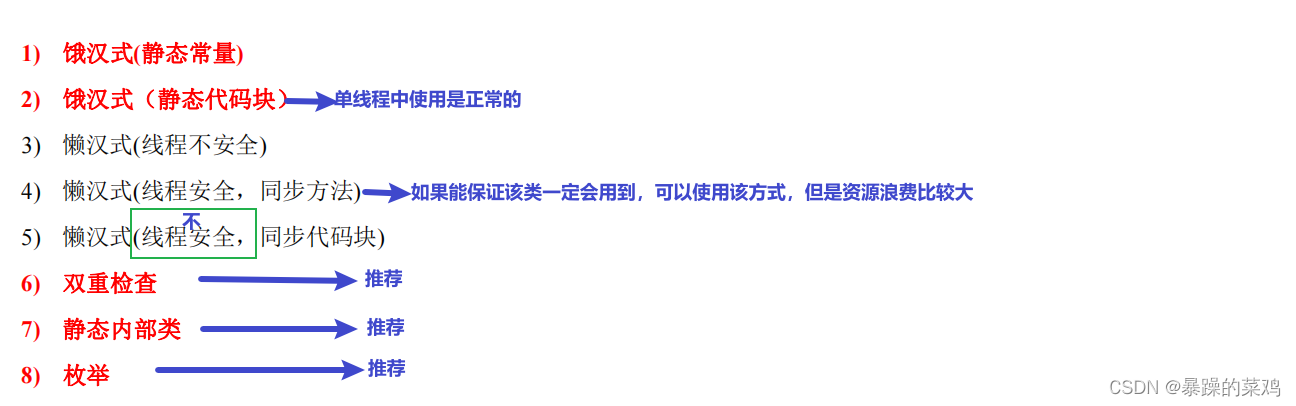
八种方式
- 1)饿汉式(静态常量)
- 2)饿汉式(静态代码块)
- 3)懒汉式(线程不安全)
- 4)懒汉式(线程安全,同步方法)
- 5)懒汉式(线程安全,同步代码块)
- 6)双重检查
- 7)静态内部类
- 8)枚举
饿汉式(静态常量)
- 构造器私有化(
防止外部 new) - 类的内部创建对象
- 向外暴露一个静态的公共方法
getInstance
public class Singleton { //1.私有构造方法 private Singleton() { } //2.类的内部创建对象 private static final Singleton instance = new Singleton(); //3.向外暴露一个静态公共方法 public static Singleton getInstance() { return instance; } public static void main(String[] args) { Singleton singleton = Singleton.getInstance(); Singleton singleton2 = Singleton.getInstance(); System.out.println(singleton.hashCode()); System.out.println(singleton2.hashCode()); } }- 1
- 2
- 3
- 4
- 5
- 6
- 7
- 8
- 9
- 10
- 11
- 12
- 13
- 14
- 15
- 16
- 17
- 18
- 19
- 20
- 21
优缺点:
- 1)优点:这种写法比较简单,就是在类装载的时候就完成实例化。避免了线程同步问题
- 2)缺点:在类装载的时候就完成实例化,没有达到 Lazy Loading 的效果。如果从始至终从未使用过这个实例,则会造成内存的浪费
- 3)这种方式基于 classloder 机制避免了多线程的同步问题。不过,instance 在类装载时就实例化,在单例模式中大多数都是调用getlnstance 方法,但是导致类装载的原因有很多种,因此不能确定有其他的方式(或者其他的静态方法)导致类装载,这时候初始化 instance 就没有达到 Lazy loading 的效果
- 4)结论:
这种单例模式可用,可能造成内存浪费
饿汉式(静态代码块)
- 构造器私有化
- 类的内部声明对象
- 在静态代码块中创建对象
- 向外暴露一个静态的公共方法
public class Singleton2 { //1.构造器私有化 private Singleton2(){}; //2.类的内部声明对象 private static Singleton2 instance; //3.静态代码块中创建对象 static { instance = new Singleton2(); } //4.向外暴露一个静态公共方法 public static Singleton2 getInstance(){ return instance; } }- 1
- 2
- 3
- 4
- 5
- 6
- 7
- 8
- 9
- 10
- 11
- 12
- 13
- 14
- 15
- 16
- 17
- 18
- 19
优缺点:
- 1)这种方式和上面的方式其实类似,只不过将类实例化的过程放在了静态代码块中,也是在类装载的时候,就执行静态代码块中的代码,初始化类的实例。优缺点和上面是一样的。
- 2)结论:
这种单例模式可用,但是可能造成内存浪费
懒汉式(线程不安全)
- 构造器私有化
- 类的内部创建对象
- 向外暴露一个静态的公共方法,当使用到该方法时,才去创建 instance
public class Singleton { //1.构造器私有化 private Singleton() { } //2.类的内部创建对象 private static Singleton instance; //3.向外暴露一个静态的公共方法,当使用到该方法时,才去创建 instance public static Singleton getInstance() { if (instance == null) { instance = new Singleton(); } return instance; } }- 1
- 2
- 3
- 4
- 5
- 6
- 7
- 8
- 9
- 10
- 11
- 12
- 13
- 14
- 15
- 16
- 17
优缺点:
- 起到了 Lazy Loading 的效果,但是只能在单线程下使用
- 如果在多线程下,一个线程进入了判断语句块,还未来得及往下执行,另一个线程也通过了这个判断语句,这时便会产生多个实例
- 结论:
在实际开发中,不要使用这种方式
懒汉式(线程安全,同步方法)
- 构造器私有化
- 类的内部创建对象
- 向外暴露一个静态的公共方法,加入同步处理的代码,解决线程安全问题
public class Singleton { //1.构造私有 private Singleton() { } //2.类的内部创建对象 private static Singleton instance; //3.向外暴露一个静态的公共方法,加入同步处理的代码,解决线程安全问题 public static synchronized Singleton getInstance() { if (instance == null) { instance = new Singleton(); } return instance; } }- 1
- 2
- 3
- 4
- 5
- 6
- 7
- 8
- 9
- 10
- 11
- 12
- 13
- 14
- 15
- 16
- 17
- 18
优缺点:
- 解决了线程不安全问题
效率太低了,每个线程在想获得类的实例时候,执行getlnstance()方法都要进行同步。而其实这个方法只执行一次实例化代码就够了,后面的想获得该类实例,直接return就行了。方法进行同步效率太低- 结论:在实际开发中,不推荐使用这种方式
懒汉式(线程
不安全,同步代码块)- 构造器私有化
- 类的内部创建对象
- 向外暴露一个静态的公共方法,加入同步处理的代码块
public class Singleton { // 1、构造器私有化 private Singleton() { } // 2、类的内部声明对象 private static Singleton instance; // 3、向外暴露一个静态的公共方法,加入同步处理的代码,解决线程安全问题 public static Singleton getInstance() { if (instance == null) { synchronized (Singleton.class) { instance = new Singleton(); } } return instance; }- 1
- 2
- 3
- 4
- 5
- 6
- 7
- 8
- 9
- 10
- 11
- 12
- 13
- 14
- 15
- 16
- 17
优缺点:
- 这种方式,本意是想对第四种实现方式的改进,因为前面同步方法效率太低,改为同步产生实例化的的代码块
- 但是这种同步并不能起到线程同步的作用。跟第3种实现方式遇到的情形一致,假如一个线程进入了判断语句块,还未来得及往下执行,另一个线程也通过了这个判断语句,这时便会产生多个实例
- 结论:
在实际开发中,不能使用这种方式

双重检查
- 构造器私有化
- 类的内部创建对象,同时用
volatile关键字修饰修饰 - 向外暴露一个静态的公共方法,加入同步处理的代码块,并进行
双重判断,解决线程安全问题
/** * 双重检查 */ public class Singleton { // 1、构造器私有化 private Singleton() { } // 2、类的内部声明对象,同时用`volatile`关键字修饰修饰 private static volatile Singleton instance; // 3、向外暴露一个静态的公共方法,加入同步处理的代码块,并进行双重判断,解决线程安全问题 public static Singleton getInstance() { if (instance == null) { synchronized (Singleton.class) { if (instance == null) { instance = new Singleton(); } } } return instance; } }- 1
- 2
- 3
- 4
- 5
- 6
- 7
- 8
- 9
- 10
- 11
- 12
- 13
- 14
- 15
- 16
- 17
- 18
- 19
- 20
- 21
- 22
- 23
- 24
优缺点:
- Double-Check 概念是多线程开发中常使用到的,我们进行了两次检查,这样就可以保证线程安全了
- 这样实例化代码只用执行一次,后面再次访问时直接 return 实例化对象,也避免的反复进行方法同步
- 线程安全;延迟加载;效率较高
- 结论:
在实际开发中,推荐使用这种单例设计模式
静态内部类
- 构造器私有化
- 定义一个静态内部类,内部定义当前类的静态属性
- 向外暴露一个静态的公共方法
/** * 静态内部类 * static保证了变量的初始值,final保证了不被JIT编译器重排序。 * 对于一个单例模式来说,它所在的类在被引用的时候,static会保证它被初始化完毕, * 且是所有线程所见的初始化,final保证了实例初始化过程的顺寻性。两者结合保证了这个实例创建的唯一性 */ public class Singleton { // 1、构造器私有化 private Singleton() { } // 2、定义一个静态内部类,内部定义当前类的静态属性 private static class SingletonInstance { private static final Singleton instance = new Singleton(); } // 3、向外暴露一个静态的公共方法 public static Singleton getInstance() { return SingletonInstance.instance; } }- 1
- 2
- 3
- 4
- 5
- 6
- 7
- 8
- 9
- 10
- 11
- 12
- 13
- 14
- 15
- 16
- 17
- 18
- 19
- 20
- 21
- 22
优缺点:
- 这种方式采用了类装载的机制,来保证初始化实例时只有一个线程
- 静态内部类方式在 Singleton 类被装载时并不会立即实例化,而是在需要实例化时,调用getlnstance方法,才会装载Singletonlnstance 类,从而完成 Singleton 的实例化
- 类的静态属性只会在第一次加载类的时候初始化,JVM帮助我们保证了线程的安全性,在类进行初始化时,别的线程是无法进入的
- 优点:避免了线程不安全,利用静态内部类特点实现延迟加载,效率高
- 结论:
推荐使用
枚举
public enum Singleton { INSTANCE; public void sayHello() { System.out.println("Hello World"); } }- 1
- 2
- 3
- 4
- 5
- 6
优缺点:
- 这借助 JDK1.5 中添加的枚举来实现单例模式。不仅能避免多线程同步问题,而且还能防止反序列化重新创建新的对象
- 这种方式是 Effective Java 作者 Josh Bloch 提倡的方式
- 结论:推荐使用
JDK 源码分析
JDK中 java.lang.Runtime 就是经典的单例模式

注意事项和细节说明
- 单例模式保证了系统内存中该类只存在一个对象,节省了系统资源,对于一些需要频繁创建销毁的对象,使用单例模式可以提高系统性能
- 当想实例化一个单例类的时候,必须要记住使用相应的获取对象的方法,而不是使用 new
- 单例模式使用的场景:需要频繁的进行创建和销毁的对象、创建对象时耗时过多或耗费资源过多但又经常用到的对象(即:重量级对象)、工具类对象、频繁访问数据库或文件的对象(比如数据源、session 工厂等)
小结
-
相关阅读:
中国人民大学与加拿大女王大学金融硕士——在金融领域里持续探索、成长
Wireshark分析HTTPS流量
高通camx开源部分简介
Linux 编写一个 简单进度条
视觉slam十四讲CH4 ---李群与李代数求导
C# 实例解释面向对象编程中的依赖反转原则
怎样做好接口自动化测试?
项目管理:使用项目管理工具制定计划要注意什么
【BUG修复日志】Anaconda + VSCode 编码错误
关于#网络安全#的问题:如下图所示其中CR 是网络的出口设备,61.100.10.2/24为电信分配的地址(相关搜索:服务器|交换机)场景描述: 某学校的网络拓扑如下图所示。
- 原文地址:https://blog.csdn.net/zfx1101804091/article/details/126293499
