-
算法基础课
算法基础课
第一讲 基础算法
快速排序
归并排序
二分
整数二分模板
关键------画一个仅有整数的一维横轴
bool check(int x) {/* ... */} // 检查x是否满足某种性质 // check()判断mid是否满足性质 // 区间[l, r]被划分成[l, mid]和[mid + 1, r]时使用: int bsearch_1(int l, int r)//右半区间的左端点==mid { while (l < r) { int mid = l + r >> 1; if (check(mid)) r = mid; else l = mid + 1; } return l; } // 区间[l, r]被划分成[l, mid - 1]和[mid, r]时使用: int bsearch_2(int l, int r)//左半区间的右端点==mid { while (l < r) { int mid = l + r + 1 >> 1;//当l=mid时答案在右区间,为了避免进入死循环————[m,r]更新过后m会一直等于m(m+1==r的情况) 所以要上取整 if (check(mid)) l = mid; else r = mid - 1; } return l; }- 1
- 2
- 3
- 4
- 5
- 6
- 7
- 8
- 9
- 10
- 11
- 12
- 13
- 14
- 15
- 16
- 17
- 18
- 19
- 20
- 21
- 22
- 23
- 24
- 25
- 26
- 27
- 28
- 29
- 30
- 31
- 32
- 33
AcWing 789. 数的范围(整数二分法)
#include#include #include using namespace std; const int N = 100010; int n,q; int a[N]; int main() { cin>>n>>q; for (int i = 0; i < n; i ++ ) cin >> a[i]; while(q--) { int k; cin >> k; int l=0,r=n-1; while(l<r)//右半区间的左端点 { int mid=(l+r)/2;//l+r>>1; if(a[mid]<k)//此处的符号<不能变 l=mid+1; else r=mid;//此时a[mid]>=k } if(a[l]!=k)//此时说明该序列中不含有k cout<<-1<<" "<<-1<<endl; else { cout <<l<<" "; l=0,r=n-1; while (l<r)//左半区间的右端点 { int mid=(l+r+1)/2; if(a[mid]<=k)//此处的符号<=不能变 l=mid; else r=mid-1;//此时a[mid]>k } cout <<l<<endl; } } } /* 为什么需要+1? 原因是如果不加上1,那么mid得到的是下取整的数, 那么有可能[m,r]更新过后m会一直等于m(m+1==r的情况)会陷入死循环。 */ - 1
- 2
- 3
- 4
- 5
- 6
- 7
- 8
- 9
- 10
- 11
- 12
- 13
- 14
- 15
- 16
- 17
- 18
- 19
- 20
- 21
- 22
- 23
- 24
- 25
- 26
- 27
- 28
- 29
- 30
- 31
- 32
- 33
- 34
- 35
- 36
- 37
- 38
- 39
- 40
- 41
- 42
- 43
- 44
- 45
- 46
- 47
- 48
- 49
- 50
- 51
- 52
- 53
- 54
- 55
- 56
- 57
- 58
AcWing 1236.递增三元组
#include#include #include using namespace std; typedef long long LL; const int N=1e5+10; const int INF=0x3f3f3f3f; int n; int a[N],b[N],c[N]; LL res; int main() { cin>>n; for(int i=1;i<=n;i++) cin>>a[i]; for(int i=1;i<=n;i++) cin>>b[i]; for(int i=1;i<=n;i++) cin>>c[i]; //由于二分的前提是单调序列 所以预先对a b c排序 直接sort sort(a+1,a+n+1); sort(b+1,b+n+1); sort(c+1,c+n+1); for(int i=1;i<=n;i++) { //直接用STL中的两个二分函数解决 LL x = (lower_bound(a+1,a+1+n,b[i])-(a+1)); //在数组a中找比b[i]小的数 的个数x LL y = n-(upper_bound(c+1,c+1+n,b[i])-(c+1)); //在数组c中找比b[i]大的数 的个数y res+=x*y; } cout<<res<<endl; return 0; } - 1
- 2
- 3
- 4
- 5
- 6
- 7
- 8
- 9
- 10
- 11
- 12
- 13
- 14
- 15
- 16
- 17
- 18
- 19
- 20
- 21
- 22
- 23
- 24
- 25
- 26
- 27
- 28
- 29
- 30
- 31
- 32
- 33
AcWing 730. 机器人跳跃问题
且答案具有单调性,证明可以使用二分法解决
易知,h[0]越大,整个过程中所有的e越大,因此,具有单调性
剪枝 :因为h[i]的范围是 [ 1 , 1 e 5 ] [1,1e5] [1,1e5],因此根据公式,只要在某一状态下e达到1e5,之后一定递增或不变,直接返回true
#include#include #include using namespace std; const int N = 1e5+10; int n; int h[N]; bool check(int mid) { for (int i = 1; i <= n; i ++ ) { mid=mid*2-h[i];//每次登录到新的柱子后的能量 if(mid<0) return false;//说明下一个柱子一定跳不上去 if(mid>=N) return true;//此时后面一定全部满足 } return true; } int main() { cin>>n; for (int i = 1; i <= n; i ++ )cin>>h[i]; int l=0,r=N; while(l<r) { int mid=(l+r)/2; if(check(mid)) r=mid; else l=mid+1; } cout <<l<<endl; return 0; } - 1
- 2
- 3
- 4
- 5
- 6
- 7
- 8
- 9
- 10
- 11
- 12
- 13
- 14
- 15
- 16
- 17
- 18
- 19
- 20
- 21
- 22
- 23
- 24
- 25
- 26
- 27
- 28
- 29
- 30
- 31
- 32
- 33
- 34
- 35
- 36
AcWing 1227. 分巧克力
#includeusing namespace std; typedef long long LL; const int N = 1e5+10; int n; int k; int h[N],w[N]; bool check(int mid) { LL res=0;//表示可以切割出来的矩形个数 for(int i=0;i<n;i++)//枚举一下所有的巧克力块 { res+=(LL)(h[i]/mid)*(w[i]/mid); if(res>=k) return true; } return false; } int main() { cin>>n>>k; for(int i=0;i<n;i++) { cin>>h[i]>>w[i]; } int l=1,r=1e5; while(l<r) { int mid=(l+r+1)/2;//此时 mid属于有区间,为了避免死循环 if(check(mid)) l=mid; else r=mid-1; } cout<<l<<endl; return 0; } - 1
- 2
- 3
- 4
- 5
- 6
- 7
- 8
- 9
- 10
- 11
- 12
- 13
- 14
- 15
- 16
- 17
- 18
- 19
- 20
- 21
- 22
- 23
- 24
- 25
- 26
- 27
- 28
- 29
- 30
- 31
- 32
- 33
- 34
- 35
- 36
- 37
- 38
- 39
AcWing 1221. 四平方和(二分法/哈希)


完全暴力写法 一定会超时
#include#include #include #include using namespace std; const int N = 2500010; int n; int main() { cin >> n; for (int a = 0; a * a <= n; a ++ ) for (int b = a; a * a + b * b <= n; b ++ ) for (int c = b; a * a + b * b + c * c <= n; c ++ ) { int t = n - a * a - b * b - c * c; int d = sqrt(t);//开平方 if (d * d == t) { printf("%d %d %d %d\n", a, b, c, d); return 0; } } } //超时 - 1
- 2
- 3
- 4
- 5
- 6
- 7
- 8
- 9
- 10
- 11
- 12
- 13
- 14
- 15
- 16
- 17
- 18
- 19
- 20
- 21
- 22
- 23
- 24
- 25
- 26
- 27
- 28
- 29
哈希表的写法,但超时了
#includeusing namespace std; typedef pair<int, int> PII; #define x first #define y second const int N = 5e6+10; unordered_map<int, PII> S; int n; int main() { cin >> n; for(int c=0;c*c<=n;c++) for(int d=c;d*d<=n;d++) { int t=c*c+d*d; if(S.count(t)==0)//如果之前没有出现过此结果,则添加入 S[t]={c,d}; } for(int a=0;a*a<=n;a++) for(int b=a;b*b<=n;b++) { int t=n-a*a-b*b; if(S.count(t)) { cout<<a<<" "<<b<<" "<<S[t].x<<" "<<S[t].y<<endl; return 0; } } return 0; } - 1
- 2
- 3
- 4
- 5
- 6
- 7
- 8
- 9
- 10
- 11
- 12
- 13
- 14
- 15
- 16
- 17
- 18
- 19
- 20
- 21
- 22
- 23
- 24
- 25
- 26
- 27
- 28
- 29
- 30
- 31
- 32
- 33
蓝桥杯-扫地机器人 (二分+贪心)
#includeusing namespace std; const int N=1e5+10; int n,k; int w[N]; bool check(int x) { int total=0; for(int i=1;i<=k;i++) { if(total>=w[i]-x) { if(total>=w[i]) total=w[i]+x; else total+=x; } else return false; } if(total>=n) return true; else return false; } int main() { cin>>n>>k; for(int i=1;i<=k;i++) cin>>w[i]; sort(w+1,w+k+1); int l=0,r=n; while(l<r) { int mid=l+r>>1; if(check(mid)) r=mid; else l=mid+1; } cout<<(l-1)*2<<endl; return 0; } - 1
- 2
- 3
- 4
- 5
- 6
- 7
- 8
- 9
- 10
- 11
- 12
- 13
- 14
- 15
- 16
- 17
- 18
- 19
- 20
- 21
- 22
- 23
- 24
- 25
- 26
- 27
- 28
- 29
- 30
- 31
- 32
- 33
- 34
- 35
- 36
- 37
- 38
- 39
- 40
- 41
- 42
- 43
AcWing 790. 数的三次方根(浮点二分法)
#include#include #include #include using namespace std; double n; int main() { cin>>n; double l=-10000,r=10000;//答案ans范围的初始化 while(r-l>=1e-8) { double mid = (l+r)/2;//中间值 if(mid*mid*mid<n) l=mid; else r=mid; }//二分过程参考 printf("%.6lf",l);//记得保留小数 return 0; } - 1
- 2
- 3
- 4
- 5
- 6
- 7
- 8
- 9
- 10
- 11
- 12
- 13
- 14
- 15
- 16
- 17
- 18
- 19
- 20
- 21
- 22
- 23
- 24
- 25
- 26
AcWing 680. 剪绳子(浮点二分法)
高精度
前缀
一维前缀和
AcWing 795. 前缀和
前缀和算法
预处理时间复杂度:O(n)
求前缀和时间复杂度:O(1)
用空间来换取时间
前缀和算法(前缀和的下标都从1开始,避免出现越界)
算法理论:
前缀和其实就是 动态规划 的思想/* 一维前缀和 ( O(1) 的时间求出一段区间的和 ) b[i] = a[1] + a[2] + … a[i]=b[i-1]+a[i] a[l] + … + a[r] = b[r] - b[l - 1] */ #includeusing namespace std; const int N=1e5+10; int a[N];//输入矩阵 int b[N];//前缀和矩阵 int n,m; int l,r; int main() { cin>>n>>m; for(int i=1;i<=n;i++) { cin>>a[i]; b[i]=b[i-1]+a[i];//前缀和的初始化 } while(m--) { cin>>l>>r; cout<<b[r]-b[l-1]<<endl;//输出区间和 } return 0; } - 1
- 2
- 3
- 4
- 5
- 6
- 7
- 8
- 9
- 10
- 11
- 12
- 13
- 14
- 15
- 16
- 17
- 18
- 19
- 20
- 21
- 22
- 23
- 24
- 25
- 26
- 27
- 28
- 29
- 30
AcWing 3956. 截断数组
#includeusing namespace std; const int N=1e5+10; typedef long long LL; LL ans; LL cnt; int n; int a[N]; int main() { cin>>n; for(int i=1;i<=n;i++) { int x; cin>>x; a[i]=a[i-1]+x;//前缀和数组 } for(int i=1;i<=n-2;i++)//枚举的第一个位置 { if(a[i]==a[n]/3)//第一个刀位置 cnt++; if(a[n]-a[i+1]==a[n]/3)//第二个位置 ---通过枚举第一个位置间接枚举第二个位置 ans+=cnt; } if(a[n]%3!=0 || n<3) cout<<0<<endl; else cout<<ans<<endl; return 0; } - 1
- 2
- 3
- 4
- 5
- 6
- 7
- 8
- 9
- 10
- 11
- 12
- 13
- 14
- 15
- 16
- 17
- 18
- 19
- 20
- 21
- 22
- 23
- 24
- 25
- 26
- 27
- 28
- 29
- 30
- 31
AcWing 1230. K倍区间(一维前缀和+同余定理)
直接一维前缀和+数学推理 求区间[l,r]的和是k的倍数的个数。 求区间和,我们可以通过前缀和来求出。我们规定sum[i]表示第1个元素到第i个元素的和。 那么sum[r] - sum[l-1]就是区间[l,r]的和。 区间[l,r]的和是k的倍数即(sum[r] - sum[l-1])%k = = 0 即sum[r]%k = = sum[l-1]%k- 1
- 2
- 3
- 4
- 5
- 6
- 7
#includeusing namespace std; typedef long long LL;//数据开大点 const int N = 1e5+10; int n,k; LL a[N],b[N]; LL cnt[N];//哈希存储 模相同的区间个数 cnt[x]:余数为x的个数 int main() { cin>>n>>k; cnt[0]=1; //就是之前找到的是两个 区间的 mod之后相同的值 //但是对于 mod == 0区间 我可以不用找另外区间,我本身就是符合 mod k == 0 这个条件 //循环里统计的时候没有考虑这个情况,所以之后要再加上 for (int i=1;i<=n;i++) { cin>>a[i]; b[i]=b[i-1]+a[i]; //求前缀和 cnt[b[i]%k]++;// 前缀和取余k的余数的数量 } LL ans=0;//ll数据太大 for (int i=0; i<k; i++)//余数必在 0~k-1之间 { ans+=cnt[i]*(cnt[i]-1)/2; //数学C n 取 2 的公式 } cout<<ans<<endl; return 0; } - 1
- 2
- 3
- 4
- 5
- 6
- 7
- 8
- 9
- 10
- 11
- 12
- 13
- 14
- 15
- 16
- 17
- 18
- 19
- 20
- 21
- 22
- 23
- 24
- 25
- 26
- 27
- 28
- 29
- 30
202012-2csp-期末预测之最佳阈值(排序+一维前缀和)
这道题我主要用到前缀和的算法,首先对数据从小到大进行排序,然后利用前缀和计算出每个数左边有多少个0,进而计算出该数右边有多少个1(包括该数在内),然后让二者相加,即为最后的正确的个数,至于如果有相同的数的话,就只计算出第一个数即可,因为其他的都小于等于第一个数。 从规则来看,我们可以利用前i-1位同学的情况来推断第i位同学的情况。从样例1中可以得到启示 因此考虑使用前缀和算法来进行优化。- 1
- 2
- 3
- 4
注意 : 遇到相同数时,应只算第一个!!! 为什么呢? 因为这个分界线只能在不同的y之间画,在相同的y之间画的话,i和i−1意义相同,在套公式的时候实际破坏了前缀和,没有发挥前缀和的作用 比如,s[0][i]表示前i个数中0的个数,那如果连续两个y相等,那么计算这个的时候,会多算。本来想算的是第i-1个数前,但是第i-1个数和第i个数是相等的,从而多算了。 在计算s[1][m]−s[1][i−1]也是同理。- 1
- 2
- 3
- 4
- 5
#includeusing namespace std; const int N=1e5+10; typedef pair<int,int> PII; #define x first #define y second PII a[N];//用pair型数组a记录每个输入的y和result int m; int s[2][N];//s[0][i]---表示前i个数中0的个数 s[1][i]---表示前i个数中1的个数 int main() { cin>>m; for(int i=1;i<=m;i++) cin>>a[i].x>>a[i].y; sort(a+1,a+m+1);//按第一个键值排序(从小到大) 对数组a按y(安全指数)进行升序排序 for(int i=0;i<2;i++) for(int j=1;j<=m;j++) s[i][j]=s[i][j-1]+(i==a[j].y);//两个 一维前缀和 int cnt=-1;//匹配项的最大值 int res=0;//保存取得最大值时的安全指数 for(int i=1;i<=m;i++) { int t=s[0][i-1]+(s[1][m]-s[1][i-1]);//表示每个数作为阈值时预测正确的数量----前i中预测为0 + 前i中预测为1 if(t>=cnt) { cnt=t; res=a[i].x; } while(i+1<=m&&a[i].x==a[i+1].x) i++;//遇到相同数时,应只算第一个!!! ----经典的错误-标准的零分 } cout<<res<<endl; return 0; } - 1
- 2
- 3
- 4
- 5
- 6
- 7
- 8
- 9
- 10
- 11
- 12
- 13
- 14
- 15
- 16
- 17
- 18
- 19
- 20
- 21
- 22
- 23
- 24
- 25
- 26
- 27
- 28
- 29
- 30
- 31
- 32
- 33
- 34
- 35
- 36
- 37
- 38
- 39
- 40
- 41
- 42
二维前缀和
AcWing 796. 子矩阵的和

/* 二维前缀和 b[i, j] = 第i行j列格子左上部分所有元素的和 b[i,j] = b[i-1,j] + b[i,j-1] - b[i-1,j-1] + a[i,j]; 以(x1,y1)为左上角,(x2,y2)为右下角的子矩阵的和为: b[x2,y2] - b[x1-1, y2] - b[x2,y1-1] + b[x1-1, y1-1] */ #includeusing namespace std; const int N=1e3+10; int a[N][N];//输入矩阵 int b[N][N]; //前缀和矩阵 int main() { int n,m,q; cin>>n>>m>>q; for(int i=1;i<=n;i++) { for(int j=1;j<=m;j++) { cin>>a[i][j]; b[i][j]=b[i-1][j]+b[i][j-1]-b[i-1][j-1]+a[i][j];//前缀和数组的初始化 } } while(q--) { int x1,x2,y1,y2; cin>>x1>>y1>>x2>>y2; cout<<b[x2][y2]-b[x1-1][y2]-b[x2][y1-1]+b[x1-1][y1-1]<<endl;//输出子矩阵的和 } return 0; } - 1
- 2
- 3
- 4
- 5
- 6
- 7
- 8
- 9
- 10
- 11
- 12
- 13
- 14
- 15
- 16
- 17
- 18
- 19
- 20
- 21
- 22
- 23
- 24
- 25
- 26
- 27
- 28
- 29
- 30
- 31
- 32
- 33
- 34
- 35
- 36
AcWing 126. 最大的和
#includeusing namespace std; const int N=110; int g[N][N],s[N][N]; int n; int main(){ cin>>n; for(int i=1;i<=n;i++) for(int j=1;j<=n;j++){ cin>>g[i][j]; s[i][j]=s[i-1][j]+s[i][j-1]-s[i-1][j-1]+g[i][j]; } int res=-1e9; //枚举一下上下左右四个点---二维前缀和 for(int x1=1;x1<n;x1++) for(int y1=1;y1<n;y1++) for(int x2=x1;x2<=n;x2++) for(int y2=y1;y2<=n;y2++) res=max(res,s[x2][y2]-s[x1-1][y2]-s[x2][y1-1]+s[x1-1][y1-1]); cout<<res<<endl; return 0; } - 1
- 2
- 3
- 4
- 5
- 6
- 7
- 8
- 9
- 10
- 11
- 12
- 13
- 14
- 15
- 16
- 17
- 18
- 19
- 20
- 21
- 22
AcWing 99. 激光炸弹(二维前缀和+边界处理)
AcWing 99. 激光炸弹
一个数组就行了,在自己身上求前缀和。
xy坐标是从0开始的。#includeusing namespace std; typedef long long LL; const int N = 5010; int n; int R; int g[N][N];//原矩阵与前缀和矩阵共用 int main() { cin>>n>>R; int x,y,w; int l=R,r=R;//因为没有定义地图的长和宽,自己来更新 for (int i = 0; i < n; i ++ ) { cin>>x>>y>>w; x++,y++;//这里是因为习惯上将二维前缀和起始点坐标从(1,1)开始 l=max(l,x),r=max(r,y); g[x][y]+=w; } for (int i = 1; i <= l; i ++ ) for (int j = 1; j <= r; j ++ ) g[i][j]+=g[i-1][j]+g[i][j-1]-g[i-1][j-1]; int res=0; for (int i = R; i <= l; i ++ )//至少从左上角的第一个R*R的正方形开始 for (int j = R; j <= r; j ++ ) res=max(res,(g[i][j]-g[i-R][j]-g[i][j-R]+g[i-R][j-R])); cout<<res<<endl; return 0; } - 1
- 2
- 3
- 4
- 5
- 6
- 7
- 8
- 9
- 10
- 11
- 12
- 13
- 14
- 15
- 16
- 17
- 18
- 19
- 20
- 21
- 22
- 23
- 24
- 25
- 26
- 27
- 28
- 29
- 30
- 31
- 32
- 33
- 34
- 35
202104-2-csp-邻域均值(二维前缀和+边界处理)
根据题意,需要求一个点附近r范围内矩阵的和,即范围为(2r+1)2大小的矩阵,考虑使用二维前缀和算法 由于矩阵有边界,因此需要对边界范围进行处理: 当要下溢出时,将边界设置为1;当要上溢出时,将边界设置为n 矩阵的大小为(x2-x1+1)*(y2-y1+1) 小细节:如果直接算均值,均值可能为小数,此处可以改写一些判断条件 737- 1
- 2
- 3
- 4
- 5
- 6
- 7
- 8
- 9
#includeusing namespace std; const int N=1e3+10; int n; int r; int t,L; int matrix[N][N];//输入矩阵 int b[N][N]; //前缀和矩阵 int main() { cin>>n>>L>>r>>t; for(int i=1;i<=n;i++) for(int j=1;j<=n;j++) { int x; cin>>x; b[i][j]=b[i-1][j]+b[i][j-1]-b[i-1][j-1]+x; //初始化二维前缀和数组 } int ans=0; for(int i=1;i<=n;i++) for(int j=1;j<=n;j++) { //判断矩阵的边界 int x1=max(i-r,1); int y1=max(j-r,1); int x2=min(i+r,n); int y2=min(j+r,n); int num=(x2-x1+1)*(y2-y1+1);//统计矩阵中元素的个数 int sum=b[x2][y2]-b[x1-1][y2]-b[x2][y1-1]+b[x1-1][y1-1]; if(sum<=num*t)//利用前缀和矩阵 求 矩阵的和 ans++; } cout<<ans<<endl; return 0; } - 1
- 2
- 3
- 4
- 5
- 6
- 7
- 8
- 9
- 10
- 11
- 12
- 13
- 14
- 15
- 16
- 17
- 18
- 19
- 20
- 21
- 22
- 23
- 24
- 25
- 26
- 27
- 28
- 29
- 30
- 31
- 32
- 33
- 34
- 35
- 36
- 37
- 38
- 39
- 40
差分
一维差分
同时改变一个区间中数的大小
AcWing 797. 差分
AcWing 797. 差分
问题:acwing 2041. 干草堆/* 给区间[l, r]中的每个数加上c:B[l] + c, B[r + 1] - c 差分可以看成前缀和的逆运算 */ /* 首先给定一个原数组a:a[1], a[2], a[3],,,,,, a[n]; 然后我们构造一个数组b : b[1] ,b[2] , b[3],,,,,, b[i]; 使得 a[i] = b[1] + b[2 ]+ b[3] +,,,,,, + b[i] 也就是说,a数组是b数组的前缀和数组,反过来我们把b数组叫做a数组的差分数组。 换句话说,每一个a[i]都是b数组中从头开始的一段区间和。 */ #includeusing namespace std; const int N=100010; int n,m; int a[N],b[N];//a数组是b数组的前缀和数组 int main() { cin>>n>>m; for(int i=1;i<=n;i++) { cin>>a[i]; b[i]=a[i]-a[i-1];//构建差分数组 } while(m--) { int l,r,c; cin>>l>>r>>c; b[l]=b[l]+c,b[r+1]=b[r+1]-c; //将序列中[l, r]之间的每个数都加上c } for(int i=1;i<=n;i++) a[i]=a[i-1]+b[i];//前缀和运算 for(int i=1;i<=n;i++) cout<<a[i]<<" ";//输出最终序列 return 0; } - 1
- 2
- 3
- 4
- 5
- 6
- 7
- 8
- 9
- 10
- 11
- 12
- 13
- 14
- 15
- 16
- 17
- 18
- 19
- 20
- 21
- 22
- 23
- 24
- 25
- 26
- 27
- 28
- 29
- 30
- 31
- 32
- 33
- 34
- 35
- 36
- 37
- 38
- 39
- 40
- 41
- 42
AcWing 3729. 改变数组元素
#includeusing namespace std; const int N=2e5+10; int b[N];//差分数组 int main() { int T; cin>>T; while(T--) { int n; cin>>n; for(int i=0;i<=n;i++) b[i]=0;//因为差分数组要使用多次,每次使用前初始化 for(int i=1;i<=n;i++) { int x,l,r; cin>>x; l=max(1,i-x+1);//差分数组的左端 r=i;//差分数组的右端 b[l]+=1; b[r+1]-=1; } for(int i=1;i<=n;i++) { b[i]=b[i]+b[i-1]; cout<<!!b[i]<<" "; } cout<<endl; } return 0; } - 1
- 2
- 3
- 4
- 5
- 6
- 7
- 8
- 9
- 10
- 11
- 12
- 13
- 14
- 15
- 16
- 17
- 18
- 19
- 20
- 21
- 22
- 23
- 24
- 25
- 26
- 27
- 28
- 29
- 30
- 31
- 32
- 33
- 34
202203-2csp-出行计划


 符合题意的做核酸区间+1----->差分来做
满分写法
#includeusing namespace std; const int N=2e5+10; int n; int m; int k; int res[N]={0};//差分数组 int main() { cin>>n>>m>>k; for(int i=0;i<n;i++) //判断出进入该场所需要的最早时间核酸报告(left)和最晚时间核酸报告(right) { int t;//t时刻进入场所 int c;//场所维持时间 cin>>t>>c; int l,r; l=max(t-k-c+1,0); r=max(t-k,0); res[l]+=1, res[r+1]-=1;//表示处于这个时间段内,场所是可以访问的 } for(int i=1;i<=N;i++)//一维前缀和 { res[i]=res[i-1]+res[i]; } for(int i=0;i<m;i++)//输出查询 { int q; cin>>q; cout<<res[q]<<endl; } return 0; } - 1
- 2
- 3
- 4
- 5
- 6
- 7
- 8
- 9
- 10
- 11
- 12
- 13
- 14
- 15
- 16
- 17
- 18
- 19
- 20
- 21
- 22
- 23
- 24
- 25
- 26
- 27
- 28
- 29
- 30
- 31
- 32
- 33
- 34
AcWing 100. 增减序列
AcWing 100. 增减序列
AcWing 100. 疑难点详解,看完不会你来打我//要使最后的数都一样,那么b数组中的b2=>bn 一定全 0 //贪心的思想,来使得b中所有数变成零 //我们知道我们在做b[L]++,b[R+1]--;操作的时候,要找两个数配对,那么 负数++,正数--,是不是就最快了。 // 但是最终结果可能依然不是全 0 的,因为 abs(sum(正数))可能!=abs(sum(负数)) //所以,我们可以 让最后不等于0 的数全和 b1||bn+1来换。 /* 那么题目就变成了对一个数组可进行三种操作 1对两个元素一个加一一个减一 2对一个元素加一 3对一个元素减一 */ //后面两种操作实质是对一个元素和队首或队尾进行操作 /*最终的序列有 abs(pos-neg)+1种 因为还剩下的abs(pos-neg) 种操作是对队尾或队首的操作 队尾或队首就会影响这个数列的值,所以最多加那么多次,最少一种 */ #includeusing namespace std; const int N=1e5+10; typedef long long LL; int n; int a[N]; int b[N]; LL pos,neg; int main() { cin>>n; for(int i=1;i<=n;i++) { cin>>a[i]; b[i]=a[i]-a[i-1];//差分数组的初始化 } for(int i=2;i<=n;i++) { if(b[i]>0) pos+=b[i];//差分数组第二个元素起所有正数和 else neg-=b[i];//差分数组第二个元素起所有负数和的绝对值 } cout<<min(pos,neg)+abs(pos-neg)<<endl; cout<<abs(pos-neg)+1<<endl; return 0; } - 1
- 2
- 3
- 4
- 5
- 6
- 7
- 8
- 9
- 10
- 11
- 12
- 13
- 14
- 15
- 16
- 17
- 18
- 19
- 20
- 21
- 22
- 23
- 24
- 25
- 26
- 27
- 28
- 29
- 30
- 31
- 32
- 33
- 34
- 35
- 36
- 37
- 38
- 39
- 40
- 41
- 42
- 43
- 44
- 45
- 46
- 47
- 48
- 49
AcWing 101. 最高的牛(差分+区间处理)
题目中说对于两头牛它们可以互相看见,说明两牛之间的牛的身高都比这两只低 因此根据最优的原则,我们可知中间的牛可以都比这两只小1即可 。 现在我们考虑关系会不会有交叉的情况。 假设i<j<k<l;存在关系ik和jl 因为存在关系ik,因此k的身高大于j,又因为存在jl,所以j的身高大于k 前后互相矛盾,因此不存在关系存在交叉的情况。 所以对于该问题,我们可以假设全部都是最高身高 然后每出现一对关系,就将他们之间的牛的身高全减1 因为涉及区间加减1,我们可以采用差分和前缀和的关系来解决该问题 具体实现看代码,注意关系判重。- 1
- 2
- 3
- 4
- 5
- 6
- 7
- 8
- 9
- 10
- 11
- 12
#includeusing namespace std; const int N=5e3+10; int height[N];//差分数组 set<pair<int,int>> S; int main() { int N,P,H,M; cin>>N>>P>>H>>M; height[1]=H;//直接初始化差分数组 for(int i=0;i<M;i++) { int A,B; cin>>A>>B; if(A>B) swap(A,B);//调整顺序 if(!S.count({A,B}))//去重 { S.insert({A,B}); height[A+1]--;//A-----B之间的所有牛身高-- height[B]++; } } for(int i=1;i<=N;i++)//求差分数组的一维前缀和 { height[i]+=height[i-1]; cout<<height[i]<<endl; } return 0; } - 1
- 2
- 3
- 4
- 5
- 6
- 7
- 8
- 9
- 10
- 11
- 12
- 13
- 14
- 15
- 16
- 17
- 18
- 19
- 20
- 21
- 22
- 23
- 24
- 25
- 26
- 27
- 28
- 29
- 30
- 31
- 32
水位每上涨一个高度差后对数组中数的关系有怎样的影响
202109-2-csp-非零段划分
区间原地划分时可以观察相邻元素之间的大小关系是否与划分有关。 前缀和与差分实现单位时间内区间数值整体加1。 当a[i]>a[i-1]时,只要p取到区间a[i-1]到a[i]-1中的值,都能构成一个新的非零段。这就是p与数组的关系 根据这个关系利用前缀和与差分实现单位时间内区间数值整体加1,将双重循环改进至单层,降低计算时间。- 1
- 2
- 3
- 4
再回看这里,这里干了个什么事呢? 就是 如果a[i]>a[i-1],也就是后一个数比前一个大 那么,当p取到它们中间的值时,就会出现一个非零段; 而当p比 a[i]大的时候,就会都变成0,没有非零段;- 1
- 2
- 3
- 4
例如(a[1]=3) >(a[0]=0) 当p取0、1、2时都会出现一个非零段,但当p取3时,就都变成0,没有非零段 b[0] = 1 b[3] = -1 b[0]从0变为1,为什么? p=0的时候,有1个非零段,同理p=1、2 、3也只有一个非零段,只用对b[0]加1就行了 为什么只加一个1呢? 因为差分数组只需要改变一个值,就可以影响一个区间的值 为什么又要把b[3]从0变为-1呢? 因为p>3的时候,3也变成0了,没有非零段了- 1
- 2
- 3
- 4
- 5
- 6
- 7
- 8
- 9
实际上就是从1到n持续循环这个过程,按数组a的元素的值,为差分数组b的下标 最后再对差分的原数组(进行前缀和操作)进行最大值求和;- 1
- 2
#includeusing namespace std; const int N=5e5+10; const int M=1e4+10; int n; int a[N]; int b[M];//差分数组 int main() { cin>>n; for(int i=1;i<=n;i++) { cin>>a[i]; if(a[i-1]<a[i])//a[i-1]到a[i]-1段的p都能构成新的非零段 { b[a[i-1]]++;//处理差分数组以实现区间整体+1 b[a[i]]--; } } int ans=0;//返回取值最大的p for(int i=1;i<=M;i++)//差分数组 求 一维前缀和 { b[i]+=b[i-1]; if(b[i]>ans) ans=b[i]; } cout<<ans<<endl; return 0; } - 1
- 2
- 3
- 4
- 5
- 6
- 7
- 8
- 9
- 10
- 11
- 12
- 13
- 14
- 15
- 16
- 17
- 18
- 19
- 20
- 21
- 22
- 23
- 24
- 25
- 26
- 27
- 28
- 29
- 30
- 31
- 32
利用---海平面下降--海岛个数的思想去理解这个题目 AcWing 2014. 岛问题的变形 AcWing 2014. 岛---海平面一直上升 AcWing 4007. 非零段划分---海平面一直下降- 1
- 2
- 3
- 4
#includeusing namespace std; const int N = 500010, M = 10010; int n; int a[N];//山峰的高度 //海水退却到i时,会比高度为i+1时,多出来的山峰个数 int cnt[M];//所有高度为i的山峰的贡献 int main() { cin>>n; a[0]=a[n+1]=0;//为了左右两边判断方便 for(int i=1;i<=n;i++) cin>>a[i]; n=unique(a+1,a+n+1)-a-1;//判重---所有连续高度相同的山峰可以看做为一个 for(int i=1;i<=n;i++) { int x=a[i-1]; int y=a[i];//处理y高度山峰的贡献 int z=a[i+1]; if (x<y && z<y) cnt[y]++;//---海平面下降---山峰个数新增加一个 else if(x>y && z>y) cnt[y]--;//---海平面下降---山峰会被减少一个 //这里少了两种情况---x - 1
- 2
- 3
- 4
- 5
- 6
- 7
- 8
- 9
- 10
- 11
- 12
- 13
- 14
- 15
- 16
- 17
- 18
- 19
- 20
- 21
- 22
- 23
- 24
- 25
- 26
- 27
- 28
- 29
- 30
- 31
- 32
- 33
- 34
- 35
- 36
- 37
- 38
- 39
- 40
AcWing 2014. 岛(贪心+模拟)
AcWing 2014. 岛(离散化+差分)c++最短代码,同非零段划分(含对差分算法的深入探究)
贪心+模拟#include#include #include #include #define x first #define y second using namespace std; typedef pair<int, int> PII; const int N = 100010; int n; int h[N]; PII q[N]; int main() { cin>>n; for (int i=1; i<=n;i++) cin>>h[i]; n=unique(h+1,h+n+1)-h-1; // 判重----删掉相邻的重复元素 h[n+1]=0; // 后续代码可能会用到第n + 1个位置,需要把第n + 1个位置清空 for (int i=1; i<=n;i++) q[i] = {h[i],i}; sort(q+1,q+n+1);//按高度排序 int ans = 0; int cnt = 1;//初始时岛屿数量----没有水的时候 for (int i = 1; i <= n; i ++ ) { int k=q[i].y;//当前海平面长到k高度 if (h[k-1]<h[k] && h[k+1]<h[k]) cnt -- ;//比两边都大 else if (h[k-1]>h[k] && h[k+1]>h[k]) cnt ++ ;//比两边都矮时 if (q[i].x != q[i + 1].x)//按高度排序(失散多年的兄弟),当高度不一样时跟新ans ans = max(ans, cnt); } cout<<ans<<endl; return 0; } - 1
- 2
- 3
- 4
- 5
- 6
- 7
- 8
- 9
- 10
- 11
- 12
- 13
- 14
- 15
- 16
- 17
- 18
- 19
- 20
- 21
- 22
- 23
- 24
- 25
- 26
- 27
- 28
- 29
- 30
- 31
- 32
- 33
- 34
- 35
- 36
- 37
- 38
- 39
- 40
- 41
- 42
差分写法
#include#include #include #include typedef long long LL; using namespace std; const int N = 100005,M = 1e9+1; int a[N]; map<int ,int >b; int n; int main() { cin >> n; for (int i = 1; i <= n; i ++ ){ cin >> a[i]; if(a[i]>a[i-1]){ //数的大小在[a[i-1],a[i]-1]之间的所有数大小都+1 b[a[i-1]]++,b[a[i]]--; } } LL sum = 0 ,res = 0; for (auto i:b ){ //求前缀和 sum+=i.second; res = max(res,sum); } cout << res; } - 1
- 2
- 3
- 4
- 5
- 6
- 7
- 8
- 9
- 10
- 11
- 12
- 13
- 14
- 15
- 16
- 17
- 18
- 19
- 20
- 21
- 22
- 23
- 24
- 25
- 26
- 27
- 28
- 29
- 30
- 31
- 32
二维差分
AcWing 798. 差分矩阵(二维差分)
/* 给以(x1,y1)为左上角,(x2,y2)为右下角的子矩阵中的所有元素加上c: S[x1,y1]+=c, S[x2 +1,y1]-=c, S[x1,y2+1]-=c, S[x2+1,y2+1]+=c */ #includeusing namespace std; const int N = 1e3 + 10; int a[N][N];//输入矩阵 int b[N][N];//b是差分矩阵 int n, m, q; void insert(int x1, int y1, int x2, int y2, int c) { b[x1][y1] += c; b[x1][y2 + 1] -= c; b[x2 + 1][y1] -= c; b[x2 + 1][y2 + 1] += c; } int main() { cin>>n>>m>>q; for (int i = 1; i <= n; i++) for (int j = 1; j <= m; j++) cin >> a[i][j]; for (int i = 1; i <= n; i++) for (int j = 1; j <= m; j++) insert(i, j, i, j, a[i][j]); //始化构造差分数组 // 多次进行矩阵区域插入 while (q--) { int x1, y1, x2, y2, c; cin>>x1>>y1>>x2>>y2>>c; insert(x1, y1, x2, y2, c); } // 对差分矩阵求二维前缀和 for (int i = 1; i <= n; i++) { for (int j = 1; j <= m; j++) { b[i][j] += b[i - 1][j] + b[i][j - 1] - b[i - 1][j - 1]; cout<<b[i][j]<<" "; } cout<<endl; } return 0; } - 1
- 2
- 3
- 4
- 5
- 6
- 7
- 8
- 9
- 10
- 11
- 12
- 13
- 14
- 15
- 16
- 17
- 18
- 19
- 20
- 21
- 22
- 23
- 24
- 25
- 26
- 27
- 28
- 29
- 30
- 31
- 32
- 33
- 34
- 35
- 36
- 37
- 38
- 39
- 40
- 41
- 42
- 43
- 44
- 45
- 46
- 47
- 48
- 49
- 50
201409-2-csp-画图—二维差分
每个格子的编号---是它的左下角坐标---从[i][j]开始- 1
暴力做法
#includeusing namespace std; const int N=110; bool st[N][N];//标记[i][j]格子是否被涂色---每个格子的坐标---是它左下角的坐标 int main() { int n; cin>>n; while(n--) { int x1,x2,y1,y2; cin>>x1>>y1>>x2>>y2; for(int i=x1;i<x2;i++)//每个格子的坐标---是它左下角的坐标 { for(int j=y1;j<y2;j++) { st[i][j]=true; } } } int ans=0; for(int i=0;i<N;i++) { for(int j=0;j<N;j++) { if(st[i][j])//将涂色的格子统计个数 ans++; } } cout<<ans<<endl; return 0; } - 1
- 2
- 3
- 4
- 5
- 6
- 7
- 8
- 9
- 10
- 11
- 12
- 13
- 14
- 15
- 16
- 17
- 18
- 19
- 20
- 21
- 22
- 23
- 24
- 25
- 26
- 27
- 28
- 29
- 30
- 31
- 32
- 33
- 34
- 35
每个格子的坐标---是它右上角坐标---二维差分方便---从[1][1]开始- 1
#includeusing namespace std; const int N=110; int b[N][N]; int ans; void insert(int x1, int y1, int x2, int y2, int c)//二维差分模板 { b[x1][y1] += c; b[x1][y2 + 1] -= c; b[x2 + 1][y1] -= c; b[x2 + 1][y2 + 1] += c; } int main() { int n; cin>>n; while(n--) { int x1,x2,y1,y2; cin>>x1>>y1>>x2>>y2; insert(x1+1,y1+1,x2,y2,1); //坐标从 [i][j]开始---方便---二维差分 } for(int i=1;i<N;i++) { for(int j=1;j<N;j++) { b[i][j]+=b[i-1][j]+b[i][j-1]-b[i-1][j-1]; //二维前缀和 if(b[i][j]) ans++; } } cout<<ans<<endl; return 0; } - 1
- 2
- 3
- 4
- 5
- 6
- 7
- 8
- 9
- 10
- 11
- 12
- 13
- 14
- 15
- 16
- 17
- 18
- 19
- 20
- 21
- 22
- 23
- 24
- 25
- 26
- 27
- 28
- 29
- 30
- 31
- 32
- 33
- 34
- 35
- 36
快速排序
双指针算法

算法模型---思路:先找出暴力解法,根据题目性质,优化到双指针 1.对撞指针------左右两个指针,向中间靠拢。 2.快慢指针------左右两个指针,一快一慢 3.滑动窗口 4.归并排序---操作两个数组- 1
- 2
- 3
- 4
- 5
- 6
- 7
- 8
- 9
AcWing 799. 最长连续不重复子序列—滑动窗口
#includeusing namespace std; const int N=1e5+10; int a[N]; int s[N]; int main() { int n; cin>>n; int ans=0;//答案 for(int i=0;i<n;i++) cin>>a[i]; //[l,r]区间端点 ----双指针维护的是以a[r]为结尾的最长不重复子序列,长度为r-l+1 for(int r=0,l=0;r<n;r++) { s[a[r]]++;//存储子序列中a[r]出现的次数 while(l<r && s[a[r]]>1) //当a[r]重复时,先把a[l]次数减1,再右移l { s[a[l]]--; l++;//区间左端点----向右移动 } ans=max(ans,r-l+1); //更新最大长度 } cout<<ans<<endl; return 0; } - 1
- 2
- 3
- 4
- 5
- 6
- 7
- 8
- 9
- 10
- 11
- 12
- 13
- 14
- 15
- 16
- 17
- 18
- 19
- 20
- 21
- 22
- 23
- 24
- 25
AcWing 3768. 字符串删减—滑动窗口
#includeusing namespace std; const int N=1e2+10; string s; int ans; int main() { int n; cin>>n; cin>>s; for(int l=0;l<n;l++)//左指针右移----[l,r] { if(s[l]=='x')//如果s[l]不是'x'时,继续往右移动----直到枚举到第一个'x' { int r=l+1;//右指针设置 while(r<n && s[r]=='x') r++;//右指针右移 ans+=max(0,r-l-2);//答案+这个区间需要删除的'x'的数量 l=r-1;//重新设置左指针 } } cout<<ans<<endl; return 0; } - 1
- 2
- 3
- 4
- 5
- 6
- 7
- 8
- 9
- 10
- 11
- 12
- 13
- 14
- 15
- 16
- 17
- 18
- 19
- 20
- 21
- 22
- 23
AcWing 1238. 日志统计—滑动窗口
排序+双指针 对所有的赞按照时间从小到大排序 通过双指针i,j维护长度不大于d的区间,并记录该区间的中所有帖子获得的赞数- 1
- 2
- 3
#includeusing namespace std; const int N = 1e5+10; typedef pair<int, int> PII; PII q[N];//用于存储日志ts, id #define ts first #define id second int n,d,k;//n行,d时间间隔,k个赞 int ts,id; int cnt[N];//用来存储每个id当前获得的点赞数 bool st[N];用于存储每个帖子是否是热帖 int main() { cin>>n>>d>>k; for (int i=0;i<n;i++) cin>>q[i].ts>>q[i].id; sort(q,q+n);//按时间排序 for (int r=0,l=0;r<n;r++)//双指针算法,[l,r] { cnt[q[r].id]++;//当前第r个记录顺序的id的点赞数++; while(q[r].ts-q[l].ts>=d)//如果俩个帖子时间相差超过d------说明该赞无效 { cnt[q[l].id]--;//获赞的时间太久远了,赞作废 l++;//要把指针l右移 } if(cnt[q[r].id]>=k)//如果该id贴赞超过k,说明是热帖 st[q[r].id]=true; } for(int i=0;i<N;i++)//最多有1e5个id if(st[i]) cout<<i<<endl; return 0; } - 1
- 2
- 3
- 4
- 5
- 6
- 7
- 8
- 9
- 10
- 11
- 12
- 13
- 14
- 15
- 16
- 17
- 18
- 19
- 20
- 21
- 22
- 23
- 24
- 25
- 26
- 27
- 28
- 29
- 30
- 31
- 32
- 33
- 34
- 35
- 36
- 37
- 38
- 39
AcWing 800. 数组元素的目标和—对撞指针—操作两个数组
#includeusing namespace std; const int N=1e5+10; int a[N]; int b[N]; int main() { int n,m,x; cin>>n>>m>>x; for(int i=0;i<n;i++) cin>>a[i]; for(int i=0;i<m;i++) cin>>b[i]; for(int l=0,r=m-1;l<n;l++)//对撞指针---l左指针 r右指针 { while(r>=0 && a[l]+b[r]>x) r--;//右指针左移 if(r>=0 && a[l]+b[r]==x)//符合答案,输出 { cout<<l<<" "<<r<<endl; break; } } return 0; } - 1
- 2
- 3
- 4
- 5
- 6
- 7
- 8
- 9
- 10
- 11
- 12
- 13
- 14
- 15
- 16
- 17
- 18
- 19
- 20
- 21
- 22
- 23
- 24
- 25
- 26
AcWing 2816. 判断子序列—操作两个数组
#includeusing namespace std; const int N=1e5+10; int a[N]; int b[N]; int main() { int n,m; cin>>n>>m; for(int i=0;i<n;i++) cin>>a[i]; for(int i=0;i<m;i++) cin>>b[i]; int l=0;//第一个数组的指针 for(int r=0;r<m;r++)//第二个数组的指针移动 { if(l<n && a[l]==b[r]) l++;//第一个数组的指针移动 } if(l==n) cout<<"Yes"<<endl; else cout<<"No"<<endl; return 0; } - 1
- 2
- 3
- 4
- 5
- 6
- 7
- 8
- 9
- 10
- 11
- 12
- 13
- 14
- 15
- 16
- 17
- 18
- 19
- 20
- 21
- 22
- 23
- 24
- 25
AcWing1532. 找硬币—对撞指针
双指针要求具有单调性
#includeusing namespace std; const int N=1e5+10; int a[N]; int main() { int n,m; cin>>n>>m; for(int i=1;i<=n;i++) cin>>a[i]; sort(a+1,a+n+1); int l=1,r=n; int suit_l=0,suit_r=0; while(l<r)//指针未相遇就一直执行 { //下面的if 不能调动顺序-------经典错误,标准零分 //如果调动顺序-----2,3,1时,假如2/3不满足,会修改l/r的值,使得到达1的时候,l/r变动 if(a[l]+a[r]==m)//-----1 { suit_l=a[l]; suit_r=a[r]; break; } if(a[l]+a[r]>m)//------2 r--; if(a[l]+a[r]<m)//------3 l++; } if(suit_l+suit_r==m) cout<<suit_l<<" "<<suit_r<<endl; else cout<<"No Solution"<<endl; return 0; } - 1
- 2
- 3
- 4
- 5
- 6
- 7
- 8
- 9
- 10
- 11
- 12
- 13
- 14
- 15
- 16
- 17
- 18
- 19
- 20
- 21
- 22
- 23
- 24
- 25
- 26
- 27
- 28
- 29
- 30
- 31
- 32
- 33
- 34
- 35
AcWing1574.接雨水—对撞指针
双指针,从左和右出发两个指针,每次记录左右两侧最大值 l_max为[1,l]最大值,r_max为[r,n]最大值 每次从最大值小的那一方开始收水 比如l_max < r_max,可以收左边的水,因为l左侧[1,l]最大值确定,右侧[l,n]有值大于左侧最大值,反之亦然。 一列一列收水,一次收完一列水- 1
- 2
- 3
- 4
- 5
#includeusing namespace std; const int N=1e5+10; int a[N]; int main() { int n; cin>>n; for(int i=1;i<=n;i++) cin>>a[i]; int l=1,r=n; int maxl=0,maxr=0; int ans=0;//保存的返回值--接到的雨水数量 while(l<r) { maxl=max(maxl,a[l]);//更新左边最大值-----当前l的左边最高值 maxr=max(maxr,a[r]);//更新右边最大值-----当前r的右边最高值 if(maxl<maxr) { ans+=maxl-a[l]; l++;//左指针---右移 } else { ans+=maxr-a[r]; r--;//右指针---左移 } } cout<<ans<<endl; return 0; } - 1
- 2
- 3
- 4
- 5
- 6
- 7
- 8
- 9
- 10
- 11
- 12
- 13
- 14
- 15
- 16
- 17
- 18
- 19
- 20
- 21
- 22
- 23
- 24
- 25
- 26
- 27
- 28
- 29
- 30
- 31
- 32
- 33
- 34
- 35
位运算
离散化
第二讲 数据结构
集合
AcWing 3542. 查找
#includeusing namespace std; int main() { int n,m; unordered_set<int> S;//定义一个集合存储a数组中的元素 cin>>n; while(n--) { int x; cin>>x; S.insert(x); } cin>>m; while(m--) { int x; cin>>x; if(S.count(x)) cout<<"YES"<<endl; else cout<<"NO"<<endl; } return 0; } - 1
- 2
- 3
- 4
- 5
- 6
- 7
- 8
- 9
- 10
- 11
- 12
- 13
- 14
- 15
- 16
- 17
- 18
- 19
- 20
- 21
- 22
- 23
- 24
- 25
- 26
- 27
- 28
单链表
双链表
栈(stack)
stack是一种先进后出(First In Last Out,FILO)的数据结构 只有stack顶端的元素,才有机会被外界取用。Stack不提供遍历功能 数据存取操作 push(elem);//向栈顶添加元素 pop();//从栈顶移除第一个元素 top();//返回栈顶元素 大小操作 empty();//判断堆栈是否为空 size();//返回堆栈的大小- 1
- 2
- 3
- 4
- 5
- 6
- 7
- 8
- 9
- 10
- 11
- 12
- 13
- 14
- 15
- 16
- 17
- 18
- 19
- 20
AcWing 3302. 中缀表达式求值—向零取整
#includeusing namespace std; unordered_map<char,int> pr;//保存运算符优先级 stack<int> num;//运算数栈 stack<char> op;//运算符栈 void eval()//执行某种运算 { int x; auto b=num.top();num.pop(); auto a=num.top();num.pop(); auto c=op.top();op.pop(); if(c=='+') x=a+b; else if(c=='-') x=a-b; else if(c=='*') x=a*b; else x=a/b; num.push(x); } int main() { pr['-']=1;//初始化运算符的优先级 pr['+']=1; pr['*']=2; pr['/']=2; string s; cin>>s; for(int i=0;i<s.size();i++) { if (isdigit(s[i]))//如果是运算数时 { int j = i, x = 0; while (j < s.size() && isdigit(s[j])) x = x * 10 + s[j ++ ] - '0'; num.push(x); i = j - 1; } else if(s[i]=='(')//左括号---直接入栈 op.push(s[i]); else if(s[i]==')')//右括号---操作到左括号为止 { while(op.top()!='(') eval(); op.pop();//左括号出栈 } else//当是运算符时 { while(op.size() && op.top()!='(' && pr[op.top()]>=pr[s[i]]) eval(); op.push(s[i]); } } while(op.size()) eval(); cout<<num.top()<<endl; return 0; } - 1
- 2
- 3
- 4
- 5
- 6
- 7
- 8
- 9
- 10
- 11
- 12
- 13
- 14
- 15
- 16
- 17
- 18
- 19
- 20
- 21
- 22
- 23
- 24
- 25
- 26
- 27
- 28
- 29
- 30
- 31
- 32
- 33
- 34
- 35
- 36
- 37
- 38
- 39
- 40
- 41
- 42
- 43
- 44
- 45
- 46
- 47
- 48
- 49
- 50
- 51
- 52
- 53
- 54
- 55
- 56
- 57
- 58
- 59
201903-2-csp-二十四点—向下取整
#includeusing namespace std; stack<int> num; stack<char> op; unordered_map<char,int> pr; int n; void eval() { auto b=num.top();num.pop(); auto a=num.top();num.pop(); auto c=op.top();op.pop(); int x; if(c=='+') x=a+b; else if(c=='-') x=a-b; else if(c=='x') x=a*b; else//向下取整---除法 { if(a*b>=0)//当ab同号时 x=a/b; else { if(a%b==0) x=a/b; else x=a/b-1;//c++默认除法---向零取整---题干要求---向下取整 } } num.push(x); } int main() { pr['+']=pr['-']=1; pr['x']=pr['/']=2;//整除---向下取整---c++默认是向零取整 cin>>n; while(n--) { //清空栈的操作 num = stack<int>(); op = stack<char>(); string s; cin>>s; for(int i=0;i<s.size();i++) { if(s[i]>='0' && s[i]<='9') //如果是运算数时 num.push(s[i]-'0'); else //如果是运算符时 { while(op.size() && pr[op.top()]>=pr[s[i]]) eval(); op.push(s[i]); } } while(op.size()) eval(); if(num.top()==24) cout<<"Yes"<<endl; else cout<<"No"<<endl; } return 0; } - 1
- 2
- 3
- 4
- 5
- 6
- 7
- 8
- 9
- 10
- 11
- 12
- 13
- 14
- 15
- 16
- 17
- 18
- 19
- 20
- 21
- 22
- 23
- 24
- 25
- 26
- 27
- 28
- 29
- 30
- 31
- 32
- 33
- 34
- 35
- 36
- 37
- 38
- 39
- 40
- 41
- 42
- 43
- 44
- 45
- 46
- 47
- 48
- 49
- 50
- 51
- 52
- 53
- 54
- 55
- 56
- 57
- 58
- 59
- 60
- 61
- 62
- 63
- 64
中缀表达式转后缀表达式—AcWing 3302. 中缀表达式求值—改编题目
是由上面的中缀表达式求值---去掉运算数栈----遇到运算数直接输出- 1
#includeusing namespace std; unordered_map<char,int> pr;//保存运算符优先级 stack<char> op;//运算符栈 void eval()//执行某种运算 { int x; auto c=op.top();op.pop(); cout<<c<<" "; } int main() { pr['-']=1;//初始化运算符的优先级 pr['+']=1; pr['*']=2; pr['/']=2; string s; cin>>s; for(int i=0;i<s.size();i++) { if (isdigit(s[i]))//如果是运算数时 { int j = i, x = 0; while (j < s.size() && isdigit(s[j])) x = x * 10 + s[j ++ ] - '0'; cout<<x<<" "; i = j - 1; } else if(s[i]=='(')//左括号---直接入栈 op.push(s[i]); else if(s[i]==')')//右括号---操作到左括号为止 { while(op.top()!='(') eval(); op.pop();//左括号出栈 } else//当是运算符时 { while(op.size() && op.top()!='(' && pr[op.top()]>=pr[s[i]]) eval(); op.push(s[i]); } } while(op.size()) eval(); return 0; } - 1
- 2
- 3
- 4
- 5
- 6
- 7
- 8
- 9
- 10
- 11
- 12
- 13
- 14
- 15
- 16
- 17
- 18
- 19
- 20
- 21
- 22
- 23
- 24
- 25
- 26
- 27
- 28
- 29
- 30
- 31
- 32
- 33
- 34
- 35
- 36
- 37
- 38
- 39
- 40
- 41
- 42
- 43
- 44
- 45
- 46
- 47
- 48
- 49
- 50
- 51
队列(queue/deque/priority_queue)
Queue——单端队列
Queue是一种先进先出(First In First Out,FIFO)的数据结构-------常见队列 只有queue的顶端元素,才有机会被外界取用-------------Queue不提供遍历功能 qeque<int> q; queue存取、插入和删除操作 q.push(elem);//往队尾添加元素 auto t=q.pop();//从队头移除第一个元素 auto t=q.back();//返回最后一个元素 auto t=q.front();//返回第一个元素 queue大小操作 empty();//判断队列是否为空 size();//返回队列的大小- 1
- 2
- 3
- 4
- 5
- 6
- 7
- 8
- 9
- 10
- 11
- 12
- 13
- 14
- 15
- 16
- 17
- 18
- 19
- 20
- 21
- 22
- 23
- 24
- 25
Deque——双端队列
dueque 可以在头尾两端分别做元素的插入和删除操作 deque<int> dq; deque双端插入和删除操作 push_back(elem);//在容器尾部添加一个数据 push_front(elem);//在容器头部插入一个数据 pop_back();//删除容器最后一个数据 pop_front();//删除容器第一个数据- 1
- 2
- 3
- 4
- 5
- 6
- 7
- 8
- 9
- 10
priority_queue//优先队列-----队列和排序的完美结合体 元素被赋予优先级,当访问元素时,具有最高级优先级的元素先被访问 默认操作 q.empty() //如果队列为空,则返回true,否则返回false q.size() //返回队列中元素的个数 q.pop() //删除队首元素,但不返回其值 q.top() //返回具有最高优先级的元素值,但不删除该元素 q.push(item) //在基于优先级的适当位置插入新元素 大顶堆构造一个空的优先队列(此优先队列默认为大顶堆) priority_queue<int,vector<int>,less<int>> big_heap; 小根堆构造一个空的优先队列,此优先队列是一个小顶堆 priority_queue<int,vector<int>,greater<int>>small_heap;- 1
- 2
- 3
- 4
- 5
- 6
- 7
- 8
- 9
- 10
- 11
- 12
- 13
- 14
- 15
- 16
- 17
- 18
201712-2csp游戏(queue)—约瑟夫问题
#includeusing namespace std; queue<int> q; int n,k; bool check(int x) { if(x%k==0||x%10==k) return true; else return false; } int main() { cin>>n>>k; for(int i=1;i<=n;i++) q.push(i); int count=1;// 从1开始报数 while(q.size()>1) { int t= q.front(); q.pop(); if(!check(count))// 如果这个数不用出局,那就再加到队尾 q.push(t); count++; } cout<<q.front()<<endl; return 0; } - 1
- 2
- 3
- 4
- 5
- 6
- 7
- 8
- 9
- 10
- 11
- 12
- 13
- 14
- 15
- 16
- 17
- 18
- 19
- 20
- 21
- 22
- 23
- 24
- 25
- 26
- 27
- 28
- 29
单调栈
单调队列
KMP
Trie
并查集
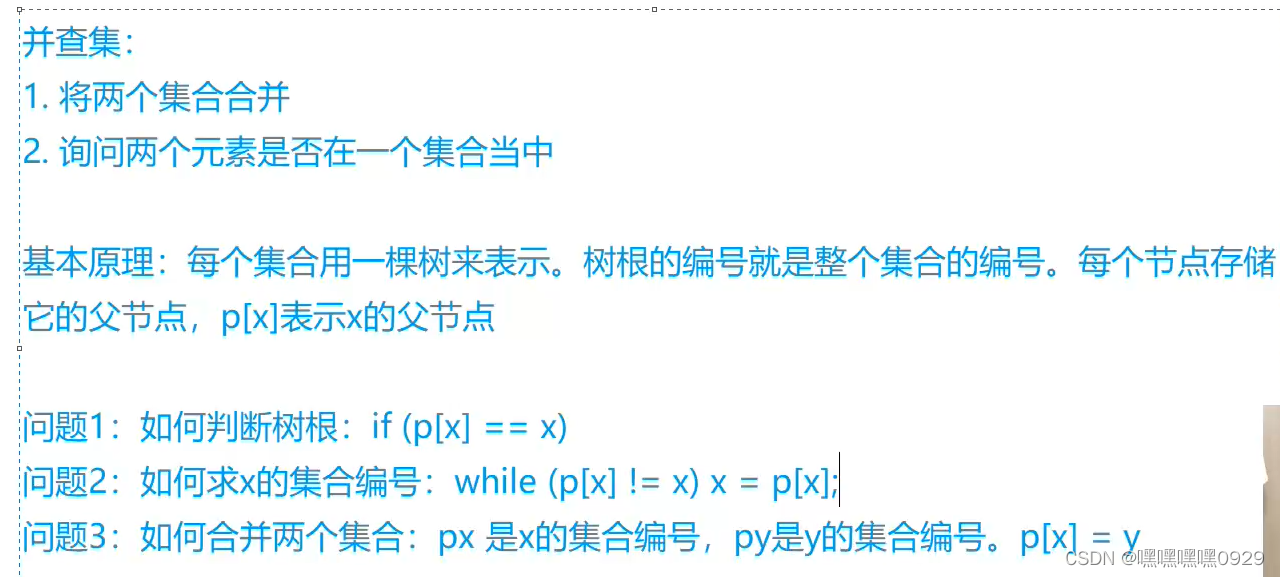
并查集思想(重点) 我们可以把每个连通分量看成一个集合,该集合包含了连通分量的所有点。而具体的连通方式无关紧要,好比集合中的元素没有先后顺序之分,只有“属于”与“不属于”的区别。图的所有连通分量可以用若干个不相交集合来表示。 分为三部分: (1)初始化:使每个结点的初始根节点为自己,并且每个结点构成一颗树,树的深度是1; (2)查找:使用递归来查找每个结点的父亲结点; (3)合并:将不同父节点的结点合并; 注:这里的并查集是优化后的,即:进行了路径压缩。如果题目中无要求,可以只写简单的并查集算法- 1
- 2
- 3
- 4
- 5
- 6
- 7
AcWing 837. 连通块中点的数量
3
#includeusing namespace std; const int N=1e5+10; int n,m; int p[N];//存储i的父亲结点的编号 int cnt[N];//记录---i所在树中结点的个数 int find(int x)//返回x的祖宗结点+路径压缩 { if(x!=p[x])//x不是根节点时 p[x]=find(p[x]); //认祖为父 return p[x];//返回x的祖宗结点 } int main() { cin>>n>>m; for(int i=1;i<=n;i++) { p[i]=i; cnt[i]=1; } while(m--) { string op; int a,b; cin>>op>>a; if(op=="C") { cin>>b; int aa=find(a); int bb=find(b); if(aa!=bb) { p[aa]=bb; cnt[bb]+=cnt[aa]; } } else if(op=="Q1") { cin>>b; if(find(a)==find(b)) cout<<"Yes"<<endl; else cout<<"No"<<endl; } else { cout<<cnt[find(a)]<<endl; } } return 0; } - 1
- 2
- 3
- 4
- 5
- 6
- 7
- 8
- 9
- 10
- 11
- 12
- 13
- 14
- 15
- 16
- 17
- 18
- 19
- 20
- 21
- 22
- 23
- 24
- 25
- 26
- 27
- 28
- 29
- 30
- 31
- 32
- 33
- 34
- 35
- 36
- 37
- 38
- 39
- 40
- 41
- 42
- 43
- 44
- 45
- 46
- 47
- 48
- 49
- 50
- 51
- 52
- 53
- 54
- 55
堆
哈希表(map/unordered_map)
map<key,value> m--------Map所有的元素都是pair---------map内部的所有元素都是有序的 第一个可以称为关键字(key),每个关键字只能在map中出现一次;第二个可能称为该关键字的值(value); first second map插入数据元素操作 //1通过pair的方式插入对象 m.insert(pair<int, string>(3, "小张")); m.inset(make_pair(-1, "校长")); //2通过数组的方式插入值--------可以覆盖以前该关键字对应的值 mapStu[3] = "小刘"; mapStu[5] = "小王"; map查找操作 方法一:[] map<int, int> mp; cout << mp[1] << endl; count(key) 返回指定key出现的次数 -------如果有,返回1;否则,返回0。注意,map中不存在相同元素,所以返回值只能是1或0 map大小操作 size();//返回容器中<key,value>的个数 遍历操作 for(auto &t : m) cout<<"key:"<<t.first<<" value:"<<t.second<<endl;- 1
- 2
- 3
- 4
- 5
- 6
- 7
- 8
- 9
- 10
- 11
- 12
- 13
- 14
- 15
- 16
- 17
- 18
- 19
- 20
- 21
- 22
- 23
- 24
- 25
- 26
- 27
- 28
- 29
- 30
- 31
- 32
- 33
- 34
- 35
- 36
- 37
- 38
- 39
- 40
- 41
- 42
- 43
- 44
- 45
unordered_map--------其元素的排列顺序是杂乱的,无序的- 1
201412-1csp门禁系统(map)
采用map存储数据,key存储编号,value存储次数 边输入边输出,先m[x]++,再输出m[x]- 1
- 2
#include#include using namespace std; const int N=1e3+10; unordered_map<int,int>m; int n; int main() { cin>>n; int temp; for(int i=0;i<n;i++) { cin>>temp; m[temp]++; cout<<m[temp]<<" "; } return 0; } - 1
- 2
- 3
- 4
- 5
- 6
- 7
- 8
- 9
- 10
- 11
- 12
- 13
- 14
- 15
- 16
- 17
- 18
- 19
- 20
201409-1csp相邻数对(map)
为了便于直接寻找相差1的数,我们采用map结构 map用来判断是否存在相应的值,如果存在则为1,不存在为0 用vector存储整个数值,然后对每个数值进行单独判断- 1
- 2
- 3
#includeusing namespace std; const int N=1e3+10; int n; vector<int> v;//数组用来存储数据遍历一遍 unordered_map<int,int> m;//用哈希表来判断该点是否存在 int ans=0;//返回答案 int main() { cin>>n; for(int i=0;i<n;i++) { int x; cin>>x; v.push_back(x);//用数组存储下来 m[x]=1; //存在该点 } for(auto i: v) { if(m[i-1]!=0) { m[i-1]=0; ans++; } } cout<<ans<<endl; return 0; } - 1
- 2
- 3
- 4
- 5
- 6
- 7
- 8
- 9
- 10
- 11
- 12
- 13
- 14
- 15
- 16
- 17
- 18
- 19
- 20
- 21
- 22
- 23
- 24
- 25
- 26
- 27
- 28
- 29
- 30
- 31
201312-1csp出现次数最多的数(map)
#includeusing namespace std; const int N= 1e4+10; map<int,int> m; int n; int main() { cin>>n; for(int i=0;i<n;i++) { int index; cin>>index; m[index]++; } int max=0,index=0; for(auto x:m) { if(x.second>max) { index=x.first; max=x.second; } } cout<<index<<endl; return 0; } - 1
- 2
- 3
- 4
- 5
- 6
- 7
- 8
- 9
- 10
- 11
- 12
- 13
- 14
- 15
- 16
- 17
- 18
- 19
- 20
- 21
- 22
- 23
- 24
- 25
- 26
- 27
- 28
202006-2csp稀疏向量(map)
map用于存储稀疏数据是最有效的,也可以用来存储稀疏向量。 2个向量不必都存储,能够边读入数据边计算可以节省存储,也有助于提高计算速度。 先读入数据存储在数据结构中,再进行处理是倒腾,既浪费存储又浪费时间,完全没有必要。- 1
- 2
- 3
- 4
- 5
- 6
- 7
#includeusing namespace std; typedef long long LL; map<int,int> M; LL n,a,b; LL ans=0; int main() { cin>>n>>a>>b; int index,val; for(int i=0;i<a;i++) { cin>>index>>val; M[index]=val; } for(int i=0;i<b;i++) { cin>>index>>val; ans+=val*M[index];//这里利用了map的性质,快速查找到了index(key)对应的value } cout<<ans<<endl; return 0; } - 1
- 2
- 3
- 4
- 5
- 6
- 7
- 8
- 9
- 10
- 11
- 12
- 13
- 14
- 15
- 16
- 17
- 18
- 19
- 20
- 21
- 22
- 23
- 24
AcWing.3447. 子串计算
#includeusing namespace std; const int N =110; int main() { string str; while(cin>>str) { map<string,int> hash;//map天然字典序---排序 for(int r=0;r<str.size();r++)//枚举一下右边端点 for(int l=0;l<=r;l++)//枚举一下左边端点 hash[str.substr(l,r-l+1)]++;//substr:第一个参数:起始下标,第二个参数:截取字符串的长度(r-l+1) for(auto &t:hash) if(t.second>1) cout<<t.first<<" "<<t.second<<endl; } return 0; } - 1
- 2
- 3
- 4
- 5
- 6
- 7
- 8
- 9
- 10
- 11
- 12
- 13
- 14
- 15
- 16
- 17
- 18
- 19
- 20
- 21
- 22
AcWing 3581. 单词识别
#includeusing namespace std; const int N=1e3+10; int main() { string str; getline(cin,str); map<string,int> hash; for(int i=0;i<str.size();i++) { int j=i; string word; if(isalpha(str[j]))//如果遇到的是字母时 { while(j<str.size() && isalpha(str[j])) word+=tolower(str[j++]);//将小写字母-->大写字母的函数---toupper() i=j;//跳出上次循环时---j指向的是非字母 hash[word]++; } } for(auto &t:hash) { cout<<t.first<<":"<<t.second<<endl; } return 0; } - 1
- 2
- 3
- 4
- 5
- 6
- 7
- 8
- 9
- 10
- 11
- 12
- 13
- 14
- 15
- 16
- 17
- 18
- 19
- 20
- 21
- 22
- 23
- 24
- 25
- 26
- 27
- 28
- 29
- 30
第三讲 搜索与图论
leetcode
leetcode.200岛屿数量(bfs/dfs)
leetcode.130被围绕的区域(dfs,bfs)
leetcode.547省份数量(dfs,bfs)
Flood fill算法—洪水覆盖算法
AcWing1113. 红与黑
bfs—Flood fill算法–最短路
#include#define x first #define y second using namespace std; const int N = 25; typedef pair<int, int> PII; int dx[4] = {-1, 0, 1, 0}; int dy[4] = {0, 1, 0, -1}; int n, m; char g[N][N]; int bfs(int sx, int sy) { queue<PII> q; q.push({sx, sy});//起点 g[sx][sy] = '#';//被走过 int res = 0;//记录个数 while(q.size()) { auto t=q.front(); q.pop(); res++;//每遍历一个点 for(int i=0;i<4;i++) { int x=t.x+dx[i],y=t.y+dy[i]; if (x>=0 && x<n && y>=0 && y<m && g[x][y]=='.')//未出界且可走 { g[x][y]='#';//标记 q.push({x,y});//加入队列 } } } return res; } int main() { while(cin>>m>>n, n || m) { int x,y; for(int i=0;i<n;i++){ for(int j=0;j<m;j++) { cin>>g[i][j]; if(g[i][j]=='@') { x = i; y = j; } } } cout<<bfs(x,y)<<endl; } return 0; } - 1
- 2
- 3
- 4
- 5
- 6
- 7
- 8
- 9
- 10
- 11
- 12
- 13
- 14
- 15
- 16
- 17
- 18
- 19
- 20
- 21
- 22
- 23
- 24
- 25
- 26
- 27
- 28
- 29
- 30
- 31
- 32
- 33
- 34
- 35
- 36
- 37
- 38
- 39
- 40
- 41
- 42
- 43
- 44
- 45
- 46
- 47
- 48
- 49
- 50
- 51
- 52
- 53
- 54
- 55
- 56
- 57
- 58
- 59
- 60
- 61
dfs—Flood fill算法—代码短
#includeusing namespace std; int dx[]={-1,1,0,0},dy[]={0,0,-1,1}; const int N=25; int n,m; char g[N][N]; int dfs(int x,int y)//参数---坐标 { int res=1;//当前格子可以走 g[x][y]='#'; for(int i=0;i<4;i++) { int a=x+dx[i],b=y+dy[i]; if(a>=0 && a<n && b>=0 && b<m && g[a][b]=='.') { res+=dfs(a,b); } } return res; } int main() { while(cin>>m>>n,m||n)//当在一行中读入的是两个零时,表示输入结束。 { int x,y; for(int i=0;i<n;i++){ for(int j=0;j<m;j++) { cin>>g[i][j]; if(g[i][j]=='@') x=i,y=j; } } cout<<dfs(x,y)<<endl; } return 0; } - 1
- 2
- 3
- 4
- 5
- 6
- 7
- 8
- 9
- 10
- 11
- 12
- 13
- 14
- 15
- 16
- 17
- 18
- 19
- 20
- 21
- 22
- 23
- 24
- 25
- 26
- 27
- 28
- 29
- 30
- 31
- 32
- 33
- 34
- 35
- 36
- 37
- 38
- 39
- 40
- 41
- 42
AcWing2060. 奶牛选美—尽可能少的区域内涂色—Flood fill算法—枚举
AcWing2060. 奶牛选美
AcWing 2060. 奶牛选美详细证明题目描述:在一个二维矩阵中,有两个点的集合,找到最短的距离(从一个集合到另一个集合中)距离的计算方式为(曼哈顿距离) 曼哈顿距离:两点间的曼哈顿距离 = | x1 - x2 | + | y1 - y2 | 输出最短距离 问题难点: 二维矩阵使用了字符类型存储 PII 上下左右的定义 dfs广度优先搜索的模板 floodfill算法的证明使用 Flood fill算法是从一个区域中提取若干个连通的点与其他相邻区域区分开(或分别染成不同颜色)的经典算法。- 1
- 2
- 3
- 4
- 5
- 6
- 7
- 8
- 9
- 10
- 11
#include#include #include //数组 using namespace std; #define x first #define y second typedef pair<int,int> PII; const int N = 55;//此处定义了数据范围 二维数组的大小 int n,m; char g[N][N]; vector<PII> points[2];//一共有两个点的集合 int dx[4]={-1,0,1,0}; int dy[4]={0,1,0,-1}; void bfs(int x,int y,vector<PII>& ps)//洪水覆盖算法 { g[x][y]='.';//将搜索过的点做标记 ps.push_back({x,y});//放入vector中去 for(int i=0;i<4;i++) { int a=x+dx[i]; int b=y+dy[i]; if(a>=0 && a<n && b>=0 && b<m && g[a][b] == 'X')//如果未超出界,且为x时 { bfs(a,b,ps); } } } int main() { cin>>n>>m; for(int i=0;i<n;i++) for(int j=0;j<m;j++) cin>>g[i][j]; for(int i=0 ,k=0;i<n;i++) for(int j=0;j<m;j++) if(g[i][j]=='X')//遇到x时,将位于同一集合中的所有x放入一个vector中去 bfs(i,j,points[k++]);//洪水覆盖算法----bfs版本 int res=1e8;//返回的距离长度,先初始化一个很大的距离 for(auto& a:points[0])//枚举两个集合中的所有点 for(auto& b:points[1]) res=min(res,abs(a.x-b.x)+abs(a.y-b.y)-1);//最优解---曼哈顿距离 cout<<res; return 0; } - 1
- 2
- 3
- 4
- 5
- 6
- 7
- 8
- 9
- 10
- 11
- 12
- 13
- 14
- 15
- 16
- 17
- 18
- 19
- 20
- 21
- 22
- 23
- 24
- 25
- 26
- 27
- 28
- 29
- 30
- 31
- 32
- 33
- 34
- 35
- 36
- 37
- 38
- 39
- 40
- 41
- 42
- 43
- 44
- 45
- 46
- 47
- 48
- 49
- 50
- 51
- 52
- 53
- 54
- 55
- 56
- 57
201512-3-csp-画图—洪水覆盖算法
AcWing 3224. 画图
AcWing 3224. 画图(dfs:坐标反着读入,即可正常处理)由数组坐标系(起点在左上角)---按数学坐标系输出(起点在左下角)- 1

DFS写法
#includeusing namespace std; const int N=1e2+10; char g[N][N];//地图 bool st[N][N];//对某类型的标记 int dx[4]={-1,0,1,0}; int dy[4]={0,1,0,-1}; int n,m;//n是高度(行),m是宽度(列) void paint(int x1,int y1,int x2,int y2)//划线函数 { if(x1==x2)//属于同行 { for(int j=y1;j<=y2;j++) { if(g[x1][j]=='|'||g[x1][j]=='+') g[x1][j]='+'; else g[x1][j]='-'; } } else if(y1==y2)//同列时 { for(int i=x1;i<=x2;i++) { if(g[i][y1]=='-'||g[i][y1]=='+') g[i][y1]='+'; else g[i][y1]='|'; } } return ; } void dfs(int x,int y,char C)//洪水覆盖算法 { st[x][y]=true;//对同类型的填充做标记 g[x][y]=C; for(int i=0;i<4;i++) { int a=x+dx[i]; int b=y+dy[i]; if(a<0 || a>=n || b<0 || b>=m || st[a][b])//不越界---未走过 continue; if(g[a][b]=='-' || g[a][b]=='|' || g[a][b]=='+')//不撞墙 continue; dfs(a,b,C); } } int main() { int q; cin>>m>>n>>q; for(int i=0;i<n;i++)//---正常的数组输入---在输入坐标是将(x,y)对调 for(int j=0;j<m;j++) g[i][j]='.'; while(q--) { int op;//操作类型 cin>>op; if(op==0)//划线 { int x1,y1,x2,y2; cin>>x1>>y1>>x2>>y2; if(x1>x2) swap(x1,x2);//保证小的坐标在前---x/y至少有一项,两个点的坐标相同--同行/同列 if(y1>y2) swap(y1,y2); paint(y1,x1,y2,x2);//交换x---y } else//填充 { int x,y; char C; cin>>x>>y>>C; memset(st,0,sizeof(st));//这里需要对状态数组重新初始化一下 dfs(y,x,C);//交换x---y } } for(int i=n-1;i>=0;i--)//由数组坐标系(起点在左上角)---按数学坐标系输出(起点在左下角) { for(int j=0;j<m;j++) { cout<<g[i][j]; } cout<<endl; } } - 1
- 2
- 3
- 4
- 5
- 6
- 7
- 8
- 9
- 10
- 11
- 12
- 13
- 14
- 15
- 16
- 17
- 18
- 19
- 20
- 21
- 22
- 23
- 24
- 25
- 26
- 27
- 28
- 29
- 30
- 31
- 32
- 33
- 34
- 35
- 36
- 37
- 38
- 39
- 40
- 41
- 42
- 43
- 44
- 45
- 46
- 47
- 48
- 49
- 50
- 51
- 52
- 53
- 54
- 55
- 56
- 57
- 58
- 59
- 60
- 61
- 62
- 63
- 64
- 65
- 66
- 67
- 68
- 69
- 70
- 71
- 72
- 73
- 74
- 75
- 76
- 77
- 78
- 79
- 80
- 81
- 82
- 83
- 84
- 85
- 86
- 87
- 88
- 89
- 90
- 91
- 92
BFS写法
#includeusing namespace std; const int N=1e2+10; typedef pair<int,int> PII; char g[N][N];//地图 bool st[N][N];//对某类型的标记 int dx[4]={-1,0,1,0}; int dy[4]={0,1,0,-1}; int n,m;//n是高度(行),m是宽度(列) void paint(int x1,int y1,int x2,int y2)//划线函数 { if(x1==x2)//属于同行 { for(int j=y1;j<=y2;j++) { if(g[x1][j]=='|'||g[x1][j]=='+') g[x1][j]='+'; else g[x1][j]='-'; } } else if(y1==y2)//同列时 { for(int i=x1;i<=x2;i++) { if(g[i][y1]=='-'||g[i][y1]=='+') g[i][y1]='+'; else g[i][y1]='|'; } } return ; } void bfs(int x,int y,char C)//洪水覆盖算法 { queue<PII> q; q.push({x,y}); st[x][y]=true;//对同类型的填充做标记 g[x][y]=C; while(q.size()) { auto t=q.front(); q.pop(); for(int i=0;i<4;i++) { int a=t.first+dx[i]; int b=t.second+dy[i]; if(a<0 || a>=n || b<0 || b>=m || st[a][b])//不越界---未走过 continue; if(g[a][b]=='-' || g[a][b]=='|' || g[a][b]=='+')//不撞墙 continue; q.push({a,b}); st[a][b]=true;//对同类型的填充做标记 g[a][b]=C; } } } int main() { int q; cin>>m>>n>>q; for(int i=0;i<n;i++)//---正常的数组输入---在输入坐标是将(x,y)对调 for(int j=0;j<m;j++) g[i][j]='.'; while(q--) { int op;//操作类型 cin>>op; if(op==0)//划线 { int x1,y1,x2,y2; cin>>x1>>y1>>x2>>y2; if(x1>x2) swap(x1,x2);//保证小的坐标在前---x/y至少有一项,两个点的坐标相同--同行/同列 if(y1>y2) swap(y1,y2); paint(y1,x1,y2,x2);//交换x---y } else//填充 { int x,y; char C; cin>>x>>y>>C; memset(st,0,sizeof(st));//这里需要对状态数组重新初始化一下 bfs(y,x,C);//交换x---y } } for(int i=n-1;i>=0;i--)//由数组坐标系(起点在左上角)---按数学坐标系输出(起点在左下角) { for(int j=0;j<m;j++) { cout<<g[i][j]; } cout<<endl; } } - 1
- 2
- 3
- 4
- 5
- 6
- 7
- 8
- 9
- 10
- 11
- 12
- 13
- 14
- 15
- 16
- 17
- 18
- 19
- 20
- 21
- 22
- 23
- 24
- 25
- 26
- 27
- 28
- 29
- 30
- 31
- 32
- 33
- 34
- 35
- 36
- 37
- 38
- 39
- 40
- 41
- 42
- 43
- 44
- 45
- 46
- 47
- 48
- 49
- 50
- 51
- 52
- 53
- 54
- 55
- 56
- 57
- 58
- 59
- 60
- 61
- 62
- 63
- 64
- 65
- 66
- 67
- 68
- 69
- 70
- 71
- 72
- 73
- 74
- 75
- 76
- 77
- 78
- 79
- 80
- 81
- 82
- 83
- 84
- 85
- 86
- 87
- 88
- 89
- 90
- 91
- 92
- 93
- 94
- 95
- 96
- 97
- 98
- 99
- 100
- 101
- 102
- 103
DFS—深度优先搜索
AcWing 842. 排列数字
AcWing 842. 排列数字
AcWing 842. 排列数字–深度优先遍历代码+注释#includeusing namespace std; const int N = 10; int path[N];//保存序列 int st[N];//数字是否被用过 int n; void dfs(int u) { if(u>n)//数字填完了,输出 { for(int i=1;i<=n;i++)//输出方案 cout<<path[i]<<" "; cout<<endl; } for(int i=1;i<=n;i++)//空位上可以选择的数字为:1 ~ n { if(!st[i])//如果数字 i 没有被用过 { path[u] = i;//放入空位 st[i]=1;//数字被用,修改状态 dfs(u+1);//填下一个位 st[i]=0;//回溯,取出 i path[u]=0; } } } int main() { cin >> n; dfs(1); } - 1
- 2
- 3
- 4
- 5
- 6
- 7
- 8
- 9
- 10
- 11
- 12
- 13
- 14
- 15
- 16
- 17
- 18
- 19
- 20
- 21
- 22
- 23
- 24
- 25
- 26
- 27
- 28
- 29
- 30
- 31
- 32
- 33
- 34
- 35
AcWing 843. n-皇后问题
代码分析 对角线 dg[u+i] ,反对角线udg[n−u+i]中的下标 u+i和 n−u+i 表示的是截距 下面分析中的(x,y) 相当于上面的(u,i) 反对角线 y=x+b , 截距 b=y−x,因为我们要把 b 当做数组下标来用,显然 b 不能是负的,所以我们加上 +n (实际上+n+4,+2n都行),来保证是结果是正的,即 y - x + n 而对角线 y=−x+b , 截距是 b=y+x ,这里截距一定是正的,所以不需要加偏移量 核心目的:找一些合法的下标来表示dg 或udg是否被标记过,所以如果你愿意,你取 udg[n+n−u+i] 也可以,只要所有(u,i)对可以映射过去就行- 1
- 2
- 3
- 4
- 5
- 6
- 7
- 8
- 9
- 10
- 11
- 12
- 13
- 14
- 15
- 16
- 17
- 18
- 19
- 20
- 21
- 22
AcWing 1432. 棋盘挑战—对角线—八皇后问题
dfs--天然保证了按照字典序- 1
#includeusing namespace std; const int N=15; int n; bool col[N];//用于标志这列是否被存放了 bool dg[N*2];//正对角线上是否有了元素 true:有 ;false :无 //正对角线 ---存储b //y=x+b y=x+b -> b=x-y; bool udg[N*2]; //反对角线上是否有了元素 true:有 ;false :无 //副对角线 ---存储b //y=-x+b y=-x+b ->b=x+y; int path[N];//方案 int ans; void dfs(int x) { if(x>n)//搜索到第n行---搜索到答案 { ans++; if(ans<=3) { for(int i=1;i<=n;i++) cout<<path[i]<<" "; cout<<endl; } return ; } for(int y=1;y<=n;y++)//枚举一下放到第几列 { if(!col[y]&&!dg[x+y]&&!udg[x-y+n])//该列、正对角线、副对角线上都没有数 { path[x]=y; col[y]=dg[x+y]=udg[x-y+n]=true;//标记一下 dfs(x+1);//搜索下一层 col[y]=dg[x+y]=udg[x-y+n]=false;//恢复现场---清空 path[x]=0; } } } int main() { cin>>n; dfs(1); cout<<ans<<endl; return 0; } - 1
- 2
- 3
- 4
- 5
- 6
- 7
- 8
- 9
- 10
- 11
- 12
- 13
- 14
- 15
- 16
- 17
- 18
- 19
- 20
- 21
- 22
- 23
- 24
- 25
- 26
- 27
- 28
- 29
- 30
- 31
- 32
- 33
- 34
- 35
- 36
- 37
- 38
- 39
- 40
- 41
- 42
- 43
- 44
- 45
- 46
- 47
- 48
- 49
- 50
201709-4-csp-通信网络—正反向两次dfs—图论
AcWing 3250. 通信网络
AcWing 3250. 通信网络—两次dfs#includeusing namespace std; const int N =1e3+10;//顶点 const int M =1e4+10;//边 bool st1[N]; bool st2[N]; //邻接表---正向存储 int idx1; int e1[M]; int ne1[M]; int h1[N]; void add1(int a,int b) { e1[idx1]=b; ne1[idx1]=h1[a]; h1[a]=idx1++; } //邻接表---逆向存储 int idx2; int e2[M]; int ne2[M]; int h2[N]; void add2(int a,int b) { e2[idx2]=b; ne2[idx2]=h2[a]; h2[a]=idx2++; } int n,m; void dfs1(int u) { st1[u]=true;//当前点已经被遍历过了 for(int i=h1[u];i!=-1;i=ne1[i]) { int j=e1[i]; if(!st1[j]) dfs1(j); } } void dfs2(int u) { st2[u]=true;//当前点已经被遍历过了 for(int i=h2[u];i!=-1;i=ne2[i]) { int j=e2[i]; if(!st2[j]) dfs2(j); } } int main() { cin>>n>>m; memset(h1,-1,sizeof(h1));//邻接表---顶点表---初始化 memset(h2,-1,sizeof(h2)); for(int i=0;i<m;i++) { int a,b; cin>>a>>b; add1(a,b),add2(b,a);//邻接表 与 逆邻接表 } int ans=0; for(int i=1;i<=n;i++) { memset(st1,0,sizeof(st1)); memset(st2,0,sizeof(st2)); dfs1(i);//正向搜索 dfs2(i);//反向搜索 int sum=0; for(int j=1;j<=n;j++) { if(st1[j]||st2[j])//只要有一个方向能搜索到就算可以 sum++; } if(sum==n) ans++; } cout<<ans<<endl; return 0; } - 1
- 2
- 3
- 4
- 5
- 6
- 7
- 8
- 9
- 10
- 11
- 12
- 13
- 14
- 15
- 16
- 17
- 18
- 19
- 20
- 21
- 22
- 23
- 24
- 25
- 26
- 27
- 28
- 29
- 30
- 31
- 32
- 33
- 34
- 35
- 36
- 37
- 38
- 39
- 40
- 41
- 42
- 43
- 44
- 45
- 46
- 47
- 48
- 49
- 50
- 51
- 52
- 53
- 54
- 55
- 56
- 57
- 58
- 59
- 60
- 61
- 62
- 63
- 64
- 65
- 66
- 67
- 68
- 69
- 70
- 71
- 72
- 73
- 74
- 75
- 76
- 77
- 78
- 79
- 80
- 81
- 82
- 83
- 84
- 85
- 86
- 87
- 88
- 89
- 90
201312-5-csp-I’m stuck!—正反两个方向dfs
AcWing 3196. I’m stuck!:矩阵地图遍历 + 详细代码注释
#includeusing namespace std; const int N=55; char g[N][N];//存储地图 bool st1[N][N];//true:从起点可以走到[i][j] bool st2[N][N];//true:从[i][j] 可以走到终点 int R,C; int ans;//返回符合答案的数目 int dx[4]={-1,0,1,0};//上0-左1-下2-右3 int dy[4]={0,1,0,-1}; bool check(int x,int y,int i)//判断是否能走 { if(g[x][y]=='+'||g[x][y]=='S'||g[x][y]=='T') return true; if(g[x][y]=='-'&& i%2!=0) return true; if(g[x][y]=='|'&& i%2==0) return true; if(g[x][y]=='.'&& i==2) return true; return false; } void dfs1(int x,int y)//深度优先遍历,求出 S 能到的所有点 { st1[x][y]=true; for(int i=0;i<4;i++) { int a=x+dx[i]; int b=y+dy[i]; if(a<1||a>R || b<1||b>C ||g[a][b]=='#' ) continue;//走的位置不合法 if(st1[a][b]) continue;//如果走过---跳过 if(check(x,y,i))//如果能走过去 dfs1(a,b); } } void dfs2(int x,int y)//深度优先遍历,求出能走到 T 的所有点 { st2[x][y]=true; for(int i=0;i<4;i++) { int a=x+dx[i]; int b=y+dy[i]; if(a<1||a>R || b<1||b>C ||g[a][b]=='#' ) continue;//走的位置不合法 if(st2[a][b]) continue;//如果走过---跳过 if(check(a,b,i ^ 2))//如果能反向走过去---注意是那个点[a][b]---而不是[x][y] dfs2(a,b); } } int main() { cin>>R>>C; for(int i=1;i<=R;i++) for(int j=1;j<=C;j++) cin>>g[i][j]; int edx,edy;//记录下终点 for(int i=1;i<=R;i++) for(int j=1;j<=C;j++) { if(g[i][j]=='S') dfs1(i,j);//从起点开始dfs搜索可以到达的点 if(g[i][j]=='T') { edx=i,edy=j; dfs2(i,j);//从终点开始dfs搜索可以到达的点 } } if(!st1[edx][edy])//如果从起点到终点不可达直接输出 { cout<<"I'm stuck!"<<endl; return 0; } for(int i=1;i<=R;i++) for(int j=1;j<=C;j++) { //cout< - 1
- 2
- 3
- 4
- 5
- 6
- 7
- 8
- 9
- 10
- 11
- 12
- 13
- 14
- 15
- 16
- 17
- 18
- 19
- 20
- 21
- 22
- 23
- 24
- 25
- 26
- 27
- 28
- 29
- 30
- 31
- 32
- 33
- 34
- 35
- 36
- 37
- 38
- 39
- 40
- 41
- 42
- 43
- 44
- 45
- 46
- 47
- 48
- 49
- 50
- 51
- 52
- 53
- 54
- 55
- 56
- 57
- 58
- 59
- 60
- 61
- 62
- 63
- 64
- 65
- 66
- 67
- 68
- 69
- 70
- 71
- 72
- 73
- 74
- 75
- 76
- 77
- 78
- 79
- 80
- 81
- 82
201503-4-csp-网络延时—图论
#includeusing namespace std; const int N=2e4+10;//这里交换机和计算机一起存储 const int M=N; //邻接表存储图 int idx; int e[M]; int ne[M]; int h[N]; int n,m; int ans;//最大深度+次大深度 void add(int a,int b) { e[idx]=b; ne[idx]=h[a]; h[a]=idx++; } int dfs(int u) { int d1=0,d2=0;//d1保存最大深度,d2保存次大深度 for(int i=h[u];i!=-1;i=ne[i]) { int j=e[i]; int d=dfs(j);//返回下一层的最大深度 if(d>d1) d2=d1,d1=d; else if(d>d2) d2=d; } ans=max(ans,d1+d2); return d1+1; } int main() { cin>>n>>m; memset(h,-1,sizeof(h)); for(int i=2;i<=n;i++) { int p; cin>>p; add(p,i);//添加一条p->i的边---交换机->交换机 } for(int i=n+1;i<=n+m;i++) { int p; cin>>p; add(p,i);//添加一条p->i的边 ---交换机->计算机 } dfs(1); cout<<ans<<endl; return 0; } - 1
- 2
- 3
- 4
- 5
- 6
- 7
- 8
- 9
- 10
- 11
- 12
- 13
- 14
- 15
- 16
- 17
- 18
- 19
- 20
- 21
- 22
- 23
- 24
- 25
- 26
- 27
- 28
- 29
- 30
- 31
- 32
- 33
- 34
- 35
- 36
- 37
- 38
- 39
- 40
- 41
- 42
- 43
- 44
- 45
- 46
- 47
- 48
- 49
- 50
- 51
- 52
- 53
- 54
- 55
- 56
- 57
- 58
- 59
- 60
BFS—广度优先搜索
AcWing 844. 走迷宫—最短路(权重相同时)
#includeusing namespace std; const int N=1e2+10; typedef pair<int,int> PII; #define x first #define y second int g[N][N]; int d[N][N];//存储从起点到达[i,j]位置的最短路径 int dx[4]={0,0,-1,1}; int dy[4]={-1,1,0,0}; int n,m; int bfs() { queue<PII> q; q.push({1,1});//将起点加入队列 while(q.size()) { auto t=q.front();//队首元素 q.pop(); for(int i=0;i<4;i++)//将上下左右加入队列 { int X=t.x+dx[i]; int Y=t.y+dy[i]; if(X>=1 && X<=n && Y>=1 && Y<=m && g[X][Y]==0 && d[X][Y]==0)//未出界、不是墙、未走过、 { d[X][Y]=d[t.x][t.y]+1; q.push({X,Y}); } } } return d[n][m];//返回到达[n,m]的距离 } int main() { cin>>n>>m; for(int i=1;i<=n;i++) for(int j=1;j<=m;j++) cin>>g[i][j]; cout<<bfs()<<endl; return 0; } - 1
- 2
- 3
- 4
- 5
- 6
- 7
- 8
- 9
- 10
- 11
- 12
- 13
- 14
- 15
- 16
- 17
- 18
- 19
- 20
- 21
- 22
- 23
- 24
- 25
- 26
- 27
- 28
- 29
- 30
- 31
- 32
- 33
- 34
- 35
- 36
- 37
- 38
- 39
- 40
- 41
- 42
- 43
201604-4-csp-游戏—最短路—拆点(通过升维来对状态点进行细分)
#includeusing namespace std; const int N=110; const int M=310;//最多花费300秒的时间就能走到终点 bool g[N][N][M];//---g[x][y][t]---t时刻,(x,y)坐标是否能走---true:表示不能走 bool st[N][N][M];//---st[x][y][t]:表示(x,y)坐标 在t时刻是否走过---为了不重复走 int dx[]={-1,0,1,0}; int dy[]={0,1,0,-1}; int n,m,t; struct Node{//结构体---方便队列存储信息 int x,y; int t; }; int bfs() { queue<Node> q; st[1][1][0]=true;//在0时刻---[1][1]位置已经走过 q.push({1,1,0});//将起点加入队列 while(q.size()) { auto z=q.front(); q.pop(); for(int i=0;i<4;i++) { int x=z.x+dx[i]; int y=z.y+dy[i]; int t=z.t+1; if(x<1 || x>n || y<1 || y>m || g[x][y][t]) continue;//如果越界 或 [x][y]在t时刻不能走 if(st[x][y][t]) continue;//[x][y]在t时刻---已经经过该位置了 if(x==n && y==m)//到达终点 return t; st[x][y][t]=true; q.push({x,y,t}); } } return -1; } int main() { cin>>n>>m>>t; while(t--) { int r,c,a,b; cin>>r>>c>>a>>b; for(int i=a;i<=b;i++) { g[r][c][i]=true;//表示x,y这个格子在i时刻不能走 } } int t=bfs(); cout<<t<<endl; return 0; } - 1
- 2
- 3
- 4
- 5
- 6
- 7
- 8
- 9
- 10
- 11
- 12
- 13
- 14
- 15
- 16
- 17
- 18
- 19
- 20
- 21
- 22
- 23
- 24
- 25
- 26
- 27
- 28
- 29
- 30
- 31
- 32
- 33
- 34
- 35
- 36
- 37
- 38
- 39
- 40
- 41
- 42
- 43
- 44
- 45
- 46
- 47
- 48
- 49
- 50
- 51
- 52
- 53
- 54
- 55
- 56
- 57
- 58
- 59
201409-4-csp-最优配餐—最短路
AcWing 3205. 最优配餐
AcWing 3205. 最优配餐——多源BFS#includeusing namespace std; const int N =1e3+10; const int INF =0x3f3f3f3f; typedef long long LL; typedef pair<int,int> PII; bool st[N][N];//标记已经走过---和---原本就是障碍物 int dist[N][N];//记录---多源起点到达该位置的最短距离 struct target{//存储买家的位置---订单数量 int x; int y; int c; }Tg[N*N]; queue<PII> q;//bfs---队列---将坐标加入队列 int n,m,k,d; int dx[4]={-1,0,1,0};//上-右-下-左 int dy[4]={0,1,0,-1}; void bfs() { while(q.size()) { auto t=q.front(); q.pop(); for(int i=0;i<4;i++) { int a=t.first+dx[i]; int b=t.second+dy[i]; if(a>=1 && a<=n && b>=1 && b<= n && !st[a][b]) { if(dist[a][b]>dist[t.first][t.second]+1) { dist[a][b]=dist[t.first][t.second]+1;//最短路径算法---边权相同---bfs st[a][b]=true; q.push({a,b}); } } } } } int main() { cin>>n>>m>>k>>d; memset(dist,INF,sizeof(dist));//初始化一下所有位置---为不可达 while(m--) { int a,b; cin>>a>>b; dist[a][b]=0;//-----------将多元起点---标记为起点---初始距离 q.push({a,b});//将起点加入队列 } for(int i=0;i<k;i++) cin>>Tg[i].x>>Tg[i].y>>Tg[i].c; while(d--) { int a,b; cin>>a>>b; st[a][b]=true;//表示该位置不可达 } bfs(); LL ans=0; for(int i=0;i<k;i++) ans+=dist[Tg[i].x][Tg[i].y]*Tg[i].c; cout<<ans<<endl; return 0; } - 1
- 2
- 3
- 4
- 5
- 6
- 7
- 8
- 9
- 10
- 11
- 12
- 13
- 14
- 15
- 16
- 17
- 18
- 19
- 20
- 21
- 22
- 23
- 24
- 25
- 26
- 27
- 28
- 29
- 30
- 31
- 32
- 33
- 34
- 35
- 36
- 37
- 38
- 39
- 40
- 41
- 42
- 43
- 44
- 45
- 46
- 47
- 48
- 49
- 50
- 51
- 52
- 53
- 54
- 55
- 56
- 57
- 58
- 59
- 60
- 61
- 62
- 63
- 64
- 65
- 66
- 67
- 68
- 69
- 70
- 71
- 72
- 73
- 74
- 75
201403-4-csp-无线网络–拆点(通过升维来对状态点进行细分)
#includeusing namespace std; const int N=210;//非特殊点+特殊点 const int M=N*N;//无向图 const int INF=0x3f3f3f3f; typedef pair<int,int> PII;//存储每个点的位置信息 PII p[N]; int dist[N][N]; // 最短距离,从1->i---dist[i][j]---i:到达点的编号,j:路线中经过了几个特殊点 #define x first #define y second typedef long long LL; int n,m,k,r; //邻接表存储图 int idx; int e[M]; int ne[M]; int h[N]; void add(int a,int b)//边权都为1 { e[idx]=b; ne[idx]=h[a]; h[a]=idx++; } bool check(PII a, PII b) { LL dx=a.x-b.x; LL dy=a.y-b.y; return (dx*dx+dy*dy<=(LL)r*r); } int bfs() { memset(dist,INF,sizeof(dist)); dist[1][0]=0;//到达1号点,经过0个特殊点,路径距离=0 queue<PII> q;//----此时存储x:几号点,y经过几个特殊点 q.push({1,0}); while(q.size()) { auto t=q.front(); q.pop(); for(int i=h[t.x];i!=-1;i=ne[i]) { int j=e[i];//以i为边-----------t.x->j int y=t.y; if(j>n)//说明此时选择的终点---是特殊点 y++; if(y<=k) { if(dist[j][y]>dist[t.x][t.y]+1) { dist[j][y]=dist[t.x][t.y]+1; q.push({j,y}); } } } } int ans=1e8; for(int i=0;i<=k;i++) { ans=min(ans,dist[2][i]); } return ans-1; } int main() { cin>>n>>m>>k>>r; memset(h,-1,sizeof(h)); for(int i=1;i<=n;i++) cin>>p[i].x>>p[i].y;//原有路由器 for(int i=n+1;i<=n+m;i++) cin>>p[i].x>>p[i].y;//新增路由器 //初始化---点与点之间的距离 for(int i=1;i<=n+m;i++) { for(int j=i+1;j<=n+m;j++) { if(check(p[i],p[j])) { add(i,j),add(j,i);//无向图--每条边存储两次 } } } cout<<bfs()<<endl; return 0; } - 1
- 2
- 3
- 4
- 5
- 6
- 7
- 8
- 9
- 10
- 11
- 12
- 13
- 14
- 15
- 16
- 17
- 18
- 19
- 20
- 21
- 22
- 23
- 24
- 25
- 26
- 27
- 28
- 29
- 30
- 31
- 32
- 33
- 34
- 35
- 36
- 37
- 38
- 39
- 40
- 41
- 42
- 43
- 44
- 45
- 46
- 47
- 48
- 49
- 50
- 51
- 52
- 53
- 54
- 55
- 56
- 57
- 58
- 59
- 60
- 61
- 62
- 63
- 64
- 65
- 66
- 67
- 68
- 69
- 70
- 71
- 72
- 73
- 74
- 75
- 76
- 77
- 78
- 79
- 80
- 81
- 82
- 83
- 84
- 85
- 86
- 87
- 88
- 89
- 90
- 91
- 92
- 93
- 94
- 95
201509-4-csp-高速公路
AcWing 3220. 高速公路
暴力bfs 60分#includeusing namespace std; const int N = 1010, M = N * N; #define x first #define y second typedef pair<int,int> PII; int h[N], e[M], ne[M], idx; int n, m; bool g[N][N]; void add(int a, int b){ e[idx] = b, ne[idx] = h[a], h[a] = idx++; } queue<PII> q; void bfs() { while(q.size()) { auto t = q.front(); q.pop(); for(int j = h[t.y]; j != -1; j = ne[j]) { if(g[t.x][e[j]])continue; q.push({t.x, e[j]}); g[t.x][e[j]] = true; } } } int main() { cin >> n >> m; memset(h, -1, sizeof h); for(int i = 0; i < m;i ++) { int a, b; cin >> a >> b; add(a, b); q.push({a, b}); } bfs(); int res = 0; for(int i = 1; i <= n; i ++) { for(int j = 1; j < i; j ++) { if(g[i][j] && g[j][i])res ++; } } cout << res << endl; return 0; } - 1
- 2
- 3
- 4
- 5
- 6
- 7
- 8
- 9
- 10
- 11
- 12
- 13
- 14
- 15
- 16
- 17
- 18
- 19
- 20
- 21
- 22
- 23
- 24
- 25
- 26
- 27
- 28
- 29
- 30
- 31
- 32
- 33
- 34
- 35
- 36
- 37
- 38
- 39
- 40
- 41
- 42
- 43
- 44
- 45
- 46
- 47
- 48
- 49
- 50
- 51
- 52
- 53
- 54
- 55
- 56
- 57
- 58
- 59
- 60
- 61
- 62
- 63
AcWing1101. 献给阿尔吉侬的花束—最短路
#include#include using namespace std; #include //广度优先搜索 #define x first #define y second typedef pair<int,int> PII; const int N=210; int dx[]={-1,1,0,0},dy[]={0,0,-1,1}; int n,m; char g[N][N]; int dist[N][N]; int bfs(PII start) { queue<PII> Q; Q.push(start); memset(dist,-1,sizeof(dist)); //初始化数组为-1 dist[start.x][start.y]=0;//起点的距离为0 while(Q.size()) { auto t =Q.front(); Q.pop(); for(int i=0;i<4;i++) { int x=t.x+dx[i],y=t.y+dy[i];//上下左右的坐标 if(x>=0&&x<n&&y>=0&&y<m&&g[x][y]!='#'&&dist[x][y]==-1)//如果没有越界 { dist[x][y]=dist[t.x][t.y]+1;//更新距离 if(g[x][y]=='E')//到达终点 return dist[x][y]; Q.push({x,y});//加入队列 } } } return -1;//如果没有找到终点---当队列中没有点时----所有能走到的点都被标记了--(距离非0) } int main() { int T; cin>>T; while(T--) { cin>>n>>m; PII start; for(int i=0;i<n;i++) for(int j=0;j<m;j++) { cin>>g[i][j]; if(g[i][j]=='S')//如果为S,则为起点 start={i,j}; } int res=bfs(start); if(res==-1) cout<<"oop!"<<endl; else cout<<res<<endl; } return 0; } - 1
- 2
- 3
- 4
- 5
- 6
- 7
- 8
- 9
- 10
- 11
- 12
- 13
- 14
- 15
- 16
- 17
- 18
- 19
- 20
- 21
- 22
- 23
- 24
- 25
- 26
- 27
- 28
- 29
- 30
- 31
- 32
- 33
- 34
- 35
- 36
- 37
- 38
- 39
- 40
- 41
- 42
- 43
- 44
- 45
- 46
- 47
- 48
- 49
- 50
- 51
- 52
- 53
- 54
- 55
- 56
- 57
- 58
- 59
- 60
- 61
- 62
- 63
- 64
AcWing 845. 八数码—至少需要进行多少次交换
#includeusing namespace std; int dx[4]={1,-1,0,0}; int dy[4]={0,0,-1,1}; int bfs(string strat) { string ed="12345678x";//定义结束状态 queue<string> q; unordered_map<string,int> m; q.push(strat); m[strat]=0;//起点距离 while(q.size()) { auto t=q.front(); q.pop(); int dist=m[t];//如果是最终状态则返回距离 if(t==ed) return dist; int index=t.find('x');//查询x在字符串中的下标,然后转换为在矩阵中的坐标 int x=index/3; int y=index%3; for(int i=0;i<4;i++) { int X=x+dx[i]; //求转移后x的坐标 int Y=y+dy[i]; if(X>=0 && X<3 && Y>=0 && Y<3) //当前坐标没有越界 { swap(t[index],t[X*3+Y]);//转移x if(!m.count(t))//如果当前状态是第一次遍历,记录距离,入队 { m[t]=dist+1; q.push(t); } swap(t[index],t[X*3+Y]);//还原状态,为下一种转换情况做准备 } } } //无法转换到目标状态,返回-1 return -1; } int main() { string c,strat;//用字符串读入-----X for(int i=1;i<=9;i++) { cin>>c;//字符串的输入是以空格截止 strat+=c;//字符串的拼接 } cout<<bfs(strat)<<endl; return 0; } - 1
- 2
- 3
- 4
- 5
- 6
- 7
- 8
- 9
- 10
- 11
- 12
- 13
- 14
- 15
- 16
- 17
- 18
- 19
- 20
- 21
- 22
- 23
- 24
- 25
- 26
- 27
- 28
- 29
- 30
- 31
- 32
- 33
- 34
- 35
- 36
- 37
- 38
- 39
- 40
- 41
- 42
- 43
- 44
- 45
- 46
- 47
- 48
- 49
- 50
- 51
- 52
- 53
- 54
- 55
- 56
AcWing 3385. 玛雅人的密码
#includeusing namespace std; int n; int bfs(string start) { queue<string> q;//存储字符串---广搜--队列 unordered_map<string,int> dist;//存储到达字符串t的最近距离 dist[start]=0; q.push(start); while(q.size()) { auto t=q.front(); q.pop(); if(t.find("2012")!=-1)//在字符串中查找目标状态 return dist[t]; for(int i=1;i<n;i++)//广度搜索 { string r=t; swap(r[i],r[i-1]); if(!dist.count(r))//如果是第一次搜索到这个字符串---加入队列 { dist[r]=dist[t]+1; q.push(r); } } } return -1; } int main() { string start; cin>>n; cin>>start; cout<<bfs(start)<<endl;//广度优先搜索 } - 1
- 2
- 3
- 4
- 5
- 6
- 7
- 8
- 9
- 10
- 11
- 12
- 13
- 14
- 15
- 16
- 17
- 18
- 19
- 20
- 21
- 22
- 23
- 24
- 25
- 26
- 27
- 28
- 29
- 30
- 31
- 32
- 33
- 34
- 35
- 36
- 37
- 38
- 39
拓扑排序
AcWing 848. 有向图的拓扑序列
AcWing 848. 有向图的拓扑序列
AcWing 848. 拓扑排序−−思路介绍+图解模拟+详细代码注释#includeusing namespace std; const int N=1e5+10; const int M=1e5+10; //邻接表存储有向图 int idx; int e[M]; int ne[M]; int h[N]; int cnt[N];//记录每个点的入度 vector<int> ans;//保存拓扑排序---点的顺序 int n,m; void add(int a,int b) { e[idx]=b,ne[idx]=h[a],h[a]=idx++; } int topsort() { queue<int> q; for(int i=1;i<=n;i++)//将初始时 入度为0 的点加入队列 if(cnt[i]==0) q.push(i); while(q.size()) { auto t=q.front(); q.pop(); ans.push_back(t);//出队时,将其加入拓扑答案中 for(int i=h[t];i!=-1;i=ne[i]) { int j=e[i];// t->j的边 cnt[j]--;//终点的入度-- if(cnt[j]==0) q.push(j); } } if(ans.size()!=n)//ans中点的个数不等于n时,说明还有点不可以进行拓扑排序 return -1; } int main() { cin>>n>>m; memset(h,-1,sizeof(h));//经典错误---标准零分 for(int i=1;i<=m;i++) { int a,b; cin>>a>>b; add(a,b); cnt[b]++;//入度++ } auto t=topsort(); if(t==-1) cout<<-1<<endl; else for(auto &x:ans) cout<<x<<" "; return 0; } - 1
- 2
- 3
- 4
- 5
- 6
- 7
- 8
- 9
- 10
- 11
- 12
- 13
- 14
- 15
- 16
- 17
- 18
- 19
- 20
- 21
- 22
- 23
- 24
- 25
- 26
- 27
- 28
- 29
- 30
- 31
- 32
- 33
- 34
- 35
- 36
- 37
- 38
- 39
- 40
- 41
- 42
- 43
- 44
- 45
- 46
- 47
- 48
- 49
- 50
- 51
- 52
- 53
- 54
- 55
- 56
- 57
- 58
- 59
- 60
- 61
- 62
- 63
- 64
- 65
- 66
- 67
- 68
- 69
- 70
- 71
- 72
- 73
- 74
最短路径之Dijkstra算法

AcWing 849. Dijkstra求最短路 I—(重边√有环√—非负—有向/无向图√)—应用于稠密图
#includeusing namespace std; const int N =500+10; const int INF=0x3f3f3f3f; int g[N][N]; bool st[N]; int dist[N]; int n,m; int dijkstra() { memset(dist,INF,sizeof(dist)); dist[1]=0;//到1号点的距离为0 for(int i=1;i<n;i++)//再选择n-1个点 { int t=-1; for(int j=1;j<=n;j++)//选择最近的点 { if(!st[j] && (t==-1||dist[j]<dist[t])) t=j; } st[t]=true;//状态数组---第一次选择的是起点---终点最终没有被选---终点是最后一个点 for(int j=1;j<=n;j++) { dist[j]=min(dist[j],dist[t]+g[t][j]); } } if(dist[n]!=INF) return dist[n]; else return -1; } int main() { cin>>n>>m; memset(g,INF,sizeof(g)); while(m--) { int x,y,c; cin>>x>>y>>c; g[x][y]=min(g[x][y],c);//盘重边 } cout<<dijkstra()<<endl; return 0; } - 1
- 2
- 3
- 4
- 5
- 6
- 7
- 8
- 9
- 10
- 11
- 12
- 13
- 14
- 15
- 16
- 17
- 18
- 19
- 20
- 21
- 22
- 23
- 24
- 25
- 26
- 27
- 28
- 29
- 30
- 31
- 32
- 33
- 34
- 35
- 36
- 37
- 38
- 39
- 40
- 41
- 42
- 43
- 44
- 45
- 46
- 47
AcWing 850. Dijkstra求最短路 II------(重边√有环√—非负—有向/无向图√)—应用于稀疏图


#includeusing namespace std; const int N=1e6+10;//边的最大数量 ---点的最大数量 const int INF=0x3f3f3f3f; typedef pair<int,int> PII;//存储每个点的信息---first:起点到i的距离,second:编号i //点的信息 bool st[N]; int dist[N]; //邻接表存储方式 ---存储边 int idx;//边的编号 //编号为idx的边---的终点为e[i] int e[N];//终点的编号---下标:边---存储:终点 //上一条以a为起点的最大序号的边的序号是head[a] int ne[N];//起点的编号---下标:边---存储:起点(链接边表结点) //编号为idx的边---的权值为w[i] int w[N];//存储第idx边的边权 ---下标:边---存储:边权 //---最后存进图的以x为起点的边的编号为h[x] int head[N];//表头结点表---下标:点---存储:边 int n,m; void add(int a,int b,int c)//输入的每条边都是由父节点 (a)子节点(b)和边权(c)组成的 { ne[idx]=head[a];//注意 ---(链接边表结点)上一条以a为起点的最大序号的边的序号是head[a] e[idx]=b; w[idx]=c; head[a]=idx++;//现在以a为起点的最大序号的边的序号是idx了 } int dijkstra() { memset(dist,INF,sizeof(dist)); dist[1]=0; priority_queue<PII,vector<PII>,greater<PII>> heap;//定义小根堆 heap.push({0,1});//把1号点放进去 while(heap.size()) { auto t=heap.top(); heap.pop();//最小值出队---每次找到距离最小的点 int ver=t.second; int distance=t.first; if(st[ver])//如果更新过某点了---如果添加到S集合中了 continue; st[ver]=true; //用这个集合S所能到达的最小值更新---该点能到达的边的dist for(int i=head[ver];i!=-1;i=ne[i])//i:边的编号 { int j=e[i];//这条边所能到达的终点---j:点的编号 if(dist[j]>dist[ver]+w[i]) { dist[j]=dist[ver]+w[i];//更新起点到任意一点的最短路 heap.push({dist[j],j}); } } } if(dist[n]!=INF) return dist[n]; else return -1; } int main() { cin>>n>>m; memset(head,-1,sizeof(head));//把表头初始化为空节点 while(m--) { int a,b,c; cin>>a>>b>>c; add(a,b,c);//堆---不怕有重边 } cout<<dijkstra()<<endl; return 0; } - 1
- 2
- 3
- 4
- 5
- 6
- 7
- 8
- 9
- 10
- 11
- 12
- 13
- 14
- 15
- 16
- 17
- 18
- 19
- 20
- 21
- 22
- 23
- 24
- 25
- 26
- 27
- 28
- 29
- 30
- 31
- 32
- 33
- 34
- 35
- 36
- 37
- 38
- 39
- 40
- 41
- 42
- 43
- 44
- 45
- 46
- 47
- 48
- 49
- 50
- 51
- 52
- 53
- 54
- 55
- 56
- 57
- 58
- 59
- 60
- 61
- 62
- 63
- 64
- 65
- 66
- 67
- 68
- 69
- 70
- 71
- 72
- 73
- 74
- 75
- 76
- 77
- 78
- 79
- 80
bellman-ford—有边数限制的最短路问题
AcWing 853. 有边数限制的最短路
#includeusing namespace std; const int N=500+10,M=1e4+10; const int INF=0x3f3f3f3f; //边结点数组 struct{ int a,b,w; }edges[M]; int dist[N]; int backup[N];//辅助数组---防止串联 ---上一次迭代后 dist[] 数组的备份 int n,m,k; void bellman_ford() { memset(dist,INF,sizeof(dist)); dist[1]=0; //若在 n-1 次松弛后还能更新,则说明图中有负环,因此无法得出结果,否则就完成。 for(int i=0;i<k;i++)//走k步 { memcpy(backup,dist,sizeof(dist)); for(int j=0;j<m;j++) { int a=edges[j].a; int b=edges[j].b; int w=edges[j].w; dist[b]=min(dist[b],backup[a]+w); } } } int main() { cin>>n>>m>>k; for(int i=0;i<m;i++) { int a,b,c; cin>>a>>b>>c; edges[i]={a,b,c}; } bellman_ford(); //INF是一个确定的值,并非真正的无穷大,会随着其他数值而受到影响,dist[n]大于某个与INF相同数量级的数即可 if(dist[n]>INF/2) cout<<"impossible"<<endl; else cout<<dist[n]<<endl; return 0; } - 1
- 2
- 3
- 4
- 5
- 6
- 7
- 8
- 9
- 10
- 11
- 12
- 13
- 14
- 15
- 16
- 17
- 18
- 19
- 20
- 21
- 22
- 23
- 24
- 25
- 26
- 27
- 28
- 29
- 30
- 31
- 32
- 33
- 34
- 35
- 36
- 37
- 38
- 39
- 40
- 41
- 42
- 43
- 44
- 45
- 46
- 47
- 48
- 49
spfa
AcWing 851. spfa求最短路-带负权—有点小小万能的感觉?
#includeusing namespace std; const int N=1E5+10; const int INF=0x3f3f3f3f; bool st[N];//标记顶点是不是在队列中 int dist[N];//保存最短路径的值 //图的邻接表存储 int idx; int e[N]; int ne[N]; int w[N]; int h[N]; int n,m; void add(int a,int b,int c) { ne[idx]=h[a]; e[idx]=b; w[idx]=c; h[a]=idx++; } int spfa() { memset(dist,INF,sizeof(dist)); dist[1]=0; queue<int> q; q.push(1);//将起点加入队列 st[1]=true; while(q.size()) { auto t=q.front(); q.pop(); st[t]=false;//从队列中取出来之后该节点st被标记为false,代表之后该节点如果发生更新可再次入队 for(int i=h[t];i!=-1;i=ne[i])//遍历邻接表中的顶点结点---后的相连边 { int j=e[i];//获得和i相连的点 if(dist[j]>dist[t]+w[i])//如果可以距离变得更短,则更新距离 { dist[j]=dist[t]+w[i];//更新距离 //当前已经加入队列的结点,无需再次加入队列,即便发生了更新也只用更新数值即可,重复添加降低效率 if(!st[j])//如果没在队列中 { q.push(j);//入队 st[j]=true;//打标记 } } } } return dist[n]; } int main() { cin>>n>>m; memset(h,-1,sizeof(h));//注意---别忘了初始化---顶点表 while(m--) { int a,b,c; cin>>a>>b>>c; add(a,b,c);//有向图 如果是无向图---+add(b,a,c) } auto t=spfa(); if(t==INF) cout<<"impossible"<<endl; else cout<<t<<endl; return 0; } - 1
- 2
- 3
- 4
- 5
- 6
- 7
- 8
- 9
- 10
- 11
- 12
- 13
- 14
- 15
- 16
- 17
- 18
- 19
- 20
- 21
- 22
- 23
- 24
- 25
- 26
- 27
- 28
- 29
- 30
- 31
- 32
- 33
- 34
- 35
- 36
- 37
- 38
- 39
- 40
- 41
- 42
- 43
- 44
- 45
- 46
- 47
- 48
- 49
- 50
- 51
- 52
- 53
- 54
- 55
- 56
- 57
- 58
- 59
- 60
- 61
- 62
- 63
- 64
- 65
- 66
- 67
- 68
- 69
- 70
- 71
201609-4-csp-交通规划
#includeusing namespace std; const int N=1e4+10; const int M=2e5+10;//无向图存储---两条边 const int INF=0x3f3f3f3f; bool st[N]; int dist[N]; //邻接表存储图 int e[M];//边 int ne[M]; int w[M]; int h[N]; //点 int idx; int n,m; void add(int a,int b,int c)//向有向图中添加边---邻接表 { e[idx]=b; w[idx]=c; ne[idx]=h[a];//注意---这里又写错了 h[a]=idx++; } void spfa()//-----spfa的代码还是不熟练 { memset(dist,INF,sizeof(dist)); dist[1]=0; queue<int> q;//注意---队列里存储的是--点的编号 q.push(1); st[1]=true;//表示在队列中 while(q.size()) { auto t=q.front(); q.pop(); st[t]=false; for(int i=h[t];i!=-1;i=ne[i]) { int j=e[i];// t->j这条边 if(dist[j]>dist[t]+w[i]) { dist[j]=dist[t]+w[i]; if(!st[j])//注意---这里需要判断一下是否需要加入队列 { st[j]=true; q.push(j);//更新过谁---我就拿这个更新过的点来更新别人 } } } } } int main() { cin>>n>>m; memset(h,-1,sizeof(h)); while(m--) { int a,b,c; cin>>a>>b>>c; add(a,b,c);//无向图 add(b,a,c); } spfa(); //求每个点满足条件的邻边(每个点的满足条件的边中权值最小的边就是我们要找的边) int ans=0; for(int a=2;a<=n;a++)//从其余的n-1个点中选 { int minw=INF;//用minw表示权值最小的边 for(int i=h[a];i!=-1;i=ne[i]) { int j=e[i]; if(dist[a]==dist[j]+w[i]) { minw=min(minw,w[i]); } } ans+=minw;//将每个点满足条件的权值最小边累加起来 } cout<<ans<<endl; return 0; } - 1
- 2
- 3
- 4
- 5
- 6
- 7
- 8
- 9
- 10
- 11
- 12
- 13
- 14
- 15
- 16
- 17
- 18
- 19
- 20
- 21
- 22
- 23
- 24
- 25
- 26
- 27
- 28
- 29
- 30
- 31
- 32
- 33
- 34
- 35
- 36
- 37
- 38
- 39
- 40
- 41
- 42
- 43
- 44
- 45
- 46
- 47
- 48
- 49
- 50
- 51
- 52
- 53
- 54
- 55
- 56
- 57
- 58
- 59
- 60
- 61
- 62
- 63
- 64
- 65
- 66
- 67
- 68
- 69
- 70
- 71
- 72
- 73
- 74
- 75
- 76
- 77
- 78
- 79
- 80
- 81
- 82
- 83
- 84
- 85
- 86
- 87
- 88
- 89
- 90
201903-5-csp-317号子任务
#includeusing namespace std; const int N=1e4+10; const int M=2e4+10;//无向图---每条边存储两次 const int INF=0x3f3f3f3f; int idx; int e[M]; int ne[M]; int w[M]; int h[N]; int dist[N]; int st[N]; int ds[N][1010]; int cnt;//记录到第几个行星发动机据点 int type[N];//记录据点的类型 int n,m,k; void add(int a,int b,int c) { e[idx]=b; w[idx]=c; ne[idx]=h[a]; h[a]=idx++; } void spfa(int start)//每次从起点strat开始求---单源最短路径 { memset(dist,INF,sizeof(dist));//每次单元最短路径都有自己的dist st数组 memset(st,0,sizeof(st)); dist[start]=0; queue<int> q; q.push(start); st[start]=true; while(q.size()) { auto t=q.front(); q.pop(); st[t]=false; for(int i=h[t];i!=-1;i=ne[i]) { int j=e[i];// t->j; if(dist[j]>dist[t]+w[i]) { dist[j]=dist[t]+w[i]; if(!st[j]) { st[j]=true; q.push(j); } } } } for(int i=1;i<=n;i++)//将第cnt行星发动机据点---到---所有据点的最短路径存储下来 ds[i][cnt]=dist[i]; } int main() { cin>>n>>m>>k; for(int i=1;i<=n;i++) cin>>type[i]; memset(h,-1,sizeof(h));//因为图还是哪一个图---仅存储一次,从不同的点求单源最短路径 while(m--) { int a,b,c; cin>>a>>b>>c; add(a,b,c),add(b,a,c);//无向图---将有向边存储两次---小心数组越界 } for(int i=1;i<=n;i++) { if(type[i]) { spfa(i);//从每个行星发动机开始进行spfa算法 cnt++; } } for(int i=1;i<=n;i++)//枚举所有的据点---找到---不是行星发动机的据点 { int ans=0; sort(ds[i],ds[i]+cnt);//将第i个据点到所有行星发动机据点的距离排序 for(int j=0;j<k && j<cnt;j++) { if(ds[i][j]!=INF) ans+=ds[i][j]; else //当排序后有一个行星发动机不可达,剩下的所有行星发动机都不可达 break; } cout<<ans<<endl; } return 0; } - 1
- 2
- 3
- 4
- 5
- 6
- 7
- 8
- 9
- 10
- 11
- 12
- 13
- 14
- 15
- 16
- 17
- 18
- 19
- 20
- 21
- 22
- 23
- 24
- 25
- 26
- 27
- 28
- 29
- 30
- 31
- 32
- 33
- 34
- 35
- 36
- 37
- 38
- 39
- 40
- 41
- 42
- 43
- 44
- 45
- 46
- 47
- 48
- 49
- 50
- 51
- 52
- 53
- 54
- 55
- 56
- 57
- 58
- 59
- 60
- 61
- 62
- 63
- 64
- 65
- 66
- 67
- 68
- 69
- 70
- 71
- 72
- 73
- 74
- 75
- 76
- 77
- 78
- 79
- 80
- 81
- 82
- 83
- 84
- 85
- 86
- 87
- 88
- 89
- 90
- 91
- 92
- 93
- 94
- 95
- 96
- 97
- 98
- 99
- 100
- 101
- 102
- 103
- 104
- 105
- 106
AcWing 3255. 行车路线
#includeusing namespace std; const int N=510;//点数 const int M=2e5+10;//边数---注意无向边*2 const int R=1e3+10;//纬度数---到达第i个点的路径上与i点直接相连的小道长度 const int INF=0x3f3f3f3f;//为了方便输出最小花费 typedef pair<int,int> PII;//[点的编号]---[到达i点的小道的长度] #define x first #define y second int dist[N][R];//dist[i][j]: (从起点到达i点)且(与i点直接相连的小道长度为j)的最短距离 bool st[N][R]; //spfa的状态数组 //邻接表存储图 int idx; int e[M]; int ne[M]; int h[N]; int w[M]; int type[M]; void add(int t,int a,int b,int c) { type[idx]=t; w[idx]=c; e[idx]=b; ne[idx]=h[a]; h[a]=idx++; } void spfa()// 求1号点到n号点的最短路距离 { memset(dist,INF,sizeof(dist)); memset(st,0,sizeof(st)); queue<PII> q; q.push({1,0}); st[1][0]=true; dist[1][0]=0; while(q.size()) { auto t=q.front(); q.pop(); st[t.x][t.y]=false; for(int i=h[t.x];i!=-1;i=ne[i]) { int j=e[i];//t.x---->j的边(编号为i) if(type[i])//type为1时---小道 { if(dist[j][t.y+w[i]]>dist[t.x][t.y]-pow(t.y,2)+pow(t.y+w[i],2) && t.y+w[i]<=R) { dist[j][t.y+w[i]]=dist[t.x][t.y]-pow(t.y,2)+pow(t.y+w[i],2); if(!st[j][t.y+w[i]] && dist[j][t.y+w[i]]<=1e6) { st[j][t.y+w[i]]=true; q.push({j,t.y+w[i]}); } } } else//因为是大道---所以用dist[x][0] { if(dist[j][0]>dist[t.x][t.y]+w[i]) { dist[j][0]=dist[t.x][t.y]+w[i]; if(!st[j][0] && dist[j][0]<=1e6) { st[j][0]=true; q.push({j,0}); } } } } } } int main() { int n,m; cin>>n>>m; memset(h,-1,sizeof(h)); for(int i=1;i<=m;i++) { int t,a,b,c; cin>>t>>a>>b>>c; add(t,a,b,c); add(t,b,a,c);//无向图---两条边 } spfa(); int ans=INF; for(int i=0;i<R;i++) ans=min(ans,dist[n][i]); cout<<ans<<endl; return 0; } - 1
- 2
- 3
- 4
- 5
- 6
- 7
- 8
- 9
- 10
- 11
- 12
- 13
- 14
- 15
- 16
- 17
- 18
- 19
- 20
- 21
- 22
- 23
- 24
- 25
- 26
- 27
- 28
- 29
- 30
- 31
- 32
- 33
- 34
- 35
- 36
- 37
- 38
- 39
- 40
- 41
- 42
- 43
- 44
- 45
- 46
- 47
- 48
- 49
- 50
- 51
- 52
- 53
- 54
- 55
- 56
- 57
- 58
- 59
- 60
- 61
- 62
- 63
- 64
- 65
- 66
- 67
- 68
- 69
- 70
- 71
- 72
- 73
- 74
- 75
- 76
- 77
- 78
- 79
- 80
- 81
- 82
- 83
- 84
- 85
- 86
- 87
- 88
- 89
- 90
- 91
- 92
- 93
- 94
- 95
- 96
- 97
AcWing 852. spfa判断负环
#includeusing namespace std; const int N=1E5+10; const int INF=0x3f3f3f3f; bool st[N]; int dist[N]; int cnt[N];//记录最短路径的长度 int idx; int e[N]; int ne[N]; int w[N]; int h[N]; int n,m; void add(int a,int b,int c) { ne[idx]=h[a]; e[idx]=b; w[idx]=c; h[a]=idx++; } int spfa() { memset(dist,INF,sizeof(dist)); dist[1]=0; queue<int> q; for(int i=1;i<=n;i++)//---不同之处---将所有点都加入队列 { st[i]=true; q.push(i); } while(q.size()) { auto t=q.front(); q.pop(); st[t]=false; for(int i=h[t];i!=-1;i=ne[i]) { int j=e[i]; if(dist[j]>dist[t]+w[i]) { dist[j]=dist[t]+w[i]; cnt[j]=cnt[t]+1;//最短路径长度的变化 if(cnt[j]>=n) return true;//有负环---负权回路 if(!st[j]) { q.push(j); st[j]=true; } } } } return false; } int main() { cin>>n>>m; memset(h,-1,sizeof(h));//注意---别忘了初始化---顶点表 while(m--) { int a,b,c; cin>>a>>b>>c; add(a,b,c);//有向图 如果是无向图---+add(b,a,c) } if (spfa()) puts("Yes"); else puts("No"); return 0; } - 1
- 2
- 3
- 4
- 5
- 6
- 7
- 8
- 9
- 10
- 11
- 12
- 13
- 14
- 15
- 16
- 17
- 18
- 19
- 20
- 21
- 22
- 23
- 24
- 25
- 26
- 27
- 28
- 29
- 30
- 31
- 32
- 33
- 34
- 35
- 36
- 37
- 38
- 39
- 40
- 41
- 42
- 43
- 44
- 45
- 46
- 47
- 48
- 49
- 50
- 51
- 52
- 53
- 54
- 55
- 56
- 57
- 58
- 59
- 60
- 61
- 62
- 63
- 64
- 65
- 66
- 67
- 68
- 69
- 70
- 71
- 72
- 73
- 74
- 75
- 76
Floyd
AcWing 854. Floyd求最短路
最短路径算法之floyd算法
AcWing 854. Floyd求最短路#includeusing namespace std; const int N = 210, INF = 1e9; int n, m, Q; int d[N][N]; void floyd() { for (int k = 1; k <= n; k ++ )//从i到j---从i到k+从k到j for (int i = 1; i <= n; i ++ ) for (int j = 1; j <= n; j ++ ) d[i][j] = min(d[i][j], d[i][k] + d[k][j]); } int main() { scanf("%d%d%d", &n, &m, &Q); for (int i = 1; i <= n; i ++ ) for (int j = 1; j <= n; j ++ ) if (i == j) d[i][j] = 0; else d[i][j] = INF; while (m -- ) { int a, b, c; scanf("%d%d%d", &a, &b, &c); d[a][b] = min(d[a][b], c); } floyd(); while (Q -- ) { int a, b; scanf("%d%d", &a, &b); int t = d[a][b]; if (t > INF / 2) puts("impossible"); else printf("%d\n", t); } return 0; } - 1
- 2
- 3
- 4
- 5
- 6
- 7
- 8
- 9
- 10
- 11
- 12
- 13
- 14
- 15
- 16
- 17
- 18
- 19
- 20
- 21
- 22
- 23
- 24
- 25
- 26
- 27
- 28
- 29
- 30
- 31
- 32
- 33
- 34
- 35
- 36
- 37
- 38
- 39
- 40
- 41
- 42
- 43
- 44
- 45
- 46
- 47
- 48
- 49
最小生成树
AcWing 858. Prim算法求最小生成树
#includeusing namespace std; const int N =500+10; const int INF=0x3f3f3f3f; int g[N][N]; bool st[N]; int dist[N]; int n,m; int prim() { memset(dist,INF,sizeof(dist)); dist[1]=0; int res=0; //不同之处 for(int i=0;i<n;i++)//选择n个点 ---与dijkstra(n-1次)不同,prim需要迭代n次 { int t=-1; for(int j=1;j<=n;j++) { if(!st[j] && (t==-1||dist[j]<dist[t])) t=j; } if (dist[t]==INF) return INF;//这里和dijkstra不同 st[t]=true; res+=dist[t];//这里和dijkstra不同 for(int j=1;j<=n;j++) { dist[j]=min(dist[j],g[t][j]);//这里和dijkstra不同---更新方式不同 } } return res; } int main() { cin>>n>>m; memset(g,INF,sizeof(g)); while(m--) { int x,y,c; cin>>x>>y>>c; g[x][y]=g[y][x]=min(g[x][y],c);//无向图 } int res = prim(); if (res == INF) puts("impossible"); else printf("%d\n", res); return 0; } - 1
- 2
- 3
- 4
- 5
- 6
- 7
- 8
- 9
- 10
- 11
- 12
- 13
- 14
- 15
- 16
- 17
- 18
- 19
- 20
- 21
- 22
- 23
- 24
- 25
- 26
- 27
- 28
- 29
- 30
- 31
- 32
- 33
- 34
- 35
- 36
- 37
- 38
- 39
- 40
- 41
- 42
- 43
- 44
- 45
- 46
- 47
- 48
- 49
- 50
- 51
- 52
- 53
- 54
AcWing 859. Kruskal算法求最小生成树
#include#include #include using namespace std; const int N = 100010, M = 200010, INF = 0x3f3f3f3f; int n, m; int p[N]; struct Edge { int a, b, w; bool operator< (const Edge &W)const { return w < W.w; } }edges[M]; int find(int x) { if (p[x] != x) p[x] = find(p[x]); return p[x]; } int kruskal() { sort(edges, edges + m); for (int i = 1; i <= n; i ++ ) p[i] = i; // 初始化并查集 int res = 0;//最小生成树的边权之和 int cnt = 0;//统计最小生成树的边的个数 for (int i = 0; i < m; i ++ ) { int a = edges[i].a, b = edges[i].b, w = edges[i].w; a = find(a), b = find(b); if (a != b) { p[a] = b; res += w; cnt ++ ; } } if (cnt < n - 1) return INF;//如果最后边数不够时 return res; } int main() { scanf("%d%d", &n, &m); for (int i = 0; i < m; i ++ ) { int a, b, w; scanf("%d%d%d", &a, &b, &w); edges[i] = {a, b, w}; } int t = kruskal(); if (t == INF) puts("impossible"); else printf("%d\n", t); return 0; } - 1
- 2
- 3
- 4
- 5
- 6
- 7
- 8
- 9
- 10
- 11
- 12
- 13
- 14
- 15
- 16
- 17
- 18
- 19
- 20
- 21
- 22
- 23
- 24
- 25
- 26
- 27
- 28
- 29
- 30
- 31
- 32
- 33
- 34
- 35
- 36
- 37
- 38
- 39
- 40
- 41
- 42
- 43
- 44
- 45
- 46
- 47
- 48
- 49
- 50
- 51
- 52
- 53
- 54
- 55
- 56
- 57
- 58
- 59
- 60
- 61
- 62
- 63
- 64
- 65
- 66
- 67
- 68
- 69
- 70
- 71
- 72
- 73
201412-4-csp-最优灌溉—非常裸的最小生成树问题
#includeusing namespace std; const int N=1e3+10; const int M=1e5+10; struct Edge{//---存储边的信息 int a; int b; int c; bool operator<(const Edge& t)const { return c<t.c; } }edges[M]; int p[N];//并查集数组 int find(int x) { if(x!=p[x]) p[x]=find(p[x]); return p[x]; } int n,m; int kruskral() { for(int i=1;i<=n;i++)//初始化 p[i]=i; sort(edges,edges+m);//对边按权重排序---选择小边 int ans=0; int cnt=0;//统计边的数量 for(int i=0;i<m;i++) { int a=edges[i].a; int b=edges[i].b; int c=edges[i].c; if(find(a)!=find(b)) { ans+=c; p[find(a)]=find(b); cnt++; } } if(cnt<n-1)//如果边数不够时---报错 return -1; return ans; } int main() { cin>>n>>m; for(int i=0;i<m;i++) { int a,b,c; cin>>a>>b>>c; edges[i]={a,b,c}; } auto t=kruskral(); cout<<t<<endl; return 0; } - 1
- 2
- 3
- 4
- 5
- 6
- 7
- 8
- 9
- 10
- 11
- 12
- 13
- 14
- 15
- 16
- 17
- 18
- 19
- 20
- 21
- 22
- 23
- 24
- 25
- 26
- 27
- 28
- 29
- 30
- 31
- 32
- 33
- 34
- 35
- 36
- 37
- 38
- 39
- 40
- 41
- 42
- 43
- 44
- 45
- 46
- 47
- 48
- 49
- 50
- 51
- 52
- 53
- 54
- 55
- 56
- 57
- 58
- 59
- 60
201703-4-csp-地铁修建
通过kruskal进行求解,加入的额外的更小权值的边并不影响结果 所以从小到大进行加入边权知道1与n节点在同一个连通块中,可达,此时的边权即是结果- 1
- 2
#includeusing namespace std; const int N=1e5+10; const int M=2e5+10; struct Edge{ int a,b,c; bool operator<(const Edge& t) const { return c<t.c; } }edges[M]; int p[N]; int find(int x) { if(x!=p[x])//这里最好不要加if else p[x]=find(p[x]); return p[x];//一直找到根节点 } int n,m; int maxw; void kruskral() { for(int i=1;i<=n;i++) p[i]=i; sort(edges,edges+m); for(int i=0;i<m;i++) { int a=edges[i].a; int b=edges[i].b; int c=edges[i].c; if(find(a)!=find(b)) { p[find(a)]=find(b); if(find(1)==find(n)) { maxw=c;//保存最大的边权 return ; } } } } int main() { cin>>n>>m; for(int i=0;i<m;i++) { int a,b,c; cin>>a>>b>>c; edges[i]={a,b,c}; } kruskral(); cout<<maxw<<endl; return 0; } - 1
- 2
- 3
- 4
- 5
- 6
- 7
- 8
- 9
- 10
- 11
- 12
- 13
- 14
- 15
- 16
- 17
- 18
- 19
- 20
- 21
- 22
- 23
- 24
- 25
- 26
- 27
- 28
- 29
- 30
- 31
- 32
- 33
- 34
- 35
- 36
- 37
- 38
- 39
- 40
- 41
- 42
- 43
- 44
- 45
- 46
- 47
- 48
- 49
- 50
- 51
- 52
- 53
- 54
- 55
- 56
- 57
- 58
- 59
- 60
201812-4-csp-数据中心
Wing 3270. 数据中心
Wing 3270. 数据中心(最小生成树之最大边权最小)#includeusing namespace std; const int N=1e5+10; const int M=2e5+10; struct Edge{ int a,b,c; bool operator<(const Edge& t) const { return c<t.c; } }edges[M]; int p[N]; int find(int x) { if(x!=p[x])//这里最好不要加if else p[x]=find(p[x]); return p[x];//一直找到根节点 } int n,m; int maxw; void kruskral() { for(int i=1;i<=n;i++) p[i]=i; sort(edges,edges+m); for(int i=0;i<m;i++) { int a=edges[i].a; int b=edges[i].b; int c=edges[i].c; if(find(a)!=find(b)) { p[find(a)]=find(b); maxw=c;//保存最大的边权 } } return ; } int main() { cin>>n; cin>>m; int root; cin>>root; for(int i=0;i<m;i++) { int a,b,c; cin>>a>>b>>c; edges[i]={a,b,c}; } kruskral(); cout<<maxw<<endl; return 0; } - 1
- 2
- 3
- 4
- 5
- 6
- 7
- 8
- 9
- 10
- 11
- 12
- 13
- 14
- 15
- 16
- 17
- 18
- 19
- 20
- 21
- 22
- 23
- 24
- 25
- 26
- 27
- 28
- 29
- 30
- 31
- 32
- 33
- 34
- 35
- 36
- 37
- 38
- 39
- 40
- 41
- 42
- 43
- 44
- 45
- 46
- 47
- 48
- 49
- 50
- 51
- 52
- 53
- 54
- 55
- 56
- 57
- 58
- 59
欧拉路径
201512-4-csp-送货
直接将邻接表放到set里做,自动判重、排序,保证输出的是最小字典序
判断欧拉路径的初始条件后直接dfs就行了#includeusing namespace std; const int N = 10010, M = 100010; int n, m; set<int> g[N];//邻接表存储---集合实现 int p[N];//并查集数组 int ans[M], top;//保存了反向答案 int find(int x) { if (p[x] != x) p[x] = find(p[x]); return p[x]; } void dfs(int u) { while (g[u].size())//当还有临边时 { int t = *g[u].begin();//边的终点 g[u].erase(t), g[t].erase(u);//删除这条边 dfs(t); } ans[ ++ top] = u;//记录答案 } int main() { scanf("%d%d", &n, &m); for (int i = 1; i <= n; i ++ ) p[i] = i; while (m -- ) { int a, b; scanf("%d%d", &a, &b); g[a].insert(b), g[b].insert(a); p[find(a)] = find(b); } int s = 0;//欧拉路径---奇数条边点个数=0/2(其中一个是起点,一个是终点) for (int i = 1; i <= n; i ++ ) if (find(i) != find(1)) { puts("-1"); return 0; } else if (g[i].size() % 2) s ++ ; if (s != 0 && s != 2 || s == 2 && g[1].size() % 2 == 0) { puts("-1"); return 0; } dfs(1); for (int i = top; i; i -- ) printf("%d ", ans[i]); return 0; } - 1
- 2
- 3
- 4
- 5
- 6
- 7
- 8
- 9
- 10
- 11
- 12
- 13
- 14
- 15
- 16
- 17
- 18
- 19
- 20
- 21
- 22
- 23
- 24
- 25
- 26
- 27
- 28
- 29
- 30
- 31
- 32
- 33
- 34
- 35
- 36
- 37
- 38
- 39
- 40
- 41
- 42
- 43
- 44
- 45
- 46
- 47
- 48
- 49
- 50
- 51
- 52
- 53
- 54
- 55
- 56
- 57
- 58
- 59
- 60
- 61
染色法判定二分图
匈牙利算法
-
相关阅读:
【Vue】组件化编程
Maven多模块管理(转载)
代码随想录训练营day55, 编辑距离问题: 判断子序列, 不同的子序列
网络精通-VLAN的高级配置之super_VLAN、相同VLAN的端口隔离
CSS隐藏滚动条
reatc的几个基础的hooks
面对DDoS和APT攻击,我们该如何有效防御?
Redis——数据结构介绍
微服务(一) go kratos 用户服务
在云服务器上搭建Jupyter Notebook服务
- 原文地址:https://blog.csdn.net/qq_50675813/article/details/133436112


- 最新文章
-
【FHE】我们如何实现同态加密推理(八):SiLU 的密文化——两条路径,和一个 8 字节的开关
SQLcl 中 c/old/new 替换变量为何失效?先定位再替换
不让模型写作文,直接从它脑子里读答案:Jev 决策在 .NET 的两条路线
Halo插件:支持GitHub的图床附件策略
电视投屏界的“一股清流”!SimpleTVCast 6.0.0-beta 抢先体验:无需TV端App,界面大换血!✨
华三VXLAN集中式网关实战指南:Spine多活网关 + 双活接入(M-LAG)
软件更好写之后口碑会更重要
大 O、大 Omega、大 Theta 的区别,O(n) 复杂度是什么意思
Java标签跳转:一个鲜为人知但却很实用的小技巧
多智能体系统论文速读