-
<STL标准库中对stack、queue、priority_queue及反向迭代器的模拟实现>——《C++初阶》
目录
后记:●由于作者水平有限,文章难免存在谬误之处,敬请读者斧正,俚语成篇,恳望指教! ——By 作者:新晓·故知
对于STL标准库中stack、queue、priority_queue及反向迭代器的模拟实现,简单实现常用函数接口,了解并学习迭代器的适配以及反向迭代器用到的迭代器萃取技术,模拟实现综合性高,这里只进行学习了解,具体可参见STL源码。
1.模拟实现stack:
简单实现常用函数接口:push、pop、top、size、empty等,附用deque等。(1)stack.h:
- #pragma once
- #include
- #include
- #include
- #include
- #include
- using namespace std;
- namespace my
- {
- template<class T, class Container = deque
> - class stack
- {
- public:
- void push(const T& x)
- {
- _con.push_back(x);
- }
- void pop()
- {
- _con.pop_back();
- }
- const T& top()
- {
- return _con.back();
- }
- size_t size()
- {
- return _con.size();
- }
- bool empty()
- {
- return _con.empty();
- }
- private:
- Container _con;
- };
- }
(2)test.cpp:
- #include"Stack.h"
- void test_stack()
- {
- my::stack<int> s; //附用std::deque
- //my::stack
- //my::stack
- //my::stack
- s.push(1);
- s.push(2);
- s.push(3);
- s.push(4);
- s.push(500);
- while (!s.empty())
- {
- cout << s.top() << " ";
- s.pop();
- }
- cout << endl;
- }
- int main()
- {
- test_stack();
- return 0;
- }
- #include
- namespace byte
- {
- template<class T, class Con = deque
> - //template
> - //template
> - class stack
- {
- public:
- stack() {}
- void push(const T& x) { _c.push_back(x); }
- void pop() { _c.pop_back(); }
- T& top() { return _c.back(); }
- const T& top()const { return _c.back(); }
- size_t size()const { return _c.size(); }
- bool empty()const { return _c.empty(); }
- private:
- Con _c;
- };
- }
2. 模拟实现queue
简单实现常用函数接口:push、pop、front、back、size、empty等,附用deque、list等。
(1)Queue.h:
- #pragma once
- #include
- #include
- #include
- #include
- #include
- #include
- using namespace std;
- namespace my
- {
- template<class T,class Container =deque
> - class queue
- {
- public:
- void push(const T& x)
- {
- _con.push_back(x);
- }
- void pop()
- {
- _con.pop_front();
- }
- const T& front()
- {
- return _con.front();
- }
- const T& back()
- {
- return _con.back();
- }
- size_t size()
- {
- return _con.size();
- }
- bool empty()
- {
- return _con.empty();
- }
- private:
- Container _con;
- };
- }
(2)test.cpp:
- #include"Queue.h"
- void test_queue()
- {
- my::queue<int> q; //附用std::deque
- //my::queue
- q.push(1);
- q.push(2);
- q.push(3);
- q.push(4);
- while (!q.empty())
- {
- cout << q.front() << " ";
- q.pop();
- }
- cout << endl;
- }
- int main()
- {
- test_queue();
- return 0;
- }
- #include
- #include
- namespace byte
- {
- template<class T, class Con = deque
> - //template
> - class queue
- {
- public:
- queue() {}
- void push(const T& x) { _c.push_back(x); }
- void pop() { _c.pop_front(); }
- T& back() { return _c.back(); }
- const T& back()const { return _c.back(); }
- T& front() { return _c.front(); }
- const T& front()const { return _c.front(); }
- size_t size()const { return _c.size(); }
- bool empty()const { return _c.empty(); }
- private:
- Con _c;
- };
- }
3.模拟实现priority_queue:
简单实现常用函数接口:push、pop、top、size、empty等,附用deque等。对于priority_queue模拟实现,还涉及仿函数less 、greater调整优先级,建立堆以及堆的调整,综合性高。
(1)priority_queue:
- #pragma once
- #include
- #include
- #include
- #include
- #include
- #include
- #include
- using namespace std;
- //仿函数版1
- //namespace my
- //{
- // A
- // 仿函数/函数对象 --对象可以像调用函数一样去使用
- // //struct less
- // //{
- // // bool operator()(int x, int y)
- // // {
- // // return x < y;
- // // }
- // //};
- //
- // //可比较不同类型,int,double等
- // //仿函数less
- // template
- // struct less
- // {
- // bool operator()(const T& x, const T& y) const
- // {
- // return x < y;
- // }
- // };
- // //仿函数greater
- // template
- // struct greater
- // {
- // bool operator()(const T& x, const T& y) const
- // {
- // return x > y;
- // }
- // };
- // //仿函数可以替代函数指针
- //
- // //优先级队列: 大堆用< 小堆用>
- // template
,class Compare=less > - // class priority_queue
- // {
- // public:
- // void AdjustUp(int child)
- // {
- // Compare comFunc;
- // int parent = (child - 1) / 2;
- // while (child > 0)
- // {
- // //if (_con[parent] < _con[child])
- // if(comFunc(_con[parent], _con[child])) //if (comFunc.operator()(_con[parent], _con[child]))
- // {
- // swap(_con[parent], _con[child]);
- // child = parent;
- // parent = (child - 1) / 2;
- // }
- // else
- // {
- // break;
- // }
- // }
- // }
- // void push(const T& x)
- // {
- // _con.push_back(x);
- // AdjustUp(_con.size() - 1);
- //
- // }
- // void AdjustDown(int parent)
- // {
- // Compare comFunc;
- //
- // size_t child = parent * 2 + 1;
- // while (child<_con.size())
- // {
- // //if (child + 1 < _con.size() && _con[child] < _con[child + 1])
- // if (child + 1 < _con.size() &&comFunc(_con[child], _con[child + 1]))
- // {
- // ++child;
- // }
- // //if (_con[parent]<_con[child])
- // if (comFunc(_con[parent] ,_con[child]))
- // {
- // swap(_con[parent], _con[child]);
- // parent = child;
- // child = parent * 2 + 1;
- // }
- // else
- // {
- // break;
- // }
- // }
- // }
- // void pop()
- // {
- // assert(!_con.empty());
- // swap(_con[0], _con[_con.size() - 1]);
- // _con.pop_back();
- //
- // AdjustDown(0);
- // }
- // const T& top()
- // {
- // return _con[0];
- // }
- // size_t size()
- // {
- // return _con.size();
- // }
- // bool empty()
- // {
- // return _con.empty();
- // }
- // private:
- // Container _con;
- // };
- //}
- 函数指针版
- //namespace my
- //{
- // bool ComIntLess(int x1, int x2)
- // {
- // return x1 > x2;
- // }
- // //仿函数less
- // template
- // struct less
- // {
- // bool operator()(const T& x, const T& y) const
- // {
- // return x < y;
- // }
- // };
- // //仿函数greater
- // template
- // struct greater
- // {
- // bool operator()(const T& x, const T& y) const
- // {
- // return x > y;
- // }
- // };
- //
- // //template
, class Compare = less > - // template
, class Compare = less > - //
- // class priority_queue
- // {
- // public:
- // priority_queue(const Compare& comFunc = Compare())
- // :_comFunc(comFunc)
- //
- // {}
- // void AdjustUp(int child)
- // {
- // //Compare comFunc;
- // int parent = (child - 1) / 2;
- // while (child > 0)
- // {
- // //if (_con[parent] < _con[child])
- // if (_comFunc(_con[parent], _con[child])) //if (comFunc.operator()(_con[parent], _con[child]))
- // {
- // swap(_con[parent], _con[child]);
- // child = parent;
- // parent = (child - 1) / 2;
- // }
- // else
- // {
- // break;
- // }
- // }
- // }
- // void push(const T& x)
- // {
- // _con.push_back(x);
- // AdjustUp(_con.size() - 1);
- //
- // }
- // void AdjustDown(int parent)
- // {
- // Compare comFunc;
- //
- // size_t child = parent * 2 + 1;
- // while (child < _con.size())
- // {
- // //if (child + 1 < _con.size() && _con[child] < _con[child + 1])
- // if (child + 1 < _con.size() && _comFunc(_con[child], _con[child + 1]))
- // {
- // ++child;
- // }
- // //if (_con[parent]<_con[child])
- // if (_comFunc(_con[parent], _con[child]))
- // {
- // swap(_con[parent], _con[child]);
- // parent = child;
- // child = parent * 2 + 1;
- // }
- // else
- // {
- // break;
- // }
- // }
- // }
- // void pop()
- // {
- // assert(!_con.empty());
- // swap(_con[0], _con[_con.size() - 1]);
- // _con.pop_back();
- //
- // AdjustDown(0);
- // }
- // const T& top()
- // {
- // return _con[0];
- // }
- // size_t size()
- // {
- // return _con.size();
- // }
- // bool empty()
- // {
- // return _con.empty();
- // }
- // private:
- // Compare _comFunc;
- // Container _con;
- // };
- //}
- //仿函数版2
- namespace my
- {
- A
- 仿函数/函数对象 --对象可以像调用函数一样去使用
- //struct less
- //{
- // bool operator()(int x, int y)
- // {
- // return x < y;
- // }
- //};
- //可比较不同类型,int,double等
- //仿函数less
- template<class T>
- struct less
- {
- bool operator()(const T& x, const T& y) const
- {
- return x < y;
- }
- };
- //仿函数greater
- template<class T>
- struct greater
- {
- bool operator()(const T& x, const T& y) const
- {
- return x > y;
- }
- };
- //仿函数可以替代函数指针
- //优先级队列: 大堆用< 小堆用>
- template<class T, class Container = vector
, class Compare = less > - class priority_queue
- {
- public:
- priority_queue(const Compare& comFunc = Compare())
- :_comFunc(comFunc)
- {}
- template <class InputIterator>
- priority_queue(InputIterator first, InputIterator last,
- const Compare& comFunc = Compare())
- :_comFunc(comFunc)
- {
- while (first != last)
- {
- _con.push_back(*first);
- ++first;
- }
- //建堆(倒着建)
- for (int i = (_con.size() - 1 - 1) / 2; i >= 0; --i)
- {
- AdjustDown(i);
- }
- }
- void AdjustUp(int child)
- {
- Compare comFunc;
- int parent = (child - 1) / 2;
- while (child > 0)
- {
- //if (_con[parent] < _con[child])
- if (comFunc(_con[parent], _con[child])) //if (comFunc.operator()(_con[parent], _con[child]))
- {
- swap(_con[parent], _con[child]);
- child = parent;
- parent = (child - 1) / 2;
- }
- else
- {
- break;
- }
- }
- }
- void push(const T& x)
- {
- _con.push_back(x);
- AdjustUp(_con.size() - 1);
- }
- void AdjustDown(int parent)
- {
- Compare comFunc;
- size_t child = parent * 2 + 1;
- while (child < _con.size())
- {
- //if (child + 1 < _con.size() && _con[child] < _con[child + 1])
- if (child + 1 < _con.size() && comFunc(_con[child], _con[child + 1]))
- {
- ++child;
- }
- //if (_con[parent]<_con[child])
- if (comFunc(_con[parent], _con[child]))
- {
- swap(_con[parent], _con[child]);
- parent = child;
- child = parent * 2 + 1;
- }
- else
- {
- break;
- }
- }
- }
- void pop()
- {
- assert(!_con.empty());
- swap(_con[0], _con[_con.size() - 1]);
- _con.pop_back();
- AdjustDown(0);
- }
- const T& top()
- {
- return _con[0];
- }
- size_t size()
- {
- return _con.size();
- }
- bool empty()
- {
- return _con.empty();
- }
- private:
- Compare _comFunc;
- Container _con;
- };
- }
(2)test.cpp:
- #include"priority_queue.h"
- //仿函数版1测试
- //void test_priority_queue()
- //{
- // //问题:优先级队列(priority_queue)默认大的优先级高,但传的是less仿函数<,底层是一个大堆
- // //如果想切换成小的优先级高,则传greater仿函数,底层是一个小堆,
- // //这种设计是反过来的,设计有些违反常规
- // //my::priority_queue
pq; //默认是大堆 less比较< - // my::priority_queue
> pq; //greater 仿函数,默认小的优先级高,这里为小堆 - // pq.push(6);
- // pq.push(4);
- // pq.push(7);
- // pq.push(3);
- // pq.push(1);
- // pq.push(9);
- // while (!pq.empty())
- // {
- // cout << pq.top() << " ";
- // pq.pop();
- // }
- // cout << endl;
- //}
- //仿函数less测试
- //这个测试对应于A
- void test_less_function()
- {
- my::less LessCom;
- cout << LessCom(6, 9) << endl; //lessCom是一个less对象,less是仿函数,
- }
- 仿函数less测试
- 这个测试对应于templ
- //void test_function()
- //{
- // //可比较不同类型,int,double等
- // my::less
LessCom; - // cout << LessCom(6, 9) << endl; //LessCom是less的对象,虽然看着像函数调用,但其实是对象
- //
- // my::greater
GreaterCom; - // cout << GreaterCom(1.1, 5.4) << endl;
- //}
- //int main()
- //{
- // test_priority_queue();
- // //test_less_function();
- // //test_function();
- // return 0;
- //}
- //函数指针版测试
- //void test_priority_queue()
- //{
- // bool my::ComIntLess(int x1, int x2);
- // //my::priority_queue
pq; - // //my::priority_queue
> pq; - // my::priority_queue
- // pq.push(6);
- // pq.push(4);
- // pq.push(7);
- // pq.push(3);
- // pq.push(1);
- // pq.push(9);
- // while (!pq.empty())
- // {
- // cout << pq.top() << " ";
- // pq.pop();
- // }
- // cout << endl;
- //
- //}
- //
- //
- //int main()
- //{
- // test_priority_queue();
- // return 0;
- //}
- //仿函数版2测试
- void test_priority_queue1()
- {
- //问题:优先级队列(priority_queue)默认大的优先级高,但传的是less仿函数<,底层是一个大堆
- //如果想切换成小的优先级高,则传greater仿函数,底层是一个小堆,
- //这种设计是反过来的,设计有些违反常规
- //my::priority_queue
pq; //默认是大堆 less比较< - my::priority_queue<int, std::vector<int>, my::greater<int>> pq; //greater
仿函数,默认小的优先级高,这里为小堆 - pq.push(6);
- pq.push(4);
- pq.push(7);
- pq.push(3);
- pq.push(1);
- pq.push(9);
- while (!pq.empty())
- {
- cout << pq.top() << " ";
- pq.pop();
- }
- cout << endl;
- }
- void test_function1()
- {
- //std::vector
v; - //v.push_back(3);
- //v.push_back(6);
- //v.push_back(9);
- //v.push_back(1);
- //v.push_back(5);
- //v.push_back(2);
- //for (auto e : v)
- //{
- // cout << e << " ";
- //}
- //cout << endl;
- //std::sort(v.begin(), v.end()); //默认升序,但调用less仿函数,与priority_queue 的仿函数顺序不一样
- //for (auto e : v)
- //{
- // cout << e << " ";
- //}
- //cout << endl;
- //std::sort(v.begin(), v.end(),greater
()); //降序,但调用greater仿函数,与priority_queue 的仿函数顺序不一样 - //for (auto e : v) //这里greater传的是匿名对象
- //{
- // cout << e << " ";
- //}
- //cout << endl;
- //给数组排序
- //指向数组的原生指针,本身就是天然的迭代器
- int a[6] = { 2,7,5,9,6,3 };
- for (auto e : a)
- {
- cout << e << " ";
- }
- cout << endl;
- std::sort(a, a + 6); //默认升序
- for (auto e : a)
- {
- cout << e << " ";
- }
- cout << endl;
- std::sort(a, a + 6, greater<int>()); //降序,这里greater传的是匿名对象,
- for (auto e : a)
- {
- cout << e << " ";
- }
- cout << endl;
- }
- //struct Goods
- //{
- // /*bool operator<(const Goods& g)const
- // {
- // return _price < g._price;
- // }*/
- // // 多种方式比较,运算符重载就不适用,可以使用仿函数
- //
- // string _name;
- // double _price;
- // size_t _saleNum;
- //
- //};
- 输入输出流运算符重载
- //std::ostream& operator<<(std::ostream& out, const Goods& g)
- //{
- // out << g._name <<" " << g._price <<" " << g._saleNum << endl;
- // return out;
- //}
- //std::istream& operator>>(std::istream& in, Goods& g)
- //{
- // in>> g._name >> g._price >> g._saleNum;
- // return in;
- //}
- //struct LessPrice
- //{
- // bool operator()(const Goods& g1,const Goods& g2)const
- // {
- // return g1._price < g2._price;
- // }
- //
- //};
- //struct GreaterPrice
- //{
- // bool operator()(const Goods& g1, const Goods& g2)const
- // {
- // return g1._price > g2._price;
- // }
- //};
- //
- //struct LessSaleNum
- //{
- // bool operator()(const Goods& g1, const Goods& g2)const
- // {
- // return g1._saleNum
- // }
- //};
- //struct GreaterSaleNum
- //{
- // bool operator()(const Goods& g1, const Goods& g2)const
- // {
- // return g1._saleNum > g2._saleNum;
- // }
- //};
- //
- //void test_function2()
- //{
- // Goods gds[] = { { "苹果", 2.1 ,100}, { "香蕉", 3 ,211}, { "橙子", 2.2,200 }, {"菠萝", 1.5,190} };
- // sort(gds, gds + sizeof(gds) / sizeof(gds[0]),LessPrice());
- // for (auto e : gds)
- // {
- // cout << e;
- // }
- // cout << endl;
- // sort(gds, gds + sizeof(gds) / sizeof(gds[0]), GreaterPrice());
- // for (auto e : gds)
- // {
- // cout << e;
- // }
- // cout << endl;
- // sort(gds, gds + sizeof(gds) / sizeof(gds[0]), LessSaleNum());
- // for (auto e : gds)
- // {
- // cout << e;
- // }
- // cout << endl;
- // sort(gds, gds + sizeof(gds) / sizeof(gds[0]),GreaterSaleNum());
- // for (auto e : gds)
- // {
- // cout << e ;
- // }
- // cout << endl;
- //}
- //建堆测试
- void test_priority_queue2()
- {
- int a[] = { 2,7,5,9,8,2,1 };
- //my::priority_queue
pq(a, a + 7); - my::priority_queue<int, std::vector<int>, my::greater<int>> pq(a, a + 7);
- cout << pq.top()<}int main(){//test_priority_queue1();//test_function1();//test_function2();test_priority_queue2();return 0;}
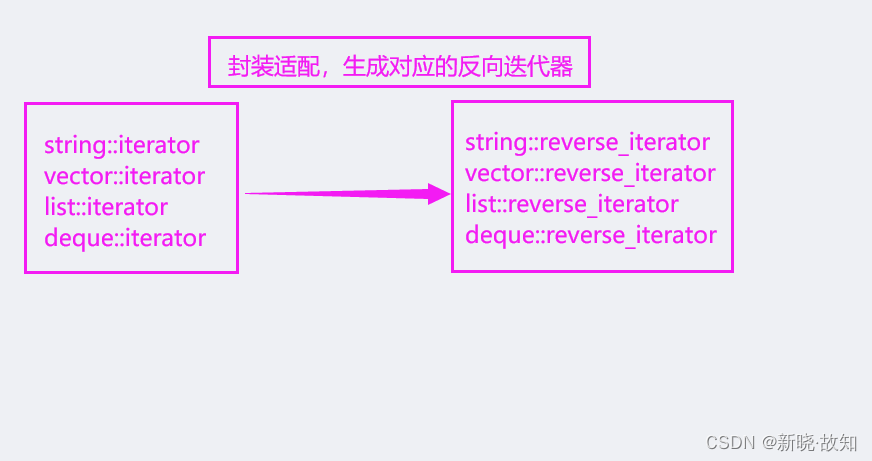
4.反向迭代器 :
与正向迭代器相比,除了++、--时方向相反,其他操作基本一致
扩展:迭代器萃取技术。
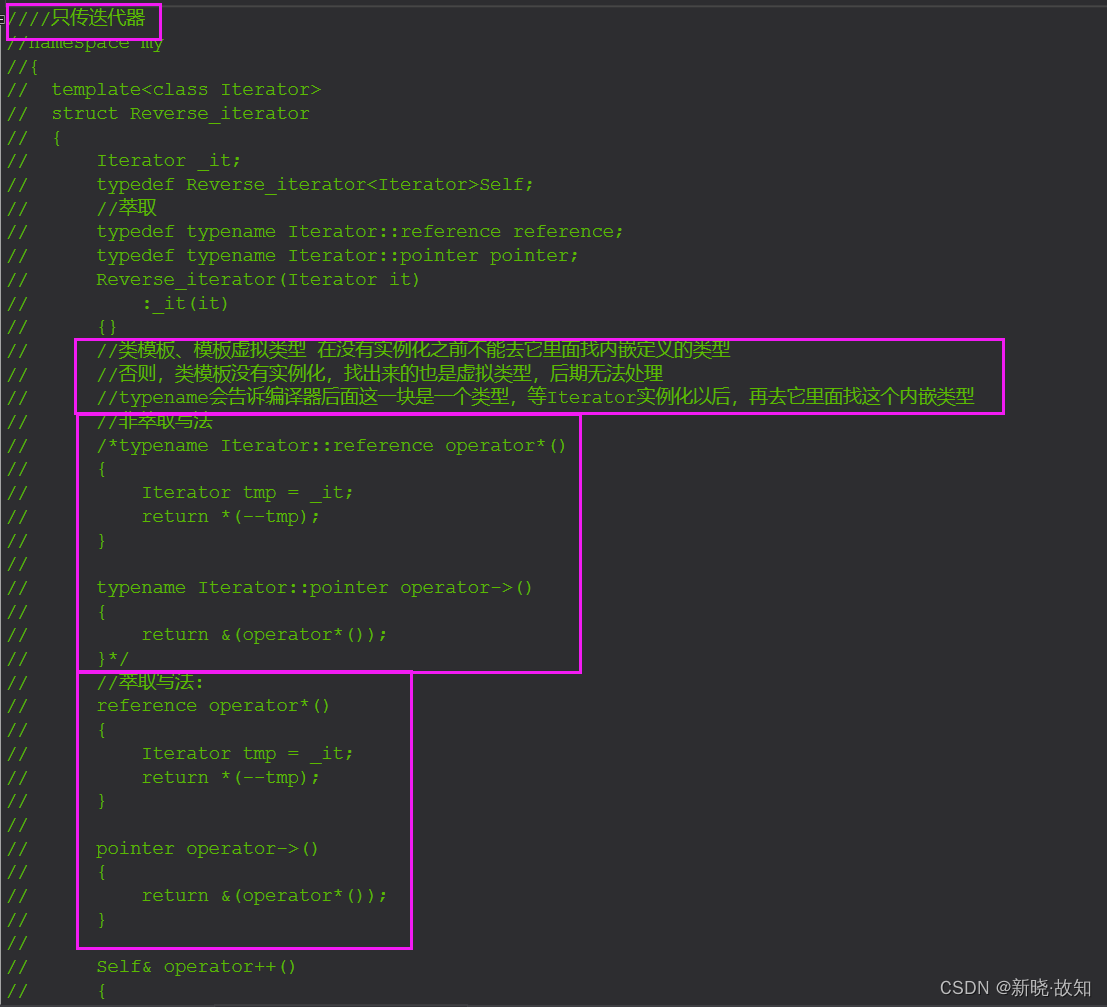
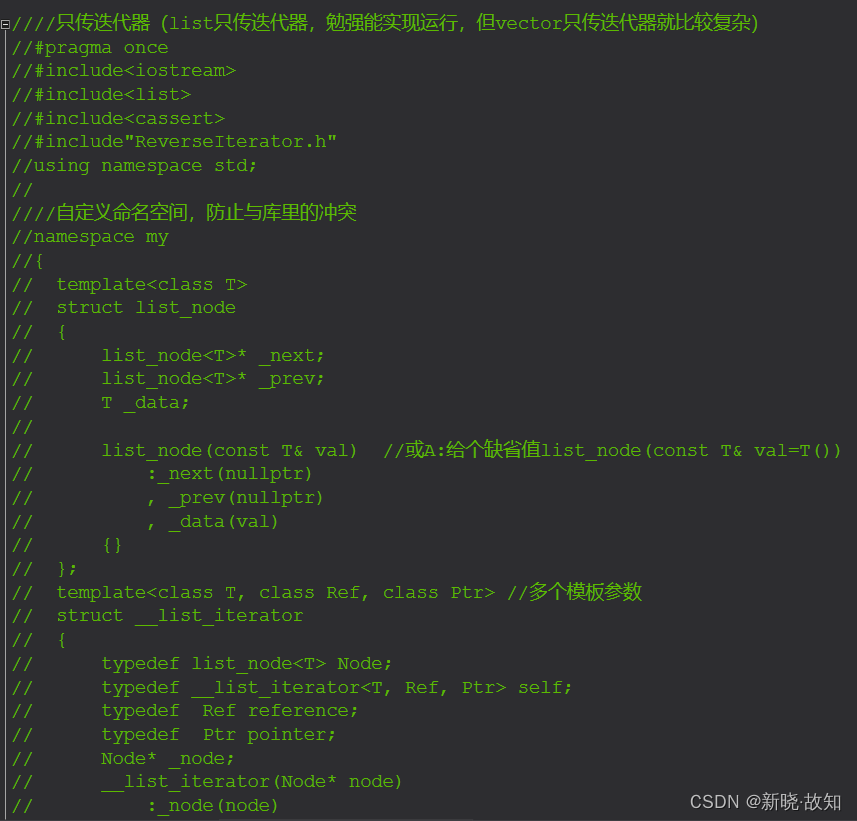
对于反向迭代器的模拟实现其实涉及到许多综合性实现,比如模板(只传模板参数、传多个参数),传不同参数实现用到的技术也不一样,而对于STL标准库里的实现则涉及到迭代器的萃取,这里只做简单学习了解,具体可参见STL源码。
以下则模拟实现了模板(只传模板参数、传多个参数)两个版本,但实际应用中,建议使用传多个参数。


4.1 ReverseIterator.h:
- #pragma once
- //显示传3个参数
- namespace my
- {
- template<class Iterator,class Ref,class Ptr>
- struct Reverse_iterator
- {
- Iterator _it;
- typedef Reverse_iterator
- Reverse_iterator(Iterator it)
- :_it(it)
- {}
- Ref operator*()
- {
- Iterator tmp = _it;
- return *(--tmp);
- }
- Ptr operator->()
- {
- return &(operator*());
- }
- Self& operator++()
- {
- --_it;
- return *this;
- }
- Self& operator--()
- {
- ++_it;
- return *this;
- }
- bool operator!=(const Self& s)
- {
- return _it != s._it;
- }
- };
- }
- 只传迭代器
- //namespace my
- //{
- // template
- // struct Reverse_iterator
- // {
- // Iterator _it;
- // typedef Reverse_iterator
Self; - // //萃取
- // typedef typename Iterator::reference reference;
- // typedef typename Iterator::pointer pointer;
- // Reverse_iterator(Iterator it)
- // :_it(it)
- // {}
- // //类模板、模板虚拟类型 在没有实例化之前不能去它里面找内嵌定义的类型
- // //否则,类模板没有实例化,找出来的也是虚拟类型,后期无法处理
- // //typename会告诉编译器后面这一块是一个类型,等Iterator实例化以后,再去它里面找这个内嵌类型
- // //非萃取写法
- // /*typename Iterator::reference operator*()
- // {
- // Iterator tmp = _it;
- // return *(--tmp);
- // }
- //
- // typename Iterator::pointer operator->()
- // {
- // return &(operator*());
- // }*/
- // //萃取写法:
- // reference operator*()
- // {
- // Iterator tmp = _it;
- // return *(--tmp);
- // }
- //
- // pointer operator->()
- // {
- // return &(operator*());
- // }
- //
- // Self& operator++()
- // {
- // --_it;
- // return *this;
- // }
- // Self& operator--()
- // {
- // ++_it;
- // return *this;
- // }
- // bool operator!=(const Self& s)
- // {
- // return _it != s._it;
- // }
- // };
- //}
4.2 list的反向迭代器:
- //反向迭代器传3个参数
- #pragma once
- #include
- #include
- #include
- #include"ReverseIterator.h"
- using namespace std;
- //自定义命名空间,防止与库里的冲突
- namespace my
- {
- template<class T>
- struct list_node
- {
- list_node
* _next; - list_node
* _prev; - T _data;
- list_node(const T& val) //或A:给个缺省值list_node(const T& val=T())
- :_next(nullptr)
- , _prev(nullptr)
- , _data(val)
- {}
- };
- template<class T, class Ref, class Ptr> //多个模板参数
- struct __list_iterator
- {
- typedef list_node
Node; - typedef __list_iterator
- Node* _node;
- __list_iterator(Node* node)
- :_node(node)
- {}
- Ref operator*()
- {
- return _node->_data;
- }
- self& operator++() //默认为前置++
- {
- _node = _node->_next;
- return *this;
- }
- self& operator++(int) //后置++
- {
- self tmp(*this);
- _node = _node->_next;
- return tmp;
- }
- self& operator--() //前置--
- {
- _node = _node->_prev;
- return *this;
- }
- self& operator--(int) //后置--
- {
- self tmp(*this);
- _node = _node->_prev;
- return tmp;
- }
- bool operator!=(const self& it)
- {
- return _node != it._node;
- }
- bool operator==(const self& it)
- {
- return _node == it._node;
- }
- //"->"重载
- Ptr operator->()
- {
- return &(operator*());//等价于return &_node->_data;
- }
- };
- template<class T>
- class list
- {
- typedef list_node
Node; - public:
- typedef __list_iterator
- typedef __list_iterator
- //反向迭代器适配支持
- typedef Reverse_iterator
- typedef Reverse_iterator
- reverse_iterator rbegin()
- {
- return reverse_iterator(end());
- }
- reverse_iterator rend()
- {
- return reverse_iterator(begin());
- }
- const_reverse_iterator rbegin() const
- {
- return const_reverse_iterator(end());
- }
- const_reverse_iterator rend() const
- {
- return const_reverse_iterator(begin());
- }
- //迭代器
- iterator begin()
- {
- return iterator(_head->_next);
- }
- iterator end()
- {
- return iterator(_head);
- }
- //const迭代器:多模板参数,附用普通迭代器
- const_iterator begin() const
- {
- return const_iterator(_head->_next);
- }
- const_iterator end() const
- {
- return const_iterator(_head);
- }
- //构造函数
- list()
- {
- _head = new Node(T()); //或A:_head = new Node(); A对应上面的A语句
- _head->_next = _head;
- _head->_prev = _head;
- }
- //析构函数
- ~list()
- {
- clear();
- delete _head;
- _head = nullptr;
- }
- //lt2(lt1)
- //构造函数传统写法
- //list(const list
& lt) - //{
- // _head = new Node(T()); //或A:_head = new Node(); A对应上面的A语句
- // _head->_next = _head;
- // _head->_prev = _head;
- // for (auto e : lt)
- // {
- // push_back(e);
- // }
- //}
- //初始化
- void empty_init()
- {
- _head = new Node(T()); //或A:_head = new Node(); A对应上面的A语句
- _head->_next = _head;
- _head->_prev = _head;
- }
- template <class InputIterator>
- list(InputIterator first, InputIterator last)
- {
- empty_init();
- while (first != last)
- {
- push_back(*first);
- ++first;
- }
- }
- //交换
- void swap(list
& lt) - {
- std::swap(_head, lt._head);
- }
- //构造函数——现代写法
- list(const list
& lt) - {
- empty_init();
- list
tmp(lt.begin(), lt.end()) ; - swap(tmp);
- }
- //赋值重载——现代写法
- list
& operator=(list lt) - {
- swap(lt);
- return *this;
- }
- void clear() //clear清理数据,结构还在
- {
- iterator it = begin();
- while (it != end())
- {
- it = erase(it);
- }
- }
- //尾插
- void push_back(const T& x)
- {
- /*Node* tail = _head->_prev;
- Node* newnode = new Node(x);
- tail->_next = newnode;
- newnode->_prev = tail;
- newnode->_next = _head;
- _head->_prev = newnode;*/
- //附用insert
- insert(end(), x);
- }
- //头插
- void push_front(const T& x)
- {
- insert(begin(), x);
- }
- //insert插入在pos位置之前
- iterator insert(iterator pos, const T& x)
- {
- Node* newNode = new Node(x);
- Node* cur = pos._node;
- Node* prev = cur->_prev;
- prev->_next = newNode;
- newNode->_prev = prev;
- newNode->_next = cur;
- cur->_prev = newNode;
- return iterator(newNode);
- }
- //尾删
- void pop_back()
- {
- erase(--end());
- }
- //头删
- void pop_front()
- {
- erase(begin());
- }
- //删除
- iterator erase(iterator pos)
- {
- assert(pos != end());
- Node* cur = pos._node;
- Node* prev = cur->_prev;
- Node* next = cur->_next;
- prev->_next = next;
- next->_prev = prev;
- delete cur;
- return iterator(next);
- }
- //总结:list::insert不存在迭代器失效问题
- //list::erase存在野指针导致的迭代器失效
- private:
- Node* _head;
- };
- }
- //反向迭代器
- //与正向迭代器相比,除了++、--时方向相反,其他操作基本一致
- 只传迭代器(list只传迭代器,勉强能实现运行,但vector只传迭代器就比较复杂)
- //#pragma once
- //#include
- //#include
- //#include
- //#include"ReverseIterator.h"
- //using namespace std;
- //
- 自定义命名空间,防止与库里的冲突
- //namespace my
- //{
- // template
- // struct list_node
- // {
- // list_node
* _next; - // list_node
* _prev; - // T _data;
- //
- // list_node(const T& val) //或A:给个缺省值list_node(const T& val=T())
- // :_next(nullptr)
- // , _prev(nullptr)
- // , _data(val)
- // {}
- // };
- // template
//多个模板参数 - // struct __list_iterator
- // {
- // typedef list_node
Node; - // typedef __list_iterator
- // typedef Ref reference;
- // typedef Ptr pointer;
- // Node* _node;
- // __list_iterator(Node* node)
- // :_node(node)
- // {}
- // Ref operator*()
- // {
- // return _node->_data;
- // }
- // self& operator++() //默认为前置++
- // {
- // _node = _node->_next;
- // return *this;
- // }
- // self& operator++(int) //后置++
- // {
- // self tmp(*this);
- // _node = _node->_next;
- // return tmp;
- // }
- // self& operator--() //前置--
- // {
- // _node = _node->_prev;
- // return *this;
- // }
- // self& operator--(int) //后置--
- // {
- // self tmp(*this);
- // _node = _node->_prev;
- // return tmp;
- // }
- // bool operator!=(const self& it)
- // {
- // return _node != it._node;
- // }
- // bool operator==(const self& it)
- // {
- // return _node == it._node;
- // }
- // //"->"重载
- // Ptr operator->()
- // {
- // return &(operator*());//等价于return &_node->_data;
- // }
- //
- // };
- //
- //
- // template
- // class list
- // {
- // typedef list_node
Node; - // public:
- // typedef __list_iterator
- // typedef __list_iterator
- //
- // //反向迭代器适配支持
- // typedef Reverse_iterator
reverse_iterator; - // typedef Reverse_iterator
const_reverse_iterator; - //
- // reverse_iterator rbegin()
- // {
- // return reverse_iterator(end());
- // }
- // reverse_iterator rend()
- // {
- // return reverse_iterator(begin());
- // }
- // const_reverse_iterator rbegin() const
- // {
- // return const_reverse_iterator(end());
- // }
- // const_reverse_iterator rend() const
- // {
- // return const_reverse_iterator(begin());
- // }
- //
- // //迭代器
- // iterator begin()
- // {
- // return iterator(_head->_next);
- // }
- // iterator end()
- // {
- // return iterator(_head);
- // }
- // //const迭代器:多模板参数,附用普通迭代器
- // const_iterator begin() const
- // {
- // return const_iterator(_head->_next);
- // }
- // const_iterator end() const
- // {
- // return const_iterator(_head);
- // }
- //
- // //构造函数
- // list()
- // {
- // _head = new Node(T()); //或A:_head = new Node(); A对应上面的A语句
- //
- // _head->_next = _head;
- // _head->_prev = _head;
- // }
- // //析构函数
- // ~list()
- // {
- // clear();
- // delete _head;
- // _head = nullptr;
- // }
- // //lt2(lt1)
- // //构造函数传统写法
- // //list(const list
& lt) - // //{
- // // _head = new Node(T()); //或A:_head = new Node(); A对应上面的A语句
- // // _head->_next = _head;
- // // _head->_prev = _head;
- // // for (auto e : lt)
- // // {
- // // push_back(e);
- // // }
- // //}
- // //初始化
- // void empty_init()
- // {
- // _head = new Node(T()); //或A:_head = new Node(); A对应上面的A语句
- // _head->_next = _head;
- // _head->_prev = _head;
- // }
- //
- // template
- // list(InputIterator first, InputIterator last)
- // {
- // empty_init();
- // while (first != last)
- // {
- // push_back(*first);
- // ++first;
- // }
- // }
- // //交换
- // void swap(list
& lt) - // {
- // std::swap(_head, lt._head);
- // }
- // //构造函数——现代写法
- // list(const list
& lt) - // {
- // empty_init();
- // list
tmp(lt.begin(), lt.end()); - // swap(tmp);
- // }
- // //赋值重载——现代写法
- // list
& operator=(list lt) - // {
- // swap(lt);
- // return *this;
- // }
- // void clear() //clear清理数据,结构还在
- // {
- // iterator it = begin();
- // while (it != end())
- // {
- // it = erase(it);
- // }
- // }
- // //尾插
- // void push_back(const T& x)
- // {
- // /*Node* tail = _head->_prev;
- // Node* newnode = new Node(x);
- //
- // tail->_next = newnode;
- // newnode->_prev = tail;
- // newnode->_next = _head;
- // _head->_prev = newnode;*/
- // //附用insert
- // insert(end(), x);
- // }
- // //头插
- // void push_front(const T& x)
- // {
- // insert(begin(), x);
- // }
- // //insert插入在pos位置之前
- // iterator insert(iterator pos, const T& x)
- // {
- // Node* newNode = new Node(x);
- // Node* cur = pos._node;
- // Node* prev = cur->_prev;
- // prev->_next = newNode;
- // newNode->_prev = prev;
- // newNode->_next = cur;
- // cur->_prev = newNode;
- // return iterator(newNode);
- // }
- // //尾删
- // void pop_back()
- // {
- // erase(--end());
- // }
- // //头删
- // void pop_front()
- // {
- // erase(begin());
- // }
- // //删除
- // iterator erase(iterator pos)
- // {
- // assert(pos != end());
- // Node* cur = pos._node;
- // Node* prev = cur->_prev;
- // Node* next = cur->_next;
- // prev->_next = next;
- // next->_prev = prev;
- // delete cur;
- // return iterator(next);
- // }
- // //总结:list::insert不存在迭代器失效问题
- // //list::erase存在野指针导致的迭代器失效
- // private:
- // Node* _head;
- // };
- //
- //}
- //
- //
- 反向迭代器
- 与正向迭代器相比,除了++、--时方向相反,其他操作基本一致
4.3 vector的反向迭代器:
- //反向迭代器传3个参数
- #pragma once
- //模拟实现vector
- #include
- #include
- #include
- #include
- #include"ReverseIterator.h"
- using namespace std;
- //自定义命名空间,防止与库里的冲突
- namespace my
- {
- template<class T>
- class vector
- {
- public:
- typedef T* iterator;
- typedef const T* const_iterator;
- //反向迭代器适配支持
- typedef Reverse_iterator
- typedef Reverse_iterator
- reverse_iterator rbegin()
- {
- return reverse_iterator(end());
- }
- reverse_iterator rend()
- {
- return reverse_iterator(begin());
- }
- const_reverse_iterator rbegin() const
- {
- return const_reverse_iterator(end());
- }
- const_reverse_iterator rend() const
- {
- return const_reverse_iterator(begin());
- }
- //构造函数
- vector()
- :_start(nullptr)
- , _finish(nullptr)
- , _endofstorage(nullptr)
- {}
- //使用n个val构造函数
- vector(size_t n, const T& val = T())
- :_start(nullptr)
- , _finish(nullptr)
- , _endofstorage(nullptr)
- {
- reserve(n);
- for (size_t i = 0; i < n; ++i)
- {
- push_back(val);
- }
- }
- vector(int n, const T& val = T())
- :_start(nullptr)
- , _finish(nullptr)
- , _endofstorage(nullptr)
- {
- reserve(n);
- for (size_t i = 0; i < n; ++i)
- {
- push_back(val);
- }
- }
- //类模板,类构造
- template<class InputIterator>
- vector(InputIterator first, InputIterator last)
- : _start(nullptr)
- , _finish(nullptr)
- , _endofstorage(nullptr)
- {
- while (first != last)
- {
- push_back(*first);
- ++first;
- }
- }
- void swap(vector
& v) - {
- std::swap(_start, v._start);
- std::swap(_finish, v._finish);
- std::swap(_endofstorage, v._endofstorage);
- }
- //拷贝构造函数(使用现代写法)
- vector(const vector
& v) - : _start(nullptr)
- , _finish(nullptr)
- , _endofstorage(nullptr)
- {
- vector
tmp(v.begin(), v.end()) ; - swap(tmp); //this->swap(tmp);
- }
- //赋值重载函数(现代写法)
- vector
& operator=(vector v) - {
- swap(v); //this->swap(v);
- return *this;
- }
- //析构函数(资源管理)
- ~vector()
- {
- if (_start)
- {
- delete[] _start;
- _start = _finish = _endofstorage = nullptr;
- }
- }
- iterator begin()
- {
- return _start;
- }
- iterator end()
- {
- return _finish;
- }
- const_iterator begin() const
- {
- return _start;
- }
- const_iterator end() const
- {
- return _finish;
- }
- size_t size() const
- {
- return _finish - _start;
- }
- size_t capacity() const
- {
- return _endofstorage - _start;
- }
- void reserve(size_t n)
- {
- size_t sz = size();
- if (n > capacity())
- {
- T* tmp = new T[n];
- if (_start)
- {
- //memcpy(tmp, _start, size() * sizeof(T)); //浅拷贝问题
- for (size_t i = 0; i < size(); ++i)
- {
- tmp[i] = _start[i];
- }
- delete[] _start;
- }
- _start = tmp;
- }
- _finish = _start + sz;
- _endofstorage = _start + n;
- }
- //总结:vector
中,当T涉及深拷贝的类型时,如:string、vector 等等, - //扩容使用memcpy拷贝数据会存在浅拷贝问题,造成析构两次
- //解决:使用传值拷贝,如上
- void push_back(const T& x)
- {
- /*if (_finish == _endofstorage)
- {
- size_t newCapacity = capacity() == 0 ? 4 : capacity() * 2;
- reserve(newCapacity);
- }
- *_finish = x;
- ++_finish;*/
- //附用insert
- insert(end(), x);
- }
- void pop_back()
- {
- /*if (_finish > _start)
- {
- --_finish;
- }*/
- //附用erase
- erase(end() - 1);
- }
- T& operator[](size_t pos)
- {
- assert(pos < size());
- return _start[pos];
- }
- const T& operator[](size_t pos) const
- {
- assert(pos < size());
- return _start[pos];
- }
- //写在类里的小函数,被当做内联函数处理,减少了多次调用建立栈帧
- //void resize(size_t n, const T& val = T())
- void resize(size_t n, T val = T()) //T()匿名对象,调用默认构造函数,若T()为int(内置类型),
- { //C++对于内置类型也可以认为有构造函数、析构函数,才能支持模板,只是int为0,double为0.1
- /*int i = 0;
- int j = int();
- int k = int(1);*/
- if (n > capacity())
- {
- reserve(n);
- }
- if (n > size())
- {
- while (_finish < _start + n)
- {
- *_finish = val;
- ++_finish;
- }
- }
- else
- {
- _finish = _start + n;
- }
- }
- iterator insert(iterator pos, const T& x) //返回值为iterator,解决迭代器失效问题
- {
- //如果pos传引用,但有些时候,传不过去
- //检查参数
- assert(pos >= _start && pos <= _finish);
- //扩容
- //扩容以后,pos就失效了,要更新
- //insert导致的迭代器失效,是因为pos没更新
- if (_finish == _endofstorage)
- {
- size_t n = pos - _start;
- size_t newCapacity = capacity() == 0 ? 4 : capacity() * 2;
- reserve(newCapacity);
- pos = _start + n;
- }
- //挪动数据
- iterator end = _finish - 1;
- while (end >= pos)
- {
- *(end + 1) = *end;
- --end;
- }
- *pos = x;
- ++_finish;
- return pos;
- }
- //总结:迭代器在insert里的两种失效:
- //1.pos失效 2.迭代器it失效
- iterator erase(iterator pos)
- {
- assert(pos >= _start && pos <= _finish);
- iterator it = pos + 1;
- while (it != _finish)
- {
- *(it - 1) = *it;
- ++it;
- }
- --_finish;
- return pos;
- }
- //总结:
- //1.erase的失效都是意义变了,过着不在有效访问数据有效范围
- //2.一般不会使用缩容的方案,那么erase的失效也不存在野指针的失效
- //在VS和Linux不同环境下,处理不同
- //erase(pos),使得pos失效,pos的意义改变,但是不同环境平台的处理不一样
- //在使用的时候,统一以失效的角度看待
- //整体总结:
- //对于insert和erase造成的迭代器失效问题,Linux环境下g++检查不严格,基本依靠操作系统自身野指针越界检查机制
- //Windows环境下,VS系列检查严格,使用一些强制检查机制,意义改变造成的失效,也可能会检查出来
- //vector迭代器的失效有两种:
- //1.扩容、缩容,导致形成野指针失效
- //2.迭代器指向的位置意义改变
- //这些通过操作系统的越界检查机制不一定能检查到
- //而通过编译器实现机制检查,相对靠谱
- void clear()
- {
- _finish = _start;
- }
- private:
- iterator _start;
- iterator _finish;
- iterator _endofstorage;
- };
- }
- 只传迭代器(vector只传迭代器,需要萃取或者将T*封装,这里未实现)
- //#pragma once
- 模拟实现vector
- //#include
- //#include
- //#include
- //#include
- //#include"ReverseIterator.h"
- //using namespace std;
- //
- 自定义命名空间,防止与库里的冲突
- //namespace my
- //{
- // template
- // class vector
- // {
- // public:
- // typedef T* iterator;
- // typedef const T* const_iterator;
- // //反向迭代器适配支持
- // typedef Reverse_iterator
- // typedef Reverse_iterator
- //
- // 只传迭代器需要支持萃取或者将T*封装
- // //typedef Reverse_iterator
reverse_iterator; - // //typedef Reverse_iterator
const_reverse_iterator; - //
- // reverse_iterator rbegin()
- // {
- // return reverse_iterator(end());
- // }
- // reverse_iterator rend()
- // {
- // return reverse_iterator(begin());
- // }
- // const_reverse_iterator rbegin() const
- // {
- // return const_reverse_iterator(end());
- // }
- // const_reverse_iterator rend() const
- // {
- // return const_reverse_iterator(begin());
- // }
- //
- // //构造函数
- // vector()
- // :_start(nullptr)
- // , _finish(nullptr)
- // , _endofstorage(nullptr)
- // {}
- // //使用n个val构造函数
- // vector(size_t n, const T& val = T())
- // :_start(nullptr)
- // , _finish(nullptr)
- // , _endofstorage(nullptr)
- // {
- // reserve(n);
- // for (size_t i = 0; i < n; ++i)
- // {
- // push_back(val);
- // }
- // }
- // vector(int n, const T& val = T())
- // :_start(nullptr)
- // , _finish(nullptr)
- // , _endofstorage(nullptr)
- // {
- // reserve(n);
- // for (size_t i = 0; i < n; ++i)
- // {
- // push_back(val);
- // }
- // }
- // //类模板,类构造
- // template
- // vector(InputIterator first, InputIterator last)
- // : _start(nullptr)
- // , _finish(nullptr)
- // , _endofstorage(nullptr)
- // {
- // while (first != last)
- // {
- // push_back(*first);
- // ++first;
- // }
- // }
- // void swap(vector
& v) - // {
- // std::swap(_start, v._start);
- // std::swap(_finish, v._finish);
- // std::swap(_endofstorage, v._endofstorage);
- //
- // }
- // //拷贝构造函数(使用现代写法)
- // vector(const vector
& v) - // : _start(nullptr)
- // , _finish(nullptr)
- // , _endofstorage(nullptr)
- // {
- // vector
tmp(v.begin(), v.end()); - // swap(tmp); //this->swap(tmp);
- // }
- // //赋值重载函数(现代写法)
- // vector
& operator=(vector v) - // {
- // swap(v); //this->swap(v);
- // return *this;
- // }
- // //析构函数(资源管理)
- // ~vector()
- // {
- // if (_start)
- // {
- // delete[] _start;
- // _start = _finish = _endofstorage = nullptr;
- // }
- // }
- //
- // iterator begin()
- // {
- // return _start;
- // }
- // iterator end()
- // {
- // return _finish;
- // }
- // const_iterator begin() const
- // {
- // return _start;
- // }
- // const_iterator end() const
- // {
- // return _finish;
- // }
- // size_t size() const
- // {
- // return _finish - _start;
- // }
- // size_t capacity() const
- // {
- // return _endofstorage - _start;
- // }
- // void reserve(size_t n)
- // {
- // size_t sz = size();
- // if (n > capacity())
- // {
- // T* tmp = new T[n];
- // if (_start)
- // {
- // //memcpy(tmp, _start, size() * sizeof(T)); //浅拷贝问题
- // for (size_t i = 0; i < size(); ++i)
- // {
- // tmp[i] = _start[i];
- // }
- // delete[] _start;
- // }
- // _start = tmp;
- // }
- // _finish = _start + sz;
- // _endofstorage = _start + n;
- // }
- // //总结:vector
中,当T涉及深拷贝的类型时,如:string、vector 等等, - // //扩容使用memcpy拷贝数据会存在浅拷贝问题,造成析构两次
- // //解决:使用传值拷贝,如上
- // void push_back(const T& x)
- // {
- // /*if (_finish == _endofstorage)
- // {
- // size_t newCapacity = capacity() == 0 ? 4 : capacity() * 2;
- // reserve(newCapacity);
- // }
- // *_finish = x;
- // ++_finish;*/
- //
- // //附用insert
- // insert(end(), x);
- // }
- // void pop_back()
- // {
- // /*if (_finish > _start)
- // {
- // --_finish;
- // }*/
- //
- // //附用erase
- // erase(end() - 1);
- // }
- // T& operator[](size_t pos)
- // {
- // assert(pos < size());
- // return _start[pos];
- // }
- // const T& operator[](size_t pos) const
- // {
- // assert(pos < size());
- // return _start[pos];
- // }
- // //写在类里的小函数,被当做内联函数处理,减少了多次调用建立栈帧
- // //void resize(size_t n, const T& val = T())
- // void resize(size_t n, T val = T()) //T()匿名对象,调用默认构造函数,若T()为int(内置类型),
- // { //C++对于内置类型也可以认为有构造函数、析构函数,才能支持模板,只是int为0,double为0.1
- // /*int i = 0;
- // int j = int();
- // int k = int(1);*/
- //
- // if (n > capacity())
- // {
- // reserve(n);
- // }
- // if (n > size())
- // {
- // while (_finish < _start + n)
- // {
- // *_finish = val;
- // ++_finish;
- // }
- // }
- // else
- // {
- // _finish = _start + n;
- // }
- // }
- // iterator insert(iterator pos, const T& x) //返回值为iterator,解决迭代器失效问题
- // {
- // //如果pos传引用,但有些时候,传不过去
- // //检查参数
- // assert(pos >= _start && pos <= _finish);
- // //扩容
- // //扩容以后,pos就失效了,要更新
- // //insert导致的迭代器失效,是因为pos没更新
- // if (_finish == _endofstorage)
- // {
- // size_t n = pos - _start;
- // size_t newCapacity = capacity() == 0 ? 4 : capacity() * 2;
- // reserve(newCapacity);
- // pos = _start + n;
- // }
- // //挪动数据
- // iterator end = _finish - 1;
- // while (end >= pos)
- // {
- // *(end + 1) = *end;
- // --end;
- // }
- // *pos = x;
- // ++_finish;
- // return pos;
- // }
- // //总结:迭代器在insert里的两种失效:
- // //1.pos失效 2.迭代器it失效
- //
- // iterator erase(iterator pos)
- // {
- // assert(pos >= _start && pos <= _finish);
- // iterator it = pos + 1;
- // while (it != _finish)
- // {
- // *(it - 1) = *it;
- // ++it;
- // }
- // --_finish;
- // return pos;
- // }
- // //总结:
- // //1.erase的失效都是意义变了,过着不在有效访问数据有效范围
- // //2.一般不会使用缩容的方案,那么erase的失效也不存在野指针的失效
- // //在VS和Linux不同环境下,处理不同
- // //erase(pos),使得pos失效,pos的意义改变,但是不同环境平台的处理不一样
- // //在使用的时候,统一以失效的角度看待
- //
- // //整体总结:
- // //对于insert和erase造成的迭代器失效问题,Linux环境下g++检查不严格,基本依靠操作系统自身野指针越界检查机制
- // //Windows环境下,VS系列检查严格,使用一些强制检查机制,意义改变造成的失效,也可能会检查出来
- //
- // //vector迭代器的失效有两种:
- // //1.扩容、缩容,导致形成野指针失效
- // //2.迭代器指向的位置意义改变
- // //这些通过操作系统的越界检查机制不一定能检查到
- // //而通过编译器实现机制检查,相对靠谱
- // void clear()
- // {
- // _finish = _start;
- // }
- //
- // private:
- // iterator _start;
- // iterator _finish;
- // iterator _endofstorage;
- //
- // };
- //}
4.4 test.cpp:
- #include"listplus.h"
- #include"vectorplus.h"
- #include
- void test_list_r_iterator()
- {
- my::list<int> lt;
- lt.push_back(10);
- lt.push_back(20);
- lt.push_back(30);
- lt.push_back(40);
- lt.push_back(50);
- for (auto e : lt)
- {
- cout << e << " ";
- }
- cout << endl;
- my::list<int>::reverse_iterator rit = lt.rbegin();
- while (rit != lt.rend())
- {
- cout << *rit << " ";
- ++rit;
- }
- cout << endl;
- }
- void test_vector_r_iterator()
- {
- my::vector<int> v;
- v.push_back(1);
- v.push_back(2);
- v.push_back(3);
- v.push_back(4);
- v.push_back(5);
- for (auto e : v)
- {
- cout << e << " ";
- }
- cout << endl;
- my::vector<int>::reverse_iterator rit = v.rbegin();
- while (rit != v.rend())
- {
- cout << *rit << " ";
- ++rit;
- }
- cout << endl;
- }
- template<class T>
- void print_list(const my::list
& lt) - {
- typename my::list
::const_iterator cit = lt.begin(); //auto cit = lt.begin(); //或直接使用auto - while (cit != lt.end())
- {
- cout << *cit << " ";
- ++cit;
- }
- cout << endl;
- }
- template<class Container>
- void print_Container(const Container& lt)
- {
- typename Container::const_iterator cit = lt.begin(); //auto cit = lt.begin(); //或直接使用auto
- while (cit != lt.end())
- {
- cout << *cit << " ";
- ++cit;
- }
- cout << endl;
- }
- int main()
- {
- //test_list_r_iterator();
- //test_vector_r_iterator();
- my::list<int> lt1;
- lt1.push_back(1);
- lt1.push_back(2);
- lt1.push_back(3);
- lt1.push_back(4);
- print_list(lt1);
- print_Container(lt1);
- my::list
lt2; - lt2.push_back("hello");
- lt2.push_back("world");
- print_list(lt2);
- print_Container(lt2);
- return 0;
- }
后记:
●由于作者水平有限,文章难免存在谬误之处,敬请读者斧正,俚语成篇,恳望指教!
——By 作者:新晓·故知
- 相关阅读:
TCP/IP 测试题(二)
单链表的方向翻转,为什么程序逻辑是这样的?
求1~100000之间所有的“水仙花数”,并输出
一个卡人机混合智能脖子的问题
【web-攻击用户】(9.1.2)XSS示例、攻击有效载荷、攻击的传送机制
OpenCV4.9.0开源计算机视觉库在 Linux 中安装
[附源码]JAVA毕业设计基于Ssm学生信息管理系统(系统+LW)
python系列教程214——列表解析与for和if
基于永磁同步发电机的风力发电系统连接到可控的三相整流器(Simulink)
Hadoop-- hdfs
- 原文地址:https://blog.csdn.net/m0_57859086/article/details/126226346
