-
Java多线程使用 CountDownLatch等待其他线程执行完成
Java多线程使用 CountDownLatch等待其他线程执行完成
CountDownLatch允许一个或者多个线程去等待其他线程完成操作。java.lang.Concurrent包下的可阻塞类CountDownLatch(倒数计数器),基于基类AQS(AbstractQueuedSynchronizer)标准队列同步器类。在同步状态state中保存的是当前的计数值。CountDownLatch接收一个int型参数,表示要等待的工作线程的个数。countDown()调用releaseShared(int arg),从而导致计数器值递减,并且计数器值为零时,解除所有等待线程的阻塞。await()调用acquireSharedInterruptibly(int arg),当计数器值为零时,acquire将立即返回,否则将阻塞。await():阻塞当前线程,将当前线程加入AQS的阻塞队列;
countDown():对计数器进行递减操作,当计数器递减至0时,当前线程会取唤醒阻塞队列中的所有线程。简单示例:
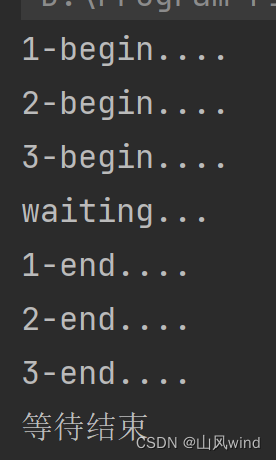
主线程等待其他线程执行完成之后执行业务:import java.util.concurrent.CountDownLatch; import java.util.concurrent.ExecutorService; import java.util.concurrent.Executors; import static java.lang.Thread.sleep; public class countdownLatchTest { public static void main(String[] args) { // 新建CountDownLatch CountDownLatch latch = new CountDownLatch(3); // 新建线程池 ExecutorService service = Executors.newFixedThreadPool(4); // 提交任务 service.submit(()->{ System.out.println("1-begin...."); try { sleep(1); // CountDownLatch - 1 latch.countDown(); } catch (InterruptedException e) { throw new RuntimeException(e); } System.out.println("1-end...."); }); service.submit(()->{ System.out.println("2-begin...."); try { sleep((long) 1.5); latch.countDown(); } catch (InterruptedException e) { throw new RuntimeException(e); } System.out.println("2-end...."); }); service.submit(()->{ System.out.println("3-begin...."); try { sleep(2); latch.countDown(); } catch (InterruptedException e) { throw new RuntimeException(e); } System.out.println("3-end...."); }); service.submit(()->{ System.out.println("waiting..."); try { latch.await(); } catch (InterruptedException e) { throw new RuntimeException(e); } System.out.println("等待结束"); }); service.shutdown(); } }- 1
- 2
- 3
- 4
- 5
- 6
- 7
- 8
- 9
- 10
- 11
- 12
- 13
- 14
- 15
- 16
- 17
- 18
- 19
- 20
- 21
- 22
- 23
- 24
- 25
- 26
- 27
- 28
- 29
- 30
- 31
- 32
- 33
- 34
- 35
- 36
- 37
- 38
- 39
- 40
- 41
- 42
- 43
- 44
- 45
- 46
- 47
- 48
- 49
- 50
- 51
- 52
- 53
- 54
- 55
- 56
- 57
- 58
- 59
写的比较粗糙,只是简单记录一下如何使用。 -
相关阅读:
【SLAM】IMU预积分的理解、手把手推导(2/4)
micropython 可视化音频 频谱解析(应该是全网首家)(预告,还没研究完成)
redis底层都有哪些数据结构?带你了解redis是如何存储数据的
实验2 SQL的多表查询
14-Kafka-Day03
『 Linux 』 进程间通信概述
ESP8285 RTOS SDK OTA
Springboot+Websocket+JWT实现的即时通讯模块
JavaScript【Text 节点、Node 节点属性(nodeName、nodeValue 、textContent、nextSibling、previousSibling)】(十二)
NVIDIA安装最新显卡驱动
- 原文地址:https://blog.csdn.net/qq_36944952/article/details/126196175

- 最新文章
-
沪漂五周年了:我越来越迷茫了
Agentic Skill Routing 实战:别再把所有 Skill 塞进 AI Agent 上下文
MySQL-Seconds_behind_master的精度误差
[MAF预定义ChatClient中间件-03]CachingChatClient——利用缓存省钱省时间
AI的至暗历史:从万众期待到被政府撤资,AI的两次死亡徘徊
Agent OS :五种驯服不确定性的范式
PortSwigger SQL注入LAB11
数据库即时编译JIT
[Begin]AI Learn Data Day 0
深度学习进阶(二十七)现代 LLM 的核心架构设计其二:SwiGLU