-
[Android][DevTips]DHCP流程与ARP相关简介
DHCP
DHCP(Dynamic Host Configuration Protocol,动态主机配置协议)通常被应用在大型的局域网络环境中,主要作用是集中地管理、分配IP地址,使网络环境中的主机动态的获得IP地址、Gateway地址、DNS服务器地址等信息,并能够提升地址的使用率。
在Android系统中,通常由dnsmasq进程负责这部分工作;
通常情况下,DHCP交互包含四次握手:

流程示意图如下:
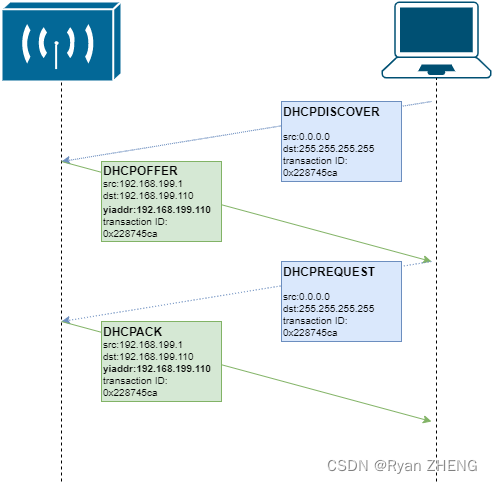
分步骤解释一下:在STA与AP已经建立连接的情况下,STA作为客户端,会首先发出一个DHCPDISCOVER的广播,寻求局域网内可以提供IP地址分配的服务器(此处即为DHCP服务器);
局域网内所有DHCP服务器(理论上同一局域网可以存在多个DHCP服务器)在收到DHCPDISCOVER后,选出自己认为可用的一个IP地址,以DHCPOFFER报文的形式发回给客户端;
客户端在收到DHCPOFFER报文后(若存在多个回执,则通常响应最早到达的一个),再次发出广播,向DHCP服务器确认IP地址(同时告知其他DHCP服务器中止其握手流程);
目标DHCP服务器确认后,回执DHCPACK,告知客户端可以使用该IP地址;
解答几个疑问:为什么需要四次握手,而不是两次即可?
因为局域网中可能存在多个DHCP服务器可以响应该报文;
为什么DHCPDISCOVER与DHCPREQUEST是以广播形式发送?
同上,为了尽可能从局域网内所有DHCP服务器中获取回执;
DHCP服务器如何选取“自己认为可用的IP地址”的?
以dnsmasq为例,是查表+ARP双重确认的(下面ARP章节会介绍)
DHCPREQUEST既然是广播,局域网内所有DHCP服务器是如何确认自己是不是目标客户端呢?
根据transaction ID确认;ARP
上面提到,dnsmasq会根据查表+ARP双重确认,以DHCPOFFER报文发出的IP地址是可用的;
查表比较简单,自己分配了哪些IP地址,肯定内部是有维护的;
那么为什么还要使用ARP来确认,ARP是什么,接下来简单介绍下:
地址解析协议,即ARP(Address Resolution Protocol),是根据IP地址获取物理地址的一个TCP/IP协议;
顾名思义,就是通过IP地址获取MAC地址的一个TCP/IP协议;
此处dnsmasq反向利用了这一特性:通过ARP,如果在局域网内获取不到MAC地址,那么就说明该IP地址没有任何人使用;
同样以上面那一次关联为例,过滤DHCP与ARP报文,结果如下:

结合dnsmasq代码可知,在确认发送DHCPOFFER报文时包含的IP地址之前,dnsmasq会花3s时间,尝试ping这个IP地址,而内核在ping该地址时,需要查找其具体MAC地址(详见__ipv4_neigh_lookup_noref()函数),从而发出了ARP报文;
int address_allocate(struct dhcp_context *context, struct in_addr *addrp, unsigned char *hwaddr, int hw_len, struct dhcp_netid *netids, time_t now) { /* Find a free address: exclude anything in use and anything allocated to a particular hwaddr/clientid/hostname in our configuration. Try to return from contexts which match netids first. */ struct in_addr start, addr; struct dhcp_context *c, *d; int i, pass; unsigned int j; /* hash hwaddr */ for (j = 0, i = 0; i < hw_len; i++) j += hwaddr[i] + (hwaddr[i] << 8) + (hwaddr[i] << 16); for (pass = 0; pass <= 1; pass++) for (c = context; c; c = c->current) if (c->flags & CONTEXT_STATIC) continue; else if (!match_netid(c->filter, netids, pass)) continue; else { /* pick a seed based on hwaddr then iterate until we find a free address. */ start.s_addr = addr.s_addr = htonl(ntohl(c->start.s_addr) + ((j + c->addr_epoch) % (1 + ntohl(c->end.s_addr) - ntohl(c->start.s_addr)))); do { /* eliminate addresses in use by the server. */ for (d = context; d; d = d->current) if (addr.s_addr == d->router.s_addr) break; /* Addresses which end in .255 and .0 are broken in Windows even when using supernetting. ie dhcp-range=192.168.0.1,192.168.1.254,255,255,254.0 then 192.168.0.255 is a valid IP address, but not for Windows as it's in the class C range. See KB281579. We therefore don't allocate these addresses to avoid hard-to-diagnose problems. Thanks Bill. */ if (!d && !lease_find_by_addr(addr) && !config_find_by_address(daemon->dhcp_conf, addr) && (!IN_CLASSC(ntohl(addr.s_addr)) || ((ntohl(addr.s_addr) & 0xff) != 0xff && ((ntohl(addr.s_addr) & 0xff) != 0x0)))) { struct ping_result *r, *victim = NULL; int count, max = (int)(0.6 * (((float)PING_CACHE_TIME)/ ((float)PING_WAIT))); *addrp = addr; if (daemon->options & OPT_NO_PING) return 1; /* check if we failed to ping addr sometime in the last PING_CACHE_TIME seconds. If so, assume the same situation still exists. This avoids problems when a stupid client bangs on us repeatedly. As a final check, if we did more than 60% of the possible ping checks in the last PING_CACHE_TIME, we are in high-load mode, so don't do any more. */ for (count = 0, r = daemon->ping_results; r; r = r->next) if (difftime(now, r->time) > (float)PING_CACHE_TIME) victim = r; /* old record */ else if (++count == max || r->addr.s_addr == addr.s_addr) return 1; if (icmp_ping(addr)) /* address in use: perturb address selection so that we are less likely to try this address again. */ c->addr_epoch++; else { /* at this point victim may hold an expired record */ if (!victim) { if ((victim = whine_malloc(sizeof(struct ping_result)))) { victim->next = daemon->ping_results; daemon->ping_results = victim; } } /* record that this address is OK for 30s without more ping checks */ if (victim) { victim->addr = addr; victim->time = now; } return 1; } } addr.s_addr = htonl(ntohl(addr.s_addr) + 1); if (addr.s_addr == htonl(ntohl(c->end.s_addr) + 1)) addr = c->start; } while (addr.s_addr != start.s_addr); } return 0; }- 1
- 2
- 3
- 4
- 5
- 6
- 7
- 8
- 9
- 10
- 11
- 12
- 13
- 14
- 15
- 16
- 17
- 18
- 19
- 20
- 21
- 22
- 23
- 24
- 25
- 26
- 27
- 28
- 29
- 30
- 31
- 32
- 33
- 34
- 35
- 36
- 37
- 38
- 39
- 40
- 41
- 42
- 43
- 44
- 45
- 46
- 47
- 48
- 49
- 50
- 51
- 52
- 53
- 54
- 55
- 56
- 57
- 58
- 59
- 60
- 61
- 62
- 63
- 64
- 65
- 66
- 67
- 68
- 69
- 70
- 71
- 72
- 73
- 74
- 75
- 76
- 77
- 78
- 79
- 80
- 81
- 82
- 83
- 84
- 85
- 86
- 87
- 88
- 89
- 90
- 91
- 92
- 93
- 94
- 95
- 96
- 97
- 98
- 99
- 100
- 101
- 102
- 103
- 104
由于在3s内没有任何人响应ARP报文,ping操作也超时,因此dnsmasq认为该IP在局域网内无人使用,从而可以将其发送给客户端;
-
相关阅读:
JAVA sql 查询3
AI - 决策树模型
java项目之共享充电宝管理系统(ssm框架)
【校招VIP】产品面试之职业规划
ES是什么?ES的使用场景有哪些?分词器??
蓝桥杯-班级活动
LM小型可编程控制器软件(基于CoDeSys)笔记三十:错误3728
循环结构 while dowhile for
ADC噪声全面分析 -03- 利用噪声分析进行实际设计
通过Web网管切换到命令行界面【华为路由器】
- 原文地址:https://blog.csdn.net/u014175785/article/details/125998388

- 最新文章
-
沪漂五周年了:我越来越迷茫了
Agentic Skill Routing 实战:别再把所有 Skill 塞进 AI Agent 上下文
MySQL-Seconds_behind_master的精度误差
[MAF预定义ChatClient中间件-03]CachingChatClient——利用缓存省钱省时间
AI的至暗历史:从万众期待到被政府撤资,AI的两次死亡徘徊
Agent OS :五种驯服不确定性的范式
PortSwigger SQL注入LAB11
数据库即时编译JIT
[Begin]AI Learn Data Day 0
深度学习进阶(二十七)现代 LLM 的核心架构设计其二:SwiGLU