-
Java设计模式之享元模式
目录
定义
运用共享技术来有效地支持大量细粒度对象的复用。它通过共享已经存在的对象来大幅度减少需要创建的对象数量、避免大量相似对象的开销,从而提高系统资源的利用率。
结构
享元模式中存在以下两种状态:
- 内部状态,即不会随着环境的改变而改变的可共享部分。
- 外部状态,指随环境改变而改变的不可以共享的部分。
享元模式的实现要领就是区分应用中的这两种状态,并将外部状态外部化。
享元模式的主要有以下角色:
- 抽象享元角色:通常是一个接口或抽象类,在抽象享元类中声明了具体享元类公共的方法,这些方法可以向外界提供享元对象的内部数据(内部状态),同时也可以通过这些方法来设置外部数据(外部状态)。
- 具体享元角色 :它实现了抽象享元类,称为享元对象;在具体享元类中为内部状态提供了存储空间。通常我们可以结合单例模式来设计具体享元类,为每一个具体享元类提供唯一的享元对象。
- 非享元角色 :并不是所有的抽象享元类的子类都需要被共享,不能被共享的子类可设计为非共享具体享元类;当需要一个非共享具体享元类的对象时可以直接通过实例化创建。
- 享元工厂角色 :负责创建和管理享元角色。当客户对象请求一个享元对象时,享元工厂检査系统中是否存在符合要求的享元对象,如果存在则提供给客户;如果不存在的话,则创建一个新的享元对象。
案例
俄罗斯方块中的方块不需要多次创建,使用享元模式可以省下极大内存空间
创建抽象享元角色
- public abstract class AbstractBox {
- //相当于内部状态为形状
- public abstract String getShape();
- //外部状态为颜色
- public void getColor(String color){
- System.out.println("形状为:"+getShape()+",颜色为:"+color);
- }
- }
创建具体享元角色
- public class IBox extends AbstractBox{
- @Override
- public String getShape() {
- return "I";
- }
- }
- public class LBox extends AbstractBox{
- @Override
- public String getShape() {
- return "L";
- }
- }
- public class OBox extends AbstractBox{
- @Override
- public String getShape() {
- return "O";
- }
- }
创建享元工厂
- public class BoxFactory {
- private static BoxFactory boxFactory = new BoxFactory();
- //工厂使用单例模式
- public static BoxFactory getInstance(){
- return boxFactory;
- }
- private Map
- public BoxFactory() {
- map = new HashMap<>();
- map.put("I",new IBox());
- map.put("L",new LBox());
- map.put("O",new OBox());
- }
- public AbstractBox getBox(String key){
- return map.get(key);
- }
- }
测试
- public class Client {
- public static void main(String[] args) {
- BoxFactory factory = BoxFactory.getInstance();
- AbstractBox IBox = factory.getBox("I");
- IBox.getColor("绿色");
- AbstractBox LBox = factory.getBox("L");
- LBox.getColor("白色");
- AbstractBox LBox2 = factory.getBox("L");
- LBox2.getColor("黑色");
- System.out.println(LBox==LBox2);
- }
- }
形状为:I,颜色为:绿色
形状为:L,颜色为:白色
形状为:L,颜色为:黑色
true
根据运行结果可以看出来外部状态(颜色)的改变不会影响共享。
优缺点
优点
- 极大减少内存中相似或相同对象数量,节约系统资源,提供系统性能
- 享元模式中的外部状态相对独立,且不影响内部状态
缺点:
为了使对象可以共享,需要将享元对象的部分状态外部化,分离内部状态和外部状态,使程序逻辑复杂
使用场景
- 一个系统有大量相同或者相似的对象,造成内存的大量耗费。
- 对象的大部分状态都可以外部化,可以将这些外部状态传入对象中。
- 在使用享元模式时需要维护一个存储享元对象的享元池,而这需要耗费一定的系统资源,因此,应当在需要多次重复使用享元对象时才值得使用享元模式。(案例中的Map作为容器)
JDK源码解析
Integer类中的ValueOf()方法就使用到了享元模式
- public class Demo {
- public static void main(String[] args) {
- Integer i1 = 127;
- Integer i2 = 127;
- System.out.println(i1 == i2);
- Integer i3 = 128;
- Integer i4 = 128;
- System.out.println(i3 == i4);
- }
- }
ture
false
由结果可以看到这里产生了两种不同的结果,对于int类型的引用变量,装箱为Integer类型的对象,使用的是ValueOf()方法,查看ValueOf源码
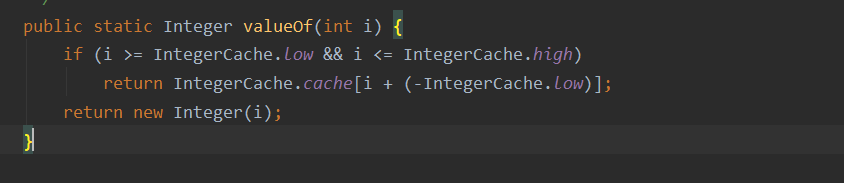
这里可以看到,对于传过来的参数有一个判断操作,点进去IntegerCache查看对应的low与high属性是什么
- private static class IntegerCache {
- static final int low = -128;
- static final int high;
- static final Integer cache[];
- static {
- // high value may be configured by property
- int h = 127;
- String integerCacheHighPropValue =
- sun.misc.VM.getSavedProperty("java.lang.Integer.IntegerCache.high");
- if (integerCacheHighPropValue != null) {
- try {
- int i = parseInt(integerCacheHighPropValue);
- i = Math.max(i, 127);
- // Maximum array size is Integer.MAX_VALUE
- h = Math.min(i, Integer.MAX_VALUE - (-low) -1);
- } catch( NumberFormatException nfe) {
- // If the property cannot be parsed into an int, ignore it.
- }
- }
- high = h;
- cache = new Integer[(high - low) + 1];
- int j = low;
- for(int k = 0; k < cache.length; k++)
- cache[k] = new Integer(j++);
- // range [-128, 127] must be interned (JLS7 5.1.7)
- assert IntegerCache.high >= 127;
- }
- private IntegerCache() {}
- }


这个静态类初始化low为-128以及定义一个high属性以及一个Integer类型的cache数组。
读取官方注释,我们可以猜测出,high属性的值可以在初始化JVM时进行更改。在静态代码块做的事情就是判断high的值是否有设置,如果没有更改就不进行if判断对h的值进行修改,如果修改了high属性值,则要进行判断是否将设置的值对h进行替换作为high属性。
对high进行完赋值后,初始化cache数组,数组长度为最大值与最小值的范围长度。然后通过for循环对范围内的所有值创建成Integer对象存放在数组中
在客户端使用时,先进行判断数组中是否存在了这个数的对象,如果存在直接返回即可,如果不存在则要进行创建Integer对象返回。
-
相关阅读:
Go简单入门
SQL--DDL数据定义语言(Oracle)
2021数学建模C题目– 生产企业原材料的订购与运输
Linux环境下离线安装jdk1.8(内置最新的jdk安装包x64)
神经网络需要的数学知识,神经网络的数学表达式
LeetCode力扣刷题——指针三剑客之三:图
RSIC-V指令及介绍(1)
springboot毕设项目摄影跟拍预定管理系统808t0(java+VUE+Mybatis+Maven+Mysql)
204、RabbitMQ 之 使用 topic 类型的 Exchange 实现通配符路由
Qt - UI进阶
- 原文地址:https://blog.csdn.net/zmbwcx/article/details/134020832

- 最新文章
-
沪漂五周年了:我越来越迷茫了
Agentic Skill Routing 实战:别再把所有 Skill 塞进 AI Agent 上下文
MySQL-Seconds_behind_master的精度误差
[MAF预定义ChatClient中间件-03]CachingChatClient——利用缓存省钱省时间
AI的至暗历史:从万众期待到被政府撤资,AI的两次死亡徘徊
Agent OS :五种驯服不确定性的范式
PortSwigger SQL注入LAB11
数据库即时编译JIT
[Begin]AI Learn Data Day 0
深度学习进阶(二十七)现代 LLM 的核心架构设计其二:SwiGLU