-
【深度学习实验】循环神经网络(四):基于 LSTM 的语言模型训练
目录
经验是智慧之父,记忆是智慧之母。
——谚语
一、实验介绍
本实验实现了基于 LSTM 的语言模型训练及测试
- 基于门控的循环神经网络(Gated RNN)
- 门控循环单元(GRU)
- 门控循环单元(GRU)具有比传统循环神经网络更少的门控单元,因此参数更少,计算效率更高。GRU通过重置门和更新门来控制信息的流动,从而改善了传统循环神经网络中的长期依赖问题。
- 长短期记忆网络(LSTM)
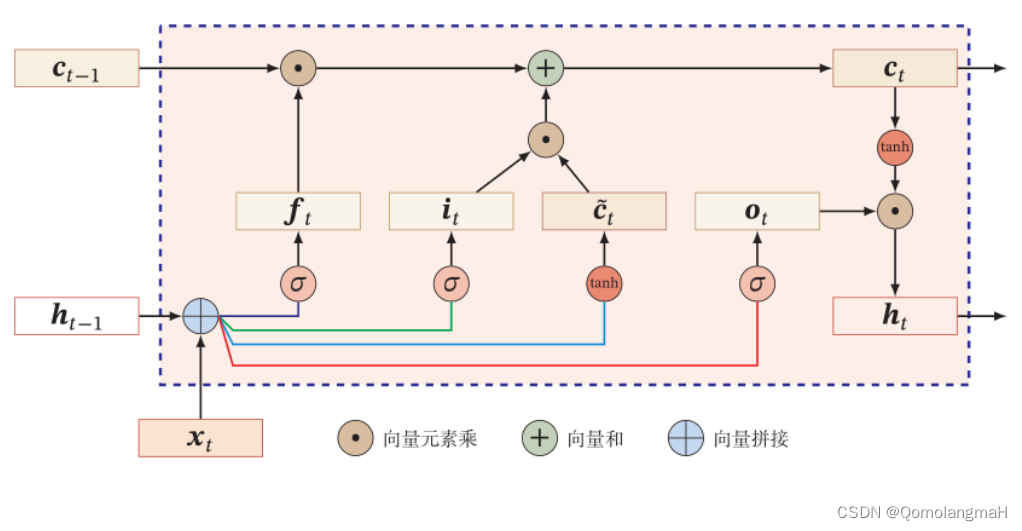
- 长短期记忆网络(LSTM)是另一种常用的门控循环神经网络结构。LSTM引入了记忆单元和输入门、输出门以及遗忘门等门控机制,通过这些门控机制可以选择性地记忆、遗忘和输出信息,有效地处理长期依赖和梯度问题。
- 门控循环单元(GRU)
- LSTM示意图
二、实验环境
本系列实验使用了PyTorch深度学习框架,相关操作如下:
1. 配置虚拟环境
conda create -n DL python=3.7conda activate DLpip install torch==1.8.1+cu102 torchvision==0.9.1+cu102 torchaudio==0.8.1 -f https://download.pytorch.org/whl/torch_stable.htmlconda install matplotlibconda install scikit-learn2. 库版本介绍
软件包 本实验版本 目前最新版 matplotlib 3.5.3 3.8.0 numpy 1.21.6 1.26.0 python 3.7.16 scikit-learn 0.22.1 1.3.0 torch 1.8.1+cu102 2.0.1 torchaudio 0.8.1 2.0.2 torchvision 0.9.1+cu102 0.15.2 三、实验内容
0. 导入必要的工具包
- import torch
- from torch import nn
- from d2l import torch as d2l
1. RNN与梯度裁剪
2. 自定义LSTM模型RNNModel
3. 训练函数
a. train_epoch
- def train_epoch(net, train_iter, loss, updater, device, use_random_iter):
- state, timer = None, d2l.Timer()
- metric = d2l.Accumulator(2) # 训练损失之和,词元数量
- for X, Y in train_iter:
- if state is None or use_random_iter:
- # 在第一次迭代或使用随机抽样时初始化state
- state = net.begin_state(batch_size=X.shape[0], device=device)
- if isinstance(net, nn.Module) and not isinstance(state, tuple):
- # state对于nn.GRU是个张量
- state.detach_()
- else:
- # state对于nn.LSTM或对于我们从零开始实现的模型是个张量
- for s in state:
- s.detach_()
- y = Y.T.reshape(-1)
- X, y = X.to(device), y.to(device)
- y_hat, state = net(X, state)
- l = loss(y_hat, y.long()).mean()
- if isinstance(updater, torch.optim.Optimizer):
- updater.zero_grad()
- l.backward()
- grad_clipping(net, 1)
- updater.step()
- else:
- l.backward()
- grad_clipping(net, 1)
- # 因为已经调用了mean函数
- updater(batch_size=1)
- metric.add(l * d2l.size(y), d2l.size(y))
- return math.exp(metric[0] / metric[1]), metric[1] / timer.stop()
-
参数:
net:神经网络模型train_iter:训练数据迭代器loss:损失函数updater:更新模型参数的方法(如优化器)device:计算设备(如CPU或GPU)use_random_iter:是否使用随机抽样
-
函数内部定义了一些辅助变量:
state:模型的隐藏状态变量timer:计时器,用于记录训练时间metric:累加器,用于计算训练损失之和和词元数量
-
函数通过迭代
train_iter中的数据进行训练。每次迭代中,执行以下步骤:- 如果是第一次迭代或者使用随机抽样,则初始化隐藏状态
state - 如果
net是nn.Module的实例并且state不是元组类型,则将state的梯度信息清零(detach_()函数用于断开与计算图的连接,并清除梯度信息) - 对于其他类型的模型(如
nn.LSTM或自定义模型),遍历state中的每个元素,将其梯度信息清零 - 将输入数据
X和标签Y转移到指定的计算设备上 - 使用神经网络模型
net和当前的隐藏状态state进行前向传播,得到预测值y_hat和更新后的隐藏状态state - 计算损失函数
loss对于预测值y_hat和标签y的损失,并取均值 - 如果
updater是torch.optim.Optimizer的实例,则执行优化器的相关操作(梯度清零、梯度裁剪、参数更新) - 否则,仅执行梯度裁剪和模型参数的更新(适用于自定义的更新方法)
- 将当前的损失值乘以当前批次样本的词元数量,累加到
metric中
- 如果是第一次迭代或者使用随机抽样,则初始化隐藏状态
-
训练完成后,函数返回以下结果:
- 对数似然损失的指数平均值(通过计算
math.exp(metric[0] / metric[1])得到) - 平均每秒处理的词元数量(通过计算
metric[1] / timer.stop()得到)
- 对数似然损失的指数平均值(通过计算
b. train
- def train(net, train_iter, vocab, lr, num_epochs, device, use_random_iter=False):
- loss = nn.CrossEntropyLoss()
- animator = d2l.Animator(xlabel='epoch', ylabel='perplexity',
- legend=['train'], xlim=[10, num_epochs])
- if isinstance(net, nn.Module):
- updater = torch.optim.SGD(net.parameters(), lr)
- else:
- updater = lambda batch_size: d2l.sgd(net.params, lr, batch_size)
- for epoch in range(num_epochs):
- ppl, speed = train_epoch(
- net, train_iter, loss, updater, device, use_random_iter)
- if (epoch + 1) % 10 == 0:
- animator.add(epoch + 1, [ppl])
- print('Train Done!')
- torch.save(net.state_dict(), 'chapter6.pth')
- print(f'困惑度 {ppl:.1f}, {speed:.1f} 词元/秒 {str(device)}')
- 参数
net(神经网络模型)train_iter(训练数据迭代器)vocab(词汇表)lr(学习率)num_epochs(训练的轮数)device(计算设备)use_random_iter(是否使用随机抽样)。
- 在函数内部,它使用交叉熵损失函数(
nn.CrossEntropyLoss())计算损失,创建了一个动画器(d2l.Animator)用于可视化训练过程中的困惑度(perplexity)指标。 - 根据
net的类型选择相应的更新器(updater)- 如果
net是nn.Module的实例,则使用torch.optim.SGD作为更新器; - 否则,使用自定义的更新器(
d2l.sgd)。
- 如果
- 通过迭代训练数据迭代器
train_iter来进行训练。在每个训练周期(epoch)中- 调用
train_epoch函数来执行训练,并得到每个周期的困惑度和处理速度。 - 每隔10个周期,将困惑度添加到动画器中进行可视化。
- 调用
- 训练完成后,打印出训练完成的提示信息,并将训练好的模型参数保存到文件中('chapter6.pth')。
- 打印出困惑度和处理速度的信息。
4. predict(文本预测)
定义了给定前缀序列,生成后续序列的predict函数。
- def predict(prefix, num_preds, net, vocab, device):
- state = net.begin_state(batch_size=1, device=device)
- outputs = [vocab[prefix[0]]]
- get_input = lambda: torch.reshape(torch.tensor(
- [outputs[-1]], device=device), (1, 1))
- for y in prefix[1:]: # 预热期
- _, state = net(get_input(), state)
- outputs.append(vocab[y])
- for _ in range(num_preds): # 预测num_preds步
- y, state = net(get_input(), state)
- outputs.append(int(y.argmax(dim=1).reshape(1)))
- return ''.join([vocab.idx_to_token[i] for i in outputs])
- 使用指定的
device和批大小为1调用net.begin_state(),初始化state变量。 - 使用
vocab[prefix[0]]将第一个标记在prefix中对应的索引添加到outputs列表中。 - 定义了一个
get_input函数,该函数返回最后一个输出标记经过reshape后的张量,作为神经网络的输入。 - 对于
prefix中除第一个标记外的每个标记,通过调用net(get_input(), state)进行前向传播。忽略输出的预测结果,并将对应的标记索引添加到outputs列表中。
5. GPU判断函数
- def try_gpu(i=0):
- """如果存在,则返回gpu(i),否则返回cpu()"""
- if torch.cuda.device_count() >= i + 1:
- return torch.device(f'cuda:{i}')
- return torch.device('cpu')
6. 训练与测试
- batch_size, num_steps = 32, 35
- train_iter, vocab = d2l.load_data_time_machine(batch_size, num_steps)
- vocab_size, num_hiddens, num_epochs, lr= 28, 256, 200, 1
- device = try_gpu()
- lstm_layer = nn.LSTM(vocab_size, num_hiddens)
- model_lstm = RNNModel(lstm_layer, vocab_size)
- train(model_lstm, train_iter, vocab, lr, num_epochs, device)
- print(predict('time ', 10, model_lstm, vocab, device))
-
训练中每个小批次(batch)的大小和每个序列的时间步数(time step)的值分别为32,25
-
加载的训练数据迭代器和词汇表

-
vocab_size是词汇表的大小,num_hiddens是 LSTM 隐藏层中的隐藏单元数量,num_epochs是训练的迭代次数,lr是学习率。 -
选择可用的 GPU 设备进行训练,如果没有可用的 GPU,则会使用 CPU。
-
训练模型

7. 代码整合
- # 导入必要的库
- import torch
- from torch import nn
- import torch.nn.functional as F
- from d2l import torch as d2l
- import math
- class RNNModel(nn.Module):
- def __init__(self, rnn_layer, vocab_size, **kwargs):
- super(RNNModel, self).__init__(**kwargs)
- self.rnn = rnn_layer
- self.vocab_size = vocab_size
- self.num_hiddens = self.rnn.hidden_size
- self.num_directions = 1
- self.linear = nn.Linear(self.num_hiddens, self.vocab_size)
- def forward(self, inputs, state):
- X = F.one_hot(inputs.T.long(), self.vocab_size)
- X = X.to(torch.float32)
- Y, state = self.rnn(X, state)
- # 全连接层首先将Y的形状改为(时间步数*批量大小,隐藏单元数)
- # 它的输出形状是(时间步数*批量大小,词表大小)。
- output = self.linear(Y.reshape((-1, Y.shape[-1])))
- return output, state
- # 在第一个时间步,需要初始化一个隐藏状态,由此函数实现
- def begin_state(self, device, batch_size=1):
- if not isinstance(self.rnn, nn.LSTM):
- # nn.GRU以张量作为隐状态
- return torch.zeros((self.num_directions * self.rnn.num_layers,
- batch_size, self.num_hiddens),
- device=device)
- else:
- # nn.LSTM以元组作为隐状态
- return (torch.zeros((
- self.num_directions * self.rnn.num_layers,
- batch_size, self.num_hiddens), device=device),
- torch.zeros((
- self.num_directions * self.rnn.num_layers,
- batch_size, self.num_hiddens), device=device))
- def train(net, train_iter, vocab, lr, num_epochs, device, use_random_iter=False):
- loss = nn.CrossEntropyLoss()
- animator = d2l.Animator(xlabel='epoch', ylabel='perplexity',
- legend=['train'], xlim=[10, num_epochs])
- if isinstance(net, nn.Module):
- updater = torch.optim.SGD(net.parameters(), lr)
- else:
- updater = lambda batch_size: d2l.sgd(net.params, lr, batch_size)
- for epoch in range(num_epochs):
- ppl, speed = train_epoch(
- net, train_iter, loss, updater, device, use_random_iter)
- if (epoch + 1) % 10 == 0:
- animator.add(epoch + 1, [ppl])
- print('Train Done!')
- torch.save(net.state_dict(), 'chapter6.pth')
- print(f'困惑度 {ppl:.1f}, {speed:.1f} 词元/秒 {str(device)}')
- # 在notebook中,若在训练后直接预测,会直接使用训练后的参数。
- # 若想保存模型参数,请解除注释下面的代码,在实例化新的模型进行预测时,请记得读入模型。
- # 读入模型的方法请参考前几章实现的Runner类。
- # torch.save(net.state_dict(), 'chapter6.pth')
- def train_epoch(net, train_iter, loss, updater, device, use_random_iter):
- state, timer = None, d2l.Timer()
- metric = d2l.Accumulator(2) # 训练损失之和,词元数量
- for X, Y in train_iter:
- if state is None or use_random_iter:
- # 在第一次迭代或使用随机抽样时初始化state
- state = net.begin_state(batch_size=X.shape[0], device=device)
- if isinstance(net, nn.Module) and not isinstance(state, tuple):
- # state对于nn.GRU是个张量
- state.detach_()
- else:
- # state对于nn.LSTM或对于我们从零开始实现的模型是个张量
- for s in state:
- s.detach_()
- y = Y.T.reshape(-1)
- X, y = X.to(device), y.to(device)
- y_hat, state = net(X, state)
- l = loss(y_hat, y.long()).mean()
- if isinstance(updater, torch.optim.Optimizer):
- updater.zero_grad()
- l.backward()
- grad_clipping(net, 1)
- updater.step()
- else:
- l.backward()
- grad_clipping(net, 1)
- # 因为已经调用了mean函数
- updater(batch_size=1)
- metric.add(l * d2l.size(y), d2l.size(y))
- return math.exp(metric[0] / metric[1]), metric[1] / timer.stop()
- def predict(prefix, num_preds, net, vocab, device):
- state = net.begin_state(batch_size=1, device=device)
- outputs = [vocab[prefix[0]]]
- get_input = lambda: torch.reshape(torch.tensor(
- [outputs[-1]], device=device), (1, 1))
- for y in prefix[1:]: # 预热期
- _, state = net(get_input(), state)
- outputs.append(vocab[y])
- for _ in range(num_preds): # 预测num_preds步
- y, state = net(get_input(), state)
- outputs.append(int(y.argmax(dim=1).reshape(1)))
- return ''.join([vocab.idx_to_token[i] for i in outputs])
- def grad_clipping(net, theta):
- if isinstance(net, nn.Module):
- params = [p for p in net.parameters() if p.requires_grad]
- else:
- params = net.params
- norm = torch.sqrt(sum(torch.sum((p.grad ** 2)) for p in params))
- if norm > theta:
- for param in params:
- param.grad[:] *= theta / norm
- def try_gpu(i=0):
- """如果存在,则返回gpu(i),否则返回cpu()"""
- # if torch.cuda.device_count() >= i + 1:
- # return torch.device(f'cuda:{i}')
- return torch.device('cpu')
- batch_size, num_steps = 32, 35
- train_iter, vocab = d2l.load_data_time_machine(batch_size, num_steps)
- vocab_size, num_hiddens, num_epochs, lr= 28, 256, 200, 1
- device = try_gpu()
- lstm_layer = nn.LSTM(vocab_size, num_hiddens)
- model_lstm = RNNModel(lstm_layer, vocab_size)
- train(model_lstm, train_iter, vocab, lr, num_epochs, device)
- print(predict('time ', 10, model_lstm, vocab, device))
- 基于门控的循环神经网络(Gated RNN)
-
相关阅读:
微信小程序 behaviors
Mybatis:Mybatis中特殊Sql执行(6)
导入sklearn报错:No module named ‘threadpoolctl‘
CNN,RNN,LSTM,GRU的前后向传播算法(梯度是怎么更新的)
【源码分析】XXL-JOB的执行器的注册流程
机器视觉技术的演进:YOLO系列与Halcon的深度对比
Revit插件“土建模块”的生成圈梁功能使用
HTML+CSS期末大作业 中国传统美食网站设计 节日美食13页 html5网页设计作业代码 html制作网页案例代码 html大作业网页代码...
level2行情接口十档行情快照如何去运用?
昇思MindSpore安装教程
- 原文地址:https://blog.csdn.net/m0_63834988/article/details/133869012
 https://blog.csdn.net/m0_63834988/article/details/133742433?spm=1001.2014.3001.5501