-
js继承的几种方式(原型链继承、构造函数继承、组合式继承、寄生组合式继承、ES6的Class类继承)
1.原型链继承
实现原理:子类的原型指向父类实例。子类在自身实例上找不到属性和方法时去它父类实例(父类实例和实例的原型对象)上查找,从而实现对父类属性和方法的继承
缺点:
- 子类创建时不能传参(即没有实现super()的功能);
- 父类实例的修改会影响子类所有实例
- function Parent(name){
- this.name = "父级的name";
- }
- Parent.prototype.getName = function(){
- console.log("getName:"+this.name);
- }
- function Child(){
- }
- // 子类原型指向父类的实例
- Child.prototype = new Parent();
- Child.prototype.constructor = Child;//这句话和原型链继承没有关系,只是根据原型链规则绑定constructor
- // 测试
- var child = new Child();
- console.log(child.name);//父级的name
- child.getName();//getName:父级的name
- // 缺点:不能传参;父类实例改变子类所有实例也改变
2.构造函数继承
实现原理:子类构造函数中执行父类的构造函数,并且为父类构造函数绑定子类的this,父类的构造函数把成员属性和方法都挂到子类的this上去,这样既能避免实例之间共享一个原型实例,又能向父类构造方法传参
缺点:无法继承父类原型上的属性和方法
- // 构造函数继承
- function Parent(name) {
- this.name = name;
- console.log("父类构造函数");
- }
- Parent.prototype.getName = function () {
- console.log("getName:" + this.name);
- }
- function Child(name){
- Parent.call(this, name);
- }
- var child = new Child("张三");
- console.log(child);//Child {name: '张三'}
- // 不能继承父类原型上的方法和属性
- child.getName();//报错,child.getName is not a function
3.组合式继承
实现原理:原型链继承+构造函数继承
缺点:父类构造函数会执行两次(Parent.call()和new Parent()),这不影响子类对父类的继承,但是每次创建子类实例时原型中都会有两份相同的属性和方法
- // 组合式继承:原型链继承+构造函数继承
- function Parent(name) {
- this.name = name;
- console.log("父类构造函数");
- }
- Parent.prototype.getName = function () {
- console.log("getName:" + name);
- }
- function Child(name) {
- Parent.call(this, this.name);
- }
- Child.prototype = new Parent();
- Child.prototype.constructor = Child;
- var child = new Child("张三");
- console.log(child);//Child {name: '张三'}
- child.getName();

4.寄生式组合继承
实现原理:父类构造函数会执行两次(Parent.call()和new Parent()),那么在原型链继承时就只继承父类的原型,就不会执行两次父类构造函数 Child.prototype = Parent.prototype;
缺点:操作子类原型对象,会影响到父类原型对象,例如给Child.prototype增加一个getName()方法,那么会导致Parent.prototype也增加或被覆盖一个getName()方法
- // 寄生式组合继承:原型链继承(只继承父类原型)+构造函数继承
- function Parent(name) {
- this.name = name;
- }
- Parent.prototype.getName = function () {
- console.log("getName:" + this.name);
- }
- function Child(name) {
- Parent.call(this, name);
- }
- Child.prototype = Parent.prototype;
- Child.prototype.constructor = Child;
- var child = new Child("张三");
- console.log(child);//Child {name: '张三'}
- child.getName();
4.1解决寄生式组合继承的缺点(使用Object.create()进行继承)
如下,对Child.prototype.getName子类中原型上属性或方法进行修改时,父类也被修改
- function Parent(name) {
- this.name = name;
- console.log("父类构造函数");
- }
- Parent.prototype.getName = function () {
- console.log("父类getName");
- }
- function Child(name) {
- Parent.call(this, name);
- }
- Child.prototype = Parent.prototype;
- Child.prototype.constructor = Child;
- Child.prototype.getName = function(){
- console.log("子类getName");
- }
- var child = new Child("张三");
- console.log(child);//Child {name: '张三'}
- child.getName();
- var parent = new Parent("李四");
- parent.getName();
解决:加上Object.create()方法即可
- // Child.prototype = Parent.prototype;
- Child.prototype = Object.create(Parent.prototype);

5.ES6的Class继承
实现原理:ES6新增,是ES5中构造函数+原型链继承组合继承,寄生组合式继承的结合
缺点:兼容性不好
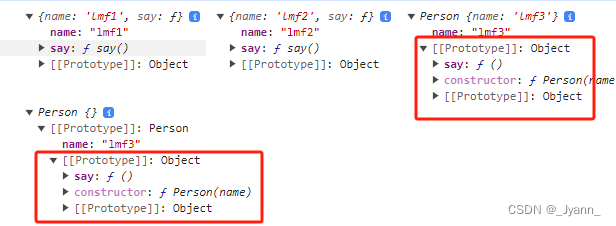
6.扩展——对象的几种创建方式
- 字面量创建
- var obj = new Object()创建
- 构造函数创建
- Object.create()创建
- // 字面量创建
- let obj1 = {
- name: 'lmf1',
- say() {
- console.log("lmf1 say");
- }
- }
- // new Object()创建
- let obj2 = new Object({
- name: 'lmf2',
- say() {
- console.log("lmf2 say");
- }
- });
- // 构造函数创建
- function Person(name) {
- this.name = name;
- }
- let obj3 = new Person("lmf3");
- Person.say = function () {
- console.log("静态方法");
- }
- Person.prototype.say = function () {
- console.log("lmf3 say");
- }
- // Object.create()创建
- let obj4 = Object.create(obj3);
- console.log(obj1, obj2, obj3, obj4);
-
相关阅读:
基于kafka项目之Keepalived高可用详细介绍
ZigBee案例笔记 -- IAR for 8051工程创建
Java面试之数据库面试题
【机器学习6】概率图模型
金九银十跳槽季进大厂靠微服务架构实战就够l
安装与使用ChatTTS文本转语音模型
十一届财经峰会,群硕凭借掌汇云荣获数字化先锋产品奖
LuBase 低代码开发框架介绍 - 可私有化部署
CAN通信----基本原理
小程序拼团业务,并发支付导致重复给用户返利bug
- 原文地址:https://blog.csdn.net/qq_34569497/article/details/133855447

- 最新文章
-
沪漂五周年了:我越来越迷茫了
Agentic Skill Routing 实战:别再把所有 Skill 塞进 AI Agent 上下文
MySQL-Seconds_behind_master的精度误差
[MAF预定义ChatClient中间件-03]CachingChatClient——利用缓存省钱省时间
AI的至暗历史:从万众期待到被政府撤资,AI的两次死亡徘徊
Agent OS :五种驯服不确定性的范式
PortSwigger SQL注入LAB11
数据库即时编译JIT
[Begin]AI Learn Data Day 0
深度学习进阶(二十七)现代 LLM 的核心架构设计其二:SwiGLU