-
【STL】用一棵红黑树封装map和set
⭐博客主页:️CS semi主页
⭐欢迎关注:点赞收藏+留言
⭐系列专栏:C++进阶
⭐代码仓库:C++进阶
家人们更新不易,你们的点赞和关注对我而言十分重要,友友们麻烦多多点赞+关注,你们的支持是我创作最大的动力,欢迎友友们私信提问,家人们不要忘记点赞收藏+关注哦!!!
一、红黑树原码
二、红黑树模板参数控制
set是Key模型的容器,map是key-value模型的容器,而我们是需要用一种模板来进行实现set和map,所以,我们使用了key-value模型来进行模拟实现set和map,我们将第二个模版参数改成class T,这样能够以示区分原来的红黑树的模版。

这个T既可能是K值,也可能是key与value共同构成的键值对,我们看一下set容器的实现形式:

我们再来写一下map的实现形式:

三、红黑树结点当中存储的数据
那我们红黑树中的结点也是需要进行一下更改的,我们看下图,MySet中第二个模板参数传到RBTree中是传的是Key,而MyMap中第二个模板参数传到RBTree中的是pair
set:K和T都代表着Key。
map:K代表键值Key,T代表键值对pair所以我们只需要使用第二个模板参数T就可以实现红黑树结点根据不同的容器进行模板实例化,但有同学要问了,为什么我们不能直接在set和map中只使用一个模版参数T呢?而偏偏要使用两个模板参数K和T?
似乎是没什么问题的,对set来讲有没有这个第一个参数K都不影响的,而对于大部分的map情况中也是没有什么影响的,而具有最重大影响的是map的find和erase这两个接口函数,这两个接口函数是需要用到第一个参数K的,所以为了保持所有的接口都能用,只能委屈一下set,让set多一个模板参数K。
//红黑树结点的定义 template<class T> struct RBTreeNode { //构造函数 RBTreeNode(const T& data) :_left(nullptr) , _right(nullptr) , _parent(nullptr) , _data(data) , _col(RED) {} //三叉链 RBTreeNode<T>* _left; RBTreeNode<T>* _right; RBTreeNode<T>* _parent; //存储的数据 T _data; //结点的颜色 int _col; //红/黑 };- 1
- 2
- 3
- 4
- 5
- 6
- 7
- 8
- 9
- 10
- 11
- 12
- 13
- 14
- 15
- 16
- 17
- 18
- 19
- 20
- 21
- 22
- 23
- 24
- 25
四、红黑树结点中仿函数
一个很简单的现象,参数T:set的上层是K,直接能进行比较,而map上层是pair
仿函数:我们之前写过这种类似的仿函数模型,其实就是要实现一个operator()的功能,这个类就有了类似函数的行为,就是一个仿函数类了。
Map:

我们Map写了以后,我们思考一下Set写不写?
看似似乎并不用写这个Set,因为我们的Key能直接拿到,但是这只是我们人的视角下是肯定可以的,但是编译器能那么聪明吗?我们了解到,编译器是没有办法进行判断我们传过来的是Map还是Set,所以我们需要委屈一下Set,把Set的仿函数也书写一下:
小故事:今天女朋友说要去逛街买包,你敢不去吗?也就是Set是一个陪逛街的身份,但它必须陪着Map逛街。


这样我们根据上面的逻辑图看实例化,是在RBTree中加入一个仿函数,将Set和Map的仿函数比较过程进行传参并实例化,那我们下面用一个Find子函数进行解析一下:
// 红黑树的查找 Node* Find(const K& key) { KeyOfT kot; Node* cur = _root; while (cur) { // 当前结点的值大于寻找的结点的值 if (key < kot(cur->_data)) { cur = cur->_left; } else if (key > kot(cur->_data)) { cur = cur->_right; } else { // 找到了 return cur; } } return nullptr; }- 1
- 2
- 3
- 4
- 5
- 6
- 7
- 8
- 9
- 10
- 11
- 12
- 13
- 14
- 15
- 16
- 17
- 18
- 19
- 20
- 21
- 22
- 23
- 24

五、正向迭代器
红黑树的正向迭代器实际上就是对结点指针进行了封装,因此在正向迭代器当中实际上就只有一个成员变量,那就是正向迭代器所封装结点的指针。
// 正向迭代器 template<class T, class Ref, class Ptr> struct __TreeIterator { typedef RBTreeNode<T> Node; //结点类型 typedef __TreeIterator<T, Ref, Ptr> Self; //正向迭代器类型 Node* _node; };- 1
- 2
- 3
- 4
- 5
- 6
- 7
- 8
- 9
我们在之前写过有关T,Ref和Ptr,所以我们先介绍一下,T就是我们的模版参数,Ref是解引用操作,Ptr是指针操作。
1、框架+构造函数
// 正向迭代器 template<class T, class Ref, class Ptr> struct __TreeIterator { typedef RBTreeNode<T> Node; //结点类型 typedef __TreeIterator<T, Ref, Ptr> Self; //正向迭代器类型 // 构造函数 __TreeIterator(Node* node) :_node(node) {} Node* _node; }- 1
- 2
- 3
- 4
- 5
- 6
- 7
- 8
- 9
- 10
- 11
- 12
解释一下:T是第一个模版参数,定义类型的,Ref是解引用操作的模版参数,Ptr是指针指向的模版参数。
2、Ref
要对于一个结点解引用的操作,我们直接返回这个结点的值即可。
// 正向迭代器解引用操作 Ref operator*() { return _node->_data; }- 1
- 2
- 3
- 4
- 5
3、Ptr
要对于一个结点进行->的操作的时候,我们直接返回这个结点数据的指针即可。
// 正向迭代器指向操作 Ptr operator->() { return &_node->_data; }- 1
- 2
- 3
- 4
- 5
4、重载operator==和operator!=
直接使用Self类型进行判断这两个迭代器是否相同。
// 判断两个正向迭代器是否不同 bool operator!=(const Self& s) const { return _node != s._node; } // 判断两个正向迭代器是否相同 bool operator==(const Self& s) const { return _node == s._node; }- 1
- 2
- 3
- 4
- 5
- 6
- 7
- 8
- 9
- 10
- 11
5、operator++ 【重点讲解】
我们要实现这个operator++,我们首先需要了解这个红黑树的遍历打印是中序遍历打印,也就是先左子树,再根,再右子树,所以我们如下两种情况:
(1)情况1:当前结点的右子树有结点
找该节点的右子树的最左节点。

(2)情况2:当前结点的右子树为空
++操作后在该结点的祖先结点中,找到孩子不在父亲右的祖先。

(3)代码
// 正向迭代器++操作 Self operator++() { // 结点的右子树不为空,找右子树的最左结点 if (_node->_right != nullptr) { Node* R_left = _node->_right; while (R_left->_left != nullptr) { R_left = R_left->_left; } _node = R_left; } // 结点的右子树为空,找祖先结点不为右的结点 else { Node* cur = _node; Node* parent = cur->_parent; while (parent&& cur == parent->_right) { cur = parent; parent = parent->_parent; } _node = parent; } return *this; }- 1
- 2
- 3
- 4
- 5
- 6
- 7
- 8
- 9
- 10
- 11
- 12
- 13
- 14
- 15
- 16
- 17
- 18
- 19
- 20
- 21
- 22
- 23
- 24
- 25
- 26
- 27
6、operator–
即遍历当前结点的前一个结点,与++正好相反。
1、如果当前结点的左子树不为空,则–操作后应该找到其左子树当中的最右结点。
2、如果当前结点的左子树为空,则–操作后应该在该结点的祖先结点中,找到孩子不在父亲左的祖先。(1)情况1:当前节点的左子树有节点
–是找左子树的最右结点。

(2)情况2:当前结点的左子树没结点
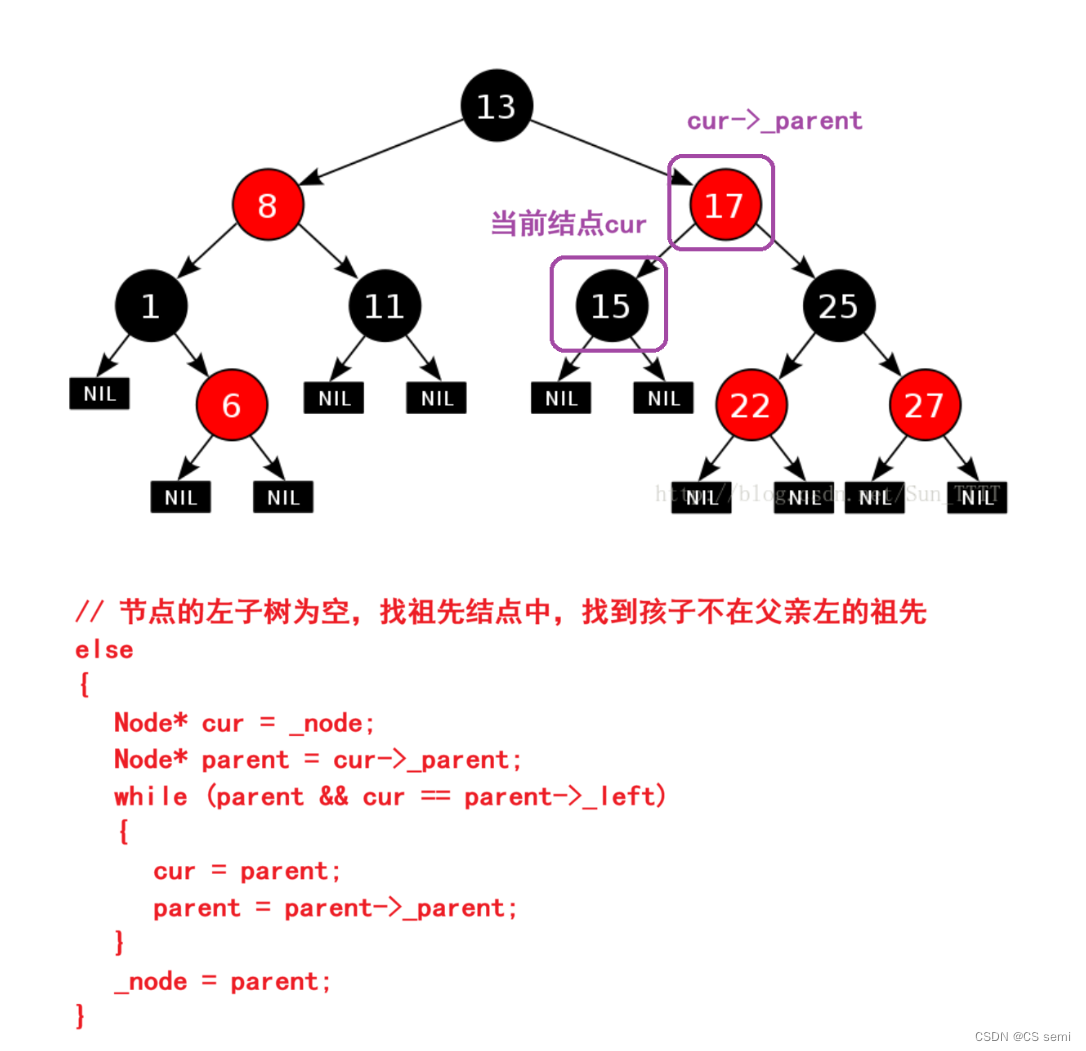
(3)代码
// 正向迭代器--操作 Self operator--() { // 结点的左子树不为空,找左子树中的最右节点 if (_node->_left != nullptr) { Node* L_right = _node->_left; while (L_right->_right != nullptr) { L_right = L_right->_right; } _node = L_right; } // 节点的左子树为空,找祖先结点中,找到孩子不在父亲左的祖先 else { Node* cur = _node; Node* parent = cur->_parent; while (parent && cur == parent->_left) { cur = parent; parent = parent->_parent; } _node = parent; } return *this; }- 1
- 2
- 3
- 4
- 5
- 6
- 7
- 8
- 9
- 10
- 11
- 12
- 13
- 14
- 15
- 16
- 17
- 18
- 19
- 20
- 21
- 22
- 23
- 24
- 25
- 26
- 27
- 28
7、正向迭代器在RBTree中的实现
正向迭代器分为begin()和end(),所以我们分析一下begin()和end():
我们要将iterator放到public当中,让外部可以拿到。
(1)begin()
begin()就是我们前面所提的红黑树的第一个位置,而第一个位置则是整颗红黑树,begin函数返回中序序列当中第一个结点的正向迭代器,即最左结点。
typedef __TreeIterator<T, T&, T*> iterator; // 最左节点 iterator begin() { Node* left = _root; while (left && left->_left != nullptr) { left = left->_left; } // 返回最左结点的迭代器 return iterator(left); }- 1
- 2
- 3
- 4
- 5
- 6
- 7
- 8
- 9
- 10
- 11
- 12
(2)end()
end()就是我们前面所提到的红黑树的最末尾的位置的下一个位置,那么就是nullptr!
typedef __TreeIterator<T, T*, T&> iterator; // end()是整个树的最末尾结点的后一个位置 iterator end() { return iterator(nullptr); }- 1
- 2
- 3
- 4
- 5
- 6
(3)代码
template<class K, class T, class KeyOfT> class RBTree { typedef RBTreeNode<T> Node; public: typedef __TreeIterator<T, T*, T&> iterator; // 最左节点 iterator begin() { Node* left = _root; while (left && left->_left != nullptr) { left = left->_left; } // 返回最左结点的迭代器 return iterator(left); } // end()是整个树的最末尾结点的后一个位置 iterator end() { return iterator(nullptr); } private: Node* _root; };- 1
- 2
- 3
- 4
- 5
- 6
- 7
- 8
- 9
- 10
- 11
- 12
- 13
- 14
- 15
- 16
- 17
- 18
- 19
- 20
- 21
- 22
- 23
- 24
- 25
- 26
- 27
- 28
8、缺陷和改进
我们大家不知道发现了没有,上述所写的end()是指向的最后一个结点的下一个位置,即nullptr,但我们的C++SGI版本中不是这样写的,其end()是指向最后一个元素的,所以我们来看一下SGI版本下的end()封装是怎么封装的:

我们看,在这个版本中,多了个header结点刚刚好是13根节点的父节点,这个header结点的左边指向这棵红黑树的最左节点象征着begin(),这个header结点的右边指向这棵红黑树的最右结点象征着rbegin()。实现end()和rend()时,直接用头结点构造出正向和反向迭代器即可。此后,通过对逻辑的控制,就可以实现end()进行–操作后得到最后一个结点的正向迭代器。
六、反向迭代器
1、反向迭代器的实现
反向迭代器我们根本都不需要一步一步写下来了,我们只需要用正向迭代器进行封装反向迭代器即可,如下代码:

//反向迭代器 -- 根据正向迭代器封装 template<class Iterator> struct ReverseIterator { typedef ReverseIterator<Iterator> Self; //反向迭代器的类型 // 这里为了能够让反向迭代器能够拿到正向迭代器的解引用和指针 typedef typename Iterator::reference Ref; //结点指针的解引用* typedef typename Iterator::pointer Ptr; //结点指针-> //构造函数 ReverseIterator(Iterator rit) :_rit(rit) {} // 和正向迭代器一样 Ref operator*() { return *_rit; } // 和正向迭代器一样 Ptr operator->() { return _rit.operator->(); } // ++操作就是正向迭代器的--操作 Self& operator++() { --_rit; return *this; } // --操作就是正向迭代器的++操作 Self& operator--() { ++_rit; return *this; } // 不等号一样 bool operator!=(const Self& s) const { return _rit != s._rit; } // 等号也一样 bool operator==(const Self& s) const { return _rit == s._rit; } Iterator _rit; };- 1
- 2
- 3
- 4
- 5
- 6
- 7
- 8
- 9
- 10
- 11
- 12
- 13
- 14
- 15
- 16
- 17
- 18
- 19
- 20
- 21
- 22
- 23
- 24
- 25
- 26
- 27
- 28
- 29
- 30
- 31
- 32
- 33
- 34
- 35
- 36
- 37
- 38
- 39
- 40
- 41
- 42
- 43
- 44
- 45
- 46
- 47
- 48
- 49
- 50
- 51
- 52
- 53
- 54
- 55
2、RBTree中使用反向迭代器
template<class K, class T, class KeyOfT> class RBTree { typedef RBTreeNode<T> Node; public: typedef __TreeIterator<T, T*, T&> iterator; typedef ReverseIterator<iterator> reverse_iterator; // 最左节点 iterator begin() { Node* left = _root; while (left && left->_left != nullptr) { left = left->_left; } // 返回最左结点的迭代器 return iterator(left); } // end()是整个树的最末尾结点的后一个位置 iterator end() { return iterator(nullptr); } // 最右结点 reverse_iterator rbegin() { Node* right = _root; while (right && right->_left != nullptr) { right = right->_right; } // 返回最右结点的迭代器 return reverse_iterator(iterator(right)); } // end()是整个树的最末尾结点的后一个位置 reverse_iterator rend() { return reverse_iterator(iterator(nullptr)); } private: Node* _root; };- 1
- 2
- 3
- 4
- 5
- 6
- 7
- 8
- 9
- 10
- 11
- 12
- 13
- 14
- 15
- 16
- 17
- 18
- 19
- 20
- 21
- 22
- 23
- 24
- 25
- 26
- 27
- 28
- 29
- 30
- 31
- 32
- 33
- 34
- 35
- 36
- 37
- 38
- 39
- 40
- 41
- 42
- 43
- 44
- 45
- 46
- 47
七、代码汇总
Set.h:
#include"MyRBTree.h" namespace JRH { template<class K, class T> class MySet { // 仿函数 struct SetKeyOfT { const K& operator()(const K& key) { return key; } }; public: typedef typename RBTree<K, K, SetKeyOfT>::iterator iterator; //正向迭代器 typedef typename RBTree<K, K, SetKeyOfT>::reverse_iterator reverse_iterator; //反向迭代器 // begin() iterator begin() { return _t.begin(); } // end() iterator end() { return _t.end(); } // rbegin() reverse_iterator rbegin() { return _t.rbegin(); } // rend() reverse_iterator rend() { return _t.rend(); } // 插入 pair<iterator, bool> insert(const K& key) { return _t.Insert(key); } // 删除 void erase(const K& key) { return _t.Erase(key); } // 查找 iterator find(const K& key) { return _t.Find(key); } private: RBTree<K, K, SetKeyOfT> _t; }; }- 1
- 2
- 3
- 4
- 5
- 6
- 7
- 8
- 9
- 10
- 11
- 12
- 13
- 14
- 15
- 16
- 17
- 18
- 19
- 20
- 21
- 22
- 23
- 24
- 25
- 26
- 27
- 28
- 29
- 30
- 31
- 32
- 33
- 34
- 35
- 36
- 37
- 38
- 39
- 40
- 41
- 42
- 43
- 44
- 45
- 46
- 47
- 48
- 49
- 50
- 51
- 52
- 53
- 54
- 55
- 56
- 57
- 58
- 59
- 60
- 61
- 62
- 63
- 64
- 65
- 66
- 67
- 68
- 69
map.h
#include"MyRBTree.h" namespace JRH { template<class K, class V> class MyMap { //仿函数 struct MapKeyOfT { const K& operator()(const pair<const K, V>& kv) //返回键值对当中的键值Key { return kv.first; } }; public: typedef typename RBTree<K, pair<K, V>, MapKeyOfT>::iterator iterator; //正向迭代器 typedef typename RBTree<K, pair<K, V>, MapKeyOfT>::reverse_iterator reverse_iterator; //反向迭代器 // begin() iterator begin() { return _t.begin(); } // end() iterator end() { return _t.end(); } // rbegin() reverse_iterator rbegin() { return _t.rbegin(); } // rend() reverse_iterator rend() { return _t.rend(); } // 插入 pair<iterator, bool> insert(const pair<const K, V>& kv) { return _t.Insert(kv); } // 删除 void erase(const K& key) { return _t.Erase(key); } // 查找 iterator find(const K& key) { return _t.Find(key); } //[]运算符重载函数 V& operator[](const K& key) { pair<iterator, bool> ret = insert(make_pair(key, V())); iterator it = ret.first; return it->second; } private: RBTree<K, pair<K, V>, MapKeyOfT> _t; }; }- 1
- 2
- 3
- 4
- 5
- 6
- 7
- 8
- 9
- 10
- 11
- 12
- 13
- 14
- 15
- 16
- 17
- 18
- 19
- 20
- 21
- 22
- 23
- 24
- 25
- 26
- 27
- 28
- 29
- 30
- 31
- 32
- 33
- 34
- 35
- 36
- 37
- 38
- 39
- 40
- 41
- 42
- 43
- 44
- 45
- 46
- 47
- 48
- 49
- 50
- 51
- 52
- 53
- 54
- 55
- 56
- 57
- 58
- 59
- 60
- 61
- 62
- 63
- 64
- 65
- 66
- 67
- 68
- 69
- 70
- 71
- 72
- 73
- 74
- 75
- 76
正向和反向迭代器:
// 正向迭代器 template<class T, class Ref, class Ptr> struct __TreeIterator { typedef RBTreeNode<T> Node; //结点类型 typedef __TreeIterator<T, Ref, Ptr> Self; //正向迭代器类型 // 为了让下面反向迭代器拿到 typedef typename Ref reference; typedef typename Ptr pointer; // 构造函数 __TreeIterator(Node* node) :_node(node) {} // 正向迭代器解引用操作 Ref operator*() { return _node->_data; } // 正向迭代器指向操作 Ptr operator->() { return &_node->_data; } // 判断两个正向迭代器是否不同 bool operator!=(const Self& s) const { return _node != s._node; } // 判断两个正向迭代器是否相同 bool operator==(const Self& s) const { return _node == s._node; } // 正向迭代器++操作 Self operator++() { // 结点的右子树不为空,找右子树的最左结点 if (_node->_right != nullptr) { Node* R_left = _node->_right; while (R_left->_left != nullptr) { R_left = R_left->_left; } _node = R_left; } // 结点的右子树为空,找祖先结点不为右的结点 else { Node* cur = _node; Node* parent = cur->_parent; while (parent&& cur == parent->_right) { cur = parent; parent = parent->_parent; } _node = parent; } return *this; } // 正向迭代器--操作 Self operator--() { // 结点的左子树不为空,找左子树中的最右节点 if (_node->_left != nullptr) { Node* L_right = _node->_left; while (L_right->_right != nullptr) { L_right = L_right->_right; } _node = L_right; } // 节点的左子树为空,找祖先结点中,找到孩子不在父亲左的祖先 else { Node* cur = _node; Node* parent = cur->_parent; while (parent && cur == parent->_left) { cur = parent; parent = parent->_parent; } _node = parent; } return *this; } Node* _node; }; //反向迭代器 -- 根据正向迭代器封装 template<class Iterator> struct ReverseIterator { typedef ReverseIterator<Iterator> Self; //反向迭代器的类型 // 这里为了能够让反向迭代器能够拿到正向迭代器的解引用和指针 typedef typename Iterator::reference Ref; //结点指针的解引用* typedef typename Iterator::pointer Ptr; //结点指针-> //构造函数 ReverseIterator(Iterator rit) :_rit(rit) {} // 和正向迭代器一样 Ref operator*() { return *_rit; } // 和正向迭代器一样 Ptr operator->() { return _rit.operator->(); } // ++操作就是正向迭代器的--操作 Self& operator++() { --_rit; return *this; } // --操作就是正向迭代器的++操作 Self& operator--() { ++_rit; return *this; } // 不等号一样 bool operator!=(const Self& s) const { return _rit != s._rit; } // 等号也一样 bool operator==(const Self& s) const { return _rit == s._rit; } Iterator _rit; };- 1
- 2
- 3
- 4
- 5
- 6
- 7
- 8
- 9
- 10
- 11
- 12
- 13
- 14
- 15
- 16
- 17
- 18
- 19
- 20
- 21
- 22
- 23
- 24
- 25
- 26
- 27
- 28
- 29
- 30
- 31
- 32
- 33
- 34
- 35
- 36
- 37
- 38
- 39
- 40
- 41
- 42
- 43
- 44
- 45
- 46
- 47
- 48
- 49
- 50
- 51
- 52
- 53
- 54
- 55
- 56
- 57
- 58
- 59
- 60
- 61
- 62
- 63
- 64
- 65
- 66
- 67
- 68
- 69
- 70
- 71
- 72
- 73
- 74
- 75
- 76
- 77
- 78
- 79
- 80
- 81
- 82
- 83
- 84
- 85
- 86
- 87
- 88
- 89
- 90
- 91
- 92
- 93
- 94
- 95
- 96
- 97
- 98
- 99
- 100
- 101
- 102
- 103
- 104
- 105
- 106
- 107
- 108
- 109
- 110
- 111
- 112
- 113
- 114
- 115
- 116
- 117
- 118
- 119
- 120
- 121
- 122
- 123
- 124
- 125
- 126
- 127
- 128
- 129
- 130
- 131
- 132
- 133
- 134
- 135
- 136
- 137
- 138
- 139
- 140
- 141
- 142
- 143
- 144
- 145
- 146
- 147
- 148
- 149
- 150
- 151
- 152
- 153
- 154
- 155
RBtree改装:
#include#include using namespace std; enum Col { BLACK, RED }; //红黑树结点的定义 template<class T> struct RBTreeNode { //构造函数 RBTreeNode(const T& data) :_left(nullptr) , _right(nullptr) , _parent(nullptr) , _data(data) , _col(RED) {} //三叉链 RBTreeNode<T>* _left; RBTreeNode<T>* _right; RBTreeNode<T>* _parent; //存储的数据 T _data; //结点的颜色 int _col; //红/黑 }; template<class K, class T, class KeyOfT> class RBTree { typedef RBTreeNode<T> Node; public: typedef __TreeIterator<T, T&,T*> iterator; typedef ReverseIterator<iterator> reverse_iterator; // 构造函数 RBTree() :_root(nullptr) {} //赋值运算符重载 RBTree<K, T, KeyOfT>& operator=(RBTree<K, T, KeyOfT> t) { swap(_root, t._root); return *this; } //析构函数 ~RBTree() { _Destroy(_root); _root = nullptr; } // 最左节点 iterator begin() { Node* left = _root; while (left && left->_left != nullptr) { left = left->_left; } // 返回最左结点的迭代器 return iterator(left); } // end()是整个树的最末尾结点的后一个位置 iterator end() { return iterator(nullptr); } // 最右结点 reverse_iterator rbegin() { Node* right = _root; while (right && right->_left != nullptr) { right = right->_right; } // 返回最右结点的迭代器 return reverse_iterator(iterator(right)); } // end()是整个树的最末尾结点的后一个位置 reverse_iterator rend() { return reverse_iterator(iterator(nullptr)); } // 红黑树的查找 Node* Find(const K& key) { KeyOfT kot; Node* cur = _root; while (cur) { // 当前结点的值大于寻找的结点的值 if (key < kot(cur->_data)) { cur = cur->_left; } else if (key > kot(cur->_data)) { cur = cur->_right; } else { // 找到了 return cur; } } return nullptr; } // 插入 pair<iterator, bool> Insert(const T& data) { KeyOfT kot; // 一棵空树 if (_root == nullptr) { // 创建新结点 + 颜色初始化为黑色 _root = new Node(data); _root->_col = BLACK; // 根节点得是黑的 return make_pair(iterator(_root), true); } // 先找到 -- 利用二叉搜索树的方法进行查找 Node* cur = _root; Node* parent = nullptr; // 左小右大 while (cur) { // 当前结点值大于待插入结点值,往左子树走 if (kot(cur->_data) > kot(data)) { parent = cur; cur = cur->_left; } // 当前结点值小于待插入结点值,往右子树走 else if (kot(cur->_data) < kot(data)) { parent = cur; cur = cur->_right; } // 待插入结点的值和当前结点的值相等,插入失败 else { return make_pair(iterator(cur), false); } } // 将当前结点的值插入进去 cur = new Node(data); // new一个新的结点 cur->_col = RED; Node* newnode = cur; // 记录新插入的结点 // 新插入的节点值小于父节点的节点值,插入到parent的左边 if (kot(data) < kot(parent->_data)) { parent->_left = cur; cur->_parent = parent; } // 新插入的节点值小于父节点的节点值,插入到parent的左边 else { parent->_right = cur; cur->_parent = parent; } // 新插入结点的父节点是红色的,需要做出调整 while (parent && parent->_col == RED) { Node* grandfather = parent->_parent; // parent是红色,则其父结点一定存在 // 以grandparent左右孩子为分界线,分成if和else if (parent == grandfather->_left) // 左孩子 { Node* uncle = grandfather->_right; if (uncle && uncle->_col == RED)// 情况一:uncle存在且为红色 { // 颜色调整 grandfather->_col = RED; uncle->_col = parent->_col = BLACK; // 继续往上处理 cur = grandfather; parent = cur->_parent; } else// 情况二:uncle存在且为黑色 / 情况三:uncle不存在 { // 用左右孩子分为两半,一半是if用来表示在左孩子,一半是else用来表示在右孩子 if (cur == parent->_left) { // g // p // c // 右单旋 RoateR(grandfather); // 颜色调整 parent->_col = BLACK; grandfather->_col = RED; } else { // g // p // c // 左右双旋 RoateLR(grandfather); // 颜色调整 cur->_col = BLACK; grandfather->_col = RED; } break; } } else // 右孩子 { Node* uncle = grandfather->_left; if (uncle && uncle->_col == RED)// 情况一:uncle存在且为红色 { // 颜色调整 grandfather->_col = RED; uncle->_col = parent->_col = BLACK; // 继续往上处理 cur = grandfather; parent = cur->_parent; } else// 情况二:uncle存在且为黑色 / 情况三:uncle不存在 { // 用左右孩子分为两半,一半是if用来表示在左孩子,一半是else用来表示在右孩子 if (cur == parent->_right) { // g // p // c // 左单旋 RoateL(grandfather); // 颜色调整 parent->_col = BLACK; grandfather->_col = RED; } else { // g // p // c // 右左双旋 RoateRL(grandfather); // 颜色调整 cur->_col = BLACK; grandfather->_col = RED; } break; } } } _root->_col = BLACK; return make_pair(iterator(newnode), true); } // 左单旋 void RoateL(Node* parent) { // 三叉链 Node* subr = parent->_right; Node* subrl = subr->_left; Node* ppnode = parent->_parent; // subrl与parent的关系 parent->_right = subrl; if (subrl) subrl->_parent = parent; // subl和parent的关系 subr->_left = parent; parent->_parent = subr; // ppnode和subr的关系 if (ppnode == nullptr) { _root = subr; subr->_parent = nullptr; } else { if (ppnode->_left == parent) { ppnode->_left = subr; } else { ppnode->_right = subr; } subr->_parent = ppnode; } } // 右单旋 void RoateR(Node* parent) { // 三叉链 Node* subl = parent->_left; Node* sublr = subl->_right; Node* ppnode = parent->_parent; //sublr和parent之间的关系 parent->_left = sublr; if (sublr) sublr->_parent = parent; //subl和parent的关系 subl->_right = parent; parent->_parent = subl; //ppnode 和 subl的关系 if (ppnode == nullptr) { _root = subl; subl->_parent = nullptr; } else { if (ppnode->_left == parent) { ppnode->_left = subl; } else { ppnode->_right = subl; } subl->_parent = ppnode; } } // 左右双旋 void RoateLR(Node* parent) { RoateL(parent->_left); RoateR(parent); } // 右左双旋 void RoateRL(Node* parent) { RoateR(parent->_right); RoateL(parent); } private: //析构函数子函数 void _Destroy(Node* root) { if (root == nullptr) { return; } _Destroy(root->_left); _Destroy(root->_right); delete root; } Node* _root; }; - 1
- 2
- 3
- 4
- 5
- 6
- 7
- 8
- 9
- 10
- 11
- 12
- 13
- 14
- 15
- 16
- 17
- 18
- 19
- 20
- 21
- 22
- 23
- 24
- 25
- 26
- 27
- 28
- 29
- 30
- 31
- 32
- 33
- 34
- 35
- 36
- 37
- 38
- 39
- 40
- 41
- 42
- 43
- 44
- 45
- 46
- 47
- 48
- 49
- 50
- 51
- 52
- 53
- 54
- 55
- 56
- 57
- 58
- 59
- 60
- 61
- 62
- 63
- 64
- 65
- 66
- 67
- 68
- 69
- 70
- 71
- 72
- 73
- 74
- 75
- 76
- 77
- 78
- 79
- 80
- 81
- 82
- 83
- 84
- 85
- 86
- 87
- 88
- 89
- 90
- 91
- 92
- 93
- 94
- 95
- 96
- 97
- 98
- 99
- 100
- 101
- 102
- 103
- 104
- 105
- 106
- 107
- 108
- 109
- 110
- 111
- 112
- 113
- 114
- 115
- 116
- 117
- 118
- 119
- 120
- 121
- 122
- 123
- 124
- 125
- 126
- 127
- 128
- 129
- 130
- 131
- 132
- 133
- 134
- 135
- 136
- 137
- 138
- 139
- 140
- 141
- 142
- 143
- 144
- 145
- 146
- 147
- 148
- 149
- 150
- 151
- 152
- 153
- 154
- 155
- 156
- 157
- 158
- 159
- 160
- 161
- 162
- 163
- 164
- 165
- 166
- 167
- 168
- 169
- 170
- 171
- 172
- 173
- 174
- 175
- 176
- 177
- 178
- 179
- 180
- 181
- 182
- 183
- 184
- 185
- 186
- 187
- 188
- 189
- 190
- 191
- 192
- 193
- 194
- 195
- 196
- 197
- 198
- 199
- 200
- 201
- 202
- 203
- 204
- 205
- 206
- 207
- 208
- 209
- 210
- 211
- 212
- 213
- 214
- 215
- 216
- 217
- 218
- 219
- 220
- 221
- 222
- 223
- 224
- 225
- 226
- 227
- 228
- 229
- 230
- 231
- 232
- 233
- 234
- 235
- 236
- 237
- 238
- 239
- 240
- 241
- 242
- 243
- 244
- 245
- 246
- 247
- 248
- 249
- 250
- 251
- 252
- 253
- 254
- 255
- 256
- 257
- 258
- 259
- 260
- 261
- 262
- 263
- 264
- 265
- 266
- 267
- 268
- 269
- 270
- 271
- 272
- 273
- 274
- 275
- 276
- 277
- 278
- 279
- 280
- 281
- 282
- 283
- 284
- 285
- 286
- 287
- 288
- 289
- 290
- 291
- 292
- 293
- 294
- 295
- 296
- 297
- 298
- 299
- 300
- 301
- 302
- 303
- 304
- 305
- 306
- 307
- 308
- 309
- 310
- 311
- 312
- 313
- 314
- 315
- 316
- 317
- 318
- 319
- 320
- 321
- 322
- 323
- 324
- 325
- 326
- 327
- 328
- 329
- 330
- 331
- 332
- 333
- 334
- 335
- 336
- 337
- 338
- 339
- 340
- 341
- 342
- 343
- 344
- 345
- 346
- 347
- 348
- 349
- 350
- 351
- 352
- 353
- 354
- 355
- 356
- 357
- 358
- 359
- 360
- 361
- 362
- 363
- 364
- 365
- 366
- 367
- 368
- 369
- 370
- 371
- 372
- 373
- 374
- 375
- 376
- 377
- 378
- 379
- 380
- 381
- 382
- 383
- 384
- 385
- 386
-
相关阅读:
Vue3 echarts v-show无法重新渲染的问题
网关gateway - 自定义实现动态路由信息存储记载
项目管理PMP好考吗,没有经验?
rabbitMQ学习笔记
LeetCode 891. 子序列宽度之和
mac安装nvm
copy模块的copy()和deepcopy()
RoHS认证测试的3种方法,RoHS测试,RoHS检测,RoHS认证是什么
NAND Flash原理
qt mingw 生成DUMP文件,和pdb文件
- 原文地址:https://blog.csdn.net/m0_70088010/article/details/133436373

- 最新文章
-
"HyFormer: Revisiting the Roles of Sequence Modeling and Feature Interaction in CTR Prediction" 论文笔记
WIZnet-EVB-Pico2开始,用MicroPython玩转以太网开发
AI 战略下架构演进:小米基于 JuiceFS 的统一存储实践
花29块让AI帮我写代码:一个测试工程师的Hermes使用体验
Ubuntu 24.04 安装企业微信(deepin-wine 版)完整指南
DeepSeek-Lane:在 Cursor 内使用 DeepSeek V4 模型
OpenHarmony.NET 停更事件复盘和思考
用 AI Agent 做面试准备和面试复盘:我写了一个Skill,把多轮面试当成系统来打
你的前端代码打包后究竟经历了什么?
开多个 Agent 后 Claude Code 账单翻了 4 倍,一个配置解决了