-
STL-函数对象、谓词、常用算法
函数对象
函数对象概念
重载函数调用操作符的类,其对象常称为函数对象
函数对象使用重载的()时,行为类似函数调用,也叫仿函数
本质:
函数对象(仿函数)是一个类,不是一个函数
函数对象使用
特点:
- 函数对象在使用时,可以想普通函数那样调用,可以有参数,可以有返回值
- 函数对象超出普通函数的概念,函数对象可以有自己的状态
- 函数对象可以作为参数传递
- //函数对象在使用时,可以像普通函数那样调用,可以有参数,可以有返回值
- class MyAdd
- {
- public:
- int operator()(int a, int b)
- {
- return a + b;
- }
- };
- //函数对象超出普通函数的概念,函数对象可以有自己的状态
- class MyPrint
- {
- public:
- MyPrint()
- {
- this->m_Count = 0;
- }
- void operator()(string test)
- {
- cout << test << endl;
- m_Count++;
- }
- int m_Count;
- };
- //函数对象可以作为参数传递
- void doPrint(MyPrint& mp, string test)
- {
- mp(test);
- }
- void test01()
- {
- //函数对象在使用时,可以像普通函数那样调用,可以有参数,可以有返回值
- MyAdd add;
- cout << add(10, 20) << endl;
- //函数对象超出普通函数的概念,函数对象可以有自己的状态
- MyPrint myPrint;
- myPrint("hello world");
- myPrint("hello world");
- myPrint("hello world");
- myPrint("hello world");
- myPrint("hello world");
- cout << "打印次数:" << myPrint.m_Count << endl;
- //函数对象可以作为参数传递
- doPrint(myPrint, "hello c++");
- }
谓词
谓词概念
返回bool类型的仿函数称为谓词
如果operator()接受一个参数,那么叫做一元谓词
如果operator()接受两个参数,那么叫做二元谓词
- //返回bool类型的仿函数称为谓词
- //一元谓词 - 大于5
- class greaterFive
- {
- public:
- bool operator()(int val)
- {
- return val > 5;
- }
- };
- void test01()
- {
- vector<int>v;
- for (int i = 0; i < 10; ++i)
- {
- v.push_back(i);
- }
- vector<int>::iterator it = find_if(v.begin(), v.end(), greaterFive());
- if (it == v.end())
- {
- cout << "没找到" << endl;
- }
- else
- {
- cout << "找到大于5的数为:" << *it << endl;
- }
- }
二元谓词之前已经提过,排序的方式修改
内建函数对象
内建函数对象意义
STL内建了一些函数对象
分类:
算术仿函数
关系仿函数
逻辑仿函数
用法:
这些仿函数所产生的对象,用法和一般函数完全相同
使用内建函数对象,需要引入头文件#include
算术仿函数
功能描述:
实现四则运算
其中negate是一元运算,其他都是二元运算
仿函数类型:

- void test01()
- {
- negate<int>n;
- cout<<n(30)<<endl;
- plus<int>p;
- cout<<p(10, 20)<<endl;
- }
注意:使用内建函数对象,需要引入头文件#include
关系仿函数
功能描述:
实现关系对比
仿函数原型:

- void printVector(vector<int>& v)
- {
- for (vector<int>::iterator it = v.begin(); it != v.end();++it)
- {
- cout << *it << " ";
- }
- cout << endl;
- }
- class Larger
- {
- public:
- bool operator()(int num1, int num2)
- {
- return num1 > num2;
- }
- };
- void test01()
- {
- vector<int>v;
- v.push_back(10);
- v.push_back(30);
- v.push_back(40);
- v.push_back(20);
- printVector(v);
- sort(v.begin(), v.end());
- printVector(v);
- //从大到小排序
- // 方法1. 自定义仿函数
- // sort(v.begin(), v.end(), Larger());
- //方法2. 内建关系仿函数
- sort(v.begin(), v.end(), greater<int>());
- printVector(v);
- }
关系仿函数中最常用的就是greater<>大于
逻辑仿函数
实现逻辑运算
函数原型:

- class print02
- {
- public:
- void operator()(bool num)
- {
- cout << num << " ";
- }
- };
- class Transform
- {
- public:
- int operator()(int num)
- {
- return num+1;
- }
- };
- void test01()
- {
- vector<bool>v;
- v.push_back(true);
- v.push_back(false);
- v.push_back(true);
- v.push_back(true);
- for_each(v.begin(), v .end(), print02());
- cout << endl;
- //搬运
- vector<bool>v2; //目标容器
- v2.resize(v.size()); //目标容器,需要提前开辟空间
- transform(v.begin(), v.end(), v2.begin(), logical_not<int>());
- for_each(v2.begin(), v2.end(), print02());
- cout << endl;
- }
STL-常用算法
- 算法主要是由头文件
组成。 是所有STL头文件中最大的一个,范围涉及到比较、交换、查找、遍历操作、复制、修改等等 体积很小,只包括几个在序列上面进行简单数学运算的模板函数 定义了一些模板类,用以声明函数对象。
常用遍历算法
for_each //遍历容器
transform //搬运容器到另一个容器中
for_each
函数原型:

- //普通函数
- void print01(int num)
- {
- cout << num << " ";
- }
- //仿函数
- class print02
- {
- public:
- void operator()(int num)
- {
- cout << num << " ";
- }
- };
- void test01()
- {
- vector<int>v;
- v.push_back(10);
- v.push_back(40);
- v.push_back(30);
- v.push_back(20);
- //遍历算法
- for_each(v.begin(), v.end(), print01);
- cout << endl;
- for_each(v.begin(), v.end(), print02());
- }
transform
函数原型:

- class Transform
- {
- public:
- int operator()(int num)
- {
- return num+1;
- }
- };
- void test01()
- {
- vector<int>v;
- v.push_back(10);
- v.push_back(40);
- v.push_back(30);
- v.push_back(20);
- //搬运
- vector<int>v2; //目标容器
- v2.resize(v.size()); //目标容器,需要提前开辟空间
- transform(v.begin(), v.end(), v2.begin(), Transform());
- for_each(v2.begin(), v2.end(), print02());
- cout << endl;
- }
常用查找算法
算法简介:

find
功能描述:查找指定元素,找到返回指定元素的迭代器,找不到返回结束迭代器end()
函数原型:

- void test01()
- {
- vector<int>v;
- v.push_back(10);
- v.push_back(20);
- v.push_back(30);
- v.push_back(14);
- for_each(v.begin(), v .end(), print02());
- cout << endl;
- vector<int>::iterator it = find(v.begin(), v.end(), 20);
- if (it == v.end())
- {
- cout << "没有找到" << endl;
- }
- else
- {
- cout << "找到了:" << *it << endl;
- }
- }
- class Person
- {
- public:
- Person(string name, int age)
- {
- m_Name = name;
- m_Age = age;
- }
- bool operator==(const Person& p)
- {
- if (this->m_Name == p.m_Name && this->m_Age == p.m_Age)
- {
- return true;
- }
- else
- {
- return false;
- }
- }
- string m_Name;
- int m_Age;
- };
- void test02()
- {
- vector<Person>v;
- Person p1("top", 10);
- Person p2("as", 32);
- Person p3("bob", 43);
- Person p4("tony", 38);
- v.push_back(p1);
- v.push_back(p2);
- v.push_back(p3);
- v.push_back(p4);
- Person pp("as", 32);
- vector<Person>::iterator it = find(v.begin(), v.end(), pp);
- if (it == v.end())
- {
- cout << "没找到" << endl;
- }
- else
- {
- cout << "找到了,姓名:" << it->m_Name << ",年龄:" << it->m_Age << endl;
- }
- }
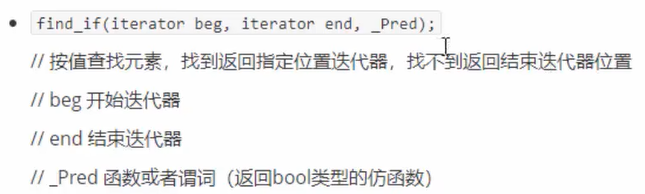
find_if
功能描述:
按条件查找元素
函数原型:
- class greaterFive
- {
- public:
- bool operator()(int val)
- {
- return val > 15;
- }
- };
- void test01()
- {
- vector<int>v;
- v.push_back(10);
- v.push_back(20);
- v.push_back(30);
- v.push_back(14);
- for_each(v.begin(), v .end(), print02());
- cout << endl;
- vector<int>::iterator it = find_if(v.begin(), v.end(), greaterFive());
- if (it == v.end())
- {
- cout << "没有找到" << endl;
- }
- else
- {
- cout << "找到了:" << *it << endl;
- }
- }
- class Person
- {
- public:
- Person(string name, int age)
- {
- m_Name = name;
- m_Age = age;
- }
- bool operator==(const Person& p)
- {
- if (this->m_Name == p.m_Name && this->m_Age == p.m_Age)
- {
- return true;
- }
- else
- {
- return false;
- }
- }
- string m_Name;
- int m_Age;
- };
- class greater20
- {
- public:
- bool operator()(const Person& p)
- {
- return p.m_Age > 20;
- }
- };
- void test02()
- {
- vector<Person>v;
- Person p1("top", 10);
- Person p2("as", 32);
- Person p3("bob", 43);
- Person p4("tony", 38);
- v.push_back(p1);
- v.push_back(p2);
- v.push_back(p3);
- v.push_back(p4);
- Person pp("as", 32);
- vector<Person>::iterator it = find_if(v.begin(), v.end(), greater20());
- if (it == v.end())
- {
- cout << "没找到" << endl;
- }
- else
- {
- cout << "找到了,姓名:" << it->m_Name << ",年龄:" << it->m_Age << endl;
- }
- }
adjacent_find
查找相邻重复元素
函数原型:

- void test01()
- {
- vector<int>v;
- v.push_back(10);
- v.push_back(20);
- v.push_back(10);
- v.push_back(30);
- v.push_back(14);
- v.push_back(14);
- vector<int>::iterator it = adjacent_find(v.begin(), v.end());
- if (it == v.end())
- {
- cout << "未找到" << endl;
- }
- else
- {
- cout << "已找到:" << *it << endl;
- }
- }
binary_search
查找指定元素是否存在
函数原型:

- void test01()
- {
- vector<int>v;
- for (int i = 0; i < 10; ++i)
- {
- v.push_back(i);
- }
- bool judge = binary_search(v.begin(), v.end(), 4);
- if (judge)
- {
- cout << "找到了" << endl;
- }
- else
- {
- cout << "未找到" << endl;
- }
- }
注意:二分查找法查找效率虽然高,但查找的容器中元素必须是有序序列
count
统计元素个数
函数原型:

- void test01()
- {
- vector<int>v;
- v.push_back(12);
- v.push_back(34);
- v.push_back(32);
- v.push_back(4);
- v.push_back(12);
- v.push_back(12);
- int sum = count(v.begin(), v.end(), 12);
- cout << "12有" << sum << "个" << endl;
- }
- class Person
- {
- public:
- Person(string name, int age)
- {
- m_Name = name;
- m_Age = age;
- }
- bool operator==(const Person& p)
- {
- if (this->m_Age == p.m_Age)
- {
- return true;
- }
- else
- {
- return false;
- }
- }
- string m_Name;
- int m_Age;
- };
- void test02()
- {
- vector<Person>v;
- Person p1("top", 10);
- Person p2("as", 32);
- Person p3("bob", 32);
- Person p4("tony", 38);
- v.push_back(p1);
- v.push_back(p2);
- v.push_back(p3);
- v.push_back(p4);
- Person pp("sq", 32);
- int sum = count(v.begin(), v.end(), pp);
- cout << "与sq同岁的人有" << sum << "个" << endl;
- }
count_if
- void test01()
- {
- vector<int>v;
- v.push_back(12);
- v.push_back(34);
- v.push_back(32);
- v.push_back(4);
- v.push_back(16);
- v.push_back(12);
- int sum = count_if(v.begin(), v.end(), greaterFive());
- cout << "大于5有" << sum << "个" << endl;
- }
- class Person
- {
- public:
- Person(string name, int age)
- {
- m_Name = name;
- m_Age = age;
- }
- string m_Name;
- int m_Age;
- };
- class AgeGreater20
- {
- public:
- bool operator()(const Person&p)
- {
- return p.m_Age > 20;
- }
- };
- void test02()
- {
- vector<Person>v;
- Person p1("top", 10);
- Person p2("as", 32);
- Person p3("bob", 32);
- Person p4("tony", 38);
- Person p5("pig", 43);
- v.push_back(p1);
- v.push_back(p2);
- v.push_back(p3);
- v.push_back(p4);
- v.push_back(p5);
- Person pp("sq", 32);
- int sum = count_if(v.begin(), v.end(), AgeGreater20());
- cout << "大于20的人有" << sum << "个" << endl;
- }
常用排序算法

sort
函数原型:
- class print02
- {
- public:
- void operator()(int num)
- {
- cout << num << " ";
- }
- };
- class greaterInt
- {
- public:
- bool operator()(int a, int b)
- {
- return a > b;
- }
- };
- void test01()
- {
- vector<int> v;
- v.push_back(10);
- v.push_back(30);
- v.push_back(40);
- v.push_back(20);
- v.push_back(50);
- sort(v.begin(), v.end());//升序
- for_each(v.begin(), v.end(), print02());
- cout << endl;
- //降序
- //sort(v.begin(), v.end(), greater<int>());
- sort(v.begin(), v.end(), greaterInt());
- for_each(v.begin(), v.end(), print02());
- cout << endl;
- }
random_shuffle
洗牌,指定范围内的元素随机调整次序
函数原型:

- void test01()
- {
- srand((unsigned int)time(NULL));
- vector<int> v;
- for (int i = 0; i < 10; ++i)
- {
- v.push_back(i);
- }
- for_each(v.begin(), v.end(), print02());
- cout << endl;
- //利用洗牌算法 打乱顺序
- random_shuffle(v.begin(), v.end());
- for_each(v.begin(), v.end(), print02());
- cout << endl;
- }
random_shuffle洗牌算法较实用,记得加随机种子
merge
两个有序的容器元素合并,并存储到另一容器中
合并之后的容器依旧是有序的
函数原型:

reverse
反转元素
函数原型:

- void test01()
- {
- srand((unsigned int)time(NULL));
- vector<int> v;
- for (int i = 0; i < 10; ++i)
- {
- v.push_back(i);
- }
- for_each(v.begin(), v.end(), print02());
- cout << endl;
- reverse(v.begin(), v.end());
- for_each(v.begin(), v.end(), print02());
- cout << endl;
- }
常用拷贝和替换算法

copy
copy(v.begin(), v.end(), v2.begin());
- void test01()
- {
- srand((unsigned int)time(NULL));
- vector<int> v;
- vector<int> v2;
- for (int i = 0; i < 10; ++i)
- {
- v.push_back(i);
- }
- for_each(v.begin(), v.end(), print02());
- cout << endl;
- v2.resize(v.size());
- copy(v.begin(), v.end(), v2.begin());
- for_each(v2.begin(), v2.end(), print02());
- cout << endl;
- }
replace

- void test01()
- {
- srand((unsigned int)time(NULL));
- vector<int> v;
- for (int i = 0; i < 10; ++i)
- {
- v.push_back(i);
- }
- v.push_back(2);
- v.push_back(2);
- for_each(v.begin(), v.end(), print02());
- cout << endl;
- replace(v.begin(), v.end(), 2, 200);//将所有2改为200
- for_each(v.begin(), v.end(), print02());
- cout << endl;
- }
replace_if
函数原型:

- void test01()
- {
- srand((unsigned int)time(NULL));
- vector<int> v;
- for (int i = 0; i < 10; ++i)
- {
- v.push_back(i);
- }
- v.push_back(2);
- v.push_back(2);
- for_each(v.begin(), v.end(), print02());
- cout << endl;
- replace_if(v.begin(), v.end(), greaterFive(), 6);//将所有大于5的改为6
- for_each(v.begin(), v.end(), print02());
- cout << endl;
- }
swap
函数原型:

常用算术生成算法
算法生成算法属于小型算法,使用时包含头文件#include

accumulate
计算区间内 容器元素累计总和
函数原型:

- #include<numeric>
- void test01()
- {
- vector<int> v;
- for (int i = 0; i <= 100; ++i)
- {
- v.push_back(i);
- }
- //参数3是其实累加值
- int total = accumulate(v.begin(), v.end(), 0); //5050
- total = accumulate(v.begin(), v.end(), 1000);//6050
- //for_each(v.begin(), v.end(), print02());
- cout << total<< endl;
- }
fill
向容器中填充指定的元素
函数原型:

- void test01()
- {
- vector<int>v;
- v.resize(10);//初始化10个0
- fill(v.begin(), v.end(), 100);//将0重新填充为100
- }
常用集合算法

set_intersection
交集:
例:
v1: 0 1 2 3 4 5 6 7 8 9 10
v2: 5 6 7 8 9 10 11 12 13 14 15
交集: 5 6 7 8 9 10

两个集合必须是有序序列!!
- void test01()
- {
- vector<int> v;
- vector<int> v2;
- for (int i = 0; i <= 10; ++i)
- {
- v.push_back(i);
- v2.push_back(i+5);
- }
- vector<int>vTarget;
- //目标容器需要提前开辟空间
- //最特殊情况也是占用空间最大情况:大容器包含小容器,
- //故开辟空间时取最小容器的size
- vTarget.resize(min(v.size(), v2.size()));
- //获取交集
- //返回目标容器的最后一个元素的迭代器地址
- vector<int>::iterator itEnd = set_intersection(v.begin(), v.end(), v2.begin(), v2.end(), vTarget.begin());
- for_each(vTarget.begin(), itEnd, print02());
- cout << endl;
- }
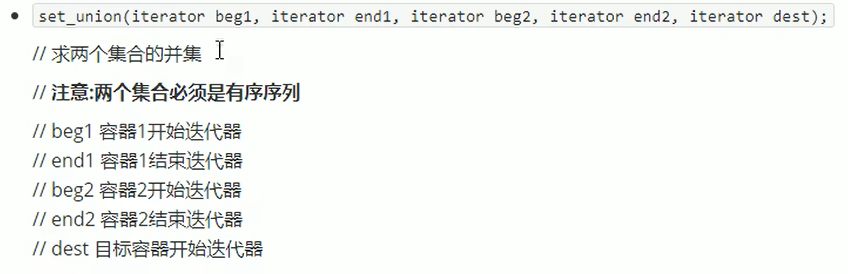
set_union
求集合并集
例:
v1: 0 1 2 3 4 5 6 7 8 9 10
v2: 5 6 7 8 9 10 11 12 13 14 15
并集: 0 1 2 3 4 5 6 7 8 9 10 11 12 13 14 15
- void test01()
- {
- vector<int> v;
- vector<int> v2;
- for (int i = 0; i <= 10; ++i)
- {
- v.push_back(i);
- v2.push_back(i+5);
- }
- for_each(v.begin(), v.end(), print02());
- cout << endl;
- for_each(v2.begin(), v2.end(), print02());
- cout << endl;
- vector<int>vTarget;
- //目标容器需要提前开辟空间
- //最特殊情况也是占用空间最大情况:两个容器没有交集,
- //并集就是两个容器size相加
- vTarget.resize(v.size()+v2.size());
- //获取并集
- vector<int>::iterator itEnd = set_union(v.begin(), v.end(), v2.begin(), v2.end(), vTarget.begin());
- for_each(vTarget.begin(), itEnd, print02());
- cout << endl;
- }
set_difference
差集
例:
v1: 0 1 2 3 4 5 6 7 8 9 10
v2: 5 6 7 8 9 10 11 12 13 14 15
v1和v2容器的差集: 0 1 2 3 4
v2和v1容器的差集:11 12 13 14 15

- void test01()
- {
- vector<int> v;
- vector<int> v2;
- for (int i = 0; i <= 10; ++i)
- {
- v.push_back(i);
- v2.push_back(i+5);
- }
- for_each(v.begin(), v.end(), print02());
- cout << endl;
- for_each(v2.begin(), v2.end(), print02());
- cout << endl;
- vector<int>vTarget;
- //目标容器需要提前开辟空间
- //最特殊情况也是占用空间最大情况:两个容器没有交集,
- //差集就是两个容器中大的size作为目标容器开辟空间
- vTarget.resize(max(v.size(), v2.size()));
- //获取v1和v2的差集
- cout << "v1和v2的差集为:" << endl;
- vector<int>::iterator itEnd = set_difference(v.begin(), v.end(), v2.begin(), v2.end(), vTarget.begin());
- for_each(vTarget.begin(), itEnd, print02());
- cout << endl;
- cout << "v2和v1的差集为:" << endl;
- itEnd = set_difference(v2.begin(), v2.end(), v.begin(), v.end(), vTarget.begin());
- for_each(vTarget.begin(), itEnd, print02());
- cout << endl;
- }
-
相关阅读:
巧用 CSS 构建渐变彩色二维码
Java手写链表和案例拓展
计算机图形学之点和直线
第七届中美创新链接峰会-区块链与绿色发展
C语言之位域(位段)入门详解
SSM考试题库管理系统毕业设计源码069043
JUC包-线程池
百万奖池角逐,华为云IoT边缘带你看懂“边缘计算开发者大赛”
LeetCode刷题日记003——无重复最长子串
如何用 GPTs 构建自己的知识分身?(进阶篇)
- 原文地址:https://blog.csdn.net/ThePaK/article/details/133223501

- 最新文章
-
沪漂五周年了:我越来越迷茫了
Agentic Skill Routing 实战:别再把所有 Skill 塞进 AI Agent 上下文
MySQL-Seconds_behind_master的精度误差
[MAF预定义ChatClient中间件-03]CachingChatClient——利用缓存省钱省时间
AI的至暗历史:从万众期待到被政府撤资,AI的两次死亡徘徊
Agent OS :五种驯服不确定性的范式
PortSwigger SQL注入LAB11
数据库即时编译JIT
[Begin]AI Learn Data Day 0
深度学习进阶(二十七)现代 LLM 的核心架构设计其二:SwiGLU