-
LeetCode 865. Smallest Subtree with all the Deepest Nodes【树,DFS,BFS,哈希表】1534
本文属于「征服LeetCode」系列文章之一,这一系列正式开始于2021/08/12。由于LeetCode上部分题目有锁,本系列将至少持续到刷完所有无锁题之日为止;由于LeetCode还在不断地创建新题,本系列的终止日期可能是永远。在这一系列刷题文章中,我不仅会讲解多种解题思路及其优化,还会用多种编程语言实现题解,涉及到通用解法时更将归纳总结出相应的算法模板。
为了方便在PC上运行调试、分享代码文件,我还建立了相关的仓库:https://github.com/memcpy0/LeetCode-Conquest。在这一仓库中,你不仅可以看到LeetCode原题链接、题解代码、题解文章链接、同类题目归纳、通用解法总结等,还可以看到原题出现频率和相关企业等重要信息。如果有其他优选题解,还可以一同分享给他人。
由于本系列文章的内容随时可能发生更新变动,欢迎关注和收藏征服LeetCode系列文章目录一文以作备忘。
给定一个根为
root的二叉树,每个节点的深度是 该节点到根的最短距离 。返回包含原始树中所有 最深节点 的 最小子树 。
如果一个节点在 整个树 的任意节点之间具有最大的深度,则该节点是 最深的 。
一个节点的 子树 是该节点加上它的所有后代的集合。
示例 1:
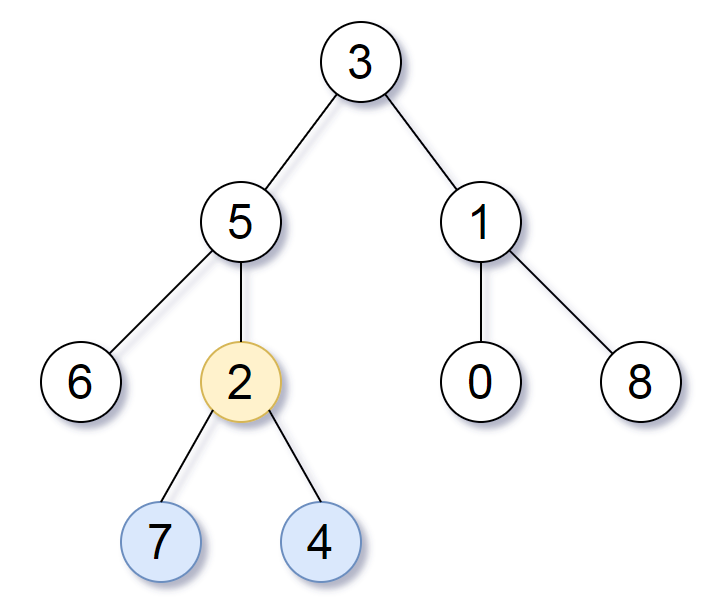
输入:root = [3,5,1,6,2,0,8,null,null,7,4] 输出:[2,7,4] 解释: 我们返回值为 2 的节点,在图中用黄色标记。 在图中用蓝色标记的是树的最深的节点。 注意,节点 5、3 和 2 包含树中最深的节点,但节点 2 的子树最小,因此我们返回它。- 1
- 2
- 3
- 4
- 5
- 6
示例 2:
输入:root = [1] 输出:[1] 解释:根节点是树中最深的节点。- 1
- 2
- 3
示例 3:
输入:root = [0,1,3,null,2] 输出:[2] 解释:树中最深的节点为 2 ,有效子树为节点 2、1 和 0 的子树,但节点 2 的子树最小。- 1
- 2
- 3
提示:
- 树中节点的数量在
[1, 500]范围内。 0 <= Node.val <= 500- 每个节点的值都是 独一无二 的。
注意: 本题与力扣 1123 重复:https://leetcode-cn.com/problems/lowest-common-ancestor-of-deepest-leaves
解法1 递归
看上图(示例 1),这棵树的节点 3 , 5 , 2 3,5,2 3,5,2 都是最深叶节点 7 , 4 7,4 7,4 的公共祖先,但只有节点 2 2 2 是最近的公共祖先。如果我们要找的节点只在左子树中,那么最近公共祖先也必然只在左子树中。对于本题,如果左子树的最大深度比右子树的大,那么最深叶结点就只在左子树中,所以最近公共祖先也只在左子树中。反过来说,如果右子树的最大深度大于左子树,那么最深叶结点就只在右子树中,所以最近公共祖先也只在右子树中。
如果左右子树的最大深度一样呢?当前节点一定是最近公共祖先吗?不一定。比如节点 1 1 1 的左右子树最深叶节点 0 , 8 0,8 0,8 的深度都是 2 2 2 ,但该深度并不是全局最大深度,所以节点 1 1 1 并不能是答案。
根据以上讨论,正确做法如下:
- 递归这棵二叉树,同时维护全局最大深度 maxDepth \textit{maxDepth} maxDepth 。
- 在「递」的时候往下传 d e p t h depth depth ,用来表示当前节点的深度。
- 在「归」的时候往上传当前子树最深叶节点的深度。
- 设左子树最深叶节点的深度为 leftMaxDepth \textit{leftMaxDepth} leftMaxDepth ,右子树最深叶节点的深度为 rightMaxDepth \textit{rightMaxDepth} rightMaxDepth 。如果 leftMaxDepth = rightMaxDepth = maxDepth \textit{leftMaxDepth}=\textit{rightMaxDepth}=\textit{maxDepth} leftMaxDepth=rightMaxDepth=maxDepth ,那么更新答案为当前节点。注意这并不代表我们找到了答案,如果后面发现了更深的叶节点,那么答案还会更新。
class Solution { public: TreeNode *subtreeWithAllDeepest(TreeNode *root) { TreeNode *ans = nullptr; int max_depth = -1; // 全局最大深度 function<int(TreeNode*, int)> dfs = [&](TreeNode *node, int depth) { if (node == nullptr) { max_depth = max(max_depth, depth); // 维护全局最大深度 return depth; } int left_max_depth = dfs(node->left, depth + 1); // 获取左子树最深叶节点的深度 int right_max_depth = dfs(node->right, depth + 1); // 获取右子树最深叶节点的深度 if (left_max_depth == right_max_depth && left_max_depth == max_depth) ans = node; return max(left_max_depth, right_max_depth); // 当前子树最深叶节点的深度 }; dfs(root, 0); return ans; } };- 1
- 2
- 3
- 4
- 5
- 6
- 7
- 8
- 9
- 10
- 11
- 12
- 13
- 14
- 15
- 16
- 17
- 18
- 19
- 20
复杂度分析:
- 时间复杂度: O ( n ) \mathcal{O}(n) O(n) 。每个节点都会恰好访问一次。
- 空间复杂度: O ( n ) \mathcal{O}(n) O(n) 。最坏情况下,二叉树是一条链,递归需要 O(n)\mathcal{O}(n)O(n) 的栈空间。
解法2 自底向上
也可以不用全局变量,而是把每棵子树都看成是一个「子问题」,即对于每棵子树,我们需要知道:
- 这棵子树最深叶结点的深度。这里是指叶子在这棵子树内的深度,而不是在整棵二叉树的视角下的深度。相当于这棵子树的高度。
- 这棵子树的最深叶结点的最近公共祖先 lca \textit{lca} lca 。
分类讨论:
- 设子树的根节点为 n o d e node node, n o d e node node 的左子树的高度为 leftHeight \textit{leftHeight} leftHeight , n o d e node node 的右子树的高度为 rightHeight \textit{rightHeight} rightHeight 。
- 如果 l e f t H e i g h t > r i g h t H e i g h t leftHeight>rightHeight leftHeight>rightHeight ,那么子树的高度为 leftHeight + 1 \textit{leftHeight} + 1 leftHeight+1 , lca \textit{lca} lca 是左子树的 lca \textit{lca} lca 。
- 如果 leftHeight < rightHeight \textit{leftHeight} < \textit{rightHeight} leftHeight<rightHeight ,那么子树的高度为 r i g h t H e i g h t + 1 rightHeight+1 rightHeight+1 , l c a lca lca 是右子树的 l c a lca lca 。
- 如果 leftHeight = rightHeight \textit{leftHeight} = \textit{rightHeight} leftHeight=rightHeight ,那么子树的高度为 leftHeight + 1 \textit{leftHeight} + 1 leftHeight+1 , l c a lca lca 就是 n o d e node node 。反证法:如果 l c a lca lca 在左子树中,那么 l c a lca lca 不是右子树的最深叶结点的祖先,这不对;如果 l c a lca lca 在右子树中,那么 l c a lca lca 不是左子树的最深叶结点的祖先,这也不对;如果 l c a lca lca 在 n o d e node node 的上面,那就不符合「最近」的要求。所以 l c a lca lca 只能是 n o d e node node。
class Solution { pair<int, TreeNode*> dfs(TreeNode *node) { if (node == nullptr) return {0, nullptr}; auto [left_height, left_lca] = dfs(node->left); auto [right_height, right_lca] = dfs(node->right); if (left_height > right_height) // 左子树更高 return {left_height + 1, left_lca}; if (left_height < right_height) // 右子树更高 return {right_height + 1, right_lca}; return {left_height + 1, node}; // 一样高 } public: TreeNode *subtreeWithAllDeepest(TreeNode *root) { return dfs(root).second; } };- 1
- 2
- 3
- 4
- 5
- 6
- 7
- 8
- 9
- 10
- 11
- 12
- 13
- 14
- 15
- 16
- 17
- 18
复杂度分析:
- 时间复杂度: O ( n ) \mathcal{O}(n) O(n) 。每个节点都会恰好访问一次。
- 空间复杂度: O ( n ) \mathcal{O}(n) O(n) 。最坏情况下,二叉树是一条链,递归需要 O ( n ) \mathcal{O}(n) O(n) 的栈空间。
更简洁的写法是:
class Solution { public: int depth[1010]; TreeNode* subtreeWithAllDeepest(TreeNode* root) { if (root == nullptr) return nullptr; TreeNode* left = root->left, *right = root->right; TreeNode* lcaLeft = subtreeWithAllDeepest(root->left), *lcaRight = subtreeWithAllDeepest(root->right); int dl = left ? depth[left->val] : 0, dr = right ? depth[right->val] : 0; depth[root->val] = max(dl, dr) + 1; if (dl > dr) return lcaLeft; if (dr > dl) return lcaRight; return root; } };- 1
- 2
- 3
- 4
- 5
- 6
- 7
- 8
- 9
- 10
- 11
- 12
- 13
- 14
-
相关阅读:
HIVE/SQL 实现同一列数据累加和累乘
ID VS UUID 主键详解
IEC 62471-6:2022 灯和灯光系统的光生物安全-第6部分:紫外线灯
深度学习的历史与八卦
基于Html的某大学校园网展示静态网页设计 课程报告+源代码
Oracle启动报错解决:ora-00119和ora-00132
HCNP Routing&Switching之MAC安全
【SSM】MyBatis 操作数据库(重点:Mybatis两种使用方式)
python----破解数据库密码(不需要重启数据库以覆盖的形式)
6G极化码低时延译码方案
- 原文地址:https://blog.csdn.net/myRealization/article/details/132748063
