-
【项目】Reactor模式的服务器
目录
3.服务器的初始化(Connection只是使用的一个结构体)
4.等待就绪事件:有事件就绪,对使用Connection的不同对象(封装fd,回调方法)调用对应的回调方法;
5._listenSock读取 :Accepter函数获取新链接怎么处理的
Reactor完整代码连接
前置知识:
Reactor叫做反应堆模式;反应:对已经就绪的事件(读、写、异常)进行处理;
我们使用epoll来实现,select、poll、epoll是多路转接的发展史,epoll完善了select、poll的缺点;
- 需要程序员维护数组 select/poll都有这个缺点
- 有大量的遍历 select/poll都有这个缺点
- 大量参数为输入输出型参数,需要重新设置 select有
- 管理的fd有上限 select有
1.普通的epoll读写有什么问题?
- 使用的是一个静态数组读取;报文长,读到就是不完整报文,报文短,一次读取可能有多个报文,最后一个报文可能不是完整的;
- 这样的错误报文没法分析和处理,就不能构造响应报文;
综上所述:问题为没法保证读取到的是完整报文,导致没法分析和处理、构建响应报文;
- void Read(int fd)
- {
- char buff[1024];
- ssize_t s = read(fd, buff, 1023);
- if(s > 0){
- buff[s] = 0;
- LOG2(INFO, buff, fd);
- }
解决办法:将文件描述符封装,并且有接受发送缓冲区,使用string就可以;
- 使用静态数组读取,然后添加到接受缓冲区保存;
- 读取完毕,对接受缓冲区分析是否有完整报文;
- 处理完整请求报文,构建响应报文添加到发送缓冲区;
- using func_t = std::function<void(Connection*)>;
- using cals_t = std::function<void(std::string &, Connection*)>;
- class Connection{
- public:
- Connection(int fd = -1 ):_fd(fd), _ts(nullptr)
- {}
- ~Connection()
- {
- if(_fd >= 0)
- close(_fd);
- }
- public:
- int _fd;
- //读写异常回调方法
- func_t _recver;
- func_t _sender;
- func_t _exception;
- //接受缓冲区
- std::string _outbuff;
- //发送缓冲区
- std::string _inbuff;
- //TcpServer的回指指针,对写事件的关心是按需打开
- TcpServer *_ts;
- //连接最近活跃活动的时间
- time_t _times;
- };
2.Connection内的回调函数是什么
一个包装器;返回值为void,参数为Connection*,的函数指针、仿函数、lamada表达,它都可以接受;
using func_t = std::function<void(Connection*)>;优势:
- _listenSock是读方法是接受新连接,普通是读取请求报文
- 初始化时设置读写异常回调方法(回调:使用函数指针执行的函数),不需要判断是_listenSock还是普通套接字,统一使用con->_recver;
3.服务器的初始化(Connection只是使用的一个结构体)
- 套接字创建,bind,监听;
- 构建epoll模型,epoll函数也封装了,_epfd封装在Epoll类内;
- 初始化_listenSock Connection结构体;读取回调方法Accept是类函数,多一个this指针,需要使用std::bind来改变参数个数,进行传递给包装器;
- epoll_wait的事件就绪队列初始化;
- class TcpServer{
- const static int gport = 8080;
- const static int gnum = 128;
- TcpServer(int port = gport, int num = gnum):_port(gport), _evts_num(num)
- {
- //套接字,创建bind监听
- _listenSock = Sock::Socket();
- Sock::Bind(_listenSock,_port);
- Sock::Listen(_listenSock);
- //构建epoll模型
- _epoll.CreateEpoll();
- //listensock添加epoll模型和_connections管理起来
- AddConnection(_listenSock, std::bind(&TcpServer::Accepter, this, std::placeholders::_1), nullptr, nullptr);
- //epoll_wait就绪队列,获取已就绪的事件
- _evts = new epoll_event[_evts_num];
- }
- ~TcpServer()
- {
- if(_listenSock >= 0)
- close(_listenSock);
- if(_evts != nullptr)
- delete[] _evts;
- for(auto &pr : _connections)
- {
- _connections.erase(pr.first);
- delete pr.second;
- }
- }
- private:
- int _listenSock;
- //epoll
- Epoll _epoll;
- //就绪队列
- epoll_event* _evts;
- int _evts_num;
- //管理connection对象
- std::unordered_map<int, Connection*> _connections;
- int _port;
- //业务处理的回调指针
- cals_t _cb;
- };
4.等待就绪事件:有事件就绪,对使用Connection的不同对象(封装fd,回调方法)调用对应的回调方法;
- void LoopOnce()
- {
- int n = _epoll.WaitEpoll(_evts, _evts_num);
- //有事件就绪
- if(n > 0)
- {
- //LOG2(INFO, "epoll wait success",fd);
- for(int i=0; i{int fd = _evts[i].data.fd;int events = _evts->events;//连接关闭或者错误,改为读写统一处理,读写失败调异常处理;if( events & EPOLLHUP){LOG2(INFO,"连接关闭",fd);events |= (EPOLLIN | EPOLLOUT);}if( events & EPOLLERR){LOG2(INFO,"错误",fd);events |= (EPOLLIN | EPOLLOUT);}if(_connections.count(fd) && events & EPOLLIN){if(IsConnectionExits(fd) && _connections[fd]->_recver != nullptr){_connections[fd]->_recver(_connections[fd]);}}if(_connections.count(fd) && events & EPOLLOUT){if(IsConnectionExits(fd) && _connections[fd]->_sender != nullptr)_connections[fd]->_sender(_connections[fd]);}}}else if(n == 0){LOG(INFO, "timeout");}else{LOG(FATAL,"epoll wait fail");exit(4);}}void Dispatcher(cals_t cb){_cb = cb;while(true){//去除不活跃的连接DeleteInactivity();LoopOnce();}}
5._listenSock读取 :Accepter函数获取新链接怎么处理的
- 得到新连接,如果新的fd是合法的,设置对应的读写异常回调方法,读:读取请求报文,写:发送响应报文,异常:出现错误进行处理;
- 所有的套接字都是使用ET模式(通知效率高,只支持非阻塞读写),EPOLLET因该被设置;
- void Accepter(Connection * con)
- {
- while(true)
- {
- con->_times = time(nullptr);
- struct sockaddr_in tmp;
- socklen_t tlen = sizeof(tmp);
- int new_sock = accept(con->_fd, (struct sockaddr *)&tmp, &tlen);
- if(new_sock < 0)
- {
- //所以事件处理完毕
- if(errno == EAGAIN || errno == EWOULDBLOCK)
- break;
- else if(errno == EINTR)//可能被信号中断,概率极小
- continue;
- else
- {
- std::cout << "accept fail , errno :" << errno << strerror(errno) << std::endl;
- break;
- }
- }
- else//添加到epoll模型和_connections中管理;
- {
- if(AddConnection(new_sock, std::bind(&TcpServer::Recver, this, std::placeholders::_1),
- std::bind(&TcpServer::Sender, this, std::placeholders::_1),
- std::bind(&TcpServer::Exception, this, std::placeholders::_1)
- ))
- LOG2(INFO, "add connection success",new_sock);
- else
- LOG2(RISK, "add connection fail", new_sock);
- }
- }
- }
6.普通套接字读取:Recver
- 一直读取,直到错误或者读取完毕;每次读取的结果都放到接受缓冲区;
- 读取完毕,对接受缓冲区处理,拿出一个个完整的报文,对请求报文进行业务处理;
- void Recver(Connection *con)
- {
- con->_times = time(nullptr);
- const int buff_size = 1024;
- char buff[buff_size];
- while(true)
- {
- ssize_t s = recv(con->_fd, buff, buff_size - 1, 0);
- if(s > 0)
- {
- buff[s] = 0;
- con->_outbuff += buff;
- }
- else if(s == 0)
- {
- LOG2(INFO, "写端关闭", con->_fd);
- con->_exception(con);
- return;
- }
- else
- {
- //读取完毕
- if(errno == EAGAIN || errno == EWOULDBLOCK )
- {
- LOG2(INFO, "处理完毕", con->_fd);
- break;
- }
- else if(errno == EINTR)
- continue;
- else
- {
- LOG2(ERROR, "recv fail ,fd: ", con->_fd);
- con->_exception(con);
- return;
- }
- }
- }
- std::cout << "fd: " << con->_fd << "outbuff: " << con->_outbuff <//对outbuff内的完整报文,进行处理std::vector//分隔报文,函数在protocol.hppSplitMessage(out, con->_outbuff);for(auto &s : out)_cb(s, con);//业务逻辑回调指针,在主函数}
7.对写事件的关心是按需关系的:
- 如果开启关心,还没有数据发送,写事件会一直就绪;所以按需关心;
- 请求报文业务处理完毕,构建好响应报文,一定有响应,打开对写事件的关心;
- 也是Connection为什么封装一个Tcperver指针的原因,这里开启写事件的关心;
- //业务处理
- void CalArguments(std::string &str, Connection *con)
- {
- //请求报文反序列化
- Request req;
- //std::cout<
- if(!req.Deserialize(str)){
- LOG2(ERROR, "deseroalize fail" ,con->_fd);
- return;
- }
- //对数据处理
- Response res;
- calculator(req, res);
- //响应报文序列化
- std::string s = res.Serialize();
- //添加到inbuff
- con->_inbuff += s;
- //一定有响应报文,打开写事件的关系
- con->_ts->EnableReadWrite(con->_fd, true, true);
- }
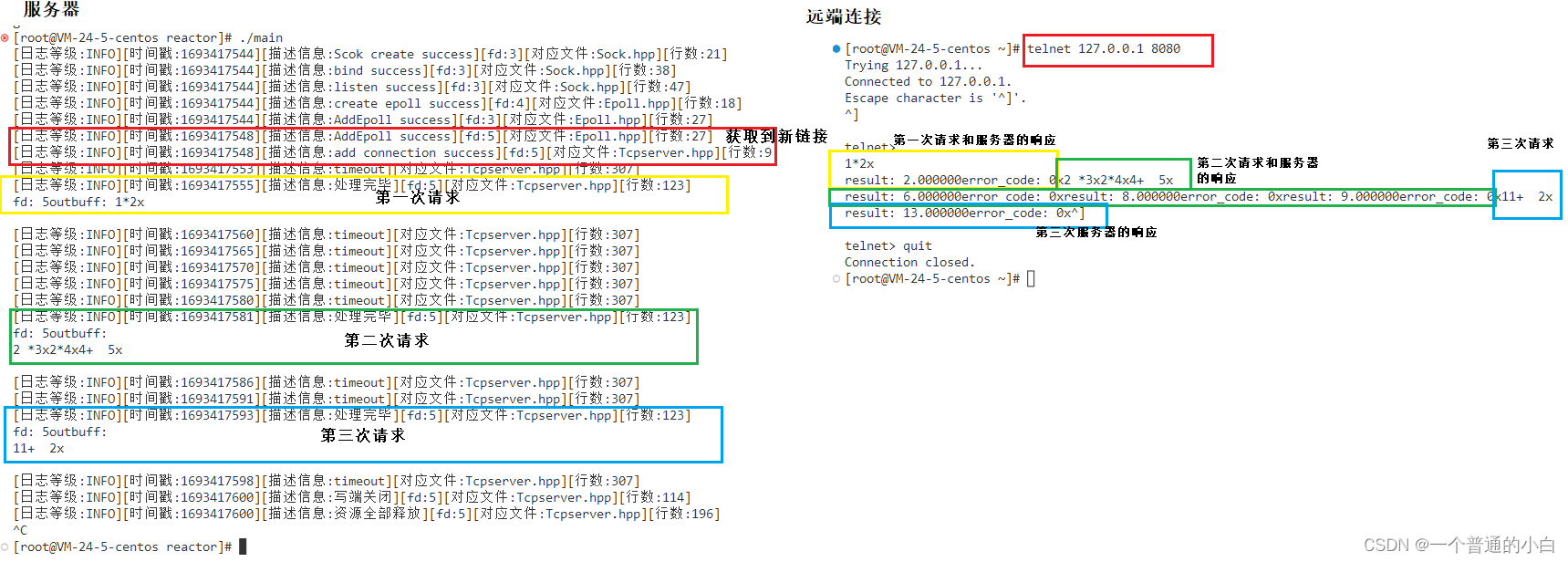
8.执行效果:
- 我写的协议是对任意两个数加减乘除;
- 每个请求或者响应都是用 x 做为分割符的;
9.Reactor的优势:
和进程/线程做比较:
- 它是一个单进程的就可以并发处理请求的服务器,比进程/线程减少了创建、销毁、调度的时间;
- 它的等待一批fd,减少了单位等待时间;一个线程等待对应一个fd;
- 有很高的复用性,替换业务逻辑就行了;
-
相关阅读:
全国5米高程DEM数据及衍生的全国地形起伏度数据
【译】.NET 7 中的性能改进(五)
思维导图:网络通信协议标准化
287. 寻找重复数
python urllib.request模块下载数据
程序员视角下的AIGC技术:现状、挑战与未来展望
成为会带团队的技术人 技术债务:如何带领团队从困境中突围而出?
redis部署与管理
二氧化钛纳米粒TIO2修饰多肽R8/CTT2/CCK8/GE11/cTAT/CPP/RVG29/SP94(无机纳米粒子偶联多肽)
神经网络中的参数量和FLOPs的计算
- 原文地址:https://blog.csdn.net/m0_72964546/article/details/132593844
- 最新文章
-
【FHE】我们如何实现同态加密推理(八):SiLU 的密文化——两条路径,和一个 8 字节的开关
SQLcl 中 c/old/new 替换变量为何失效?先定位再替换
不让模型写作文,直接从它脑子里读答案:Jev 决策在 .NET 的两条路线
Halo插件:支持GitHub的图床附件策略
电视投屏界的“一股清流”!SimpleTVCast 6.0.0-beta 抢先体验:无需TV端App,界面大换血!✨
华三VXLAN集中式网关实战指南:Spine多活网关 + 双活接入(M-LAG)
软件更好写之后口碑会更重要
大 O、大 Omega、大 Theta 的区别,O(n) 复杂度是什么意思
Java标签跳转:一个鲜为人知但却很实用的小技巧
多智能体系统论文速读
