-
第十四章 集合(集合框架体系、List)
一、集合框架体系
(1)可以动态保存任意多个对象
(2)提供了一系列方便的操作对象的方法:add、remove、set、get 等集合框架体系:


二、Collection
1. Collection 接口常用方法
(1)add:添加单个元素
(2)remove:删除指定元素
(3)contains:查找元素是否存在
(4)size:获取元素个数
(5)isEmpty:判断是否为空
(6)clear:清空
(7)addAll:添加多个元素
(8)containsAIl:查找多个元素是否都存在
(9)removeAll:删除多个元素
2. Collection 接口遍历元素方式1,使用 Iterator(迭代器)
(1)Iterator 对象称为迭代器,主要用于遍历 Collection 集合中的元素。
(2)所有实现了 Collection 接口 的集合类都有一个 iterator() 方法,用以返口一个实现了Iterator 接口的对象,即可以返回一个迭代器。
(3)Iterator 仅用于遍历集合,lterator 本身并不存放对象。- public class Test {
- public static void main(String[] args) {
- ArrayList
list = new ArrayList<>(); - list.add(1);
- list.add(2);
- list.add(3);
- // list.iterator() 重置迭代器,可重复
- Iterator
iterator = list.iterator(); - while (iterator.hasNext()) {
- Integer next = iterator.next();
- System.out.println(next);
- }
- }
- }
3. Collection 接口遍历元素方式2,增强 for 循环
增强 for 循环,可以代替 iterator 迭代器,特点:增强 for 本质就是迭代器。只能用于遍历集合或数组。
- public class Test {
- public static void main(String[] args) {
- ArrayList
list = new ArrayList<>(); - list.add(1);
- list.add(2);
- list.add(3);
- for (Integer e : list) {
- System.out.println(e);
- }
- }
- }
三、List
1. List 接口基本介绍
(1)List 接口是 Collection 接口的子接口
(2)List 集合类中元素有序(即添加顺序和取出顺序一致)、且可重复
(3)List 集合中的每个元素都有其对应的顺序索引,即支持索引。
(4)List 容器中的元素都对应一个整数型的序号记载其在容器中的位置,可以根据序号存取容器中的元素
2. List 集合里添加了一些根据索引来操作集合元素的方法
(1)void add (int index, Object ele):在 index 位置插入 ele 元素
(2)boolean addAll (int index, Collection eles):从 index 位置开始将 eles 中的所有元素添加进来
(3)Object get (int index):获取指定 index 位置的元素
(4)int indexOf (Object obj):返回 obj 在集合中首次出现的位置
(5)int lastlndexOf (Object obj):返回 obj 在当前集合中末次出现的位置
(6)Object remove (int index):移除指定 index 位置的元素,并返回此元素
(7)Object set (int index, Object ele):设置指定 index 位置的元素为 ele,相当于是替换
(8)List subList (int fromlndex,int tolndex):返回从 fromlndex 到(tolndex -1)位置的子集合
- public class Test {
- public static void main(String[] args) {
- List
list = new ArrayList<>(); - list.add("乔峰");
- list.add("段誉");
- list.add(1, "虚竹");
- list.add("Tom");
- System.out.println(list); // [乔峰, 虚竹, 段誉, Tom]
- List
list2 = new ArrayList<>(); - list2.add("Jack");
- list2.add("Tom");
- list.addAll(1, list2);
- System.out.println(list); // [乔峰, Jack, Tom, 虚竹, 段誉, Tom]
- System.out.println(list.get(1)); // Jack
- System.out.println(list.indexOf("Tom")); // 2
- System.out.println(list.lastIndexOf("Tom")); // 5
- list.remove(5);
- System.out.println(list); // [乔峰, Jack, Tom, 虚竹, 段誉]
- list.set(2, "Mike");
- System.out.println(list); // [乔峰, Jack, Mike, 虚竹, 段誉]
- System.out.println(list.subList(0, 2)); // [乔峰, Jack]
- }
- }
四、ArrayList(P509)
1. ArrayList 的注意事项
(1)ArrayList 可以加入 null,并且多个。
(2)ArrayList 是由数组来实现数据存储的。
(3)ArrayList 基本等同于 Vector。ArrayList 是线程不安全(执行效率高),在多线程情况下,不建议使用ArrayList。
2. ArrayList 的底层操作机制源码分析(P510)
(1)ArrayList 中维护了一个 Object 类型的数组,transient Object[] elementData【transient 表示该属性不会被序列化】
(2)当创建 ArrayList 对象时,如果使用的是无参构造器,则初始 elementData 容量为 0。
第一次添加,则扩容 elementData 为 10。如果需要再次扩容的话,则扩容 elementData 为1.5 倍。
(3)如果使用的是指定大小的构造器,则初始 elementData 容量为指定大小,如果需要扩容,则直接扩容 elementData 为1.5倍。
- public class ArrayList_
{ - transient Object[] elementData;
- private int size;
- protected transient int modCount = 0;
- private static final int DEFAULT_CAPACITY = 10;
- private static final Object[] DEFAULTCAPACITY_EMPTY_ELEMENTDATA = {};
- // 无参构造
- public ArrayList_() {
- // 创建一个空的数组
- this.elementData = DEFAULTCAPACITY_EMPTY_ELEMENTDATA;
- }
- public ArrayList_(int initialCapacity) {
- if (initialCapacity > 0) {
- this.elementData = new Object[initialCapacity];
- }
- }
- public boolean add(E e) {
- ensureCapacityInternal(size + 1); // Increments modCount!!
- // 在 elementData[size] 赋值,并且size++
- elementData[size++] = e;
- return true;
- }
- private void ensureCapacityInternal(int minCapacity) {
- ensureExplicitCapacity(calculateCapacity(elementData, minCapacity));
- }
- private void ensureExplicitCapacity(int minCapacity) {
- // 操作次数
- modCount++;
- // overflow-conscious code
- // 判断是否扩容,如果elementData数组大小不够就扩容
- if (minCapacity - elementData.length > 0){
- grow(minCapacity);
- }
- }
- private static int calculateCapacity(Object[] elementData, int minCapacity) {
- if (elementData == DEFAULTCAPACITY_EMPTY_ELEMENTDATA) {
- return Math.max(DEFAULT_CAPACITY, minCapacity);
- }
- return minCapacity;
- }
- private static final int MAX_ARRAY_SIZE = Integer.MAX_VALUE - 8;
- // 扩容方法
- private void grow(int minCapacity) {
- // overflow-conscious code
- int oldCapacity = elementData.length;
- // 扩容为1.5倍
- int newCapacity = oldCapacity + (oldCapacity >> 1);
- if (newCapacity - minCapacity < 0){
- newCapacity = minCapacity;
- }
- // 防止超过最大值2147483639
- if (newCapacity - MAX_ARRAY_SIZE > 0){
- newCapacity = hugeCapacity(minCapacity);
- }
- // minCapacity is usually close to size, so this is a win:
- // Arrays.copyOf 可以保留原先的数据,并扩容
- elementData = Arrays.copyOf(elementData, newCapacity);
- }
- private static int hugeCapacity(int minCapacity) {
- if (minCapacity < 0){
- // overflow
- throw new OutOfMemoryError();
- }
- return (minCapacity > MAX_ARRAY_SIZE) ?
- Integer.MAX_VALUE :
- MAX_ARRAY_SIZE;
- }
- }
五、Vector(P513)
1. Vector 的基本介绍
(1)Vector 类的定义说明
- public class Vector
- extends AbstractList
- implements List
, RandomAccess, Cloneable, java.io.Serializable
(2)Vector 底层也是一个对象数组 protected Object[] elementData;
(3)Vector 是线程同步的,即线程安全,Vector 类的操作方法带有 synchronized。
(4)在开发中,需要线程同步安全时,考虑使用 Vector。

2. Vector 的底层操作机制源码分析
Vector 扩容源码类似于 ArrayList
- public class Vector_
{ - protected Object[] elementData;
- protected int capacityIncrement;
- protected transient int modCount = 0;
- protected int elementCount;
- public Vector_() {
- this(10);
- }
- public Vector_(int initialCapacity) {
- this(initialCapacity, 0);
- }
- public Vector_(int initialCapacity, int capacityIncrement) {
- super();
- if (initialCapacity < 0){
- throw new IllegalArgumentException("Illegal Capacity: "+
- initialCapacity);
- }
- // 初始化数组
- this.elementData = new Object[initialCapacity];
- this.capacityIncrement = capacityIncrement;
- }
- public synchronized boolean add(E e) {
- modCount++;
- ensureCapacityHelper(elementCount + 1);
- elementData[elementCount++] = e;
- return true;
- }
- private void ensureCapacityHelper(int minCapacity) {
- // overflow-conscious code
- // 判断是否扩容
- if (minCapacity - elementData.length > 0){
- grow(minCapacity);
- }
- }
- private void grow(int minCapacity) {
- // overflow-conscious code
- int oldCapacity = elementData.length;
- // newCapacity = oldCapacity + oldCapacity
- int newCapacity = oldCapacity + ((capacityIncrement > 0) ?
- capacityIncrement : oldCapacity);
- if (newCapacity - minCapacity < 0){
- newCapacity = minCapacity;
- }
- elementData = Arrays.copyOf(elementData, newCapacity);
- }
- }
六、LinkedList(P515)
1. LinkedList 说明
(1)LinkedList 底层实现了双向链表和双端队列特点。
(2)可以添加任意元素(元素可以重复),包括 null。
(3)线程不安全,没有实现同步。2. LinkedList 的底层操作机制
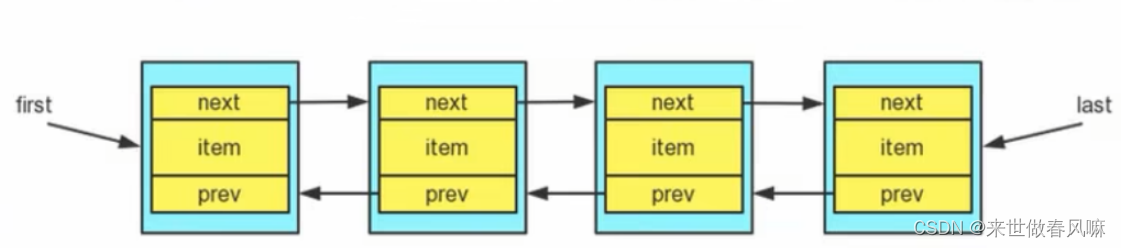
(1)LinkedList 底层维护了一个双向链表。
(2)LinkedList 中维护了两个属性 first 和 last 分别指向首节点和尾节点。
(3)每个节点(Node对象),里面又维护了 prev 、next 、item 三个属性,其中通过 prev 指向前一个,通过 next 指向后一个节点。最终实现双向链表。(4)所以 LinkedList 的元素的添加和删除,不是通过数组完成的,相对来说效率较高。
3. LinkedList 源码解读(P516)
- public class LinkedList_
{ - transient int size = 0;
- protected transient int modCount = 0;
- transient Node
first; - transient Node
last; - private static class Node
{ - E item; // 存放数据
- Node
next; - Node
prev; - Node(Node
prev, E element, Node next) { - this.item = element;
- this.next = next;
- this.prev = prev;
- }
- }
- public boolean add(E e) {
- linkLast(e);
- return true;
- }
- void linkLast(E e) {
- final Node
l = last; - final Node
newNode = new Node<>(l, e, null); - last = newNode;
- if (l == null) {
- first = newNode;
- } else {
- l.next = newNode;
- }
- size++;
- modCount++;
- }
- public E remove() {
- return removeFirst();
- }
- public E removeFirst() {
- final Node
f = first; - if (f == null) {
- throw new NoSuchElementException();
- }
- return unlinkFirst(f);
- }
- private E unlinkFirst(Node
f) { - // assert f == first && f != null;
- final E element = f.item;
- final Node
next = f.next; - f.item = null;
- f.next = null; // help GC
- first = next;
- if (next == null) {
- last = null;
- } else {
- next.prev = null;
- }
- size--;
- modCount++;
- return element;
- }
- }
七、ArrayList 和 LinkedList 比较(P517)

(1)如果我们改查的操作多,选择 ArrayList。
(2)如果我们增删的操作多,选择 LinkedList。
(3)一般来说,在程序中,80%-90%都是查询,因此大部分情况下会选择 ArrayList。 -
相关阅读:
conan入门(二十九):对阿里mnn进行Conan封装塈conans.CMake和conan.tools.cmake.CMake的区别
AI算法助力室内家具布局
机器学习2--matplotlib绘图包
[Spring Framework]AOP经典案例、AOP总结
Java通过Lettuce访问Redis主从,哨兵,集群
如何计算多分组交互pp值
菲律宾外汇储备降至两年来的最低水平
《Effective Objective-C 2.0》读书笔记——对象、消息、运行期
vue清除动态路由
基于Redis实现分布式锁(执行流程)
- 原文地址:https://blog.csdn.net/yirenyuan/article/details/130882284

- 最新文章
-
沪漂五周年了:我越来越迷茫了
Agentic Skill Routing 实战:别再把所有 Skill 塞进 AI Agent 上下文
MySQL-Seconds_behind_master的精度误差
[MAF预定义ChatClient中间件-03]CachingChatClient——利用缓存省钱省时间
AI的至暗历史:从万众期待到被政府撤资,AI的两次死亡徘徊
Agent OS :五种驯服不确定性的范式
PortSwigger SQL注入LAB11
数据库即时编译JIT
[Begin]AI Learn Data Day 0
深度学习进阶(二十七)现代 LLM 的核心架构设计其二:SwiGLU