-
postgres源码解析40 表创建执行全流程梳理--4
本文讲解非系统表的创建逻辑([
postgres源码解析38 表创建执行全流程梳理–1
postgres源码解析38 表创建执行全流程梳理–2
postgres源码解析38 表创建执行全流程梳理–3heap_create 执行逻辑

1)首先进行安全性检查,不允许在系统表中创建relations,判断是否需要创建持久化文件等;
2)根据表名、表空间、表对象标识符和文件节点relfilenode等信息调用 RelationBuildLocalRelation在内存中构建Relation,并插入全局relcache 哈希表中;
3)结合relation类型调用相应的接口函数进行relation的创建,[普通表/TOAST/物化视图: table_relation_set_new_filenode,索引/序列:RelationCreateStorage];
4) 对于无需创建持久化的relation且用户指定表空间,则需要在 pg_tablespace 中注册对应的信息。RelationBuildLocalRelation
该函数目的是在内存中构建创建表的relcache Entry,并插入全局Relcache 哈希表中,用于加速后续对此表的访问。
1)如果不存在CacheMemoryContext,则创建此上下文,后续操作均在此上下文进行;
2)分配并初始化Relation结构体,结合入参的TueDesc填充Relation结构体中rd_att字段:字段属性的详细信息;
3)分配并根据入参填充Relation结构体中rd_att字段的Form_pg_class字段:表名、命名空间、字段属性/数目等;
4)调用 RelationInitLockInfo初始化relation描述符锁信息;
5)调用 RelationInitPhysicalAddr 初始化relation描述符对应的物理地址:spcNode/dbNode//RelNode [表空间/数据库/表]
6)将上述构建好的RelCache Entry插入全局ralcache 哈希表中,并增加该条目的引用计数

* * RelationBuildLocalRelation * Build a relcache entry for an about-to-be-created relation, * and enter it into the relcache. */ Relation RelationBuildLocalRelation(const char *relname, Oid relnamespace, TupleDesc tupDesc, Oid relid, Oid accessmtd, Oid relfilenode, Oid reltablespace, bool shared_relation, bool mapped_relation, char relpersistence, char relkind) { Relation rel; MemoryContext oldcxt; int natts = tupDesc->natts; int i; bool has_not_null; bool nailit; AssertArg(natts >= 0); /* * check for creation of a rel that must be nailed in cache. * * XXX this list had better match the relations specially handled in * RelationCacheInitializePhase2/3. */ switch (relid) { case DatabaseRelationId: case AuthIdRelationId: case AuthMemRelationId: case RelationRelationId: case AttributeRelationId: case ProcedureRelationId: case TypeRelationId: nailit = true; break; default: nailit = false; break; } /* * check that hardwired list of shared rels matches what's in the * bootstrap .bki file. If you get a failure here during initdb, you * probably need to fix IsSharedRelation() to match whatever you've done * to the set of shared relations. */ if (shared_relation != IsSharedRelation(relid)) elog(ERROR, "shared_relation flag for \"%s\" does not match IsSharedRelation(%u)", relname, relid); /* Shared relations had better be mapped, too */ Assert(mapped_relation || !shared_relation); /* * switch to the cache context to create the relcache entry. */ if (!CacheMemoryContext) CreateCacheMemoryContext(); oldcxt = MemoryContextSwitchTo(CacheMemoryContext); /* * allocate a new relation descriptor and fill in basic state fields. */ rel = (Relation) palloc0(sizeof(RelationData)); /* make sure relation is marked as having no open file yet */ rel->rd_smgr = NULL; /* mark it nailed if appropriate */ rel->rd_isnailed = nailit; rel->rd_refcnt = nailit ? 1 : 0; /* it's being created in this transaction */ rel->rd_createSubid = GetCurrentSubTransactionId(); rel->rd_newRelfilenodeSubid = InvalidSubTransactionId; rel->rd_firstRelfilenodeSubid = InvalidSubTransactionId; rel->rd_droppedSubid = InvalidSubTransactionId; /* * create a new tuple descriptor from the one passed in. We do this * partly to copy it into the cache context, and partly because the new * relation can't have any defaults or constraints yet; they have to be * added in later steps, because they require additions to multiple system * catalogs. We can copy attnotnull constraints here, however. */ rel->rd_att = CreateTupleDescCopy(tupDesc); rel->rd_att->tdrefcount = 1; /* mark as refcounted */ has_not_null = false; for (i = 0; i < natts; i++) { Form_pg_attribute satt = TupleDescAttr(tupDesc, i); Form_pg_attribute datt = TupleDescAttr(rel->rd_att, i); datt->attidentity = satt->attidentity; datt->attgenerated = satt->attgenerated; datt->attnotnull = satt->attnotnull; has_not_null |= satt->attnotnull; } if (has_not_null) { TupleConstr *constr = (TupleConstr *) palloc0(sizeof(TupleConstr)); constr->has_not_null = true; rel->rd_att->constr = constr; } /* * initialize relation tuple form (caller may add/override data later) */ rel->rd_rel = (Form_pg_class) palloc0(CLASS_TUPLE_SIZE); namestrcpy(&rel->rd_rel->relname, relname); rel->rd_rel->relnamespace = relnamespace; rel->rd_rel->relkind = relkind; rel->rd_rel->relnatts = natts; rel->rd_rel->reltype = InvalidOid; /* needed when bootstrapping: */ rel->rd_rel->relowner = BOOTSTRAP_SUPERUSERID; /* set up persistence and relcache fields dependent on it */ rel->rd_rel->relpersistence = relpersistence; switch (relpersistence) { case RELPERSISTENCE_UNLOGGED: case RELPERSISTENCE_PERMANENT: rel->rd_backend = InvalidBackendId; rel->rd_islocaltemp = false; break; case RELPERSISTENCE_TEMP: Assert(isTempOrTempToastNamespace(relnamespace)); rel->rd_backend = BackendIdForTempRelations(); rel->rd_islocaltemp = true; break; default: elog(ERROR, "invalid relpersistence: %c", relpersistence); break; } /* if it's a materialized view, it's not populated initially */ if (relkind == RELKIND_MATVIEW) rel->rd_rel->relispopulated = false; else rel->rd_rel->relispopulated = true; /* set replica identity -- system catalogs and non-tables don't have one */ if (!IsCatalogNamespace(relnamespace) && (relkind == RELKIND_RELATION || relkind == RELKIND_MATVIEW || relkind == RELKIND_PARTITIONED_TABLE)) rel->rd_rel->relreplident = REPLICA_IDENTITY_DEFAULT; else rel->rd_rel->relreplident = REPLICA_IDENTITY_NOTHING; /* * Insert relation physical and logical identifiers (OIDs) into the right * places. For a mapped relation, we set relfilenode to zero and rely on * RelationInitPhysicalAddr to consult the map. */ rel->rd_rel->relisshared = shared_relation; RelationGetRelid(rel) = relid; for (i = 0; i < natts; i++) TupleDescAttr(rel->rd_att, i)->attrelid = relid; rel->rd_rel->reltablespace = reltablespace; if (mapped_relation) { rel->rd_rel->relfilenode = InvalidOid; /* Add it to the active mapping information */ RelationMapUpdateMap(relid, relfilenode, shared_relation, true); } else rel->rd_rel->relfilenode = relfilenode; RelationInitLockInfo(rel); /* see lmgr.c */ RelationInitPhysicalAddr(rel); rel->rd_rel->relam = accessmtd; /* * RelationInitTableAccessMethod will do syscache lookups, so we mustn't * run it in CacheMemoryContext. Fortunately, the remaining steps don't * require a long-lived current context. */ MemoryContextSwitchTo(oldcxt); if (relkind == RELKIND_RELATION || relkind == RELKIND_SEQUENCE || relkind == RELKIND_TOASTVALUE || relkind == RELKIND_MATVIEW) RelationInitTableAccessMethod(rel); /* * Okay to insert into the relcache hash table. * * Ordinarily, there should certainly not be an existing hash entry for * the same OID; but during bootstrap, when we create a "real" relcache * entry for one of the bootstrap relations, we'll be overwriting the * phony one created with formrdesc. So allow that to happen for nailed * rels. */ RelationCacheInsert(rel, nailit); /* * Flag relation as needing eoxact cleanup (to clear rd_createSubid). We * can't do this before storing relid in it. */ EOXactListAdd(rel); /* It's fully valid */ rel->rd_isvalid = true; /* * Caller expects us to pin the returned entry. */ RelationIncrementReferenceCount(rel); return rel; }- 1
- 2
- 3
- 4
- 5
- 6
- 7
- 8
- 9
- 10
- 11
- 12
- 13
- 14
- 15
- 16
- 17
- 18
- 19
- 20
- 21
- 22
- 23
- 24
- 25
- 26
- 27
- 28
- 29
- 30
- 31
- 32
- 33
- 34
- 35
- 36
- 37
- 38
- 39
- 40
- 41
- 42
- 43
- 44
- 45
- 46
- 47
- 48
- 49
- 50
- 51
- 52
- 53
- 54
- 55
- 56
- 57
- 58
- 59
- 60
- 61
- 62
- 63
- 64
- 65
- 66
- 67
- 68
- 69
- 70
- 71
- 72
- 73
- 74
- 75
- 76
- 77
- 78
- 79
- 80
- 81
- 82
- 83
- 84
- 85
- 86
- 87
- 88
- 89
- 90
- 91
- 92
- 93
- 94
- 95
- 96
- 97
- 98
- 99
- 100
- 101
- 102
- 103
- 104
- 105
- 106
- 107
- 108
- 109
- 110
- 111
- 112
- 113
- 114
- 115
- 116
- 117
- 118
- 119
- 120
- 121
- 122
- 123
- 124
- 125
- 126
- 127
- 128
- 129
- 130
- 131
- 132
- 133
- 134
- 135
- 136
- 137
- 138
- 139
- 140
- 141
- 142
- 143
- 144
- 145
- 146
- 147
- 148
- 149
- 150
- 151
- 152
- 153
- 154
- 155
- 156
- 157
- 158
- 159
- 160
- 161
- 162
- 163
- 164
- 165
- 166
- 167
- 168
- 169
- 170
- 171
- 172
- 173
- 174
- 175
- 176
- 177
- 178
- 179
- 180
- 181
- 182
- 183
- 184
- 185
- 186
- 187
- 188
- 189
- 190
- 191
- 192
- 193
- 194
- 195
- 196
- 197
- 198
- 199
- 200
- 201
- 202
- 203
- 204
- 205
- 206
- 207
- 208
- 209
- 210
- 211
- 212
- 213
- 214
- 215
- 216
- 217
- 218
- 219
- 220
- 221
- 222
- 223
- 224
- 225
- 226
- 227
- 228
- 229
- 230
- 231
- 232
- 233
- 234
- 235
RelationCreateStorage
物理文件的创建由磁盘管理器负责,pg中所有文件系统均调用这统一接口,而RelationCreateStorage 函数的实现就是通过调用这些函数进一步封装而成,期执行流程如下:
1)对于持久化的relation,设置字段表示need_wal,表明需要写WAL日志,对于临时relation或者unlogged relation无需此操作;
2)根据输入的RelFileNode调用 smgropen返回 SMgrRelation对象,不存在会创建一个;
3)结合上述返回的 SMgrRelation和ForkNumber号调用 smgrcreate创建relation的物理文件;
4)如需写WAL日志,调用 log_smgrcreate函数记录下此relation的实际物理信息;
5)最后将其添加至PendingRelDelete链表尾,在事务真正提交的时候如需回滚则可通过此信息将创建的文件删除,并返回 SMgrRelation对象。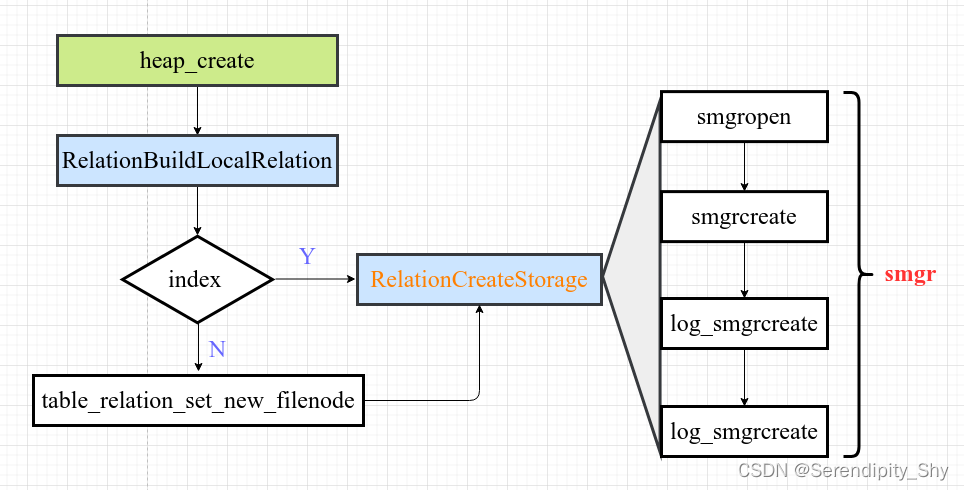
/* * RelationCreateStorage * Create physical storage for a relation. * * Create the underlying disk file storage for the relation. This only * creates the main fork; additional forks are created lazily by the * modules that need them. * * This function is transactional. The creation is WAL-logged, and if the * transaction aborts later on, the storage will be destroyed. */ SMgrRelation RelationCreateStorage(RelFileNode rnode, char relpersistence) { PendingRelDelete *pending; SMgrRelation srel; BackendId backend; bool needs_wal; Assert(!IsInParallelMode()); /* couldn't update pendingSyncHash */ switch (relpersistence) { case RELPERSISTENCE_TEMP: backend = BackendIdForTempRelations(); needs_wal = false; break; case RELPERSISTENCE_UNLOGGED: backend = InvalidBackendId; needs_wal = false; break; case RELPERSISTENCE_PERMANENT: backend = InvalidBackendId; needs_wal = true; break; default: elog(ERROR, "invalid relpersistence: %c", relpersistence); return NULL; /* placate compiler */ } srel = smgropen(rnode, backend); smgrcreate(srel, MAIN_FORKNUM, false); if (needs_wal) log_smgrcreate(&srel->smgr_rnode.node, MAIN_FORKNUM); /* Add the relation to the list of stuff to delete at abort */ pending = (PendingRelDelete *) MemoryContextAlloc(TopMemoryContext, sizeof(PendingRelDelete)); pending->relnode = rnode; pending->backend = backend; pending->atCommit = false; /* delete if abort */ pending->nestLevel = GetCurrentTransactionNestLevel(); pending->next = pendingDeletes; pendingDeletes = pending; if (relpersistence == RELPERSISTENCE_PERMANENT && !XLogIsNeeded()) { Assert(backend == InvalidBackendId); AddPendingSync(&rnode); } return srel; }- 1
- 2
- 3
- 4
- 5
- 6
- 7
- 8
- 9
- 10
- 11
- 12
- 13
- 14
- 15
- 16
- 17
- 18
- 19
- 20
- 21
- 22
- 23
- 24
- 25
- 26
- 27
- 28
- 29
- 30
- 31
- 32
- 33
- 34
- 35
- 36
- 37
- 38
- 39
- 40
- 41
- 42
- 43
- 44
- 45
- 46
- 47
- 48
- 49
- 50
- 51
- 52
- 53
- 54
- 55
- 56
- 57
- 58
- 59
- 60
- 61
- 62
- 63
- 64
-
相关阅读:
一些程序员不可错过的开发工具
Hash算法 平衡二叉树(调整平衡)
JAVA - 项目启动后执行定时任务
第九章 Linux实际操作——Linux磁盘分区、挂载
sql注入挖掘
权限系统--前后端分离
攻防世界流量分析1
python+flask计算机毕业设计web的房屋租赁系统的设计与实现(程序+开题+论文)
企业微信开发教程一:添加企微应用流程图解以及常见问题图文说明
尼莫地平PEG-PLGA纳米粒|葛根素PEG-PLGA纳米粒(Pue-NPs)|负载替米沙坦PLGA纳米粒
- 原文地址:https://blog.csdn.net/qq_52668274/article/details/128126708

- 最新文章
-
沪漂五周年了:我越来越迷茫了
Agentic Skill Routing 实战:别再把所有 Skill 塞进 AI Agent 上下文
MySQL-Seconds_behind_master的精度误差
[MAF预定义ChatClient中间件-03]CachingChatClient——利用缓存省钱省时间
AI的至暗历史:从万众期待到被政府撤资,AI的两次死亡徘徊
Agent OS :五种驯服不确定性的范式
PortSwigger SQL注入LAB11
数据库即时编译JIT
[Begin]AI Learn Data Day 0
深度学习进阶(二十七)现代 LLM 的核心架构设计其二:SwiGLU