-
HIve数仓新零售项目DWS层的构建(Full join)模型
HIve数仓新零售项目
注:大家觉得博客好的话,别忘了点赞收藏呀,本人每周都会更新关于人工智能和大数据相关的内容,内容多为原创,Python Java Scala SQL 代码,CV NLP 推荐系统等,Spark Flink Kafka Hbase Hive Flume等等~写的都是纯干货,各种顶会的论文解读,一起进步。
今天继续和大家分享一下HIve数仓新零售项目
#博学谷IT学习技术支持
前言
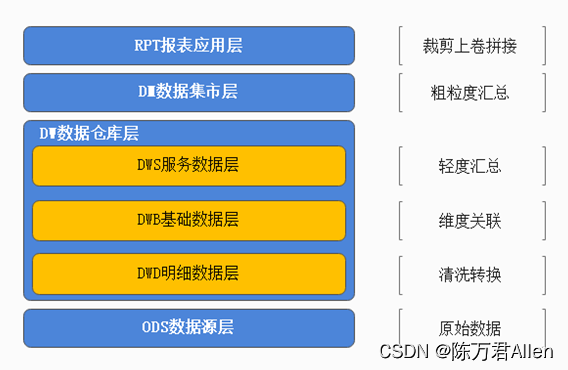

这是一个线下真实HIve数仓的一个搭建项目,还是比较复杂的,主要和大家一起分享一下整个HIve数仓的思路。
整个项目分为:
1.ODS层
2.DWD层
3.DWB层
4.DWS层
5.DM层
6.RPT层
每一层都有每一层的知识点。我会和大家分享从数据源MySQL开始,如何搭建整个完整的项目。
一、Full join模型思路
- 先统计各自结果小表数据

- 将结果小表数据进行full join

- 通过coalesce(t1.dt,t2.dt,t3.dt) 从full join的结果表中进行数据的抽取

- 去重,将日期和goods_id重复的数据去掉
最后通过group by + sum 对数据进行去重即可
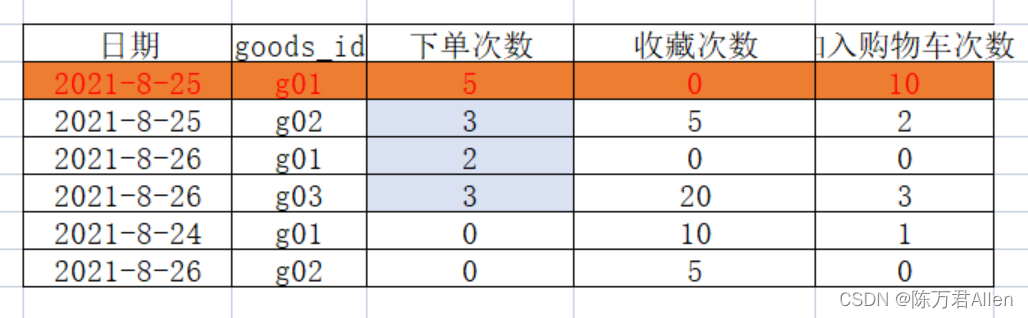
实现低维度,多指标的模型
二、商品主题
上次和大家介绍了Grouping sets 模型,主要适合于多维度,多指标的情况。今天通过Full join方法实现低维度,多指标的情况。
- 维度
日期(day)+商品
- 指标
下单次数、下单件数、下单金额、被支付次数、被支付件数、被支付金额、被退款次数、被退款件数、被退款金额、被加入购物车次数、被加入购物车件数、被收藏次数、好评数、中评数、差评数
1.确定目标表
create table yp_dws.dws_sku_daycount ( -- 维度字段 dt STRING, sku_id string comment 'sku_id', sku_name string comment '商品名称', -- 指标 order_count bigint comment '被下单次数', order_num bigint comment '被下单件数', order_amount decimal(38,2) comment '被下单金额', payment_count bigint comment '被支付次数', payment_num bigint comment '被支付件数', payment_amount decimal(38,2) comment '被支付金额', refund_count bigint comment '被退款次数', refund_num bigint comment '被退款件数', refund_amount decimal(38,2) comment '被退款金额', cart_count bigint comment '被加入购物车次数', cart_num bigint comment '被加入购物车件数', favor_count bigint comment '被收藏次数', evaluation_good_count bigint comment '好评数', evaluation_mid_count bigint comment '中评数', evaluation_bad_count bigint comment '差评数' ) COMMENT '每日商品行为' --PARTITIONED BY(dt STRING) ROW format delimited fields terminated BY '\t' stored AS orc tblproperties ('orc.compress' = 'SNAPPY');- 1
- 2
- 3
- 4
- 5
- 6
- 7
- 8
- 9
- 10
- 11
- 12
- 13
- 14
- 15
- 16
- 17
- 18
- 19
- 20
- 21
- 22
- 23
- 24
- 25
- 26
2.实现代码
with t0 as ( select dt, goods_id as sku_id, goods_name as sku_name, order_id, buy_num, total_price, order_state, refund_id, evaluation_id, geval_scores, row_number() over (partition by order_id,goods_id) as rk from yp_dwb.dwb_order_detail ), -- 被下单次数,被下单件数,被下单金额 t1 as ( select dt, sku_id, sku_name, count(order_id) as order_count, -- 被下单次数 sum(buy_num) as order_num, -- 被下单件数 sum(total_price) as order_amount -- 被下单金额 from t0 where rk = 1 group by dt,sku_id,sku_name ), -- 被支付次数,被支付件数,被支付金额 t2 as ( select dt, sku_id, sku_name, count(order_id) as payment_count, -- 被支付次数 sum(buy_num) as payment_num, -- 被支付件数 sum(total_price) as payment_amount -- 被支付金额 from t0 where rk = 1 and order_state not in (1,7) group by dt,sku_id,sku_name ), -- 被退款次数,被退款件数,被退款金额 t3 as( select dt, sku_id, sku_name, count(order_id) as refund_count, -- 被退款次数 sum(buy_num) as refund_num, -- 被退款件数 sum(total_price) as refund_amount -- 被退款金额 from t0 where rk = 1 and refund_id is not null group by dt,sku_id,sku_name ), -- 被加入购物车次数,被加入购物车件数 -- 通过分析我们发现,之前的DWB层中并没有关联和购物车相关联的表,我们需要去跨层去DWD层去访问数据 -- 通过分析发现fact_shop_cart表没有商品名,所以需要和dim_goods商品表进行关联,获取商品名 t4 as ( select substring(sc.create_time,1,10) as dt, sc.goods_id as sku_id, g.goods_name as sku_name, count(sc.id) as cart_count, -- 被加入购物车次数 sum(sc.buy_num) as cart_num -- 被加入购物车件数 from yp_dwd.fact_shop_cart sc left join yp_dwd.dim_goods g on sc.goods_id = g.id where sc.end_date = '9999-99-99' group by substring(sc.create_time,1,10),goods_id,goods_name ), -- 被收藏次数 t5 as ( select substring(gc.create_time,1,10) as dt, gc.goods_id as sku_id, g.goods_name as sku_name, count(gc.id) as favor_count -- 被收藏次数 from yp_dwd.fact_goods_collect gc left join yp_dwd.dim_goods g on gc.goods_id = g.id where gc.end_date = '9999-99-99' group by substring(gc.create_time,1,10),gc.goods_id,g.goods_name ), -- 好评数 中评数,差评数 t6 as ( select dt, sku_id, sku_name, count(if(geval_scores>=9,evaluation_id,null)) as evaluation_good_count, -- 好评数 count(if(geval_scores<9 and geval_scores > 6,evaluation_id,null)) as evaluation_mid_count, -- 中评数 count(if(geval_scores <= 6,evaluation_id,null)) as evaluation_bad_count -- 差评数 from t0 where rk = 1 and evaluation_id is not null group by dt,sku_id,sku_name ), t7 as ( select coalesce(t1.dt,t2.dt,t3.dt,t4.dt,t5.dt,t6.dt) as dt, coalesce(t1.sku_id,t2.sku_id,t3.sku_id,t4.sku_id,t5.sku_id,t6.sku_id) as sku_id, coalesce(t1.sku_name,t2.sku_name,t3.sku_name,t4.sku_name,t5.sku_name,t6.sku_name) as sku_name, coalesce(t1.order_count,0) as order_count, coalesce(t1.order_num,0) as order_num, coalesce(t1.order_amount,0) as order_amount, coalesce(t2.payment_count,0) as payment_count, coalesce(t2.payment_num,0) as payment_num, coalesce(t2.payment_amount,0) as payment_amount, coalesce(t3.refund_count,0) as refund_count, coalesce(t3.refund_num,0) as refund_num, coalesce(t3.refund_amount,0) as refund_amount, coalesce(t4.cart_count,0) as cart_count, coalesce(t4.cart_num,0) as cart_num, coalesce(t5.favor_count,0) as favor_count, coalesce(t6.evaluation_good_count,0) as evaluation_good_count, coalesce(t6.evaluation_mid_count,0) as evaluation_mid_count, coalesce(t6.evaluation_bad_count,0) as evaluation_bad_count from t1 full join t2 on t1.dt = t2.dt and t1.sku_id = t2.sku_id full join t3 on t2.dt = t3.dt and t2.sku_id = t3.sku_id full join t4 on t3.dt = t4.dt and t3.sku_id = t4.sku_id full join t5 on t4.dt = t5.dt and t4.sku_id = t5.sku_id full join t6 on t5.dt = t6.dt and t5.sku_id = t6.sku_id ) -- 对最终的结果进行分组去重 select dt, sku_id, sku_name, sum(order_count) as order_count, sum(order_num) as order_num, sum(order_amount) as order_amount, sum(payment_count) as payment_count, sum(payment_num) as payment_num, sum(payment_amount) as payment_amount, sum(refund_count) as refund_count, sum(refund_num) as refund_num, sum(refund_amount) as refund_amount, sum(cart_count) as cart_count, sum(cart_num) as cart_num, sum(favor_count) as favor_count, sum(evaluation_good_count) as evaluation_good_count, sum(evaluation_mid_count) as evaluation_mid_count, sum(evaluation_bad_count) as evaluation_bad_count from t7 group by dt,sku_id,sku_name- 1
- 2
- 3
- 4
- 5
- 6
- 7
- 8
- 9
- 10
- 11
- 12
- 13
- 14
- 15
- 16
- 17
- 18
- 19
- 20
- 21
- 22
- 23
- 24
- 25
- 26
- 27
- 28
- 29
- 30
- 31
- 32
- 33
- 34
- 35
- 36
- 37
- 38
- 39
- 40
- 41
- 42
- 43
- 44
- 45
- 46
- 47
- 48
- 49
- 50
- 51
- 52
- 53
- 54
- 55
- 56
- 57
- 58
- 59
- 60
- 61
- 62
- 63
- 64
- 65
- 66
- 67
- 68
- 69
- 70
- 71
- 72
- 73
- 74
- 75
- 76
- 77
- 78
- 79
- 80
- 81
- 82
- 83
- 84
- 85
- 86
- 87
- 88
- 89
- 90
- 91
- 92
- 93
- 94
- 95
- 96
- 97
- 98
- 99
- 100
- 101
- 102
- 103
- 104
- 105
- 106
- 107
- 108
- 109
- 110
- 111
- 112
- 113
- 114
- 115
- 116
- 117
- 118
- 119
- 120
- 121
- 122
- 123
- 124
- 125
- 126
- 127
- 128
- 129
- 130
- 131
- 132
- 133
- 134
- 135
- 136
- 137
- 138
- 139
- 140
- 141
- 142
总结
这里介绍了HIve数仓新零售项目DWS层的构建(Full join)模型,主要针对低维度,多指标的情况。Full join模型的主要思路为
- 用with语句将dwb_order_detail表关键字段提取
- 先统计6张结果小表数据
- 将6张结果小表数据进行full join
- 从full join的结果表中进行数据的抽取
- 去重,将日期和goods_id重复的数据去掉
-
相关阅读:
竞赛 题目:基于卷积神经网络的手写字符识别 - 深度学习
RV1126/RV1109 IPC板 + RK3568+鸿蒙AI视频解决方案
什么是冲突域,什么是广播域?区别又是什么
软件杯 深度学习YOLO安检管制物品识别与检测 - python opencv
React基础(叁)———事件处理
【高等数学】二.一元函数微分学
MTK联发科、高通、紫光展锐手机SOC平台型号汇总(含详细参数)
基于函数计算自定义运行时快速部署一个 springboot 项目
win11怎么看cpu几核几线程? win11查看cpu是几核几线程的教程
网络入门基础
- 原文地址:https://blog.csdn.net/weixin_53280379/article/details/127954111
- 最新文章
-
沪漂五周年了:我越来越迷茫了
Agentic Skill Routing 实战:别再把所有 Skill 塞进 AI Agent 上下文
MySQL-Seconds_behind_master的精度误差
[MAF预定义ChatClient中间件-03]CachingChatClient——利用缓存省钱省时间
AI的至暗历史:从万众期待到被政府撤资,AI的两次死亡徘徊
Agent OS :五种驯服不确定性的范式
PortSwigger SQL注入LAB11
数据库即时编译JIT
[Begin]AI Learn Data Day 0
深度学习进阶(二十七)现代 LLM 的核心架构设计其二:SwiGLU