题目截图

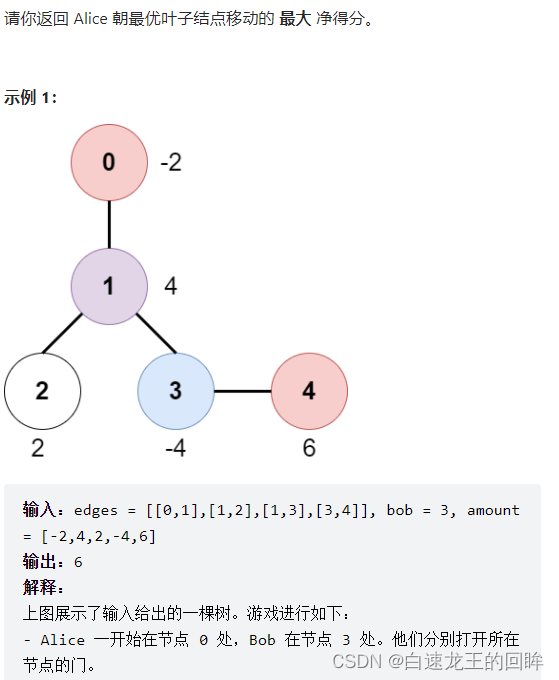

题目分析
- 记录每个点相邻的节点g = defaultdict(list)
- 记录除0外的所有叶子节点
- Alice可能有多条路径到叶子
- bob只有一条路径到0,一次dfs找出这条路径
- 并将bob路径中的遍历的时间标上序号,方便alice进行判断
- alice开始dfs,一边遍历一边记录当前路径的分数(根据bob的访问时间),如果到达叶子,更新ans即可
tle例子(使用list作为参数,耗时++)
class Solution:
def mostProfitablePath(self, edges: List[List[int]], bob: int, amount: List[int]) -> int:
g = defaultdict(list)
for x, y in edges:
g[x].append(y)
g[y].append(x)
leaves = []
for node in g:
if len(g[node]) == 1 and node != 0:
leaves.append(node)
leaves = set(leaves)
leaves_bool = defaultdict(bool)
for leaf in leaves:
leaves_bool[leaf] = True
path = []
flag = False
def dfs1(cur, temp_path, fa):
nonlocal flag, path
if flag:
return
if cur == 0:
path = temp_path[:]
flag = True
return
for next in g[cur]:
if next != fa:
dfs1(next, temp_path + [next], cur)
dfs1(bob, [bob], -1)
bob_step = defaultdict(int)
bob_step_bool = defaultdict(bool)
for i, v in enumerate(path):
bob_step[v] = i
bob_step_bool[v] = True
ans = -inf
@cache
def dfs2(cur, temp_path, fa, cnt):
nonlocal ans
v = cur
if bob_step_bool[v] is False:
cnt += amount[v]
else:
if len(temp_path) - 1 == bob_step[v]:
cnt += amount[v] // 2
elif len(temp_path) - 1 > bob_step[v]:
cnt += 0
else:
cnt += amount[v]
if leaves_bool[cur] is True:
ans = max(ans, cnt)
return
for next in g[cur]:
if next != fa:
dfs2(next, tuple(list(temp_path) + [next]), cur, cnt)
dfs2(0, tuple([0]), -1, 0)
return ans
- 1
- 2
- 3
- 4
- 5
- 6
- 7
- 8
- 9
- 10
- 11
- 12
- 13
- 14
- 15
- 16
- 17
- 18
- 19
- 20
- 21
- 22
- 23
- 24
- 25
- 26
- 27
- 28
- 29
- 30
- 31
- 32
- 33
- 34
- 35
- 36
- 37
- 38
- 39
- 40
- 41
- 42
- 43
- 44
- 45
- 46
- 47
- 48
- 49
- 50
- 51
- 52
- 53
- 54
- 55
- 56
- 57
- 58
- 59
- 60
- 61
ac code(list抽离,使用回溯算法)
class Solution:
def mostProfitablePath(self, edges: List[List[int]], bob: int, amount: List[int]) -> int:
g = defaultdict(list)
for x, y in edges:
g[x].append(y)
g[y].append(x)
leaves = []
for node in g:
if len(g[node]) == 1 and node != 0:
leaves.append(node)
leaves = set(leaves)
leaves_bool = defaultdict(bool)
for leaf in leaves:
leaves_bool[leaf] = True
path = []
flag = False
temp_path = [bob]
def dfs1(cur, fa):
nonlocal flag, path
if flag:
return
if cur == 0:
path = temp_path[:]
flag = True
return
for next in g[cur]:
if next != fa:
temp_path.append(next)
dfs1(next, cur)
temp_path.pop()
dfs1(bob, -1)
bob_step = defaultdict(int)
bob_step_bool = defaultdict(bool)
for i, v in enumerate(path):
bob_step[v] = i
bob_step_bool[v] = True
ans = -inf
temp_path = [0]
cnt = 0
def dfs2(cur, fa):
nonlocal ans, cnt
cnt1 = cnt
v = cur
if bob_step_bool[v] is False:
cnt1 += amount[v]
else:
if len(temp_path) - 1 == bob_step[v]:
cnt1 += amount[v] // 2
elif len(temp_path) - 1 > bob_step[v]:
cnt1 += 0
else:
cnt1 += amount[v]
if leaves_bool[cur] is True:
ans = max(ans, cnt1)
return
origin_cnt = cnt
for next in g[cur]:
if next != fa:
temp_path.append(next)
cnt = cnt1
dfs2(next, cur)
cnt = origin_cnt
temp_path.pop()
dfs2(0, -1)
return ans
- 1
- 2
- 3
- 4
- 5
- 6
- 7
- 8
- 9
- 10
- 11
- 12
- 13
- 14
- 15
- 16
- 17
- 18
- 19
- 20
- 21
- 22
- 23
- 24
- 25
- 26
- 27
- 28
- 29
- 30
- 31
- 32
- 33
- 34
- 35
- 36
- 37
- 38
- 39
- 40
- 41
- 42
- 43
- 44
- 45
- 46
- 47
- 48
- 49
- 50
- 51
- 52
- 53
- 54
- 55
- 56
- 57
- 58
- 59
- 60
- 61
- 62
- 63
- 64
- 65
- 66
- 67
- 68
- 69
- 70
- 71
总结
- 简单模拟dfs
- 不要用list作为py的函数参数了!
- 以后都用dfs + 回溯即可