-
Clang-format格式化及配置参数
Clang-format格式化C代码
Author:Once Day Date:2022年11月3日
漫漫长路有人对你微笑过嘛…
参考文档:
- Clang-Format Style Options — Clang 16.0.0git documentation (llvm.org)
- ClangFormat — Clang 16.0.0git documentation (llvm.org)
- clang-format的介绍和使用 - Tudou_Blog - 博客园 (cnblogs.com)
文章目录
- Clang-format格式化C代码
- 1.引言
- 2. 配置字段解释
- 2.1 language 编程语言
- 2.2 BaseOnStyle 基础风格
- 2.3 AccessModifierOffset 访问性修饰符偏移
- 2.4 AlignAfterOpenBracket 开括号后的对齐
- 2.5 AlignArrayOfStructures 对齐结构体数组
- 2.6 AlignConsecutiveAssignments 对齐连续赋值
- 2.7 AlignConsecutiveBitFields 位段对齐
- 2.8 AlignConsecutiveDeclarations 连续声明对齐
- 2.9 AlignConsecutiveMacros 连续宏定义对齐
- 2.10 AlignEscapedNewlines 对齐分割语法行的斜杠符`\`
- 2.11 AlignOperands 竖直对齐表达式的操作数
- 2.12 AlignTrailingComments 对齐尾部注释
- 2.13 AllowAllArgumentsOnNextLine 允许参数在下一行上
- 2.14 AllowAllConstructorInitializersOnNextLine 已弃用
- 2.15 AllowAllParametersOfDeclarationOnNextLine 允许声明的参数在下一行上
- 2.16 AllowShortBlocksOnASingleLine 允许短语法块在单行上
- 2.17 AllowShortEnumsOnASingleLine 允许短枚举在单行上
- 2.18 AllowShortFunctionsOnASingleLine 允许短函数在单行上
- 2.19 **AllowShortIfStatementsOnASingleLine** 允许if块在单行上
- 2.20 AllowShortLambdasOnASingleLine 允许短匿Lambda函数在单行上
- 2.21 AllowShortLoopsOnASingleLine 允许合并短循环到单行上
- 2.22 AlwaysBreakAfterDefinitionReturnType 函数定义返回类型换行风格
- 2.23 AlwaysBreakAfterReturnType 函数声明的返回类型换行风格
- 2.24 AlwaysBreakBeforeMultilineStrings 多行字符串断行
- 2.25 AlwaysBreakTemplateDeclarations 模板声明断行
- 2.26 AttributeMacros 属性宏
- 2.27 BinPackArguments 装箱变量
- 2.28 BinPackParameters 装箱声明参数
- 2.29 BitFieldColonSpacing 位段列的空白风格
- 2.30 BraceWrapping 大括号换行风格
- 2.31 BreakAfterJavaFieldAnnotations 在修饰器之后断行
- 2.32 BreakArrays Json数组断行
- 2.33 BreakBeforeBinaryOperators 二元操作符断行
- 2.34 BreakBeforeBraces 大括号断行风格
- 2.35 BreakBeforeConceptDeclarations 概念声明断行风格
- 2.36 BreakBeforeTernaryOperators 三元操作符断行规则
- 2.37 BreakConstructorInitializers 构造初始化断行风格
- 2.38 BreakInheritanceList 继承链断行风格
- 2.39 BreakStringLiterals 字符串常量断行
- 2.40 ColumnLimit 列数限制
- 2.41 CommentPragmas 注释表示
- 2.42 CompactNamespaces 紧凑命名空间
- 2.43 ConstructorInitializerAllOnOneLineOrOnePerLine 构造初始化断行风格
- 2.44 ConstructorInitializerIndentWidth 构造初始化缩进宽度
- 2.45 ContinuationIndentWidth
- 2.46 Cpp11BracedListStyle 大括号列表风格
- 2.47 DeriveLineEnding 提取行结尾
- 2.48 DerivePointerAlignment 提取指针对齐
- 2.49 DisableFormat 禁用格式化
- 2.50 EmptyLineAfterAccessModifier 访问修饰符后空行
- 2.51 EmptyLineBeforeAccessModifier 访问修饰符前空行
- 2.52 ExperimentalAutoDetectBinPacking
- 2.53 FixNamespaceComments 修复命名空间描述
- 2.54 ForEachMacros 迭代循环宏
- 2.55 IfMacros 条件判断宏
- 2.56 IncludeBlocks `include`块风格
- 2.57 IncludeCategories `include`种类
- 2.58 IncludeIsMainRegex 判断主包含的正则表达式
- 2.59 IncludeIsMainSourceRegex 判断源文件的正则表达式
- 2.60 IndentAccessModifiers 访问修饰符缩进
- 2.61.1 IndentCaseBlocks `case`块缩进
- 2.61.2 **IndentCaseLabels** `case label`标签缩进
- 2.62 IndentExternBlock `Extern`扩展块缩进
- 2.63 IndentGotoLabels 缩进`Goto`跳转符号
- 2.64 IndentPPDirectives 预处理指令缩进
- 2.65 IndentRequiresClause 缩进要求子句
- 2.66 IndentWidth 缩进宽度
- 2.67 IndentWrappedFunctionNames 函数名缩进
- 2.68 InsertBraces 插入括号
- 2.69 InsertTrailingCommas 掺入尾部冒号
- 2.70 JavaImportGroups
- 2.71 JavaScriptQuotes Java引号风格
- 2.72 JavaScriptWrapImports `import/export`语句换行
- 2.73 KeepEmptyLinesAtTheStartOfBlocks 在语法块开始留空行
- 2.74 LambdaBodyIndentation Lambda表达式主体缩进
- 2.75 Language 目标格式化编程语言
- 2.76 MacroBlockBegin 开始块的宏
- 2.77 MacroBlockEnd 结束块的宏
- 2.78 MaxEmptyLinesToKeep 最大持续空行
- 2.79 NamespaceIndentation 命名空间缩进
- 2.80 NamespaceMacro 命名空间宏
- 2.81 ObjCBinPackProtocolList Objective-C打包风格
- 2.82 ObjCBlockIndentWidth ObjC块缩进
- 2.83 ObjCBreakBeforeNestedBlockParam 分解嵌套块参数
- 2.84 ObjCSpaceAfterProperty 属性修饰符空格
- 2.85 ObjCSpaceBeforeProtocolList 协议列表前空白
- 2.86 PPIndentWidth 预处理符号缩进指定
- 2.87 PackConstructorInitializers 打包构造器初始化列表
- 2.88 PenaltyXxxx 各类情况的惩罚
- 2.89 PointerAlignment 指针对齐风格
- 2.90 QualifierAlignment 限定符对齐
- 2.91 QualifierOrder 说明/限定符顺序
- 2.92 RawStringFormats 原始字符串格式
- 2.93 ReferenceAlignment 引用对齐格式
- 2.94 ReflowComments 重排版注释
- 2.95 RemoveBracesLLVM 移除括号
- 2.96 RemoveSemicolon 移除分号
- 2.97 RequiresClausePosition 要求子句位置
- 2.98 RequiresExpressionIndentation `require`表达式缩进
- 2.99 SeparateDefinitionBlocks 分离定义语句块
- 2.100 ShortNamespaceLines 短命名空间的行数
- 2.101 SortIncludes 对inclue排序
- 2.102 SortJavaStaticImport 排序java静态导入
- 2.103 SortUsingDeclarations 对using声明排序
- 2.104 SpaceAfterCStyleCast c风格类型转换
- 2.105 SpaceAfterLogicalNot 逻辑`!`操作符
- 2.106 SpaceAfterTemplateKeyword 模板关键字
- 2.107 SpaceAroundPointerQualifiers 指针限定符空格
- 2.108 SpaceBeforeAssignmentOperators 赋值操作符空格
- 2.109 SpaceBeforeCaseColon `case`前空格
- 2.110 SpaceBeforeCpp11BracedList 大括号列表空格
- 2.111 SpaceBeforeCtorInitializerColon 构造器初始化冒号空格
- 2.112 SpaceBeforeInheritanceColon 继承冒号空格
- 2.113 SpaceBeforeParens 圆括号空格
- 2.114 SpaceBeforeParensOptions 圆括号前空格控制
- 2.115 SpaceBeforeRangeBasedForLoopColon 循环范围里的冒号
- 2.116 SpaceBeforeSquareBrackets 方括号前空格
- 2.117 SpaceInEmptyBlock 空块中的空格
- 2.118 SpaceInEmptyParentheses 圆括号之间的空格
- 2.119 SpacesBeforeTrailingComments 尾部注释之前的空格
- 2.120 SpacesInAngles 角括号空白
- 2.121 SpacesInCStyleCastParentheses C`cast`转换里的空格
- 2.122 SpacesInConditionalStatement 条件表达式中的空白
- 2.123 SpacesInContainerLiterals 容器中空格
- 2.124 SpacesInLineCommentPrefix 行注释前缀空格
- 2.125 SpacesInParentheses 在圆括号里面的空格
- 2.126 SpacesInSquareBrackets 方括号之中的空白
- 2.127 Standard C++标准
- 2.128 StatementAttributeLikeMacros
- 2.129 StatementMacros
- 2.130 TabWidth Tab的宽度,替换为空白字符
- 2.131 TypenameMacros 类型名宏定义
- 2.132 UseCRLF 换行符种类
- 2.133 UseTab Tab的使用
- 2.134 WhitespaceSensitiveMacros
- 3. 结束
- 2.121 SpacesInCStyleCastParentheses C`cast`转换里的空格
- 2.122 SpacesInConditionalStatement 条件表达式中的空白
- 2.123 SpacesInContainerLiterals 容器中空格
- 2.124 SpacesInLineCommentPrefix 行注释前缀空格
- 2.125 SpacesInParentheses 在圆括号里面的空格
- 2.126 SpacesInSquareBrackets 方括号之中的空白
- 2.127 Standard C++标准
- 2.128 StatementAttributeLikeMacros
- 2.129 StatementMacros
- 2.130 TabWidth Tab的宽度,替换为空白字符
- 2.131 TypenameMacros 类型名宏定义
- 2.132 UseCRLF 换行符种类
- 2.133 UseTab Tab的使用
- 2.134 WhitespaceSensitiveMacros
- 3. 结束
1.引言
Clang-format是一种代码格式化工具,可以用来格式化各种代码,可以支持以下语言:
C/C++/Java/JavaScript/Objective-C/Protobuf/C#- 1
此外,也可以使用
prettier,但是其对c语言支持有限。使用方法如下:
USAGE: clang-format [options] [...] - 1
更多的信息可以查找使用帮助。正常来说,使用以下命令就够了:
clang-format -style=可选格式名 [-i] main.c- 1
上面即可根据指定的格式对指定的文件进行格式化,默认的格式有以下种类:
LLVMA style complying with the LLVM coding standardsGoogleA style complying with Google’s C++ style guideChromiumA style complying with Chromium’s style guideMozillaA style complying with Mozilla’s style guideWebKitA style complying with WebKit’s style guideMicrosoftA style complying with Microsoft’s style guideGNUA style complying with the GNU coding standards
此外还可以指定为
InheritParentConfig,表示继承上一级父文件夹内的.clang-format配置,甚至可以指定继承其中的一部分:--style={BaseOnStyle:InheritParentConfig, ColumnLimit:20}。此外可以指定风格为
-style=file,表示使用自定义的配置文件。Clang-format的配置文件可以取名为
.clang-format或者_clang-format。该文件可以放在根目录或者最近的父目录,Clang-format都会自己去尝试寻找配置文件。也可以直接指定配置文件的完整路径:
-style=file:。下面命令导出配置文件,以此为基础进行自定义(.clang-foramt)
clang-format -style=可选格式名 -dump-config > .clang-format- 1
.clang-format配置文件使用YAML格式,如下:key1: value1 key2: value2 #A comment ...- 1
- 2
- 3
- 4
可以在配置文件时,一次性使用多个语言配置:
--- # We'll use defaults from the LLVM style, but with 4 columns indentation. BasedOnStyle: LLVM IndentWidth: 4 --- Language: Cpp # Force pointers to the type for C++. DerivePointerAlignment: false PointerAlignment: Left --- Language: JavaScript # Use 100 columns for JS. ColumnLimit: 100 --- Language: Proto # Don't format .proto files. DisableFormat: true --- Language: CSharp # Use 100 columns for C#. ColumnLimit: 100 ...- 1
- 2
- 3
- 4
- 5
- 6
- 7
- 8
- 9
- 10
- 11
- 12
- 13
- 14
- 15
- 16
- 17
- 18
- 19
- 20
- 21
- 22
也可以在源码里面进行特殊注释,来表明哪一段代码不需要格式化。
int formatted_code; // clang-format off void unformatted_code ; // clang-format on void formatted_code_again;- 1
- 2
- 3
- 4
- 5
// clang-format off和// clang-format on自身会被格式化。1.2 下载Clang-tools
Clang-tool是LLVM环境自带的工具集,其除了Clang-format格式化工具外,还有代码检查工具,如Clang-tidy,Clang-check等。
Clang-tool可以被集成在Vim、Emacs、VS code、Git等中,详情参考官方文档:
Clang-format也可以源码的形式集成在应用中。
下载有多种方式,最新版本需要在LLVM下载界面进行下载,其被包含在LLVM环境中:
比如Windows下载:

由于这些下载在github上,因此下载速度有限,可通过浏览器插件安装github下载加速插件,或者使用代理进行下载。
安装之后,clang-format即在安装根目录之下:
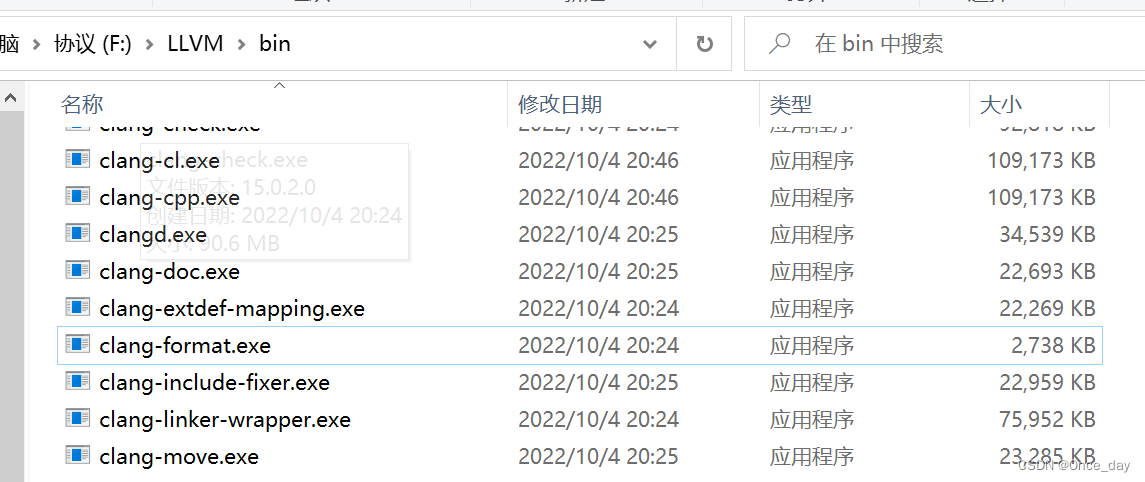
将该目录加进
PATH环境变量中即可(安装时有这个选项,也可以手动添加)。此外,诸如VScode,其C/C++扩展插件自带一个捆绑的clang-format和clang-tidy,但是版本可能并不是最新的。
在Linux下,也可以之间通过包管理器来安装:
sudo apt install clang-format- 1
注意,该版本同样大概率不是最新的,因此一些特性是无法使用的。
2. 配置字段解释
2.1 language 编程语言
# 语言: None, Cpp, Java, JavaScript, ObjC, Proto, TableGen, TextProto Language: Cpp- 1
- 2
可以指定当前配置文件为了哪些文件配置的。
2.2 BaseOnStyle 基础风格
BasedOnStyle: LLVM|Google|Chromium|Mozilla|WebKit|Microsoft|GNU- 1
指定基本的风格样式,实际开发时无需从头开始指定所有的格式。
2.3 AccessModifierOffset 访问性修饰符偏移
# 访问说明符(public、private等)的偏移(缩进或者对齐) AccessModifierOffset: -4- 1
- 2
这个是相对于原来已有的缩进而言:
template//模板定义 // template 较老的实现 class stack //定义一个模板类 { private: //私有是默认属性,可省略 //类声明中无法给没有分配空间的变量赋值(只是一起声明了一类变量) //某些常量或者静态常量变量(含有存储空间)则可以初始化 int var; } - 1
- 2
- 3
- 4
- 5
- 6
- 7
- 8
- 9
原来的缩进是4个空白字符,这个表明在原来缩进4个字符的情况下偏移量,即回退4个字符,那相当于不缩进了。
2.4 AlignAfterOpenBracket 开括号后的对齐
# 开括号(开圆括号、开尖括号、开方括号)后的对齐: Align, DontAlign, AlwaysBreak(总是在开括号后换行) AlignAfterOpenBracket: Align- 1
- 2
-
Align,在开括号之后对齐变量someLongFunction(argument1, argument2);- 1
- 2
-
DontAlign, 不对齐,换行后使用ContinuationIndentWidth。someLongFunction(argument1, argument2);- 1
- 2
-
AlwaysBreak,一行放不下时,总是在一个开括号之后换行。someLongFunction( argument1, argument2);- 1
- 2
-
BlockIndext,一行放不下时,总是在一个开括号之后换行,且在新行关闭尾括号。仅限于圆括号。someLongFunction( argument1, argument2 )- 1
- 2
- 3
2.5 AlignArrayOfStructures 对齐结构体数组
当数组的列数相等时,会对齐每行的文本。
Left,左对齐列:
struct test demo[] = { {56, 23, "hello"}, {-1, 93463, "world"}, {7, 5, "!!" } };- 1
- 2
- 3
- 4
- 5
- 6
Right,右对齐列:
struct test demo[] = { {56, 23, "hello"}, {-1, 93463, "world"}, { 7, 5, "!!"} };- 1
- 2
- 3
- 4
- 5
- 6
使用
None表示不用对齐。2.6 AlignConsecutiveAssignments 对齐连续赋值
# 连续赋值时,对齐所有等号 AlignConsecutiveAssignments: true- 1
- 2
下面的格式是连续赋值:
int a = 1; int somelongname = 2; double c = 3;- 1
- 2
- 3
该选项有两种生效方法,低版本只支持指定固定的模式,如下面其中一种:
#配置一个参数:None - Consecutive - AcrossEmptyLines - AcrossComments - AcrossEmptyLinesAndComments AlignConsecutiveAssignments: AcrossEmptyLinesAndComments- 1
- 2
最新版本支持分别指定属性,包括额外对混合元素符(+=等)的支持:
AlignConsecutiveAssignments: Enabled: true AcrossEmptyLines: true AcrossComments: true AlignCompound: true PadOperators: true- 1
- 2
- 3
- 4
- 5
- 6
bool Enabled: true默认的连续赋值对齐在以下的情况下生效:
int a = 1; int somelongname = 2; double c = 3; int aaaa : 1; int b : 12; int ccc : 8; int aaaa = 12; float b = 23; std::string ccc;- 1
- 2
- 3
- 4
- 5
- 6
- 7
- 8
- 9
- 10
- 11
bool AcrossEmptyLines可以跨越空白行进行对齐
true: int a = 1; int somelongname = 2; double c = 3; int d = 3; false: int a = 1; int somelongname = 2; double c = 3; int d = 3;- 1
- 2
- 3
- 4
- 5
- 6
- 7
- 8
- 9
- 10
- 11
- 12
- 13
bool AcrossComments可以跨越注释行进行对齐
true: int d = 3; /* A comment. */ double e = 4; false: int d = 3; /* A comment. */ double e = 4;- 1
- 2
- 3
- 4
- 5
- 6
- 7
- 8
- 9
bool AlignCompound混合运算符+=会对齐于=(仅限于连续赋值)
true: a &= 2; bbb = 2; false: a &= 2; bbb = 2;- 1
- 2
- 3
- 4
- 5
- 6
- 7
bool PadOperators混合运算符填补对齐到所有左值的最右边边界。(仅限于连续赋值)
true: a >>= 2; bbb = 2; a = 2; bbb >>= 2; false: a >>= 2; bbb = 2; a = 2; bbb >>= 2;- 1
- 2
- 3
- 4
- 5
- 6
- 7
- 8
- 9
- 10
- 11
- 12
- 13
2.7 AlignConsecutiveBitFields 位段对齐
主要用于结构体位段的对齐,如下:
struct aa { int test : 4; int b : 5; int c : 8; };- 1
- 2
- 3
- 4
- 5
其支持以下属性:
None - Consecutive - AcrossEmptyLines - AcrossComments - AcrossEmptyLinesAndComments- 1
其设置方法和属性与
AlignConsecutiveAssignments一致。AlignConsecutiveBitFields: AcrossEmptyLinesAndComments #或者 AlignConsecutiveBitFields: Enabled: true AcrossEmptyLines: true AcrossComments: true- 1
- 2
- 3
- 4
- 5
- 6
2.8 AlignConsecutiveDeclarations 连续声明对齐
可以对齐变量等连续声明的语句。
int aaaa = 12; float b = 23; std::string ccc; const char hexdigits[] = "0123456789abcdef"; void Ipv6_deal(const uint16_t *a); int main(const uint16_t *a, const uint16_t *k) { ... }- 1
- 2
- 3
- 4
- 5
- 6
- 7
需要注意,这个方法配置最好不要跨过空白行,因为容易把函数定义也给对齐了。
其支持以下属性:
None - Consecutive - AcrossEmptyLines - AcrossComments - AcrossEmptyLinesAndComments- 1
其设置方法和属性与
AlignConsecutiveAssignments一致。AlignConsecutiveDeclarations: AcrossComments #或者 AlignConsecutiveDeclarations: Enabled: true AcrossEmptyLines: false AcrossComments: true- 1
- 2
- 3
- 4
- 5
- 6
2.9 AlignConsecutiveMacros 连续宏定义对齐
#define SHORT_NAME 42 #define LONGER_NAME 0x007f #define EVEN_LONGER_NAME (2) #define foo(x) (x * x) #define bar(y, z) (y + z)- 1
- 2
- 3
- 4
- 5
需要注意,这个方法配置最好不要跨过空白行,因为空白行可以用来做段分割符。
其支持以下属性:
None - Consecutive - AcrossEmptyLines - AcrossComments - AcrossEmptyLinesAndComments- 1
其设置方法和属性与
AlignConsecutiveAssignments一致。AlignConsecutiveMacros: AcrossComments #或者 AlignConsecutiveMacros: Enabled: true AcrossEmptyLines: false AcrossComments: true- 1
- 2
- 3
- 4
- 5
- 6
2.10 AlignEscapedNewlines 对齐分割语法行的斜杠符
\有三个选项:
DontAlign、Left、Right左对齐,是尽可能的向左边对齐。
true: #define A \ int aaaa; \ int b; \ int dddddddddd;- 1
- 2
- 3
- 4
- 5
右对齐是对齐到列的最右边:
#define A \ int aaaa; \ int b; \ int dddddddddd;- 1
- 2
- 3
- 4
2.11 AlignOperands 竖直对齐表达式的操作数
竖直对齐二元表达式或者三元表达式操作数。
可用选项有:
DontAlign,Align,AlignAfterOperators对齐操作符是在需要换行时来起作用的,如下:
int aaa = bbbbbbbbbbbbbbb + ccccccccccccccc;- 1
- 2
如果指定
BreakBeforeBinaryOperators,那么操作符+也会被换行。int aaa = bbbbbbbbbbbbbbb + ccccccccccccccc;- 1
- 2
AlignAfterOperators选项是当BreakBeforeBinaryOperators被设置时,会将操作符对齐:int aaa = bbbbbbbbbbbbbbb + ccccccccccccccc;- 1
- 2
2.12 AlignTrailingComments 对齐尾部注释
旧版本是bool值,直接使用true或者false。(16版本才执行下面的语法)
True等价于,Always + OverEmptyLines: 0。
AlignTrailingComments: Kind: Always OverEmptyLines: 1- 1
- 2
- 3
Kind的值可以选择为:Leave,Always,Never。leave保留不做格式化:int a; // comment int ab; // comment int abc; // comment int abcd; // comment- 1
- 2
- 3
- 4
- 5
Always对齐尾部注释:int a; // comment int ab; // comment int abc; // comment int abcd; // comment- 1
- 2
- 3
- 4
- 5
Never不对齐尾部注释,但是应用其他的格式化手段,如缩进。int a; // comment int ab; // comment int abc; // comment int abcd; // comment- 1
- 2
- 3
- 4
- 5
OverEmptyLines是跨越的空白行数,超过这个行数的注释不会对齐(分别对齐自身所属段)。int a; // these are int ab; // aligned int abcdef; // but this isn't- 1
- 2
- 3
- 4
- 5
- 6
2.13 AllowAllArgumentsOnNextLine 允许参数在下一行上
如果函数调用或带括号的初始化列表不在一行中,则允许将所有参数放到下一行,即使
BinPackArguments为false。AllowAllArgumentsOnNextLine: true- 1
true: callFunction( a, b, c, d); false: callFunction(a, b, c, d);- 1
- 2
- 3
- 4
- 5
- 6
- 7
- 8
- 9
2.14 AllowAllConstructorInitializersOnNextLine 已弃用
See
NextLineofPackConstructorInitializers.2.15 AllowAllParametersOfDeclarationOnNextLine 允许声明的参数在下一行上
函数声明的参数无法放在一行上,允许将所有的变量放在下一行上,尽管
BinPackParametersisfalse。true: void myFunction( int a, int b, int c, int d, int e); false: void myFunction(int a, int b, int c, int d, int e);- 1
- 2
- 3
- 4
- 5
- 6
- 7
- 8
- 9
- 10
2.16 AllowShortBlocksOnASingleLine 允许短语法块在单行上
根据情况,
while (true) { continue;}可以放在单行上。可以是以下值:
Never,Empty,Always。Never从不合并块到单行上。while (true) { } while (true) { continue; }- 1
- 2
- 3
- 4
- 5
Empty只合并空块到单行上。while (true) {} while (true) { continue; }- 1
- 2
- 3
- 4
Always总是合并短块到单行上。while (true) {} while (true) { continue; }- 1
- 2
2.17 AllowShortEnumsOnASingleLine 允许短枚举在单行上
true: enum { A, B } myEnum; false: enum { A, B } myEnum;- 1
- 2
- 3
- 4
- 5
- 6
- 7
- 8
2.18 AllowShortFunctionsOnASingleLine 允许短函数在单行上
根据情况,
int f() { return 0;}可以被放在单行上。可以选择以下值:
None,InlineOnly,Empty,Inline,ALL。None从不合并函数到单行。InlineOnly仅合并被定义在类里面的短函数,与Inline区别在于不含外部顶级定义的空函数。class Foo { void f() { foo(); } }; void f() { foo(); } void f() { }- 1
- 2
- 3
- 4
- 5
- 6
- 7
- 8
Empty只合并空函数。void f() {} void f2() { bar2(); }- 1
- 2
- 3
- 4
Inline合并被定义在类里面的短函数,以及空函数。class Foo { void f() { foo(); } }; void f() { foo(); } void f() {}- 1
- 2
- 3
- 4
- 5
- 6
- 7
All合并所有合适的短函数在单行上。class Foo { void f() { foo(); } }; void f() { bar(); }- 1
- 2
- 3
- 4
2.19 AllowShortIfStatementsOnASingleLine 允许if块在单行上
只对没有括号的语句块起作用,如
if (a) return;有以下的选项:
Never,WithoutElse,OnlyFirstIf,AllIfsAndElseNever从不把if块放在单行上。if (a) return; if (b) return; else return; if (c) return; else { return; }- 1
- 2
- 3
- 4
- 5
- 6
- 7
- 8
- 9
- 10
- 11
- 12
- 13
WithoutElse,仅在没有else语句时才会把if放在单行上。if (a) return; if (b) return; else return; if (c) return; else { return; }- 1
- 2
- 3
- 4
- 5
- 6
- 7
- 8
- 9
- 10
- 11
- 12
OnlyFirstIf只把第一个if语句放在单行,后续的else if和else都不会放在单行上。if (a) return; if (b) return; else if (b) return; else return; if (c) return; else { return; }- 1
- 2
- 3
- 4
- 5
- 6
- 7
- 8
- 9
- 10
- 11
- 12
AllIfsAndElse总是把短语句放在单行上。if (a) return; if (b) return; else return; if (c) return; else { return; }- 1
- 2
- 3
- 4
- 5
- 6
- 7
- 8
- 9
2.20 AllowShortLambdasOnASingleLine 允许短匿Lambda函数在单行上
只针对形式
auto lambda []() {return 0;}。有以下选项:
None,Empty,Inline,All。None从不合并。Empty只合并空的Lambda函数。auto lambda = [](int a) {}; auto lambda2 = [](int a) { return a; };- 1
- 2
- 3
- 4
Inline,当Lambda函数作为变量时,合并在单行上。auto lambda = [](int a) { return a; }; sort(a.begin(), a.end(), []() { return x < y; });- 1
- 2
- 3
- 4
All合并所有适合的Lambda表达式在单行上。auto lambda = [](int a) {}; auto lambda2 = [](int a) { return a; };- 1
- 2
2.21 AllowShortLoopsOnASingleLine 允许合并短循环到单行上
当配置为
true时,形式while (true) continue会被放在单行上。2.22 AlwaysBreakAfterDefinitionReturnType 函数定义返回类型换行风格
该选项已经弃用.
None,返回类型之后自动断行,PenaltyReturnTypeOnItsOwnLine需要考虑在内。All,总是在返回类型后断行。TopLevel总是在顶级函数的返回类型处断行。
2.23 AlwaysBreakAfterReturnType 函数声明的返回类型换行风格
有以下的选项:
None,All,TopLevel,AllDefinitions,TopLevelDefinitionsNone在返回类型之后自动断行,PenaltyReturnTypeOnItsOwnLine需要考虑在内。class A { int f() { return 0; }; }; int f(); int f() { return 1; }- 1
- 2
- 3
- 4
- 5
All总是在返回类型之后断行.class A { int f() { return 0; }; }; int f(); int f() { return 1; }- 1
- 2
- 3
- 4
- 5
- 6
- 7
- 8
- 9
- 10
- 11
- 12
TopLevel在顶级函数顶级返回类型处断行。class A { int f() { return 0; }; }; int f(); int f() { return 1; }- 1
- 2
- 3
- 4
- 5
- 6
- 7
- 8
- 9
AllDefinitions在函数定义的返回类型处断行。class A { int f() { return 0; }; }; int f(); int f() { return 1; }- 1
- 2
- 3
- 4
- 5
- 6
- 7
- 8
- 9
- 10
- 11
TopLevelDefinitions在顶级函数定义的返回类型处断行。class A { int f() { return 0; }; }; int f(); int f() { return 1; }- 1
- 2
- 3
- 4
- 5
- 6
- 7
- 8
2.24 AlwaysBreakBeforeMultilineStrings 多行字符串断行
在多行字符串字面量时之前断行。
如下(只有当字符串需要换行时,才会生效):
true: false: aaaa = vs. aaaa = "bbbb" "bbbb" "cccc"; "cccc";- 1
- 2
- 3
- 4
2.25 AlwaysBreakTemplateDeclarations 模板声明断行
有三个选项:
No,MultiLine,YesNo不会强制在模板声明处断行,需要考虑PenaltyBreakTemplateDeclaration。templateT foo() { } template T foo(int aaaaaaaaaaaaaaaaaaaaa, int bbbbbbbbbbbbbbbbbbbbb) { } - 1
- 2
- 3
- 4
- 5
MultiLine仅在接下来的函数/类声明参数需要跨行时才会在模板处断行。templateT foo() { } template T foo(int aaaaaaaaaaaaaaaaaaaaa, int bbbbbbbbbbbbbbbbbbbbb) { } - 1
- 2
- 3
- 4
- 5
- 6
Yes总是在模板声明之后进行断行。templateT foo() { } template T foo(int aaaaaaaaaaaaaaaaaaaaa, int bbbbbbbbbbbbbbbbbbbbb) { } - 1
- 2
- 3
- 4
- 5
- 6
- 7
2.26 AttributeMacros 属性宏
应该被解释为属性/限定符而不是标识符的字符串向量。这对于语言扩展或静态分析器注释非常有用。
下面是一个配置的例子:
x = (char *__capability)&y; int function(void) __ununsed; void only_writes_to_buffer(char *__output buffer);- 1
- 2
- 3
.clang-format配置文件,可以被配置成下面这样:AttributeMacros: ['__capability', '__output', '__ununsed'] #或者 AttributeMacros: - __capability - __output - __ununsed- 1
- 2
- 3
- 4
- 5
- 6
2.27 BinPackArguments 装箱变量
如果为
false,函数调用变量要么都在同一行上,要么每个变量都独自在一行。如果
true,则会把变量合理打包放在一行上,显得更紧凑。true: void f() { f(aaaaaaaaaaaaaaaaaaaa, aaaaaaaaaaaaaaaaaaaa, aaaaaaaaaaaaaaaaaaaaaaaaaaaaaaaaaaaaaaaaaaa); } false: void f() { f(aaaaaaaaaaaaaaaaaaaa, aaaaaaaaaaaaaaaaaaaa, aaaaaaaaaaaaaaaaaaaaaaaaaaaaaaaaaaaaaaaaaaa); }- 1
- 2
- 3
- 4
- 5
- 6
- 7
- 8
- 9
- 10
- 11
- 12
2.28 BinPackParameters 装箱声明参数
如果
false,函数声明的参数或者函数定义的参数要么在同一行上,要么每个变量都独自在一行。如果
true,则会把变量合理打包放在一行上,显得更紧凑。true: void f(int aaaaaaaaaaaaaaaaaaaa, int aaaaaaaaaaaaaaaaaaaa, int aaaaaaaaaaaaaaaaaaaaaaaaaaaaaaaaaaaaaaaaaaa) {} false: void f(int aaaaaaaaaaaaaaaaaaaa, int aaaaaaaaaaaaaaaaaaaa, int aaaaaaaaaaaaaaaaaaaaaaaaaaaaaaaaaaaaaaaaaaa) {}- 1
- 2
- 3
- 4
- 5
- 6
- 7
- 8
2.29 BitFieldColonSpacing 位段列的空白风格
可选以下值:
Both,None,Before,Afterboth在:号每边都增加一个空白。unsigned bf : 2;- 1
None不加任何空白,除了AlignConsecutiveBitFields需要之外。unsigned bf:2;- 1
Before仅在:号之前添加空白。unsigned bf :2;- 1
After仅在:之后添加空白,除了AlignConsecutiveBitFields需要在前面添加空白之外。unsigned bf: 2;- 1
2.30 BraceWrapping 大括号换行风格
控制单独的大括号换行情况。
如果
breakbeforebrace设置为BS_Custom,则使用它来指定应该如何处理每个独立的大括号情况。否则,它将被忽略。# Example of usage: BreakBeforeBraces: Custom BraceWrapping: AfterEnum: true AfterStruct: false SplitEmptyFunction: false- 1
- 2
- 3
- 4
- 5
- 6
以下是具体的属性设置。
bool AfterCaseLabel,对case后面的大括号换行。false: true: switch (foo) { vs. switch (foo) { case 1: { case 1: bar(); { break; bar(); } break; default: { } plop(); default: } { } plop(); } }- 1
- 2
- 3
- 4
- 5
- 6
- 7
- 8
- 9
- 10
- 11
- 12
bool AfterClass类定义换行。true: class foo {}; false: class foo {};- 1
- 2
- 3
- 4
- 5
- 6
AfterControlStatement,对语句if/for/while/switch/...的换行风格控制。-
Never在控制条件语句之后从不换行。if (foo()) { } else { } for (int i = 0; i < 10; ++i) { }- 1
- 2
- 3
- 4
- 5
-
MultiLine只在一个多行控制语句之后换行。if (foo && bar && baz) { quux(); } while (foo || bar) { }- 1
- 2
- 3
- 4
- 5
- 6
- 7
-
Always在控制语句之后总是换行。if (foo()) { } else {} for (int i = 0; i < 10; ++i) {}- 1
- 2
- 3
- 4
- 5
- 6
bool AfterEnum枚举定义后大括号换行。true: enum X : int { B }; false: enum X : int { B };- 1
- 2
- 3
- 4
- 5
- 6
- 7
- 8
bool AfterFunction在函数定义之后大括号换行。true: void foo() { bar(); bar2(); } false: void foo() { bar(); bar2(); }- 1
- 2
- 3
- 4
- 5
- 6
- 7
- 8
- 9
- 10
- 11
- 12
bool AfterNamespace命名空间后换行。true: namespace { int foo(); int bar(); } false: namespace { int foo(); int bar(); }- 1
- 2
- 3
- 4
- 5
- 6
- 7
- 8
- 9
- 10
- 11
- 12
bool AfterObjCDeclaration在ObjC定义之后换行,@autoreleasepool 和 @synchronized 块根据AfterControlStatement标志换行。bool AfterStruct结构体定义之后换行。true: struct foo { int x; }; false: struct foo { int x; };- 1
- 2
- 3
- 4
- 5
- 6
- 7
- 8
- 9
- 10
bool AfterUnion联合定义之后换行。true: union foo { int x; } false: union foo { int x; }- 1
- 2
- 3
- 4
- 5
- 6
- 7
- 8
- 9
- 10
bool AfterExternBlockextern声明之后换行。true: extern "C" { int foo(); } false: extern "C" { int foo(); }- 1
- 2
- 3
- 4
- 5
- 6
- 7
- 8
- 9
- 10
bool BeforeCatch在catch之前换行。true: try { foo(); } catch () { } false: try { foo(); } catch () { }- 1
- 2
- 3
- 4
- 5
- 6
- 7
- 8
- 9
- 10
- 11
- 12
bool BeforeElse在else之前换行。true: if (foo()) { } else { } false: if (foo()) { } else { }- 1
- 2
- 3
- 4
- 5
- 6
- 7
- 8
- 9
- 10
bool BeforeLambdaBody在Lambda表达式块之前换行。true: connect( []() { foo(); bar(); }); false: connect([]() { foo(); bar(); });- 1
- 2
- 3
- 4
- 5
- 6
- 7
- 8
- 9
- 10
- 11
- 12
- 13
bool BeforeWhile在while之前换行。true: do { foo(); } while (1); false: do { foo(); } while (1);- 1
- 2
- 3
- 4
- 5
- 6
- 7
- 8
- 9
- 10
bool IndentBraces对换行的大括号缩进。bool SplitEmptyFunction如果为false,空函数体可以放在单行上。此选项仅在函数的左大括号已经被换行的情况下使用,即设置了AfterFunction大括号换行模式,并且函数不应该放在单行上(根据AllowShortFunctionsOnASingleLine和构造函数格式选项)。false: true: int f() vs. int f() {} { }- 1
- 2
- 3
- 4
bool SplitEmptyRecord如果为false,空记录(例如类、结构或联合)主体可以放在单行上。此选项仅在记录的开始大括号已经被换行的情况下使用,即设置了AfterClass(用于类)大括号换行模式。false: true: class Foo vs. class Foo {} { }- 1
- 2
- 3
- 4
bool SplitEmptyNamespace如果为false,空的namespace主体可以放在单行上。此选项仅在命名空间的开始大括号已经被换行的情况下使用,即设置了AfterNamespace大括号换行模式。false: true: namespace Foo vs. namespace Foo {} { }- 1
- 2
- 3
- 4
2.31 BreakAfterJavaFieldAnnotations 在修饰器之后断行
true: false: @Partial vs. @Partial @Mock DataLoad loader; @Mock DataLoad loader;- 1
- 2
- 3
- 4
2.32 BreakArrays Json数组断行
版本16支持,仅用于格式化Json数组。
如果为true, clang-format将总是在Json数组之后断行,否则它将扫描到结束,以确定是否应该在元素之间添加换行符(兼容更漂亮的格式)。
true: false: [ vs. [1, 2, 3, 4] 1, 2, 3, 4 ]- 1
- 2
- 3
- 4
- 5
- 6
- 7
2.33 BreakBeforeBinaryOperators 二元操作符断行
用于对二元操作符断行,支持以下选项:
None在操作符之后断行。LooooooooooongType loooooooooooooooooooooongVariable = someLooooooooooooooooongFunction(); bool value = aaaaaaaaaaaaaaaaaaaaaaaaaaaaaaaaaaaaaaaaaaaaa + aaaaaaaaaaaaaaaaaaaaaaaaaaaaaaaaaaaaa == aaaaaaaaaaaaaaaaaaaaaaaaaaaaaaaaaaaaaaaaa && aaaaaaaaaaaaaaaaaaaaaaaaaaaaaaaaaaaaaaaaaaaaa > ccccccccccccccccccccccccccccccccccccccccc;- 1
- 2
- 3
- 4
- 5
- 6
- 7
- 8
NonAssignment只在非赋值操作符之前断行。LooooooooooongType loooooooooooooooooooooongVariable = someLooooooooooooooooongFunction(); bool value = aaaaaaaaaaaaaaaaaaaaaaaaaaaaaaaaaaaaaaaaaaaaa + aaaaaaaaaaaaaaaaaaaaaaaaaaaaaaaaaaaaa == aaaaaaaaaaaaaaaaaaaaaaaaaaaaaaaaaaaaaaaaa && aaaaaaaaaaaaaaaaaaaaaaaaaaaaaaaaaaaaaaaaaaaaa > ccccccccccccccccccccccccccccccccccccccccc;- 1
- 2
- 3
- 4
- 5
- 6
- 7
- 8
All在操作符之前断行。LooooooooooongType loooooooooooooooooooooongVariable = someLooooooooooooooooongFunction(); bool value = aaaaaaaaaaaaaaaaaaaaaaaaaaaaaaaaaaaaaaaaaaaaa + aaaaaaaaaaaaaaaaaaaaaaaaaaaaaaaaaaaaa == aaaaaaaaaaaaaaaaaaaaaaaaaaaaaaaaaaaaaaaaa && aaaaaaaaaaaaaaaaaaaaaaaaaaaaaaaaaaaaaaaaaaaaa > ccccccccccccccccccccccccccccccccccccccccc;- 1
- 2
- 3
- 4
- 5
- 6
- 7
- 8
2.34 BreakBeforeBraces 大括号断行风格
指定大括号断行风格,有以下的选项。
Attach总是将大括号附加到周围的上下文。namespace N { enum E { E1, E2, }; class C { public: C(); }; bool baz(int i) { try { do { switch (i) { case 1: { foobar(); break; } default: { break; } } } while (--i); return true; } catch (...) { handleError(); return false; } } void foo(bool b) { if (b) { baz(2); } else { baz(5); } } void bar() { foo(true); } } // namespace N- 1
- 2
- 3
- 4
- 5
- 6
- 7
- 8
- 9
- 10
- 11
- 12
- 13
- 14
- 15
- 16
- 17
- 18
- 19
- 20
- 21
- 22
- 23
- 24
- 25
- 26
- 27
- 28
- 29
- 30
- 31
- 32
- 33
- 34
- 35
- 36
- 37
- 38
- 39
- 40
- 41
Linux和Attach类似,但是会在函数、命名空间namespace和类定义之前换行。namespace N { enum E { E1, E2, }; class C { public: C(); }; bool baz(int i) { try { do { switch (i) { case 1: { foobar(); break; } default: { break; } } } while (--i); return true; } catch (...) { handleError(); return false; } } void foo(bool b) { if (b) { baz(2); } else { baz(5); } } void bar() { foo(true); } } // namespace N- 1
- 2
- 3
- 4
- 5
- 6
- 7
- 8
- 9
- 10
- 11
- 12
- 13
- 14
- 15
- 16
- 17
- 18
- 19
- 20
- 21
- 22
- 23
- 24
- 25
- 26
- 27
- 28
- 29
- 30
- 31
- 32
- 33
- 34
- 35
- 36
- 37
- 38
- 39
- 40
- 41
- 42
- 43
- 44
- 45
Mozilla和Attach类似,但是会在枚举、函数、record定义之前换行。namespace N { enum E { E1, E2, }; class C { public: C(); }; bool baz(int i) { try { do { switch (i) { case 1: { foobar(); break; } default: { break; } } } while (--i); return true; } catch (...) { handleError(); return false; } } void foo(bool b) { if (b) { baz(2); } else { baz(5); } } void bar() { foo(true); } } // namespace N- 1
- 2
- 3
- 4
- 5
- 6
- 7
- 8
- 9
- 10
- 11
- 12
- 13
- 14
- 15
- 16
- 17
- 18
- 19
- 20
- 21
- 22
- 23
- 24
- 25
- 26
- 27
- 28
- 29
- 30
- 31
- 32
- 33
- 34
- 35
- 36
- 37
- 38
- 39
- 40
- 41
- 42
- 43
- 44
- 45
Stroustrup和Attach类似,但是在函数定义、catch、else之前换行。namespace N { enum E { E1, E2, }; class C { public: C(); }; bool baz(int i) { try { do { switch (i) { case 1: { foobar(); break; } default: { break; } } } while (--i); return true; } catch (...) { handleError(); return false; } } void foo(bool b) { if (b) { baz(2); } else { baz(5); } } void bar() { foo(true); } } // namespace N- 1
- 2
- 3
- 4
- 5
- 6
- 7
- 8
- 9
- 10
- 11
- 12
- 13
- 14
- 15
- 16
- 17
- 18
- 19
- 20
- 21
- 22
- 23
- 24
- 25
- 26
- 27
- 28
- 29
- 30
- 31
- 32
- 33
- 34
- 35
- 36
- 37
- 38
- 39
- 40
- 41
- 42
- 43
- 44
- 45
Allman总是会在大括号之前断行。namespace N { enum E { E1, E2, }; class C { public: C(); }; bool baz(int i) { try { do { switch (i) { case 1: { foobar(); break; } default: { break; } } } while (--i); return true; } catch (...) { handleError(); return false; } } void foo(bool b) { if (b) { baz(2); } else { baz(5); } } void bar() { foo(true); } } // namespace N- 1
- 2
- 3
- 4
- 5
- 6
- 7
- 8
- 9
- 10
- 11
- 12
- 13
- 14
- 15
- 16
- 17
- 18
- 19
- 20
- 21
- 22
- 23
- 24
- 25
- 26
- 27
- 28
- 29
- 30
- 31
- 32
- 33
- 34
- 35
- 36
- 37
- 38
- 39
- 40
- 41
- 42
- 43
- 44
- 45
- 46
- 47
- 48
- 49
- 50
- 51
- 52
- 53
- 54
- 55
- 56
Whitesmiths和Allman类似,但是始终要缩进大括号并使用大括号排列代码。namespace N { enum E { E1, E2, }; class C { public: C(); }; bool baz(int i) { try { do { switch (i) { case 1: { foobar(); break; } default: { break; } } } while (--i); return true; } catch (...) { handleError(); return false; } } void foo(bool b) { if (b) { baz(2); } else { baz(5); } } void bar() { foo(true); } } // namespace N- 1
- 2
- 3
- 4
- 5
- 6
- 7
- 8
- 9
- 10
- 11
- 12
- 13
- 14
- 15
- 16
- 17
- 18
- 19
- 20
- 21
- 22
- 23
- 24
- 25
- 26
- 27
- 28
- 29
- 30
- 31
- 32
- 33
- 34
- 35
- 36
- 37
- 38
- 39
- 40
- 41
- 42
- 43
- 44
- 45
- 46
- 47
- 48
- 49
- 50
- 51
- 52
- 53
- 54
- 55
- 56
GNU总是在大括号之前断行,并在控制语句的大括号中增加额外的缩进级别,而在类、函数或其他定义的大括号中不会缩进大括号。namespace N { enum E { E1, E2, }; class C { public: C(); }; bool baz(int i) { try { do { switch (i) { case 1: { foobar(); break; } default: { break; } } } while (--i); return true; } catch (...) { handleError(); return false; } } void foo(bool b) { if (b) { baz(2); } else { baz(5); } } void bar() { foo(true); } } // namespace N- 1
- 2
- 3
- 4
- 5
- 6
- 7
- 8
- 9
- 10
- 11
- 12
- 13
- 14
- 15
- 16
- 17
- 18
- 19
- 20
- 21
- 22
- 23
- 24
- 25
- 26
- 27
- 28
- 29
- 30
- 31
- 32
- 33
- 34
- 35
- 36
- 37
- 38
- 39
- 40
- 41
- 42
- 43
- 44
- 45
- 46
- 47
- 48
- 49
- 50
- 51
- 52
- 53
- 54
- 55
- 56
- 57
WebKit和Attach类似,但是在函数之前断行。namespace N { enum E { E1, E2, }; class C { public: C(); }; bool baz(int i) { try { do { switch (i) { case 1: { foobar(); break; } default: { break; } } } while (--i); return true; } catch (...) { handleError(); return false; } } void foo(bool b) { if (b) { baz(2); } else { baz(5); } } void bar() { foo(true); } } // namespace N- 1
- 2
- 3
- 4
- 5
- 6
- 7
- 8
- 9
- 10
- 11
- 12
- 13
- 14
- 15
- 16
- 17
- 18
- 19
- 20
- 21
- 22
- 23
- 24
- 25
- 26
- 27
- 28
- 29
- 30
- 31
- 32
- 33
- 34
- 35
- 36
- 37
- 38
- 39
- 40
- 41
- 42
- 43
Custom,客制化配置每个大括号的情况。2.35 BreakBeforeConceptDeclarations 概念声明断行风格
有以下几种选项:
Never保持模板声明行和concept在一起。templateconcept C = ...; - 1
Allowed允许在模板声明和concept之间断行,实际的表现取决于上下文和断行规则。Always永远在concept之前断行,并且将该行放在模板声明之前。templateconcept C = ...; - 1
- 2
2.36 BreakBeforeTernaryOperators 三元操作符断行规则
如果为true,三元操作符将放在换行符之后。
true: veryVeryVeryVeryVeryVeryVeryVeryVeryVeryVeryLongDescription ? firstValue : SecondValueVeryVeryVeryVeryLong; false: veryVeryVeryVeryVeryVeryVeryVeryVeryVeryVeryLongDescription ? firstValue : SecondValueVeryVeryVeryVeryLong;- 1
- 2
- 3
- 4
- 5
- 6
- 7
- 8
- 9
2.37 BreakConstructorInitializers 构造初始化断行风格
有以下几种风格:
BeforeColon断行冒号前和逗号后的构造函数初始化式Constructor() : initializer1(), initializer2()- 1
- 2
- 3
BeforeComma在冒号和逗号之前断行构造函数的初始化式,并将逗号与冒号对齐。Constructor() : initializer1() , initializer2()- 1
- 2
- 3
AfterColon在冒号和逗号后面断行构造函数初始化式。Constructor() : initializer1(), initializer2()- 1
- 2
- 3
2.38 BreakInheritanceList 继承链断行风格
有以下选项。
BeforeColon在冒号之前,逗号之后断行继承链。class Foo : Base1, Base2 {};- 1
- 2
- 3
- 4
BeforeComma在冒号和逗号之前断行,并且对齐它们。class Foo : Base1 , Base2 {};- 1
- 2
- 3
- 4
AfterColon在冒号和逗号之后断行。class Foo : Base1, Base2 {};- 1
- 2
- 3
- 4
AfterComma仅在逗号之后进行断行。class Foo : Base1, Base2 {};- 1
- 2
- 3
2.39 BreakStringLiterals 字符串常量断行
允许对字符串字面量进行断行。
true: const char* x = "veryVeryVeryVeryVeryVe" "ryVeryVeryVeryVeryVery" "VeryLongString"; false: const char* x = "veryVeryVeryVeryVeryVeryVeryVeryVeryVeryVeryVeryLongString";- 1
- 2
- 3
- 4
- 5
- 6
- 7
- 8
2.40 ColumnLimit 列数限制
列限制为0表示没有列限制。在这种情况下,clang-format将尊重语句中的输入断行决定,除非它们与其他规则相冲突。
即在列数最大值为0时,则不会进行一行语句太长导致的换行。
2.41 CommentPragmas 注释表示
值为字符串,含有正则表达式,其描述具有特殊含义的注释,这些注释不应被分割成行或以其他方式更改。
CommentPragmas: '^ FOOBAR pragma:'- 1
// Will leave the following line unaffected #include// FOOBAR pragma: keep - 1
- 2
2.42 CompactNamespaces 紧凑命名空间
如果为true,则连续的名称空间声明将在同一行上。如果为false,则每个名称空间都在新行中声明。
true: namespace Foo { namespace Bar { }} false: namespace Foo { namespace Bar { } }- 1
- 2
- 3
- 4
- 5
- 6
- 7
- 8
- 9
如果一行放不下,那么就会换行。
namespace Foo { namespace Bar { namespace Extra { }}}- 1
- 2
- 3
2.43 ConstructorInitializerAllOnOneLineOrOnePerLine 构造初始化断行风格
选项已弃用, See
CurrentLineofPackConstructorInitializers.2.44 ConstructorInitializerIndentWidth 构造初始化缩进宽度
用于构造函数初始化列表和继承列表缩进的字符数,无符号整数。
2.45 ContinuationIndentWidth
延续下一行的缩进宽度,只原来一行放不下时,换行后,新行缩进的字符数。
ContinuationIndentWidth: 2 int i = // VeryVeryVeryVeryVeryLongComment longFunction( // Again a long comment arg);- 1
- 2
- 3
- 4
- 5
2.46 Cpp11BracedListStyle 大括号列表风格
重要区别:
- 括号列表中没有空格。
- 在结束大括号前不能换行。
- 用连续缩进,而不是用块缩进。
基本上,c++ 11的大括号列表的格式与函数调用的格式完全相同。如果括号列表后面跟着一个名称(例如类型或变量名),clang-format的格式就像{}是带有该名称的函数调用的圆括号一样。如果没有名称,则假定名称长度为零。
true: false: vectorx{1, 2, 3, 4}; vs. vector x{ 1, 2, 3, 4 }; vector x{{}, {}, {}, {}}; vector x{ {}, {}, {}, {} }; f(MyMap[{composite, key}]); f(MyMap[{ composite, key }]); new int[3]{1, 2, 3}; new int[3]{ 1, 2, 3 }; - 1
- 2
- 3
- 4
- 5
2.47 DeriveLineEnding 提取行结尾
分析格式化文件中最常用的行结尾(\r\n或\n)。
UseCRLF仅在无法派生任何方法时用作备用。2.48 DerivePointerAlignment 提取指针对齐
如果为true,分析格式化文件中
&和*最常见的对齐方式。指针和引用对齐样式将根据在文件中找到的首选项进行更新。然后,只将PointerAlignment用作备用。2.49 DisableFormat 禁用格式化
完全禁用格式化。
2.50 EmptyLineAfterAccessModifier 访问修饰符后空行
定义何时在访问修饰符之后放置空行。
EmptyLineBeforeAccessModifier配置处理两个访问修饰符之间的空行数。有以下的选项:
Never移除访问修饰符之后所有的空行。struct foo { private: int i; protected: int j; /* comment */ public: foo() {} private: protected: };- 1
- 2
- 3
- 4
- 5
- 6
- 7
- 8
- 9
- 10
- 11
Leave在访问修饰符之后保持现有的空行。取而代之的是MaxEmptyLinesToKeep。Always如果没有访问修饰符,总是在后面添加空行。MaxEmptyLinesToKeep也被应用。struct foo { private: int i; protected: int j; /* comment */ public: foo() {} private: protected: };- 1
- 2
- 3
- 4
- 5
- 6
- 7
- 8
- 9
- 10
- 11
- 12
- 13
- 14
- 15
- 16
2.51 EmptyLineBeforeAccessModifier 访问修饰符前空行
有以下选项:
Never移除访问修饰符之前的所有空行。struct foo { private: int i; protected: int j; /* comment */ public: foo() {} private: protected: };- 1
- 2
- 3
- 4
- 5
- 6
- 7
- 8
- 9
- 10
- 11
leave保留在访问符之间的空行。LogicalBlock只有当访问修饰符开始一个新的逻辑块时才添加空行。逻辑块是由一个或多个成员字段或函数组成的一组。struct foo { private: int i; protected: int j; /* comment */ public: foo() {} private: protected: };- 1
- 2
- 3
- 4
- 5
- 6
- 7
- 8
- 9
- 10
- 11
- 12
- 13
Always总是在访问修饰符之前添加空行,除非访问修饰符位于结构或类定义的开头。struct foo { private: int i; protected: int j; /* comment */ public: foo() {} private: protected: };- 1
- 2
- 3
- 4
- 5
- 6
- 7
- 8
- 9
- 10
- 11
- 12
- 13
- 14
- 15
2.52 ExperimentalAutoDetectBinPacking
实现性功能。
如果为true, clang-format将检测函数调用和定义是否使用每行一个参数进行格式化。
每个调用可以打包,每行一个或不确定。如果它是不确定的,例如完全在一行上,但需要做出决定,clang-format分析输入文件中是否有其他打包情况,并相应地采取行动。
注意:这是一个实验标志,它可能会消失或被重命名。不要在配置文件中使用它,等等。使用风险自负。
2.53 FixNamespaceComments 修复命名空间描述
如果为true, clang-format将为短名称空间添加丢失的“名称空间的结束注释”并修复无效的现有注释。短命名空间的换行风格由“ShortNamespaceLines”控制。
true: false: namespace a { vs. namespace a { foo(); foo(); bar(); bar(); } // namespace a }- 1
- 2
- 3
- 4
- 5
2.54 ForEachMacros 迭代循环宏
应该被解释为foreach循环而不是函数调用的宏向量。
它们应该具有以下的宏定义形式:
FOREACH(, ...) - 1
- 2
在
.clang-format配置文件里,可以被配置成以下形式:ForEachMacros: ['RANGES_FOR', 'FOREACH']- 1
2.55 IfMacros 条件判断宏
一组宏应该被解释为条件语句而不是函数调用。
它们应该具有以下的形式:
IF(...)else IF(...) - 1
- 2
- 3
- 4
在
.clang-format配置文件里,可以被配置成以下形式:IfMacros: ['IF']- 1
2.56 IncludeBlocks
include块风格根据该值,多个
#include块可以被排序为一个,并根据类别进行划分。Preserve,每个#include块单独排序。#include "b.h" into #include "b.h" #include#include "a.h" #include "a.h" #include - 1
- 2
- 3
- 4
Merge合并多个#include块,并且整体排序。#include "b.h" into #include "a.h" #include "b.h" #include#include #include "a.h" - 1
- 2
- 3
- 4
Regroup合并多个#include块,并且整体排序,然后根据类别优先级分组,可查询IncludeCategories。#include "b.h" into #include "a.h" #include "b.h" #include#include "a.h" #include - 1
- 2
- 3
- 4
2.57 IncludeCategories
include种类正则表达式表示不同的
#include类别,用于对#includes进行排序。支持POSIX扩展正则表达式(ERE)。
这些正则表达式按顺序匹配
include的文件名(包括<>或" ")。对匹配上的第一个匹配正则表达式的值进行赋值,#include首先根据类别数量的增加排序,然后在每个类别内按字母顺序排序。如果没有匹配的正则表达式,则赋值INT_MAX,并作为类别。源文件的主头文件自动获得类别0。因此它通常被保存在
#includes(https://llvm.org/docs/CodingStandards.html#include-style)的开头。但是,如果您有某些头文件总是需要放在首位,您也可以分配负优先级。在
IncludeBlocks = IBS_Regroup时,可以使用第三个可选字段SortPriority来定义优先级,其中#includes应该排序。Priority的值定义了#include块的顺序,还允许对具有不同优先级的#include进行分组。如果没有分配,SortPriority将被设置为Priority的默认值。每个正则表达式都可以用
CaseSensitive字段标记为区分大小写,默认情况下不区分大小写。可以像下面这样配置
.clang-format文件。IncludeCategories: - Regex: '^"(llvm|llvm-c|clang|clang-c)/' Priority: 2 SortPriority: 2 CaseSensitive: true - Regex: '^((<|")(gtest|gmock|isl|json)/)' Priority: 3 - Regex: '<[[:alnum:].]+>' Priority: 4 - Regex: '.*' Priority: 1 SortPriority: 0- 1
- 2
- 3
- 4
- 5
- 6
- 7
- 8
- 9
- 10
- 11
- 12
2.58 IncludeIsMainRegex 判断主包含的正则表达式
指定一个正则表达式,其表明了文件到主包含映射中被允许的后缀名。
当猜测一个
#include是否为“main” include(分配类别0,见上文)时,使用这个由允许后缀名组成的正则表达式到主干部分。部分匹配完成,因此:""表示“任意后缀”"$"表示“无后缀”
例如,如果配置为“(_test)?”$ “,则头文件
a.h将被视为a.cc和a_test.cc中的"主包含”。2.59 IncludeIsMainSourceRegex 判断源文件的正则表达式
为被格式化的文件指定正则表达式,匹配正则表达式的这些文件允许在文件到
main-include映射中被视为“main”。默认情况下,clang-format认为只有当文件以
.c,.cc,.cpp,.c++,.cxx,.m或.mm扩展名结尾时,文件才是" main "。对于这些文件,将进行“main”include的猜测(分配类别0,参见上面)。该配置选项允许为被视为“main”的文件添加额外的后缀和扩展名。例如,如果这个选项被配置为
(Impl.hpp)$,那么一个文件classimple .hpp被认为是" main "(此外还有Class.c,Class.c,Class.cpp)和“main include file”逻辑将被执行(IncludeIsMainRegex设置在后面的阶段也会被执行)。如果没有设置这个选项,classimple .hpp就不会把主包含文件放在任何其他包含文件之前。2.60 IndentAccessModifiers 访问修饰符缩进
指定访问修饰符是否应该有自己的缩进级别。
当为false时,访问修饰符相对于记录成员缩进(或向外缩进),根据
AccessModifierOffset。记录成员的缩进位置比记录低一级。当为true时,访问修饰符获得自己的缩进级别。因此,无论是否存在访问修饰符,记录成员总是在记录下方缩进2级。AccessModifierOffset的值被忽略。false: true: class C { vs. class C { class D { class D { void bar(); void bar(); protected: protected: D(); D(); }; }; public: public: C(); C(); }; }; void foo() { void foo() { return 1; return 1; } }- 1
- 2
- 3
- 4
- 5
- 6
- 7
- 8
- 9
- 10
- 11
- 12
- 13
2.61.1 IndentCaseBlocks
case块缩进缩进
case label将case label隔一层。当为
false时,case标签后面的块使用与case标签相同的缩进级别,将case标签视为if语句。当为true时,该块缩进为作用域块。false: true: switch (fool) { vs. switch (fool) { case 1: { case 1: bar(); { } break; bar(); default: { } plop(); break; } default: } { plop(); } }- 1
- 2
- 3
- 4
- 5
- 6
- 7
- 8
- 9
- 10
- 11
- 12
2.61.2 IndentCaseLabels
case label标签缩进从switch语句开始,缩进
cache label一个级别。当为false时,使用与switch语句相同的缩进级别。Switch语句体总是比case标签多缩进一级(除了case标签后面的第一个块,它本身缩进代码)。
当启用了IndentCaseBlocks之后,case标签后面的第一个块缩进级别会更多。
false: true: switch (fool) { vs. switch (fool) { case 1: case 1: bar(); bar(); break; break; default: default: plop(); plop(); } }- 1
- 2
- 3
- 4
- 5
- 6
- 7
- 8
2.62 IndentExternBlock
Extern扩展块缩进有以下的选线:
AfterExternBlock向后兼容AfterExternBlock的缩进,即按BraceWrapping.AfterExternBlock设置来进行格式化。IndentExternBlock: AfterExternBlock BraceWrapping.AfterExternBlock: true extern "C" { void foo(); }- 1
- 2
- 3
- 4
- 5
- 6
IndentExternBlock: AfterExternBlock BraceWrapping.AfterExternBlock: false extern "C" { void foo(); }- 1
- 2
- 3
- 4
- 5
NoIndent不缩进extern扩展块extern "C" { void foo(); }- 1
- 2
- 3
Indent缩进extern扩展块extern "C" { void foo(); }- 1
- 2
- 3
2.63 IndentGotoLabels 缩进
Goto跳转符号true: false: int f() { vs. int f() { if (foo()) { if (foo()) { label1: label1: bar(); bar(); } } label2: label2: return 1; return 1; } }- 1
- 2
- 3
- 4
- 5
- 6
- 7
- 8
- 9
2.64 IndentPPDirectives 预处理指令缩进
要使用的预处理器指令缩进样式。
None不缩进任何预处理器指示符。#if FOO #if BAR #include#endif #endif - 1
- 2
- 3
- 4
- 5
AfterHash缩进散列之后的指令。#if FOO # if BAR # include# endif #endif - 1
- 2
- 3
- 4
- 5
BeforeHash缩进散列之前的指令#if FOO #if BAR #include#endif #endif - 1
- 2
- 3
- 4
- 5
2.65 IndentRequiresClause 缩进要求子句
缩进模板中的require子句。这只适用于
RequiresClausePosition为OwnLine或WithFollowing时。在一些版本中,其名字为
IndentRequires。true: templaterequires Iterator void sort(It begin, It end) { //.... } false: template requires Iterator void sort(It begin, It end) { //.... } - 1
- 2
- 3
- 4
- 5
- 6
- 7
- 8
- 9
- 10
- 11
- 12
- 13
2.66 IndentWidth 缩进宽度
用于缩进的列数。
IndentWidth: 3 void f() { someFunction(); if (true, false) { f(); } }- 1
- 2
- 3
- 4
- 5
- 6
- 7
- 8
2.67 IndentWrappedFunctionNames 函数名缩进
如果函数定义或声明在类型之后换行,则缩进。
true: LoooooooooooooooooooooooooooooooooooooooongReturnType LoooooooooooooooooooooooooooooooongFunctionDeclaration(); false: LoooooooooooooooooooooooooooooooooooooooongReturnType LoooooooooooooooooooooooooooooooongFunctionDeclaration();- 1
- 2
- 3
- 4
- 5
- 6
- 7
2.68 InsertBraces 插入括号
在c++中,在控制语句(if、else、for、do和while)后面插入大括号,除非控制语句在宏定义中,或者大括号包含预处理程序指令。
将此选项设置为true可能导致错误的代码格式,因为clang-format缺乏完整的语义信息。因此,在检查此选项所做的代码更改时应格外小心。
false: true: if (isa(D)) vs. if (isa (D)) { handleFunctionDecl(D); handleFunctionDecl(D); else if (isa (D)) } else if (isa (D)) { handleVarDecl(D); handleVarDecl(D); else } else { return; return; } while (i--) vs. while (i--) { for (auto *A : D.attrs()) for (auto *A : D.attrs()) { handleAttr(A); handleAttr(A); } } do vs. do { --i; --i; while (i); } while (i); - 1
- 2
- 3
- 4
- 5
- 6
- 7
- 8
- 9
- 10
- 11
- 12
- 13
- 14
- 15
- 16
- 17
- 18
- 19
2.69 InsertTrailingCommas 掺入尾部冒号
如果设置为TCS_Wrapped,则会在跨多行换行的容器字面量(数组和对象)中插入尾随逗号。它目前只对JavaScript可用,默认禁用
TCS_None。inserttrailingcomma不能与BinPackArguments一起使用,因为插入逗号将禁用bin-packing。TSC_Wrapped: const someArray = [ aaaaaaaaaaaaaaaaaaaaaaaaaa, aaaaaaaaaaaaaaaaaaaaaaaaaa, aaaaaaaaaaaaaaaaaaaaaaaaaa, // ^ inserted ]- 1
- 2
- 3
- 4
- 5
- 6
- 7
可以选
None或者Wrapped。2.70 JavaImportGroups
为Java导入按所需组排序的前缀向量。
一个组的前缀可以是另一个组的前缀子集——最长的前缀总是匹配的。在一个组中,导入是按字典顺序排列的。静态导入被单独分组,并遵循相同的分组规则。默认情况下,静态导入放置在非静态导入之前,但是这种行为由另一个选项
SortJavaStaticImport改变。在
.clang-format的配置文件中,可以像下面的yaml示例那样进行配置。这将导致导入的格式如下面的Java示例所示。JavaImportGroups: ['com.example', 'com', 'org']- 1
import static com.example.function1; import static com.test.function2; import static org.example.function3; import com.example.ClassA; import com.example.Test; import com.example.a.ClassB; import com.test.ClassC; import org.example.ClassD;- 1
- 2
- 3
- 4
- 5
- 6
- 7
- 8
- 9
- 10
- 11
- 12
- 13
2.71 JavaScriptQuotes Java引号风格
有以下选项:
Leave保持原始值不变。string1 = "foo"; string2 = 'bar';- 1
- 2
Single总是使用单引号。string1 = 'foo'; string2 = 'bar';- 1
- 2
Double总是使用双引号。string1 = "foo"; string2 = "bar";- 1
- 2
2.72 JavaScriptWrapImports
import/export语句换行true: import { VeryLongImportsAreAnnoying, VeryLongImportsAreAnnoying, VeryLongImportsAreAnnoying, } from 'some/module.js' false: import {VeryLongImportsAreAnnoying, VeryLongImportsAreAnnoying, VeryLongImportsAreAnnoying,} from "some/module.js"- 1
- 2
- 3
- 4
- 5
- 6
- 7
- 8
- 9
2.73 KeepEmptyLinesAtTheStartOfBlocks 在语法块开始留空行
true: false: if (foo) { vs. if (foo) { bar(); bar(); } }- 1
- 2
- 3
- 4
- 5
2.74 LambdaBodyIndentation Lambda表达式主体缩进
lambda体的缩进样式。Signature(默认值)导致lambda体相对于签名的缩进级别额外缩进一个级别。OuterScope强制lambda主体相对于包含lambda签名的父作用域额外缩进一级。对于回调较多的代码,将签名缩进两层并使用OuterScope可能会提高可读性。KJ风格指南需要OuterScope。可能的值:
Signature将lambda主体相对于lambda签名对齐。这是默认设置。someMethod( [](SomeReallyLongLambdaSignatureArgument foo) { return; });- 1
- 2
- 3
- 4
OuterScope相对于lambda签名所在的外部作用域的缩进级别对齐lambda主体。someMethod( [](SomeReallyLongLambdaSignatureArgument foo) { return; });- 1
- 2
- 3
- 4
2.75 Language 目标格式化编程语言
可能的值:
None,Cpp,CSharp,Java,JavaScript,Json,Objc,Proto,TableGen,TextProto,Verilog。2.76 MacroBlockBegin 开始块的宏
匹配启动块的宏的正则表达式。
# With: MacroBlockBegin: "^NS_MAP_BEGIN|\ NS_TABLE_HEAD$" MacroBlockEnd: "^\ NS_MAP_END|\ NS_TABLE_.*_END$" NS_MAP_BEGIN foo(); NS_MAP_END NS_TABLE_HEAD bar(); NS_TABLE_FOO_END # Without: NS_MAP_BEGIN foo(); NS_MAP_END NS_TABLE_HEAD bar(); NS_TABLE_FOO_END- 1
- 2
- 3
- 4
- 5
- 6
- 7
- 8
- 9
- 10
- 11
- 12
- 13
- 14
- 15
- 16
- 17
- 18
- 19
- 20
- 21
- 22
- 23
2.77 MacroBlockEnd 结束块的宏
详情见
2.76 MacroBlockBegin。2.78 MaxEmptyLinesToKeep 最大持续空行
要保留的连续空行的最大数目。
MaxEmptyLinesToKeep: 1 vs. MaxEmptyLinesToKeep: 0 int f() { int f() { int = 1; int i = 1; i = foo(); i = foo(); return i; } return i; }- 1
- 2
- 3
- 4
- 5
- 6
- 7
- 8
2.79 NamespaceIndentation 命名空间缩进
有以下的选项:
None,不缩进命名空间。namespace out { int i; namespace in { int i; } }- 1
- 2
- 3
- 4
- 5
- 6
Inner只缩进嵌套的命名空间。namespace out { int i; namespace in { int i; } }- 1
- 2
- 3
- 4
- 5
- 6
All缩进所有的命名空间。namespace out { int i; namespace in { int i; } }- 1
- 2
- 3
- 4
- 5
- 6
2.80 NamespaceMacro 命名空间宏
用于打开名称空间块的宏向量。
这些被期望为如下形式的宏:
NAMESPACE(, ...) { } - 1
- 2
- 3
2.81 ObjCBinPackProtocolList Objective-C打包风格
当
object - c协议一致性列表项超过ColumnLimit时,控制将它们打包成尽可能少的行。如果
Auto(默认值),则委托给BinPackParameters中的值。如果这是正确的,那么当object - c协议一致性列表项超过ColumnLimit时,会将它们打包成尽可能少的行。如果
Always, 当它们超过ColumnLimit时,就会将Objective-C协议一致性列表项打包成尽可能少的行。如果
Never,则在超出ColumnLimit时将Objective-C协议一致性列表项布局到单独的行上。Always (or Auto, if BinPackParameters=true): @interface ccccccccccccc () < ccccccccccccc, ccccccccccccc, ccccccccccccc, ccccccccccccc> { } Never (or Auto, if BinPackParameters=false): @interface ddddddddddddd () < ddddddddddddd, ddddddddddddd, ddddddddddddd, ddddddddddddd> { }- 1
- 2
- 3
- 4
- 5
- 6
- 7
- 8
- 9
- 10
- 11
- 12
- 13
2.82 ObjCBlockIndentWidth ObjC块缩进
用于ObjC块缩进的字符数。
ObjCBlockIndentWidth: 4 [operation setCompletionBlock:^{ [self onOperationDone]; }];- 1
- 2
- 3
- 4
- 5
2.83 ObjCBreakBeforeNestedBlockParam 分解嵌套块参数
当函数调用中有嵌套的块参数时,将参数列表分解成行。
false: - (void)_aMethod { [self.test1 t:self w:self callback:^(typeof(self) self, NSNumber *u, NSNumber *v) { u = c; }] } true: - (void)_aMethod { [self.test1 t:self w:self callback:^(typeof(self) self, NSNumber *u, NSNumber *v) { u = c; }] }- 1
- 2
- 3
- 4
- 5
- 6
- 7
- 8
- 9
- 10
- 11
- 12
- 13
- 14
- 15
- 16
- 17
2.84 ObjCSpaceAfterProperty 属性修饰符空格
在Objective-C中在@property后面添加一个空格,即使用
@property (readonly)而不是@property(readonly)。2.85 ObjCSpaceBeforeProtocolList 协议列表前空白
在Objective-C协议列表前面添加一个空格,即使用
Foo而不是Foo。2.86 PPIndentWidth 预处理符号缩进指定
用于预处理器语句缩进的列数。当
IndentWidth设置为-1(默认值)时,IndentWidth也用于预处理器语句。PPIndentWidth: 1 #ifdef __linux__ # define FOO #else # define BAR #endif- 1
- 2
- 3
- 4
- 5
- 6
- 7
2.87 PackConstructorInitializers 打包构造器初始化列表
有以下的选项:
Never总是将每个构造函数初始化列表放在单独的一行上。Constructor() : a(), b()- 1
- 2
- 3
BinPack打包构造函数初始化列表。Constructor() : aaaaaaaaaaaaaaaaaaaa(), bbbbbbbbbbbbbbbbbbbb(), cccccccccccccccccccc()- 1
- 2
- 3
CurrentLine如果合适,将所有构造函数初始化式放在当前行中。否则,将每一个放在单独的一行上。Constructor() : a(), b() Constructor() : aaaaaaaaaaaaaaaaaaaa(), bbbbbbbbbbbbbbbbbbbb(), ddddddddddddd()- 1
- 2
- 3
- 4
- 5
- 6
NextLine与PCIS_CurrentLine相同的是,如果所有的构造函数初始化式都不适合当前行,则尝试将它们适合下一行。Constructor() : a(), b() Constructor() : aaaaaaaaaaaaaaaaaaaa(), bbbbbbbbbbbbbbbbbbbb(), ddddddddddddd() Constructor() : aaaaaaaaaaaaaaaaaaaa(), bbbbbbbbbbbbbbbbbbbb(), cccccccccccccccccccc()- 1
- 2
- 3
- 4
- 5
- 6
- 7
- 8
- 9
2.88 PenaltyXxxx 各类情况的惩罚
(个人猜测是不同格式化情况的优先级情况,数值越高,优先级越大)
详情参考原文档:Clang-Format Style Options — Clang 16.0.0git documentation (llvm.org)
2.89 PointerAlignment 指针对齐风格
可选以下选项:
Left向左对齐指针。int* a;- 1
Right向右对齐指针。int *a;- 1
Middle中间对齐指针。int * a;- 1
2.90 QualifierAlignment 限定符对齐
不同的排列说明符和限定符的方法(例如const/volatile)。
将QualifierAlignment设置为Leave以外的值,可能会导致由于clang-formats缺乏完整的语义信息而做出的错误决策而导致错误的代码格式。因此,在检查使用此选项所做的代码更改时应格外小心。
有以下选项:
Leave保持原状,不强制左或右对齐。int const a; const int *a;- 1
- 2
Left左对齐说明符和限定符。const int a; const int *a;- 1
- 2
Right右对齐说明符和限定符。int const a; int const *a;- 1
- 2
Custom将说明符/限定符更改为基于QualifierOrder对齐。QualifierOrder: ['inline', 'static', 'type', 'const'] int const a; int const *a;- 1
- 2
- 3
2.91 QualifierOrder 说明/限定符顺序
限定符出现的顺序。Order是一个数组,可以包含以下任何一个:
const, inline, static, constexpr, volatile, restrict, type- 1
注意:它必须包含’ type ‘。在’ type '左边的项目将被放置在类型的左边,并按提供的顺序排列。“类型”右侧的项目将被放置在类型的右侧,并按提供的顺序排列。
QualifierOrder: ['inline', 'static', 'type', 'const', 'volatile' ]- 1
2.92 RawStringFormats 原始字符串格式
定义在原始字符串中检测支持的语言代码块的提示。
具有匹配分隔符或匹配封闭函数名的原始字符串将根据
.clang-format文件中定义的指定语言的样式进行重新格式化。如果在.clang-format文件中没有为特定语言定义样式,则使用BasedOnStyle给出的预定义样式。如果没有找到BasedOnStyle,则格式化基于llvm样式。在确定原始字符串内容的语言时,匹配的分隔符优先于匹配的封闭函数名。如果指定了规范分隔符,则同一语言中出现的其他分隔符将尽可能更新为规范分隔符。
每种语言最多应该有一个规范,每个分隔符和封闭函数不应该出现在多个规范中。
要在
.clang-format文件中配置这个,使用:RawStringFormats: - Language: TextProto Delimiters: - 'pb' - 'proto' EnclosingFunctions: - 'PARSE_TEXT_PROTO' BasedOnStyle: google - Language: Cpp Delimiters: - 'cc' - 'cpp' BasedOnStyle: llvm CanonicalDelimiter: 'cc'- 1
- 2
- 3
- 4
- 5
- 6
- 7
- 8
- 9
- 10
- 11
- 12
- 13
- 14
2.93 ReferenceAlignment 引用对齐格式
引用对齐样式(对于引用其覆盖了
PointerAlignment选项)。有以下可能的选项:
Pointer,引用对齐风格和PointerAlignment一致。Left向左对齐。int& a;- 1
Right向右对齐。int &a;- 1
Middle在中间对齐。int & a;- 1
2.94 ReflowComments 重排版注释
如果为
true,clang-format会重新排版注释。false: // veryVeryVeryVeryVeryVeryVeryVeryVeryVeryVeryLongComment with plenty of information /* second veryVeryVeryVeryVeryVeryVeryVeryVeryVeryVeryLongComment with plenty of information */ true: // veryVeryVeryVeryVeryVeryVeryVeryVeryVeryVeryLongComment with plenty of // information /* second veryVeryVeryVeryVeryVeryVeryVeryVeryVeryVeryLongComment with plenty of * information */- 1
- 2
- 3
- 4
- 5
- 6
- 7
- 8
- 9
2.95 RemoveBracesLLVM 移除括号
这个功能是用来移除部分可以去掉的括号(大括号),即
if/else/for/while等语句。通过LLVM风格实现。该选项可能被修改名称以支持更多的风格。
该选项可能带来未知的错误,需要小心使用。
false: true: if (isa(D)) { vs. if (isa (D)) handleFunctionDecl(D); handleFunctionDecl(D); } else if (isa (D)) { else if (isa (D)) handleVarDecl(D); handleVarDecl(D); } if (isa (D)) { vs. if (isa (D)) { for (auto *A : D.attrs()) { for (auto *A : D.attrs()) if (shouldProcessAttr(A)) { if (shouldProcessAttr(A)) handleAttr(A); handleAttr(A); } } } } if (isa (D)) { vs. if (isa (D)) for (auto *A : D.attrs()) { for (auto *A : D.attrs()) handleAttr(A); handleAttr(A); } } if (auto *D = (T)(D)) { vs. if (auto *D = (T)(D)) { if (shouldProcess(D)) { if (shouldProcess(D)) handleVarDecl(D); handleVarDecl(D); } else { else markAsIgnored(D); markAsIgnored(D); } } } if (a) { vs. if (a) b(); b(); } else { else if (c) if (c) { d(); d(); else } else { e(); e(); } } - 1
- 2
- 3
- 4
- 5
- 6
- 7
- 8
- 9
- 10
- 11
- 12
- 13
- 14
- 15
- 16
- 17
- 18
- 19
- 20
- 21
- 22
- 23
- 24
- 25
- 26
- 27
- 28
- 29
- 30
- 31
- 32
- 33
- 34
- 35
- 36
- 37
- 38
- 39
2.96 RemoveSemicolon 移除分号
移除非空函数的分号。
注意,该函数可能带来未知的风险。
false: true: int max(int a, int b) { int max(int a, int b) { return a > b ? a : b; return a > b ? a : b; }; }- 1
- 2
- 3
- 4
- 5
2.97 RequiresClausePosition 要求子句位置
要求(
require)子句的位置。有以下可能的值:OwnLine,总是把要求子句放在单独一行上。templaterequires C struct Foo {... template requires C void bar(T t) {... template void baz(T t) requires C {... - 1
- 2
- 3
- 4
- 5
- 6
- 7
- 8
- 9
- 10
- 11
- 12
WithPreceding,试着把从句和声明的前面部分放在一起。- 对于类模板:坚持和模板声明放在一起。
- 对于函数模板:坚持和模板声明放在一起。
- 对于后面跟着required子句的函数声明:坚持和形参列表放在一起。
templaterequires C struct Foo {... template requires C void bar(T t) {... template void baz(T t) requires C {... - 1
- 2
- 3
- 4
- 5
- 6
- 7
- 8
- 9
WithFollowing,尝试把requires子句和函数声明放在一起。templaterequires C struct Foo {... template requires C void bar(T t) {... template void baz(T t) requires C {... - 1
- 2
- 3
- 4
- 5
- 6
- 7
- 8
- 9
SingleLine如果可能的话,尽量把所有内容放在同一行。否则正常的断行规则就会被取代。// Fitting: templaterequires C struct Foo {... template requires C void bar(T t) {... template void bar(T t) requires C {... // Not fitting, one possible example: template requires C struct Foo {... template requires C void bar(LongName ln) { template void bar(LongName ln) requires C { - 1
- 2
- 3
- 4
- 5
- 6
- 7
- 8
- 9
- 10
- 11
- 12
- 13
- 14
- 15
- 16
- 17
- 18
- 19
2.98 RequiresExpressionIndentation
require表达式缩进有以下选项:
OuterScope,相对于require表达式所在的外部范围的缩进级别,Align要求表达式体。这是默认设置。templateconcept C = requires(T t) { ... } - 1
- 2
- 3
- 4
Keyword,Align要求相对于requires关键字的表达式体。templateconcept C = requires(T t) { ... } - 1
- 2
- 3
- 4
2.99 SeparateDefinitionBlocks 分离定义语句块
指定使用空行分隔定义块,包括类、结构、枚举和函数。
Never v.s. Always #include#include struct Foo { int a, b, c; struct Foo { }; int a, b, c; namespace Ns { }; class Bar { public: namespace Ns { struct Foobar { class Bar { int a; public: int b; struct Foobar { }; int a; private: int b; int t; }; int method1() { // ... private: } int t; enum List { ITEM1, int method1() { ITEM2 // ... }; } template int method2(T x) { enum List { // ... ITEM1, } ITEM2 int i, j, k; }; int method3(int par) { // ... template } int method2(T x) { }; // ... class C {}; } } int i, j, k; int method3(int par) { // ... } }; class C {}; } - 1
- 2
- 3
- 4
- 5
- 6
- 7
- 8
- 9
- 10
- 11
- 12
- 13
- 14
- 15
- 16
- 17
- 18
- 19
- 20
- 21
- 22
- 23
- 24
- 25
- 26
- 27
- 28
- 29
- 30
- 31
- 32
- 33
- 34
- 35
- 36
- 37
- 38
- 39
- 40
- 41
以下是可能的值:
Leave保留原来的样子不变。Always在定义块之间插入空行。Never在定义块之间移除空行。
2.100 ShortNamespaceLines 短命名空间的行数
短名称空间所跨越的最大未换行行数。默认值为1。
这通过计算未换行行(即既不包含开始名称空间也不包含结束名称空间大括号)来确定短名称空间的最大长度,并使“
FixNamespaceComments”忽略为这些名称空间添加结束注释。ShortNamespaceLines: 1 vs. ShortNamespaceLines: 0 namespace a { namespace a { int foo; int foo; } } // namespace a ShortNamespaceLines: 1 vs. ShortNamespaceLines: 0 namespace b { namespace b { int foo; int foo; int bar; int bar; } // namespace b } // namespace b- 1
- 2
- 3
- 4
- 5
- 6
- 7
- 8
- 9
- 10
2.101 SortIncludes 对inclue排序
控制
clang-format是否以及如何对#include进行排序。如果Never,则包含永远不会排序。如果不区分大小写,则以ascii或不区分大小写的方式对包含进行排序。如果大小写敏感,则包含按字母或大小写敏感的方式排序。以下是可能的选项:
Never,不对include进行排序。#include "B/A.h" #include "A/B.h" #include "a/b.h" #include "A/b.h" #include "B/a.h"- 1
- 2
- 3
- 4
- 5
CaseSensitive,包含以ascii或区分大小写的方式进行排序。#include "A/B.h" #include "A/b.h" #include "B/A.h" #include "B/a.h" #include "a/b.h"- 1
- 2
- 3
- 4
- 5
CaseInsensitive,包含以字母或不区分大小写的方式排序。#include "A/B.h" #include "A/b.h" #include "a/b.h" #include "B/A.h" #include "B/a.h"- 1
- 2
- 3
- 4
- 5
2.102 SortJavaStaticImport 排序java静态导入
在对Java导入进行排序时,默认情况下静态导入放在非静态导入之前。如果JavaStaticImportAfterImport为After,则静态导入放在非静态导入之后。
有以下选项:
Before,静态导入被放在非静态导入前面。import static org.example.function1; import org.example.ClassA;- 1
- 2
- 3
After,静态导入被放在非静态导入前面。import org.example.ClassA; import static org.example.function1;- 1
- 2
- 3
2.103 SortUsingDeclarations 对using声明排序
如果为true, clang-format将使用声明进行排序。使用声明的顺序定义如下
用“::”分隔字符串并丢弃任何初始空字符串。每个列表的最后一个元素是非名称空间名称;其他的都是名称空间名称。按字典顺序对名称列表进行排序,先对非名称空间名字排序,然后再对名称空间排序。并且在这些组中,名称按照不区分大小写的字典顺序排列。
false: true: using std::cout; vs. using std::cin; using std::cin; using std::cout;- 1
- 2
- 3
2.104 SpaceAfterCStyleCast c风格类型转换
是否在c风格的类型转换之后插入空白符。
true: false: (int) i; vs. (int)i;- 1
- 2
2.105 SpaceAfterLogicalNot 逻辑
!操作符是否在逻辑
!操作符后面插入空白符。true: false: ! someExpression(); vs. !someExpression();- 1
- 2
2.106 SpaceAfterTemplateKeyword 模板关键字
是否在模板关键字
template之后插入空格。true: false: templatevoid foo(); vs. template void foo(); - 1
- 2
2.107 SpaceAroundPointerQualifiers 指针限定符空格
定义在何种情况下在指针限定符之前或之后放置空格
可能的情况:
Default不用确保指针限定符周围的空格,而是使用PointerAlignment代替。PointerAlignment: Left PointerAlignment: Right void* const* x = NULL; vs. void *const *x = NULL;- 1
- 2
Before确保在指针限定符之前有一个空格。PointerAlignment: Left PointerAlignment: Right void* const* x = NULL; vs. void * const *x = NULL;- 1
- 2
After确保在指针限定符之后有一个空格。PointerAlignment: Left PointerAlignment: Right void* const * x = NULL; vs. void *const *x = NULL;- 1
- 2
Both确保在指针限定符之后和之前都有一个空格。PointerAlignment: Left PointerAlignment: Right void* const * x = NULL; vs. void *const *x = NULL;- 1
- 2
2.108 SpaceBeforeAssignmentOperators 赋值操作符空格
如果为false,则在赋值操作符之前删除空格。
true: false: int a = 5; vs. int a= 5; a += 42; a+= 42;- 1
- 2
- 3
2.109 SpaceBeforeCaseColon
case前空格如果为false,则大小写冒号前的空格将被删除。
true: false switch (x) { vs. switch (x) { case 1 : break; case 1: break; } }- 1
- 2
- 3
- 4
2.110 SpaceBeforeCpp11BracedList 大括号列表空格
如果为true,则在用于初始化对象的c++ 11大括号列表(前面的标识符或类型之后)之前插入一个空格。
true: false: Foo foo { bar }; vs. Foo foo{ bar }; Foo {}; Foo{}; vector{ 1, 2, 3 }; vector { 1, 2, 3 }; new int[3] { 1, 2, 3 }; new int[3]{ 1, 2, 3 }; - 1
- 2
- 3
- 4
- 5
2.111 SpaceBeforeCtorInitializerColon 构造器初始化冒号空格
如果为false,则在构造函数初始化式冒号之前删除空格。
true: false: Foo::Foo() : a(a) {} Foo::Foo(): a(a) {}- 1
- 2
2.112 SpaceBeforeInheritanceColon 继承冒号空格
如果为false,则继承冒号前的空格将被删除。
true: false: class Foo : Bar {} vs. class Foo: Bar {}- 1
- 2
2.113 SpaceBeforeParens 圆括号空格
定义在什么情况下在圆括号前放空格。
有以下的选项:
Never,从不在一个开圆括号之前放一个空格。void f() { if(true) { f(); } }- 1
- 2
- 3
- 4
- 5
ControlStatement只在控制语句关键字(for/if/while…)之后的开括号前加空格。void f() { if (true) { f(); } }- 1
- 2
- 3
- 4
- 5
ControlStatementsExceptControlMacros和ControlStatement类似,但是排除控制宏定义,例如ForEach宏等。在这种情况下,ForEach宏被当成函数调用。void f() { Q_FOREACH(...) { f(); } }- 1
- 2
- 3
- 4
- 5
NonEmptyParentheses, 只有当圆括号不是空的时候,才在圆括号前放空格。void() { if (true) { f(); g (x, y, z); } }- 1
- 2
- 3
- 4
- 5
- 6
Always总是在开括号之前放一个空格,除非语法规则禁止这样做(在函数类宏定义中),或者由其他样式规则决定(在一元运算符、开括号之后等)。void f () { if (true) { f (); } }- 1
- 2
- 3
- 4
- 5
Custom在SpaceBeforeParensOptions中独立配置不同情况下的括号前空格。2.114 SpaceBeforeParensOptions 圆括号前空格控制
控制括号前的个别空格。
如果
SpaceBeforeParens被设置为自定义,那么使用它来指定如何处理括号前的每个空格。否则,它将被忽略。# Example of usage: SpaceBeforeParens: Custom SpaceBeforeParensOptions: AfterControlStatements: true AfterFunctionDefinitionName: true- 1
- 2
- 3
- 4
- 5
有以下属性配置项:
bool AfterControlStatements,在控制语句for/if/while...关键字和开圆括号之间放置空格。true: false: if (...) {} vs. if(...) {}- 1
- 2
bool AfterForeachMacros,在foreach宏和开圆括号之间放置空格。true: false: FOREACH (...) vs. FOREACH(...)- 1
- 2
- 3
bool AfterFunctionDeclarationName,在函数声明和开圆括号之前放置空格。true: false: void f (); vs. void f();- 1
- 2
bool AfterFunctionDefinitionName,在函数定义名称和左括号之间用空格隔开。true: false: void f () {} vs. void f() {}- 1
- 2
bool AfterIfMacros,在if宏和左括号之间放空格。true: false: IF (...) vs. IF(...)- 1
- 2
- 3
bool AfterOverloadedOperator,在操作符重载和开括号之间放一个空格。true: false: void operator++ (int a); vs. void operator++(int a); object.operator++ (10); object.operator++(10);- 1
- 2
- 3
bool AfterRequiresInClause,在required子句中的required关键字和开括号(如果有的话)之间放空格。true: false: templatevs. template requires (A && B ) requires(A && B ) ... - 1
- 2
- 3
- 4
bool AfterRequiresInExpression,在required表达式中的required关键字和开括号之间放空格。true: false: templatevs. template concept C = requires (T t) { concept C = requires(T t) { ... ... } } - 1
- 2
- 3
- 4
- 5
bool BeforeNonEmptyParentheses,只有当圆括号不是空的时候,才在圆括号前放空格。true: false: void f (int a); vs. void f(); f (a); f();- 1
- 2
- 3
2.115 SpaceBeforeRangeBasedForLoopColon 循环范围里的冒号
如果为false,则在基于范围的for循环冒号之前删除空格。
true: false: for (auto v : values) {} vs. for(auto v: values) {}- 1
- 2
2.116 SpaceBeforeSquareBrackets 方括号前空格
如果为true,空格将在
[之前。Lambdas不会受到影响。只有第一个[会被添加一个空格。true: false: int a [5]; vs. int a[5]; int a [5][5]; vs. int a[5][5];- 1
- 2
- 3
2.117 SpaceInEmptyBlock 空块中的空格
如果为true,将在{}中插入空格。
true: false: void f() { } vs. void f() {} while (true) { } while (true) {}- 1
- 2
- 3
2.118 SpaceInEmptyParentheses 圆括号之间的空格
如果为true,则可以在()中插入空格。
true: false: void f( ) { vs. void f() { int x[] = {foo( ), bar( )}; int x[] = {foo(), bar()}; if (true) { if (true) { f( ); f(); } } } }- 1
- 2
- 3
- 4
- 5
- 6
- 7
2.119 SpacesBeforeTrailingComments 尾部注释之前的空格
尾随行注释前的空格数(
//- comments)。这并不影响尾随块注释(
/*-注释),因为它们通常具有不同的使用模式和许多特殊情况。SpacesBeforeTrailingComments: 3 void f() { if (true) { // foo1 f(); // bar } // foo }- 1
- 2
- 3
- 4
- 5
- 6
2.120 SpacesInAngles 角括号空白
用于模板参数列表的SpacesInAnglesStyle。
Never,删除<和>之前的空格。static_cast(arg); std::function - 1
- 2
ALways,在<和>之间增加空白符。static_cast< int >(arg); std::function< void(int) > fct;- 1
- 2
Leave,如果有空格,则在<之后和>之前保留一个空格。选项Standard:Cpp03优先。2.121 SpacesInCStyleCastParentheses C
cast转换里的空格如果为true,空格可以插入到C样式强制转换中。
true: false: x = ( int32 )y vs. x = (int32)y- 1
- 2
2.122 SpacesInConditionalStatement 条件表达式中的空白
如果为true,将在If /for/switch/while条件周围插入空格。
true: false: if ( a ) { ... } vs. if (a) { ... } while ( i < 5 ) { ... } while (i < 5) { ... }- 1
- 2
- 3
2.123 SpacesInContainerLiterals 容器中空格
如果为true,则在容器字面量中插入空格(例如
ObjC和Javascript数组和dict字面量)。true: false: var arr = [ 1, 2, 3 ]; vs. var arr = [1, 2, 3]; f({a : 1, b : 2, c : 3}); f({a: 1, b: 2, c: 3});- 1
- 2
- 3
2.124 SpacesInLineCommentPrefix 行注释前缀空格
行注释的开头允许有多少空格。要禁用最大值,请将其设置为
-1,除此之外,最大值优先于最小值。Minimum = 1 Maximum = -1 // One space is forced // but more spaces are possible Minimum = 0 Maximum = 0 //Forces to start every comment directly after the slashes- 1
- 2
- 3
- 4
- 5
- 6
- 7
- 8
- 9
注意,在行注释区中,后面的行保持相对缩进,这意味着:
before: after: Minimum: 1 //if (b) { // if (b) { // return true; // return true; //} // } Maximum: 0 /// List: ///List: /// - Foo /// - Foo /// - Bar /// - Bar- 1
- 2
- 3
- 4
- 5
- 6
- 7
- 8
- 9
- 10
2.125 SpacesInParentheses 在圆括号里面的空格
如果为true,则在后面(和前面)插入空格。
true: false: t f( Deleted & ) & = delete; vs. t f(Deleted &) & = delete;- 1
- 2
2.126 SpacesInSquareBrackets 方括号之中的空白
如果为true,则在
[和]之前插入空格。没有参数或未指定大小的数组声明的Lambdas不会受到影响。true: false: int a[ 5 ]; vs. int a[5]; std::unique_ptr- 1
- 2
- 3
2.127 Standard C++标准
解析和格式化与此标准兼容的c++结构。
c++03: latest: vector- 1
- 2
可能的情况:
c++03,解析和格式化为c++03。Cpp03是c++03已弃用的别名c++11,解析和格式化为c++11。c++14,解析和格式化为c++14。c++17,解析和格式化为c++17。c++20,解析和格式化为c++20。Latest,解析和格式化为最新的支持版本。Auto,根据输入和输出自动检测语言。2.128 StatementAttributeLikeMacros
在语句前面被忽略的宏,就像它们是一个属性一样。这样它们就不会被解析为标识符,例如Qts的发出。
AlignConsecutiveDeclarations: true StatementAttributeLikeMacros: [] unsigned char data = 'x'; emit signal(data); // This is parsed as variable declaration. AlignConsecutiveDeclarations: true StatementAttributeLikeMacros: [emit] unsigned char data = 'x'; emit signal(data); // Now it's fine again.- 1
- 2
- 3
- 4
- 5
- 6
- 7
- 8
- 9
2.129 StatementMacros
应该被解释为完整语句的宏向量。
典型的宏是表达式,需要添加分号; 有时情况并非如此,这允许clang-format意识到这种情况。
StatementMacros:["Stack",...]- 1
2.130 TabWidth Tab的宽度,替换为空白字符
2.131 TypenameMacros 类型名宏定义
应该被解释为类型声明而不是函数调用的宏向量。
STACK_OF(...)- 1
.clang-format,可以被配置如下。TypenameMacros: ['STACK_OF', 'LIST']- 1
2.132 UseCRLF 换行符种类
换行时使用
\r\n而不是\n。如果DeriveLineEnding为真,也可用作回退。2.133 UseTab Tab的使用
在结果文件中使用制表符的方法。
可能的值:
Never,从不使用tab。ForIndentation,仅用于缩进。ForContinuationAndIndentation,用制表符填充所有前导空白,并使用空格对齐出现在一行内(例如连续赋值和声明)。AlignWithSpaces,使用制表符进行行继续和缩进,使用空格进行对齐。Always,每当需要填充至少跨越一个制表位到下一个制表位的空白时,就使用制表符。2.134 WhitespaceSensitiveMacros
对空白敏感且不应被触及的宏向量。这些被期望为如下形式的宏:
STRINGIZE(...)- 1
WhitespaceSensitiveMacros: ['STRINGIZE', 'PP_STRINGIZE']- 1
3. 结束
格式工整的代码是每个programmer应该追求的。
保留一个空格。选项Standard:Cpp03优先。2.121 SpacesInCStyleCastParentheses C
cast转换里的空格如果为true,空格可以插入到C样式强制转换中。
true: false: x = ( int32 )y vs. x = (int32)y- 1
- 2
2.122 SpacesInConditionalStatement 条件表达式中的空白
如果为true,将在If /for/switch/while条件周围插入空格。
true: false: if ( a ) { ... } vs. if (a) { ... } while ( i < 5 ) { ... } while (i < 5) { ... }- 1
- 2
- 3
2.123 SpacesInContainerLiterals 容器中空格
如果为true,则在容器字面量中插入空格(例如
ObjC和Javascript数组和dict字面量)。true: false: var arr = [ 1, 2, 3 ]; vs. var arr = [1, 2, 3]; f({a : 1, b : 2, c : 3}); f({a: 1, b: 2, c: 3});- 1
- 2
- 3
2.124 SpacesInLineCommentPrefix 行注释前缀空格
行注释的开头允许有多少空格。要禁用最大值,请将其设置为
-1,除此之外,最大值优先于最小值。Minimum = 1 Maximum = -1 // One space is forced // but more spaces are possible Minimum = 0 Maximum = 0 //Forces to start every comment directly after the slashes- 1
- 2
- 3
- 4
- 5
- 6
- 7
- 8
- 9
注意,在行注释区中,后面的行保持相对缩进,这意味着:
before: after: Minimum: 1 //if (b) { // if (b) { // return true; // return true; //} // } Maximum: 0 /// List: ///List: /// - Foo /// - Foo /// - Bar /// - Bar- 1
- 2
- 3
- 4
- 5
- 6
- 7
- 8
- 9
- 10
2.125 SpacesInParentheses 在圆括号里面的空格
如果为true,则在后面(和前面)插入空格。
true: false: t f( Deleted & ) & = delete; vs. t f(Deleted &) & = delete;- 1
- 2
2.126 SpacesInSquareBrackets 方括号之中的空白
如果为true,则在
[和]之前插入空格。没有参数或未指定大小的数组声明的Lambdas不会受到影响。true: false: int a[ 5 ]; vs. int a[5]; std::unique_ptr- 1
- 2
- 3
2.127 Standard C++标准
解析和格式化与此标准兼容的c++结构。
c++03: latest: vector- 1
- 2
可能的情况:
c++03,解析和格式化为c++03。Cpp03是c++03已弃用的别名c++11,解析和格式化为c++11。c++14,解析和格式化为c++14。c++17,解析和格式化为c++17。c++20,解析和格式化为c++20。Latest,解析和格式化为最新的支持版本。Auto,根据输入和输出自动检测语言。2.128 StatementAttributeLikeMacros
在语句前面被忽略的宏,就像它们是一个属性一样。这样它们就不会被解析为标识符,例如Qts的发出。
AlignConsecutiveDeclarations: true StatementAttributeLikeMacros: [] unsigned char data = 'x'; emit signal(data); // This is parsed as variable declaration. AlignConsecutiveDeclarations: true StatementAttributeLikeMacros: [emit] unsigned char data = 'x'; emit signal(data); // Now it's fine again.- 1
- 2
- 3
- 4
- 5
- 6
- 7
- 8
- 9
2.129 StatementMacros
应该被解释为完整语句的宏向量。
典型的宏是表达式,需要添加分号; 有时情况并非如此,这允许clang-format意识到这种情况。
StatementMacros:["Stack",...]- 1
2.130 TabWidth Tab的宽度,替换为空白字符
2.131 TypenameMacros 类型名宏定义
应该被解释为类型声明而不是函数调用的宏向量。
STACK_OF(...)- 1
.clang-format,可以被配置如下。TypenameMacros: ['STACK_OF', 'LIST']- 1
2.132 UseCRLF 换行符种类
换行时使用
\r\n而不是\n。如果DeriveLineEnding为真,也可用作回退。2.133 UseTab Tab的使用
在结果文件中使用制表符的方法。
可能的值:
Never,从不使用tab。ForIndentation,仅用于缩进。ForContinuationAndIndentation,用制表符填充所有前导空白,并使用空格对齐出现在一行内(例如连续赋值和声明)。AlignWithSpaces,使用制表符进行行继续和缩进,使用空格进行对齐。Always,每当需要填充至少跨越一个制表位到下一个制表位的空白时,就使用制表符。2.134 WhitespaceSensitiveMacros
对空白敏感且不应被触及的宏向量。这些被期望为如下形式的宏:
STRINGIZE(...)- 1
WhitespaceSensitiveMacros: ['STRINGIZE', 'PP_STRINGIZE']- 1
3. 结束
格式工整的代码是每个programmer应该追求的。
-
相关阅读:
重复的子字符串(K M P算法)
【云原生】K8s pod 动态弹性扩缩容 HAP(metrics-server)
L1-7 分寝室(Python)
arduino32 esp32路舵机驱动板(开源可自制,附程序和固件以及烧录方法)
(const char *format, ...) 可变参数在文本日志中的巧妙使用
蓝桥杯每日一题20223.9.26
剑指 Offer 63. 股票的最大利润(JAVA)
Day19:信息打点-红蓝队自动化项目&资产侦察&武器库部署&企查产权&网络空间
NodeJS开发环境搭建
【论文基本功】【LaTeX】个人常用易忘LaTeX命令
- 原文地址:https://blog.csdn.net/Once_day/article/details/127761573
