-
三个线程顺序打印ABC?我有十二种做法,彻底掌握多线程同步通信机制
大家好,我是老三,这篇文章分享一道非常不错的题目:三个线程按序打印ABC。
很多读者朋友应该都觉得这道题目不难,这次给大家带来十二种做法,一定有你没有见过的新姿势。
1. synchronized+wait+notify
说到同步,我们很容易就想到synchronized。
线程间通信呢?我们先回忆一下线程间的调度。
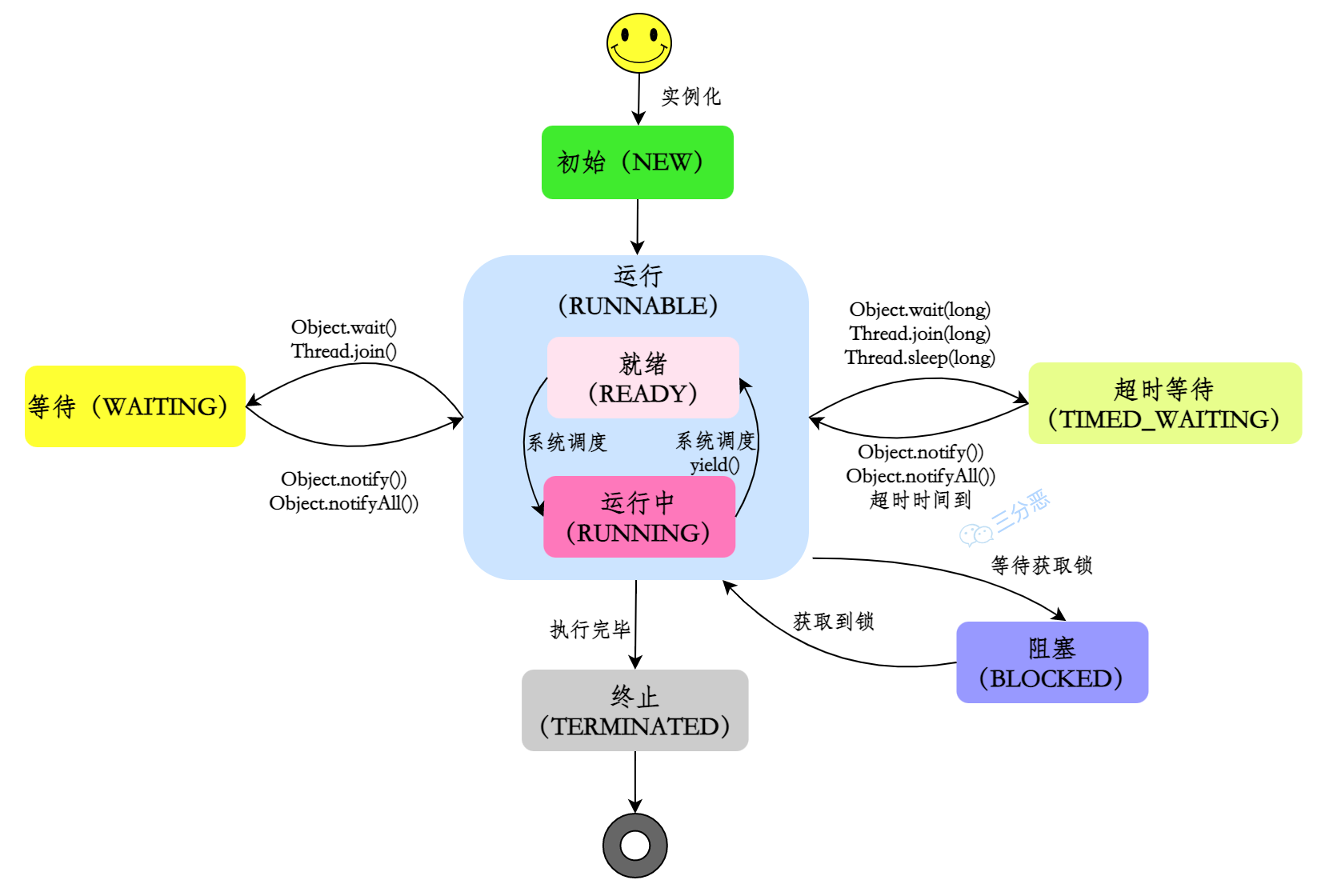
可以看到,等待和运行之间的转换可以用wait和notify。
那么整体思路也就有了:
- 打印的时候需要获取锁
- 打印B的线程需要等待打印A线程执行完,打印C的线程需要等待打印B线程执行完

- 代码
public class ABC1 { //锁住的对象 private final static Object lock = new Object(); //A是否已经执行 private static boolean aExecuted = false; //B是否已经执行过 private static boolean bExecuted = false; public static void printA() { synchronized (lock) { System.out.println("A"); aExecuted = true; //唤醒所有等待线程 lock.notifyAll(); } } public static void printB() throws InterruptedException { synchronized (lock) { //获取到锁,但是要等A执行 while (!aExecuted) { lock.wait(); } System.out.println("B"); bExecuted = true; lock.notifyAll(); } } public static void printC() throws InterruptedException { synchronized (lock) { //获取到锁,但是要等B执行 while (!bExecuted) { lock.wait(); } System.out.println("C"); } } }- 测试:后面几种方法的单测基本和这种方法一致,所以后面的单测就省略了。
    @Test
    void abc1() {
        //线程A
        new Thread(() -> {
            ABC1.printA();
        }, "A").start();
        //线程B
        new Thread(() -> {
            try {
                ABC1.printB();
            } catch (InterruptedException e) {
                e.printStackTrace();
            }
        }, "B").start();
        //线程C
        new Thread(() -> {
            try {
                ABC1.printC();
            } catch (InterruptedException e) {
                e.printStackTrace();
            }
        }, "C").start();
    }
2. lock+全局变量state
还可以用lock+state来实现,大概思路:
- 用lock来实现同步
- 用全局变量state标识改哪个线程执行,不执行就释放锁

- 代码
public class ABC2 {
    //可重入锁
    private final static Lock lock = new ReentrantLock();
    //判断是否执行:1表示应该A执行,2表示应该B执行,3表示应该C执行
    private static int state = 1;

    public static void printA() {
        //自旋
        while (state < 4) {
            try {
                //获取锁
                lock.lock();
                //并发情况下,不能用if,要用循环判断等待条件,避免虚假唤醒
                while (state == 1) {
                    System.out.println("A");
                    state++;
                }
            } finally {
                //要保证不执行的时候,锁能释放掉
                lock.unlock();
            }
        }
    }

    public static void printB() throws InterruptedException {
        while (state < 4) {
            try {
                lock.lock();
                //获取到锁,应该执行
                while (state == 2) {
                    System.out.println("B");
                    state++;
                }
            } finally {
                lock.unlock();
            }
        }
    }

    public static void printC() throws InterruptedException {
        while (state < 4) {
            try {
                lock.lock();
                while (state == 3) {
                    //获取到锁,应该执行
                    System.out.println("C");
                    state++;
                }
            } finally {
                lock.unlock();
            }
        }
    }

}
这里也有几个细节要注意:
- 要在循环里获取锁,不然线程可能会在获取到锁之前就终止了
- 要用while,而不是if判断,是否当前线程应该打印输出
- 要在finally里释放锁,保证其它的线程能获取到锁
3. volatile
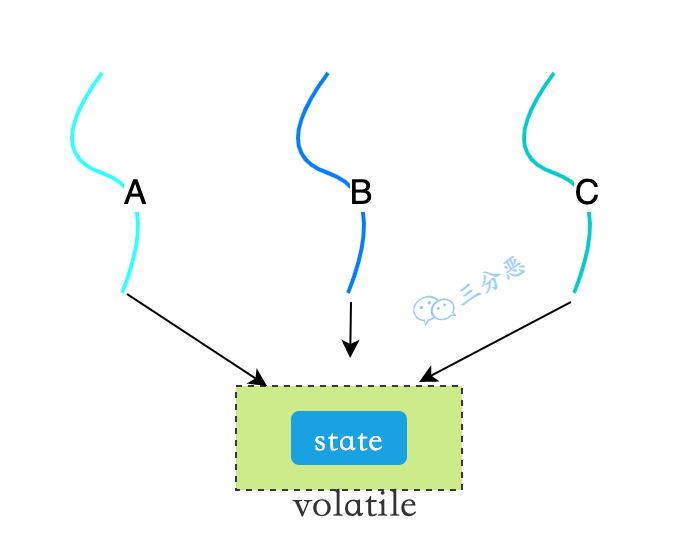
上一种做法,我们用了同步+全局变量的方式,那么有没有什么更轻量级的做法?
我们可以直接用volatile修饰变量,volatile能保证变量的更改对所有线程可见。
- 代码
public class ABC3 {

    //判断是否执行:1表示应该A执行,2表示应该B执行,3表示应该C执行
    private static volatile Integer state = 1;

    public static void printA() {
        //通过循环,hang住线程
        while (state != 1) {
        }
        System.out.println("A");
        state++;
    }

    public static void printB() throws InterruptedException {
        while (state != 2) {
        }
        System.out.println("B");
        state++;
    }

    public static void printC() throws InterruptedException {
        while (state != 3) {
        }
        System.out.println("C");
        state++;
    }

}
4. AtomicInteger
除了无锁的volatile方法,还有没有什么轻量级锁的方法呢?
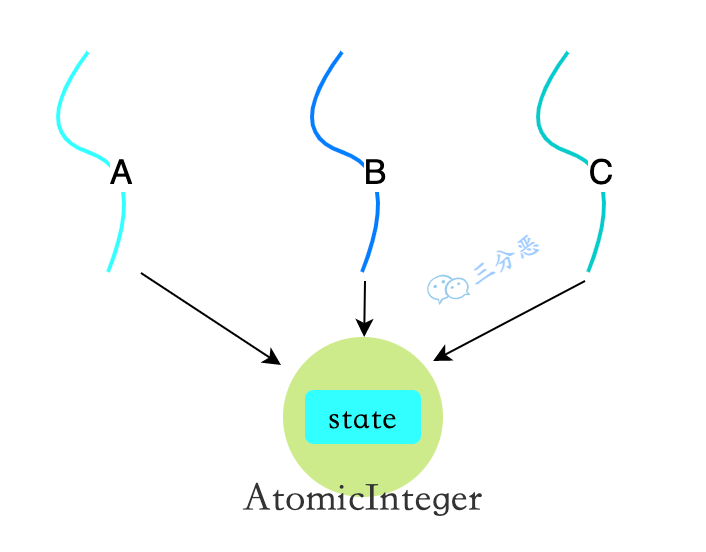
我们都知道synchronized和lock都属于悲观锁,我们还可以用乐观锁来实现。
在Java里,我们熟悉的原子操作类AtomicInteger就是基于CAS实现的,可以用来保证Integer操作的原子性。
- 代码
public class ABC4 {

    //判断是否执行:1表示应该A执行,2表示应该B执行,3表示应该C执行
    private static AtomicInteger state = new AtomicInteger(1);

    public static void printA() {
        System.out.println("A");
        state.incrementAndGet();
    }

    public static void printB() throws InterruptedException {
        while (state.get() < 4) {
            while (state.get() == 2) {
                System.out.println("B");
                state.incrementAndGet();
            }
        }
    }

    public static void printC() throws InterruptedException {
        while (state.get() < 4) {
            while (state.get() == 3) {
                System.out.println("C");
                state.incrementAndGet();
            }
        }
    }

}
5.lock+condition
在Java中,除了Object的wait和notify/notify可以实现等待/通知机制,Condition和Lock配合同样可以完成等待通知机制。
使用
condition.await(),使当前线程进入等待状态,使用condition.signal()或者condition.signalAll()唤醒等待线程。- 代码
public class ABC5 {
    //可重入锁
    private final static Lock lock = new ReentrantLock();
    //判断是否执行:1表示应该A执行,2表示应该B执行,3表示应该C执行
    private static int state = 1;
    //condition对象
    private static Condition a = lock.newCondition();
    private static Condition b = lock.newCondition();
    private static Condition c = lock.newCondition();

    public static void printA() {
        //通过循环,hang住线程
        while (state < 4) {
            try {
                //获取锁
                lock.lock();
                //并发情况下,不能用if,要用循环判断等待条件,避免虚假唤醒
                while (state != 1) {
                    a.await();
                }
                System.out.println("A");
                state++;
                b.signal();
            } catch (InterruptedException e) {
                e.printStackTrace();
            } finally {
                //要保证不执行的时候,锁能释放掉
                lock.unlock();
            }
        }
    }

    public static void printB() throws InterruptedException {
        while (state < 4) {
            try {
                lock.lock();
                //获取到锁,应该执行
                while (state != 2) {
                    b.await();
                }
                System.out.println("B");
                state++;
                c.signal();
            } finally {
                lock.unlock();
            }
        }
    }

    public static void printC() throws InterruptedException {
        while (state < 4) {
            try {
                lock.lock();
                while (state != 3) {
                    c.await();
                }
                //获取到锁,应该执行
                System.out.println("C");
                state++;
            } finally {
                lock.unlock();
            }
        }
    }

}
6.信号量Semaphore
线程间同步,还可以使用信号量Semaphore,信号量顾名思义,多线程协作时完成信号传递。
使用acquire()获取许可,如果没有可用的许可,线程进入阻塞等待状态;使用release释放许可。

- 代码
public class ABC6 {

    private static Semaphore semaphoreB = new Semaphore(0);
    private static Semaphore semaphoreC = new Semaphore(0);

    public static void printA() {
        System.out.println("A");
        semaphoreB.release();
    }

    public static void printB() throws InterruptedException {
        semaphoreB.acquire();
        System.out.println("B");
        semaphoreC.release();
    }

    public static void printC() throws InterruptedException {
        semaphoreC.acquire();
        System.out.println("C");
    }

}
7.计数器CountDownLatch
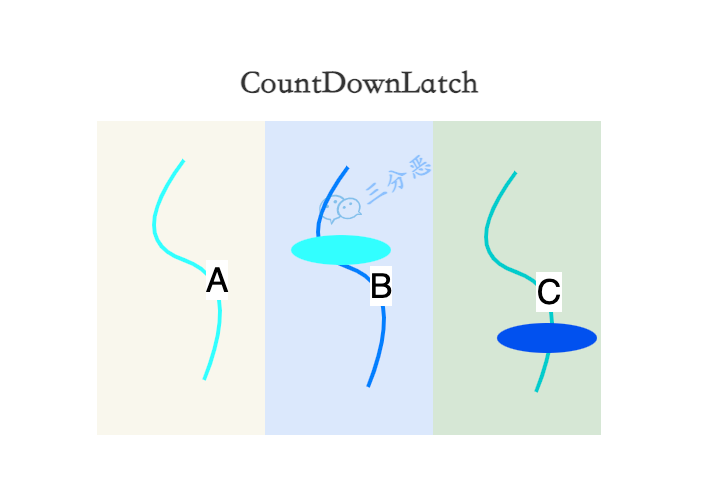
CountDownLatch的一个适用场景,就是用来进行多个线程的同步管理,线程调用了countDownLatch.await()之后,需要等待countDownLatch的信号countDownLatch.countDown(),在收到信号前,它不会往下执行。
public class ABC7 {

    private static CountDownLatch countDownLatchB = new CountDownLatch(1);
    private static CountDownLatch countDownLatchC = new CountDownLatch(1);

    public static void printA() {
        System.out.println("A");
        countDownLatchB.countDown();
    }

    public static void printB() throws InterruptedException {
        countDownLatchB.await();
        System.out.println("B");
        countDownLatchC.countDown();
    }

    public static void printC() throws InterruptedException {
        countDownLatchC.await();
        System.out.println("C");
    }

}
8. 循环栅栏CyclicBarrier
用到了
CountDownLatch,我们应该想到,还有一个功能和它类似的工具类CyclicBarrier。有的翻译叫同步屏障,我觉得翻译成循环栅栏,更能体现它的功能特性。
就像是出去旅游,大家不同时间到了景区门口,但是景区疫情限流,先把栅栏拉下来,在景区里的游客走一批,打开栅栏,再放进去一批,走一批,再放进去一批……
这就是CyclicBarrier的两个特性,
- 栅栏:多个线程相互等待,到齐后再执行特定动作
- 循环:所有线程释放后,还能继续复用它
这道题怎么用CyclicBarrier解决呢?
- 线程B和线程C需要使用栅栏等待
- 为了让B和C也顺序执行,需要用一个状态,来标识应该执行的线程

- 代码
public class ABC8 {

    private static CyclicBarrier cyclicBarrier = new CyclicBarrier(1);
    private static Integer state = 1;

    public static void printA() {
        while (state != 1) {
        }
        System.out.println("A");
        state = 2;
    }

    public static void printB() throws InterruptedException {
        try {
            //在栅栏前等待
            cyclicBarrier.await();
            //state不等于2的时候等待
            while (state != 2) {
            }
            System.out.println("B");
            state = 3;
        } catch (BrokenBarrierException e) {
            e.printStackTrace();
        }
    }

    public static void printC() throws InterruptedException {
        try {
            cyclicBarrier.await();
            while (state != 3) {
            }
            System.out.println("C");
        } catch (BrokenBarrierException e) {
            e.printStackTrace();
        }
    }

}
当然,CyclicBarrier的实现其实还是基于lock+condition,多个线程在到达一定条件前await,到达条件后signalAll。
9.交换器Exchanger
在前面,我们已经用到了常用的并发工具类,其实还有一个不那么常用的并发工具类
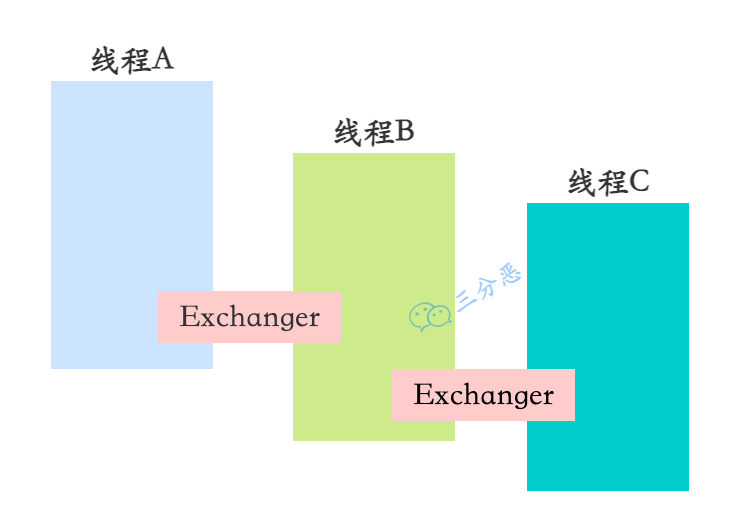
Exchanger,同样也可以用来解决这道题目。Exchanger用于两个线程在某个节点时进行数据交换,在这道题里:
- 线程A执行完之后,和线程B用一个交换器交换state,线程B执行完之后,和线程C用一个交换器交换state
- 在没有轮到自己执行之前,先进行等待
public class ABC9 {
    private static Exchanger<Integer> exchangerB = new Exchanger<>();
    private static Exchanger<Integer> exchangerC = new Exchanger<>();

    public static void printA() {
        System.out.println("A");
        try {
            //交换
            exchangerB.exchange(2);
        } catch (InterruptedException e) {
            e.printStackTrace();
        }
    }

    public static void printB() {
        try {
            //交换
            Integer state = exchangerB.exchange(0);
            //等待
            while (state != 2) {
            }
            //执行
            System.out.println("B");
            //第二次交换
            exchangerC.exchange(3);
        } catch (InterruptedException e) {
            e.printStackTrace();
        }
    }

    public static void printC() {
        try {
            Integer state = exchangerC.exchange(0);
            while (state != 3) {
            }
            System.out.println("C");
        } catch (InterruptedException e) {
            e.printStackTrace();
        }
    }
}
Exchanger是基于ThreadLocal实现的,那么我们这个问题可以基于ThreadLocal来实现吗?
10.ThreadLocal
ThreadLocal,我们应该都了解过它的用法和原理,那么怎么用ThreadLocal实现三个线程顺序打印ABC呢?
子线程是并发执行的,但是主线程的代码是顺序执行的,我们在主线程里改变变量,子线程根据变量判断。
那么问题来了,子线程怎么获取主线程的变量呢?可以用
InheritableThreadLocal。
- 代码
public class ABC10 {

    public static void main(String[] args) {
        //使用ThreadLocal存储变量
        ThreadLocal<Integer> threadLocal = new InheritableThreadLocal<>();
        threadLocal.set(1);
        new Thread(() -> {
            System.out.println("A");
        }, "A").start();
        //设置变量值
        threadLocal.set(2);

        new Thread(() -> {
            //等待
            while (threadLocal.get() != 2) {
            }
            System.out.println("B");
        }, "B").start();
        threadLocal.set(3);

        new Thread(() -> {
            while (threadLocal.get() != 3) {
            }
            System.out.println("C");
        }, "C").start();
    }
}
11.管道流PipedStream
线程之间通信,还有一种比较笨重的办法——PipedInputStream/PipedOutStream。
一个线程使用PipedOutStream写数据,一个线程使用PipedInputStream读数据,而且Piped的读取只能一对一。
那么,在这道题里:
- 线程A使用PipedOutStream向线程B写入数据,线程B读取后,打印输出
- 线程B和C也是相同的姿势

- 代码
public class ABC11 {
    public static void main(String[] args) throws IOException {
        //线程A的输出流
        PipedOutputStream outputStreamA = new PipedOutputStream();
        //线程B的输出流
        PipedOutputStream outputStreamB = new PipedOutputStream();
        //线程B的输入流
        PipedInputStream inputStreamB = new PipedInputStream();
        //线程C的输入流
        PipedInputStream inputStreamC = new PipedInputStream();


        outputStreamA.connect(inputStreamB);
        outputStreamB.connect(inputStreamC);

        new Thread(() -> {
            System.out.println("A");
            try {
                //流写入
                outputStreamA.write("B".getBytes());
            } catch (IOException e) {
                e.printStackTrace();
            }
        }, "A").start();

        new Thread(() -> {
            //流读取
            byte[] buffer = new byte[1];
            try {
                inputStreamB.read(buffer);
                //转换成String
                String msg = new String(buffer);
                System.out.println(msg);
                outputStreamB.write("C".getBytes());
            } catch (IOException e) {
                e.printStackTrace();
            }
        }, "B").start();

        new Thread(() -> {
            byte[] buffer = new byte[1];
            try {
                inputStreamC.read(buffer);
                String msg = new String(buffer);
                System.out.println(msg);
            } catch (IOException e) {
                e.printStackTrace();
            }
        }, "C").start();
    }
}
12.阻塞队列BlockingQueue
阻塞队列同样也可以用来进行线程调度。
- 利用队列的长度,来确定执行者
- 利用队列的阻塞性,来保证入队操作同步执行。

- 代码
public class ABC12 {

    private static BlockingQueue<String> queue = new ArrayBlockingQueue<>(3);

    public static void printA() {
        System.out.println("A");
        queue.offer("B");
    }

    public static void printB() throws InterruptedException {
        while (queue.size() != 1) {
        }
        System.out.println("B");
        queue.offer("C");
    }

    public static void printC() throws InterruptedException {
        while (queue.size() != 2) {
        }
        System.out.println("C");
    }

}
总结
这篇文章给大家带来了
三个线程顺序打印ABC的的十二种做法,里面有些写法肯定是冗余的,大家有没有什么更好的写法呢?通过十二种题解,我们基本上把Java并发中主要的线程同步和通信方式过了一遍,相信通过这道题的实践,我们也能对Java线程的同步和通信有更深的理解。
最后,也给大家留两道“进阶”一点的题目,感兴趣可以自己实现一下:
- 两个线程,一个线程打印奇数,一个线程打印偶数
- 按照顺序,三个线程分别打印A5次,B10次,C15次
参考:
[1]. https://zhuanlan.zhihu.com/p/368409843
[2].http://edisonxu.com/2017/03/02/java-thread-communication.html
[3].https://redspider.gitbook.io/concurrent/di-yi-pian-ji-chu-pian/5
关注下方公众号,领取独家面试资料 ⬇️⬇️⬇️
-
相关阅读:
LeetCode43.字符串相乘【大整数相乘】
LeetCode每日一题(1383. Maximum Performance of a Team)
音频——I2S 标准模式(二)
ES6模块化
EasyRAFT
【iOS】—— Tagged Pointer对象
外贸邮件推广怎么统计维度
MATLAB编程:简易读取分割存储 tif 格式图片
Kruskal重构树+AC自动机+树状数组:Gym - 104542F
Spring整合RabbitMQ-配制文件方式-3-消息拉模式
- 原文地址:https://blog.csdn.net/sinat_40770656/article/details/127120157