-
orb-slam2 从单目开始的简单学习(7):Optimizer
前言
有不足或者不正确不清晰的地方可以随时在评论区或者私我,敬请斧正!
1. 整体介绍
class Optimizer
{
public:
    void static BundleAdjustment(const std::vector<KeyFrame*> &vpKF, const std::vector<MapPoint*> &vpMP,
                                 int nIterations = 5, bool *pbStopFlag=NULL, const unsigned long nLoopKF=0,
                                 const bool bRobust = true);
    void static GlobalBundleAdjustemnt(Map* pMap, int nIterations=5, bool *pbStopFlag=NULL,
                                       const unsigned long nLoopKF=0, const bool bRobust = true);
    void static LocalBundleAdjustment(KeyFrame* pKF, bool *pbStopFlag, Map *pMap);
    int static PoseOptimization(Frame* pFrame);

    // if bFixScale is true, 6DoF optimization (stereo,rgbd), 7DoF otherwise (mono)
    void static OptimizeEssentialGraph(Map* pMap, KeyFrame* pLoopKF, KeyFrame* pCurKF,
                                       const LoopClosing::KeyFrameAndPose &NonCorrectedSim3,
                                       const LoopClosing::KeyFrameAndPose &CorrectedSim3,
                                       const map<KeyFrame *, set<KeyFrame *> > &LoopConnections,
                                       const bool &bFixScale);

    // if bFixScale is true, optimize SE3 (stereo,rgbd), Sim3 otherwise (mono)
    static int OptimizeSim3(KeyFrame* pKF1, KeyFrame* pKF2, std::vector<MapPoint *> &vpMatches1,
                            g2o::Sim3 &g2oS12, const float th2, const bool bFixScale);
};
1.1 数据类型
主要在
slam/ORB_SLAM2/Thirdparty/g2o/g2o/types
1.3 浅浅了解一下G2O
1.3.1 常见的数据结构
1.3.1.1 EdgeStereoSE3ProjectXYZOnlyPose
EdgeSE3ProjectXYZOnlyPose:一元边以仅优化相机姿势
详见slam/ORB_SLAM2/Thirdparty/g2o/g2o/types/types_six_dof_expmap.cpp以下来自slam/ORB_SLAM2/Thirdparty/g2o/g2o/types/types_six_dof_expmap.h
class  EdgeSE3ProjectXYZOnlyPose: public  BaseUnaryEdge<2, Vector2d, VertexSE3Expmap>{
public:
  EIGEN_MAKE_ALIGNED_OPERATOR_NEW

  EdgeSE3ProjectXYZOnlyPose(){}

  bool read(std::istream& is);

  bool write(std::ostream& os) const;

  void computeError()  {
    const VertexSE3Expmap* v1 = static_cast<const VertexSE3Expmap*>(_vertices[0]);
    Vector2d obs(_measurement);
    _error = obs-cam_project(v1->estimate().map(Xw));
  }

  bool isDepthPositive() {
    const VertexSE3Expmap* v1 = static_cast<const VertexSE3Expmap*>(_vertices[0]);
    return (v1->estimate().map(Xw))(2)>0.0;
  }


  virtual void linearizeOplus();

  Vector2d cam_project(const Vector3d & trans_xyz) const;

  Vector3d Xw;
  double fx, fy, cx, cy;
};
1.3.1.2 VertexSBAPointXYZ
使用到的g2o顶点包括:
-
VertexSE3Expmap():SE(3)位姿
-
VertexSim3Expmap():Sim(3)位姿
-
VertexSBAPointXYZ():地图点坐标
使用到的g2o边包括:
-
EdgeSE3ProjectXYZ():BA中的重投影误差(3D-2D(u,v)误差),将地图点投影到相机坐标系下的相机平面。
-
EdgeSE3ProjectXYZOnlyPose():PoseEstimation中的重投影误差,将地图点投影到相机坐标系下的相机平面。优化变量只有pose,地图点位置固定,是一边元,双目中使用的是EdgeStereoSE3ProjectXYZOnlyPoze()。
-
EdgeSim3():Sim3之间的相对误差。优化变量只有Sim3表示的pose,用于OptimizeEssentialGraph。
-
EdgeSim3ProjectXYZ():重投影误差。优化变量Sim3位姿与地图点,用于闭环检测中的OptimizeSim3。
【参考文档】:ORB-SLAM(十二)优化
1.3.2 常见的边的函数
1.3.2.1 设置鲁棒核函数setRobustKernel
《slam14讲》p255
【参考文档】非线性优化库g2o使用教程,探索一些常见的用法,以及信息矩阵、鲁棒核函数对于优化的结果的影响

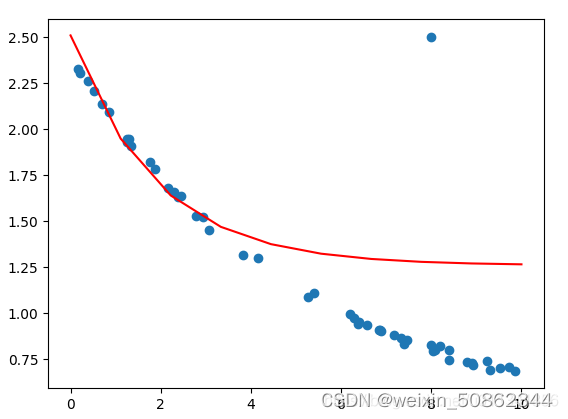
由于右上角那个离谱的点,导致优化时将整个函数被拉偏了。
那么怎么解决这种问题呢?g2o中提供了鲁棒核函数来抑制某些误差特别大的点,拉偏整个优化结果。
使用方法如下://构造一个Huber鲁棒核函数 g2o::RobustKernelHuber* robust_kernel_huber = new g2o::RobustKernelHuber; robust_kernel_huber->setDelta(0.3); //设置delta的大小。注意这个要根据实际的应用场景去尝试,然后选择合适的大小 e->setRobustKernel(robust_kernel_huber);//向边中添加鲁棒核函数g2o中提供了多种鲁棒核函数,你可以根据自己的需要进行选择。
加入鲁棒核函数之后,结果明显好转。1.3.2.2 其他鲁棒核函数
//todo!!
1.3.2.3 设置信息矩阵setInformation
【参考文档】非线性优化库g2o使用教程,探索一些常见的用法,以及信息矩阵、鲁棒核函数对于优化的结果的影响
在一次优化中,对于某一次测量,我们有十足的把握,它非常的准确,所以优化时我们希望对于这次测量给予更高的权重。
假设我们认为右上角那个异常点是一个比较正确的点(只是假设),我们希望拟合的曲线尽量往这个点偏移。那么我们就这可以设置这次测量边的权重更大。代码如下:
e->setInformation(Eigen::Matrix<double, 1, 1>::Identity() * 10);因为测量值的维度为1,所以信息矩阵也为1。如果我们把每一条边的信息矩阵都设置为一样,那么在优化时将认为所有边的优化权重是一样的,将不会对某一条边执行过多的优化!
对于那个异常点设置权重为别的点的10倍,则曲线会往右上角那个点靠。最终的结果如下图:
一般情况下,信息矩阵和鲁棒核函数都会一起使用!
1.3.2.4 设置优化边setLevel
一般g2o默认
只处理level为0的边,可以将,不进行优化的边的level设为11.3.3.4 设置边缘化 setMarginalized
利用H稀疏性加速计算的方法:schur消元,在SLAM研究中也被称为Marginalizeation(边缘化)
本质:求解位姿部分的增量方程,然后把解得的delta xc 代入到原方程,然后求解delta xp
【参考文档】《slam14讲》p2531.3.3.5 设置顶点setVertex
(1)单元边
e->setVertex(0, dynamic_cast<g2o::OptimizableGraph::Vertex*>(optimizer.vertex(0)));(2)双元边
如果是双元边,则0对应三维点顶点,1对应位姿顶点e->setVertex(0, dynamic_cast<g2o::OptimizableGraph::Vertex*>(optimizer.vertex(id))); e->setVertex(1, dynamic_cast<g2o::OptimizableGraph::Vertex*>(optimizer.vertex(pKFi->mnId)));1.3.3 常见的顶点的函数
1.3.3.1setEstimate
设置测量量
vSE3->setEstimate(Converter::toSE3Quat(pKFi->GetPose()));需要先将当前的坐标转换为四元数
orb-slam2中转换函数toSE3Quatg2o::SE3Quat Converter::toSE3Quat(const cv::Mat &cvT) { Eigen::Matrix<double,3,3> R; R << cvT.at<float>(0,0), cvT.at<float>(0,1), cvT.at<float>(0,2), cvT.at<float>(1,0), cvT.at<float>(1,1), cvT.at<float>(1,2), cvT.at<float>(2,0), cvT.at<float>(2,1), cvT.at<float>(2,2); Eigen::Matrix<double,3,1> t(cvT.at<float>(0,3), cvT.at<float>(1,3), cvT.at<float>(2,3)); return g2o::SE3Quat(R,t); } 至于SE3Quat有这两个重载方式: SE3Quat(const Matrix3d& R, const Vector3d& t) SE3Quat(const Quaterniond& q, const Vector3d& t) 从而最终转化为四元数1.3.3.2 设置顶点ID setId
使用示例:
vSE3->setId(pKFi->mnId);1.3.3.3 固定顶点setFixed
vSE3->setFixed(pKFi->mnId==0);//只固定第一帧2. PoseOptimization
只优化当前帧pose,地图点固定
2.1 PoseOptimization完整代码及注释
int Optimizer::PoseOptimization(Frame *pFrame)//只优化当前帧pose,地图点固定
{
    g2o::SparseOptimizer optimizer;
    g2o::BlockSolver_6_3::LinearSolverType * linearSolver;
    		//pose维度为6(3个R,3个t),landmark维度为3

    linearSolver = new g2o::LinearSolverDense<g2o::BlockSolver_6_3::PoseMatrixType>();

    g2o::BlockSolver_6_3 * solver_ptr = new g2o::BlockSolver_6_3(linearSolver);

    g2o::OptimizationAlgorithmLevenberg* solver = new g2o::OptimizationAlgorithmLevenberg(solver_ptr);
    optimizer.setAlgorithm(solver);

    int nInitialCorrespondences=0;//当前帧对应到的地图点的数量

    // 顶点:李代数位姿 Set Frame vertex
    g2o::VertexSE3Expmap * vSE3 = new g2o::VertexSE3Expmap();
    vSE3->setEstimate(Converter::toSE3Quat(pFrame->mTcw));
    vSE3->setId(0);
    vSE3->setFixed(false);
    optimizer.addVertex(vSE3);

    // Set MapPoint vertices
    const int N = pFrame->N;

//单目
    vector<g2o::EdgeSE3ProjectXYZOnlyPose*> vpEdgesMono;
    vector<size_t> vnIndexEdgeMono;
    vpEdgesMono.reserve(N);//传入边
    vnIndexEdgeMono.reserve(N);//传入边对应的索引

//双目
    vector<g2o::EdgeStereoSE3ProjectXYZOnlyPose*> vpEdgesStereo;
    vector<size_t> vnIndexEdgeStereo;
    vpEdgesStereo.reserve(N);
    vnIndexEdgeStereo.reserve(N);

//定义自由度为2的卡方分布
    const float deltaMono = sqrt(5.991);
    const float deltaStereo = sqrt(7.815);


    {
    unique_lock<mutex> lock(MapPoint::mGlobalMutex);

    for(int i=0; i<N; i++)
    {
        MapPoint* pMP = pFrame->mvpMapPoints[i];//对于传入的帧中的地图点
        if(pMP)//物理判断
        {
            // Monocular observation
            if(pFrame->mvuRight[i]<0)//单目相机没有右眼
            {
                nInitialCorrespondences++;
                pFrame->mvbOutlier[i] = false;

                Eigen::Matrix<double,2,1> obs;//定义一个观测量 (u,v)
                const cv::KeyPoint &kpUn = pFrame->mvKeysUn[i];
                obs << kpUn.pt.x, kpUn.pt.y;//将未矫正的点传入obs

                g2o::EdgeSE3ProjectXYZOnlyPose* e = new g2o::EdgeSE3ProjectXYZOnlyPose();//定义一条边

                e->setVertex(0, dynamic_cast<g2o::OptimizableGraph::Vertex*>(optimizer.vertex(0)));
                e->setMeasurement(obs);
                const float invSigma2 = pFrame->mvInvLevelSigma2[kpUn.octave];
                e->setInformation(Eigen::Matrix2d::Identity()*invSigma2);//信息矩阵

                g2o::RobustKernelHuber* rk = new g2o::RobustKernelHuber;
                e->setRobustKernel(rk);//使用鲁棒核函数
                rk->setDelta(deltaMono);

		//传入内参
                e->fx = pFrame->fx;
                e->fy = pFrame->fy;
                e->cx = pFrame->cx;nInitialCorrespondences
                e->cy = pFrame->cy;
                cv::Mat Xw = pMP->GetWorldPos();//地图点的世界坐标
                e->Xw[0] = Xw.at<float>(0);
                e->Xw[1] = Xw.at<float>(1);
                e->Xw[2] = Xw.at<float>(2);

                optimizer.addEdge(e);

                vpEdgesMono.push_back(e);
                vnIndexEdgeMono.push_back(i);
            }
            else  //双目 Stereo observation
            {
                nInitialCorrespondences++;
                pFrame->mvbOutlier[i] = false;

                //SET EDGE
                Eigen::Matrix<double,3,1> obs;
                const cv::KeyPoint &kpUn = pFrame->mvKeysUn[i];

                //每个关键点对应的立体坐标
                const float &kp_ur = pFrame->mvuRight[i];
                obs << kpUn.pt.x, kpUn.pt.y, kp_ur;

                g2o::EdgeStereoSE3ProjectXYZOnlyPose* e = new g2o::EdgeStereoSE3ProjectXYZOnlyPose();

                e->setVertex(0, dynamic_cast<g2o::OptimizableGraph::Vertex*>(optimizer.vertex(0)));
                e->setMeasurement(obs);
                const float invSigma2 = pFrame->mvInvLevelSigma2[kpUn.octave];
                Eigen::Matrix3d Info = Eigen::Matrix3d::Identity()*invSigma2;
                e->setInformation(Info);

                g2o::RobustKernelHuber* rk = new g2o::RobustKernelHuber;
                e->setRobustKernel(rk);
                rk->setDelta(deltaStereo);

                e->fx = pFrame->fx;
                e->fy = pFrame->fy;
                e->cx = pFrame->cx;
                e->cy = pFrame->cy;
                e->bf = pFrame->mbf;
                cv::Mat Xw = pMP->GetWorldPos();
                e->Xw[0] = Xw.at<float>(0);
                e->Xw[1] = Xw.at<float>(1);
                e->Xw[2] = Xw.at<float>(2);

                optimizer.addEdge(e);

                vpEdgesStereo.push_back(e);
                vnIndexEdgeStereo.push_back(i);
            }
        }

    }
    }


    if(nInitialCorrespondences<3)
        return 0;
delta
    // 我们执行了4次优化,每次优化后,我们将观察结果分类为内值/离群值
    //We perform 4 optimizations, after each optimization we classify observation as inlier/outlier
    //在下一次优化中,不包括离群值,但最终可以将其再次分类为内值。
    // At the next optimization, outliers are not included, but at the end they can be classified as inliers again.


    const float chi2Mono[4]={5.991,5.991,5.991,5.991};//单目卡方
    const float chi2Stereo[4]={7.815,7.815,7.815, 7.815};//双目卡方
    const int its[4]={10,10,10,10};

    int nBad=0;
    for(size_t it=0; it<4; it++)
    {

        vSE3->setEstimate(Converter::toSE3Quat(pFrame->mTcw));//更新估计值
        optimizer.initializeOptimization(0);
        optimizer.optimize(its[it]);//优化10次

        nBad=0;
        //单目
        for(size_t i=0, iend=vpEdgesMono.size(); i<iend; i++)
        {
            g2o::EdgeSE3ProjectXYZOnlyPose* e = vpEdgesMono[i];//经过外循环后获得优化后的边

            const size_t idx = vnIndexEdgeMono[i];//获得优化后的边的索引
            if(pFrame->mvbOutlier[idx])
            {
                e->computeError();
            }

            const float chi2 = e->chi2();//卡方统计量

            if(chi2>chi2Mono[it])
            {
                pFrame->mvbOutlier[idx]=true;//置为离群点
                e->setLevel(1);//将离群点的level设为1,不进行优化
                nBad++;
            }
            else
            {
                pFrame->mvbOutlier[idx]=false;
                e->setLevel(0);// 一般g2o默认只处理level为0的边
            }

            if(it==2)//优化过一次之后离群点不再优化,不再需要鲁棒核
                e->setRobustKernel(0);
        }

	//双目
        for(size_t i=0, iend=vpEdgesStereo.size(); i<iend; i++)
        {
            g2o::EdgeStereoSE3ProjectXYZOnlyPose* e = vpEdgesStereo[i];

            const size_t idx = vnIndexEdgeStereo[i];

            if(pFrame->mvbOutlier[idx])
            {
                e->computeError();
            }

            const float chi2 = e->chi2();

            if(chi2>chi2Stereo[it])
            {
                pFrame->mvbOutlier[idx]=true;
                e->setLevel(1);
                nBad++;
            }
            else
            {
                e->setLevel(0);
                pFrame->mvbOutlier[idx]=false;
            }

            if(it==2)
                e->setRobustKernel(0);
        }

        if(optimizer.edges().size()<10)
            break;
    }

    // 恢复优化的姿态和返回内联点 Recover optimized pose and return number of inliers
    g2o::VertexSE3Expmap* vSE3_recov = static_cast<g2o::VertexSE3Expmap*>(optimizer.vertex(0));//优化后的顶点
    g2o::SE3Quat SE3quat_recov = vSE3_recov->estimate();
    cv::Mat pose = Converter::toCvMat(SE3quat_recov);
    pFrame->SetPose(pose);

    return nInitialCorrespondences-nBad;
}
3. BundleAdjustment
3.1 BundleAdjustment完整代码及注释
void Optimizer::BundleAdjustment(const vector<KeyFrame *> &vpKFs, const vector<MapPoint *> &vpMP,
                                 int nIterations, bool* pbStopFlag, const unsigned long nLoopKF, const bool bRobust)
{
    vector<bool> vbNotIncludedMP;
    vbNotIncludedMP.resize(vpMP.size());
//-----------经典套路--------------------------
    g2o::SparseOptimizer optimizer;
    g2o::BlockSolver_6_3::LinearSolverType * linearSolver;

    linearSolver = new g2o::LinearSolverEigen<g2o::BlockSolver_6_3::PoseMatrixType>();

    g2o::BlockSolver_6_3 * solver_ptr = new g2o::BlockSolver_6_3(linearSolver);

    g2o::OptimizationAlgorithmLevenberg* solver = new g2o::OptimizationAlgorithmLevenberg(solver_ptr);
    optimizer.setAlgorithm(solver);
//-----------经典套路--------------------------

//setForceStopFlag:设置在每次迭代时检查的变量,以强制用户停止。当变量为true时,迭代退出
    if(pbStopFlag)
        optimizer.setForceStopFlag(pbStopFlag);//停止优化标志位

    long unsigned int maxKFid = 0;

    // Set KeyFrame vertices
    for(size_t i=0; i<vpKFs.size(); i++)
    {
        KeyFrame* pKF = vpKFs[i];
        if(pKF->isBad())
            continue;
	//---------为每一个关键帧的位姿设置顶点----------------------
        g2o::VertexSE3Expmap * vSE3 = new g2o::VertexSE3Expmap();
        vSE3->setEstimate(Converter::toSE3Quat(pKF->GetPose()));//顶点设置为位姿
        vSE3->setId(pKF->mnId);
        vSE3->setFixed(pKF->mnId==0);
        optimizer.addVertex(vSE3);
        //---------为每一个关键帧的位姿设置顶点----------------------
        if(pKF->mnId>maxKFid)
            maxKFid=pKF->mnId;
    }
//自由度为2(x,y)的卡方分布
    const float thHuber2D = sqrt(5.99);//95%
//自由度为3(x,y,deep)的卡方分布
    const float thHuber3D = sqrt(7.815);//95%

    // Set MapPoint vertices
    for(size_t i=0; i<vpMP.size(); i++)
    {
        MapPoint* pMP = vpMP[i];
        if(pMP->isBad())
            continue;
        g2o::VertexSBAPointXYZ* vPoint = new g2o::VertexSBAPointXYZ();//landmark点
        vPoint->setEstimate(Converter::toVector3d(pMP->GetWorldPos()));
        //mnId给了位姿顶点
        const int id = pMP->mnId+maxKFid+1;

        vPoint->setId(id);
        vPoint->setMarginalized(true);
        optimizer.addVertex(vPoint);

       const map<KeyFrame*,size_t> observations = pMP->GetObservations();

        int nEdges = 0;
        //SET EDGES
        for(map<KeyFrame*,size_t>::const_iterator mit=observations.begin(); mit!=observations.end(); mit++)
        {

            KeyFrame* pKF = mit->first;
            if(pKF->isBad() || pKF->mnId>maxKFid)
                continue;

            nEdges++;

            const cv::KeyPoint &kpUn = pKF->mvKeysUn[mit->second];

            if(pKF->mvuRight[mit->second]<0)//单目
            {
                Eigen::Matrix<double,2,1> obs;
                obs << kpUn.pt.x, kpUn.pt.y;
//---------为每一个共视关系设置边----------------------
                g2o::EdgeSE3ProjectXYZ* e = new g2o::EdgeSE3ProjectXYZ();

                e->setVertex(0, dynamic_cast<g2o::OptimizableGraph::Vertex*>(optimizer.vertex(id)));
                e->setVertex(1, dynamic_cast<g2o::OptimizableGraph::Vertex*>(optimizer.vertex(pKF->mnId)));
                e->setMeasurement(obs);
                const float &invSigma2 = pKF->mvInvLevelSigma2[kpUn.octave];
                e->setInformation(Eigen::Matrix2d::Identity()*invSigma2);
//---------为每一个共视关系设置边----------------------
                if(bRobust)
                {
                    g2o::RobustKernelHuber* rk = new g2o::RobustKernelHuber;
                    e->setRobustKernel(rk);
                    rk->setDelta(thHuber2D);
                }

                e->fx = pKF->fx;
                e->fy = pKF->fy;
                e->cx = pKF->cx;
                e->cy = pKF->cy;

                optimizer.addEdge(e);
            }
            else//双目
            {
                Eigen::Matrix<double,3,1> obs;
                const float kp_ur = pKF->mvuRight[mit->second];
                obs << kpUn.pt.x, kpUn.pt.y, kp_ur;

                g2o::EdgeStereoSE3ProjectXYZ* e = new g2o::EdgeStereoSE3ProjectXYZ();

                e->setVertex(0, dynamic_cast<g2o::OptimizableGraph::Vertex*>(optimizer.vertex(id)));
                e->setVertex(1, dynamic_cast<g2o::OptimizableGraph::Vertex*>(optimizer.vertex(pKF->mnId)));
                e->setMeasurement(obs);
                const float &invSigma2 = pKF->mvInvLevelSigma2[kpUn.octave];
                Eigen::Matrix3d Info = Eigen::Matrix3d::Identity()*invSigma2;
                e->setInformation(Info);

                if(bRobust)
                {
                    g2o::RobustKernelHuber* rk = new g2o::RobustKernelHuber;
                    e->setRobustKernel(rk);
                    rk->setDelta(thHuber3D);
                }

                e->fx = pKF->fx;
                e->fy = pKF->fy;
                e->cx = pKF->cx;
                e->cy = pKF->cy;
                e->bf = pKF->mbf;

                optimizer.addEdge(e);
            }
        }
	 //如果图中的边数为0,则删除图中的结点
        if(nEdges==0)
        {
            optimizer.removeVertex(vPoint);
            vbNotIncludedMP[i]=true;
        }
        else
        {
            vbNotIncludedMP[i]=false;
        }
    }

    // Optimize!
    optimizer.initializeOptimization();
    optimizer.optimize(nIterations);

    // Recover optimized data

    //Keyframes
    for(size_t i=0; i<vpKFs.size(); i++)
    {
        KeyFrame* pKF = vpKFs[i];
        if(pKF->isBad())
            continue;
        g2o::VertexSE3Expmap* vSE3 = static_cast<g2o::VertexSE3Expmap*>(optimizer.vertex(pKF->mnId));
        g2o::SE3Quat SE3quat = vSE3->estimate();
        if(nLoopKF==0)//不发生回环,nLoopKF:回环帧数量
        {
        //无回环就默认当前位姿
            pKF->SetPose(Converter::toCvMat(SE3quat));
        }
        else
        {//若出现回环要提取估计值进行回环检测在更新位姿
            pKF->mTcwGBA.create(4,4,CV_32F);
            Converter::toCvMat(SE3quat).copyTo(pKF->mTcwGBA);
            pKF->mnBAGlobalForKF = nLoopKF;
        }
    }

    //Points
    for(size_t i=0; i<vpMP.size(); i++)
    {
        if(vbNotIncludedMP[i])
            continue;

        MapPoint* pMP = vpMP[i];

        if(pMP->isBad())
            continue;
        g2o::VertexSBAPointXYZ* vPoint = static_cast<g2o::VertexSBAPointXYZ*>(optimizer.vertex(pMP->mnId+maxKFid+1));

        if(nLoopKF==0)//获得优化后的世界坐标系坐标
        {
            pMP->SetWorldPos(Converter::toCvMat(vPoint->estimate()));
            pMP->UpdateNormalAndDepth();
        }
        else
        {
            pMP->mPosGBA.create(3,1,CV_32F);
            Converter::toCvMat(vPoint->estimate()).copyTo(pMP->mPosGBA);
            pMP->mnBAGlobalForKF = nLoopKF;
        }
    }

}
4.LocalBundleAdjustment
用于LocalMapping线程中剔除关键帧之前的局部地图优化
4.1 LocalBundleAdjustment中数据关系
LocalBundleAdjustment数据关系有点乱,因此特别说明一下
数据结构 来源 条件 vNeighKFs pKF->GetVectorCovisibleKeyFrames() lLocalKeyFrames vNeighKFs[i](当前帧的共视关键帧) 不是坏点 lLocalMapPoints 与正常的的共视关键帧匹配的地图点 (1)不是坏点(2)mnBALocalForKF未被当前帧固定(后面就被固定了) lFixedCameras 地图点的所有共视关系中的关键帧 mnBALocalForKF,mnBAFixedForKF均不属于当前帧(后面就属于了) 4.2 LocalBundleAdjustment完整代码及注释
void Optimizer::LocalBundleAdjustment(KeyFrame *pKF, bool* pbStopFlag, Map* pMap)
{
    // Local KeyFrames: First Breath Search from Current Keyframe
    list<KeyFrame*> lLocalKeyFrames;

    lLocalKeyFrames.push_back(pKF);
    pKF->mnBALocalForKF = pKF->mnId;//对于每一个正常的KF或地图点都需要维护一个mnBALocalForKF
	//mnBALocalForKF:用于局部建图

    const vector<KeyFrame*> vNeighKFs = pKF->GetVectorCovisibleKeyFrames();//获得当前帧的共视关键帧

    //遍历当前帧的共视关键帧 	lLocalKeyFrames存放不是坏点的pKFi
    for(int i=0, iend=vNeighKFs.size(); i<iend; i++)
    {
        KeyFrame* pKFi = vNeighKFs[i];
        pKFi->mnBALocalForKF = pKF->mnId;
        if(!pKFi->isBad())
            lLocalKeyFrames.push_back(pKFi);
    }

    // 在局部关键帧中看到的局部地图点 Local MapPoints seen in Local KeyFrames

    list<MapPoint*> lLocalMapPoints;//lLocalMapPoints存放不是坏点的地图点
    //遍历当前帧正常的的共视关键帧寻找地图点
    for(list<KeyFrame*>::iterator lit=lLocalKeyFrames.begin() , lend=lLocalKeyFrames.end(); lit!=lend; lit++)
    {
        vector<MapPoint*> vpMPs = (*lit)->GetMapPointMatches();//与正常的的共视关键帧匹配的地图点
        for(vector<MapPoint*>::iterator vit=vpMPs.begin(), vend=vpMPs.end(); vit!=vend; vit++)
        {
            MapPoint* pMP = *vit;
            if(pMP)
                if(!pMP->isBad())
                    if(pMP->mnBALocalForKF!=pKF->mnId)
                    {
                        lLocalMapPoints.push_back(pMP);
                        pMP->mnBALocalForKF=pKF->mnId;
                    }
        }
    }

    //Fixed Keyframes. Keyframes that see Local MapPoints but that are not Local Keyframes
    // 固定关键帧。可以看到局部地图点但不是局部关键帧的关键帧
    list<KeyFrame*> lFixedCameras;					//存放了正常的地图点
    for(list<MapPoint*>::iterator lit=lLocalMapPoints.begin(), lend=lLocalMapPoints.end(); lit!=lend; lit++)
    {
        map<KeyFrame*,size_t> observations = (*lit)->GetObservations();//对 当前地图点 找它的共视关系

        //遍历当前地图点的所有共视关系 寻找不是当前帧的共视关键帧
        for(map<KeyFrame*,size_t>::iterator mit=observations.begin(), mend=observations.end(); mit!=mend; mit++)
        {
            KeyFrame* pKFi = mit->first;

	//暂时不是当前帧的共视关键帧 :在遍历当前帧的共视关键帧时已经将pKFi->mnBALocalForKF = pKF->mnId;
            if(pKFi->mnBALocalForKF!=pKF->mnId && pKFi->mnBAFixedForKF!=pKF->mnId)
            {   					//该关键帧尚未被固定为当前关键帧的
                pKFi->mnBAFixedForKF=pKF->mnId;
                if(!pKFi->isBad())
                    lFixedCameras.push_back(pKFi);
            }
        }
    }
//-----------经典套路--------------------------
    // Setup optimizer
    g2o::SparseOptimizer optimizer;
    g2o::BlockSolver_6_3::LinearSolverType * linearSolver;

    linearSolver = new g2o::LinearSolverEigen<g2o::BlockSolver_6_3::PoseMatrixType>();

    g2o::BlockSolver_6_3 * solver_ptr = new g2o::BlockSolver_6_3(linearSolver);

    g2o::OptimizationAlgorithmLevenberg* solver = new g2o::OptimizationAlgorithmLevenberg(solver_ptr);
    optimizer.setAlgorithm(solver);
//-----------经典套路--------------------------
    if(pbStopFlag)//setForceStopFlag:设置在每次迭代时检查的变量,以强制用户停止。当变量为true时,迭代退出
        optimizer.setForceStopFlag(pbStopFlag);//停止优化标志位

    unsigned long maxKFid = 0;

//------------为lLocalKeyFrames(当前关键帧的正常的共视关键帧)建立位姿顶点--------------------------------------------------
    // Set Local KeyFrame vertices
    for(list<KeyFrame*>::iterator lit=lLocalKeyFrames.begin(), lend=lLocalKeyFrames.end(); lit!=lend; lit++)
    {
        KeyFrame* pKFi = *lit;
        g2o::VertexSE3Expmap * vSE3 = new g2o::VertexSE3Expmap();
        vSE3->setEstimate(Converter::toSE3Quat(pKFi->GetPose()));
        vSE3->setId(pKFi->mnId);
        vSE3->setFixed(pKFi->mnId==0);//只固定第一帧
        optimizer.addVertex(vSE3);
        if(pKFi->mnId>maxKFid)
            maxKFid=pKFi->mnId;
    }

//------------为Fixed KeyFrame建立位姿顶点--------------------------------------------------
    // Set Fixed KeyFrame vertices
    for(list<KeyFrame*>::iterator lit=lFixedCameras.begin(), lend=lFixedCameras.end(); lit!=lend; lit++)
    {
        KeyFrame* pKFi = *lit;
        g2o::VertexSE3Expmap * vSE3 = new g2o::VertexSE3Expmap();
        vSE3->setEstimate(Converter::toSE3Quat(pKFi->GetPose()));
        vSE3->setId(pKFi->mnId);
        vSE3->setFixed(true);
        optimizer.addVertex(vSE3);
        if(pKFi->mnId>maxKFid)
            maxKFid=pKFi->mnId;
    }


    // Set MapPoint vertices
    const int nExpectedSize = (lLocalKeyFrames.size()+lFixedCameras.size())*lLocalMapPoints.size();

    vector<g2o::EdgeSE3ProjectXYZ*> vpEdgesMono;
    vpEdgesMono.reserve(nExpectedSize);

    vector<KeyFrame*> vpEdgeKFMono;
    vpEdgeKFMono.reserve(nExpectedSize);

    vector<MapPoint*> vpMapPointEdgeMono;
    vpMapPointEdgeMono.reserve(nExpectedSize);

    vector<g2o::EdgeStereoSE3ProjectXYZ*> vpEdgesStereo;
    vpEdgesStereo.reserve(nExpectedSize);

    vector<KeyFrame*> vpEdgeKFStereo;
    vpEdgeKFStereo.reserve(nExpectedSize);

    vector<MapPoint*> vpMapPointEdgeStereo;
    vpMapPointEdgeStereo.reserve(nExpectedSize);

    //自由度为2(x,y)的卡方分布
    const float thHuberMono = sqrt(5.991);
    //自由度为3(x,y,deep)的卡方分布
    const float thHuberStereo = sqrt(7.815);

    for(list<MapPoint*>::iterator lit=lLocalMapPoints.begin(), lend=lLocalMapPoints.end(); lit!=lend; lit++)
    {
    //------------为MapPoint建立顶点------------------------------------
        MapPoint* pMP = *lit;
        g2o::VertexSBAPointXYZ* vPoint = new g2o::VertexSBAPointXYZ();
        vPoint->setEstimate(Converter::toVector3d(pMP->GetWorldPos()));
        int id = pMP->mnId+maxKFid+1;
        vPoint->setId(id);
        vPoint->setMarginalized(true);
        optimizer.addVertex(vPoint);

        const map<KeyFrame*,size_t> observations = pMP->GetObservations();

        //Set edges
        for(map<KeyFrame*,size_t>::const_iterator mit=observations.begin(), mend=observations.end(); mit!=mend; mit++)
        {
            KeyFrame* pKFi = mit->first;

            if(!pKFi->isBad())
            {
                const cv::KeyPoint &kpUn = pKFi->mvKeysUn[mit->second];

                // 单目 Monocular observation
                if(pKFi->mvuRight[mit->second]<0)
                {
                    Eigen::Matrix<double,2,1> obs;
                    obs << kpUn.pt.x, kpUn.pt.y;

                    g2o::EdgeSE3ProjectXYZ* e = new g2o::EdgeSE3ProjectXYZ();
		    								//此时顶点应该代表MapPoint
                    e->setVertex(0, dynamic_cast<g2o::OptimizableGraph::Vertex*>(optimizer.vertex(id)));
                    								//此时顶点应该代表KF
                    e->setVertex(1, dynamic_cast<g2o::OptimizableGraph::Vertex*>(optimizer.vertex(pKFi->mnId)));
                    e->setMeasurement(obs);
                    const float &invSigma2 = pKFi->mvInvLevelSigma2[kpUn.octave];
                    e->setInformation(Eigen::Matrix2d::Identity()*invSigma2);

                    g2o::RobustKernelHuber* rk = new g2o::RobustKernelHuber;
                    e->setRobustKernel(rk);
                    rk->setDelta(thHuberMono);

                    e->fx = pKFi->fx;
                    e->fy = pKFi->fy;
                    e->cx = pKFi->cx;
                    e->cy = pKFi->cy;

                    optimizer.addEdge(e);
                    vpEdgesMono.push_back(e);
                    vpEdgeKFMono.push_back(pKFi);
                    vpMapPointEdgeMono.push_back(pMP);
                }
                else // Stereo observation
                {
                    Eigen::Matrix<double,3,1> obs;
                    const float kp_ur = pKFi->mvuRight[mit->second];
                    obs << kpUn.pt.x, kpUn.pt.y, kp_ur;

                    g2o::EdgeStereoSE3ProjectXYZ* e = new g2o::EdgeStereoSE3ProjectXYZ();

                    e->setVertex(0, dynamic_cast<g2o::OptimizableGraph::Vertex*>(optimizer.vertex(id)));
                    e->setVertex(1, dynamic_cast<g2o::OptimizableGraph::Vertex*>(optimizer.vertex(pKFi->mnId)));
                    e->setMeasurement(obs);
                    const float &invSigma2 = pKFi->mvInvLevelSigma2[kpUn.octave];
                    Eigen::Matrix3d Info = Eigen::Matrix3d::Identity()*invSigma2;
                    e->setInformation(Info);

                    g2o::RobustKernelHuber* rk = new g2o::RobustKernelHuber;
                    e->setRobustKernel(rk);
                    rk->setDelta(thHuberStereo);

                    e->fx = pKFi->fx;
                    e->fy = pKFi->fy;
                    e->cx = pKFi->cx;
                    e->cy = pKFi->cy;
                    e->bf = pKFi->mbf;

                    optimizer.addEdge(e);
                    vpEdgesStereo.push_back(e);
                    vpEdgeKFStereo.push_back(pKFi);
                    vpMapPointEdgeStereo.push_back(pMP);
                }
            }
        }
    }

    if(pbStopFlag)
        if(*pbStopFlag)
            return;

    optimizer.initializeOptimization();
    optimizer.optimize(5);//优化5次

    bool bDoMore= true;

    if(pbStopFlag)
        if(*pbStopFlag)
            bDoMore = false;

    if(bDoMore)//进一步进行优化
    {

    // Check inlier observations
    for(size_t i=0, iend=vpEdgesMono.size(); i<iend;i++)
    {
        g2o::EdgeSE3ProjectXYZ* e = vpEdgesMono[i];
        MapPoint* pMP = vpMapPointEdgeMono[i];

        if(pMP->isBad())
            continue;

        if(e->chi2()>5.991 || !e->isDepthPositive())
        {
            e->setLevel(1);//不进行优化
        }

        e->setRobustKernel(0);
    }

    for(size_t i=0, iend=vpEdgesStereo.size(); i<iend;i++)
    {
        g2o::EdgeStereoSE3ProjectXYZ* e = vpEdgesStereo[i];
        MapPoint* pMP = vpMapPointEdgeStereo[i];

        if(pMP->isBad())
            continue;

        if(e->chi2()>7.815 || !e->isDepthPositive())
        {
            e->setLevel(1);
        }

        e->setRobustKernel(0);
    }

    // Optimize again without the outliers

    optimizer.initializeOptimization(0);
    optimizer.optimize(10);

    }//if(bDoMore)

    vector<pair<KeyFrame*,MapPoint*> > vToErase;
    vToErase.reserve(vpEdgesMono.size()+vpEdgesStereo.size());

    // Check inlier observations
    for(size_t i=0, iend=vpEdgesMono.size(); i<iend;i++)
    {
        g2o::EdgeSE3ProjectXYZ* e = vpEdgesMono[i];
        MapPoint* pMP = vpMapPointEdgeMono[i];

        if(pMP->isBad())
            continue;

        if(e->chi2()>5.991 || !e->isDepthPositive())
        {
            KeyFrame* pKFi = vpEdgeKFMono[i];
            //不符合条件的先放入vToErase,之后再进一步消除
            vToErase.push_back(make_pair(pKFi,pMP));
        }
    }

    for(size_t i=0, iend=vpEdgesStereo.size(); i<iend;i++)
    {
        g2o::EdgeStereoSE3ProjectXYZ* e = vpEdgesStereo[i];
        MapPoint* pMP = vpMapPointEdgeStereo[i];

        if(pMP->isBad())
            continue;

        if(e->chi2()>7.815 || !e->isDepthPositive())
        {
        //为什么不先置为坏(尽管没有这个操作)
            KeyFrame* pKFi = vpEdgeKFStereo[i];
            vToErase.push_back(make_pair(pKFi,pMP));
        }
    }

    // 得到锁才能正式消除掉Get Map Mutex
    unique_lock<mutex> lock(pMap->mMutexMapUpdate);

    if(!vToErase.empty())
    {
        for(size_t i=0;i<vToErase.size();i++)
        {
            KeyFrame* pKFi = vToErase[i].first;
            MapPoint* pMPi = vToErase[i].second;
            pKFi->EraseMapPointMatch(pMPi);
            pMPi->EraseObservation(pKFi);
        }
    }

    // 恢复优化后的Recover optimized data

    //Keyframes
    for(list<KeyFrame*>::iterator lit=lLocalKeyFrames.begin(), lend=lLocalKeyFrames.end(); lit!=lend; lit++)
    {
        KeyFrame* pKF = *lit;
        g2o::VertexSE3Expmap* vSE3 = static_cast<g2o::VertexSE3Expmap*>(optimizer.vertex(pKF->mnId));
        g2o::SE3Quat SE3quat = vSE3->estimate();
        pKF->SetPose(Converter::toCvMat(SE3quat));
    }

    //Points
    for(list<MapPoint*>::iterator lit=lLocalMapPoints.begin(), lend=lLocalMapPoints.end(); lit!=lend; lit++)
    {
        MapPoint* pMP = *lit;
        g2o::VertexSBAPointXYZ* vPoint = static_cast<g2o::VertexSBAPointXYZ*>(optimizer.vertex(pMP->mnId+maxKFid+1));
        pMP->SetWorldPos(Converter::toCvMat(vPoint->estimate()));
        pMP->UpdateNormalAndDepth();
    }
}
5. GlobalBundleAdjustemnt
全局BA优化的代码是最简单的,调用了
BundleAdjustment()进行优化void Optimizer::GlobalBundleAdjustemnt(Map* pMap, int nIterations, bool* pbStopFlag, const unsigned long nLoopKF, const bool bRobust) { vector<KeyFrame*> vpKFs = pMap->GetAllKeyFrames(); vector<MapPoint*> vpMP = pMap->GetAllMapPoints(); BundleAdjustment(vpKFs,vpMP,nIterations,pbStopFlag, nLoopKF, bRobust); }【参考文档】https://www.cnblogs.com/shang-slam/p/6483725.html
-
-
相关阅读:
读书笔记:《浪潮之巅:下》
JAVA集合01_Collection接口概述、常用方法、集合和数组互转、3种遍历方式
pytorch_autograd v1.backward()+variable.grad
Open3D FPS最远点下采样
ACM第三周总结
深度学习之 11 卷积神经网络实现
文字弹性跳动CSS3代码
Android音视频开发:MediaRecorder录制音频
Docker安装redis
论文解读(AGC)《Attributed Graph Clustering via Adaptive Graph Convolution》
- 原文地址:https://blog.csdn.net/weixin_50862344/article/details/126912325