-
Android 系统启动流程解析
1.android系统启动流程概述
-
Boot ROM:当电源按下,引导芯片代码开始从预定义的地方(固化在ROM)开始执行。加载引导程序到RAM,然后
执行 -
Boot Loader:引导程序是在Android操作系统开始运行前的一个小程序。引导程序是运行的第一个程序,因此它是针
对特定的主板与芯片的。引导程序分两个阶段执行:
第一个阶段,检测外部的RAM以及加载对第二阶段有用的程序;
第二阶段,引导程序设置网络、内存等等。这些对于运行内核是必要的,为了达到特殊的目标,引导程序可以根据配置参数或者输入数据设置内核。
-
Kernel:Android内核与桌面linux内核启动的方式差不多。内核启动时,设置缓存、被保护存储器、计划列表,加载驱动。当内核完成系统设置,它首先在系统文件中寻找”init”文件,然后启动root进程或者系统的第一个进程。
-
init( pid=1):init进程是Linux系统中用户空间的第一个进程,进程号固定为1。Kernel启动后,在用户空间启动init进
程,并调用init中的main()方法执行init进程的职责。- 创建 挂载所需要启动的文件
- 初始化 和启动属性服务
- 解析init.rc 并启动zygote进程
-
zygote
-
System Server
-
Launcher app 手机桌面
2.init进程分析
其中init进程是Android系统中及其重要的第一个进程,这个进程的职责是:
- 创建和挂载启动所需要的文件目录
- 初始化和启动属性服务
- 解析init.rc配置文件并启动Zygote进程
下面是:
system/core/init/init.cpp部分源码//init的main函数有两个其它入口,一是参数中有ueventd,进入ueventd_main,二是参数中有watchdogd,进入watchdogd_main int main(int argc, char** argv) { /** * 1.strcmp是String的一个函数,比较字符串,相等返回0 * 2.basename是C库中的一个函数,得到特定的路径中的最后一个'/'后面的内容,比如/sdcard/miui_recovery/backup,得到的结果是backup * 3.当argv[0]的内容为ueventd时,strcmp的值为0,!strcmp为1 1表示true,也就执行ueventd_main,ueventd主要是负责设备节点的创建、权限设定等一 * 些列工作 */ if (!strcmp(basename(argv[0]), "ueventd")) { return ueventd_main(argc, argv); } //watchdogd俗称看门狗,用于系统出问题时重启系统 if (!strcmp(basename(argv[0]), "watchdogd")) { return watchdogd_main(argc, argv); } if (argc > 1 && !strcmp(argv[1], "subcontext")) { InitKernelLogging(argv); const BuiltinFunctionMap function_map; return SubcontextMain(argc, argv, &function_map); } //初始化重启系统的处理信号,内部通过 sigaction 注册信号,当监听到该信号时重启系统 if (REBOOT_BOOTLOADER_ON_PANIC) { InstallRebootSignalHandlers(); } //查看是否有环境变量INIT_SECOND_STAGE bool is_first_stage = (getenv("INIT_SECOND_STAGE") == nullptr); //1.init的main方法会执行两次,由is_first_stage控制,first_stage就是第一阶段要 做的事 if (is_first_stage) { boot_clock::time_point start_time = boot_clock::now(); // Clear the umask. 清空文件权限 umask(0); clearenv(); setenv("PATH", _PATH_DEFPATH, 1); // Get the basic filesystem setup we need put together in the initramdisk // on / and then we'll let the rc file figure out the rest. //mount是用来挂载文件系统的,mount属于Linux系统调用 mount("tmpfs", "/dev", "tmpfs", MS_NOSUID, "mode=0755"); mkdir("/dev/pts", 0755); //创建目录,第一个参数是目录路径,第二个是读写权限 mkdir("/dev/socket", 0755); mount("devpts", "/dev/pts", "devpts", 0, NULL); #define MAKE_STR(x) __STRING(x) mount("proc", "/proc", "proc", 0, "hidepid=2,gid=" MAKE_STR(AID_READPROC)); // Don't expose the raw commandline to unprivileged processes. chmod("/proc/cmdline", 0440); //用于修改文件/目录的读写权限 gid_t groups[] = { AID_READPROC }; setgroups(arraysize(groups), groups); // 用来将list 数组中所标明的组加入到目前进程的组设置中 mount("sysfs", "/sys", "sysfs", 0, NULL); mount("selinuxfs", "/sys/fs/selinux", "selinuxfs", 0, NULL); //mknod用于创建Linux中的设备文件 mknod("/dev/kmsg", S_IFCHR | 0600, makedev(1, 11)); if constexpr (WORLD_WRITABLE_KMSG) { mknod("/dev/kmsg_debug", S_IFCHR | 0622, makedev(1, 11)); } mknod("/dev/random", S_IFCHR | 0666, makedev(1, 8)); mknod("/dev/urandom", S_IFCHR | 0666, makedev(1, 9)); // Mount staging areas for devices managed by vold // See storage config details at http://source.android.com/devices/storage/ mount("tmpfs", "/mnt", "tmpfs", MS_NOEXEC | MS_NOSUID | MS_NODEV, "mode=0755,uid=0,gid=1000"); // /mnt/vendor is used to mount vendor-specific partitions that can not be // part of the vendor partition, e.g. because they are mounted read-write. mkdir("/mnt/vendor", 0755); // Now that tmpfs is mounted on /dev and we have /dev/kmsg, we can actually // talk to the outside world... //将标准输入输出重定向到"/sys/fs/selinux/null" InitKernelLogging(argv); LOG(INFO) << "init first stage started!"; if (!DoFirstStageMount()) { LOG(FATAL) << "Failed to mount required partitions early ..."; } //Avb即Android Verfied boot,功能包括Secure Boot, verfying boot 和 dm-verity, //原理都是对二进制文件进行签名,在系统启动时进行认证,确保系统运行的是合法的二进制镜像文件。 //其中认证的范围涵盖:bootloader,boot.img,system.img //在刷机模式下初始化avb的版本,不是刷机模式直接跳过 SetInitAvbVersionInRecovery(); // Enable seccomp if global boot option was passed (otherwise it is enabled in zygote). global_seccomp(); // Set up SELinux, loading the SELinux policy. 设置 SELinux,加载 SELinux 策略。 SelinuxSetupKernelLogging(); SelinuxInitialize();//加载SELinux policy,也就是安全策略, // We're in the kernel domain, so re-exec init to transition to the init domain now // that the SELinux policy has been loaded. //1.我们执行第一遍时是在kernel domain,所以要重新执行 init文件,切换到init domain,这样SELinux policy才已经加载进来了 //2.后面的security_failure函数会调用panic重启系统 if (selinux_android_restorecon("/init", 0) == -1) { PLOG(FATAL) << "restorecon failed of /init failed"; } setenv("INIT_SECOND_STAGE", "true", 1); static constexpr uint32_t kNanosecondsPerMillisecond = 1e6; uint64_t start_ms = start_time.time_since_epoch().count() / kNanosecondsPerMillisecond; setenv("INIT_STARTED_AT", std::to_string(start_ms).c_str(), 1); char* path = argv[0]; char* args[] = { path, nullptr }; execv(path, args);//重新执行main方法,进入第二阶段 // execv() only returns if an error happened, in which case we // panic and never fall through this conditional. PLOG(FATAL) << "execv(\"" << path << "\") failed"; } // At this point we're in the second stage of init. InitKernelLogging(argv); LOG(INFO) << "init second stage started!"; // Set up a session keyring that all processes will have access to. It // will hold things like FBE encryption keys. No process should override // its session keyring. keyctl_get_keyring_ID(KEY_SPEC_SESSION_KEYRING, 1); // Indicate that booting is in progress to background fw loaders, etc. close(open("/dev/.booting", O_WRONLY | O_CREAT | O_CLOEXEC, 0000)); property_init(); //初始化属性系统,并从指定文件读取属性 从各个文件读取一些属性,然后通过property_set设置系统属性 // If arguments are passed both on the command line and in DT, // properties set in DT always have priority over the command-line ones. //如果参数同时从命令行和DT传过来,DT的优先级总是大于命令行 //2.DT即device-tree,中文意思是设备树,这里面记录自己的硬件配置和系统运行参数,参考http://www.wowotech.net/linux_kenrel/why-dt.html process_kernel_dt();//处理DT属性 process_kernel_cmdline(); //处理命令行属性 // Propagate the kernel variables to internal variables // used by init as well as the current required properties. 将内核变量传播到 init 使用的内部变量以及当前所需的属性 export_kernel_boot_props(); //处理其他的一些属性 // Make the time that init started available for bootstat to log. property_set("ro.boottime.init", getenv("INIT_STARTED_AT")); property_set("ro.boottime.init.selinux", getenv("INIT_SELINUX_TOOK")); // Set libavb version for Framework-only OTA match in Treble build. const char* avb_version = getenv("INIT_AVB_VERSION"); if (avb_version) property_set("ro.boot.avb_version", avb_version); // Clean up our environment. unsetenv("INIT_SECOND_STAGE");//清空这些环境变量,因为之前都已经存入到系统属性 unsetenv("INIT_STARTED_AT"); unsetenv("INIT_SELINUX_TOOK"); unsetenv("INIT_AVB_VERSION"); // Now set up SELinux for second stage. SelinuxSetupKernelLogging(); SelabelInitialize(); SelinuxRestoreContext(); epoll_fd = epoll_create1(EPOLL_CLOEXEC); //创建epoll实例,并返回epoll的文件描述符 if (epoll_fd == -1) { PLOG(FATAL) << "epoll_create1 failed"; } sigchld_handler_init();//主要是创建handler处理子进程终止信号,创建一个匿名socket并注册到epoll进行监听 if (!IsRebootCapable()) { // If init does not have the CAP_SYS_BOOT capability, it is running in a container. // In that case, receiving SIGTERM will cause the system to shut down. InstallSigtermHandler(); } property_load_boot_defaults(); //从文件中加载一些属性,读取usb配置 export_oem_lock_status();//设置ro.boot.flash.locked 属性 start_property_service();//开启一个socket监听系统属性的设置 set_usb_controller();//设置sys.usb.controller 属性 const BuiltinFunctionMap function_map; //方法映射“class_start”-> "do_class_start" Action::set_function_map(&function_map); // 设置解析命令映射表 将function_map存放到Action中作 为成员属性 subcontexts = InitializeSubcontexts(); ActionManager& am = ActionManager::GetInstance(); ServiceList& sm = ServiceList::GetInstance(); LoadBootScripts(am, sm); //加载 引导脚本 xxx.rc // Turning this on and letting the INFO logging be discarded adds 0.2s to // Nexus 9 boot time, so it's disabled by default. if (false) DumpState(); //打印一些当前Parser的信息,默认是不执行的 am.QueueEventTrigger("early-init");//QueueEventTrigger用于触发Action,这里 触发 early-init事件 // Queue an action that waits for coldboot done so we know ueventd has set up all of /dev... //QueueBuiltinAction用于添加Action,第一个参数是Action要执行的Command,第二个是Trigger am.QueueBuiltinAction(wait_for_coldboot_done_action, "wait_for_coldboot_done"); // ... so that we can start queuing up actions that require stuff from /dev. am.QueueBuiltinAction(MixHwrngIntoLinuxRngAction, "MixHwrngIntoLinuxRng"); am.QueueBuiltinAction(SetMmapRndBitsAction, "SetMmapRndBits"); am.QueueBuiltinAction(SetKptrRestrictAction, "SetKptrRestrict"); am.QueueBuiltinAction(keychord_init_action, "keychord_init"); am.QueueBuiltinAction(console_init_action, "console_init"); // Trigger all the boot actions to get us started. am.QueueEventTrigger("init"); // Repeat mix_hwrng_into_linux_rng in case /dev/hw_random or /dev/random // wasn't ready immediately after wait_for_coldboot_done am.QueueBuiltinAction(MixHwrngIntoLinuxRngAction, "MixHwrngIntoLinuxRng"); // Don't mount filesystems or start core system services in charger mode. std::string bootmode = GetProperty("ro.bootmode", ""); if (bootmode == "charger") { am.QueueEventTrigger("charger"); } else { am.QueueEventTrigger("late-init"); } // Run all property triggers based on current state of the properties. am.QueueBuiltinAction(queue_property_triggers_action, "queue_property_triggers"); while (true) { // By default, sleep until something happens. int epoll_timeout_ms = -1; //epoll超时时间,相当于阻塞时间 if (do_shutdown && !shutting_down) { do_shutdown = false; if (HandlePowerctlMessage(shutdown_command)) { shutting_down = true; } } //1.waiting_for_prop和IsWaitingForExec都是判断一个Timer为不为空,相当于一个标志位 //2.waiting_for_prop负责属性设置,IsWaitingForExe负责service运行 //3.当有属性设置或Service开始运行时,这两个值就不为空,直到执行完毕才置为空 //4.其实这两个判断条件主要作用就是保证属性设置和service启动的完整性,也可以说是为了同步 if (!(waiting_for_prop || Service::is_exec_service_running())) { am.ExecuteOneCommand();//执行一个command } if (!(waiting_for_prop || Service::is_exec_service_running())) { if (!shutting_down) { auto next_process_restart_time = RestartProcesses(); //重启服务 // If there's a process that needs restarting, wake up in time for that. if (next_process_restart_time) { epoll_timeout_ms = std::chrono::ceil- 1
- 2
- 3
- 4
- 5
- 6
- 7
- 8
- 9
- 10
- 11
- 12
- 13
- 14
- 15
- 16
- 17
- 18
- 19
- 20
- 21
- 22
- 23
- 24
- 25
- 26
- 27
- 28
- 29
- 30
- 31
- 32
- 33
- 34
- 35
- 36
- 37
- 38
- 39
- 40
- 41
- 42
- 43
- 44
- 45
- 46
- 47
- 48
- 49
- 50
- 51
- 52
- 53
- 54
- 55
- 56
- 57
- 58
- 59
- 60
- 61
- 62
- 63
- 64
- 65
- 66
- 67
- 68
- 69
- 70
- 71
- 72
- 73
- 74
- 75
- 76
- 77
- 78
- 79
- 80
- 81
- 82
- 83
- 84
- 85
- 86
- 87
- 88
- 89
- 90
- 91
- 92
- 93
- 94
- 95
- 96
- 97
- 98
- 99
- 100
- 101
- 102
- 103
- 104
- 105
- 106
- 107
- 108
- 109
- 110
- 111
- 112
- 113
- 114
- 115
- 116
- 117
- 118
- 119
- 120
- 121
- 122
- 123
- 124
- 125
- 126
- 127
- 128
- 129
- 130
- 131
- 132
- 133
- 134
- 135
- 136
- 137
- 138
- 139
- 140
- 141
- 142
- 143
- 144
- 145
- 146
- 147
- 148
- 149
- 150
- 151
- 152
- 153
- 154
- 155
- 156
- 157
- 158
- 159
- 160
- 161
- 162
- 163
- 164
- 165
- 166
- 167
- 168
- 169
- 170
- 171
- 172
- 173
- 174
- 175
- 176
- 177
- 178
- 179
- 180
- 181
- 182
- 183
- 184
- 185
- 186
- 187
- 188
- 189
- 190
- 191
- 192
- 193
- 194
- 195
- 196
- 197
- 198
- 199
- 200
- 201
- 202
- 203
- 204
- 205
- 206
- 207
- 208
- 209
- 210
- 211
- 212
- 213
- 214
- 215
- 216
- 217
- 218
- 219
- 220
- 221
- 222
- 223
- 224
- 225
- 226
- 227
- 228
- 229
- 230
- 231
- 232
- 233
- 234
- 235
- 236
- 237
- 238
- 239
- 240
- 241
- 242
- 243
- 244
- 245
- 246
- 247
- 248
- 249
- 250
- 251
- 252
- 253
- 254
- 255
- 256
- 257
- 258
- 259
- 260
- 261
- 262
- 263
- 264
- 265
- 266
- 267
- 268
- 269
- 270
- 271
- 272
3.init.rc 文件解析
init.rc是一个非常重要的配置文件,它是由Android初始化语言(Android Init Language)编写的脚本,它主要包含五种类型语句:Action(Action中包含了一系列的Command)、Commands(init语言中的命令)、Services(由init进程启动的服务)、Options(对服务进行配置的选项)和Import(引入其他配置文件)。init.rc的配置代码如下所示:
# \system\core\rootdir\init.rc on init # L41 sysclktz 0 # Mix device-specific information into the entropy pool copy /proc/cmdline /dev/urandom copy /default.prop /dev/urandom on[&& ]* //设置触发器 //动作触发之后要执行的命令 service [ ]* // <执行程序路径><传递参数> - 1
- 2
- 3
- 4
- 5
- 6
- 7
- 8
- 9
- 10
- 11
- 12
- 13
- 14
- 15
- 16
- 17
- 18
Action: 通过触发器trigger,即以on开头的语句来决定执行相应的service的时机,具体有如下时机:
- on early-init; 在初始化早期阶段触发;
- on init; 在初始化阶段触发;
- on late-init; 在初始化晚期阶段触发;
- on boot/charger: 当系统启动/充电时触发,还包含其他情况,此处不一一列举;
- on property:=: 当属性值满足条件时触发
Service:服务Service,以 service开头,由init进程启动,一般运行在init的一个子进程,所以启动service前需要判断对应的可执行文件是否存在。init生成的子进程,定义在rc文件,其中每一个service在启动时会通过fork方式生成子进程。
例如: service servicemanager /system/bin/servicemanager 代表的是服务名为servicemanager,服务执行的路径为/system/bin/servicemanager。
Command:常用的命令
- class_start
: 启动属于同一个class的所有服务; - start
: 启动指定的服务,若已启动则跳过; - stop
: 停止正在运行的服务 - setprop :设置属性值
- mkdir :创建指定目录
- symlink
: 创建连接到的 符号链接; - write : 向文件path中写入字符串;
- exec: fork并执行,会阻塞init进程直到程序完毕;
- exprot :设定环境变量;
- loglevel :设置log级别
Options:是Service的可选项,与service配合使用
- disabled: 不随class自动启动,只有根据service名才启动;
- oneshot: service退出后不再重启;
- user/group: 设置执行服务的用户/用户组,默认都是root;
- class:设置所属的类名,当所属类启动/退出时,服务也启动/停止,默认为default;
- onrestart:当服务重启时执行相应命令;
- socket: 创建名为 /dev/socket/ 的socket
- critical: 在规定时间内该service不断重启,则系统会重启并进入恢复模式
default:意味着disabled=false,oneshot=false,critical=false。
service zygote /system/bin/app_process64 -Xzygote /system/bin --zygote -- start-system-server class main priority -20 user root group root readproc reserved_disk socket zygote stream 660 root system onrestart write /sys/android_power/request_state wake onrestart write /sys/power/state on onrestart restart audioserver onrestart restart cameraserver onrestart restart media onrestart restart netd onrestart restart wificond writepid /dev/cpuset/foreground/tasks- 1
- 2
- 3
- 4
- 5
- 6
- 7
- 8
- 9
- 10
- 11
- 12
- 13
- 14
- 15
4.service解析流程
// /system/core/init/init.cpp LoadBootScripts() static void LoadBootScripts(ActionManager& action_manager, ServiceList& service_list) { Parser parser = CreateParser(action_manager, service_list); std::string bootscript = GetProperty("ro.boot.init_rc", ""); if (bootscript.empty()) { parser.ParseConfig("/init.rc"); //解析init.rc 文件 if (!parser.ParseConfig("/system/etc/init")) { late_import_paths.emplace_back("/system/etc/init"); } if (!parser.ParseConfig("/product/etc/init")) { late_import_paths.emplace_back("/product/etc/init"); } if (!parser.ParseConfig("/odm/etc/init")) { late_import_paths.emplace_back("/odm/etc/init"); } if (!parser.ParseConfig("/vendor/etc/init")) { late_import_paths.emplace_back("/vendor/etc/init"); } } else { parser.ParseConfig(bootscript); } }- 1
- 2
- 3
- 4
- 5
- 6
- 7
- 8
- 9
- 10
- 11
- 12
- 13
- 14
- 15
- 16
- 17
- 18
- 19
- 20
- 21
- 22
- 23
- 24
\system\core\init\init.cpp CreateParser()L100//创建解析器 Parser CreateParser(ActionManager& action_manager, ServiceList& service_list) { Parser parser; parser.AddSectionParser("service", std::make_unique(&service_list, subcontexts)); parser.AddSectionParser("on", std::make_unique (&action_manager, subcontexts)); parser.AddSectionParser("import", std::make_unique (&parser)); return parser; } - 1
- 2
- 3
- 4
- 5
- 6
- 7
- 8
- 9
- 10
\system\core\init\parser.cpp ParseData()L 42//解析数据 void Parser::ParseData(const std::string& filename, const std::string& data, size_t* parse_errors) { // TODO: Use a parser with const input and remove this copy std::vectordata_copy(data.begin(), data.end()); data_copy.push_back('\0'); parse_state state; state.line = 0; state.ptr = &data_copy[0]; state.nexttoken = 0; SectionParser* section_parser = nullptr; int section_start_line = -1; std::vector - 1
- 2
- 3
- 4
- 5
- 6
- 7
- 8
- 9
- 10
- 11
- 12
- 13
- 14
- 15
- 16
- 17
- 18
- 19
- 20
- 21
- 22
- 23
- 24
- 25
- 26
- 27
- 28
- 29
- 30
- 31
- 32
- 33
- 34
- 35
- 36
- 37
- 38
- 39
- 40
- 41
- 42
- 43
- 44
- 45
- 46
- 47
- 48
- 49
- 50
- 51
- 52
- 53
- 54
- 55
- 56
- 57
- 58
- 59
- 60
- 61
- 62
- 63
- 64
- 65
- 66
- 67
- 68
- 69
- 70
- 71
- 72
- 73
- 74
- 75
\system\core\init\service.cpp ParseSection()L1180//解析部分 ResultServiceParser::ParseSection(std::vector (name, restart_action_subcontext, str_args); return Success(); } - 1
- 2
- 3
- 4
- 5
- 6
- 7
- 8
- 9
- 10
- 11
- 12
- 13
- 14
- 15
- 16
- 17
- 18
- 19
- 20
- 21
- 22
- 23
- 24
- 25
- 26
\system\core\init\service.cpp ParseLineSection()L1206ResultServiceParser::ParseLineSection(std::vector - 1
- 2
- 3
\system\core\init\service.cpp EndSection()L1210ResultServiceParser::EndSection() { if (service_) { Service* old_service = service_list_->FindService(service_->name()); if (old_service) { if (!service_->is_override()) { return Error() << "ignored duplicate definition of service '" << service_->name() << "'"; } service_list_->RemoveService(*old_service); old_service = nullptr; } service_list_->AddService(std::move(service_)); } return Success(); } - 1
- 2
- 3
- 4
- 5
- 6
- 7
- 8
- 9
- 10
- 11
- 12
- 13
- 14
- 15
- 16
- 17
- 18
\system\core\init\service.cpp AddService()L1082void ServiceList::AddService(std::unique_ptrservice) { services_.emplace_back(std::move(service)); } - 1
- 2
- 3
上面解析完成后,接下来就是启动Service,这里我们以启动Zygote来分析
\system\core\rootdir\init.rcL680on nonencrypted class_start main //class_start是一个命令,通过do_class_start函数处理 class_start late_start- 1
- 2
- 3
\system\core\init\builtins..cpp do_class_start()L101static Resultdo_class_start(const BuiltinArguments& args) { // Starting a class does not start services which are explicitly disabled. // They must be started individually. for (const auto& service : ServiceList::GetInstance()) { if (service->classnames().count(args[1])) { if (auto result = service->StartIfNotDisabled(); !result) { LOG(ERROR) << "Could not start service '" << service->name() << "' as part of class '" << args[1] << "': " << result.error(); } } } return Success(); } - 1
- 2
- 3
- 4
- 5
- 6
- 7
- 8
- 9
- 10
- 11
- 12
- 13
\system\core\init\service.cpp StartIfNotDisabled()L977ResultService::StartIfNotDisabled() { if (!(flags_ & SVC_DISABLED)) { return Start(); } else { flags_ |= SVC_DISABLED_START; } return Success(); } - 1
- 2
- 3
- 4
- 5
- 6
- 7
- 8
\system\core\init\service.cpp Start()L785//启动服务 ResultService::Start() { bool disabled = (flags_ & (SVC_DISABLED | SVC_RESET)); // Starting a service removes it from the disabled or reset state and // immediately takes it out of the restarting state if it was in there. flags_ &= (~(SVC_DISABLED|SVC_RESTARTING|SVC_RESET|SVC_RESTART|SVC_DISABLED_START)); // Running processes require no additional work --- if they're in the // process of exiting, we've ensured that they will immediately restart // on exit, unless they are ONESHOT. For ONESHOT service, if it's in // stopping status, we just set SVC_RESTART flag so it will get restarted // in Reap(). if (flags_ & SVC_RUNNING) {//如果service已经运行,则不启动 if ((flags_ & SVC_ONESHOT) && disabled) { flags_ |= SVC_RESTART; } // It is not an error to try to start a service that is already running. return Success(); } bool needs_console = (flags_ & SVC_CONSOLE); if (needs_console) { if (console_.empty()) { console_ = default_console; } // Make sure that open call succeeds to ensure a console driver is // properly registered for the device node int console_fd = open(console_.c_str(), O_RDWR | O_CLOEXEC); if (console_fd < 0) { flags_ |= SVC_DISABLED; return ErrnoError() << "Couldn't open console '" << console_ << "'"; } close(console_fd); } struct stat sb; //判断需要启动的service的对应的执行文件是否存在,不存在则不启动service if (stat(args_[0].c_str(), &sb) == -1) { flags_ |= SVC_DISABLED; return ErrnoError() << "Cannot find '" << args_[0] << "'"; } std::string scon; if (!seclabel_.empty()) { scon = seclabel_; } else { auto result = ComputeContextFromExecutable(args_[0]); if (!result) { return result.error(); } scon = *result; } LOG(INFO) << "starting service '" << name_ << "'..."; //如果子进程没有启动,则调用fork函数创建子进程 pid_t pid = -1; if (namespace_flags_) { pid = clone(nullptr, nullptr, namespace_flags_ | SIGCHLD, nullptr); } else { pid = fork(); } if (pid == 0) {//当期代码逻辑在子进程中运行 umask(077); if (auto result = EnterNamespaces(); !result) { LOG(FATAL) << "Service '" << name_ << "' could not enter namespaces: " << result.error(); } if (namespace_flags_ & CLONE_NEWNS) { if (auto result = SetUpMountNamespace(); !result) { LOG(FATAL) << "Service '" << name_ << "' could not set up mount namespace: " << result.error(); } } if (namespace_flags_ & CLONE_NEWPID) { // This will fork again to run an init process inside the PID // namespace. if (auto result = SetUpPidNamespace(); !result) { LOG(FATAL) << "Service '" << name_ << "' could not set up PID namespace: " << result.error(); } } for (const auto& [key, value] : environment_vars_) { setenv(key.c_str(), value.c_str(), 1); } std::for_each(descriptors_.begin(), descriptors_.end(), std::bind(&DescriptorInfo::CreateAndPublish, std::placeholders::_1, scon)); // See if there were "writepid" instructions to write to files under /dev/cpuset/. auto cpuset_predicate = [](const std::string& path) { return StartsWith(path, "/dev/cpuset/"); }; auto iter = std::find_if(writepid_files_.begin(), writepid_files_.end(), cpuset_predicate); if (iter == writepid_files_.end()) { // There were no "writepid" instructions for cpusets, check if the system default // cpuset is specified to be used for the process. std::string default_cpuset = GetProperty("ro.cpuset.default", ""); if (!default_cpuset.empty()) { // Make sure the cpuset name starts and ends with '/'. // A single '/' means the 'root' cpuset. if (default_cpuset.front() != '/') { default_cpuset.insert(0, 1, '/'); } if (default_cpuset.back() != '/') { default_cpuset.push_back('/'); } writepid_files_.push_back( StringPrintf("/dev/cpuset%stasks", default_cpuset.c_str())); } } std::string pid_str = std::to_string(getpid()); for (const auto& file : writepid_files_) { if (!WriteStringToFile(pid_str, file)) { PLOG(ERROR) << "couldn't write " << pid_str << " to " << file; } } if (ioprio_class_ != IoSchedClass_NONE) { if (android_set_ioprio(getpid(), ioprio_class_, ioprio_pri_)) { PLOG(ERROR) << "failed to set pid " << getpid() << " ioprio=" << ioprio_class_ << "," << ioprio_pri_; } } if (needs_console) { setsid(); OpenConsole(); } else { ZapStdio(); } // As requested, set our gid, supplemental gids, uid, context, and // priority. Aborts on failure. SetProcessAttributes(); if (!ExpandArgsAndExecv(args_)) {//调用execv函数,启动sevice子进程 PLOG(ERROR) << "cannot execve('" << args_[0] << "')"; } _exit(127); } if (pid < 0) { pid_ = 0; return ErrnoError() << "Failed to fork"; } if (oom_score_adjust_ != -1000) { std::string oom_str = std::to_string(oom_score_adjust_); std::string oom_file = StringPrintf("/proc/%d/oom_score_adj", pid); if (!WriteStringToFile(oom_str, oom_file)) { PLOG(ERROR) << "couldn't write oom_score_adj: " << strerror(errno); } } time_started_ = boot_clock::now(); pid_ = pid; flags_ |= SVC_RUNNING; start_order_ = next_start_order_++; process_cgroup_empty_ = false; errno = -createProcessGroup(uid_, pid_); if (errno != 0) { PLOG(ERROR) << "createProcessGroup(" << uid_ << ", " << pid_ << ") failed for service '" << name_ << "'"; } else { if (swappiness_ != -1) { if (!setProcessGroupSwappiness(uid_, pid_, swappiness_)) { PLOG(ERROR) << "setProcessGroupSwappiness failed"; } } if (soft_limit_in_bytes_ != -1) { if (!setProcessGroupSoftLimit(uid_, pid_, soft_limit_in_bytes_)) { PLOG(ERROR) << "setProcessGroupSoftLimit failed"; } } if (limit_in_bytes_ != -1) { if (!setProcessGroupLimit(uid_, pid_, limit_in_bytes_)) { PLOG(ERROR) << "setProcessGroupLimit failed"; } } } NotifyStateChange("running"); return Success(); } - 1
- 2
- 3
- 4
- 5
- 6
- 7
- 8
- 9
- 10
- 11
- 12
- 13
- 14
- 15
- 16
- 17
- 18
- 19
- 20
- 21
- 22
- 23
- 24
- 25
- 26
- 27
- 28
- 29
- 30
- 31
- 32
- 33
- 34
- 35
- 36
- 37
- 38
- 39
- 40
- 41
- 42
- 43
- 44
- 45
- 46
- 47
- 48
- 49
- 50
- 51
- 52
- 53
- 54
- 55
- 56
- 57
- 58
- 59
- 60
- 61
- 62
- 63
- 64
- 65
- 66
- 67
- 68
- 69
- 70
- 71
- 72
- 73
- 74
- 75
- 76
- 77
- 78
- 79
- 80
- 81
- 82
- 83
- 84
- 85
- 86
- 87
- 88
- 89
- 90
- 91
- 92
- 93
- 94
- 95
- 96
- 97
- 98
- 99
- 100
- 101
- 102
- 103
- 104
- 105
- 106
- 107
- 108
- 109
- 110
- 111
- 112
- 113
- 114
- 115
- 116
- 117
- 118
- 119
- 120
- 121
- 122
- 123
- 124
- 125
- 126
- 127
- 128
- 129
- 130
- 131
- 132
- 133
- 134
- 135
- 136
- 137
- 138
- 139
- 140
- 141
- 142
- 143
- 144
- 145
- 146
- 147
- 148
- 149
- 150
- 151
- 152
- 153
- 154
- 155
- 156
- 157
- 158
- 159
- 160
- 161
- 162
- 163
- 164
- 165
- 166
- 167
- 168
- 169
- 170
- 171
- 172
- 173
- 174
- 175
- 176
- 177
- 178
- 179
- 180
- 181
- 182
- 183
- 184
- 185
- 186
- 187
- 188
- 189
- 190
- 191
- 192
- 193
5.zygote概述
Zygote中文翻译为“受精卵”,正如其名,它主要用于孵化子进程。所有的Java应用程序进程及系统服务SystemServer进程都由Zygote
进程通过Linux的fork()函数孵化出来的,Zygote进程最初的名字不是“zygote”而是“app_process”。Zygote是一个C/S模型,Zygote进程作为服务端,它主要负责创建Java虚拟机,加载系统资源,启动SystemServer进程,以及在后续运行过程中启动普通的应用程序,其他进程作为客户端向它发出“孵化”请求,而Zygote接收到这个请求后就“孵化”出一个新的进程。比如,当点击Launcher里的应用程序图标去启动一个新的应用程序进程时,这个请求会到达框架层的核心服务ActivityManagerService中,当AMS收到这个请求后,它通过调用Process类发出一个“孵化”子进程的Socket请求,而Zygote监听到这个请求后就立刻fork一个新的进程出来。
6.zygote 触发流程
6.1.init.zygoteXX.rc
import /init.${ro.zygote}.rc- 1
${ro.zygote} 会被替换成 ro.zyogte 的属性值,这个是由不同的硬件厂商自己定制的:
- zygote32: zygote 进程对应的执行程序是 app_process (纯 32bit 模式)
- zygote64: zygote 进程对应的执行程序是 app_process64 (纯 64bit 模式)
- zygote32_64: 启动两个 zygote 进程 (名为 zygote 和 zygote_secondary),对应的执行程序分别
是 app_process32 (主模式) - zygote64_32: 启动两个 zygote 进程 (名为 zygote 和 zygote_secondary),对应的执行程序分别
是 app_process64 (主模式)、app_process32
6.2.start zygote
system\core\rootdir\init.rcL560# It is recommended to put unnecessary data/ initialization from post-fs-data # to start-zygote in device's init.rc to unblock zygote start. on zygote-start && property:ro.crypto.state=unencrypted # A/B update verifier that marks a successful boot. exec_start update_verifier_nonencrypted start netd start zygote start zygote_secondary on zygote-start && property:ro.crypto.state=unsupported # A/B update verifier that marks a successful boot. exec_start update_verifier_nonencrypted start netd start zygote start zygote_secondary on zygote-start && property:ro.crypto.state=encrypted && property:ro.crypto.type=file # A/B update verifier that marks a successful boot. exec_start update_verifier_nonencrypted start netd start zygote start zygote_secondary- 1
- 2
- 3
- 4
- 5
- 6
- 7
- 8
- 9
- 10
- 11
- 12
- 13
- 14
- 15
- 16
- 17
- 18
- 19
- 20
- 21
- 22
zygote-start 是在 on late-init 中触发的
# Mount filesystems and start core system services. on late-init trigger early-fs # Mount fstab in init.{$device}.rc by mount_all command. Optional parameter # '--early' can be specified to skip entries with 'latemount'. # /system and /vendor must be mounted by the end of the fs stage, # while /data is optional. trigger fs trigger post-fs # Mount fstab in init.{$device}.rc by mount_all with '--late' parameter # to only mount entries with 'latemount'. This is needed if '--early' is # specified in the previous mount_all command on the fs stage. # With /system mounted and properties form /system + /factory available, # some services can be started. trigger late-fs # Now we can mount /data. File encryption requires keymaster to decrypt # /data, which in turn can only be loaded when system properties are present. trigger post-fs-data # Now we can start zygote for devices with file based encryption trigger zygote-start zygote 在late-init中触发的 # Load persist properties and override properties (if enabled) from /data. trigger load_persist_props_action # Remove a file to wake up anything waiting for firmware. trigger firmware_mounts_complete trigger early-boot trigger boot- 1
- 2
- 3
- 4
- 5
- 6
- 7
- 8
- 9
- 10
- 11
- 12
- 13
- 14
- 15
- 16
- 17
- 18
- 19
- 20
- 21
- 22
- 23
- 24
- 25
- 26
- 27
- 28
- 29
- 30
- 31
- 32
- 33
\frameworks\base\cmds\app_process\Android.mkapp_process_src_files := \ app_main.cpp \ LOCAL_MODULE:= app_process LOCAL_MULTILIB := both LOCAL_MODULE_STEM_32 := app_process32 LOCAL_MODULE_STEM_64 := app_process64- 1
- 2
- 3
- 4
- 5
- 6
6.3.Zygote启动过程
入口:
\frameworks\base\cmds\app_process\app_main.cpp在app_main.cpp的main函数中,主要做的事情就是参数解析. 这个函数有两种启动模式:
- 一种是zygote模式,也就是初始化zygote进程,传递的参数有–start-system-server --socket-name=zygote,前者表示启动SystemServer,后者指定socket的名称
- 一种是application模式,也就是启动普通应用程序,传递的参数有class名字以及class带的参数
两者最终都是调用AppRuntime对象的start函数,加载ZygoteInit或RuntimeInit两个Java类,并将之前整理的参数传入进去
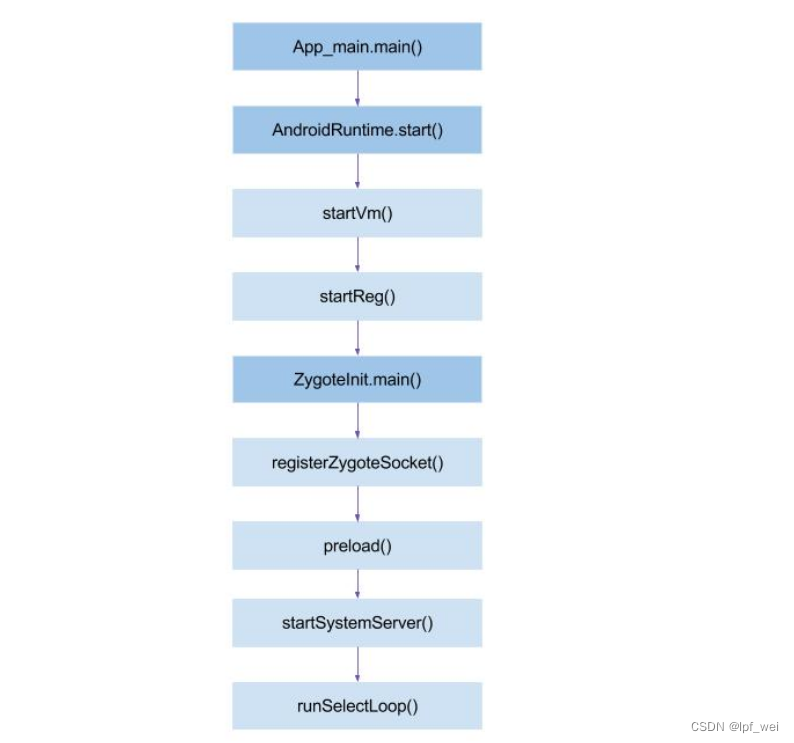
\frameworks\base\cmds\app_process\app_main.cpp main()L280if (strcmp(arg, "--zygote") == 0) { zygote = true; niceName = ZYGOTE_NICE_NAME; } else if (strcmp(arg, "--start-system-server") == 0) { startSystemServer = true; } else if (strcmp(arg, "--application") == 0) { application = true; } else if (strncmp(arg, "--nice-name=", 12) == 0) { niceName.setTo(arg + 12); } else if (strncmp(arg, "--", 2) != 0) { className.setTo(arg); break; } ... if (zygote) { runtime.start("com.android.internal.os.ZygoteInit", args, zygote); //启动zygote } else if (className) { runtime.start("com.android.internal.os.RuntimeInit", args, zygote); } else { fprintf(stderr, "Error: no class name or --zygote supplied.\n"); app_usage(); LOG_ALWAYS_FATAL("app_process: no class name or --zygote supplied."); }- 1
- 2
- 3
- 4
- 5
- 6
- 7
- 8
- 9
- 10
- 11
- 12
- 13
- 14
- 15
- 16
- 17
- 18
- 19
- 20
- 21
- 22
- 23
- 24
- 25
app_process 里面定义了三种应用程序类型:
-
Zygote: com.android.internal.os.ZygoteInit
-
System Server, 不单独启动,而是由Zygote启动
-
其他指定类名的Java 程序
\frameworks\base\core\jni\androidRuntime.cpp/*static*/ JavaVM* AndroidRuntime::mJavaVM = NULL; AndroidRuntime::AndroidRuntime(char* argBlockStart, const size_t argBlockLength) : mExitWithoutCleanup(false), mArgBlockStart(argBlockStart), mArgBlockLength(argBlockLength) { SkGraphics::Init(); // Pre-allocate enough space to hold a fair number of options. mOptions.setCapacity(20); assert(gCurRuntime == NULL); // one per process gCurRuntime = this; } AndroidRuntime::~AndroidRuntime() { } /* * Register native methods using JNI. */ /*static*/ int AndroidRuntime::registerNativeMethods(JNIEnv* env, const char* className, const JNINativeMethod* gMethods, int numMethods) { return jniRegisterNativeMethods(env, className, gMethods, numMethods); } void AndroidRuntime::setArgv0(const char* argv0, bool setProcName) { if (setProcName) { int len = strlen(argv0); if (len < 15) { pthread_setname_np(pthread_self(), argv0); } else { pthread_setname_np(pthread_self(), argv0 + len - 15); } } memset(mArgBlockStart, 0, mArgBlockLength); strlcpy(mArgBlockStart, argv0, mArgBlockLength); } status_t AndroidRuntime::callMain(const String8& className, jclass clazz, const Vector& args) { JNIEnv* env; jmethodID methodId; ALOGD("Calling main entry %s", className.string()); env = getJNIEnv(); if (clazz == NULL || env == NULL) { return UNKNOWN_ERROR; } methodId = env->GetStaticMethodID(clazz, "main", "([Ljava/lang/String;)V"); if (methodId == NULL) { ALOGE("ERROR: could not find method %s.main(String[])\n", className.string()); return UNKNOWN_ERROR; } /* * We want to call main() with a String array with our arguments in it. * Create an array and populate it. */ jclass stringClass; jobjectArray strArray; const size_t numArgs = args.size(); stringClass = env->FindClass("java/lang/String"); strArray = env->NewObjectArray(numArgs, stringClass, NULL); for (size_t i = 0; i < numArgs; i++) { jstring argStr = env->NewStringUTF(args[i].string()); env->SetObjectArrayElement(strArray, i, argStr); } env->CallStaticVoidMethod(clazz, methodId, strArray); return NO_ERROR; } /* * The VM calls this through the "exit" hook. */ static void runtime_exit(int code) { gCurRuntime->exit(code); } - 1
- 2
- 3
- 4
- 5
- 6
- 7
- 8
- 9
- 10
- 11
- 12
- 13
- 14
- 15
- 16
- 17
- 18
- 19
- 20
- 21
- 22
- 23
- 24
- 25
- 26
- 27
- 28
- 29
- 30
- 31
- 32
- 33
- 34
- 35
- 36
- 37
- 38
- 39
- 40
- 41
- 42
- 43
- 44
- 45
- 46
- 47
- 48
- 49
- 50
- 51
- 52
- 53
- 54
- 55
- 56
- 57
- 58
- 59
- 60
- 61
- 62
- 63
- 64
- 65
- 66
- 67
- 68
- 69
- 70
- 71
- 72
- 73
- 74
- 75
- 76
- 77
- 78
- 79
- 80
- 81
- 82
- 83
- 84
- 85
- 86
- 87
- 88
Runtime 是支撑程序运行的基础库,它是与语言绑定在一起的:
- C Runtime:就是C standard lib, 也就是我们常说的libc
- Java Runtime: 同样,Wiki将其重定向到” Java Virtual Machine”, 这里当然包括Java 的支撑类库(.jar)
- AndroidRuntime: 显而易见,就是为Android应用运行所需的运行时环境
- Dalvik VM: Android的Java VM, 解释运行Dex格式Java程序。每个进程运行一个虚拟机(什么叫运行虚拟机?说白了,就是一些C代码,不停的去解释Dex格式的二进制码(Bytecode),把它们转成机器码(Machine code),然后执行,当然,现在大多数的Java 虚拟机都支持JIT,也就是说,bytecode可能在运行前就已经被转换成机器码,从而大大提高了性能。过去一个普遍的认识是Java 程序比C,C++等静态编译的语言慢,但随着JIT的介入和发展,这个已经完全是过去时了,JIT的动态性运行允许虚拟机根据运行时环境,优化机器码的生成,在某些情况下,Java甚至可以比C/C++跑得更快,同时又兼具平台无关的特性。
- Android的Java 类库, 大部分来自于 Apache Hamony, 开源的Java API 实现,如 java.lang,java.util, java.net. 但去除了AWT, Swing 等部件。
- JNI: C和Java互调的接口。
- Libc: Android也有很多C代码,自然少不了libc,注意的是,Android的libc叫 bionic C
\frameworks\base\core\jni\androidRuntime.cpp start()L1091/* * Start the Android runtime. This involves starting the virtual machine * and calling the "static void main(String[] args)" method in the class * named by "className". * * Passes the main function two arguments, the class name and the specified * options string. 启动 Android 运行时。这涉及启动虚拟机并在“className”命名的类中调用“static void main(String[] args)”方法。向主函数传递两个参数,类名和指定的选项字符串。 */ void AndroidRuntime::start(const char* className, const Vector& options, bool zygote) { ALOGD(">>>>>> START %s uid %d <<<<<<\n", className != NULL ? className : "(unknown)", getuid()); static const String8 startSystemServer("start-system-server"); /* * 'startSystemServer == true' means runtime is obsolete and not run from * init.rc anymore, so we print out the boot start event here. */ for (size_t i = 0; i < options.size(); ++i) { if (options[i] == startSystemServer) { /* track our progress through the boot sequence */ const int LOG_BOOT_PROGRESS_START = 3000; LOG_EVENT_LONG(LOG_BOOT_PROGRESS_START, ns2ms(systemTime(SYSTEM_TIME_MONOTONIC))); } } const char* rootDir = getenv("ANDROID_ROOT"); if (rootDir == NULL) { rootDir = "/system"; if (!hasDir("/system")) { LOG_FATAL("No root directory specified, and /android does not exist."); return; } setenv("ANDROID_ROOT", rootDir, 1); } //const char* kernelHack = getenv("LD_ASSUME_KERNEL"); //ALOGD("Found LD_ASSUME_KERNEL='%s'\n", kernelHack); /* start the virtual machine */ JniInvocation jni_invocation; jni_invocation.Init(NULL); JNIEnv* env; if (startVm(&mJavaVM, &env, zygote) != 0) { return; } onVmCreated(env); /* * Register android functions. */ if (startReg(env) < 0) { ALOGE("Unable to register all android natives\n"); return; } /* * We want to call main() with a String array with arguments in it. * At present we have two arguments, the class name and an option string. * Create an array to hold them. */ jclass stringClass; jobjectArray strArray; jstring classNameStr; stringClass = env->FindClass("java/lang/String"); assert(stringClass != NULL); strArray = env->NewObjectArray(options.size() + 1, stringClass, NULL); assert(strArray != NULL); classNameStr = env->NewStringUTF(className); assert(classNameStr != NULL); env->SetObjectArrayElement(strArray, 0, classNameStr); for (size_t i = 0; i < options.size(); ++i) { jstring optionsStr = env->NewStringUTF(options.itemAt(i).string()); assert(optionsStr != NULL); env->SetObjectArrayElement(strArray, i + 1, optionsStr); } /* * Start VM. This thread becomes the main thread of the VM, and will * not return until the VM exits. */ char* slashClassName = toSlashClassName(className != NULL ? className : ""); jclass startClass = env->FindClass(slashClassName); if (startClass == NULL) { ALOGE("JavaVM unable to locate class '%s'\n", slashClassName); /* keep going */ } else { jmethodID startMeth = env->GetStaticMethodID(startClass, "main", "([Ljava/lang/String;)V"); if (startMeth == NULL) { ALOGE("JavaVM unable to find main() in '%s'\n", className); /* keep going */ } else { env->CallStaticVoidMethod(startClass, startMeth, strArray); #if 0 if (env->ExceptionCheck()) threadExitUncaughtException(env); #endif } } free(slashClassName); ALOGD("Shutting down VM\n"); if (mJavaVM->DetachCurrentThread() != JNI_OK) ALOGW("Warning: unable to detach main thread\n"); if (mJavaVM->DestroyJavaVM() != 0) ALOGW("Warning: VM did not shut down cleanly\n"); } - 1
- 2
- 3
- 4
- 5
- 6
- 7
- 8
- 9
- 10
- 11
- 12
- 13
- 14
- 15
- 16
- 17
- 18
- 19
- 20
- 21
- 22
- 23
- 24
- 25
- 26
- 27
- 28
- 29
- 30
- 31
- 32
- 33
- 34
- 35
- 36
- 37
- 38
- 39
- 40
- 41
- 42
- 43
- 44
- 45
- 46
- 47
- 48
- 49
- 50
- 51
- 52
- 53
- 54
- 55
- 56
- 57
- 58
- 59
- 60
- 61
- 62
- 63
- 64
- 65
- 66
- 67
- 68
- 69
- 70
- 71
- 72
- 73
- 74
- 75
- 76
- 77
- 78
- 79
- 80
- 81
- 82
- 83
- 84
- 85
- 86
- 87
- 88
- 89
- 90
- 91
- 92
- 93
- 94
- 95
- 96
- 97
- 98
- 99
- 100
- 101
- 102
- 103
- 104
- 105
- 106
- 107
- 108
- 109
- 110
- 111
- 112
- 113
Java虚拟机的启动大致做了以下一些事情:
-
从property读取一系列启动参数。
-
创建和初始化结构体全局对象(每个进程)gDVM,及对应与JavaVM和JNIEnv的内部结构体JavaVMExt, JNIEnvExt.
-
初始化java虚拟机,并创建虚拟机线程
-
注册系统的JNI,Java程序通过这些JNI接口来访问底层的资源。
-
为Zygote的启动做最后的准备,包括设置SID/UID, 以及mount 文件系统
-
返回JavaVM 给Native代码,这样它就可以向上访问Java的接口
\frameworks\base\core\jni\androidRuntime.cpp startVm()L596int AndroidRuntime::startVm(JavaVM** pJavaVM, JNIEnv** pEnv, bool zygote) { ... /* * Initialize the VM. * * The JavaVM* is essentially per-process, and the JNIEnv* is per-thread. * If this call succeeds, the VM is ready, and we can start issuing * JNI calls. */ if (JNI_CreateJavaVM(pJavaVM, pEnv, &initArgs) < 0) { ALOGE("JNI_CreateJavaVM failed\n"); return -1; } return 0; }- 1
- 2
- 3
- 4
- 5
- 6
- 7
- 8
- 9
- 10
- 11
- 12
- 13
- 14
- 15
- 16
- 17
- 18
\art\runtime\java_vm_ext.cc JNI_CreateJavaVM()L1139extern "C" jint JNI_CreateJavaVM(JavaVM** p_vm, JNIEnv** p_env, void* vm_args) { ScopedTrace trace(__FUNCTION__); const JavaVMInitArgs* args = static_cast- 1
- 2
- 3
- 4
- 5
- 6
- 7
- 8
- 9
- 10
- 11
- 12
- 13
- 14
- 15
- 16
- 17
- 18
- 19
- 20
- 21
- 22
- 23
- 24
- 25
- 26
- 27
- 28
- 29
- 30
- 31
- 32
- 33
- 34
- 35
首先通过Runtime的create方法创建单例的Runtime对象,runtime负责提供art虚拟机的运行时环境,然后调用其init方法来初始化虚拟机
\art\runtime\runtime.cc Init()L1109bool Runtime::Init(RuntimeArgumentMap&& runtime_options_in) { L1255 创建java堆 heap_ = new gc::Heap(runtime_options.GetOrDefault(Opt::MemoryInitialSize), runtime_options.GetOrDefault(Opt::HeapGrowthLimit), runtime_options.GetOrDefault(Opt::HeapMinFree), runtime_options.GetOrDefault(Opt::HeapMaxFree), runtime_options.GetOrDefault(Opt::HeapTargetUtilization), foreground_heap_growth_multiplier, runtime_options.GetOrDefault(Opt::MemoryMaximumSize), runtime_options.GetOrDefault(Opt::NonMovingSpaceCapacity), runtime_options.GetOrDefault(Opt::Image), runtime_options.GetOrDefault(Opt::ImageInstructionSet), // Override the collector type to CC if the read barrier config. kUseReadBarrier ? gc::kCollectorTypeCC : xgc_option.collector_type_, kUseReadBarrier ? BackgroundGcOption(gc::kCollectorTypeCCBackground) : runtime_options.GetOrDefault(Opt::BackgroundGc), runtime_options.GetOrDefault(Opt::LargeObjectSpace), runtime_options.GetOrDefault(Opt::LargeObjectThreshold), runtime_options.GetOrDefault(Opt::ParallelGCThreads), runtime_options.GetOrDefault(Opt::ConcGCThreads), runtime_options.Exists(Opt::LowMemoryMode), runtime_options.GetOrDefault(Opt::LongPauseLogThreshold), runtime_options.GetOrDefault(Opt::LongGCLogThreshold), runtime_options.Exists(Opt::IgnoreMaxFootprint), runtime_options.GetOrDefault(Opt::UseTLAB), xgc_option.verify_pre_gc_heap_, xgc_option.verify_pre_sweeping_heap_, xgc_option.verify_post_gc_heap_, xgc_option.verify_pre_gc_rosalloc_, xgc_option.verify_pre_sweeping_rosalloc_, xgc_option.verify_post_gc_rosalloc_, xgc_option.gcstress_, xgc_option.measure_, runtime_options.GetOrDefault(Opt::EnableHSpaceCompactForOOM), runtime_options.GetOrDefault(Opt::HSpaceCompactForOOMMinIntervalsMs)); if (!heap_->HasBootImageSpace() && !allow_dex_file_fallback_) { LOG(ERROR) << "Dex file fallback disabled, cannot continue without image."; return false; } //L1408 创建java虚拟机 std::string error_msg; java_vm_ = JavaVMExt::Create(this, runtime_options, &error_msg); if (java_vm_.get() == nullptr) { LOG(ERROR) << "Could not initialize JavaVMExt: " << error_msg; return false; } // Add the JniEnv handler. // TODO Refactor this stuff. java_vm_->AddEnvironmentHook(JNIEnvExt::GetEnvHandler); Thread::Startup(); //L1424 连接主线程 Thread* self = Thread::Attach("main", false, nullptr, false); CHECK_EQ(self->GetThreadId(), ThreadList::kMainThreadId); CHECK(self != nullptr); // L1437 创建类连接器 if (UNLIKELY(IsAotCompiler())) { class_linker_ = new AotClassLinker(intern_table_); } else { class_linker_ = new ClassLinker(intern_table_); } }- 1
- 2
- 3
- 4
- 5
- 6
- 7
- 8
- 9
- 10
- 11
- 12
- 13
- 14
- 15
- 16
- 17
- 18
- 19
- 20
- 21
- 22
- 23
- 24
- 25
- 26
- 27
- 28
- 29
- 30
- 31
- 32
- 33
- 34
- 35
- 36
- 37
- 38
- 39
- 40
- 41
- 42
- 43
- 44
- 45
- 46
- 47
- 48
- 49
- 50
- 51
- 52
- 53
- 54
- 55
- 56
- 57
- 58
- 59
- 60
- 61
- 62
- 63
- 64
- 65
- 66
- 67
- 68
- new gc::heap(),创建Heap对象,这是虚拟机管理对内存的起点。
- new JavaVmExt(),创建Java虚拟机实例。
- Thread::attach(),attach主线程
- 创建ClassLinker
- 初始化ClassLinker,成功attach到runtime环境后,创建ClassLinker实例负责管理java class到这里,虚拟机的创建和初始化就完成了
\art\runtime\threed.cc Attach()L775templateThread* Thread::Attach(const char* thread_name, bool as_daemon, PeerAction peer_action) { Runtime* runtime = Runtime::Current(); if (runtime == nullptr) { LOG(ERROR) << "Thread attaching to non-existent runtime: " << ((thread_name != nullptr) ? thread_name : "(Unnamed)"); return nullptr; } Thread* self; { MutexLock mu(nullptr, *Locks::runtime_shutdown_lock_); if (runtime->IsShuttingDownLocked()) { LOG(WARNING) << "Thread attaching while runtime is shutting down: " << ((thread_name != nullptr) ? thread_name : "(Unnamed)"); return nullptr; } else { Runtime::Current()->StartThreadBirth(); self = new Thread(as_daemon); bool init_success = self->Init(runtime->GetThreadList(), runtime->GetJavaVM()); Runtime::Current()->EndThreadBirth(); if (!init_success) { delete self; return nullptr; } } } self->InitStringEntryPoints(); CHECK_NE(self->GetState(), kRunnable); self->SetState(kNative); // Run the action that is acting on the peer. if (!peer_action(self)) { runtime->GetThreadList()->Unregister(self); // Unregister deletes self, no need to do this here. return nullptr; } if (VLOG_IS_ON(threads)) { if (thread_name != nullptr) { VLOG(threads) << "Attaching thread " << thread_name; } else { VLOG(threads) << "Attaching unnamed thread."; } ScopedObjectAccess soa(self); self->Dump(LOG_STREAM(INFO)); } { ScopedObjectAccess soa(self); runtime->GetRuntimeCallbacks()->ThreadStart(self); } return self; } - 1
- 2
- 3
- 4
- 5
- 6
- 7
- 8
- 9
- 10
- 11
- 12
- 13
- 14
- 15
- 16
- 17
- 18
- 19
- 20
- 21
- 22
- 23
- 24
- 25
- 26
- 27
- 28
- 29
- 30
- 31
- 32
- 33
- 34
- 35
- 36
- 37
- 38
- 39
- 40
- 41
- 42
- 43
- 44
- 45
- 46
- 47
- 48
- 49
- 50
- 51
- 52
- 53
- 54
- 55
- 56
除了系统的JNI接口(”javacore”, “nativehelper”), android framework 还有大量的Native实现,Android将所有这些接口一次性的通过start_reg()来完成
\frameworks\base\core\jni\androidRuntime.cpp startReg()L1511/* * Register android native functions with the VM. */ /*static*/ int AndroidRuntime::startReg(JNIEnv* env) { ATRACE_NAME("RegisterAndroidNatives"); /* * This hook causes all future threads created in this process to be * attached to the JavaVM. (This needs to go away in favor of JNI * Attach calls.) */ androidSetCreateThreadFunc((android_create_thread_fn) javaCreateThreadEtc); ALOGV("--- registering native functions ---\n"); /* * Every "register" function calls one or more things that return * a local reference (e.g. FindClass). Because we haven't really * started the VM yet, they're all getting stored in the base frame * and never released. Use Push/Pop to manage the storage. */ env->PushLocalFrame(200); if (register_jni_procs(gRegJNI, NELEM(gRegJNI), env) < 0) { env->PopLocalFrame(NULL); return -1; } env->PopLocalFrame(NULL); //createJavaThread("fubar", quickTest, (void*) "hello"); return 0; }- 1
- 2
- 3
- 4
- 5
- 6
- 7
- 8
- 9
- 10
- 11
- 12
- 13
- 14
- 15
- 16
- 17
- 18
- 19
- 20
- 21
- 22
- 23
- 24
- 25
- 26
- 27
- 28
- 29
- 30
- 31
- 32
- 33
\system\core\libutils\Threads.cpp run()L662status_t Thread::run(const char* name, int32_t priority, size_t stack) { LOG_ALWAYS_FATAL_IF(name == nullptr, "thread name not provided to Thread::run"); Mutex::Autolock _l(mLock); if (mRunning) { // thread already started return INVALID_OPERATION; } // reset status and exitPending to their default value, so we can // try again after an error happened (either below, or in readyToRun()) mStatus = NO_ERROR; mExitPending = false; mThread = thread_id_t(-1); // hold a strong reference on ourself mHoldSelf = this; mRunning = true; bool res; if (mCanCallJava) { res = createThreadEtc(_threadLoop, this, name, priority, stack, &mThread); } else { res = androidCreateRawThreadEtc(_threadLoop, this, name, priority, stack, &mThread); } if (res == false) { mStatus = UNKNOWN_ERROR; // something happened! mRunning = false; mThread = thread_id_t(-1); mHoldSelf.clear(); // "this" may have gone away after this. return UNKNOWN_ERROR; } // Do not refer to mStatus here: The thread is already running (may, in fact // already have exited with a valid mStatus result). The NO_ERROR indication // here merely indicates successfully starting the thread and does not // imply successful termination/execution. return NO_ERROR; // Exiting scope of mLock is a memory barrier and allows new thread to run }- 1
- 2
- 3
- 4
- 5
- 6
- 7
- 8
- 9
- 10
- 11
- 12
- 13
- 14
- 15
- 16
- 17
- 18
- 19
- 20
- 21
- 22
- 23
- 24
- 25
- 26
- 27
- 28
- 29
- 30
- 31
- 32
- 33
- 34
- 35
- 36
- 37
- 38
- 39
- 40
- 41
- 42
- 43
- 44
- 45
- 46
- 47
- 48
它们的区别在是是否能够调用Java端函数,普通的thread就是对pthread_create的简单封装
\system\core\libutils\Threads.cpp run() L117int androidCreateRawThreadEtc(android_thread_func_t entryFunction, void *userData, const char* threadName __android_unused, int32_t threadPriority, size_t threadStackSize, android_thread_id_t *threadId) { ... errno = 0; pthread_t thread; int result = pthread_create(&thread, &attr, (android_pthread_entry)entryFunction, userData); ... return 1; }- 1
- 2
- 3
- 4
- 5
- 6
- 7
- 8
- 9
- 10
- 11
- 12
- 13
- 14
- 15
\frameworks\base\core\jni\androidRuntime.cpp javaCreateThreadEtc() L1271/* * This is invoked from androidCreateThreadEtc() via the callback * set with androidSetCreateThreadFunc(). * * We need to create the new thread in such a way that it gets hooked * into the VM before it really starts executing. */ /*static*/ int AndroidRuntime::javaCreateThreadEtc( android_thread_func_t entryFunction, void* userData, const char* threadName, int32_t threadPriority, size_t threadStackSize, android_thread_id_t* threadId) { void** args = (void**) malloc(3 * sizeof(void*)); // javaThreadShell must free int result; LOG_ALWAYS_FATAL_IF(threadName == nullptr, "threadName not provided to javaCreateThreadEtc"); args[0] = (void*) entryFunction; args[1] = userData; args[2] = (void*) strdup(threadName); // javaThreadShell must free result = androidCreateRawThreadEtc(AndroidRuntime::javaThreadShell, args, threadName, threadPriority, threadStackSize, threadId); return result; }- 1
- 2
- 3
- 4
- 5
- 6
- 7
- 8
- 9
- 10
- 11
- 12
- 13
- 14
- 15
- 16
- 17
- 18
- 19
- 20
- 21
- 22
- 23
- 24
- 25
- 26
- 27
- 28
\frameworks\base\core\jni\androidRuntime.cpp javaThreadShell() L1242/* * When starting a native thread that will be visible from the VM, we * bounce through this to get the right attach/detach action. * Note that this function calls free(args) */ /*static*/ int AndroidRuntime::javaThreadShell(void* args) { void* start = ((void**)args)[0]; void* userData = ((void **)args)[1]; char* name = (char*) ((void **)args)[2]; // we own this storage free(args); JNIEnv* env; int result; /* hook us into the VM */ if (javaAttachThread(name, &env) != JNI_OK) return -1; /* start the thread running */ result = (*(android_thread_func_t)start)(userData); /* unhook us */ javaDetachThread(); free(name); return result; }- 1
- 2
- 3
- 4
- 5
- 6
- 7
- 8
- 9
- 10
- 11
- 12
- 13
- 14
- 15
- 16
- 17
- 18
- 19
- 20
- 21
- 22
- 23
- 24
- 25
- 26
\frameworks\base\core\jni\androidRuntime.cpp javaThreadShell() L1200/* * Makes the current thread visible to the VM. * * The JNIEnv pointer returned is only valid for the current thread, and * thus must be tucked into thread-local storage. */ static int javaAttachThread(const char* threadName, JNIEnv** pEnv) { JavaVMAttachArgs args; JavaVM* vm; jint result; vm = AndroidRuntime::getJavaVM(); assert(vm != NULL); args.version = JNI_VERSION_1_4; args.name = (char*) threadName; args.group = NULL; result = vm->AttachCurrentThread(pEnv, (void*) &args); if (result != JNI_OK) ALOGI("NOTE: attach of thread '%s' failed\n", threadName); return result; }- 1
- 2
- 3
- 4
- 5
- 6
- 7
- 8
- 9
- 10
- 11
- 12
- 13
- 14
- 15
- 16
- 17
- 18
- 19
- 20
- 21
- 22
- 23
- 24
- 25
\frameworks\base\core\java\com\android\internal\os\RuntimeInit.java main() L325public static final void main(String[] argv) { enableDdms(); if (argv.length == 2 && argv[1].equals("application")) { if (DEBUG) Slog.d(TAG, "RuntimeInit: Starting application"); //将System.out 和 System.err 输出重定向到Android 的Log系统(定义在android.util.Log) redirectLogStreams(); } else { if (DEBUG) Slog.d(TAG, "RuntimeInit: Starting tool"); } //commonInit(): 初始化了一下系统属性,其中最重要的一点就是设置了一个未捕捉异常的 //handler,当代码有任何未知异常,就会执行它,调试过Android代码的经常看到的”*** FATAL //EXCEPTION IN SYSTEM PROCESS” 打印就出自这里 commonInit(); /* * Now that we're running in interpreted code, call back into native code * to run the system. */ nativeFinishInit(); if (DEBUG) Slog.d(TAG, "Leaving RuntimeInit!"); }- 1
- 2
- 3
- 4
- 5
- 6
- 7
- 8
- 9
- 10
- 11
- 12
- 13
- 14
- 15
- 16
- 17
- 18
- 19
- 20
- 21
- 22
\frameworks\base\core\jni\androidRuntime.cpp nativeFinishInit() L225/* * Code written in the Java Programming Language calls here from main(). */ static void com_android_internal_os_RuntimeInit_nativeFinishInit(JNIEnv* env, jobject clazz) { gCurRuntime->onStarted(); }- 1
- 2
- 3
- 4
- 5
- 6
- 7
\frameworks\base\cmds\app_process\app_main.cpp onStarted()L78virtual void onStarted() { spproc = ProcessState::self(); ALOGV("App process: starting thread pool.\n"); proc->startThreadPool(); AndroidRuntime* ar = AndroidRuntime::getRuntime(); ar->callMain(mClassName, mClass, mArgs); IPCThreadState::self()->stopProcess(); hardware::IPCThreadState::self()->stopProcess(); } - 1
- 2
- 3
- 4
- 5
- 6
- 7
- 8
- 9
- 10
- 11
- 12
\frameworks\base\core\java\com\android\internal\os\ZygotInit.java main()L750public static void main(String argv[]) { ZygoteServer zygoteServer = new ZygoteServer(); //新建Zygote服务器端 // Mark zygote start. This ensures that thread creation will throw // an error. ZygoteHooks.startZygoteNoThreadCreation(); // Zygote goes into its own process group. try { Os.setpgid(0, 0); } catch (ErrnoException ex) { throw new RuntimeException("Failed to setpgid(0,0)", ex); } final Runnable caller; try { // Report Zygote start time to tron unless it is a runtime restart if (!"1".equals(SystemProperties.get("sys.boot_completed"))) { MetricsLogger.histogram(null, "boot_zygote_init", (int) SystemClock.elapsedRealtime()); } String bootTimeTag = Process.is64Bit() ? "Zygote64Timing" : "Zygote32Timing"; TimingsTraceLog bootTimingsTraceLog = new TimingsTraceLog(bootTimeTag, Trace.TRACE_TAG_DALVIK); bootTimingsTraceLog.traceBegin("ZygoteInit"); RuntimeInit.enableDdms(); boolean startSystemServer = false; String socketName = "zygote"; //Dalvik VM进程系统 String abiList = null; boolean enableLazyPreload = false; for (int i = 1; i < argv.length; i++) { //app_main.cpp中传的start-system-server参数吗,在这里用到了 if ("start-system-server".equals(argv[i])) { startSystemServer = true; } else if ("--enable-lazy-preload".equals(argv[i])) { enableLazyPreload = true; } else if (argv[i].startsWith(ABI_LIST_ARG)) { abiList = argv[i].substring(ABI_LIST_ARG.length()); } else if (argv[i].startsWith(SOCKET_NAME_ARG)) { socketName = argv[i].substring(SOCKET_NAME_ARG.length()); } else { throw new RuntimeException("Unknown command line argument: " + argv[i]); } } if (abiList == null) { throw new RuntimeException("No ABI list supplied."); } zygoteServer.registerServerSocketFromEnv(socketName); // In some configurations, we avoid preloading resources and classes eagerly. // In such cases, we will preload things prior to our first fork. // 在有些情况下我们需要在第一个fork之前进行预加载资源 if (!enableLazyPreload) { bootTimingsTraceLog.traceBegin("ZygotePreload"); EventLog.writeEvent(LOG_BOOT_PROGRESS_PRELOAD_START, SystemClock.uptimeMillis()); preload(bootTimingsTraceLog); EventLog.writeEvent(LOG_BOOT_PROGRESS_PRELOAD_END, SystemClock.uptimeMillis()); bootTimingsTraceLog.traceEnd(); // ZygotePreload } else { Zygote.resetNicePriority(); } // Do an initial gc to clean up after startup bootTimingsTraceLog.traceBegin("PostZygoteInitGC"); gcAndFinalize();//主动进行一次资源GC bootTimingsTraceLog.traceEnd(); // PostZygoteInitGC bootTimingsTraceLog.traceEnd(); // ZygoteInit // Disable tracing so that forked processes do not inherit stale tracing tags from // Zygote. Trace.setTracingEnabled(false, 0); Zygote.nativeSecurityInit(); // Zygote process unmounts root storage spaces. Zygote.nativeUnmountStorageOnInit(); ZygoteHooks.stopZygoteNoThreadCreation(); if (startSystemServer) { Runnable r = forkSystemServer(abiList, socketName, zygoteServer); // {@code r == null} in the parent (zygote) process, and {@code r != null} in the // child (system_server) process. if (r != null) { r.run(); return; } } Log.i(TAG, "Accepting command socket connections"); // The select loop returns early in the child process after a fork and // loops forever in the zygote. caller = zygoteServer.runSelectLoop(abiList); } catch (Throwable ex) { Log.e(TAG, "System zygote died with exception", ex); throw ex; } finally { zygoteServer.closeServerSocket(); } // We're in the child process and have exited the select loop. Proceed to execute the // command. if (caller != null) { caller.run(); } }- 1
- 2
- 3
- 4
- 5
- 6
- 7
- 8
- 9
- 10
- 11
- 12
- 13
- 14
- 15
- 16
- 17
- 18
- 19
- 20
- 21
- 22
- 23
- 24
- 25
- 26
- 27
- 28
- 29
- 30
- 31
- 32
- 33
- 34
- 35
- 36
- 37
- 38
- 39
- 40
- 41
- 42
- 43
- 44
- 45
- 46
- 47
- 48
- 49
- 50
- 51
- 52
- 53
- 54
- 55
- 56
- 57
- 58
- 59
- 60
- 61
- 62
- 63
- 64
- 65
- 66
- 67
- 68
- 69
- 70
- 71
- 72
- 73
- 74
- 75
- 76
- 77
- 78
- 79
- 80
- 81
- 82
- 83
- 84
- 85
- 86
- 87
- 88
- 89
- 90
- 91
- 92
- 93
- 94
- 95
- 96
- 97
- 98
- 99
- 100
- 101
- 102
- 103
- 104
- 105
- 106
- 107
- 108
- 109
- 110
- 111
- 112
- 113
preload() 的作用就是提前将需要的资源加载到VM中,比如class、resource等
\frameworks\base\core\java\com\android\internal\os\ZygotInit.java preload() L123static void preload(TimingsTraceLog bootTimingsTraceLog) { Log.d(TAG, "begin preload"); bootTimingsTraceLog.traceBegin("BeginIcuCachePinning"); beginIcuCachePinning(); bootTimingsTraceLog.traceEnd(); // BeginIcuCachePinning bootTimingsTraceLog.traceBegin("PreloadClasses"); preloadClasses(); bootTimingsTraceLog.traceEnd(); // PreloadClasses bootTimingsTraceLog.traceBegin("PreloadResources"); preloadResources(); bootTimingsTraceLog.traceEnd(); // PreloadResources Trace.traceBegin(Trace.TRACE_TAG_DALVIK, "PreloadAppProcessHALs"); nativePreloadAppProcessHALs(); Trace.traceEnd(Trace.TRACE_TAG_DALVIK); Trace.traceBegin(Trace.TRACE_TAG_DALVIK, "PreloadOpenGL"); preloadOpenGL(); Trace.traceEnd(Trace.TRACE_TAG_DALVIK); preloadSharedLibraries(); preloadTextResources(); // Ask the WebViewFactory to do any initialization that must run in the zygote process, // for memory sharing purposes. WebViewFactory.prepareWebViewInZygote(); endIcuCachePinning(); warmUpJcaProviders(); Log.d(TAG, "end preload"); sPreloadComplete = true; }- 1
- 2
- 3
- 4
- 5
- 6
- 7
- 8
- 9
- 10
- 11
- 12
- 13
- 14
- 15
- 16
- 17
- 18
- 19
- 20
- 21
- 22
- 23
- 24
- 25
- 26
- 27
- 28
preloadClassess 将framework.jar里的preloaded-classes 定义的所有class load到内存里,preloaded-classes 编译Android后可以在framework/base下找到。而preloadResources 将系统的Resource(不是在用户apk里定义的resource)load到内存。资源preload到Zygoted的进程地址空间,所有fork的子进程将共享这份空间而无需重新load, 这大大减少了应用程序的启动时间,但反过来增加了系统的启动时间。通过对preload 类和资源数目进行调整可以加快系统启动。Preload也是Android启动最耗时的部分之一
\frameworks\base\core\java\com\android\internal\os\ZygotInit.java gcAndFinalize() L439/** * Runs several special GCs to try to clean up a few generations of * softly- and final-reachable objects, along with any other garbage. * This is only useful just before a fork(). 运行几个特殊的 GC 以尝试清理几代软可到达和最终可到达的对象,以及任何其他垃圾。这仅在 fork() 之前有用。 */ /*package*/ static void gcAndFinalize() { final VMRuntime runtime = VMRuntime.getRuntime(); /* runFinalizationSync() lets finalizers be called in Zygote, * which doesn't have a HeapWorker thread. */ System.gc(); runtime.runFinalizationSync(); System.gc(); }- 1
- 2
- 3
- 4
- 5
- 6
- 7
- 8
- 9
- 10
- 11
- 12
- 13
- 14
- 15
- 16
gc()调用只是通知VM进行垃圾回收,是否回收,什么时候回收全由VM内部算法决定。GC的回收有一个复杂的状态机控制,通过多次调用,可以使得尽可能多的资源得到回收。gc()必须在fork之前完成(接下来的StartSystemServer就会有fork操作),这样将来被复制出来的子进程才能有尽可能少的垃圾内存没有释放
\frameworks\base\core\java\com\android\internal\os\ZygotInit.java forkSystemServer L657/** * Prepare the arguments and forks for the system server process. * * Returns an {@code Runnable} that provides an entrypoint into system_server code in the * child process, and {@code null} in the parent. 为系统服务器进程准备参数和分叉。返回一个 {@code Runnable},它为子进程中的 system_server 代码和父进程中的 {@code null} 提供入口点 */ private static Runnable forkSystemServer(String abiList, String socketName, ZygoteServer zygoteServer) { long capabilities = posixCapabilitiesAsBits( OsConstants.CAP_IPC_LOCK, OsConstants.CAP_KILL, OsConstants.CAP_NET_ADMIN, OsConstants.CAP_NET_BIND_SERVICE, OsConstants.CAP_NET_BROADCAST, OsConstants.CAP_NET_RAW, OsConstants.CAP_SYS_MODULE, OsConstants.CAP_SYS_NICE, OsConstants.CAP_SYS_PTRACE, OsConstants.CAP_SYS_TIME, OsConstants.CAP_SYS_TTY_CONFIG, OsConstants.CAP_WAKE_ALARM, OsConstants.CAP_BLOCK_SUSPEND ); /* Containers run without some capabilities, so drop any caps that are not available. */ StructCapUserHeader header = new StructCapUserHeader( OsConstants._LINUX_CAPABILITY_VERSION_3, 0); StructCapUserData[] data; try { data = Os.capget(header); } catch (ErrnoException ex) { throw new RuntimeException("Failed to capget()", ex); } capabilities &= ((long) data[0].effective) | (((long) data[1].effective) << 32); /* Hardcoded command line to start the system server 硬编码命令行启动系统服务器 //启动SystemServer的命令行,部分参数写死 */ String args[] = { "--setuid=1000", "--setgid=1000", "--setgroups=1001,1002,1003,1004,1005,1006,1007,1008,1009,1010,1018,1021,1023,1024,1032,1065,3001,3002,3003,3006,3007,3009,3010", "--capabilities=" + capabilities + "," + capabilities, "--nice-name=system_server", "--runtime-args", "--target-sdk-version=" + VMRuntime.SDK_VERSION_CUR_DEVELOPMENT, "com.android.server.SystemServer", }; ZygoteConnection.Arguments parsedArgs = null; int pid; try { parsedArgs = new ZygoteConnection.Arguments(args); ZygoteConnection.applyDebuggerSystemProperty(parsedArgs); ZygoteConnection.applyInvokeWithSystemProperty(parsedArgs); boolean profileSystemServer = SystemProperties.getBoolean( "dalvik.vm.profilesystemserver", false); if (profileSystemServer) { parsedArgs.runtimeFlags |= Zygote.PROFILE_SYSTEM_SERVER; } /* Request to fork the system server process 创建 system server 进程 */ pid = Zygote.forkSystemServer( parsedArgs.uid, parsedArgs.gid, parsedArgs.gids, parsedArgs.runtimeFlags, null, parsedArgs.permittedCapabilities, parsedArgs.effectiveCapabilities); } catch (IllegalArgumentException ex) { throw new RuntimeException(ex); } /* For child process */ if (pid == 0) { if (hasSecondZygote(abiList)) { waitForSecondaryZygote(socketName); } zygoteServer.closeServerSocket(); return handleSystemServerProcess(parsedArgs); } return null; }- 1
- 2
- 3
- 4
- 5
- 6
- 7
- 8
- 9
- 10
- 11
- 12
- 13
- 14
- 15
- 16
- 17
- 18
- 19
- 20
- 21
- 22
- 23
- 24
- 25
- 26
- 27
- 28
- 29
- 30
- 31
- 32
- 33
- 34
- 35
- 36
- 37
- 38
- 39
- 40
- 41
- 42
- 43
- 44
- 45
- 46
- 47
- 48
- 49
- 50
- 51
- 52
- 53
- 54
- 55
- 56
- 57
- 58
- 59
- 60
- 61
- 62
- 63
- 64
- 65
- 66
- 67
- 68
- 69
- 70
- 71
- 72
- 73
- 74
- 75
- 76
- 77
- 78
- 79
- 80
- 81
- 82
- 83
- 84
- 85
ZygoteInit.forkSystemServer() 方法fork 出一个新的进程,这个进程就是SystemServer进程。fork出来的子进程在handleSystemServerProcess 里开始初始化工作,主要工作分为:
-
prepareSystemServerProfile()方法中将SYSTEMSERVERCLASSPATH中的AppInfo加载到VM中。
-
判断fork args中是否有invokWith参数,如果有则进行WrapperInit.execApplication。如果没有则调用
\frameworks\base\core\java\com\android\internal\os\ZygoteInit.java handleSystemServerProcess() L453/** * Finish remaining work for the newly forked system server process. */ private static Runnable handleSystemServerProcess(ZygoteConnection.Arguments parsedArgs) { // set umask to 0077 so new files and directories will default to owner-only permissions. Os.umask(S_IRWXG | S_IRWXO); if (parsedArgs.niceName != null) { Process.setArgV0(parsedArgs.niceName); } final String systemServerClasspath = Os.getenv("SYSTEMSERVERCLASSPATH"); if (systemServerClasspath != null) { performSystemServerDexOpt(systemServerClasspath); // Capturing profiles is only supported for debug or eng builds since selinux normally // prevents it. boolean profileSystemServer = SystemProperties.getBoolean( "dalvik.vm.profilesystemserver", false); if (profileSystemServer && (Build.IS_USERDEBUG || Build.IS_ENG)) { try {//将SYSTEMSERVERCLASSPATH中的AppInfo加载到VM中 prepareSystemServerProfile(systemServerClasspath); } catch (Exception e) { Log.wtf(TAG, "Failed to set up system server profile", e); } } } if (parsedArgs.invokeWith != null) { String[] args = parsedArgs.remainingArgs; // If we have a non-null system server class path, we'll have to duplicate the // existing arguments and append the classpath to it. ART will handle the classpath // correctly when we exec a new process. if (systemServerClasspath != null) { String[] amendedArgs = new String[args.length + 2]; amendedArgs[0] = "-cp"; amendedArgs[1] = systemServerClasspath; System.arraycopy(args, 0, amendedArgs, 2, args.length); args = amendedArgs; } //判断fork args中是否有invokWith参数,如果有则进行 WrapperInit.execApplication WrapperInit.execApplication(parsedArgs.invokeWith, parsedArgs.niceName, parsedArgs.targetSdkVersion, VMRuntime.getCurrentInstructionSet(), null, args); throw new IllegalStateException("Unexpected return from WrapperInit.execApplication"); } else { ClassLoader cl = null; if (systemServerClasspath != null) { cl = createPathClassLoader(systemServerClasspath, parsedArgs.targetSdkVersion); Thread.currentThread().setContextClassLoader(cl); } /* * Pass the remaining arguments to SystemServer. 将剩余的参数传递给 SystemServer * 调用zygoteInit */ return ZygoteInit.zygoteInit(parsedArgs.targetSdkVersion, parsedArgs.remainingArgs, cl); } /* should never reach here */ }- 1
- 2
- 3
- 4
- 5
- 6
- 7
- 8
- 9
- 10
- 11
- 12
- 13
- 14
- 15
- 16
- 17
- 18
- 19
- 20
- 21
- 22
- 23
- 24
- 25
- 26
- 27
- 28
- 29
- 30
- 31
- 32
- 33
- 34
- 35
- 36
- 37
- 38
- 39
- 40
- 41
- 42
- 43
- 44
- 45
- 46
- 47
- 48
- 49
- 50
- 51
- 52
- 53
- 54
- 55
- 56
- 57
- 58
- 59
- 60
- 61
- 62
\frameworks\base\core\java\com\android\internal\os\RuntimeInit.java applicationInit() L345protected static Runnable applicationInit(int targetSdkVersion, String[] argv, ClassLoader classLoader) { // If the application calls System.exit(), terminate the process // immediately without running any shutdown hooks. It is not possible to // shutdown an Android application gracefully. Among other things, the // Android runtime shutdown hooks close the Binder driver, which can cause // leftover running threads to crash before the process actually exits. // 如果应用程序调用 System.exit(),立即终止进程而不运行任何关闭挂钩。无法正常关闭 Android 应用程序。除此之外,Android 运行时关闭挂钩会关闭 Binder 驱动程序,这可能会导致剩余运行的线程在进程实际退出之前崩溃 nativeSetExitWithoutCleanup(true); // We want to be fairly aggressive about heap utilization, to avoid // holding on to a lot of memory that isn't needed. VMRuntime.getRuntime().setTargetHeapUtilization(0.75f); VMRuntime.getRuntime().setTargetSdkVersion(targetSdkVersion); final Arguments args = new Arguments(argv); // The end of of the RuntimeInit event (see #zygoteInit). Trace.traceEnd(Trace.TRACE_TAG_ACTIVITY_MANAGER); // Remaining arguments are passed to the start class's static main return findStaticMain(args.startClass, args.startArgs, classLoader); }- 1
- 2
- 3
- 4
- 5
- 6
- 7
- 8
- 9
- 10
- 11
- 12
- 13
- 14
- 15
- 16
- 17
- 18
- 19
- 20
- 21
- 22
- 23
\frameworks\base\core\java\com\android\internal\os\RuntimeInit.java findStaticMain() L287/** * Invokes a static "main(argv[]) method on class "className". * Converts various failing exceptions into RuntimeExceptions, with * the assumption that they will then cause the VM instance to exit. * 在类“className”上调用静态“main(argv[]) 方法。将各种失败的异常转换为 RuntimeExceptions,假设它们将导致 VM 实例退出。 * @param className Fully-qualified class name * @param argv Argument vector for main() * @param classLoader the classLoader to load {@className} with */ protected static Runnable findStaticMain(String className, String[] argv, ClassLoader classLoader) { Class<?> cl; try { cl = Class.forName(className, true, classLoader); } catch (ClassNotFoundException ex) { throw new RuntimeException( "Missing class when invoking static main " + className, ex); } Method m; try { m = cl.getMethod("main", new Class[] { String[].class }); } catch (NoSuchMethodException ex) { throw new RuntimeException( "Missing static main on " + className, ex); } catch (SecurityException ex) { throw new RuntimeException( "Problem getting static main on " + className, ex); } int modifiers = m.getModifiers(); if (! (Modifier.isStatic(modifiers) && Modifier.isPublic(modifiers))) { throw new RuntimeException( "Main method is not public and static on " + className); } /* * This throw gets caught in ZygoteInit.main(), which responds * by invoking the exception's run() method. This arrangement * clears up all the stack frames that were required in setting * up the process. */ return new MethodAndArgsCaller(m, argv); }- 1
- 2
- 3
- 4
- 5
- 6
- 7
- 8
- 9
- 10
- 11
- 12
- 13
- 14
- 15
- 16
- 17
- 18
- 19
- 20
- 21
- 22
- 23
- 24
- 25
- 26
- 27
- 28
- 29
- 30
- 31
- 32
- 33
- 34
- 35
- 36
- 37
- 38
- 39
- 40
- 41
- 42
- 43
- 44
- 45
- 46
很明显这是一个耗时操作所以使用线程来完成:
\frameworks\base\core\java\com\android\internal\os\RuntimeInit.java MethodAndArgsCaller L479/** * Helper class which holds a method and arguments and can call them. This is used as part of * a trampoline to get rid of the initial process setup stack frames. */ static class MethodAndArgsCaller implements Runnable { /** method to call */ private final Method mMethod; /** argument array */ private final String[] mArgs; public MethodAndArgsCaller(Method method, String[] args) { mMethod = method; mArgs = args; } public void run() { try { mMethod.invoke(null, new Object[] { mArgs }); } catch (IllegalAccessException ex) { throw new RuntimeException(ex); } catch (InvocationTargetException ex) { Throwable cause = ex.getCause(); if (cause instanceof RuntimeException) { throw (RuntimeException) cause; } else if (cause instanceof Error) { throw (Error) cause; } throw new RuntimeException(ex); } } }- 1
- 2
- 3
- 4
- 5
- 6
- 7
- 8
- 9
- 10
- 11
- 12
- 13
- 14
- 15
- 16
- 17
- 18
- 19
- 20
- 21
- 22
- 23
- 24
- 25
- 26
- 27
- 28
- 29
- 30
- 31
- 32
7.System Server 启动流程
System Server 是Zygote fork 的第一个Java 进程, 这个进程非常重要,因为他们有很多的系统线程,提供所有核心的系统服务
WindowManager, ActivityManager,它们都是运行在system_server的进程里。还有很多“Binder-x”的线程,它们是各个Service为了响应应用程序远程调用请求而创建的。除此之外,还有很多内部的线程,比如 ”UI thread”, “InputReader”, “InputDispatch” 等等,现在我们只关心System Server是如何创建起来的。
SystemServer的main() 函数。
/** * The main entry point from zygote. * zygote 的主要入口点。 */ public static void main(String[] args) { new SystemServer().run(); }- 1
- 2
- 3
- 4
- 5
- 6
- 7
记下来我分成4部分详细分析SystemServer run方法的初始化流程:
- 初始化必要的SystemServer环境参数,比如系统时间、默认时区、语言、load一些Library等等,
- 初始化Looper,我们在主线程中使用到的looper就是在SystemServer中进行初始化的
- 初始化Context,只有初始化一个Context才能进行启动Service等操作,这里看一下源码:
// Initialize the system context. 初始化系统上下文。 private void createSystemContext() { ActivityThread activityThread = ActivityThread.systemMain(); mSystemContext = activityThread.getSystemContext(); mSystemContext.setTheme(DEFAULT_SYSTEM_THEME); final Context systemUiContext = activityThread.getSystemUiContext(); systemUiContext.setTheme(DEFAULT_SYSTEM_THEME); }- 1
- 2
- 3
- 4
- 5
- 6
- 7
- 8
- 9
ActivityThread就是这个时候生成的
继续看ActivityThread中如何生成Context:
public ContextImpl getSystemContext() { synchronized(this) { if (mSystemContext == null) { ContextImpl context = ContextImpl.createSystemContext(this); LoadedApk info = new LoadedApk(this, "android", context, (ApplicationInfo)null, CompatibilityInfo.DEFAULT_COMPATIBILITY_INFO); context.init(info, (IBinder)null, this); context.getResources().updateConfiguration(this.getConfiguration(), this.getDisplayMetricsLocked(0, CompatibilityInfo.DEFAULT_COMPATIBILITY_INFO)); mSystemContext = context; } } return mSystemContext; }- 1
- 2
- 3
- 4
- 5
- 6
- 7
- 8
- 9
- 10
- 11
- 12
- 13
ContextImpl是Context类的具体实现,createContext的方法:
static ContextImpl createSystemContext(ActivityThread mainThread) { ContextImpl context = new ContextImpl(); context.init(Resources.getSystem(), mainThread, Process.myUserHandle()); return context; }- 1
- 2
- 3
- 4
- 5
初始化SystemServiceManager,用来管理启动service,SystemServiceManager中封装了启动Service的startService方法启动系统必要的Service,启动service的流程又分成三步走:
// Start services. try { traceBeginAndSlog("StartServices"); /*引导服务启动*/ startBootstrapServices(); startCoreServices(); startOtherServices(); SystemServerInitThreadPool.shutdown(); } catch (Throwable ex) { Slog.e("System", "******************************************"); Slog.e("System", "************ Failure starting system services", ex); throw ex; } finally { traceEnd(); }- 1
- 2
- 3
- 4
- 5
- 6
- 7
- 8
- 9
- 10
- 11
- 12
- 13
- 14
- 15
- 16
启动BootstrapServices,就是系统必须需要的服务,这些服务直接耦合性很高,所以干脆就放在一个方法里面一起启动,比如PowerManagerService、RecoverySystemService、DisplayManagerService、ActivityManagerService等等启动以基本的核心Service,很简单,只有三个BatteryService、
UsageStatsService、WebViewUpdateService启动其它需要用到的Service,比如NetworkScoreService、AlarmManagerServiceSytem Server 责任重大重任,出问题了zygote。Zygote会默默的在后台凝视这自己的大儿子,一旦发现SystemServer 挂掉了,将其回收,然后将自己杀掉,重新开始新的一生, 可怜天下父母心啊。这段实现在代码 :com_android_internal_os_Zygote.cpp 中,systemServer 和zygote 共存亡
// This signal handler is for zygote mode, since the zygote must reap its children //此信号处理程序用于 zygote 模式,因为 zygote 必须收获其子代 static void SigChldHandler(int /*signal_number*/) { pid_t pid; int status; // It's necessary to save and restore the errno during this function. // Since errno is stored per thread, changing it here modifies the errno // on the thread on which this signal handler executes. If a signal occurs // between a call and an errno check, it's possible to get the errno set // here. // See b/23572286 for extra information. int saved_errno = errno; while ((pid = waitpid(-1, &status, WNOHANG)) > 0) { // Log process-death status that we care about. In general it is // not safe to call LOG(...) from a signal handler because of // possible reentrancy. However, we know a priori that the // current implementation of LOG() is safe to call from a SIGCHLD // handler in the zygote process. If the LOG() implementation // changes its locking strategy or its use of syscalls within the // lazy-init critical section, its use here may become unsafe. if (WIFEXITED(status)) { ALOGI("Process %d exited cleanly (%d)", pid, WEXITSTATUS(status)); } else if (WIFSIGNALED(status)) { ALOGI("Process %d exited due to signal (%d)", pid, WTERMSIG(status)); if (WCOREDUMP(status)) { ALOGI("Process %d dumped core.", pid); } } // If the just-crashed process is the system_server, bring down zygote // so that it is restarted by init and system server will be restarted // from there. 如果刚刚崩溃的进程是 system_server,则关闭 zygote 以便它由 init 重新启动,系统服务器将从那里重新启动。 //如果挂掉的是SystemServer if (pid == gSystemServerPid) { ALOGE("Exit zygote because system server (%d) has terminated", pid); kill(getpid(), SIGKILL); //zygote 自杀 重启 } } // Note that we shouldn't consider ECHILD an error because // the secondary zygote might have no children left to wait for. if (pid < 0 && errno != ECHILD) { ALOGW("Zygote SIGCHLD error in waitpid: %s", strerror(errno)); } errno = saved_errno; }- 1
- 2
- 3
- 4
- 5
- 6
- 7
- 8
- 9
- 10
- 11
- 12
- 13
- 14
- 15
- 16
- 17
- 18
- 19
- 20
- 21
- 22
- 23
- 24
- 25
- 26
- 27
- 28
- 29
- 30
- 31
- 32
- 33
- 34
- 35
- 36
- 37
- 38
- 39
- 40
- 41
- 42
- 43
- 44
- 45
- 46
- 47
- 48
- 49
总结:
- init 根据init.rc 运行 app_process, 并携带‘–zygote’ 和 ’–startSystemServer’ 参数。
- AndroidRuntime.cpp::start() 里将启动JavaVM,并且注册所有framework相关的系统JNI接口。
- 第一次进入Java世界,运行ZygoteInit.java::main() 函数初始化Zygote. Zygote 并创建Socket的server 端。
- 然后fork一个新的进程并在新进程里初始化SystemServer. Fork之前,Zygote是preload常用的Java类库,以及系统的resources,同时GC()清理内存空间,为子进程省去重复的工作。
- SystemServer 里将所有的系统Service初始化,包括ActivityManager 和 WindowManager, 他们是应用程序运行起来的前提。
- 依次同时,Zygote监听服务端Socket,等待新的应用启动请求。
- ActivityManager ready 之后寻找系统的“Startup” Application, 将请求发给Zygote。
- Zygote收到请求后,fork出一个新的进程。
- Zygote监听并处理SystemServer 的 SIGCHID 信号,一旦System Server崩溃,立即将自己杀死。init会重启Zygote.
什么情况下Zygote进程会重启呢?
- servicemanager进程被杀;
- (onresart)surfaceflinger进程被杀;
- (onresart)Zygote进程自己被杀;
- (oneshot=false)system_server进程被杀; (waitpid)
8.fork 函数
8.1 fork介绍
pid_t fork(void)- 1
参数:不需要参数
需要的头文件
和 返回值分两种情况:
- 返回0表示成功创建子进程,并且接下来### Android 系统启动流程解析
1.android系统启动流程概述
-
Boot ROM:当电源按下,引导芯片代码开始从预定义的地方(固化在ROM)开始执行。加载引导程序到RAM,然后
执行 -
Boot Loader:引导程序是在Android操作系统开始运行前的一个小程序。引导程序是运行的第一个程序,因此它是针
对特定的主板与芯片的。引导程序分两个阶段执行:
第一个阶段,检测外部的RAM以及加载对第二阶段有用的程序;
第二阶段,引导程序设置网络、内存等等。这些对于运行内核是必要的,为了达到特殊的目标,引导程序可以根据配置参数或者输入数据设置内核。
-
Kernel:Android内核与桌面linux内核启动的方式差不多。内核启动时,设置缓存、被保护存储器、计划列表,加载驱动。当内核完成系统设置,它首先在系统文件中寻找”init”文件,然后启动root进程或者系统的第一个进程。
-
init( pid=1):init进程是Linux系统中用户空间的第一个进程,进程号固定为1。Kernel启动后,在用户空间启动init进
程,并调用init中的main()方法执行init进程的职责。- 创建 挂载所需要启动的文件
- 初始化 和启动属性服务
- 解析init.rc 并启动zygote进程
-
zygote
-
System Server
-
Launcher app 手机桌面
2.init进程分析
其中init进程是Android系统中及其重要的第一个进程,这个进程的职责是:
- 创建和挂载启动所需要的文件目录
- 初始化和启动属性服务
- 解析init.rc配置文件并启动Zygote进程
下面是:
system/core/init/init.cpp部分源码//init的main函数有两个其它入口,一是参数中有ueventd,进入ueventd_main,二是参数中有watchdogd,进入watchdogd_main int main(int argc, char** argv) { /** * 1.strcmp是String的一个函数,比较字符串,相等返回0 * 2.basename是C库中的一个函数,得到特定的路径中的最后一个'/'后面的内容,比如/sdcard/miui_recovery/backup,得到的结果是backup * 3.当argv[0]的内容为ueventd时,strcmp的值为0,!strcmp为1 1表示true,也就执行ueventd_main,ueventd主要是负责设备节点的创建、权限设定等一 * 些列工作 */ if (!strcmp(basename(argv[0]), "ueventd")) { return ueventd_main(argc, argv); } //watchdogd俗称看门狗,用于系统出问题时重启系统 if (!strcmp(basename(argv[0]), "watchdogd")) { return watchdogd_main(argc, argv); } if (argc > 1 && !strcmp(argv[1], "subcontext")) { InitKernelLogging(argv); const BuiltinFunctionMap function_map; return SubcontextMain(argc, argv, &function_map); } //初始化重启系统的处理信号,内部通过 sigaction 注册信号,当监听到该信号时重启系统 if (REBOOT_BOOTLOADER_ON_PANIC) { InstallRebootSignalHandlers(); } //查看是否有环境变量INIT_SECOND_STAGE bool is_first_stage = (getenv("INIT_SECOND_STAGE") == nullptr); //1.init的main方法会执行两次,由is_first_stage控制,first_stage就是第一阶段要 做的事 if (is_first_stage) { boot_clock::time_point start_time = boot_clock::now(); // Clear the umask. 清空文件权限 umask(0); clearenv(); setenv("PATH", _PATH_DEFPATH, 1); // Get the basic filesystem setup we need put together in the initramdisk // on / and then we'll let the rc file figure out the rest. //mount是用来挂载文件系统的,mount属于Linux系统调用 mount("tmpfs", "/dev", "tmpfs", MS_NOSUID, "mode=0755"); mkdir("/dev/pts", 0755); //创建目录,第一个参数是目录路径,第二个是读写权限 mkdir("/dev/socket", 0755); mount("devpts", "/dev/pts", "devpts", 0, NULL); #define MAKE_STR(x) __STRING(x) mount("proc", "/proc", "proc", 0, "hidepid=2,gid=" MAKE_STR(AID_READPROC)); // Don't expose the raw commandline to unprivileged processes. chmod("/proc/cmdline", 0440); //用于修改文件/目录的读写权限 gid_t groups[] = { AID_READPROC }; setgroups(arraysize(groups), groups); // 用来将list 数组中所标明的组加入到目前进程的组设置中 mount("sysfs", "/sys", "sysfs", 0, NULL); mount("selinuxfs", "/sys/fs/selinux", "selinuxfs", 0, NULL); //mknod用于创建Linux中的设备文件 mknod("/dev/kmsg", S_IFCHR | 0600, makedev(1, 11)); if constexpr (WORLD_WRITABLE_KMSG) { mknod("/dev/kmsg_debug", S_IFCHR | 0622, makedev(1, 11)); } mknod("/dev/random", S_IFCHR | 0666, makedev(1, 8)); mknod("/dev/urandom", S_IFCHR | 0666, makedev(1, 9)); // Mount staging areas for devices managed by vold // See storage config details at http://source.android.com/devices/storage/ mount("tmpfs", "/mnt", "tmpfs", MS_NOEXEC | MS_NOSUID | MS_NODEV, "mode=0755,uid=0,gid=1000"); // /mnt/vendor is used to mount vendor-specific partitions that can not be // part of the vendor partition, e.g. because they are mounted read-write. mkdir("/mnt/vendor", 0755); // Now that tmpfs is mounted on /dev and we have /dev/kmsg, we can actually // talk to the outside world... //将标准输入输出重定向到"/sys/fs/selinux/null" InitKernelLogging(argv); LOG(INFO) << "init first stage started!"; if (!DoFirstStageMount()) { LOG(FATAL) << "Failed to mount required partitions early ..."; } //Avb即Android Verfied boot,功能包括Secure Boot, verfying boot 和 dm-verity, //原理都是对二进制文件进行签名,在系统启动时进行认证,确保系统运行的是合法的二进制镜像文件。 //其中认证的范围涵盖:bootloader,boot.img,system.img //在刷机模式下初始化avb的版本,不是刷机模式直接跳过 SetInitAvbVersionInRecovery(); // Enable seccomp if global boot option was passed (otherwise it is enabled in zygote). global_seccomp(); // Set up SELinux, loading the SELinux policy. 设置 SELinux,加载 SELinux 策略。 SelinuxSetupKernelLogging(); SelinuxInitialize();//加载SELinux policy,也就是安全策略, // We're in the kernel domain, so re-exec init to transition to the init domain now // that the SELinux policy has been loaded. //1.我们执行第一遍时是在kernel domain,所以要重新执行 init文件,切换到init domain,这样SELinux policy才已经加载进来了 //2.后面的security_failure函数会调用panic重启系统 if (selinux_android_restorecon("/init", 0) == -1) { PLOG(FATAL) << "restorecon failed of /init failed"; } setenv("INIT_SECOND_STAGE", "true", 1); static constexpr uint32_t kNanosecondsPerMillisecond = 1e6; uint64_t start_ms = start_time.time_since_epoch().count() / kNanosecondsPerMillisecond; setenv("INIT_STARTED_AT", std::to_string(start_ms).c_str(), 1); char* path = argv[0]; char* args[] = { path, nullptr }; execv(path, args);//重新执行main方法,进入第二阶段 // execv() only returns if an error happened, in which case we // panic and never fall through this conditional. PLOG(FATAL) << "execv(\"" << path << "\") failed"; } // At this point we're in the second stage of init. InitKernelLogging(argv); LOG(INFO) << "init second stage started!"; // Set up a session keyring that all processes will have access to. It // will hold things like FBE encryption keys. No process should override // its session keyring. keyctl_get_keyring_ID(KEY_SPEC_SESSION_KEYRING, 1); // Indicate that booting is in progress to background fw loaders, etc. close(open("/dev/.booting", O_WRONLY | O_CREAT | O_CLOEXEC, 0000)); property_init(); //初始化属性系统,并从指定文件读取属性 从各个文件读取一些属性,然后通过property_set设置系统属性 // If arguments are passed both on the command line and in DT, // properties set in DT always have priority over the command-line ones. //如果参数同时从命令行和DT传过来,DT的优先级总是大于命令行 //2.DT即device-tree,中文意思是设备树,这里面记录自己的硬件配置和系统运行参数,参考http://www.wowotech.net/linux_kenrel/why-dt.html process_kernel_dt();//处理DT属性 process_kernel_cmdline(); //处理命令行属性 // Propagate the kernel variables to internal variables // used by init as well as the current required properties. 将内核变量传播到 init 使用的内部变量以及当前所需的属性 export_kernel_boot_props(); //处理其他的一些属性 // Make the time that init started available for bootstat to log. property_set("ro.boottime.init", getenv("INIT_STARTED_AT")); property_set("ro.boottime.init.selinux", getenv("INIT_SELINUX_TOOK")); // Set libavb version for Framework-only OTA match in Treble build. const char* avb_version = getenv("INIT_AVB_VERSION"); if (avb_version) property_set("ro.boot.avb_version", avb_version); // Clean up our environment. unsetenv("INIT_SECOND_STAGE");//清空这些环境变量,因为之前都已经存入到系统属性 unsetenv("INIT_STARTED_AT"); unsetenv("INIT_SELINUX_TOOK"); unsetenv("INIT_AVB_VERSION"); // Now set up SELinux for second stage. SelinuxSetupKernelLogging(); SelabelInitialize(); SelinuxRestoreContext(); epoll_fd = epoll_create1(EPOLL_CLOEXEC); //创建epoll实例,并返回epoll的文件描述符 if (epoll_fd == -1) { PLOG(FATAL) << "epoll_create1 failed"; } sigchld_handler_init();//主要是创建handler处理子进程终止信号,创建一个匿名socket并注册到epoll进行监听 if (!IsRebootCapable()) { // If init does not have the CAP_SYS_BOOT capability, it is running in a container. // In that case, receiving SIGTERM will cause the system to shut down. InstallSigtermHandler(); } property_load_boot_defaults(); //从文件中加载一些属性,读取usb配置 export_oem_lock_status();//设置ro.boot.flash.locked 属性 start_property_service();//开启一个socket监听系统属性的设置 set_usb_controller();//设置sys.usb.controller 属性 const BuiltinFunctionMap function_map; //方法映射“class_start”-> "do_class_start" Action::set_function_map(&function_map); // 设置解析命令映射表 将function_map存放到Action中作 为成员属性 subcontexts = InitializeSubcontexts(); ActionManager& am = ActionManager::GetInstance(); ServiceList& sm = ServiceList::GetInstance(); LoadBootScripts(am, sm); //加载 引导脚本 xxx.rc // Turning this on and letting the INFO logging be discarded adds 0.2s to // Nexus 9 boot time, so it's disabled by default. if (false) DumpState(); //打印一些当前Parser的信息,默认是不执行的 am.QueueEventTrigger("early-init");//QueueEventTrigger用于触发Action,这里 触发 early-init事件 // Queue an action that waits for coldboot done so we know ueventd has set up all of /dev... //QueueBuiltinAction用于添加Action,第一个参数是Action要执行的Command,第二个是Trigger am.QueueBuiltinAction(wait_for_coldboot_done_action, "wait_for_coldboot_done"); // ... so that we can start queuing up actions that require stuff from /dev. am.QueueBuiltinAction(MixHwrngIntoLinuxRngAction, "MixHwrngIntoLinuxRng"); am.QueueBuiltinAction(SetMmapRndBitsAction, "SetMmapRndBits"); am.QueueBuiltinAction(SetKptrRestrictAction, "SetKptrRestrict"); am.QueueBuiltinAction(keychord_init_action, "keychord_init"); am.QueueBuiltinAction(console_init_action, "console_init"); // Trigger all the boot actions to get us started. am.QueueEventTrigger("init"); // Repeat mix_hwrng_into_linux_rng in case /dev/hw_random or /dev/random // wasn't ready immediately after wait_for_coldboot_done am.QueueBuiltinAction(MixHwrngIntoLinuxRngAction, "MixHwrngIntoLinuxRng"); // Don't mount filesystems or start core system services in charger mode. std::string bootmode = GetProperty("ro.bootmode", ""); if (bootmode == "charger") { am.QueueEventTrigger("charger"); } else { am.QueueEventTrigger("late-init"); } // Run all property triggers based on current state of the properties. am.QueueBuiltinAction(queue_property_triggers_action, "queue_property_triggers"); while (true) { // By default, sleep until something happens. int epoll_timeout_ms = -1; //epoll超时时间,相当于阻塞时间 if (do_shutdown && !shutting_down) { do_shutdown = false; if (HandlePowerctlMessage(shutdown_command)) { shutting_down = true; } } //1.waiting_for_prop和IsWaitingForExec都是判断一个Timer为不为空,相当于一个标志位 //2.waiting_for_prop负责属性设置,IsWaitingForExe负责service运行 //3.当有属性设置或Service开始运行时,这两个值就不为空,直到执行完毕才置为空 //4.其实这两个判断条件主要作用就是保证属性设置和service启动的完整性,也可以说是为了同步 if (!(waiting_for_prop || Service::is_exec_service_running())) { am.ExecuteOneCommand();//执行一个command } if (!(waiting_for_prop || Service::is_exec_service_running())) { if (!shutting_down) { auto next_process_restart_time = RestartProcesses(); //重启服务 // If there's a process that needs restarting, wake up in time for that. if (next_process_restart_time) { epoll_timeout_ms = std::chrono::ceil- 1
- 2
- 3
- 4
- 5
- 6
- 7
- 8
- 9
- 10
- 11
- 12
- 13
- 14
- 15
- 16
- 17
- 18
- 19
- 20
- 21
- 22
- 23
- 24
- 25
- 26
- 27
- 28
- 29
- 30
- 31
- 32
- 33
- 34
- 35
- 36
- 37
- 38
- 39
- 40
- 41
- 42
- 43
- 44
- 45
- 46
- 47
- 48
- 49
- 50
- 51
- 52
- 53
- 54
- 55
- 56
- 57
- 58
- 59
- 60
- 61
- 62
- 63
- 64
- 65
- 66
- 67
- 68
- 69
- 70
- 71
- 72
- 73
- 74
- 75
- 76
- 77
- 78
- 79
- 80
- 81
- 82
- 83
- 84
- 85
- 86
- 87
- 88
- 89
- 90
- 91
- 92
- 93
- 94
- 95
- 96
- 97
- 98
- 99
- 100
- 101
- 102
- 103
- 104
- 105
- 106
- 107
- 108
- 109
- 110
- 111
- 112
- 113
- 114
- 115
- 116
- 117
- 118
- 119
- 120
- 121
- 122
- 123
- 124
- 125
- 126
- 127
- 128
- 129
- 130
- 131
- 132
- 133
- 134
- 135
- 136
- 137
- 138
- 139
- 140
- 141
- 142
- 143
- 144
- 145
- 146
- 147
- 148
- 149
- 150
- 151
- 152
- 153
- 154
- 155
- 156
- 157
- 158
- 159
- 160
- 161
- 162
- 163
- 164
- 165
- 166
- 167
- 168
- 169
- 170
- 171
- 172
- 173
- 174
- 175
- 176
- 177
- 178
- 179
- 180
- 181
- 182
- 183
- 184
- 185
- 186
- 187
- 188
- 189
- 190
- 191
- 192
- 193
- 194
- 195
- 196
- 197
- 198
- 199
- 200
- 201
- 202
- 203
- 204
- 205
- 206
- 207
- 208
- 209
- 210
- 211
- 212
- 213
- 214
- 215
- 216
- 217
- 218
- 219
- 220
- 221
- 222
- 223
- 224
- 225
- 226
- 227
- 228
- 229
- 230
- 231
- 232
- 233
- 234
- 235
- 236
- 237
- 238
- 239
- 240
- 241
- 242
- 243
- 244
- 245
- 246
- 247
- 248
- 249
- 250
- 251
- 252
- 253
- 254
- 255
- 256
- 257
- 258
- 259
- 260
- 261
- 262
- 263
- 264
- 265
- 266
- 267
- 268
- 269
- 270
- 271
- 272
3.init.rc 文件解析
init.rc是一个非常重要的配置文件,它是由Android初始化语言(Android Init Language)编写的脚本,它主要包含五种类型语句:Action(Action中包含了一系列的Command)、Commands(init语言中的命令)、Services(由init进程启动的服务)、Options(对服务进行配置的选项)和Import(引入其他配置文件)。init.rc的配置代码如下所示:
# \system\core\rootdir\init.rc on init # L41 sysclktz 0 # Mix device-specific information into the entropy pool copy /proc/cmdline /dev/urandom copy /default.prop /dev/urandom on[&& ]* //设置触发器 //动作触发之后要执行的命令 service [ ]* // <执行程序路径><传递参数> - 1
- 2
- 3
- 4
- 5
- 6
- 7
- 8
- 9
- 10
- 11
- 12
- 13
- 14
- 15
- 16
- 17
- 18
Action: 通过触发器trigger,即以on开头的语句来决定执行相应的service的时机,具体有如下时机:
- on early-init; 在初始化早期阶段触发;
- on init; 在初始化阶段触发;
- on late-init; 在初始化晚期阶段触发;
- on boot/charger: 当系统启动/充电时触发,还包含其他情况,此处不一一列举;
- on property:=: 当属性值满足条件时触发
Service:服务Service,以 service开头,由init进程启动,一般运行在init的一个子进程,所以启动service前需要判断对应的可执行文件是否存在。init生成的子进程,定义在rc文件,其中每一个service在启动时会通过fork方式生成子进程。
例如: service servicemanager /system/bin/servicemanager 代表的是服务名为servicemanager,服务执行的路径为/system/bin/servicemanager。
Command:常用的命令
- class_start
: 启动属于同一个class的所有服务; - start
: 启动指定的服务,若已启动则跳过; - stop
: 停止正在运行的服务 - setprop :设置属性值
- mkdir :创建指定目录
- symlink
: 创建连接到的 符号链接; - write : 向文件path中写入字符串;
- exec: fork并执行,会阻塞init进程直到程序完毕;
- exprot :设定环境变量;
- loglevel :设置log级别
Options:是Service的可选项,与service配合使用
- disabled: 不随class自动启动,只有根据service名才启动;
- oneshot: service退出后不再重启;
- user/group: 设置执行服务的用户/用户组,默认都是root;
- class:设置所属的类名,当所属类启动/退出时,服务也启动/停止,默认为default;
- onrestart:当服务重启时执行相应命令;
- socket: 创建名为 /dev/socket/ 的socket
- critical: 在规定时间内该service不断重启,则系统会重启并进入恢复模式
default:意味着disabled=false,oneshot=false,critical=false。
service zygote /system/bin/app_process64 -Xzygote /system/bin --zygote -- start-system-server class main priority -20 user root group root readproc reserved_disk socket zygote stream 660 root system onrestart write /sys/android_power/request_state wake onrestart write /sys/power/state on onrestart restart audioserver onrestart restart cameraserver onrestart restart media onrestart restart netd onrestart restart wificond writepid /dev/cpuset/foreground/tasks- 1
- 2
- 3
- 4
- 5
- 6
- 7
- 8
- 9
- 10
- 11
- 12
- 13
- 14
- 15
4.service解析流程
// /system/core/init/init.cpp LoadBootScripts() static void LoadBootScripts(ActionManager& action_manager, ServiceList& service_list) { Parser parser = CreateParser(action_manager, service_list); std::string bootscript = GetProperty("ro.boot.init_rc", ""); if (bootscript.empty()) { parser.ParseConfig("/init.rc"); //解析init.rc 文件 if (!parser.ParseConfig("/system/etc/init")) { late_import_paths.emplace_back("/system/etc/init"); } if (!parser.ParseConfig("/product/etc/init")) { late_import_paths.emplace_back("/product/etc/init"); } if (!parser.ParseConfig("/odm/etc/init")) { late_import_paths.emplace_back("/odm/etc/init"); } if (!parser.ParseConfig("/vendor/etc/init")) { late_import_paths.emplace_back("/vendor/etc/init"); } } else { parser.ParseConfig(bootscript); } }- 1
- 2
- 3
- 4
- 5
- 6
- 7
- 8
- 9
- 10
- 11
- 12
- 13
- 14
- 15
- 16
- 17
- 18
- 19
- 20
- 21
- 22
- 23
- 24
\system\core\init\init.cpp CreateParser()L100//创建解析器 Parser CreateParser(ActionManager& action_manager, ServiceList& service_list) { Parser parser; parser.AddSectionParser("service", std::make_unique(&service_list, subcontexts)); parser.AddSectionParser("on", std::make_unique (&action_manager, subcontexts)); parser.AddSectionParser("import", std::make_unique (&parser)); return parser; } - 1
- 2
- 3
- 4
- 5
- 6
- 7
- 8
- 9
- 10
\system\core\init\parser.cpp ParseData()L 42//解析数据 void Parser::ParseData(const std::string& filename, const std::string& data, size_t* parse_errors) { // TODO: Use a parser with const input and remove this copy std::vectordata_copy(data.begin(), data.end()); data_copy.push_back('\0'); parse_state state; state.line = 0; state.ptr = &data_copy[0]; state.nexttoken = 0; SectionParser* section_parser = nullptr; int section_start_line = -1; std::vector - 1
- 2
- 3
- 4
- 5
- 6
- 7
- 8
- 9
- 10
- 11
- 12
- 13
- 14
- 15
- 16
- 17
- 18
- 19
- 20
- 21
- 22
- 23
- 24
- 25
- 26
- 27
- 28
- 29
- 30
- 31
- 32
- 33
- 34
- 35
- 36
- 37
- 38
- 39
- 40
- 41
- 42
- 43
- 44
- 45
- 46
- 47
- 48
- 49
- 50
- 51
- 52
- 53
- 54
- 55
- 56
- 57
- 58
- 59
- 60
- 61
- 62
- 63
- 64
- 65
- 66
- 67
- 68
- 69
- 70
- 71
- 72
- 73
- 74
- 75
\system\core\init\service.cpp ParseSection()L1180//解析部分 ResultServiceParser::ParseSection(std::vector (name, restart_action_subcontext, str_args); return Success(); } - 1
- 2
- 3
- 4
- 5
- 6
- 7
- 8
- 9
- 10
- 11
- 12
- 13
- 14
- 15
- 16
- 17
- 18
- 19
- 20
- 21
- 22
- 23
- 24
- 25
- 26
\system\core\init\service.cpp ParseLineSection()L1206ResultServiceParser::ParseLineSection(std::vector - 1
- 2
- 3
\system\core\init\service.cpp EndSection()L1210ResultServiceParser::EndSection() { if (service_) { Service* old_service = service_list_->FindService(service_->name()); if (old_service) { if (!service_->is_override()) { return Error() << "ignored duplicate definition of service '" << service_->name() << "'"; } service_list_->RemoveService(*old_service); old_service = nullptr; } service_list_->AddService(std::move(service_)); } return Success(); } - 1
- 2
- 3
- 4
- 5
- 6
- 7
- 8
- 9
- 10
- 11
- 12
- 13
- 14
- 15
- 16
- 17
- 18
\system\core\init\service.cpp AddService()L1082void ServiceList::AddService(std::unique_ptrservice) { services_.emplace_back(std::move(service)); } - 1
- 2
- 3
上面解析完成后,接下来就是启动Service,这里我们以启动Zygote来分析
\system\core\rootdir\init.rcL680on nonencrypted class_start main //class_start是一个命令,通过do_class_start函数处理 class_start late_start- 1
- 2
- 3
\system\core\init\builtins..cpp do_class_start()L101static Resultdo_class_start(const BuiltinArguments& args) { // Starting a class does not start services which are explicitly disabled. // They must be started individually. for (const auto& service : ServiceList::GetInstance()) { if (service->classnames().count(args[1])) { if (auto result = service->StartIfNotDisabled(); !result) { LOG(ERROR) << "Could not start service '" << service->name() << "' as part of class '" << args[1] << "': " << result.error(); } } } return Success(); } - 1
- 2
- 3
- 4
- 5
- 6
- 7
- 8
- 9
- 10
- 11
- 12
- 13
\system\core\init\service.cpp StartIfNotDisabled()L977ResultService::StartIfNotDisabled() { if (!(flags_ & SVC_DISABLED)) { return Start(); } else { flags_ |= SVC_DISABLED_START; } return Success(); } - 1
- 2
- 3
- 4
- 5
- 6
- 7
- 8
\system\core\init\service.cpp Start()L785//启动服务 ResultService::Start() { bool disabled = (flags_ & (SVC_DISABLED | SVC_RESET)); // Starting a service removes it from the disabled or reset state and // immediately takes it out of the restarting state if it was in there. flags_ &= (~(SVC_DISABLED|SVC_RESTARTING|SVC_RESET|SVC_RESTART|SVC_DISABLED_START)); // Running processes require no additional work --- if they're in the // process of exiting, we've ensured that they will immediately restart // on exit, unless they are ONESHOT. For ONESHOT service, if it's in // stopping status, we just set SVC_RESTART flag so it will get restarted // in Reap(). if (flags_ & SVC_RUNNING) {//如果service已经运行,则不启动 if ((flags_ & SVC_ONESHOT) && disabled) { flags_ |= SVC_RESTART; } // It is not an error to try to start a service that is already running. return Success(); } bool needs_console = (flags_ & SVC_CONSOLE); if (needs_console) { if (console_.empty()) { console_ = default_console; } // Make sure that open call succeeds to ensure a console driver is // properly registered for the device node int console_fd = open(console_.c_str(), O_RDWR | O_CLOEXEC); if (console_fd < 0) { flags_ |= SVC_DISABLED; return ErrnoError() << "Couldn't open console '" << console_ << "'"; } close(console_fd); } struct stat sb; //判断需要启动的service的对应的执行文件是否存在,不存在则不启动service if (stat(args_[0].c_str(), &sb) == -1) { flags_ |= SVC_DISABLED; return ErrnoError() << "Cannot find '" << args_[0] << "'"; } std::string scon; if (!seclabel_.empty()) { scon = seclabel_; } else { auto result = ComputeContextFromExecutable(args_[0]); if (!result) { return result.error(); } scon = *result; } LOG(INFO) << "starting service '" << name_ << "'..."; //如果子进程没有启动,则调用fork函数创建子进程 pid_t pid = -1; if (namespace_flags_) { pid = clone(nullptr, nullptr, namespace_flags_ | SIGCHLD, nullptr); } else { pid = fork(); } if (pid == 0) {//当期代码逻辑在子进程中运行 umask(077); if (auto result = EnterNamespaces(); !result) { LOG(FATAL) << "Service '" << name_ << "' could not enter namespaces: " << result.error(); } if (namespace_flags_ & CLONE_NEWNS) { if (auto result = SetUpMountNamespace(); !result) { LOG(FATAL) << "Service '" << name_ << "' could not set up mount namespace: " << result.error(); } } if (namespace_flags_ & CLONE_NEWPID) { // This will fork again to run an init process inside the PID // namespace. if (auto result = SetUpPidNamespace(); !result) { LOG(FATAL) << "Service '" << name_ << "' could not set up PID namespace: " << result.error(); } } for (const auto& [key, value] : environment_vars_) { setenv(key.c_str(), value.c_str(), 1); } std::for_each(descriptors_.begin(), descriptors_.end(), std::bind(&DescriptorInfo::CreateAndPublish, std::placeholders::_1, scon)); // See if there were "writepid" instructions to write to files under /dev/cpuset/. auto cpuset_predicate = [](const std::string& path) { return StartsWith(path, "/dev/cpuset/"); }; auto iter = std::find_if(writepid_files_.begin(), writepid_files_.end(), cpuset_predicate); if (iter == writepid_files_.end()) { // There were no "writepid" instructions for cpusets, check if the system default // cpuset is specified to be used for the process. std::string default_cpuset = GetProperty("ro.cpuset.default", ""); if (!default_cpuset.empty()) { // Make sure the cpuset name starts and ends with '/'. // A single '/' means the 'root' cpuset. if (default_cpuset.front() != '/') { default_cpuset.insert(0, 1, '/'); } if (default_cpuset.back() != '/') { default_cpuset.push_back('/'); } writepid_files_.push_back( StringPrintf("/dev/cpuset%stasks", default_cpuset.c_str())); } } std::string pid_str = std::to_string(getpid()); for (const auto& file : writepid_files_) { if (!WriteStringToFile(pid_str, file)) { PLOG(ERROR) << "couldn't write " << pid_str << " to " << file; } } if (ioprio_class_ != IoSchedClass_NONE) { if (android_set_ioprio(getpid(), ioprio_class_, ioprio_pri_)) { PLOG(ERROR) << "failed to set pid " << getpid() << " ioprio=" << ioprio_class_ << "," << ioprio_pri_; } } if (needs_console) { setsid(); OpenConsole(); } else { ZapStdio(); } // As requested, set our gid, supplemental gids, uid, context, and // priority. Aborts on failure. SetProcessAttributes(); if (!ExpandArgsAndExecv(args_)) {//调用execv函数,启动sevice子进程 PLOG(ERROR) << "cannot execve('" << args_[0] << "')"; } _exit(127); } if (pid < 0) { pid_ = 0; return ErrnoError() << "Failed to fork"; } if (oom_score_adjust_ != -1000) { std::string oom_str = std::to_string(oom_score_adjust_); std::string oom_file = StringPrintf("/proc/%d/oom_score_adj", pid); if (!WriteStringToFile(oom_str, oom_file)) { PLOG(ERROR) << "couldn't write oom_score_adj: " << strerror(errno); } } time_started_ = boot_clock::now(); pid_ = pid; flags_ |= SVC_RUNNING; start_order_ = next_start_order_++; process_cgroup_empty_ = false; errno = -createProcessGroup(uid_, pid_); if (errno != 0) { PLOG(ERROR) << "createProcessGroup(" << uid_ << ", " << pid_ << ") failed for service '" << name_ << "'"; } else { if (swappiness_ != -1) { if (!setProcessGroupSwappiness(uid_, pid_, swappiness_)) { PLOG(ERROR) << "setProcessGroupSwappiness failed"; } } if (soft_limit_in_bytes_ != -1) { if (!setProcessGroupSoftLimit(uid_, pid_, soft_limit_in_bytes_)) { PLOG(ERROR) << "setProcessGroupSoftLimit failed"; } } if (limit_in_bytes_ != -1) { if (!setProcessGroupLimit(uid_, pid_, limit_in_bytes_)) { PLOG(ERROR) << "setProcessGroupLimit failed"; } } } NotifyStateChange("running"); return Success(); } - 1
- 2
- 3
- 4
- 5
- 6
- 7
- 8
- 9
- 10
- 11
- 12
- 13
- 14
- 15
- 16
- 17
- 18
- 19
- 20
- 21
- 22
- 23
- 24
- 25
- 26
- 27
- 28
- 29
- 30
- 31
- 32
- 33
- 34
- 35
- 36
- 37
- 38
- 39
- 40
- 41
- 42
- 43
- 44
- 45
- 46
- 47
- 48
- 49
- 50
- 51
- 52
- 53
- 54
- 55
- 56
- 57
- 58
- 59
- 60
- 61
- 62
- 63
- 64
- 65
- 66
- 67
- 68
- 69
- 70
- 71
- 72
- 73
- 74
- 75
- 76
- 77
- 78
- 79
- 80
- 81
- 82
- 83
- 84
- 85
- 86
- 87
- 88
- 89
- 90
- 91
- 92
- 93
- 94
- 95
- 96
- 97
- 98
- 99
- 100
- 101
- 102
- 103
- 104
- 105
- 106
- 107
- 108
- 109
- 110
- 111
- 112
- 113
- 114
- 115
- 116
- 117
- 118
- 119
- 120
- 121
- 122
- 123
- 124
- 125
- 126
- 127
- 128
- 129
- 130
- 131
- 132
- 133
- 134
- 135
- 136
- 137
- 138
- 139
- 140
- 141
- 142
- 143
- 144
- 145
- 146
- 147
- 148
- 149
- 150
- 151
- 152
- 153
- 154
- 155
- 156
- 157
- 158
- 159
- 160
- 161
- 162
- 163
- 164
- 165
- 166
- 167
- 168
- 169
- 170
- 171
- 172
- 173
- 174
- 175
- 176
- 177
- 178
- 179
- 180
- 181
- 182
- 183
- 184
- 185
- 186
- 187
- 188
- 189
- 190
- 191
- 192
- 193
5.zygote概述
Zygote中文翻译为“受精卵”,正如其名,它主要用于孵化子进程。所有的Java应用程序进程及系统服务SystemServer进程都由Zygote
进程通过Linux的fork()函数孵化出来的,Zygote进程最初的名字不是“zygote”而是“app_process”。Zygote是一个C/S模型,Zygote进程作为服务端,它主要负责创建Java虚拟机,加载系统资源,启动SystemServer进程,以及在后续运行过程中启动普通的应用程序,其他进程作为客户端向它发出“孵化”请求,而Zygote接收到这个请求后就“孵化”出一个新的进程。比如,当点击Launcher里的应用程序图标去启动一个新的应用程序进程时,这个请求会到达框架层的核心服务ActivityManagerService中,当AMS收到这个请求后,它通过调用Process类发出一个“孵化”子进程的Socket请求,而Zygote监听到这个请求后就立刻fork一个新的进程出来。
6.zygote 触发流程
6.1.init.zygoteXX.rc
import /init.${ro.zygote}.rc- 1
${ro.zygote} 会被替换成 ro.zyogte 的属性值,这个是由不同的硬件厂商自己定制的:
- zygote32: zygote 进程对应的执行程序是 app_process (纯 32bit 模式)
- zygote64: zygote 进程对应的执行程序是 app_process64 (纯 64bit 模式)
- zygote32_64: 启动两个 zygote 进程 (名为 zygote 和 zygote_secondary),对应的执行程序分别
是 app_process32 (主模式) - zygote64_32: 启动两个 zygote 进程 (名为 zygote 和 zygote_secondary),对应的执行程序分别
是 app_process64 (主模式)、app_process32
6.2.start zygote
system\core\rootdir\init.rcL560# It is recommended to put unnecessary data/ initialization from post-fs-data # to start-zygote in device's init.rc to unblock zygote start. on zygote-start && property:ro.crypto.state=unencrypted # A/B update verifier that marks a successful boot. exec_start update_verifier_nonencrypted start netd start zygote start zygote_secondary on zygote-start && property:ro.crypto.state=unsupported # A/B update verifier that marks a successful boot. exec_start update_verifier_nonencrypted start netd start zygote start zygote_secondary on zygote-start && property:ro.crypto.state=encrypted && property:ro.crypto.type=file # A/B update verifier that marks a successful boot. exec_start update_verifier_nonencrypted start netd start zygote start zygote_secondary- 1
- 2
- 3
- 4
- 5
- 6
- 7
- 8
- 9
- 10
- 11
- 12
- 13
- 14
- 15
- 16
- 17
- 18
- 19
- 20
- 21
- 22
zygote-start 是在 on late-init 中触发的
# Mount filesystems and start core system services. on late-init trigger early-fs # Mount fstab in init.{$device}.rc by mount_all command. Optional parameter # '--early' can be specified to skip entries with 'latemount'. # /system and /vendor must be mounted by the end of the fs stage, # while /data is optional. trigger fs trigger post-fs # Mount fstab in init.{$device}.rc by mount_all with '--late' parameter # to only mount entries with 'latemount'. This is needed if '--early' is # specified in the previous mount_all command on the fs stage. # With /system mounted and properties form /system + /factory available, # some services can be started. trigger late-fs # Now we can mount /data. File encryption requires keymaster to decrypt # /data, which in turn can only be loaded when system properties are present. trigger post-fs-data # Now we can start zygote for devices with file based encryption trigger zygote-start zygote 在late-init中触发的 # Load persist properties and override properties (if enabled) from /data. trigger load_persist_props_action # Remove a file to wake up anything waiting for firmware. trigger firmware_mounts_complete trigger early-boot trigger boot- 1
- 2
- 3
- 4
- 5
- 6
- 7
- 8
- 9
- 10
- 11
- 12
- 13
- 14
- 15
- 16
- 17
- 18
- 19
- 20
- 21
- 22
- 23
- 24
- 25
- 26
- 27
- 28
- 29
- 30
- 31
- 32
- 33
\frameworks\base\cmds\app_process\Android.mkapp_process_src_files := \ app_main.cpp \ LOCAL_MODULE:= app_process LOCAL_MULTILIB := both LOCAL_MODULE_STEM_32 := app_process32 LOCAL_MODULE_STEM_64 := app_process64- 1
- 2
- 3
- 4
- 5
- 6
6.3.Zygote启动过程
入口:
\frameworks\base\cmds\app_process\app_main.cpp在app_main.cpp的main函数中,主要做的事情就是参数解析. 这个函数有两种启动模式:
- 一种是zygote模式,也就是初始化zygote进程,传递的参数有–start-system-server --socket-name=zygote,前者表示启动SystemServer,后者指定socket的名称
- 一种是application模式,也就是启动普通应用程序,传递的参数有class名字以及class带的参数
两者最终都是调用AppRuntime对象的start函数,加载ZygoteInit或RuntimeInit两个Java类,并将之前整理的参数传入进去
[外链图片转存失败,源站可能有防盗链机制,建议将图片保存下来直接上传(img-1MwSAnKo-1663163010234)(/home/ms/snap/typora/72/.config/Typora/typora-user-images/image-20220914193328549.png)]
\frameworks\base\cmds\app_process\app_main.cpp main()L280if (strcmp(arg, "--zygote") == 0) { zygote = true; niceName = ZYGOTE_NICE_NAME; } else if (strcmp(arg, "--start-system-server") == 0) { startSystemServer = true; } else if (strcmp(arg, "--application") == 0) { application = true; } else if (strncmp(arg, "--nice-name=", 12) == 0) { niceName.setTo(arg + 12); } else if (strncmp(arg, "--", 2) != 0) { className.setTo(arg); break; } ... if (zygote) { runtime.start("com.android.internal.os.ZygoteInit", args, zygote); //启动zygote } else if (className) { runtime.start("com.android.internal.os.RuntimeInit", args, zygote); } else { fprintf(stderr, "Error: no class name or --zygote supplied.\n"); app_usage(); LOG_ALWAYS_FATAL("app_process: no class name or --zygote supplied."); }- 1
- 2
- 3
- 4
- 5
- 6
- 7
- 8
- 9
- 10
- 11
- 12
- 13
- 14
- 15
- 16
- 17
- 18
- 19
- 20
- 21
- 22
- 23
- 24
- 25
app_process 里面定义了三种应用程序类型:
-
Zygote: com.android.internal.os.ZygoteInit
-
System Server, 不单独启动,而是由Zygote启动
-
其他指定类名的Java 程序
\frameworks\base\core\jni\androidRuntime.cpp/*static*/ JavaVM* AndroidRuntime::mJavaVM = NULL; AndroidRuntime::AndroidRuntime(char* argBlockStart, const size_t argBlockLength) : mExitWithoutCleanup(false), mArgBlockStart(argBlockStart), mArgBlockLength(argBlockLength) { SkGraphics::Init(); // Pre-allocate enough space to hold a fair number of options. mOptions.setCapacity(20); assert(gCurRuntime == NULL); // one per process gCurRuntime = this; } AndroidRuntime::~AndroidRuntime() { } /* * Register native methods using JNI. */ /*static*/ int AndroidRuntime::registerNativeMethods(JNIEnv* env, const char* className, const JNINativeMethod* gMethods, int numMethods) { return jniRegisterNativeMethods(env, className, gMethods, numMethods); } void AndroidRuntime::setArgv0(const char* argv0, bool setProcName) { if (setProcName) { int len = strlen(argv0); if (len < 15) { pthread_setname_np(pthread_self(), argv0); } else { pthread_setname_np(pthread_self(), argv0 + len - 15); } } memset(mArgBlockStart, 0, mArgBlockLength); strlcpy(mArgBlockStart, argv0, mArgBlockLength); } status_t AndroidRuntime::callMain(const String8& className, jclass clazz, const Vector& args) { JNIEnv* env; jmethodID methodId; ALOGD("Calling main entry %s", className.string()); env = getJNIEnv(); if (clazz == NULL || env == NULL) { return UNKNOWN_ERROR; } methodId = env->GetStaticMethodID(clazz, "main", "([Ljava/lang/String;)V"); if (methodId == NULL) { ALOGE("ERROR: could not find method %s.main(String[])\n", className.string()); return UNKNOWN_ERROR; } /* * We want to call main() with a String array with our arguments in it. * Create an array and populate it. */ jclass stringClass; jobjectArray strArray; const size_t numArgs = args.size(); stringClass = env->FindClass("java/lang/String"); strArray = env->NewObjectArray(numArgs, stringClass, NULL); for (size_t i = 0; i < numArgs; i++) { jstring argStr = env->NewStringUTF(args[i].string()); env->SetObjectArrayElement(strArray, i, argStr); } env->CallStaticVoidMethod(clazz, methodId, strArray); return NO_ERROR; } /* * The VM calls this through the "exit" hook. */ static void runtime_exit(int code) { gCurRuntime->exit(code); } - 1
- 2
- 3
- 4
- 5
- 6
- 7
- 8
- 9
- 10
- 11
- 12
- 13
- 14
- 15
- 16
- 17
- 18
- 19
- 20
- 21
- 22
- 23
- 24
- 25
- 26
- 27
- 28
- 29
- 30
- 31
- 32
- 33
- 34
- 35
- 36
- 37
- 38
- 39
- 40
- 41
- 42
- 43
- 44
- 45
- 46
- 47
- 48
- 49
- 50
- 51
- 52
- 53
- 54
- 55
- 56
- 57
- 58
- 59
- 60
- 61
- 62
- 63
- 64
- 65
- 66
- 67
- 68
- 69
- 70
- 71
- 72
- 73
- 74
- 75
- 76
- 77
- 78
- 79
- 80
- 81
- 82
- 83
- 84
- 85
- 86
- 87
- 88
Runtime 是支撑程序运行的基础库,它是与语言绑定在一起的:
- C Runtime:就是C standard lib, 也就是我们常说的libc
- Java Runtime: 同样,Wiki将其重定向到” Java Virtual Machine”, 这里当然包括Java 的支撑类库(.jar)
- AndroidRuntime: 显而易见,就是为Android应用运行所需的运行时环境
- Dalvik VM: Android的Java VM, 解释运行Dex格式Java程序。每个进程运行一个虚拟机(什么叫运行虚拟机?说白了,就是一些C代码,不停的去解释Dex格式的二进制码(Bytecode),把它们转成机器码(Machine code),然后执行,当然,现在大多数的Java 虚拟机都支持JIT,也就是说,bytecode可能在运行前就已经被转换成机器码,从而大大提高了性能。过去一个普遍的认识是Java 程序比C,C++等静态编译的语言慢,但随着JIT的介入和发展,这个已经完全是过去时了,JIT的动态性运行允许虚拟机根据运行时环境,优化机器码的生成,在某些情况下,Java甚至可以比C/C++跑得更快,同时又兼具平台无关的特性。
- Android的Java 类库, 大部分来自于 Apache Hamony, 开源的Java API 实现,如 java.lang,java.util, java.net. 但去除了AWT, Swing 等部件。
- JNI: C和Java互调的接口。
- Libc: Android也有很多C代码,自然少不了libc,注意的是,Android的libc叫 bionic C
\frameworks\base\core\jni\androidRuntime.cpp start()L1091/* * Start the Android runtime. This involves starting the virtual machine * and calling the "static void main(String[] args)" method in the class * named by "className". * * Passes the main function two arguments, the class name and the specified * options string. 启动 Android 运行时。这涉及启动虚拟机并在“className”命名的类中调用“static void main(String[] args)”方法。向主函数传递两个参数,类名和指定的选项字符串。 */ void AndroidRuntime::start(const char* className, const Vector& options, bool zygote) { ALOGD(">>>>>> START %s uid %d <<<<<<\n", className != NULL ? className : "(unknown)", getuid()); static const String8 startSystemServer("start-system-server"); /* * 'startSystemServer == true' means runtime is obsolete and not run from * init.rc anymore, so we print out the boot start event here. */ for (size_t i = 0; i < options.size(); ++i) { if (options[i] == startSystemServer) { /* track our progress through the boot sequence */ const int LOG_BOOT_PROGRESS_START = 3000; LOG_EVENT_LONG(LOG_BOOT_PROGRESS_START, ns2ms(systemTime(SYSTEM_TIME_MONOTONIC))); } } const char* rootDir = getenv("ANDROID_ROOT"); if (rootDir == NULL) { rootDir = "/system"; if (!hasDir("/system")) { LOG_FATAL("No root directory specified, and /android does not exist."); return; } setenv("ANDROID_ROOT", rootDir, 1); } //const char* kernelHack = getenv("LD_ASSUME_KERNEL"); //ALOGD("Found LD_ASSUME_KERNEL='%s'\n", kernelHack); /* start the virtual machine */ JniInvocation jni_invocation; jni_invocation.Init(NULL); JNIEnv* env; if (startVm(&mJavaVM, &env, zygote) != 0) { return; } onVmCreated(env); /* * Register android functions. */ if (startReg(env) < 0) { ALOGE("Unable to register all android natives\n"); return; } /* * We want to call main() with a String array with arguments in it. * At present we have two arguments, the class name and an option string. * Create an array to hold them. */ jclass stringClass; jobjectArray strArray; jstring classNameStr; stringClass = env->FindClass("java/lang/String"); assert(stringClass != NULL); strArray = env->NewObjectArray(options.size() + 1, stringClass, NULL); assert(strArray != NULL); classNameStr = env->NewStringUTF(className); assert(classNameStr != NULL); env->SetObjectArrayElement(strArray, 0, classNameStr); for (size_t i = 0; i < options.size(); ++i) { jstring optionsStr = env->NewStringUTF(options.itemAt(i).string()); assert(optionsStr != NULL); env->SetObjectArrayElement(strArray, i + 1, optionsStr); } /* * Start VM. This thread becomes the main thread of the VM, and will * not return until the VM exits. */ char* slashClassName = toSlashClassName(className != NULL ? className : ""); jclass startClass = env->FindClass(slashClassName); if (startClass == NULL) { ALOGE("JavaVM unable to locate class '%s'\n", slashClassName); /* keep going */ } else { jmethodID startMeth = env->GetStaticMethodID(startClass, "main", "([Ljava/lang/String;)V"); if (startMeth == NULL) { ALOGE("JavaVM unable to find main() in '%s'\n", className); /* keep going */ } else { env->CallStaticVoidMethod(startClass, startMeth, strArray); #if 0 if (env->ExceptionCheck()) threadExitUncaughtException(env); #endif } } free(slashClassName); ALOGD("Shutting down VM\n"); if (mJavaVM->DetachCurrentThread() != JNI_OK) ALOGW("Warning: unable to detach main thread\n"); if (mJavaVM->DestroyJavaVM() != 0) ALOGW("Warning: VM did not shut down cleanly\n"); } - 1
- 2
- 3
- 4
- 5
- 6
- 7
- 8
- 9
- 10
- 11
- 12
- 13
- 14
- 15
- 16
- 17
- 18
- 19
- 20
- 21
- 22
- 23
- 24
- 25
- 26
- 27
- 28
- 29
- 30
- 31
- 32
- 33
- 34
- 35
- 36
- 37
- 38
- 39
- 40
- 41
- 42
- 43
- 44
- 45
- 46
- 47
- 48
- 49
- 50
- 51
- 52
- 53
- 54
- 55
- 56
- 57
- 58
- 59
- 60
- 61
- 62
- 63
- 64
- 65
- 66
- 67
- 68
- 69
- 70
- 71
- 72
- 73
- 74
- 75
- 76
- 77
- 78
- 79
- 80
- 81
- 82
- 83
- 84
- 85
- 86
- 87
- 88
- 89
- 90
- 91
- 92
- 93
- 94
- 95
- 96
- 97
- 98
- 99
- 100
- 101
- 102
- 103
- 104
- 105
- 106
- 107
- 108
- 109
- 110
- 111
- 112
- 113
Java虚拟机的启动大致做了以下一些事情:
-
从property读取一系列启动参数。
-
创建和初始化结构体全局对象(每个进程)gDVM,及对应与JavaVM和JNIEnv的内部结构体JavaVMExt, JNIEnvExt.
-
初始化java虚拟机,并创建虚拟机线程
-
注册系统的JNI,Java程序通过这些JNI接口来访问底层的资源。
-
为Zygote的启动做最后的准备,包括设置SID/UID, 以及mount 文件系统
-
返回JavaVM 给Native代码,这样它就可以向上访问Java的接口
\frameworks\base\core\jni\androidRuntime.cpp startVm()L596int AndroidRuntime::startVm(JavaVM** pJavaVM, JNIEnv** pEnv, bool zygote) { ... /* * Initialize the VM. * * The JavaVM* is essentially per-process, and the JNIEnv* is per-thread. * If this call succeeds, the VM is ready, and we can start issuing * JNI calls. */ if (JNI_CreateJavaVM(pJavaVM, pEnv, &initArgs) < 0) { ALOGE("JNI_CreateJavaVM failed\n"); return -1; } return 0; }- 1
- 2
- 3
- 4
- 5
- 6
- 7
- 8
- 9
- 10
- 11
- 12
- 13
- 14
- 15
- 16
- 17
- 18
\art\runtime\java_vm_ext.cc JNI_CreateJavaVM()L1139extern "C" jint JNI_CreateJavaVM(JavaVM** p_vm, JNIEnv** p_env, void* vm_args) { ScopedTrace trace(__FUNCTION__); const JavaVMInitArgs* args = static_cast- 1
- 2
- 3
- 4
- 5
- 6
- 7
- 8
- 9
- 10
- 11
- 12
- 13
- 14
- 15
- 16
- 17
- 18
- 19
- 20
- 21
- 22
- 23
- 24
- 25
- 26
- 27
- 28
- 29
- 30
- 31
- 32
- 33
- 34
- 35
首先通过Runtime的create方法创建单例的Runtime对象,runtime负责提供art虚拟机的运行时环境,然后调用其init方法来初始化虚拟机
\art\runtime\runtime.cc Init()L1109bool Runtime::Init(RuntimeArgumentMap&& runtime_options_in) { L1255 创建java堆 heap_ = new gc::Heap(runtime_options.GetOrDefault(Opt::MemoryInitialSize), runtime_options.GetOrDefault(Opt::HeapGrowthLimit), runtime_options.GetOrDefault(Opt::HeapMinFree), runtime_options.GetOrDefault(Opt::HeapMaxFree), runtime_options.GetOrDefault(Opt::HeapTargetUtilization), foreground_heap_growth_multiplier, runtime_options.GetOrDefault(Opt::MemoryMaximumSize), runtime_options.GetOrDefault(Opt::NonMovingSpaceCapacity), runtime_options.GetOrDefault(Opt::Image), runtime_options.GetOrDefault(Opt::ImageInstructionSet), // Override the collector type to CC if the read barrier config. kUseReadBarrier ? gc::kCollectorTypeCC : xgc_option.collector_type_, kUseReadBarrier ? BackgroundGcOption(gc::kCollectorTypeCCBackground) : runtime_options.GetOrDefault(Opt::BackgroundGc), runtime_options.GetOrDefault(Opt::LargeObjectSpace), runtime_options.GetOrDefault(Opt::LargeObjectThreshold), runtime_options.GetOrDefault(Opt::ParallelGCThreads), runtime_options.GetOrDefault(Opt::ConcGCThreads), runtime_options.Exists(Opt::LowMemoryMode), runtime_options.GetOrDefault(Opt::LongPauseLogThreshold), runtime_options.GetOrDefault(Opt::LongGCLogThreshold), runtime_options.Exists(Opt::IgnoreMaxFootprint), runtime_options.GetOrDefault(Opt::UseTLAB), xgc_option.verify_pre_gc_heap_, xgc_option.verify_pre_sweeping_heap_, xgc_option.verify_post_gc_heap_, xgc_option.verify_pre_gc_rosalloc_, xgc_option.verify_pre_sweeping_rosalloc_, xgc_option.verify_post_gc_rosalloc_, xgc_option.gcstress_, xgc_option.measure_, runtime_options.GetOrDefault(Opt::EnableHSpaceCompactForOOM), runtime_options.GetOrDefault(Opt::HSpaceCompactForOOMMinIntervalsMs)); if (!heap_->HasBootImageSpace() && !allow_dex_file_fallback_) { LOG(ERROR) << "Dex file fallback disabled, cannot continue without image."; return false; } //L1408 创建java虚拟机 std::string error_msg; java_vm_ = JavaVMExt::Create(this, runtime_options, &error_msg); if (java_vm_.get() == nullptr) { LOG(ERROR) << "Could not initialize JavaVMExt: " << error_msg; return false; } // Add the JniEnv handler. // TODO Refactor this stuff. java_vm_->AddEnvironmentHook(JNIEnvExt::GetEnvHandler); Thread::Startup(); //L1424 连接主线程 Thread* self = Thread::Attach("main", false, nullptr, false); CHECK_EQ(self->GetThreadId(), ThreadList::kMainThreadId); CHECK(self != nullptr); // L1437 创建类连接器 if (UNLIKELY(IsAotCompiler())) { class_linker_ = new AotClassLinker(intern_table_); } else { class_linker_ = new ClassLinker(intern_table_); } }- 1
- 2
- 3
- 4
- 5
- 6
- 7
- 8
- 9
- 10
- 11
- 12
- 13
- 14
- 15
- 16
- 17
- 18
- 19
- 20
- 21
- 22
- 23
- 24
- 25
- 26
- 27
- 28
- 29
- 30
- 31
- 32
- 33
- 34
- 35
- 36
- 37
- 38
- 39
- 40
- 41
- 42
- 43
- 44
- 45
- 46
- 47
- 48
- 49
- 50
- 51
- 52
- 53
- 54
- 55
- 56
- 57
- 58
- 59
- 60
- 61
- 62
- 63
- 64
- 65
- 66
- 67
- 68
- new gc::heap(),创建Heap对象,这是虚拟机管理对内存的起点。
- new JavaVmExt(),创建Java虚拟机实例。
- Thread::attach(),attach主线程
- 创建ClassLinker
- 初始化ClassLinker,成功attach到runtime环境后,创建ClassLinker实例负责管理java class到这里,虚拟机的创建和初始化就完成了
\art\runtime\threed.cc Attach()L775templateThread* Thread::Attach(const char* thread_name, bool as_daemon, PeerAction peer_action) { Runtime* runtime = Runtime::Current(); if (runtime == nullptr) { LOG(ERROR) << "Thread attaching to non-existent runtime: " << ((thread_name != nullptr) ? thread_name : "(Unnamed)"); return nullptr; } Thread* self; { MutexLock mu(nullptr, *Locks::runtime_shutdown_lock_); if (runtime->IsShuttingDownLocked()) { LOG(WARNING) << "Thread attaching while runtime is shutting down: " << ((thread_name != nullptr) ? thread_name : "(Unnamed)"); return nullptr; } else { Runtime::Current()->StartThreadBirth(); self = new Thread(as_daemon); bool init_success = self->Init(runtime->GetThreadList(), runtime->GetJavaVM()); Runtime::Current()->EndThreadBirth(); if (!init_success) { delete self; return nullptr; } } } self->InitStringEntryPoints(); CHECK_NE(self->GetState(), kRunnable); self->SetState(kNative); // Run the action that is acting on the peer. if (!peer_action(self)) { runtime->GetThreadList()->Unregister(self); // Unregister deletes self, no need to do this here. return nullptr; } if (VLOG_IS_ON(threads)) { if (thread_name != nullptr) { VLOG(threads) << "Attaching thread " << thread_name; } else { VLOG(threads) << "Attaching unnamed thread."; } ScopedObjectAccess soa(self); self->Dump(LOG_STREAM(INFO)); } { ScopedObjectAccess soa(self); runtime->GetRuntimeCallbacks()->ThreadStart(self); } return self; } - 1
- 2
- 3
- 4
- 5
- 6
- 7
- 8
- 9
- 10
- 11
- 12
- 13
- 14
- 15
- 16
- 17
- 18
- 19
- 20
- 21
- 22
- 23
- 24
- 25
- 26
- 27
- 28
- 29
- 30
- 31
- 32
- 33
- 34
- 35
- 36
- 37
- 38
- 39
- 40
- 41
- 42
- 43
- 44
- 45
- 46
- 47
- 48
- 49
- 50
- 51
- 52
- 53
- 54
- 55
- 56
除了系统的JNI接口(”javacore”, “nativehelper”), android framework 还有大量的Native实现,Android将所有这些接口一次性的通过start_reg()来完成
\frameworks\base\core\jni\androidRuntime.cpp startReg()L1511/* * Register android native functions with the VM. */ /*static*/ int AndroidRuntime::startReg(JNIEnv* env) { ATRACE_NAME("RegisterAndroidNatives"); /* * This hook causes all future threads created in this process to be * attached to the JavaVM. (This needs to go away in favor of JNI * Attach calls.) */ androidSetCreateThreadFunc((android_create_thread_fn) javaCreateThreadEtc); ALOGV("--- registering native functions ---\n"); /* * Every "register" function calls one or more things that return * a local reference (e.g. FindClass). Because we haven't really * started the VM yet, they're all getting stored in the base frame * and never released. Use Push/Pop to manage the storage. */ env->PushLocalFrame(200); if (register_jni_procs(gRegJNI, NELEM(gRegJNI), env) < 0) { env->PopLocalFrame(NULL); return -1; } env->PopLocalFrame(NULL); //createJavaThread("fubar", quickTest, (void*) "hello"); return 0; }- 1
- 2
- 3
- 4
- 5
- 6
- 7
- 8
- 9
- 10
- 11
- 12
- 13
- 14
- 15
- 16
- 17
- 18
- 19
- 20
- 21
- 22
- 23
- 24
- 25
- 26
- 27
- 28
- 29
- 30
- 31
- 32
- 33
\system\core\libutils\Threads.cpp run()L662status_t Thread::run(const char* name, int32_t priority, size_t stack) { LOG_ALWAYS_FATAL_IF(name == nullptr, "thread name not provided to Thread::run"); Mutex::Autolock _l(mLock); if (mRunning) { // thread already started return INVALID_OPERATION; } // reset status and exitPending to their default value, so we can // try again after an error happened (either below, or in readyToRun()) mStatus = NO_ERROR; mExitPending = false; mThread = thread_id_t(-1); // hold a strong reference on ourself mHoldSelf = this; mRunning = true; bool res; if (mCanCallJava) { res = createThreadEtc(_threadLoop, this, name, priority, stack, &mThread); } else { res = androidCreateRawThreadEtc(_threadLoop, this, name, priority, stack, &mThread); } if (res == false) { mStatus = UNKNOWN_ERROR; // something happened! mRunning = false; mThread = thread_id_t(-1); mHoldSelf.clear(); // "this" may have gone away after this. return UNKNOWN_ERROR; } // Do not refer to mStatus here: The thread is already running (may, in fact // already have exited with a valid mStatus result). The NO_ERROR indication // here merely indicates successfully starting the thread and does not // imply successful termination/execution. return NO_ERROR; // Exiting scope of mLock is a memory barrier and allows new thread to run }- 1
- 2
- 3
- 4
- 5
- 6
- 7
- 8
- 9
- 10
- 11
- 12
- 13
- 14
- 15
- 16
- 17
- 18
- 19
- 20
- 21
- 22
- 23
- 24
- 25
- 26
- 27
- 28
- 29
- 30
- 31
- 32
- 33
- 34
- 35
- 36
- 37
- 38
- 39
- 40
- 41
- 42
- 43
- 44
- 45
- 46
- 47
- 48
它们的区别在是是否能够调用Java端函数,普通的thread就是对pthread_create的简单封装
\system\core\libutils\Threads.cpp run() L117int androidCreateRawThreadEtc(android_thread_func_t entryFunction, void *userData, const char* threadName __android_unused, int32_t threadPriority, size_t threadStackSize, android_thread_id_t *threadId) { ... errno = 0; pthread_t thread; int result = pthread_create(&thread, &attr, (android_pthread_entry)entryFunction, userData); ... return 1; }- 1
- 2
- 3
- 4
- 5
- 6
- 7
- 8
- 9
- 10
- 11
- 12
- 13
- 14
- 15
\frameworks\base\core\jni\androidRuntime.cpp javaCreateThreadEtc() L1271/* * This is invoked from androidCreateThreadEtc() via the callback * set with androidSetCreateThreadFunc(). * * We need to create the new thread in such a way that it gets hooked * into the VM before it really starts executing. */ /*static*/ int AndroidRuntime::javaCreateThreadEtc( android_thread_func_t entryFunction, void* userData, const char* threadName, int32_t threadPriority, size_t threadStackSize, android_thread_id_t* threadId) { void** args = (void**) malloc(3 * sizeof(void*)); // javaThreadShell must free int result; LOG_ALWAYS_FATAL_IF(threadName == nullptr, "threadName not provided to javaCreateThreadEtc"); args[0] = (void*) entryFunction; args[1] = userData; args[2] = (void*) strdup(threadName); // javaThreadShell must free result = androidCreateRawThreadEtc(AndroidRuntime::javaThreadShell, args, threadName, threadPriority, threadStackSize, threadId); return result; }- 1
- 2
- 3
- 4
- 5
- 6
- 7
- 8
- 9
- 10
- 11
- 12
- 13
- 14
- 15
- 16
- 17
- 18
- 19
- 20
- 21
- 22
- 23
- 24
- 25
- 26
- 27
- 28
\frameworks\base\core\jni\androidRuntime.cpp javaThreadShell() L1242/* * When starting a native thread that will be visible from the VM, we * bounce through this to get the right attach/detach action. * Note that this function calls free(args) */ /*static*/ int AndroidRuntime::javaThreadShell(void* args) { void* start = ((void**)args)[0]; void* userData = ((void **)args)[1]; char* name = (char*) ((void **)args)[2]; // we own this storage free(args); JNIEnv* env; int result; /* hook us into the VM */ if (javaAttachThread(name, &env) != JNI_OK) return -1; /* start the thread running */ result = (*(android_thread_func_t)start)(userData); /* unhook us */ javaDetachThread(); free(name); return result; }- 1
- 2
- 3
- 4
- 5
- 6
- 7
- 8
- 9
- 10
- 11
- 12
- 13
- 14
- 15
- 16
- 17
- 18
- 19
- 20
- 21
- 22
- 23
- 24
- 25
- 26
\frameworks\base\core\jni\androidRuntime.cpp javaThreadShell() L1200/* * Makes the current thread visible to the VM. * * The JNIEnv pointer returned is only valid for the current thread, and * thus must be tucked into thread-local storage. */ static int javaAttachThread(const char* threadName, JNIEnv** pEnv) { JavaVMAttachArgs args; JavaVM* vm; jint result; vm = AndroidRuntime::getJavaVM(); assert(vm != NULL); args.version = JNI_VERSION_1_4; args.name = (char*) threadName; args.group = NULL; result = vm->AttachCurrentThread(pEnv, (void*) &args); if (result != JNI_OK) ALOGI("NOTE: attach of thread '%s' failed\n", threadName); return result; }- 1
- 2
- 3
- 4
- 5
- 6
- 7
- 8
- 9
- 10
- 11
- 12
- 13
- 14
- 15
- 16
- 17
- 18
- 19
- 20
- 21
- 22
- 23
- 24
- 25
\frameworks\base\core\java\com\android\internal\os\RuntimeInit.java main() L325public static final void main(String[] argv) { enableDdms(); if (argv.length == 2 && argv[1].equals("application")) { if (DEBUG) Slog.d(TAG, "RuntimeInit: Starting application"); //将System.out 和 System.err 输出重定向到Android 的Log系统(定义在android.util.Log) redirectLogStreams(); } else { if (DEBUG) Slog.d(TAG, "RuntimeInit: Starting tool"); } //commonInit(): 初始化了一下系统属性,其中最重要的一点就是设置了一个未捕捉异常的 //handler,当代码有任何未知异常,就会执行它,调试过Android代码的经常看到的”*** FATAL //EXCEPTION IN SYSTEM PROCESS” 打印就出自这里 commonInit(); /* * Now that we're running in interpreted code, call back into native code * to run the system. */ nativeFinishInit(); if (DEBUG) Slog.d(TAG, "Leaving RuntimeInit!"); }- 1
- 2
- 3
- 4
- 5
- 6
- 7
- 8
- 9
- 10
- 11
- 12
- 13
- 14
- 15
- 16
- 17
- 18
- 19
- 20
- 21
- 22
\frameworks\base\core\jni\androidRuntime.cpp nativeFinishInit() L225/* * Code written in the Java Programming Language calls here from main(). */ static void com_android_internal_os_RuntimeInit_nativeFinishInit(JNIEnv* env, jobject clazz) { gCurRuntime->onStarted(); }- 1
- 2
- 3
- 4
- 5
- 6
- 7
\frameworks\base\cmds\app_process\app_main.cpp onStarted()L78virtual void onStarted() { spproc = ProcessState::self(); ALOGV("App process: starting thread pool.\n"); proc->startThreadPool(); AndroidRuntime* ar = AndroidRuntime::getRuntime(); ar->callMain(mClassName, mClass, mArgs); IPCThreadState::self()->stopProcess(); hardware::IPCThreadState::self()->stopProcess(); } - 1
- 2
- 3
- 4
- 5
- 6
- 7
- 8
- 9
- 10
- 11
- 12
\frameworks\base\core\java\com\android\internal\os\ZygotInit.java main()L750public static void main(String argv[]) { ZygoteServer zygoteServer = new ZygoteServer(); //新建Zygote服务器端 // Mark zygote start. This ensures that thread creation will throw // an error. ZygoteHooks.startZygoteNoThreadCreation(); // Zygote goes into its own process group. try { Os.setpgid(0, 0); } catch (ErrnoException ex) { throw new RuntimeException("Failed to setpgid(0,0)", ex); } final Runnable caller; try { // Report Zygote start time to tron unless it is a runtime restart if (!"1".equals(SystemProperties.get("sys.boot_completed"))) { MetricsLogger.histogram(null, "boot_zygote_init", (int) SystemClock.elapsedRealtime()); } String bootTimeTag = Process.is64Bit() ? "Zygote64Timing" : "Zygote32Timing"; TimingsTraceLog bootTimingsTraceLog = new TimingsTraceLog(bootTimeTag, Trace.TRACE_TAG_DALVIK); bootTimingsTraceLog.traceBegin("ZygoteInit"); RuntimeInit.enableDdms(); boolean startSystemServer = false; String socketName = "zygote"; //Dalvik VM进程系统 String abiList = null; boolean enableLazyPreload = false; for (int i = 1; i < argv.length; i++) { //app_main.cpp中传的start-system-server参数吗,在这里用到了 if ("start-system-server".equals(argv[i])) { startSystemServer = true; } else if ("--enable-lazy-preload".equals(argv[i])) { enableLazyPreload = true; } else if (argv[i].startsWith(ABI_LIST_ARG)) { abiList = argv[i].substring(ABI_LIST_ARG.length()); } else if (argv[i].startsWith(SOCKET_NAME_ARG)) { socketName = argv[i].substring(SOCKET_NAME_ARG.length()); } else { throw new RuntimeException("Unknown command line argument: " + argv[i]); } } if (abiList == null) { throw new RuntimeException("No ABI list supplied."); } zygoteServer.registerServerSocketFromEnv(socketName); // In some configurations, we avoid preloading resources and classes eagerly. // In such cases, we will preload things prior to our first fork. // 在有些情况下我们需要在第一个fork之前进行预加载资源 if (!enableLazyPreload) { bootTimingsTraceLog.traceBegin("ZygotePreload"); EventLog.writeEvent(LOG_BOOT_PROGRESS_PRELOAD_START, SystemClock.uptimeMillis()); preload(bootTimingsTraceLog); EventLog.writeEvent(LOG_BOOT_PROGRESS_PRELOAD_END, SystemClock.uptimeMillis()); bootTimingsTraceLog.traceEnd(); // ZygotePreload } else { Zygote.resetNicePriority(); } // Do an initial gc to clean up after startup bootTimingsTraceLog.traceBegin("PostZygoteInitGC"); gcAndFinalize();//主动进行一次资源GC bootTimingsTraceLog.traceEnd(); // PostZygoteInitGC bootTimingsTraceLog.traceEnd(); // ZygoteInit // Disable tracing so that forked processes do not inherit stale tracing tags from // Zygote. Trace.setTracingEnabled(false, 0); Zygote.nativeSecurityInit(); // Zygote process unmounts root storage spaces. Zygote.nativeUnmountStorageOnInit(); ZygoteHooks.stopZygoteNoThreadCreation(); if (startSystemServer) { Runnable r = forkSystemServer(abiList, socketName, zygoteServer); // {@code r == null} in the parent (zygote) process, and {@code r != null} in the // child (system_server) process. if (r != null) { r.run(); return; } } Log.i(TAG, "Accepting command socket connections"); // The select loop returns early in the child process after a fork and // loops forever in the zygote. caller = zygoteServer.runSelectLoop(abiList); } catch (Throwable ex) { Log.e(TAG, "System zygote died with exception", ex); throw ex; } finally { zygoteServer.closeServerSocket(); } // We're in the child process and have exited the select loop. Proceed to execute the // command. if (caller != null) { caller.run(); } }- 1
- 2
- 3
- 4
- 5
- 6
- 7
- 8
- 9
- 10
- 11
- 12
- 13
- 14
- 15
- 16
- 17
- 18
- 19
- 20
- 21
- 22
- 23
- 24
- 25
- 26
- 27
- 28
- 29
- 30
- 31
- 32
- 33
- 34
- 35
- 36
- 37
- 38
- 39
- 40
- 41
- 42
- 43
- 44
- 45
- 46
- 47
- 48
- 49
- 50
- 51
- 52
- 53
- 54
- 55
- 56
- 57
- 58
- 59
- 60
- 61
- 62
- 63
- 64
- 65
- 66
- 67
- 68
- 69
- 70
- 71
- 72
- 73
- 74
- 75
- 76
- 77
- 78
- 79
- 80
- 81
- 82
- 83
- 84
- 85
- 86
- 87
- 88
- 89
- 90
- 91
- 92
- 93
- 94
- 95
- 96
- 97
- 98
- 99
- 100
- 101
- 102
- 103
- 104
- 105
- 106
- 107
- 108
- 109
- 110
- 111
- 112
- 113
preload() 的作用就是提前将需要的资源加载到VM中,比如class、resource等
\frameworks\base\core\java\com\android\internal\os\ZygotInit.java preload() L123static void preload(TimingsTraceLog bootTimingsTraceLog) { Log.d(TAG, "begin preload"); bootTimingsTraceLog.traceBegin("BeginIcuCachePinning"); beginIcuCachePinning(); bootTimingsTraceLog.traceEnd(); // BeginIcuCachePinning bootTimingsTraceLog.traceBegin("PreloadClasses"); preloadClasses(); bootTimingsTraceLog.traceEnd(); // PreloadClasses bootTimingsTraceLog.traceBegin("PreloadResources"); preloadResources(); bootTimingsTraceLog.traceEnd(); // PreloadResources Trace.traceBegin(Trace.TRACE_TAG_DALVIK, "PreloadAppProcessHALs"); nativePreloadAppProcessHALs(); Trace.traceEnd(Trace.TRACE_TAG_DALVIK); Trace.traceBegin(Trace.TRACE_TAG_DALVIK, "PreloadOpenGL"); preloadOpenGL(); Trace.traceEnd(Trace.TRACE_TAG_DALVIK); preloadSharedLibraries(); preloadTextResources(); // Ask the WebViewFactory to do any initialization that must run in the zygote process, // for memory sharing purposes. WebViewFactory.prepareWebViewInZygote(); endIcuCachePinning(); warmUpJcaProviders(); Log.d(TAG, "end preload"); sPreloadComplete = true; }- 1
- 2
- 3
- 4
- 5
- 6
- 7
- 8
- 9
- 10
- 11
- 12
- 13
- 14
- 15
- 16
- 17
- 18
- 19
- 20
- 21
- 22
- 23
- 24
- 25
- 26
- 27
- 28
preloadClassess 将framework.jar里的preloaded-classes 定义的所有class load到内存里,preloaded-classes 编译Android后可以在framework/base下找到。而preloadResources 将系统的Resource(不是在用户apk里定义的resource)load到内存。资源preload到Zygoted的进程地址空间,所有fork的子进程将共享这份空间而无需重新load, 这大大减少了应用程序的启动时间,但反过来增加了系统的启动时间。通过对preload 类和资源数目进行调整可以加快系统启动。Preload也是Android启动最耗时的部分之一
\frameworks\base\core\java\com\android\internal\os\ZygotInit.java gcAndFinalize() L439/** * Runs several special GCs to try to clean up a few generations of * softly- and final-reachable objects, along with any other garbage. * This is only useful just before a fork(). 运行几个特殊的 GC 以尝试清理几代软可到达和最终可到达的对象,以及任何其他垃圾。这仅在 fork() 之前有用。 */ /*package*/ static void gcAndFinalize() { final VMRuntime runtime = VMRuntime.getRuntime(); /* runFinalizationSync() lets finalizers be called in Zygote, * which doesn't have a HeapWorker thread. */ System.gc(); runtime.runFinalizationSync(); System.gc(); }- 1
- 2
- 3
- 4
- 5
- 6
- 7
- 8
- 9
- 10
- 11
- 12
- 13
- 14
- 15
- 16
gc()调用只是通知VM进行垃圾回收,是否回收,什么时候回收全由VM内部算法决定。GC的回收有一个复杂的状态机控制,通过多次调用,可以使得尽可能多的资源得到回收。gc()必须在fork之前完成(接下来的StartSystemServer就会有fork操作),这样将来被复制出来的子进程才能有尽可能少的垃圾内存没有释放
\frameworks\base\core\java\com\android\internal\os\ZygotInit.java forkSystemServer L657/** * Prepare the arguments and forks for the system server process. * * Returns an {@code Runnable} that provides an entrypoint into system_server code in the * child process, and {@code null} in the parent. 为系统服务器进程准备参数和分叉。返回一个 {@code Runnable},它为子进程中的 system_server 代码和父进程中的 {@code null} 提供入口点 */ private static Runnable forkSystemServer(String abiList, String socketName, ZygoteServer zygoteServer) { long capabilities = posixCapabilitiesAsBits( OsConstants.CAP_IPC_LOCK, OsConstants.CAP_KILL, OsConstants.CAP_NET_ADMIN, OsConstants.CAP_NET_BIND_SERVICE, OsConstants.CAP_NET_BROADCAST, OsConstants.CAP_NET_RAW, OsConstants.CAP_SYS_MODULE, OsConstants.CAP_SYS_NICE, OsConstants.CAP_SYS_PTRACE, OsConstants.CAP_SYS_TIME, OsConstants.CAP_SYS_TTY_CONFIG, OsConstants.CAP_WAKE_ALARM, OsConstants.CAP_BLOCK_SUSPEND ); /* Containers run without some capabilities, so drop any caps that are not available. */ StructCapUserHeader header = new StructCapUserHeader( OsConstants._LINUX_CAPABILITY_VERSION_3, 0); StructCapUserData[] data; try { data = Os.capget(header); } catch (ErrnoException ex) { throw new RuntimeException("Failed to capget()", ex); } capabilities &= ((long) data[0].effective) | (((long) data[1].effective) << 32); /* Hardcoded command line to start the system server 硬编码命令行启动系统服务器 //启动SystemServer的命令行,部分参数写死 */ String args[] = { "--setuid=1000", "--setgid=1000", "--setgroups=1001,1002,1003,1004,1005,1006,1007,1008,1009,1010,1018,1021,1023,1024,1032,1065,3001,3002,3003,3006,3007,3009,3010", "--capabilities=" + capabilities + "," + capabilities, "--nice-name=system_server", "--runtime-args", "--target-sdk-version=" + VMRuntime.SDK_VERSION_CUR_DEVELOPMENT, "com.android.server.SystemServer", }; ZygoteConnection.Arguments parsedArgs = null; int pid; try { parsedArgs = new ZygoteConnection.Arguments(args); ZygoteConnection.applyDebuggerSystemProperty(parsedArgs); ZygoteConnection.applyInvokeWithSystemProperty(parsedArgs); boolean profileSystemServer = SystemProperties.getBoolean( "dalvik.vm.profilesystemserver", false); if (profileSystemServer) { parsedArgs.runtimeFlags |= Zygote.PROFILE_SYSTEM_SERVER; } /* Request to fork the system server process 创建 system server 进程 */ pid = Zygote.forkSystemServer( parsedArgs.uid, parsedArgs.gid, parsedArgs.gids, parsedArgs.runtimeFlags, null, parsedArgs.permittedCapabilities, parsedArgs.effectiveCapabilities); } catch (IllegalArgumentException ex) { throw new RuntimeException(ex); } /* For child process */ if (pid == 0) { if (hasSecondZygote(abiList)) { waitForSecondaryZygote(socketName); } zygoteServer.closeServerSocket(); return handleSystemServerProcess(parsedArgs); } return null; }- 1
- 2
- 3
- 4
- 5
- 6
- 7
- 8
- 9
- 10
- 11
- 12
- 13
- 14
- 15
- 16
- 17
- 18
- 19
- 20
- 21
- 22
- 23
- 24
- 25
- 26
- 27
- 28
- 29
- 30
- 31
- 32
- 33
- 34
- 35
- 36
- 37
- 38
- 39
- 40
- 41
- 42
- 43
- 44
- 45
- 46
- 47
- 48
- 49
- 50
- 51
- 52
- 53
- 54
- 55
- 56
- 57
- 58
- 59
- 60
- 61
- 62
- 63
- 64
- 65
- 66
- 67
- 68
- 69
- 70
- 71
- 72
- 73
- 74
- 75
- 76
- 77
- 78
- 79
- 80
- 81
- 82
- 83
- 84
- 85
ZygoteInit.forkSystemServer() 方法fork 出一个新的进程,这个进程就是SystemServer进程。fork出来的子进程在handleSystemServerProcess 里开始初始化工作,主要工作分为:
-
prepareSystemServerProfile()方法中将SYSTEMSERVERCLASSPATH中的AppInfo加载到VM中。
-
判断fork args中是否有invokWith参数,如果有则进行WrapperInit.execApplication。如果没有则调用
\frameworks\base\core\java\com\android\internal\os\ZygoteInit.java handleSystemServerProcess() L453/** * Finish remaining work for the newly forked system server process. */ private static Runnable handleSystemServerProcess(ZygoteConnection.Arguments parsedArgs) { // set umask to 0077 so new files and directories will default to owner-only permissions. Os.umask(S_IRWXG | S_IRWXO); if (parsedArgs.niceName != null) { Process.setArgV0(parsedArgs.niceName); } final String systemServerClasspath = Os.getenv("SYSTEMSERVERCLASSPATH"); if (systemServerClasspath != null) { performSystemServerDexOpt(systemServerClasspath); // Capturing profiles is only supported for debug or eng builds since selinux normally // prevents it. boolean profileSystemServer = SystemProperties.getBoolean( "dalvik.vm.profilesystemserver", false); if (profileSystemServer && (Build.IS_USERDEBUG || Build.IS_ENG)) { try {//将SYSTEMSERVERCLASSPATH中的AppInfo加载到VM中 prepareSystemServerProfile(systemServerClasspath); } catch (Exception e) { Log.wtf(TAG, "Failed to set up system server profile", e); } } } if (parsedArgs.invokeWith != null) { String[] args = parsedArgs.remainingArgs; // If we have a non-null system server class path, we'll have to duplicate the // existing arguments and append the classpath to it. ART will handle the classpath // correctly when we exec a new process. if (systemServerClasspath != null) { String[] amendedArgs = new String[args.length + 2]; amendedArgs[0] = "-cp"; amendedArgs[1] = systemServerClasspath; System.arraycopy(args, 0, amendedArgs, 2, args.length); args = amendedArgs; } //判断fork args中是否有invokWith参数,如果有则进行 WrapperInit.execApplication WrapperInit.execApplication(parsedArgs.invokeWith, parsedArgs.niceName, parsedArgs.targetSdkVersion, VMRuntime.getCurrentInstructionSet(), null, args); throw new IllegalStateException("Unexpected return from WrapperInit.execApplication"); } else { ClassLoader cl = null; if (systemServerClasspath != null) { cl = createPathClassLoader(systemServerClasspath, parsedArgs.targetSdkVersion); Thread.currentThread().setContextClassLoader(cl); } /* * Pass the remaining arguments to SystemServer. 将剩余的参数传递给 SystemServer * 调用zygoteInit */ return ZygoteInit.zygoteInit(parsedArgs.targetSdkVersion, parsedArgs.remainingArgs, cl); } /* should never reach here */ }- 1
- 2
- 3
- 4
- 5
- 6
- 7
- 8
- 9
- 10
- 11
- 12
- 13
- 14
- 15
- 16
- 17
- 18
- 19
- 20
- 21
- 22
- 23
- 24
- 25
- 26
- 27
- 28
- 29
- 30
- 31
- 32
- 33
- 34
- 35
- 36
- 37
- 38
- 39
- 40
- 41
- 42
- 43
- 44
- 45
- 46
- 47
- 48
- 49
- 50
- 51
- 52
- 53
- 54
- 55
- 56
- 57
- 58
- 59
- 60
- 61
- 62
\frameworks\base\core\java\com\android\internal\os\RuntimeInit.java applicationInit() L345protected static Runnable applicationInit(int targetSdkVersion, String[] argv, ClassLoader classLoader) { // If the application calls System.exit(), terminate the process // immediately without running any shutdown hooks. It is not possible to // shutdown an Android application gracefully. Among other things, the // Android runtime shutdown hooks close the Binder driver, which can cause // leftover running threads to crash before the process actually exits. // 如果应用程序调用 System.exit(),立即终止进程而不运行任何关闭挂钩。无法正常关闭 Android 应用程序。除此之外,Android 运行时关闭挂钩会关闭 Binder 驱动程序,这可能会导致剩余运行的线程在进程实际退出之前崩溃 nativeSetExitWithoutCleanup(true); // We want to be fairly aggressive about heap utilization, to avoid // holding on to a lot of memory that isn't needed. VMRuntime.getRuntime().setTargetHeapUtilization(0.75f); VMRuntime.getRuntime().setTargetSdkVersion(targetSdkVersion); final Arguments args = new Arguments(argv); // The end of of the RuntimeInit event (see #zygoteInit). Trace.traceEnd(Trace.TRACE_TAG_ACTIVITY_MANAGER); // Remaining arguments are passed to the start class's static main return findStaticMain(args.startClass, args.startArgs, classLoader); }- 1
- 2
- 3
- 4
- 5
- 6
- 7
- 8
- 9
- 10
- 11
- 12
- 13
- 14
- 15
- 16
- 17
- 18
- 19
- 20
- 21
- 22
- 23
\frameworks\base\core\java\com\android\internal\os\RuntimeInit.java findStaticMain() L287/** * Invokes a static "main(argv[]) method on class "className". * Converts various failing exceptions into RuntimeExceptions, with * the assumption that they will then cause the VM instance to exit. * 在类“className”上调用静态“main(argv[]) 方法。将各种失败的异常转换为 RuntimeExceptions,假设它们将导致 VM 实例退出。 * @param className Fully-qualified class name * @param argv Argument vector for main() * @param classLoader the classLoader to load {@className} with */ protected static Runnable findStaticMain(String className, String[] argv, ClassLoader classLoader) { Class<?> cl; try { cl = Class.forName(className, true, classLoader); } catch (ClassNotFoundException ex) { throw new RuntimeException( "Missing class when invoking static main " + className, ex); } Method m; try { m = cl.getMethod("main", new Class[] { String[].class }); } catch (NoSuchMethodException ex) { throw new RuntimeException( "Missing static main on " + className, ex); } catch (SecurityException ex) { throw new RuntimeException( "Problem getting static main on " + className, ex); } int modifiers = m.getModifiers(); if (! (Modifier.isStatic(modifiers) && Modifier.isPublic(modifiers))) { throw new RuntimeException( "Main method is not public and static on " + className); } /* * This throw gets caught in ZygoteInit.main(), which responds * by invoking the exception's run() method. This arrangement * clears up all the stack frames that were required in setting * up the process. */ return new MethodAndArgsCaller(m, argv); }- 1
- 2
- 3
- 4
- 5
- 6
- 7
- 8
- 9
- 10
- 11
- 12
- 13
- 14
- 15
- 16
- 17
- 18
- 19
- 20
- 21
- 22
- 23
- 24
- 25
- 26
- 27
- 28
- 29
- 30
- 31
- 32
- 33
- 34
- 35
- 36
- 37
- 38
- 39
- 40
- 41
- 42
- 43
- 44
- 45
- 46
很明显这是一个耗时操作所以使用线程来完成:
\frameworks\base\core\java\com\android\internal\os\RuntimeInit.java MethodAndArgsCaller L479/** * Helper class which holds a method and arguments and can call them. This is used as part of * a trampoline to get rid of the initial process setup stack frames. */ static class MethodAndArgsCaller implements Runnable { /** method to call */ private final Method mMethod; /** argument array */ private final String[] mArgs; public MethodAndArgsCaller(Method method, String[] args) { mMethod = method; mArgs = args; } public void run() { try { mMethod.invoke(null, new Object[] { mArgs }); } catch (IllegalAccessException ex) { throw new RuntimeException(ex); } catch (InvocationTargetException ex) { Throwable cause = ex.getCause(); if (cause instanceof RuntimeException) { throw (RuntimeException) cause; } else if (cause instanceof Error) { throw (Error) cause; } throw new RuntimeException(ex); } } }- 1
- 2
- 3
- 4
- 5
- 6
- 7
- 8
- 9
- 10
- 11
- 12
- 13
- 14
- 15
- 16
- 17
- 18
- 19
- 20
- 21
- 22
- 23
- 24
- 25
- 26
- 27
- 28
- 29
- 30
- 31
- 32
7.System Server 启动流程
System Server 是Zygote fork 的第一个Java 进程, 这个进程非常重要,因为他们有很多的系统线程,提供所有核心的系统服务
WindowManager, ActivityManager,它们都是运行在system_server的进程里。还有很多“Binder-x”的线程,它们是各个Service为了响应应用程序远程调用请求而创建的。除此之外,还有很多内部的线程,比如 ”UI thread”, “InputReader”, “InputDispatch” 等等,现在我们只关心System Server是如何创建起来的。
SystemServer的main() 函数。
/** * The main entry point from zygote. * zygote 的主要入口点。 */ public static void main(String[] args) { new SystemServer().run(); }- 1
- 2
- 3
- 4
- 5
- 6
- 7
记下来我分成4部分详细分析SystemServer run方法的初始化流程:
- 初始化必要的SystemServer环境参数,比如系统时间、默认时区、语言、load一些Library等等,
- 初始化Looper,我们在主线程中使用到的looper就是在SystemServer中进行初始化的
- 初始化Context,只有初始化一个Context才能进行启动Service等操作,这里看一下源码:
// Initialize the system context. 初始化系统上下文。 private void createSystemContext() { ActivityThread activityThread = ActivityThread.systemMain(); mSystemContext = activityThread.getSystemContext(); mSystemContext.setTheme(DEFAULT_SYSTEM_THEME); final Context systemUiContext = activityThread.getSystemUiContext(); systemUiContext.setTheme(DEFAULT_SYSTEM_THEME); }- 1
- 2
- 3
- 4
- 5
- 6
- 7
- 8
- 9
ActivityThread就是这个时候生成的
继续看ActivityThread中如何生成Context:
public ContextImpl getSystemContext() { synchronized(this) { if (mSystemContext == null) { ContextImpl context = ContextImpl.createSystemContext(this); LoadedApk info = new LoadedApk(this, "android", context, (ApplicationInfo)null, CompatibilityInfo.DEFAULT_COMPATIBILITY_INFO); context.init(info, (IBinder)null, this); context.getResources().updateConfiguration(this.getConfiguration(), this.getDisplayMetricsLocked(0, CompatibilityInfo.DEFAULT_COMPATIBILITY_INFO)); mSystemContext = context; } } return mSystemContext; }- 1
- 2
- 3
- 4
- 5
- 6
- 7
- 8
- 9
- 10
- 11
- 12
- 13
ContextImpl是Context类的具体实现,createContext的方法:
static ContextImpl createSystemContext(ActivityThread mainThread) { ContextImpl context = new ContextImpl(); context.init(Resources.getSystem(), mainThread, Process.myUserHandle()); return context; }- 1
- 2
- 3
- 4
- 5
初始化SystemServiceManager,用来管理启动service,SystemServiceManager中封装了启动Service的startService方法启动系统必要的Service,启动service的流程又分成三步走:
// Start services. try { traceBeginAndSlog("StartServices"); /*引导服务启动*/ startBootstrapServices(); startCoreServices(); startOtherServices(); SystemServerInitThreadPool.shutdown(); } catch (Throwable ex) { Slog.e("System", "******************************************"); Slog.e("System", "************ Failure starting system services", ex); throw ex; } finally { traceEnd(); }- 1
- 2
- 3
- 4
- 5
- 6
- 7
- 8
- 9
- 10
- 11
- 12
- 13
- 14
- 15
- 16
启动BootstrapServices,就是系统必须需要的服务,这些服务直接耦合性很高,所以干脆就放在一个方法里面一起启动,比如PowerManagerService、RecoverySystemService、DisplayManagerService、ActivityManagerService等等启动以基本的核心Service,很简单,只有三个BatteryService、
UsageStatsService、WebViewUpdateService启动其它需要用到的Service,比如NetworkScoreService、AlarmManagerServiceSytem Server 责任重大重任,出问题了zygote。Zygote会默默的在后台凝视这自己的大儿子,一旦发现SystemServer 挂掉了,将其回收,然后将自己杀掉,重新开始新的一生, 可怜天下父母心啊。这段实现在代码 :com_android_internal_os_Zygote.cpp 中,systemServer 和zygote 共存亡
// This signal handler is for zygote mode, since the zygote must reap its children //此信号处理程序用于 zygote 模式,因为 zygote 必须收获其子代 static void SigChldHandler(int /*signal_number*/) { pid_t pid; int status; // It's necessary to save and restore the errno during this function. // Since errno is stored per thread, changing it here modifies the errno // on the thread on which this signal handler executes. If a signal occurs // between a call and an errno check, it's possible to get the errno set // here. // See b/23572286 for extra information. int saved_errno = errno; while ((pid = waitpid(-1, &status, WNOHANG)) > 0) { // Log process-death status that we care about. In general it is // not safe to call LOG(...) from a signal handler because of // possible reentrancy. However, we know a priori that the // current implementation of LOG() is safe to call from a SIGCHLD // handler in the zygote process. If the LOG() implementation // changes its locking strategy or its use of syscalls within the // lazy-init critical section, its use here may become unsafe. if (WIFEXITED(status)) { ALOGI("Process %d exited cleanly (%d)", pid, WEXITSTATUS(status)); } else if (WIFSIGNALED(status)) { ALOGI("Process %d exited due to signal (%d)", pid, WTERMSIG(status)); if (WCOREDUMP(status)) { ALOGI("Process %d dumped core.", pid); } } // If the just-crashed process is the system_server, bring down zygote // so that it is restarted by init and system server will be restarted // from there. 如果刚刚崩溃的进程是 system_server,则关闭 zygote 以便它由 init 重新启动,系统服务器将从那里重新启动。 //如果挂掉的是SystemServer if (pid == gSystemServerPid) { ALOGE("Exit zygote because system server (%d) has terminated", pid); kill(getpid(), SIGKILL); //zygote 自杀 重启 } } // Note that we shouldn't consider ECHILD an error because // the secondary zygote might have no children left to wait for. if (pid < 0 && errno != ECHILD) { ALOGW("Zygote SIGCHLD error in waitpid: %s", strerror(errno)); } errno = saved_errno; }- 1
- 2
- 3
- 4
- 5
- 6
- 7
- 8
- 9
- 10
- 11
- 12
- 13
- 14
- 15
- 16
- 17
- 18
- 19
- 20
- 21
- 22
- 23
- 24
- 25
- 26
- 27
- 28
- 29
- 30
- 31
- 32
- 33
- 34
- 35
- 36
- 37
- 38
- 39
- 40
- 41
- 42
- 43
- 44
- 45
- 46
- 47
- 48
- 49
总结:
- init 根据init.rc 运行 app_process, 并携带‘–zygote’ 和 ’–startSystemServer’ 参数。
- AndroidRuntime.cpp::start() 里将启动JavaVM,并且注册所有framework相关的系统JNI接口。
- 第一次进入Java世界,运行ZygoteInit.java::main() 函数初始化Zygote. Zygote 并创建Socket的server 端。
- 然后fork一个新的进程并在新进程里初始化SystemServer. Fork之前,Zygote是preload常用的Java类库,以及系统的resources,同时GC()清理内存空间,为子进程省去重复的工作。
- SystemServer 里将所有的系统Service初始化,包括ActivityManager 和 WindowManager, 他们是应用程序运行起来的前提。
- 依次同时,Zygote监听服务端Socket,等待新的应用启动请求。
- ActivityManager ready 之后寻找系统的“Startup” Application, 将请求发给Zygote。
- Zygote收到请求后,fork出一个新的进程。
- Zygote监听并处理SystemServer 的 SIGCHID 信号,一旦System Server崩溃,立即将自己杀死。init会重启Zygote.
什么情况下Zygote进程会重启呢?
- servicemanager进程被杀;
- (onresart)surfaceflinger进程被杀;
- (onresart)Zygote进程自己被杀;
- (oneshot=false)system_server进程被杀; (waitpid)
8.fork 函数
8.1 fork介绍
pid_t fork(void)- 1
参数:不需要参数
需要的头文件
和 返回值分两种情况:
- 返回0表示成功创建子进程,并且接下来进入子进程执行流程
- 返回PID(>0),成功创建子进程,并且继续执行父进程流程代码
- 返回非正数(<0),创建子进程失败,失败原因主要有:
- 进程数超过系统所能创建的上限,errno会被设置为EAGAIN系统内存不足,errno会被设置为ENOMEM
使用 fork() 函数得到的子进程是父进程的一个复制品,它从父进程处继承了整个进程的地址空间:包括进程上下文(进程执行活动全过程的静态描述)、进程堆栈、打开的文件描述符、信号控制设定、进程优先级、进程组号等。子进程所独有的只有它的进程号,计时器等(只有小量信息)。因此,使用 fork() 函数的代价是很大的
子进程与父进程的区别:
- 除了文件锁以外,其他的锁都会被继承
- 各自的进程ID和父进程ID不同
- 子进程的未决告警被清除;
- 子进程的未决信号集设置为空集。
8.2.写时拷贝 (copy- on-write)
Linux 的 fork() 使用是通过写时拷贝 (copy- on-write) 实现。写时拷贝是一种可以推迟甚至避免拷贝数据的技术。内核此时并不复制整个进程的地址空间,而是让父子进程共享同一个地址空间。只用在需要写入的时候才会复制地址空间,从而使各个进行拥有各自的地址空间。也就是说,资源的复制是在需要写入的时候才会进行,在此之前,只有以只读方式共享。
8.3.孤儿进程、僵尸进程
fork系统调用之后,父子进程将交替执行,执行顺序不定。如果父进程先退出,子进程还没退出那么子进程的父进程将变为init进程(托孤给了init进程)。(注:任何一个进程都必须有父进程)如果子进程先退出,父进程还没退出,那么子进程必须等到父进程捕获到了子进程的退出状态才真正结束,否则这个时候子进程就成为僵进程(僵尸进程:只保留一些退出信息供父进程查询)
8.4.多线程进程的Fork调用
在 POSIX 标准中,fork 的行为是这样的:复制整个用户空间的数据(通常使用 copy-on-write 的策略,所以可以实现的速度很快)以及所有系统对象,然后仅复制当前线程到子进程。这里:所有父进程中别的线程,到了子进程中都是突然蒸发掉的。
假设这么一个环境,在 fork 之前,有一个子线程 lock 了某个锁,获得了对锁的所有权。fork 以后,在子进程中,所有的额外线程都人间蒸发了。而锁却被正常复制了,在子进程看来,这个锁没有主人,所以没有任何人可以对它解锁。当子进程想 lock 这个锁时,不再有任何手段可以解开了。程序发生死锁。
9.系统启动的相关疑问总结
9.1.简述Android 系统启动流程
当按电源键触发开机,首先会从 ROM 中预定义的地方加载引导程序 BootLoader 到 RAM 中,并执行 BootLoader 程序启动 Linux Kernel, 然后启动用户级别的第一个进程: init 进程。init 进程会解析init.rc 脚本做一些初始化工作,包括挂载文件系统、创建工作目录以及启动系统服务进程等,其中系统服务进程包括 Zygote、service manager、media 等。在 Zygote 中会进一步去启动 system_server 进程,然后在 system_server 进程中会启动 AMS、WMS、PMS 等服务,等这些服务启动之后,AMS 中就会打开 Launcher 应用的 home Activity,最终就看到了手机的 “桌面”。
9.2.system_server 为什么要在 Zygote 中启动,而不是由 init 直接启动呢
Zygote 作为一个孵化器,可以提前加载一些资源,这样 fork() 时基于 Copy-On-Write 机制创建的其他进程就能直接使用这些资源,而不用重新加载。比如 system_server 就可以直接使用 Zygote 中的 JNI函数、共享库、常用的类、以及主题资源。
9.3.为什么要专门使用 Zygote 进程去孵化应用进程,而不是让 system_server 去孵化呢?
首先 system_server 相比 Zygote 多运行了 AMS、WMS 等服务,这些对一个应用程序来说是不需要的。另外进程的 fork() 对多线程不友好,仅会将发起调用的线程拷贝到子进程,这可能会导致死锁,而system_server 中肯定是有很多线程的。
9.4.描述下是怎么导致死锁的
在 POSIX 标准中,fork 的行为是这样的:复制整个用户空间的数据(通常使用 copy-on-write 的策略,所以可以实现的速度很快)以及所有系统对象,然后仅复制当前线程到子进程。这里:所有父进程中别的线程,到了子进程中都是突然蒸发掉的
对于锁来说,从 OS 看,每个锁有一个所有者,即最后一次 lock 它的线程。假设这么一个环境,在 fork之前,有一个子线程 lock 了某个锁,获得了对锁的所有权。fork 以后,在子进程中,所有的额外线程都人间蒸发了。而锁却被正常复制了,在子进程看来,这个锁没有主人,所以没有任何人可以对它解锁。当子进程想 lock 这个锁时,不再有任何手段可以解开了。程序发生死锁。
9.5.Zygote 为什么不采用 Binder 机制进行 IPC 通信
Binder 机制中存在 Binder 线程池,是多线程的,如果 Zygote 采用 Binder 的话就存在上面说的fork() 与 多线程的问题了。其实严格来说,Binder 机制不一定要多线程,所谓的 Binder 线程只不过是在循环读取 Binder 驱动的消息而已,只注册一个 Binder 线程也是可以工作的,比如 service manager就是这样的。实际上 Zygote 尽管没有采取 Binder 机制,它也不是单线程的,但它在 fork() 前主动停止了其他线程,fork() 后重新启动了。进入子进程执行流程
- 返回PID(>0),成功创建子进程,并且继续执行父进程流程代码
- 返回非正数(<0),创建子进程失败,失败原因主要有:
- 进程数超过系统所能创建的上限,errno会被设置为EAGAIN系统内存不足,errno会被设置为ENOMEM
使用 fork() 函数得到的子进程是父进程的一个复制品,它从父进程处继承了整个进程的地址空间:包括进程上下文(进程执行活动全过程的静态描述)、进程堆栈、打开的文件描述符、信号控制设定、进程优先级、进程组号等。子进程所独有的只有它的进程号,计时器等(只有小量信息)。因此,使用 fork() 函数的代价是很大的
子进程与父进程的区别:
- 除了文件锁以外,其他的锁都会被继承
- 各自的进程ID和父进程ID不同
- 子进程的未决告警被清除;
- 子进程的未决信号集设置为空集。
8.2.写时拷贝 (copy- on-write)
Linux 的 fork() 使用是通过写时拷贝 (copy- on-write) 实现。写时拷贝是一种可以推迟甚至避免拷贝数据的技术。内核此时并不复制整个进程的地址空间,而是让父子进程共享同一个地址空间。只用在需要写入的时候才会复制地址空间,从而使各个进行拥有各自的地址空间。也就是说,资源的复制是在需要写入的时候才会进行,在此之前,只有以只读方式共享。
8.3.孤儿进程、僵尸进程
fork系统调用之后,父子进程将交替执行,执行顺序不定。如果父进程先退出,子进程还没退出那么子进程的父进程将变为init进程(托孤给了init进程)。(注:任何一个进程都必须有父进程)如果子进程先退出,父进程还没退出,那么子进程必须等到父进程捕获到了子进程的退出状态才真正结束,否则这个时候子进程就成为僵进程(僵尸进程:只保留一些退出信息供父进程查询)
8.4.多线程进程的Fork调用
在 POSIX 标准中,fork 的行为是这样的:复制整个用户空间的数据(通常使用 copy-on-write 的策略,所以可以实现的速度很快)以及所有系统对象,然后仅复制当前线程到子进程。这里:所有父进程中别的线程,到了子进程中都是突然蒸发掉的。
假设这么一个环境,在 fork 之前,有一个子线程 lock 了某个锁,获得了对锁的所有权。fork 以后,在子进程中,所有的额外线程都人间蒸发了。而锁却被正常复制了,在子进程看来,这个锁没有主人,所以没有任何人可以对它解锁。当子进程想 lock 这个锁时,不再有任何手段可以解开了。程序发生死锁。
9.系统启动的相关疑问总结
9.1.简述Android 系统启动流程
当按电源键触发开机,首先会从 ROM 中预定义的地方加载引导程序 BootLoader 到 RAM 中,并执行 BootLoader 程序启动 Linux Kernel, 然后启动用户级别的第一个进程: init 进程。init 进程会解析init.rc 脚本做一些初始化工作,包括挂载文件系统、创建工作目录以及启动系统服务进程等,其中系统服务进程包括 Zygote、service manager、media 等。在 Zygote 中会进一步去启动 system_server 进程,然后在 system_server 进程中会启动 AMS、WMS、PMS 等服务,等这些服务启动之后,AMS 中就会打开 Launcher 应用的 home Activity,最终就看到了手机的 “桌面”。
9.2.system_server 为什么要在 Zygote 中启动,而不是由 init 直接启动呢
Zygote 作为一个孵化器,可以提前加载一些资源,这样 fork() 时基于 Copy-On-Write 机制创建的其他进程就能直接使用这些资源,而不用重新加载。比如 system_server 就可以直接使用 Zygote 中的 JNI函数、共享库、常用的类、以及主题资源。
9.3.为什么要专门使用 Zygote 进程去孵化应用进程,而不是让 system_server 去孵化呢?
首先 system_server 相比 Zygote 多运行了 AMS、WMS 等服务,这些对一个应用程序来说是不需要的。另外进程的 fork() 对多线程不友好,仅会将发起调用的线程拷贝到子进程,这可能会导致死锁,而system_server 中肯定是有很多线程的。
9.4.描述下是怎么导致死锁的
在 POSIX 标准中,fork 的行为是这样的:复制整个用户空间的数据(通常使用 copy-on-write 的策略,所以可以实现的速度很快)以及所有系统对象,然后仅复制当前线程到子进程。这里:所有父进程中别的线程,到了子进程中都是突然蒸发掉的
对于锁来说,从 OS 看,每个锁有一个所有者,即最后一次 lock 它的线程。假设这么一个环境,在 fork之前,有一个子线程 lock 了某个锁,获得了对锁的所有权。fork 以后,在子进程中,所有的额外线程都人间蒸发了。而锁却被正常复制了,在子进程看来,这个锁没有主人,所以没有任何人可以对它解锁。当子进程想 lock 这个锁时,不再有任何手段可以解开了。程序发生死锁。
9.5.Zygote 为什么不采用 Binder 机制进行 IPC 通信
Binder 机制中存在 Binder 线程池,是多线程的,如果 Zygote 采用 Binder 的话就存在上面说的fork() 与 多线程的问题了。其实严格来说,Binder 机制不一定要多线程,所谓的 Binder 线程只不过是在循环读取 Binder 驱动的消息而已,只注册一个 Binder 线程也是可以工作的,比如 service manager就是这样的。实际上 Zygote 尽管没有采取 Binder 机制,它也不是单线程的,但它在 fork() 前主动停止了其他线程,fork() 后重新启动了。
-
-
相关阅读:
【2023,学点儿新Java-05】搭建Java开发环境:什么是JDK、JRE、JVM、Java API?|G1垃圾回收算法 |应该选择哪个版本的jdk?| 安装jdk17 |如何找到各个版本jdk
istio安装文档
实践是成为网工最快的方法,网络工程师实战项目整理
[buuctf.reverse] 126-130
如何给firefox和google chrome鼠标手势
小程序发成绩
【RuoYi-Cloud-Plus】学习笔记 05 - Spring Cloud Gateway(一)关于配置文件参数
词根词缀学单词【3】
【C++】SLT — list的使用 + 模拟实现
Qt地铁智慧换乘系统浅学( 三 )最少路径和最少换乘实现
- 原文地址:https://blog.csdn.net/u014078003/article/details/126861039
