-
GO中二叉树的实现必知必会
前言
如果你是一个开发人员,或多或少对树型结构都有一定的认识,我个人对树型数据结构是又爱又恨。二叉树作为树的一种,是一种重要的数据结构,也是面试官经常考的东西。这篇文章主要分享下关于二叉树相关的知识点,并用go语言实现一个二叉树和对二叉树进行遍历。
二叉树概念
二叉树是具有两个节点的树形结构,通常左边的子树被称为左子树,右边的子树称为右子树,图示如下:

在代码中我们可以用代码来定义一个二叉树结构:
- type treeNode struct {
- Val string //节点值
- left *treeNode //左节点
- right *treeNode //右节点
- }
二叉树的性质
- 若二叉树结点的层次从1开始,则在二叉树第i层最多有2i-1 (i > 0)个节点。
- 深度为k的二叉树至少有k个结点,最多有2i - 1个结点。
- 对任何一个二叉树,如果其叶结点有n0 个,度为2的非叶结点有n2 个,则有 n0 = n2 + 1
- 具有n个结点的完全二叉树的深度为⌈log2(𝑛+1)⌉
创建二叉树
- // 创建节点
- func CreateBinaryTree(data string) *treeNode {
- return &treeNode{data, nil, nil}
- }
- // 插入节点
- func (node *treeNode) Insert(n *treeNode, data string) bool {
- cur := n
- for cur != nil {
- if cur.Val < data {
- if cur.Right != nil {
- cur = cur.Right
- } else {
- cur.Right = CreateBinaryTree(data)
- return true
- }
- } else {
- if cur.Left != nil {
- cur = cur.Left
- } else {
- cur.Left = CreateBinaryTree(data)
- return true
- }
- }
- }
- return false
- }
树的遍历
树的遍历分为三种方式,分别为前序遍历,中序遍历,后序遍历。
前序遍历(V-L-R)
前序遍历访问顺序为先输 root 结点,然后再输出左子树,然后再输出右子树。
我们通过递归的方式进行遍历

- func preOrder(root *bt) {
- if root != nil {
- fmt.Print(root.Val, " ")
- preOrder(root.Left)
- preOrder(root.Right)
- }
- }
中序遍历(L-V-R)
中序遍历访问顺序为先输出 root 的左子树,再输 root 结点,最后输出 root 的右子树。

- func inOrder(root *bt) {
- if root != nil {
- inOrder(root.Left)
- fmt.Print(root.Val, " ")
- inOrder(root.Right)
- }
- }
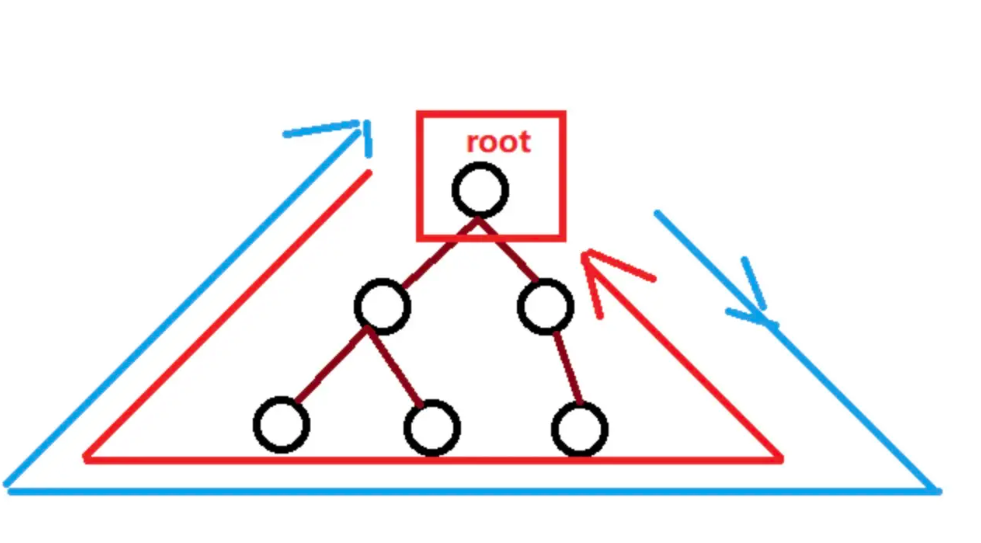
后序遍历(L-R-V)
后序遍历访问顺序为先输出 root 的左子树,最后输出 root 的右子树,再输 root 结点。
- func posOrder(root *bt) {
- if root != nil {
- posOrder(root.Left)
- posOrder(root.Right)
- fmt.Print(root.Val, " ")
- }
- }
-
相关阅读:
环境生态学知识点
Java中的泛型:高效编程的利器
Spring Bean的生命周期、Java配置BeanFactoryPostProcessor失效与解决
使用coverlet统计单元测试的代码覆盖率
(表格固定尾列)bower安装的相关问题
嵌入式工程师成长之路
【JS学习】--深拷贝与浅拷贝
机器学习笔记之隐马尔可夫模型(四)求值问题——后向算法(Backward Algorithm)
【JVM深层系列】「逆向ClassLoader加载机制」认识一下线程上下文类加载器实现
在UE4虚幻引擎中加入导航网格体边界体积后丧尸不能移动和发现玩家
- 原文地址:https://blog.csdn.net/weixin_62421895/article/details/126539896
