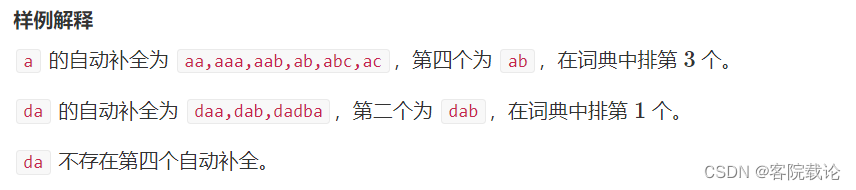
奶牛贝茜买了一个新手机,并十分喜欢用它发短信。 农夫约翰同意通过编写一个自动补全程序来帮助它,当它输入部分单词时,该应用程序可以给出补全建议。 自动补全程序可以访问一个包含W个单词的词典,每个单词由a…z范围内的小写字母组成,其中所有单词中的字母总数最多为1000000。 现在给定一个包含N个部分单词的列表,每个部分单词最多包含1000个字母。 对于每个部分单词i,还会提供一个整数Ki ,自动补全程序需要找到词典中以部分单词i作为前缀的所有单词中,按字典序排序排在第Ki 个的单词。 也就是说,对所有部分单词i的有效补全按字典序进行排序,输出此顺序下的第Ki 个补全。 第一行包含两个整数W和N。 接下来W行,按单词在词典中的顺序,每行描述一个单词。字典中的所有字符串均互不相同。 接下来N行,每行首先包含一个整数Ki ,然后包含一个部分单词i。 共N行,第i行输出部分单词i的第Ki 个有效补全在词典中出现的位置(一个1~W之间的整数)。 如果第Ki 个有效补全不存在,则输出—1。 10 3
dab
ba
ab
daa
aa
aaa
aab
abc
ac
dadba
4 a
2 da
4 da
3
1
-1
# include # include # include
using namespace std;
map< const string , int > words;
list< string> dictSort;
int solution ( int valueNum, string searchValue ) {
list< string> :: iterator Iterator;
int IteratorNum = 1 ;
for ( Iterator = dictSort. begin ( ) ; Iterator != dictSort. end ( ) ; Iterator ++ ) {
cout<< * Iterator<< " " ;
if ( ( * Iterator) . substr ( 0 , searchValue. size ( ) ) == searchValue) {
if ( IteratorNum == valueNum) {
return words[ * Iterator] ;
}
IteratorNum ++ ;
}
}
return - 1 ;
}
int main ( ) {
int dictNum;
int searchNum;
cin>> dictNum>> searchNum;
for ( int i = 1 ; i <= dictNum; i ++ ) {
string wordItem = "" ;
cin>> wordItem;
dictSort. push_back ( wordItem) ;
words[ wordItem] = i;
}
dictSort. sort ( ) ;
for ( int j = 0 ; j < searchNum; ++ j) {
int valueNum = 0 ;
string searchValue = "" ;
cin>> valueNum>> searchValue;
cout<< solution ( valueNum, searchValue) ;
}
return 0 ;
}
1 2 3 4 5 6 7 8 9 10 11 12 13 14 15 16 17 18 19 20 21 22 23 24 25 26 27 28 29 30 31 32 33 34 35 36 37 38 39 40 41 42 43 44 45 46 47 48 49 50 51 52 53 54 55 56 57 58 59 60 61 62 63 64 65 66 67 68 69 70 71 72 73 74 75 76 77 78 79
超时,主要是因为搜索的问题,我是逐个遍历进行搜索的,严重超时。 可以修改为二分查找进行实现。 二分搜索
自己选取的数据结构list适合首尾快速插入和删除,但是不能获取任意位置的元素,所以需要替换整个数据结构。 # include # include # include using namespace std;
map< const string , int > words;
string dictArray[ 30010 ] ;
int dictNum;
int searchNum;
int solutionBinarySearch ( int valueNum, string searchValue ) {
int L = 1 , R = dictNum + 1 ;
while ( L < R) {
int mid = L + R >> 1 ;
if ( dictArray[ mid] >= searchValue)
R = mid;
else
L = mid + 1 ;
}
int t = R + valueNum - 1 ;
if ( t > dictNum+ 1 || dictArray[ t] . substr ( 0 , searchValue. size ( ) ) != searchValue)
return - 1 ;
else
return words[ dictArray[ t] ] ;
}
int main ( ) {
cin>> dictNum>> searchNum;
for ( int i = 1 ; i <= dictNum; i ++ ) {
string wordItem = "" ;
cin>> wordItem;
words[ wordItem] = i;
dictArray[ i] = wordItem;
}
sort ( dictArray+ 1 , dictArray + dictNum) ;
for ( int j = 0 ; j < searchNum; ++ j) {
int valueNum = 0 ;
string searchValue = "" ;
cin>> valueNum>> searchValue;
cout<< solutionBinarySearch ( valueNum, searchValue) ;
}
return 0 ;
}
1 2 3 4 5 6 7 8 9 10 11 12 13 14 15 16 17 18 19 20 21 22 23 24 25 26 27 28 29 30 31 32 33 34 35 36 37 38 39 40 41 42 43 44 45 46 47 48 49 50 51 52 53 54 总是显示wrong Answer,但是自己对了一下输出,并没有任何问题,在官方的调试台上,显示30000,并且所有的输出都是空,说明内存溢出了,不能保存那么大的数据。
# include # include # include # define x first # define y second using namespace std;
typedef pair< string, int > PSI;
const int N = 30010 ;
int m, n;
PSI dict[ N] ;
int main ( ) {
cin >> m >> n;
for ( int i = 1 ; i <= m; i ++ ) {
cin >> dict[ i] . x;
dict[ i] . y = i;
}
sort ( dict+ 1 , dict + m + 1 ) ;
while ( n -- ) {
int k;
string str;
cin>> k>> str;
int l = 1 , r = m + 1 ;
while ( l < r) {
int mid = l + r >> 1 ;
if ( dict[ mid] . x >= str) r = mid;
else l = mid + 1 ;
}
int t = r + k - 1 ;
if ( t > m || dict[ t] . x. substr ( 0 , str. size ( ) ) != str)
puts ( "-1" ) ;
else
cout << dict[ t] . y << endl;
}
}
1 2 3 4 5 6 7 8 9 10 11 12 13 14 15 16 17 18 19 20 21 22 23 24 25 26 27 28 29 30 31 32 33 34 35 36 37 38 39 40 41 42 43 44 45 46 47 48 49 50 51 52 53 54 通过构建pair类型的数据,我觉得很方便。首先,pair构成array能够按照字典顺序进行排序,很方便。然后就是通过字典顺序访问的pair元素,能够获取对应单词的补全情况和在原来的字典中的顺序。将字典和数组进行组合。 在上文中,涉及到排序,即需要对保存数据的结构进行随机访问,所以应该使用vector,而不是list vector底层结构是使用动态顺序表,在内存中有连续的空间,支持随机访问。 list在底层结构是带头结点的双向循环链表,在内存上不是一段连续的空间,不支持随机访问。