-
python机器学习:集成算法与随机森林(5)
集成算法与随机森林
import numpy as np import os %matplotlib inline import matplotlib import matplotlib.pyplot as plt plt.rcParams['axes.labelsize'] = 14 plt.rcParams['xtick.labelsize'] = 12 plt.rcParams['ytick.labelsize'] = 12 import warnings warnings.filterwarnings('ignore') np.random.seed(42)- 1
- 2
- 3
- 4
- 5
- 6
- 7
- 8
- 9
- 10
- 11
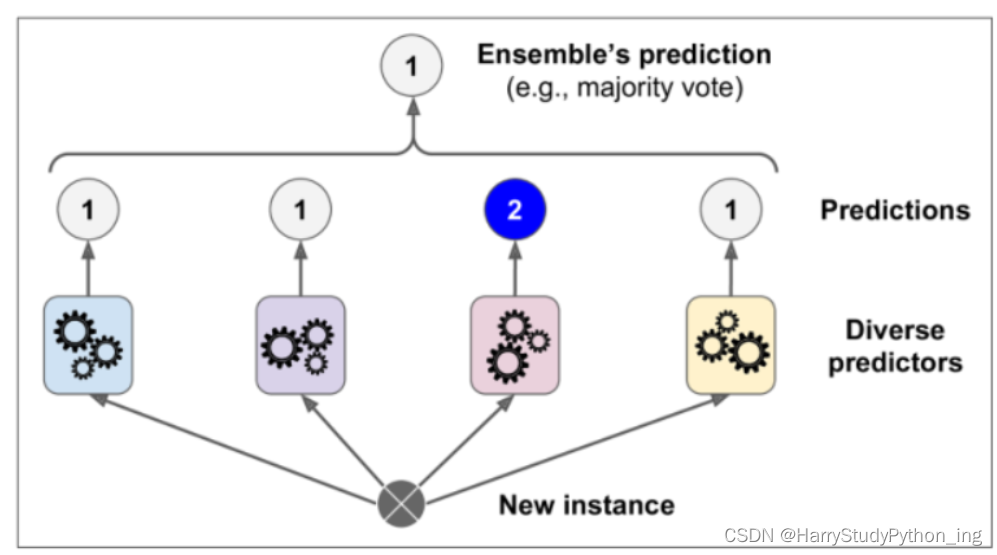
集成基本思想:
训练时用多种分类器一起完成同一份任务

测试时对待测试样本分别通过不同的分类器,汇总最后的结果
from sklearn.model_selection import train_test_split from sklearn.datasets import make_moons X,y = make_moons(n_samples=500, noise=0.30, random_state=42) X_train, X_test, y_train, y_test = train_test_split(X, y, random_state=42) plt.plot(X[:,0][y==0],X[:,1][y==0],'yo',alpha = 0.6) plt.plot(X[:,0][y==0],X[:,1][y==1],'bs',alpha = 0.6)- 1
- 2
- 3
- 4
- 5
- 6
- 7

投票策略:软投票与硬投票
- 硬投票:直接用类别值,少数服从多数
- 软投票:各自分类器的概率值进行加权平均
硬投票实验
from sklearn.ensemble import RandomForestClassifier, VotingClassifier from sklearn.linear_model import LogisticRegression from sklearn.svm import SVC log_clf = LogisticRegression(random_state=42) rnd_clf = RandomForestClassifier(random_state=42) svm_clf = SVC(random_state=42) voting_clf = VotingClassifier(estimators =[('lr',log_clf),('rf',rnd_clf),('svc',svm_clf)],voting='hard') voting_clf.fit(X_train,y_train)- 1
- 2
- 3
- 4
- 5
- 6
- 7
- 8
- 9
- 10

from sklearn.metrics import accuracy_score for clf in (log_clf,rnd_clf,svm_clf,voting_clf): clf.fit(X_train,y_train) y_pred = clf.predict(X_test) print (clf.__class__.__name__,accuracy_score(y_test,y_pred))- 1
- 2
- 3
- 4
- 5

软投票实验
from sklearn.ensemble import RandomForestClassifier, VotingClassifier from sklearn.linear_model import LogisticRegression from sklearn.svm import SVC log_clf = LogisticRegression(random_state=42) rnd_clf = RandomForestClassifier(random_state=42) svm_clf = SVC(probability = True,random_state=42) voting_clf = VotingClassifier(estimators =[('lr',log_clf),('rf',rnd_clf),('svc',svm_clf)],voting='soft') voting_clf.fit(X_train,y_train)- 1
- 2
- 3
- 4
- 5
- 6
- 7
- 8
- 9
- 10

from sklearn.metrics import accuracy_score for clf in (log_clf,rnd_clf,svm_clf,voting_clf): clf.fit(X_train,y_train) y_pred = clf.predict(X_test) print (clf.__class__.__name__,accuracy_score(y_test,y_pred))- 1
- 2
- 3
- 4
- 5
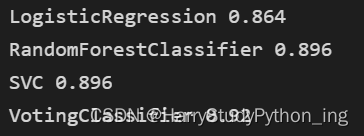
软投票:要求必须各个分别器都能得出概率值
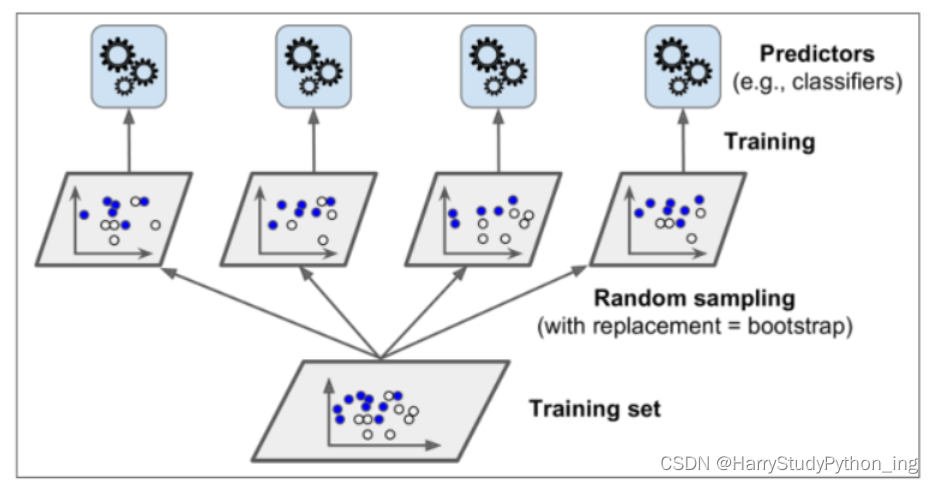
Bagging策略
- 首先对训练数据集进行多次采样,保证每次得到的采样数据都是不同的
- 分别训练多个模型,例如树模型
- 预测时需得到所有模型结果再进行集成
from sklearn.ensemble import BaggingClassifier from sklearn.tree import DecisionTreeClassifier bag_clf = BaggingClassifier(DecisionTreeClassifier(), n_estimators = 500, max_samples = 100, bootstrap = True, n_jobs = -1, random_state = 42 ) bag_clf.fit(X_train,y_train) y_pred = bag_clf.predict(X_test) import sys import codecs sys.stdout = codecs.getwriter("utf-8")(sys.stdout)- 1
- 2
- 3
- 4
- 5
- 6
- 7
- 8
- 9
- 10
- 11
- 12
- 13
- 14
- 15
accuracy_score(y_test,y_pred)- 1
tree_clf = DecisionTreeClassifier(random_state = 42) tree_clf.fit(X_train,y_train) y_pred_tree = tree_clf.predict(X_test) accuracy_score(y_test,y_pred_tree)- 1
- 2
- 3
- 4
决策边界
- 集成与传统方法对比
from matplotlib.colors import ListedColormap def plot_decision_boundary(clf,X,y,axes=[-1.5,2.5,-1,1.5],alpha=0.5,contour =True): x1s=np.linspace(axes[0],axes[1],100) x2s=np.linspace(axes[2],axes[3],100) x1,x2 = np.meshgrid(x1s,x2s) X_new = np.c_[x1.ravel(),x2.ravel()] y_pred = clf.predict(X_new).reshape(x1.shape) custom_cmap = ListedColormap(['#fafab0','#9898ff','#a0faa0']) plt.contourf(x1,x2,y_pred,cmap = custom_cmap,alpha=0.3) if contour: custom_cmap2 = ListedColormap(['#7d7d58','#4c4c7f','#507d50']) plt.contour(x1,x2,y_pred,cmap = custom_cmap2,alpha=0.8) plt.plot(X[:,0][y==0],X[:,1][y==0],'yo',alpha = 0.6) plt.plot(X[:,0][y==0],X[:,1][y==1],'bs',alpha = 0.6) plt.axis(axes) plt.xlabel('x1') plt.xlabel('x2') plt.figure(figsize = (12,5)) plt.subplot(121) plot_decision_boundary(tree_clf,X,y) plt.title('Decision Tree') plt.subplot(122) plot_decision_boundary(bag_clf,X,y) plt.title('Decision Tree With Bagging')- 1
- 2
- 3
- 4
- 5
- 6
- 7
- 8
- 9
- 10
- 11
- 12
- 13
- 14
- 15
- 16
- 17
- 18
- 19
- 20
- 21
- 22
- 23
- 24
- 25

Colormap颜色:https://blog.csdn.net/zhaogeng111/article/details/78419015
OOB策略
- Out Of Bag
bag_clf = BaggingClassifier(DecisionTreeClassifier(), n_estimators = 500, max_samples = 100, bootstrap = True, n_jobs = -1, random_state = 42, oob_score = True ) bag_clf.fit(X_train,y_train) bag_clf.oob_score_- 1
- 2
- 3
- 4
- 5
- 6
- 7
- 8
- 9
- 10
y_pred = bag_clf.predict(X_test) accuracy_score(y_test,y_pred) bag_clf.oob_decision_function_- 1
- 2
- 3
随机森林
from sklearn.ensemble import RandomForestClassifier rf_clf = RandomForestClassifier() rf_clf.fit(X_train,y_train)- 1
- 2
- 3
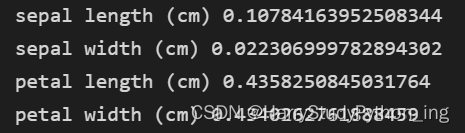
特征重要性:
sklearn中是看每个特征的平均深度
from sklearn.datasets import load_iris iris = load_iris() rf_clf = RandomForestClassifier(n_estimators=500,n_jobs=-1) rf_clf.fit(iris['data'],iris['target']) for name,score in zip(iris['feature_names'],rf_clf.feature_importances_): print (name,score)- 1
- 2
- 3
- 4
- 5
- 6
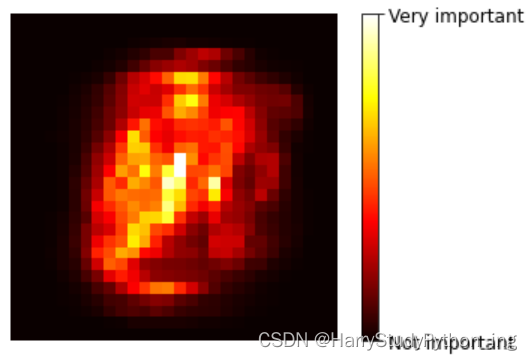
Mnist中哪些特征比较重要呢?
from sklearn.datasets import fetch_openml mnist = fetch_openml('mnist_784') rf_clf = RandomForestClassifier(n_estimators=500,n_jobs=-1) rf_clf.fit(mnist['data'],mnist['target']) rf_clf.feature_importances_.shape def plot_digit(data): image = data.reshape(28,28) plt.imshow(image,cmap=matplotlib.cm.hot) plt.axis('off') plot_digit(rf_clf.feature_importances_) char = plt.colorbar(ticks=[rf_clf.feature_importances_.min(),rf_clf.feature_importances_.max()]) char.ax.set_yticklabels(['Not important','Very important'])- 1
- 2
- 3
- 4
- 5
- 6
- 7
- 8
- 9
- 10
- 11
- 12
- 13
- 14
Boosting-提升策略
AdaBoost
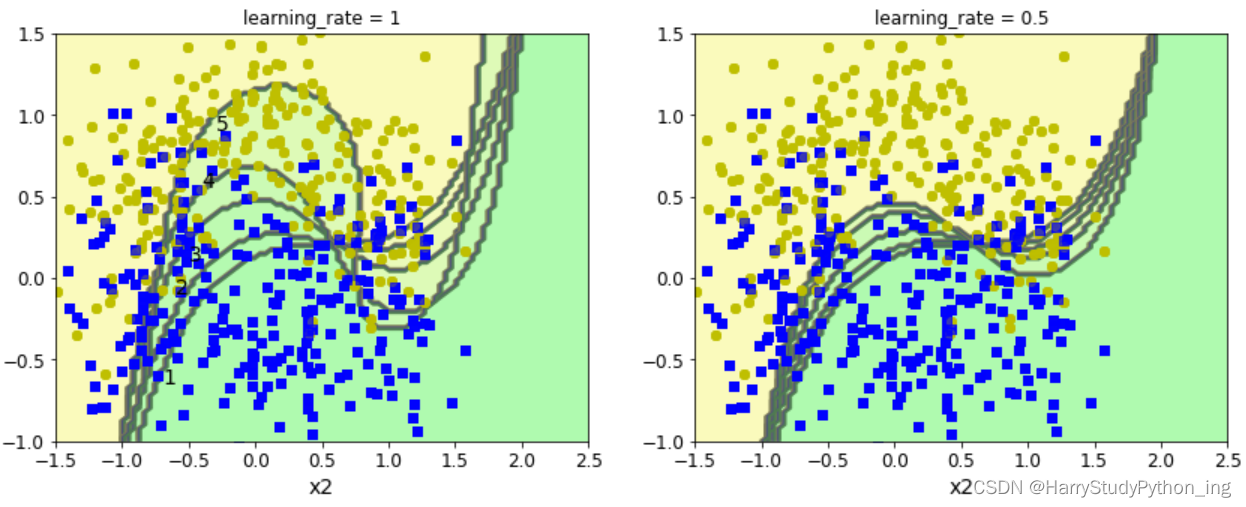
跟上学时的考试一样,这次做错的题,是不是得额外注意,下次的时候就和别错了!

以SVM分类器为例来演示AdaBoost的基本策略
from sklearn.svm import SVC m = len(X_train) plt.figure(figsize=(14,5)) for subplot,learning_rate in ((121,1),(122,0.5)): sample_weights = np.ones(m) plt.subplot(subplot) for i in range(5): svm_clf = SVC(kernel='rbf',C=0.05,random_state=42) svm_clf.fit(X_train,y_train,sample_weight = sample_weights) y_pred = svm_clf.predict(X_train) sample_weights[y_pred != y_train] *= (1+learning_rate) plot_decision_boundary(svm_clf,X,y,alpha=0.2) plt.title('learning_rate = {}'.format(learning_rate)) if subplot == 121: plt.text(-0.7, -0.65, "1", fontsize=14) plt.text(-0.6, -0.10, "2", fontsize=14) plt.text(-0.5, 0.10, "3", fontsize=14) plt.text(-0.4, 0.55, "4", fontsize=14) plt.text(-0.3, 0.90, "5", fontsize=14) plt.show()- 1
- 2
- 3
- 4
- 5
- 6
- 7
- 8
- 9
- 10
- 11
- 12
- 13
- 14
- 15
- 16
- 17
- 18
- 19
- 20
- 21
- 22
from sklearn.ensemble import AdaBoostClassifier ada_clf = AdaBoostClassifier(DecisionTreeClassifier(max_depth=1), n_estimators = 200, learning_rate = 0.5, random_state = 42 ) ada_clf.fit(X_train,y_train) plot_decision_boundary(ada_clf,X,y)- 1
- 2
- 3
- 4
- 5
- 6
- 7
- 8

Gradient Boosting
np.random.seed(42) X = np.random.rand(100,1) - 0.5 y = 3*X[:,0]**2 + 0.05*np.random.randn(100) y.shape from sklearn.tree import DecisionTreeRegressor tree_reg1 = DecisionTreeRegressor(max_depth = 2) tree_reg1.fit(X,y) y2 = y - tree_reg1.predict(X) tree_reg2 = DecisionTreeRegressor(max_depth = 2) tree_reg2.fit(X,y2) y3 = y2 - tree_reg2.predict(X) tree_reg3 = DecisionTreeRegressor(max_depth = 2) tree_reg3.fit(X,y3) X_new = np.array([[0.8]]) y_pred = sum(tree.predict(X_new) for tree in (tree_reg1,tree_reg2,tree_reg3)) y_pred def plot_predictions(regressors, X, y, axes, label=None, style="r-", data_style="b.", data_label=None): x1 = np.linspace(axes[0], axes[1], 500) y_pred = sum(regressor.predict(x1.reshape(-1, 1)) for regressor in regressors) plt.plot(X[:, 0], y, data_style, label=data_label) plt.plot(x1, y_pred, style, linewidth=2, label=label) if label or data_label: plt.legend(loc="upper center", fontsize=16) plt.axis(axes) plt.figure(figsize=(11,11)) plt.subplot(321) plot_predictions([tree_reg1], X, y, axes=[-0.5, 0.5, -0.1, 0.8], label="$h_1(x_1)$", style="g-", data_label="Training set") plt.ylabel("$y$", fontsize=16, rotation=0) plt.title("Residuals and tree predictions", fontsize=16) plt.subplot(322) plot_predictions([tree_reg1], X, y, axes=[-0.5, 0.5, -0.1, 0.8], label="$h(x_1) = h_1(x_1)$", data_label="Training set") plt.ylabel("$y$", fontsize=16, rotation=0) plt.title("Ensemble predictions", fontsize=16) plt.subplot(323) plot_predictions([tree_reg2], X, y2, axes=[-0.5, 0.5, -0.5, 0.5], label="$h_2(x_1)$", style="g-", data_style="k+", data_label="Residuals") plt.ylabel("$y - h_1(x_1)$", fontsize=16) plt.subplot(324) plot_predictions([tree_reg1, tree_reg2], X, y, axes=[-0.5, 0.5, -0.1, 0.8], label="$h(x_1) = h_1(x_1) + h_2(x_1)$") plt.ylabel("$y$", fontsize=16, rotation=0) plt.subplot(325) plot_predictions([tree_reg3], X, y3, axes=[-0.5, 0.5, -0.5, 0.5], label="$h_3(x_1)$", style="g-", data_style="k+") plt.ylabel("$y - h_1(x_1) - h_2(x_1)$", fontsize=16) plt.xlabel("$x_1$", fontsize=16) plt.subplot(326) plot_predictions([tree_reg1, tree_reg2, tree_reg3], X, y, axes=[-0.5, 0.5, -0.1, 0.8], label="$h(x_1) = h_1(x_1) + h_2(x_1) + h_3(x_1)$") plt.xlabel("$x_1$", fontsize=16) plt.ylabel("$y$", fontsize=16, rotation=0) plt.show()- 1
- 2
- 3
- 4
- 5
- 6
- 7
- 8
- 9
- 10
- 11
- 12
- 13
- 14
- 15
- 16
- 17
- 18
- 19
- 20
- 21
- 22
- 23
- 24
- 25
- 26
- 27
- 28
- 29
- 30
- 31
- 32
- 33
- 34
- 35
- 36
- 37
- 38
- 39
- 40
- 41
- 42
- 43
- 44
- 45
- 46
- 47
- 48
- 49
- 50
- 51
- 52
- 53
- 54
- 55
- 56

from sklearn.ensemble import GradientBoostingRegressor gbrt = GradientBoostingRegressor(max_depth = 2, n_estimators = 3, learning_rate = 1.0, random_state = 41 ) gbrt.fit(X,y) gbrt_slow_1 = GradientBoostingRegressor(max_depth = 2, n_estimators = 3, learning_rate = 0.1, random_state = 41 ) gbrt_slow_1.fit(X,y) gbrt_slow_2 = GradientBoostingRegressor(max_depth = 2, n_estimators = 200, learning_rate = 0.1, random_state = 41 ) gbrt_slow_2.fit(X,y) plt.figure(figsize = (11,4)) plt.subplot(121) plot_predictions([gbrt],X,y,axes=[-0.5,0.5,-0.1,0.8],label = 'Ensemble predictions') plt.title('learning_rate={},n_estimators={}'.format(gbrt.learning_rate,gbrt.n_estimators)) plt.subplot(122) plot_predictions([gbrt_slow_1],X,y,axes=[-0.5,0.5,-0.1,0.8],label = 'Ensemble predictions') plt.title('learning_rate={},n_estimators={}'.format(gbrt_slow_1.learning_rate,gbrt_slow_1.n_estimators))- 1
- 2
- 3
- 4
- 5
- 6
- 7
- 8
- 9
- 10
- 11
- 12
- 13
- 14
- 15
- 16
- 17
- 18
- 19
- 20
- 21
- 22
- 23
- 24
- 25
- 26
- 27

plt.figure(figsize = (11,4)) plt.subplot(121) plot_predictions([gbrt_slow_2],X,y,axes=[-0.5,0.5,-0.1,0.8],label = 'Ensemble predictions') plt.title('learning_rate={},n_estimators={}'.format(gbrt_slow_2.learning_rate,gbrt_slow_2.n_estimators)) plt.subplot(122) plot_predictions([gbrt_slow_1],X,y,axes=[-0.5,0.5,-0.1,0.8],label = 'Ensemble predictions') plt.title('learning_rate={},n_estimators={}'.format(gbrt_slow_1.learning_rate,gbrt_slow_1.n_estimators))- 1
- 2
- 3
- 4
- 5
- 6
- 7
- 8

提前停止策略
from sklearn.metrics import mean_squared_error X_train,X_val,y_train,y_val = train_test_split(X,y,random_state=49) gbrt = GradientBoostingRegressor(max_depth = 2, n_estimators = 120, random_state = 42 ) gbrt.fit(X_train,y_train) errors = [mean_squared_error(y_val,y_pred) for y_pred in gbrt.staged_predict(X_val)] bst_n_estimators = np.argmin(errors) gbrt_best = GradientBoostingRegressor(max_depth = 2, n_estimators = bst_n_estimators, random_state = 42 ) gbrt_best.fit(X_train,y_train) min_error = np.min(errors) min_error plt.figure(figsize = (11,4)) plt.subplot(121) plt.plot(errors,'b.-') plt.plot([bst_n_estimators,bst_n_estimators],[0,min_error],'k--') plt.plot([0,120],[min_error,min_error],'k--') plt.axis([0,120,0,0.01]) plt.title('Val Error') plt.subplot(122) plot_predictions([gbrt_best],X,y,axes=[-0.5,0.5,-0.1,0.8]) plt.title('Best Model(%d trees)'%bst_n_estimators)- 1
- 2
- 3
- 4
- 5
- 6
- 7
- 8
- 9
- 10
- 11
- 12
- 13
- 14
- 15
- 16
- 17
- 18
- 19
- 20
- 21
- 22
- 23
- 24
- 25
- 26
- 27
- 28
- 29

gbrt = GradientBoostingRegressor(max_depth = 2, random_state = 42, warm_start =True ) error_going_up = 0 min_val_error = float('inf') for n_estimators in range(1,120): gbrt.n_estimators = n_estimators gbrt.fit(X_train,y_train) y_pred = gbrt.predict(X_val) val_error = mean_squared_error(y_val,y_pred) if val_error < min_val_error: min_val_error = val_error error_going_up = 0 else: error_going_up +=1 if error_going_up == 5: break print (gbrt.n_estimators)- 1
- 2
- 3
- 4
- 5
- 6
- 7
- 8
- 9
- 10
- 11
- 12
- 13
- 14
- 15
- 16
- 17
- 18
- 19
- 20
- 21
Stacking(堆叠集成)


from sklearn.model_selection import train_test_split from sklearn.datasets import fetch_openml mnist = fetch_openml('mnist_784') X_train_val, X_test, y_train_val, y_test = train_test_split( mnist.data, mnist.target, test_size=10000, random_state=42) X_train, X_val, y_train, y_val = train_test_split( X_train_val, y_train_val, test_size=10000, random_state=42) from sklearn.ensemble import RandomForestClassifier, ExtraTreesClassifier from sklearn.svm import LinearSVC from sklearn.neural_network import MLPClassifier random_forest_clf = RandomForestClassifier(random_state=42) extra_trees_clf = ExtraTreesClassifier(random_state=42) svm_clf = LinearSVC(random_state=42) mlp_clf = MLPClassifier(random_state=42) estimators = [random_forest_clf, extra_trees_clf, svm_clf, mlp_clf] for estimator in estimators: print("Training the", estimator) estimator.fit(X_train, y_train) X_val_predictions = np.empty((len(X_val), len(estimators)), dtype=np.float32) for index, estimator in enumerate(estimators): X_val_predictions[:, index] = estimator.predict(X_val) X_val_predictions rnd_forest_blender = RandomForestClassifier(n_estimators=200, oob_score=True, random_state=42) rnd_forest_blender.fit(X_val_predictions, y_val) rnd_forest_blender.oob_score_- 1
- 2
- 3
- 4
- 5
- 6
- 7
- 8
- 9
- 10
- 11
- 12
- 13
- 14
- 15
- 16
- 17
- 18
- 19
- 20
- 21
- 22
- 23
- 24
- 25
- 26
- 27
- 28
- 29
-
相关阅读:
KT6368A蓝牙的认证问题_FCC和BQB_CE_KC认证或者其它说明
sylar服务器框架分析——日志系统
跨越千年医学对话:用AI技术解锁中医古籍知识,构建能够精准问答的智能语言模型,成就专业级古籍解读助手(LLAMA)
数据结构之快速排序(重点)
改变世界的开发者丨以梦为码,华工小哥的致青春
4.Spring Boot
JS DataTable中导出PDF右侧列被截断的问题解决
busybox命令裁剪
基于ACO蚁群算法的tsp优化问题matlab仿真
4 轮拿下字节 Offer,面试题复盘
- 原文地址:https://blog.csdn.net/qq_47805483/article/details/125825257
