-
基于深度学习的监控场景下是否佩戴安全帽检测(yolov5)
内容:基于目标检测对图像中的人员是否佩戴安全帽进行检测
具体要求:1) 使用Python编程语言,建议使用深度学习框架PyTorch;
2) 完成自定义数据集的制作,基于目标检测方法在数据集上完成训练和验证,可使用开源框架;
3) 使用数据集外的图像数据进行验证,对图像中的行人是否佩戴安全帽进行检测,检测到有人员未佩戴安全帽时改变人员检测框颜色,起到告警作用;
环境
PyTorch 1.8.1
Python 3.8
Cuda 11.1
RTX 2080 Ti * 1
显存:11GB
首先先给大家推荐一个GPU租用平台,关于为什么笔者本人会知道这种类型的平台,
那必然是笔者我见多识广(说多了都是泪),你看我这破电脑运行的有多慢!!!(要我连跑60小时,达咩)
好了,言归正传,今天给大家推荐的平台是AutoDL
附上链接:AutoDL-品质GPU租用平台-租GPU就上AutoDL
价钱低,关键是注册就有10元体验券,像笔者租了个RTX 2080的卡,一小时0.85元,跑个简单的深度学习还是绰绰有余的。

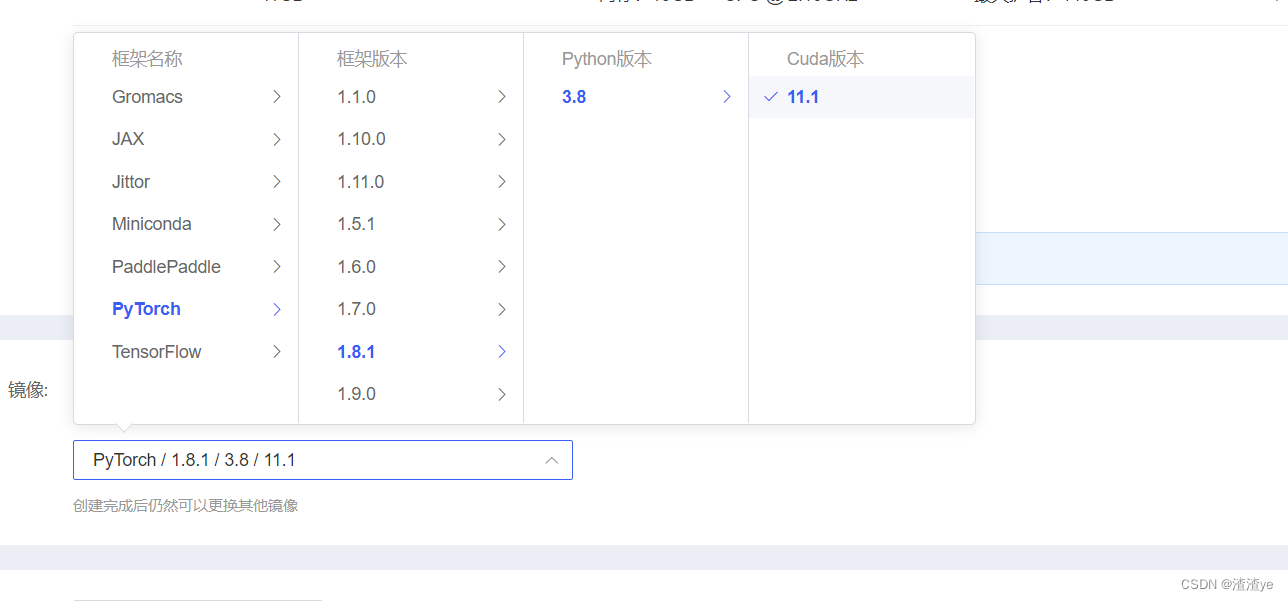
还可在其后方进行环境的配置,如图(我用的是pytorch1.8.1,python3.8,cuda11.1)
进入控制台后,选择jupyterlab进入

可以先看看pytorch是否安装成功,进入终端打开输入python
- python
- import torch
- torch.__version__


基于Yolov5训练模型
先把yolov5的框架下载出来,可以去github直接下,也可以用我上传的网盘资源
链接:https://pan.baidu.com/s/1KIIjNOf449ueD8OdRJUH9g
提取码:0329通过jupyter内的文件上传,即可将下载好的zip文件上传,在终端找到对应压缩包,执行下述指令,即可解压,随后进入yolov5文件夹
unzip yolov5-5.0.zipcd yolov5-5.0
右击新建文件夹VOCdevkit,随后进入文件夹

老方法,将数据集上传至文件包内

数据集已全部标注,可直接食用
链接:https://pan.baidu.com/s/1L4t9MQj48pT71mGaQlO4Tw
提取码:0329标注方法(可跳过):
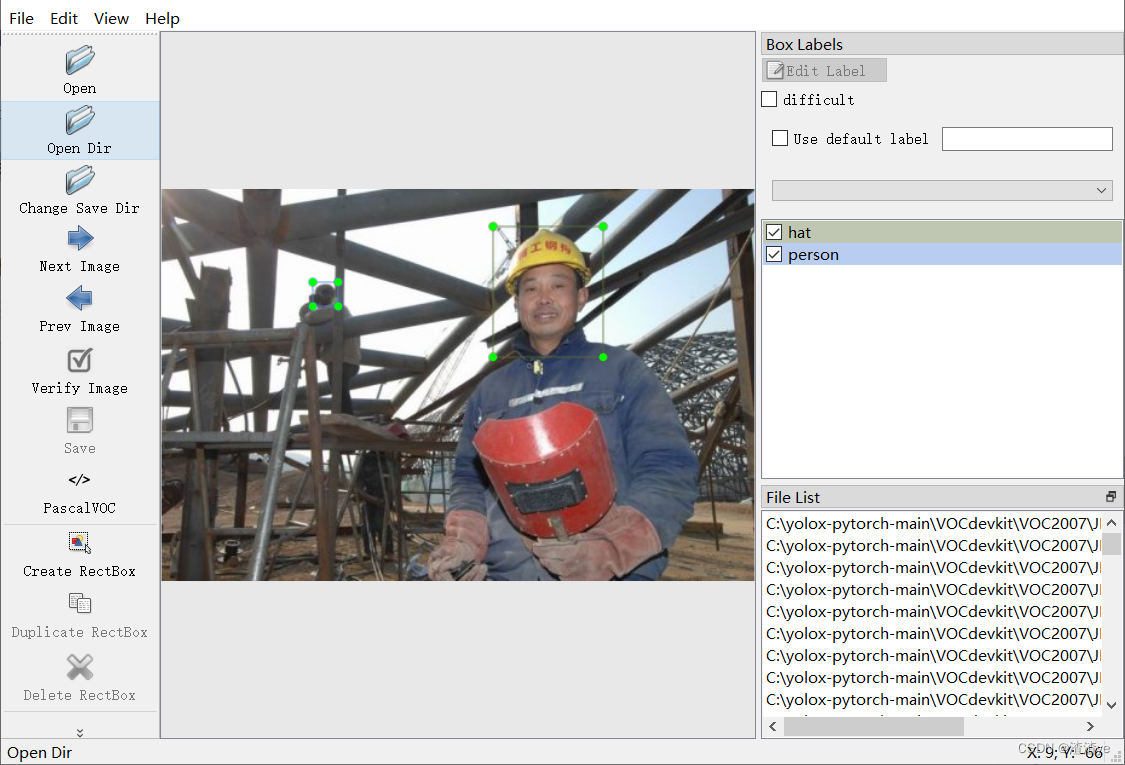
(本机)使用labelimg进行标注
pip install -i https://pypi.tuna.tsinghua.edu.cn/simple labelimg
输入labelimg,打开界面

点击 Open Dir 选择数据集的保存路径,即VOCdevkit文件夹下的JPEGImages文件
点击Change Save Dir选择保存标注好的文件路径,选择VOCdevkit文件夹下的Annotations文件
在View中选中Auto Save mode,即可自动保存
选中Create RectBox,框选出要识别的物体(如:hat),标注相应类别
快捷键:A上一张,D下一张
数据集处理(接着上两步标注过程前)
同刚开始处理zip压缩包,unzip数据集即可
unzip VOC2007.zip回退到yolov5主界面,进行环境配置
pip install -r requirements.txt配置预训练权重,用yolov5s.pt即可
链接:https://pan.baidu.com/s/1oopsiHUEclmO2U47FiuSJQ
提取码:0329下载完后,老方法上传至jupyter

划分训练集和测试集
新建prepare.py文件
yolov5-5.0/prepare.py将VOC标签格式.xml转yolo格式.txt进行训练集和测试集的划分代码如下:
- import xml.etree.ElementTree as ET
- import pickle
- import os
- from os import listdir, getcwd
- from os.path import join
- import random
- from shutil import copyfile
- classes = ["hat","person"]
- TRAIN_RATIO = 80
- def clear_hidden_files(path):
- dir_list = os.listdir(path)
- for i in dir_list:
- abspath = os.path.join(os.path.abspath(path), i)
- if os.path.isfile(abspath):
- if i.startswith("._"):
- os.remove(abspath)
- else:
- clear_hidden_files(abspath)
- def convert(size, box):
- dw = 1./size[0]
- dh = 1./size[1]
- x = (box[0] + box[1])/2.0
- y = (box[2] + box[3])/2.0
- w = box[1] - box[0]
- h = box[3] - box[2]
- x = x*dw
- w = w*dw
- y = y*dh
- h = h*dh
- return (x,y,w,h)
- def convert_annotation(image_id):
- in_file = open('VOCdevkit/VOC2007/Annotations/%s.xml' %image_id)
- out_file = open('VOCdevkit/VOC2007/YOLOLabels/%s.txt' %image_id, 'w')
- tree=ET.parse(in_file)
- root = tree.getroot()
- size = root.find('size')
- w = int(size.find('width').text)
- h = int(size.find('height').text)
- for obj in root.iter('object'):
- difficult = obj.find('difficult').text
- cls = obj.find('name').text
- if cls not in classes or int(difficult) == 1:
- continue
- cls_id = classes.index(cls)
- xmlbox = obj.find('bndbox')
- b = (float(xmlbox.find('xmin').text), float(xmlbox.find('xmax').text), float(xmlbox.find('ymin').text), float(xmlbox.find('ymax').text))
- bb = convert((w,h), b)
- out_file.write(str(cls_id) + " " + " ".join([str(a) for a in bb]) + '\n')
- in_file.close()
- out_file.close()
- wd = os.getcwd()
- wd = os.getcwd()
- data_base_dir = os.path.join(wd, "VOCdevkit/")
- if not os.path.isdir(data_base_dir):
- os.mkdir(data_base_dir)
- work_sapce_dir = os.path.join(data_base_dir, "VOC2007/")
- if not os.path.isdir(work_sapce_dir):
- os.mkdir(work_sapce_dir)
- annotation_dir = os.path.join(work_sapce_dir, "Annotations/")
- if not os.path.isdir(annotation_dir):
- os.mkdir(annotation_dir)
- clear_hidden_files(annotation_dir)
- image_dir = os.path.join(work_sapce_dir, "JPEGImages/")
- if not os.path.isdir(image_dir):
- os.mkdir(image_dir)
- clear_hidden_files(image_dir)
- yolo_labels_dir = os.path.join(work_sapce_dir, "YOLOLabels/")
- if not os.path.isdir(yolo_labels_dir):
- os.mkdir(yolo_labels_dir)
- clear_hidden_files(yolo_labels_dir)
- yolov5_images_dir = os.path.join(data_base_dir, "images/")
- if not os.path.isdir(yolov5_images_dir):
- os.mkdir(yolov5_images_dir)
- clear_hidden_files(yolov5_images_dir)
- yolov5_labels_dir = os.path.join(data_base_dir, "labels/")
- if not os.path.isdir(yolov5_labels_dir):
- os.mkdir(yolov5_labels_dir)
- clear_hidden_files(yolov5_labels_dir)
- yolov5_images_train_dir = os.path.join(yolov5_images_dir, "train/")
- if not os.path.isdir(yolov5_images_train_dir):
- os.mkdir(yolov5_images_train_dir)
- clear_hidden_files(yolov5_images_train_dir)
- yolov5_images_test_dir = os.path.join(yolov5_images_dir, "val/")
- if not os.path.isdir(yolov5_images_test_dir):
- os.mkdir(yolov5_images_test_dir)
- clear_hidden_files(yolov5_images_test_dir)
- yolov5_labels_train_dir = os.path.join(yolov5_labels_dir, "train/")
- if not os.path.isdir(yolov5_labels_train_dir):
- os.mkdir(yolov5_labels_train_dir)
- clear_hidden_files(yolov5_labels_train_dir)
- yolov5_labels_test_dir = os.path.join(yolov5_labels_dir, "val/")
- if not os.path.isdir(yolov5_labels_test_dir):
- os.mkdir(yolov5_labels_test_dir)
- clear_hidden_files(yolov5_labels_test_dir)
- train_file = open(os.path.join(wd, "yolov5_train.txt"), 'w')
- test_file = open(os.path.join(wd, "yolov5_val.txt"), 'w')
- train_file.close()
- test_file.close()
- train_file = open(os.path.join(wd, "yolov5_train.txt"), 'a')
- test_file = open(os.path.join(wd, "yolov5_val.txt"), 'a')
- list_imgs = os.listdir(image_dir) # list image files
- prob = random.randint(1, 100)
- print("Probability: %d" % prob)
- for i in range(0,len(list_imgs)):
- path = os.path.join(image_dir,list_imgs[i])
- if os.path.isfile(path):
- image_path = image_dir + list_imgs[i]
- voc_path = list_imgs[i]
- (nameWithoutExtention, extention) = os.path.splitext(os.path.basename(image_path))
- (voc_nameWithoutExtention, voc_extention) = os.path.splitext(os.path.basename(voc_path))
- annotation_name = nameWithoutExtention + '.xml'
- annotation_path = os.path.join(annotation_dir, annotation_name)
- label_name = nameWithoutExtention + '.txt'
- label_path = os.path.join(yolo_labels_dir, label_name)
- prob = random.randint(1, 100)
- print("Probability: %d" % prob)
- if(prob < TRAIN_RATIO): # train dataset
- if os.path.exists(annotation_path):
- train_file.write(image_path + '\n')
- convert_annotation(nameWithoutExtention) # convert label
- copyfile(image_path, yolov5_images_train_dir + voc_path)
- copyfile(label_path, yolov5_labels_train_dir + label_name)
- else: # test dataset
- if os.path.exists(annotation_path):
- test_file.write(image_path + '\n')
- convert_annotation(nameWithoutExtention) # convert label
- copyfile(image_path, yolov5_images_test_dir + voc_path)
- copyfile(label_path, yolov5_labels_test_dir + label_name)
- train_file.close()
- test_file.close()
运行后产生文件夹:
yolov5-5.0/VOCdevkit/images: 分为train和val两个文件夹,存放图片yolov5-5.0/VOCdevkit/labels: 分为train和val两个文件夹,存放.txt label
配置文件的编写
数据配置文件
data/hat.yaml在data文件夹内新建一个hat.yaml
- train: /root/yolov5-5.0/VOCdevkit/images/train/ # 16551 images
- val: /root/yolov5-5.0/VOCdevkit/images/val/ # 4952 images
- # Classes
- nc: 2 # number of classes
- names: ["hat","person"] # class names
模型配置文件
models/yolov5s_hat.yaml在models文件夹内,找到yolov5x.yaml文件夹,复制后重命名为
yolov5s_hat.yaml修改nc即可
- # parameters
- nc: 2 # number of classes
- depth_multiple: 0.33 # model depth multiple
- width_multiple: 0.50 # layer channel multiple
- # anchors
- anchors:
- - [10,13, 16,30, 33,23] # P3/8
- - [30,61, 62,45, 59,119] # P4/16
- - [116,90, 156,198, 373,326] # P5/32
- # YOLOv5 backbone
- backbone:
- # [from, number, module, args]
- [[-1, 1, Focus, [64, 3]], # 0-P1/2
- [-1, 1, Conv, [128, 3, 2]], # 1-P2/4
- [-1, 3, C3, [128]],
- [-1, 1, Conv, [256, 3, 2]], # 3-P3/8
- [-1, 9, C3, [256]],
- [-1, 1, Conv, [512, 3, 2]], # 5-P4/16
- [-1, 9, C3, [512]],
- [-1, 1, Conv, [1024, 3, 2]], # 7-P5/32
- [-1, 1, SPP, [1024, [5, 9, 13]]],
- [-1, 3, C3, [1024, False]], # 9
- ]
- # YOLOv5 head
- head:
- [[-1, 1, Conv, [512, 1, 1]],
- [-1, 1, nn.Upsample, [None, 2, 'nearest']],
- [[-1, 6], 1, Concat, [1]], # cat backbone P4
- [-1, 3, C3, [512, False]], # 13
- [-1, 1, Conv, [256, 1, 1]],
- [-1, 1, nn.Upsample, [None, 2, 'nearest']],
- [[-1, 4], 1, Concat, [1]], # cat backbone P3
- [-1, 3, C3, [256, False]], # 17 (P3/8-small)
- [-1, 1, Conv, [256, 3, 2]],
- [[-1, 14], 1, Concat, [1]], # cat head P4
- [-1, 3, C3, [512, False]], # 20 (P4/16-medium)
- [-1, 1, Conv, [512, 3, 2]],
- [[-1, 10], 1, Concat, [1]], # cat head P5
- [-1, 3, C3, [1024, False]], # 23 (P5/32-large)
- [[17, 20, 23], 1, Detect, [nc, anchors]], # Detect(P3, P4, P5)
- ]
训练模型
先将yolov5-5.0/train.py(456行开始)中的部分内容配置
一般是修改这些,也可直接复制下方代码替换

- import argparse
- import logging
- import math
- import os
- import random
- import time
- from copy import deepcopy
- from pathlib import Path
- from threading import Thread
- import numpy as np
- import torch.distributed as dist
- import torch.nn as nn
- import torch.nn.functional as F
- import torch.optim as optim
- import torch.optim.lr_scheduler as lr_scheduler
- import torch.utils.data
- import yaml
- from torch.cuda import amp
- from torch.nn.parallel import DistributedDataParallel as DDP
- from torch.utils.tensorboard import SummaryWriter
- from tqdm import tqdm
- import test # import test.py to get mAP after each epoch
- from models.experimental import attempt_load
- from models.yolo import Model
- from utils.autoanchor import check_anchors
- from utils.datasets import create_dataloader
- from utils.general import labels_to_class_weights, increment_path, labels_to_image_weights, init_seeds, \
- fitness, strip_optimizer, get_latest_run, check_dataset, check_file, check_git_status, check_img_size, \
- check_requirements, print_mutation, set_logging, one_cycle, colorstr
- from utils.google_utils import attempt_download
- from utils.loss import ComputeLoss
- from utils.plots import plot_images, plot_labels, plot_results, plot_evolution
- from utils.torch_utils import ModelEMA, select_device, intersect_dicts, torch_distributed_zero_first, is_parallel
- from utils.wandb_logging.wandb_utils import WandbLogger, check_wandb_resume
- logger = logging.getLogger(__name__)
- def train(hyp, opt, device, tb_writer=None):
- logger.info(colorstr('hyperparameters: ') + ', '.join(f'{k}={v}' for k, v in hyp.items()))
- save_dir, epochs, batch_size, total_batch_size, weights, rank = \
- Path(opt.save_dir), opt.epochs, opt.batch_size, opt.total_batch_size, opt.weights, opt.global_rank
- # Directories
- wdir = save_dir / 'weights'
- wdir.mkdir(parents=True, exist_ok=True) # make dir
- last = wdir / 'last.pt'
- best = wdir / 'best.pt'
- results_file = save_dir / 'results.txt'
- # Save run settings
- with open(save_dir / 'hyp.yaml', 'w') as f:
- yaml.dump(hyp, f, sort_keys=False)
- with open(save_dir / 'opt.yaml', 'w') as f:
- yaml.dump(vars(opt), f, sort_keys=False)
- # Configure
- plots = not opt.evolve # create plots
- cuda = device.type != 'cpu'
- init_seeds(2 + rank)
- with open(opt.data) as f:
- data_dict = yaml.load(f, Loader=yaml.SafeLoader) # data dict
- is_coco = opt.data.endswith('coco.yaml')
- # Logging- Doing this before checking the dataset. Might update data_dict
- loggers = {'wandb': None} # loggers dict
- if rank in [-1, 0]:
- opt.hyp = hyp # add hyperparameters
- run_id = torch.load(weights).get('wandb_id') if weights.endswith('.pt') and os.path.isfile(weights) else None
- wandb_logger = WandbLogger(opt, Path(opt.save_dir).stem, run_id, data_dict)
- loggers['wandb'] = wandb_logger.wandb
- data_dict = wandb_logger.data_dict
- if wandb_logger.wandb:
- weights, epochs, hyp = opt.weights, opt.epochs, opt.hyp # WandbLogger might update weights, epochs if resuming
- nc = 1 if opt.single_cls else int(data_dict['nc']) # number of classes
- names = ['item'] if opt.single_cls and len(data_dict['names']) != 1 else data_dict['names'] # class names
- assert len(names) == nc, '%g names found for nc=%g dataset in %s' % (len(names), nc, opt.data) # check
- # Model
- pretrained = weights.endswith('.pt')
- if pretrained:
- with torch_distributed_zero_first(rank):
- attempt_download(weights) # download if not found locally
- ckpt = torch.load(weights, map_location=device) # load checkpoint
- model = Model(opt.cfg or ckpt['model'].yaml, ch=3, nc=nc, anchors=hyp.get('anchors')).to(device) # create
- exclude = ['anchor'] if (opt.cfg or hyp.get('anchors')) and not opt.resume else [] # exclude keys
- state_dict = ckpt['model'].float().state_dict() # to FP32
- state_dict = intersect_dicts(state_dict, model.state_dict(), exclude=exclude) # intersect
- model.load_state_dict(state_dict, strict=False) # load
- logger.info('Transferred %g/%g items from %s' % (len(state_dict), len(model.state_dict()), weights)) # report
- else:
- model = Model(opt.cfg, ch=3, nc=nc, anchors=hyp.get('anchors')).to(device) # create
- with torch_distributed_zero_first(rank):
- check_dataset(data_dict) # check
- train_path = data_dict['train']
- test_path = data_dict['val']
- # Freeze
- freeze = [] # parameter names to freeze (full or partial)
- for k, v in model.named_parameters():
- v.requires_grad = True # train all layers
- if any(x in k for x in freeze):
- print('freezing %s' % k)
- v.requires_grad = False
- # Optimizer
- nbs = 64 # nominal batch size
- accumulate = max(round(nbs / total_batch_size), 1) # accumulate loss before optimizing
- hyp['weight_decay'] *= total_batch_size * accumulate / nbs # scale weight_decay
- logger.info(f"Scaled weight_decay = {hyp['weight_decay']}")
- pg0, pg1, pg2 = [], [], [] # optimizer parameter groups
- for k, v in model.named_modules():
- if hasattr(v, 'bias') and isinstance(v.bias, nn.Parameter):
- pg2.append(v.bias) # biases
- if isinstance(v, nn.BatchNorm2d):
- pg0.append(v.weight) # no decay
- elif hasattr(v, 'weight') and isinstance(v.weight, nn.Parameter):
- pg1.append(v.weight) # apply decay
- if opt.adam:
- optimizer = optim.Adam(pg0, lr=hyp['lr0'], betas=(hyp['momentum'], 0.999)) # adjust beta1 to momentum
- else:
- optimizer = optim.SGD(pg0, lr=hyp['lr0'], momentum=hyp['momentum'], nesterov=True)
- optimizer.add_param_group({'params': pg1, 'weight_decay': hyp['weight_decay']}) # add pg1 with weight_decay
- optimizer.add_param_group({'params': pg2}) # add pg2 (biases)
- logger.info('Optimizer groups: %g .bias, %g conv.weight, %g other' % (len(pg2), len(pg1), len(pg0)))
- del pg0, pg1, pg2
- # Scheduler https://arxiv.org/pdf/1812.01187.pdf
- # https://pytorch.org/docs/stable/_modules/torch/optim/lr_scheduler.html#OneCycleLR
- if opt.linear_lr:
- lf = lambda x: (1 - x / (epochs - 1)) * (1.0 - hyp['lrf']) + hyp['lrf'] # linear
- else:
- lf = one_cycle(1, hyp['lrf'], epochs) # cosine 1->hyp['lrf']
- scheduler = lr_scheduler.LambdaLR(optimizer, lr_lambda=lf)
- # plot_lr_scheduler(optimizer, scheduler, epochs)
- # EMA
- ema = ModelEMA(model) if rank in [-1, 0] else None
- # Resume
- start_epoch, best_fitness = 0, 0.0
- if pretrained:
- # Optimizer
- if ckpt['optimizer'] is not None:
- optimizer.load_state_dict(ckpt['optimizer'])
- best_fitness = ckpt['best_fitness']
- # EMA
- if ema and ckpt.get('ema'):
- ema.ema.load_state_dict(ckpt['ema'].float().state_dict())
- ema.updates = ckpt['updates']
- # Results
- if ckpt.get('training_results') is not None:
- results_file.write_text(ckpt['training_results']) # write results.txt
- # Epochs
- start_epoch = ckpt['epoch'] + 1
- if opt.resume:
- assert start_epoch > 0, '%s training to %g epochs is finished, nothing to resume.' % (weights, epochs)
- if epochs < start_epoch:
- logger.info('%s has been trained for %g epochs. Fine-tuning for %g additional epochs.' %
- (weights, ckpt['epoch'], epochs))
- epochs += ckpt['epoch'] # finetune additional epochs
- del ckpt, state_dict
- # Image sizes
- gs = max(int(model.stride.max()), 32) # grid size (max stride)
- nl = model.model[-1].nl # number of detection layers (used for scaling hyp['obj'])
- imgsz, imgsz_test = [check_img_size(x, gs) for x in opt.img_size] # verify imgsz are gs-multiples
- # DP mode
- if cuda and rank == -1 and torch.cuda.device_count() > 1:
- model = torch.nn.DataParallel(model)
- # SyncBatchNorm
- if opt.sync_bn and cuda and rank != -1:
- model = torch.nn.SyncBatchNorm.convert_sync_batchnorm(model).to(device)
- logger.info('Using SyncBatchNorm()')
- # Trainloader
- dataloader, dataset = create_dataloader(train_path, imgsz, batch_size, gs, opt,
- hyp=hyp, augment=True, cache=opt.cache_images, rect=opt.rect, rank=rank,
- world_size=opt.world_size, workers=opt.workers,
- image_weights=opt.image_weights, quad=opt.quad, prefix=colorstr('train: '))
- mlc = np.concatenate(dataset.labels, 0)[:, 0].max() # max label class
- nb = len(dataloader) # number of batches
- assert mlc < nc, 'Label class %g exceeds nc=%g in %s. Possible class labels are 0-%g' % (mlc, nc, opt.data, nc - 1)
- # Process 0
- if rank in [-1, 0]:
- testloader = create_dataloader(test_path, imgsz_test, batch_size * 2, gs, opt, # testloader
- hyp=hyp, cache=opt.cache_images and not opt.notest, rect=True, rank=-1,
- world_size=opt.world_size, workers=opt.workers,
- pad=0.5, prefix=colorstr('val: '))[0]
- if not opt.resume:
- labels = np.concatenate(dataset.labels, 0)
- c = torch.tensor(labels[:, 0]) # classes
- # cf = torch.bincount(c.long(), minlength=nc) + 1. # frequency
- # model._initialize_biases(cf.to(device))
- if plots:
- plot_labels(labels, names, save_dir, loggers)
- if tb_writer:
- tb_writer.add_histogram('classes', c, 0)
- # Anchors
- if not opt.noautoanchor:
- check_anchors(dataset, model=model, thr=hyp['anchor_t'], imgsz=imgsz)
- model.half().float() # pre-reduce anchor precision
- # DDP mode
- if cuda and rank != -1:
- model = DDP(model, device_ids=[opt.local_rank], output_device=opt.local_rank,
- # nn.MultiheadAttention incompatibility with DDP https://github.com/pytorch/pytorch/issues/26698
- find_unused_parameters=any(isinstance(layer, nn.MultiheadAttention) for layer in model.modules()))
- # Model parameters
- hyp['box'] *= 3. / nl # scale to layers
- hyp['cls'] *= nc / 80. * 3. / nl # scale to classes and layers
- hyp['obj'] *= (imgsz / 640) ** 2 * 3. / nl # scale to image size and layers
- hyp['label_smoothing'] = opt.label_smoothing
- model.nc = nc # attach number of classes to model
- model.hyp = hyp # attach hyperparameters to model
- model.gr = 1.0 # iou loss ratio (obj_loss = 1.0 or iou)
- model.class_weights = labels_to_class_weights(dataset.labels, nc).to(device) * nc # attach class weights
- model.names = names
- # Start training
- t0 = time.time()
- nw = max(round(hyp['warmup_epochs'] * nb), 1000) # number of warmup iterations, max(3 epochs, 1k iterations)
- # nw = min(nw, (epochs - start_epoch) / 2 * nb) # limit warmup to < 1/2 of training
- maps = np.zeros(nc) # mAP per class
- results = (0, 0, 0, 0, 0, 0, 0) # P, R, mAP@.5, mAP@.5-.95, val_loss(box, obj, cls)
- scheduler.last_epoch = start_epoch - 1 # do not move
- scaler = amp.GradScaler(enabled=cuda)
- compute_loss = ComputeLoss(model) # init loss class
- logger.info(f'Image sizes {imgsz} train, {imgsz_test} test\n'
- f'Using {dataloader.num_workers} dataloader workers\n'
- f'Logging results to {save_dir}\n'
- f'Starting training for {epochs} epochs...')
- for epoch in range(start_epoch, epochs): # epoch ------------------------------------------------------------------
- model.train()
- # Update image weights (optional)
- if opt.image_weights:
- # Generate indices
- if rank in [-1, 0]:
- cw = model.class_weights.cpu().numpy() * (1 - maps) ** 2 / nc # class weights
- iw = labels_to_image_weights(dataset.labels, nc=nc, class_weights=cw) # image weights
- dataset.indices = random.choices(range(dataset.n), weights=iw, k=dataset.n) # rand weighted idx
- # Broadcast if DDP
- if rank != -1:
- indices = (torch.tensor(dataset.indices) if rank == 0 else torch.zeros(dataset.n)).int()
- dist.broadcast(indices, 0)
- if rank != 0:
- dataset.indices = indices.cpu().numpy()
- # Update mosaic border
- # b = int(random.uniform(0.25 * imgsz, 0.75 * imgsz + gs) // gs * gs)
- # dataset.mosaic_border = [b - imgsz, -b] # height, width borders
- mloss = torch.zeros(4, device=device) # mean losses
- if rank != -1:
- dataloader.sampler.set_epoch(epoch)
- pbar = enumerate(dataloader)
- logger.info(('\n' + '%10s' * 8) % ('Epoch', 'gpu_mem', 'box', 'obj', 'cls', 'total', 'labels', 'img_size'))
- if rank in [-1, 0]:
- pbar = tqdm(pbar, total=nb) # progress bar
- optimizer.zero_grad()
- for i, (imgs, targets, paths, _) in pbar: # batch -------------------------------------------------------------
- ni = i + nb * epoch # number integrated batches (since train start)
- imgs = imgs.to(device, non_blocking=True).float() / 255.0 # uint8 to float32, 0-255 to 0.0-1.0
- # Warmup
- if ni <= nw:
- xi = [0, nw] # x interp
- # model.gr = np.interp(ni, xi, [0.0, 1.0]) # iou loss ratio (obj_loss = 1.0 or iou)
- accumulate = max(1, np.interp(ni, xi, [1, nbs / total_batch_size]).round())
- for j, x in enumerate(optimizer.param_groups):
- # bias lr falls from 0.1 to lr0, all other lrs rise from 0.0 to lr0
- x['lr'] = np.interp(ni, xi, [hyp['warmup_bias_lr'] if j == 2 else 0.0, x['initial_lr'] * lf(epoch)])
- if 'momentum' in x:
- x['momentum'] = np.interp(ni, xi, [hyp['warmup_momentum'], hyp['momentum']])
- # Multi-scale
- if opt.multi_scale:
- sz = random.randrange(imgsz * 0.5, imgsz * 1.5 + gs) // gs * gs # size
- sf = sz / max(imgs.shape[2:]) # scale factor
- if sf != 1:
- ns = [math.ceil(x * sf / gs) * gs for x in imgs.shape[2:]] # new shape (stretched to gs-multiple)
- imgs = F.interpolate(imgs, size=ns, mode='bilinear', align_corners=False)
- # Forward
- with amp.autocast(enabled=cuda):
- pred = model(imgs) # forward
- loss, loss_items = compute_loss(pred, targets.to(device)) # loss scaled by batch_size
- if rank != -1:
- loss *= opt.world_size # gradient averaged between devices in DDP mode
- if opt.quad:
- loss *= 4.
- # Backward
- scaler.scale(loss).backward()
- # Optimize
- if ni % accumulate == 0:
- scaler.step(optimizer) # optimizer.step
- scaler.update()
- optimizer.zero_grad()
- if ema:
- ema.update(model)
- # Print
- if rank in [-1, 0]:
- mloss = (mloss * i + loss_items) / (i + 1) # update mean losses
- mem = '%.3gG' % (torch.cuda.memory_reserved() / 1E9 if torch.cuda.is_available() else 0) # (GB)
- s = ('%10s' * 2 + '%10.4g' * 6) % (
- '%g/%g' % (epoch, epochs - 1), mem, *mloss, targets.shape[0], imgs.shape[-1])
- pbar.set_description(s)
- # Plot
- if plots and ni < 3:
- f = save_dir / f'train_batch{ni}.jpg' # filename
- Thread(target=plot_images, args=(imgs, targets, paths, f), daemon=True).start()
- # if tb_writer:
- # tb_writer.add_image(f, result, dataformats='HWC', global_step=epoch)
- # tb_writer.add_graph(torch.jit.trace(model, imgs, strict=False), []) # add model graph
- elif plots and ni == 10 and wandb_logger.wandb:
- wandb_logger.log({"Mosaics": [wandb_logger.wandb.Image(str(x), caption=x.name) for x in
- save_dir.glob('train*.jpg') if x.exists()]})
- # end batch ------------------------------------------------------------------------------------------------
- # end epoch ----------------------------------------------------------------------------------------------------
- # Scheduler
- lr = [x['lr'] for x in optimizer.param_groups] # for tensorboard
- scheduler.step()
- # DDP process 0 or single-GPU
- if rank in [-1, 0]:
- # mAP
- ema.update_attr(model, include=['yaml', 'nc', 'hyp', 'gr', 'names', 'stride', 'class_weights'])
- final_epoch = epoch + 1 == epochs
- if not opt.notest or final_epoch: # Calculate mAP
- wandb_logger.current_epoch = epoch + 1
- results, maps, times = test.test(data_dict,
- batch_size=batch_size * 2,
- imgsz=imgsz_test,
- model=ema.ema,
- single_cls=opt.single_cls,
- dataloader=testloader,
- save_dir=save_dir,
- verbose=nc < 50 and final_epoch,
- plots=plots and final_epoch,
- wandb_logger=wandb_logger,
- compute_loss=compute_loss,
- is_coco=is_coco)
- # Write
- with open(results_file, 'a') as f:
- f.write(s + '%10.4g' * 7 % results + '\n') # append metrics, val_loss
- if len(opt.name) and opt.bucket:
- os.system('gsutil cp %s gs://%s/results/results%s.txt' % (results_file, opt.bucket, opt.name))
- # Log
- tags = ['train/box_loss', 'train/obj_loss', 'train/cls_loss', # train loss
- 'metrics/precision', 'metrics/recall', 'metrics/mAP_0.5', 'metrics/mAP_0.5:0.95',
- 'val/box_loss', 'val/obj_loss', 'val/cls_loss', # val loss
- 'x/lr0', 'x/lr1', 'x/lr2'] # params
- for x, tag in zip(list(mloss[:-1]) + list(results) + lr, tags):
- if tb_writer:
- tb_writer.add_scalar(tag, x, epoch) # tensorboard
- if wandb_logger.wandb:
- wandb_logger.log({tag: x}) # W&B
- # Update best mAP
- fi = fitness(np.array(results).reshape(1, -1)) # weighted combination of [P, R, mAP@.5, mAP@.5-.95]
- if fi > best_fitness:
- best_fitness = fi
- wandb_logger.end_epoch(best_result=best_fitness == fi)
- # Save model
- if (not opt.nosave) or (final_epoch and not opt.evolve): # if save
- ckpt = {'epoch': epoch,
- 'best_fitness': best_fitness,
- 'training_results': results_file.read_text(),
- 'model': deepcopy(model.module if is_parallel(model) else model).half(),
- 'ema': deepcopy(ema.ema).half(),
- 'updates': ema.updates,
- 'optimizer': optimizer.state_dict(),
- 'wandb_id': wandb_logger.wandb_run.id if wandb_logger.wandb else None}
- # Save last, best and delete
- torch.save(ckpt, last)
- if best_fitness == fi:
- torch.save(ckpt, best)
- if wandb_logger.wandb:
- if ((epoch + 1) % opt.save_period == 0 and not final_epoch) and opt.save_period != -1:
- wandb_logger.log_model(
- last.parent, opt, epoch, fi, best_model=best_fitness == fi)
- del ckpt
- # end epoch ----------------------------------------------------------------------------------------------------
- # end training
- if rank in [-1, 0]:
- # Plots
- if plots:
- plot_results(save_dir=save_dir) # save as results.png
- if wandb_logger.wandb:
- files = ['results.png', 'confusion_matrix.png', *[f'{x}_curve.png' for x in ('F1', 'PR', 'P', 'R')]]
- wandb_logger.log({"Results": [wandb_logger.wandb.Image(str(save_dir / f), caption=f) for f in files
- if (save_dir / f).exists()]})
- # Test best.pt
- logger.info('%g epochs completed in %.3f hours.\n' % (epoch - start_epoch + 1, (time.time() - t0) / 3600))
- if opt.data.endswith('coco.yaml') and nc == 80: # if COCO
- for m in (last, best) if best.exists() else (last): # speed, mAP tests
- results, _, _ = test.test(opt.data,
- batch_size=batch_size * 2,
- imgsz=imgsz_test,
- conf_thres=0.001,
- iou_thres=0.7,
- model=attempt_load(m, device).half(),
- single_cls=opt.single_cls,
- dataloader=testloader,
- save_dir=save_dir,
- save_json=True,
- plots=False,
- is_coco=is_coco)
- # Strip optimizers
- final = best if best.exists() else last # final model
- for f in last, best:
- if f.exists():
- strip_optimizer(f) # strip optimizers
- if opt.bucket:
- os.system(f'gsutil cp {final} gs://{opt.bucket}/weights') # upload
- if wandb_logger.wandb and not opt.evolve: # Log the stripped model
- wandb_logger.wandb.log_artifact(str(final), type='model',
- name='run_' + wandb_logger.wandb_run.id + '_model',
- aliases=['last', 'best', 'stripped'])
- wandb_logger.finish_run()
- else:
- dist.destroy_process_group()
- torch.cuda.empty_cache()
- return results
- if __name__ == '__main__':
- parser = argparse.ArgumentParser()
- parser.add_argument('--weights', type=str, default='yolov5s.pt', help='initial weights path')
- parser.add_argument('--cfg', type=str, default='models/yolov5s_hat.yaml', help='model.yaml path')
- parser.add_argument('--data', type=str, default='data/hat.yaml', help='data.yaml path')
- parser.add_argument('--hyp', type=str, default='data/hyp.scratch.yaml', help='hyperparameters path')
- parser.add_argument('--epochs', type=int, default=50)
- parser.add_argument('--batch-size', type=int, default=32, help='total batch size for all GPUs')
- parser.add_argument('--img-size', nargs='+', type=int, default=[640, 640], help='[train, test] image sizes')
- parser.add_argument('--rect', action='store_true', help='rectangular training')
- parser.add_argument('--resume', nargs='?', const=True, default=False, help='resume most recent training')
- parser.add_argument('--nosave', action='store_true', help='only save final checkpoint')
- parser.add_argument('--notest', action='store_true', help='only test final epoch')
- parser.add_argument('--noautoanchor', action='store_true', help='disable autoanchor check')
- parser.add_argument('--evolve', action='store_true', help='evolve hyperparameters')
- parser.add_argument('--bucket', type=str, default='', help='gsutil bucket')
- parser.add_argument('--cache-images', action='store_true', help='cache images for faster training')
- parser.add_argument('--image-weights', action='store_true', help='use weighted image selection for training')
- parser.add_argument('--device', default='0', help='cuda device, i.e. 0 or 0,1,2,3 or cpu')
- parser.add_argument('--multi-scale', action='store_true', help='vary img-size +/- 50%%')
- parser.add_argument('--single-cls', action='store_true', help='train multi-class data as single-class')
- parser.add_argument('--adam', action='store_true', help='use torch.optim.Adam() optimizer')
- parser.add_argument('--sync-bn', action='store_true', help='use SyncBatchNorm, only available in DDP mode')
- parser.add_argument('--local_rank', type=int, default=-1, help='DDP parameter, do not modify')
- parser.add_argument('--workers', type=int, default=8, help='maximum number of dataloader workers')
- parser.add_argument('--project', default='runs/train', help='save to project/name')
- parser.add_argument('--entity', default=None, help='W&B entity')
- parser.add_argument('--name', default='exp', help='save to project/name')
- parser.add_argument('--exist-ok', action='store_true', help='existing project/name ok, do not increment')
- parser.add_argument('--quad', action='store_true', help='quad dataloader')
- parser.add_argument('--linear-lr', action='store_true', help='linear LR')
- parser.add_argument('--label-smoothing', type=float, default=0.0, help='Label smoothing epsilon')
- parser.add_argument('--upload_dataset', action='store_true', help='Upload dataset as W&B artifact table')
- parser.add_argument('--bbox_interval', type=int, default=-1, help='Set bounding-box image logging interval for W&B')
- parser.add_argument('--save_period', type=int, default=-1, help='Log model after every "save_period" epoch')
- parser.add_argument('--artifact_alias', type=str, default="latest", help='version of dataset artifact to be used')
- opt = parser.parse_args()
- # Set DDP variables
- opt.world_size = int(os.environ['WORLD_SIZE']) if 'WORLD_SIZE' in os.environ else 1
- opt.global_rank = int(os.environ['RANK']) if 'RANK' in os.environ else -1
- set_logging(opt.global_rank)
- if opt.global_rank in [-1, 0]:
- check_git_status()
- check_requirements()
- # Resume
- wandb_run = check_wandb_resume(opt)
- if opt.resume and not wandb_run: # resume an interrupted run
- ckpt = opt.resume if isinstance(opt.resume, str) else get_latest_run() # specified or most recent path
- assert os.path.isfile(ckpt), 'ERROR: --resume checkpoint does not exist'
- apriori = opt.global_rank, opt.local_rank
- with open(Path(ckpt).parent.parent / 'opt.yaml') as f:
- opt = argparse.Namespace(**yaml.load(f, Loader=yaml.SafeLoader)) # replace
- opt.cfg, opt.weights, opt.resume, opt.batch_size, opt.global_rank, opt.local_rank = '', ckpt, True, opt.total_batch_size, *apriori # reinstate
- logger.info('Resuming training from %s' % ckpt)
- else:
- # opt.hyp = opt.hyp or ('hyp.finetune.yaml' if opt.weights else 'hyp.scratch.yaml')
- opt.data, opt.cfg, opt.hyp = check_file(opt.data), check_file(opt.cfg), check_file(opt.hyp) # check files
- assert len(opt.cfg) or len(opt.weights), 'either --cfg or --weights must be specified'
- opt.img_size.extend([opt.img_size[-1]] * (2 - len(opt.img_size))) # extend to 2 sizes (train, test)
- opt.name = 'evolve' if opt.evolve else opt.name
- opt.save_dir = increment_path(Path(opt.project) / opt.name, exist_ok=opt.exist_ok | opt.evolve) # increment run
- # DDP mode
- opt.total_batch_size = opt.batch_size
- device = select_device(opt.device, batch_size=opt.batch_size)
- if opt.local_rank != -1:
- assert torch.cuda.device_count() > opt.local_rank
- torch.cuda.set_device(opt.local_rank)
- device = torch.device('cuda', opt.local_rank)
- dist.init_process_group(backend='nccl', init_method='env://') # distributed backend
- assert opt.batch_size % opt.world_size == 0, '--batch-size must be multiple of CUDA device count'
- opt.batch_size = opt.total_batch_size // opt.world_size
- # Hyperparameters
- with open(opt.hyp) as f:
- hyp = yaml.load(f, Loader=yaml.SafeLoader) # load hyps
- # Train
- logger.info(opt)
- if not opt.evolve:
- tb_writer = None # init loggers
- if opt.global_rank in [-1, 0]:
- prefix = colorstr('tensorboard: ')
- logger.info(f"{prefix}Start with 'tensorboard --logdir {opt.project}', view at http://localhost:6006/")
- tb_writer = SummaryWriter(opt.save_dir) # Tensorboard
- train(hyp, opt, device, tb_writer)
- # Evolve hyperparameters (optional)
- else:
- # Hyperparameter evolution metadata (mutation scale 0-1, lower_limit, upper_limit)
- meta = {'lr0': (1, 1e-5, 1e-1), # initial learning rate (SGD=1E-2, Adam=1E-3)
- 'lrf': (1, 0.01, 1.0), # final OneCycleLR learning rate (lr0 * lrf)
- 'momentum': (0.3, 0.6, 0.98), # SGD momentum/Adam beta1
- 'weight_decay': (1, 0.0, 0.001), # optimizer weight decay
- 'warmup_epochs': (1, 0.0, 5.0), # warmup epochs (fractions ok)
- 'warmup_momentum': (1, 0.0, 0.95), # warmup initial momentum
- 'warmup_bias_lr': (1, 0.0, 0.2), # warmup initial bias lr
- 'box': (1, 0.02, 0.2), # box loss gain
- 'cls': (1, 0.2, 4.0), # cls loss gain
- 'cls_pw': (1, 0.5, 2.0), # cls BCELoss positive_weight
- 'obj': (1, 0.2, 4.0), # obj loss gain (scale with pixels)
- 'obj_pw': (1, 0.5, 2.0), # obj BCELoss positive_weight
- 'iou_t': (0, 0.1, 0.7), # IoU training threshold
- 'anchor_t': (1, 2.0, 8.0), # anchor-multiple threshold
- 'anchors': (2, 2.0, 10.0), # anchors per output grid (0 to ignore)
- 'fl_gamma': (0, 0.0, 2.0), # focal loss gamma (efficientDet default gamma=1.5)
- 'hsv_h': (1, 0.0, 0.1), # image HSV-Hue augmentation (fraction)
- 'hsv_s': (1, 0.0, 0.9), # image HSV-Saturation augmentation (fraction)
- 'hsv_v': (1, 0.0, 0.9), # image HSV-Value augmentation (fraction)
- 'degrees': (1, 0.0, 45.0), # image rotation (+/- deg)
- 'translate': (1, 0.0, 0.9), # image translation (+/- fraction)
- 'scale': (1, 0.0, 0.9), # image scale (+/- gain)
- 'shear': (1, 0.0, 10.0), # image shear (+/- deg)
- 'perspective': (0, 0.0, 0.001), # image perspective (+/- fraction), range 0-0.001
- 'flipud': (1, 0.0, 1.0), # image flip up-down (probability)
- 'fliplr': (0, 0.0, 1.0), # image flip left-right (probability)
- 'mosaic': (1, 0.0, 1.0), # image mixup (probability)
- 'mixup': (1, 0.0, 1.0)} # image mixup (probability)
- assert opt.local_rank == -1, 'DDP mode not implemented for --evolve'
- opt.notest, opt.nosave = True, True # only test/save final epoch
- # ei = [isinstance(x, (int, float)) for x in hyp.values()] # evolvable indices
- yaml_file = Path(opt.save_dir) / 'hyp_evolved.yaml' # save best result here
- if opt.bucket:
- os.system('gsutil cp gs://%s/evolve.txt .' % opt.bucket) # download evolve.txt if exists
- for _ in range(300): # generations to evolve
- if Path('evolve.txt').exists(): # if evolve.txt exists: select best hyps and mutate
- # Select parent(s)
- parent = 'single' # parent selection method: 'single' or 'weighted'
- x = np.loadtxt('evolve.txt', ndmin=2)
- n = min(5, len(x)) # number of previous results to consider
- x = x[np.argsort(-fitness(x))][:n] # top n mutations
- w = fitness(x) - fitness(x).min() # weights
- if parent == 'single' or len(x) == 1:
- # x = x[random.randint(0, n - 1)] # random selection
- x = x[random.choices(range(n), weights=w)[0]] # weighted selection
- elif parent == 'weighted':
- x = (x * w.reshape(n, 1)).sum(0) / w.sum() # weighted combination
- # Mutate
- mp, s = 0.8, 0.2 # mutation probability, sigma
- npr = np.random
- npr.seed(int(time.time()))
- g = np.array([x[0] for x in meta.values()]) # gains 0-1
- ng = len(meta)
- v = np.ones(ng)
- while all(v == 1): # mutate until a change occurs (prevent duplicates)
- v = (g * (npr.random(ng) < mp) * npr.randn(ng) * npr.random() * s + 1).clip(0.3, 3.0)
- for i, k in enumerate(hyp.keys()): # plt.hist(v.ravel(), 300)
- hyp[k] = float(x[i + 7] * v[i]) # mutate
- # Constrain to limits
- for k, v in meta.items():
- hyp[k] = max(hyp[k], v[1]) # lower limit
- hyp[k] = min(hyp[k], v[2]) # upper limit
- hyp[k] = round(hyp[k], 5) # significant digits
- # Train mutation
- results = train(hyp.copy(), opt, device)
- # Write mutation results
- print_mutation(hyp.copy(), results, yaml_file, opt.bucket)
- # Plot results
- plot_evolution(yaml_file)
- print(f'Hyperparameter evolution complete. Best results saved as: {yaml_file}\n'
- f'Command to train a new model with these hyperparameters: $ python train.py --hyp {yaml_file}')
终端执行train.py即可
python train.py
训练好的模型是
runs/train/exp3/best.pt最后一次模型是
runs/train/exp3/last.pt训练好后检测图片
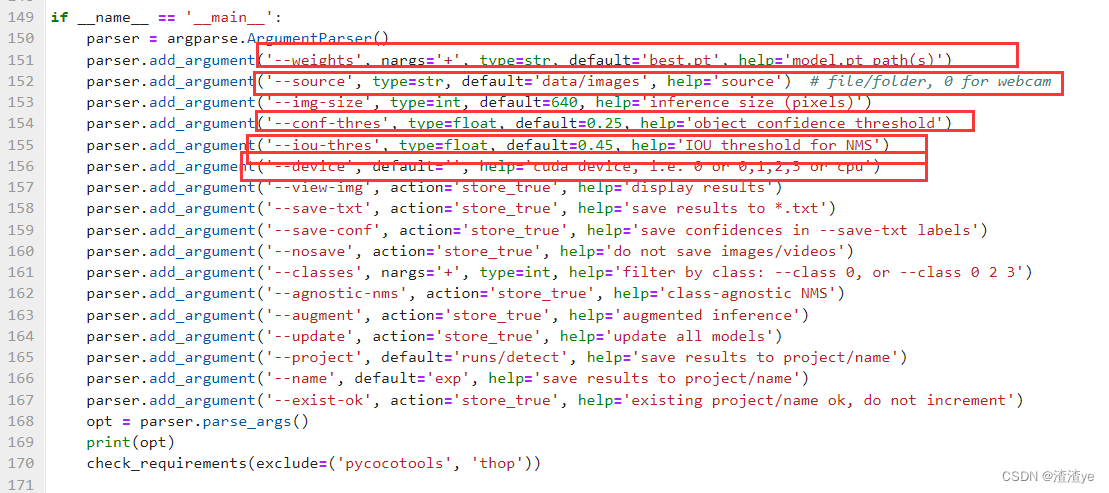
先修改detect.py(149行开始)内的部分内容
主要修改以下参数,也可直接复制下方代码替换
- import argparse
- import time
- from pathlib import Path
- import cv2
- import torch
- import torch.backends.cudnn as cudnn
- from numpy import random
- from models.experimental import attempt_load
- from utils.datasets import LoadStreams, LoadImages
- from utils.general import check_img_size, check_requirements, check_imshow, non_max_suppression, apply_classifier, \
- scale_coords, xyxy2xywh, strip_optimizer, set_logging, increment_path
- from utils.plots import plot_one_box
- from utils.torch_utils import select_device, load_classifier, time_synchronized
- def detect(save_img=False):
- source, weights, view_img, save_txt, imgsz = opt.source, opt.weights, opt.view_img, opt.save_txt, opt.img_size
- save_img = not opt.nosave and not source.endswith('.txt') # save inference images
- webcam = source.isnumeric() or source.endswith('.txt') or source.lower().startswith(
- ('rtsp://', 'rtmp://', 'http://', 'https://'))
- # Directories
- save_dir = Path(increment_path(Path(opt.project) / opt.name, exist_ok=opt.exist_ok)) # increment run
- (save_dir / 'labels' if save_txt else save_dir).mkdir(parents=True, exist_ok=True) # make dir
- # Initialize
- set_logging()
- device = select_device(opt.device)
- half = device.type != 'cpu' # half precision only supported on CUDA
- # Load model
- model = attempt_load(weights, map_location=device) # load FP32 model
- stride = int(model.stride.max()) # model stride
- imgsz = check_img_size(imgsz, s=stride) # check img_size
- if half:
- model.half() # to FP16
- # Second-stage classifier
- classify = False
- if classify:
- modelc = load_classifier(name='resnet101', n=2) # initialize
- modelc.load_state_dict(torch.load('weights/resnet101.pt', map_location=device)['model']).to(device).eval()
- # Set Dataloader
- vid_path, vid_writer = None, None
- if webcam:
- view_img = check_imshow()
- cudnn.benchmark = True # set True to speed up constant image size inference
- dataset = LoadStreams(source, img_size=imgsz, stride=stride)
- else:
- dataset = LoadImages(source, img_size=imgsz, stride=stride)
- # Get names and colors
- names = model.module.names if hasattr(model, 'module') else model.names
- colors = [[random.randint(0, 255) for _ in range(3)] for _ in names]
- # Run inference
- if device.type != 'cpu':
- model(torch.zeros(1, 3, imgsz, imgsz).to(device).type_as(next(model.parameters()))) # run once
- t0 = time.time()
- for path, img, im0s, vid_cap in dataset:
- img = torch.from_numpy(img).to(device)
- img = img.half() if half else img.float() # uint8 to fp16/32
- img /= 255.0 # 0 - 255 to 0.0 - 1.0
- if img.ndimension() == 3:
- img = img.unsqueeze(0)
- # Inference
- t1 = time_synchronized()
- pred = model(img, augment=opt.augment)[0]
- # Apply NMS
- pred = non_max_suppression(pred, opt.conf_thres, opt.iou_thres, classes=opt.classes, agnostic=opt.agnostic_nms)
- t2 = time_synchronized()
- # Apply Classifier
- if classify:
- pred = apply_classifier(pred, modelc, img, im0s)
- # Process detections
- for i, det in enumerate(pred): # detections per image
- if webcam: # batch_size >= 1
- p, s, im0, frame = path[i], '%g: ' % i, im0s[i].copy(), dataset.count
- else:
- p, s, im0, frame = path, '', im0s, getattr(dataset, 'frame', 0)
- p = Path(p) # to Path
- save_path = str(save_dir / p.name) # img.jpg
- txt_path = str(save_dir / 'labels' / p.stem) + ('' if dataset.mode == 'image' else f'_{frame}') # img.txt
- s += '%gx%g ' % img.shape[2:] # print string
- gn = torch.tensor(im0.shape)[[1, 0, 1, 0]] # normalization gain whwh
- if len(det):
- # Rescale boxes from img_size to im0 size
- det[:, :4] = scale_coords(img.shape[2:], det[:, :4], im0.shape).round()
- # Print results
- for c in det[:, -1].unique():
- n = (det[:, -1] == c).sum() # detections per class
- s += f"{n} {names[int(c)]}{'s' * (n > 1)}, " # add to string
- # Write results
- for *xyxy, conf, cls in reversed(det):
- if save_txt: # Write to file
- xywh = (xyxy2xywh(torch.tensor(xyxy).view(1, 4)) / gn).view(-1).tolist() # normalized xywh
- line = (cls, *xywh, conf) if opt.save_conf else (cls, *xywh) # label format
- with open(txt_path + '.txt', 'a') as f:
- f.write(('%g ' * len(line)).rstrip() % line + '\n')
- if save_img or view_img: # Add bbox to image
- label = f'{names[int(cls)]} {conf:.2f}'
- plot_one_box(xyxy, im0, label=label, color=colors[int(cls)], line_thickness=3)
- # Print time (inference + NMS)
- print(f'{s}Done. ({t2 - t1:.3f}s)')
- # Stream results
- if view_img:
- cv2.imshow(str(p), im0)
- cv2.waitKey(1) # 1 millisecond
- # Save results (image with detections)
- if save_img:
- if dataset.mode == 'image':
- cv2.imwrite(save_path, im0)
- else: # 'video' or 'stream'
- if vid_path != save_path: # new video
- vid_path = save_path
- if isinstance(vid_writer, cv2.VideoWriter):
- vid_writer.release() # release previous video writer
- if vid_cap: # video
- fps = vid_cap.get(cv2.CAP_PROP_FPS)
- w = int(vid_cap.get(cv2.CAP_PROP_FRAME_WIDTH))
- h = int(vid_cap.get(cv2.CAP_PROP_FRAME_HEIGHT))
- else: # stream
- fps, w, h = 30, im0.shape[1], im0.shape[0]
- save_path += '.mp4'
- vid_writer = cv2.VideoWriter(save_path, cv2.VideoWriter_fourcc(*'mp4v'), fps, (w, h))
- vid_writer.write(im0)
- if save_txt or save_img:
- s = f"\n{len(list(save_dir.glob('labels/*.txt')))} labels saved to {save_dir / 'labels'}" if save_txt else ''
- print(f"Results saved to {save_dir}{s}")
- print(f'Done. ({time.time() - t0:.3f}s)')
- if __name__ == '__main__':
- parser = argparse.ArgumentParser()
- parser.add_argument('--weights', nargs='+', type=str, default='best.pt', help='model.pt path(s)')
- parser.add_argument('--source', type=str, default='data/images', help='source') # file/folder, 0 for webcam
- parser.add_argument('--img-size', type=int, default=640, help='inference size (pixels)')
- parser.add_argument('--conf-thres', type=float, default=0.25, help='object confidence threshold')
- parser.add_argument('--iou-thres', type=float, default=0.45, help='IOU threshold for NMS')
- parser.add_argument('--device', default='', help='cuda device, i.e. 0 or 0,1,2,3 or cpu')
- parser.add_argument('--view-img', action='store_true', help='display results')
- parser.add_argument('--save-txt', action='store_true', help='save results to *.txt')
- parser.add_argument('--save-conf', action='store_true', help='save confidences in --save-txt labels')
- parser.add_argument('--nosave', action='store_true', help='do not save images/videos')
- parser.add_argument('--classes', nargs='+', type=int, help='filter by class: --class 0, or --class 0 2 3')
- parser.add_argument('--agnostic-nms', action='store_true', help='class-agnostic NMS')
- parser.add_argument('--augment', action='store_true', help='augmented inference')
- parser.add_argument('--update', action='store_true', help='update all models')
- parser.add_argument('--project', default='runs/detect', help='save results to project/name')
- parser.add_argument('--name', default='exp', help='save results to project/name')
- parser.add_argument('--exist-ok', action='store_true', help='existing project/name ok, do not increment')
- opt = parser.parse_args()
- print(opt)
- check_requirements(exclude=('pycocotools', 'thop'))
- with torch.no_grad():
- if opt.update: # update all models (to fix SourceChangeWarning)
- for opt.weights in ['yolov5s.pt', 'yolov5m.pt', 'yolov5l.pt', 'yolov5x.pt']:
- detect()
- strip_optimizer(opt.weights)
- else:
- detect()
运行
detect.pypython detect.py --weight runs/train/exp3/weights/best.pt --source VOCdevkit/images/train/000002.jpg或者
python detect.py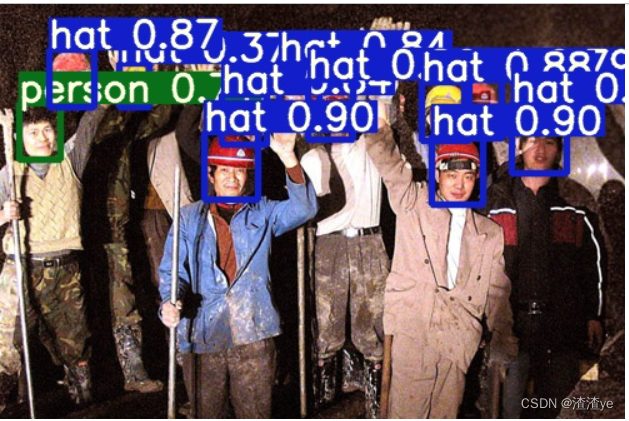
识别出佩戴安全帽和未佩戴安全帽,完成简单案例的流程(第一次用yolo框架,如有不妥请见谅)!
-
相关阅读:
六、回归与聚类算法 - K-means算法
Oracle的listagg的用法和例子
jvm 内存泄露、内存溢出、栈溢出区别
Redis基础架构
【四旋翼飞行器】模拟四旋翼飞行器的平移和旋转动力学(Simulink仿真实现)
MySQL 8.0 新特性
C++ 学习笔记(五)(泛型算法篇)
Redis基础
【ROOTFS】1-构建rootfs与nfs调试
【通信工程笔记】【终端与业务-第十二章】市场营销计划、实施和控制
- 原文地址:https://blog.csdn.net/yyfloveqcw/article/details/125628085