-
一文掌握数仓中auto analyze的使用
摘要:analyze执行的是否及时,在一定程度上直接决定了SQL执行的快慢。
本文分享自华为云社区《一文读懂autoanalyze使用【这次高斯不是数学家】》,作者: leapdb。
analyze执行的是否及时,在一定程度上直接决定了SQL执行的快慢。因此,GaussDB(DWS)引入了自动统计信息收集,可以做到让用户不再担心统计信息是否过期。
1. 自动收集场景
需要进行自动统计信息收集的场景通常有五个:批量DML结束时,增量DML结束时,DDL结束时,查询开始时和后台定时任务。
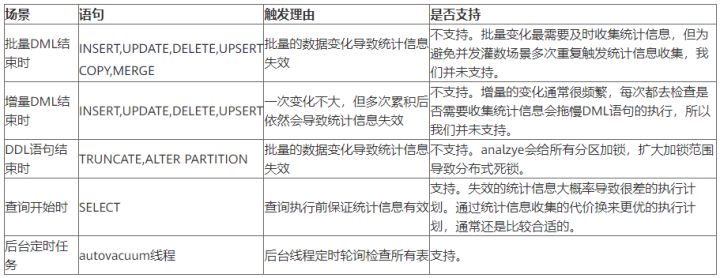
所以,为了避免对DML,DDL带来不必要的性能开销和死锁风险,我们选择了在查询开始前触发analzye。
2. 自动收集原理
GaussDB(DWS)在SQL执行过程中,会记录表增删改查相关的运行时统计信息,并在事务提交或回滚后记录到共享的内存种。
这些信息可以通过 “pg_stat_all_tables视图” 查询,也可以通过下面函数进行查询。
- pg_stat_get_tuples_inserted --表累积insert条数
- pg_stat_get_tuples_updated --表累积update条数
- pg_stat_get_tuples_deleted --表累积delete条数
- pg_stat_get_tuples_changed --表自上次analyze以来,修改的条数
- pg_stat_get_last_analyze_time --查询最近一次analyze时间
因此,根据共享内存中 "表自上次analyze以来修改过的条数" 是否超过一定阈值,就可以判定是否需要做analyze了。
3. 自动收集阈值
3.1 全局阈值
- autovacuum_analyze_threshold #表触发analyze的最小修改量
- autovacuum_analyze_scale_factor #表触发analyze时的修改百分比
当"表自上次analyze以来修改的条数" >= autovacuum_analyze_threshold + 表估算大小 * autovacuum_analyze_scale_factor时,需要自动触发analyze。
3.2 表级阈值
- --设置表级阈值
- ALTER TABLE item SET (autovacuum_analyze_threshold=50);
- ALTER TABLE item SET (autovacuum_analyze_scale_factor=0.1);
- --查询阈值
- postgres=# select pg_options_to_table(reloptions) from pg_class where relname='item';
- pg_options_to_table
- ---------------------------------------
- (autovacuum_analyze_threshold,50)
- (autovacuum_analyze_scale_factor,0.1)
- (2 rows)
- --重置阈值
- ALTER TABLE item RESET (autovacuum_analyze_threshold);
- ALTER TABLE item RESET (autovacuum_analyze_scale_factor);
不同表的数据特征不一样,需要触发analyze的阈值可能有不同的需求。表级阈值优先级高于全局阈值。
3.3 查看表的修改量是否超过了阈值(仅当前CN)
- postgres=# select pg_stat_get_local_analyze_status('t_analyze'::regclass);
- pg_stat_get_local_analyze_status
- ----------------------------------
- Analyze not needed
- (1 row)
4. 自动收集方式
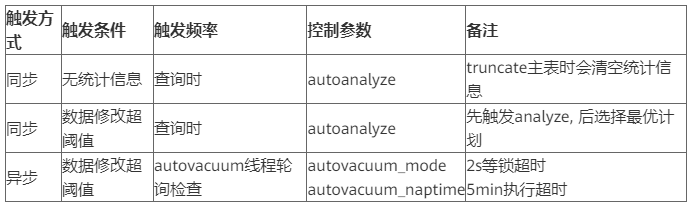
GaussDB(DWS)提供了三种场景下表的自动分析。
- 当查询中存在“统计信息完全缺失”或“修改量达到analyze阈值”的表,且执行计划不采取FQS (Fast Query Shipping)执行时,则通过autoanalyze控制此场景下表统计信息的自动收集。此时,查询语句会等待统计信息收集成功后,生成更优的执行计划,再执行原查询语句。
- 当autovacuum设置为on时,系统会定时启动autovacuum线程,对“修改量达到analyze阈值”的表在后台自动进行统计信息收集。
5.冻结统计信息
5.1 冻结表的distinct值
当一个表的distinct总是估算不准,例如:数据扎堆儿重复场景。如果表的distinct值固定,可以通过以下方式冻结表的distinct值。
- postgres=# alter table lineitem alter l_orderkey set (n_distinct=0.9);
- ALTER TABLE
- postgres=# select relname,attname,attoptions from pg_attribute a,pg_class c where c.oid=a.attrelid and attname='l_orderkey';
- relname | attname | attoptions
- ----------+------------+------------------
- lineitem | l_orderkey | {n_distinct=0.9}
- (1 row)
- postgres=# alter table lineitem alter l_orderkey reset (n_distinct);
- ALTER TABLE
- postgres=# select relname,attname,attoptions from pg_attribute a,pg_class c where c.oid=a.attrelid and attname='l_orderkey';
- relname | attname | attoptions
- ----------+------------+------------
- lineitem | l_orderkey |
- (1 row)
5.2. 冻结表的全部统计信息
如果表的数据特征基本不变,还可以冻结表的统计信息,来避免重复进行analyze。
alter table table_name set frozen_stats=true;6. 手动查看表是否需要做analyze
a. 不想在业务高峰期时触发数据库后台任务,所以不愿意打开autovacuum来触发analyze,怎么办?
b. 业务修改了一批表,想立即对这些表马上做一次analyze,又不知道都有哪些表,怎么办?
c. 业务高峰来临前想对临近阈值的表都做一次analyze,怎么办?
我们将autovacuum检查阈值判断是否需要analyze逻辑,抽取成了函数,帮助用户灵活主动的检查哪些表需要做analyze。
6.1 判断表是否需要analyze(串行版,适用于所有历史版本)
- -- the function for get all pg_stat_activity information in all CN of current cluster.
- CREATE OR REPLACE FUNCTION pg_catalog.pgxc_stat_table_need_analyze(in table_name text)
- RETURNS BOOl
- AS $$
- DECLARE
- row_data record;
- coor_name record;
- fet_active text;
- fetch_coor text;
- relTuples int4;
- changedTuples int4:= 0;
- rel_anl_threshold int4;
- rel_anl_scale_factor float4;
- sys_anl_threshold int4;
- sys_anl_scale_factor float4;
- anl_threshold int4;
- anl_scale_factor float4;
- need_analyze bool := false;
- BEGIN
- --Get all the node names
- fetch_coor := 'SELECT node_name FROM pgxc_node WHERE node_type=''C''';
- FOR coor_name IN EXECUTE(fetch_coor) LOOP
- fet_active := 'EXECUTE DIRECT ON (' || coor_name.node_name || ') ''SELECT pg_stat_get_tuples_changed(oid) from pg_class where relname = ''''|| table_name ||'''';''';
- FOR row_data IN EXECUTE(fet_active) LOOP
- changedTuples = changedTuples + row_data.pg_stat_get_tuples_changed;
- END LOOP;
- END LOOP;
- EXECUTE 'select pg_stat_get_live_tuples(oid) from pg_class c where c.oid = '''|| table_name ||'''::REGCLASS;' into relTuples;
- EXECUTE 'show autovacuum_analyze_threshold;' into sys_anl_threshold;
- EXECUTE 'show autovacuum_analyze_scale_factor;' into sys_anl_scale_factor;
- EXECUTE 'select (select option_value from pg_options_to_table(c.reloptions) where option_name = ''autovacuum_analyze_threshold'') as value
- from pg_class c where c.oid = '''|| table_name ||'''::REGCLASS;' into rel_anl_threshold;
- EXECUTE 'select (select option_value from pg_options_to_table(c.reloptions) where option_name = ''autovacuum_analyze_scale_factor'') as value
- from pg_class c where c.oid = '''|| table_name ||'''::REGCLASS;' into rel_anl_scale_factor;
- --dbms_output.put_line('relTuples='||relTuples||'; sys_anl_threshold='||sys_anl_threshold||'; sys_anl_scale_factor='||sys_anl_scale_factor||'; rel_anl_threshold='||rel_anl_threshold||'; rel_anl_scale_factor='||rel_anl_scale_factor||';');
- if rel_anl_threshold IS NOT NULL then
- anl_threshold = rel_anl_threshold;
- else
- anl_threshold = sys_anl_threshold;
- end if;
- if rel_anl_scale_factor IS NOT NULL then
- anl_scale_factor = rel_anl_scale_factor;
- else
- anl_scale_factor = sys_anl_scale_factor;
- end if;
- if changedTuples > anl_threshold + anl_scale_factor * relTuples then
- need_analyze := true;
- end if;
- return need_analyze;
- END; $$
- LANGUAGE 'plpgsql';
6.2 判断表是否需要analyze(并行版,适用于支持并行执行框架的版本)
- -- the function for get all pg_stat_activity information in all CN of current cluster.
- --SELECT sum(a) FROM pg_catalog.pgxc_parallel_query('cn', 'SELECT 1::int FROM pg_class LIMIT 10') AS (a int); 利用并发执行框架
- CREATE OR REPLACE FUNCTION pg_catalog.pgxc_stat_table_need_analyze(in table_name text)
- RETURNS BOOl
- AS $$
- DECLARE
- relTuples int4;
- changedTuples int4:= 0;
- rel_anl_threshold int4;
- rel_anl_scale_factor float4;
- sys_anl_threshold int4;
- sys_anl_scale_factor float4;
- anl_threshold int4;
- anl_scale_factor float4;
- need_analyze bool := false;
- BEGIN
- --Get all the node names
- EXECUTE 'SELECT sum(a) FROM pg_catalog.pgxc_parallel_query(''cn'', ''SELECT pg_stat_get_tuples_changed(oid)::int4 from pg_class where relname = ''''|| table_name ||'''';'') AS (a int4);' into changedTuples;
- EXECUTE 'select pg_stat_get_live_tuples(oid) from pg_class c where c.oid = '''|| table_name ||'''::REGCLASS;' into relTuples;
- EXECUTE 'show autovacuum_analyze_threshold;' into sys_anl_threshold;
- EXECUTE 'show autovacuum_analyze_scale_factor;' into sys_anl_scale_factor;
- EXECUTE 'select (select option_value from pg_options_to_table(c.reloptions) where option_name = ''autovacuum_analyze_threshold'') as value
- from pg_class c where c.oid = '''|| table_name ||'''::REGCLASS;' into rel_anl_threshold;
- EXECUTE 'select (select option_value from pg_options_to_table(c.reloptions) where option_name = ''autovacuum_analyze_scale_factor'') as value
- from pg_class c where c.oid = '''|| table_name ||'''::REGCLASS;' into rel_anl_scale_factor;
- dbms_output.put_line('relTuples='||relTuples||'; sys_anl_threshold='||sys_anl_threshold||'; sys_anl_scale_factor='||sys_anl_scale_factor||'; rel_anl_threshold='||rel_anl_threshold||'; rel_anl_scale_factor='||rel_anl_scale_factor||';');
- if rel_anl_threshold IS NOT NULL then
- anl_threshold = rel_anl_threshold;
- else
- anl_threshold = sys_anl_threshold;
- end if;
- if rel_anl_scale_factor IS NOT NULL then
- anl_scale_factor = rel_anl_scale_factor;
- else
- anl_scale_factor = sys_anl_scale_factor;
- end if;
- if changedTuples > anl_threshold + anl_scale_factor * relTuples then
- need_analyze := true;
- end if;
- return need_analyze;
- END; $$
- LANGUAGE 'plpgsql';
6.3 判断表是否需要analyze(自定义阈值)
- -- the function for get all pg_stat_activity information in all CN of current cluster.
- CREATE OR REPLACE FUNCTION pg_catalog.pgxc_stat_table_need_analyze(in table_name text, int anl_threshold, float anl_scale_factor)
- RETURNS BOOl
- AS $$
- DECLARE
- relTuples int4;
- changedTuples int4:= 0;
- need_analyze bool := false;
- BEGIN
- --Get all the node names
- EXECUTE 'SELECT sum(a) FROM pg_catalog.pgxc_parallel_query(''cn'', ''SELECT pg_stat_get_tuples_changed(oid)::int4 from pg_class where relname = ''''|| table_name ||'''';'') AS (a int4);' into changedTuples;
- EXECUTE 'select pg_stat_get_live_tuples(oid) from pg_class c where c.oid = '''|| table_name ||'''::REGCLASS;' into relTuples;
- if changedTuples > anl_threshold + anl_scale_factor * relTuples then
- need_analyze := true;
- end if;
- return need_analyze;
- END; $$
- LANGUAGE 'plpgsql';
通“优化器触发的实时analyze”和“后台autovacuum触发的轮询analyze”,GaussDB(DWS)已经可以做到让用户不再关心表是否需要analyze。建议在最新版本中试用。
-
相关阅读:
科研人如何做PPT、答辩、演讲
labelme标注格式的数据集转COCO格式脚本
VR云游:让游客足不出户享受旅行的乐趣
电脑商城系统
VL-Adapter: 针对视觉和语言(Vision-and-Language)的参数高效迁移学习
函数计算|如何使用层解决依赖包问题?
基于 Vue 实现页面中文本的复制功能
【JAVA】06 封装、继承、多态 总结(初级)
【IMX6ULL学习笔记之驱动学习02】LED字符设备驱动
Echarts绘制地图,且可以下钻到省区
- 原文地址:https://blog.csdn.net/devcloud/article/details/125595831
