-
go高并发数据结构---channel
1. chan 是什么,为什么用它
1.1 chan 的声明
代码演示:
func main() { // channel 声明 c := make(chan int) c <- 1 // 向管道发送 1 <-c // 丢弃 s := <-c // 赋给s // 或者声明string //c := make(chan string) //c <- "1" }- 1
- 2
- 3
- 4
- 5
- 6
- 7
- 8
- 9
- 10
- 11
说明:
make(chan int)// 表示无缓冲chanmake(chan bool, 0)// 无缓冲make(chan string, 2)// 有缓冲, 有数字就代表有缓冲
1.2 chan 的基本用法
ch <- x// 发送数据x = <- ch// 接收数据,赋给x<- ch// 接收数据,并丢弃
1.3 错误用法及修改
- 无缓冲区,会卡住
func main() { c := make(chan string) c <- "ping" fmt.Println(<-c) }- 1
- 2
- 3
- 4
- 5
- 修改,添加协程
func main() { c := make(chan string) // 还必须在前面开启这个协程 go func() { fmt.Println(<-c) }() c <- "ping" }- 1
- 2
- 3
- 4
- 5
- 6
- 7
- 8
- 9
1.4 内存与通信
在go官方有这样一个建议:
不要通过共享内存的方式进行通信,而是应该通过通信的方式共享内存
怎么理解呢, 我分别给出两个例子就可以了解了
- 使用共享内存方案
func watch(p *int) { for true { if *p == 1 { fmt.Println("break....") break } } } func main() { i := 0 go watch(&i) time.Sleep(time.Second * 2) i = 1 time.Sleep(time.Second) }- 1
- 2
- 3
- 4
- 5
- 6
- 7
- 8
- 9
- 10
- 11
- 12
- 13
- 14
- 15
共享内存方案: i的地址给另一个协程, 典型的共享内存需要一直遍历, 消耗系统资源
- 使用通信方式
func watch(c chan int) { // 管道不需要一遍一遍去查询 if <-c == 1 { fmt.Println("hello....") } } func main() { c := make(chan int) go watch(c) time.Sleep(time.Second * 2) c <- 1 time.Sleep(time.Second) }- 1
- 2
- 3
- 4
- 5
- 6
- 7
- 8
- 9
- 10
- 11
- 12
- 13
通信方式: 不需要一直遍历, 提高系统使用资源
1.5 为什么使用通信来共享内存
- 避免协程竞争和数据冲突的问题(加锁又会影响性能)
- 更高级的抽象,降低开发难度,增加程序可读性
- 模块之间更容易解耦,增强扩展性和可维护性
2. chan 底层设计
2.1 chan 数据结构需要有哪些成员
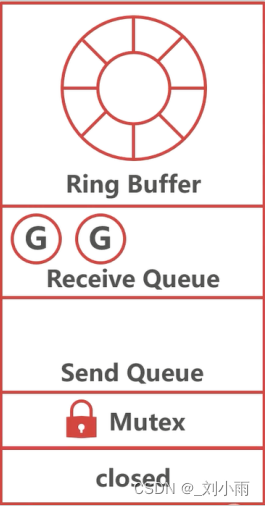
总共需要三个成员
-
需要一个缓存buffer

-
发送数据满之后,发送会阻塞,这时会有一个等待队列

- 接收数据也是同理,需要有一个接收队列

合并起来,chan 设计需要3个重要的成员

2.2 chan 源码阅读
2.2.1 在runtime/chan.go 中
hchan 数据结构就是go官方实现的chan 底层设计
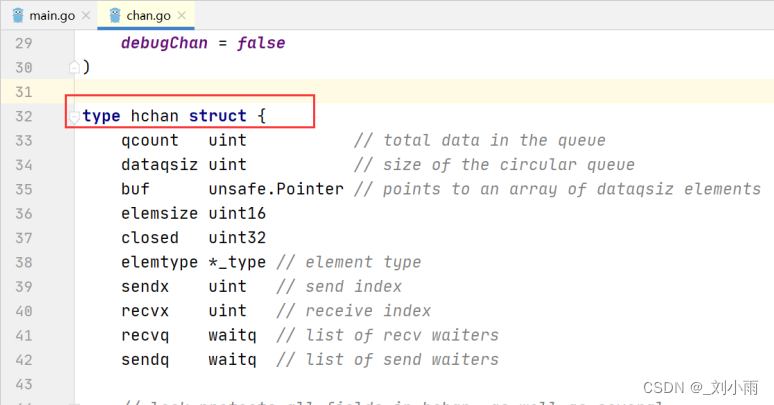
type hchan struct { qcount uint // total data in the queue dataqsiz uint // size of the circular queue buf unsafe.Pointer // points to an array of dataqsiz elements elemsize uint16 closed uint32 elemtype *_type // element type sendx uint // send index recvx uint // receive index recvq waitq // list of recv waiters sendq waitq // list of send waiters // lock protects all fields in hchan, as well as several // fields in sudogs blocked on this channel. // // Do not change another G's status while holding this lock // (in particular, do not ready a G), as this can deadlock // with stack shrinking. lock mutex }- 1
- 2
- 3
- 4
- 5
- 6
- 7
- 8
- 9
- 10
- 11
- 12
- 13
- 14
- 15
- 16
- 17
- 18
- 19
其中下面几个成员组成了一个缓存区环形缓存

qcount uint // total data in thequeue dataqsiz uint // size of the circularqueue buf unsafe.Pointer // points to an arrayof dataqsiz elements elemsize uint16 closed uint32 elemtype *_type // element type- 1
- 2
- 3
- 4
- 5
- 6
下面两个成员组成了发送队列,其中是用的链表实现的
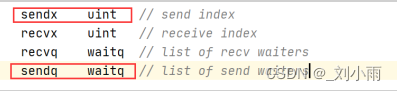
从这里看出是形成的链表

同理这两个成员组成了接收队列

另外还有一个互斥锁, 这个字段是锁所有字段的

下面是对hchan 中锁的认识 :- 互斥锁并不是排队发送、接收数据
- 互斥锁保护的hchan 结构体本身
- channel并不是无锁的
最后还有一个状态值字段, close 字段
1 : 表开启
0 :表关闭2.3 chan 成员一览表
channel 数据结构是go 中的一等公民
chan 成员一览表:

3. chan 收发数据原理
3.1 channel 发送数据的底层原理
上面讲解了数据结构,这里就是算法了
3.1.1 <- 关键字
- c <- 关键字是一个语法糖
- 编译阶段,会把c <- 转化为 runtime.chansend1() // 可以用汇编看
- chansend1() 会调用chansend() 方法
3.1.2 channel 发送的情形

- 直接发送
- 放入缓存
- 休眠等待
3.1.3 直接发送
- 发送数据前,已经有G 在休眠等待 (之前写的代码就是这种 watch)
- 此时缓存肯定是空的,不用考虑缓存
- 将数据直接拷贝给G的接收量, 唤醒G
code:func watch(c chan int) { // 管道不需要一遍一遍去查询 if <-c == 1 { fmt.Println("hello....") } } func main() { c := make(chan int) go watch(c) time.Sleep(time.Second * 2) c <- 1 time.Sleep(time.Second) }- 1
- 2
- 3
- 4
- 5
- 6
- 7
- 8
- 9
- 10
- 11
- 12
- 13
实现步骤:
- 从队列里取出一个等待接收的G
- 将数据直接拷贝到接收变量中
- 唤醒G
3.1.4 放入缓存
- 没有G 在休眠等待,但是有缓存空间
- 将数据放入缓存

实现步骤:- 获取可存入的缓存地址
- 存入数据
- 维护索引 (告诉下一位存在什么位置)
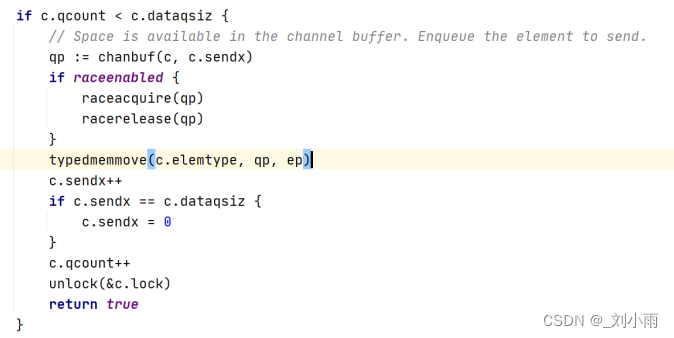
3.1.5 休眠等待
原理:
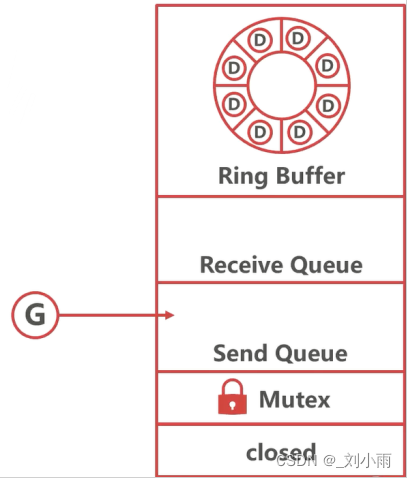
- 没有G在休眠等待,而且没有缓存或满了
- 自己进入发送队列,休眠等待
实现步骤:
3. 把自己包装成sudog
4. sudog 放入sendq 队列
5. 休眠并解锁
6. 被唤醒后,数据已经被取走,维护其他数据3.1.6 channel 发送数据总结
编译阶段, 会把 <- 转化为 runtime.chansend1()
- 直接发送时,将数据直接拷贝到目标变量
- 放入缓存时,将数据放入环形缓存,成功返回
- 休眠等待时,将自己包装后放入sendq, 休眠
3.2 channel 接收数据原理
3.2.1 <- 关键字
- <- c 关键字是一个语法糖
- 编译阶段, i <- c 转化为 runtime.chanrecv1()
- 编译阶段, i, ok <- c 转化为runtime.chanrecv2()
- 上面两种最后会调用chanrecv() 方法

3.2.2 channel 接收的情形

接收步骤:- 有等待的G, 从G接收
- 有等待的G, 从缓存接收
- 接收缓存
- 阻塞缓存
3.2.3 有等待的G, 从G 接收
- 原理

- 接收数据前,已经有G 在休眠等待发送
- 而且这个channel 没有缓存
- 将数据直接从G 拷贝过来,唤醒G
- 实现
- 判断有G 在发送队列等待,进入recv()
- 判断此channel 无缓存
- 直接从等待的G中取走数据,唤醒G
3.2.4 有等待的G, 从缓存接收

原理- 接收数据前,已经有G 在休眠等待发送
- 而且这个channel 有缓存
- 从缓存取走一个数据
实现
- 判断有G 在发送队列等待,进入recv()
- 判断此channel 有缓存
- 从缓存中取走一个数据
- 将G的数据放入缓存,唤醒G
3.2.5 接收缓存

原理- 没有G在休眠等待发送,但是缓存有内容
- 从缓存取走数据
实现
- 判断没有G 在发送队列等待
- 判断此channel有缓存
- 从缓存中取走一个数据
3.2.6 阻塞接收

原理- 没有G 在休眠等待,而且没有缓存或缓存空
- 自己进入接收队列,休眠等待
实现
3. 判断没有G在发送队列等待
4. 判断此channel 无缓存
5. 将自己包装成sudog
6. sudog 放入接收等待队列,休眠
7. 唤醒时,发送的G已经把数据拷贝到位3.2.7 channel 接收数据总结
- 编译阶段, <- c 会转化为chanrecv()
- 有等待的G, 且无缓存时,从G接收
- 有等待的G, 且有缓存时,从缓存接收
- 无等待的G,且缓存有数据,从缓存接收
- 无等待的G,且缓存无数据,等待喂数据
4. 非阻塞的channel 怎么做
4.1 select 提出
只用 <- 接收时, 永远是阻塞的,什么时候用非阻塞呢, 答案是 select

4.2 select 原理
- 同时存在接收、发送、默认路径
- 首先查看是否有可以即使执行的case
- 没有的话,有default, 走default
- 没有default, 把自己注册在所有channel 中,休眠的等待
code:
func main() { // 快捷键补全 ctrl + alt + v (qq音乐会冲突) c1 := make(chan int, 5) c2 := make(chan int) select { case <-c1: fmt.Println("c1") case c2 <- 1: fmt.Println("c2") default: fmt.Println("none") } }- 1
- 2
- 3
- 4
- 5
- 6
- 7
- 8
- 9
- 10
- 11
- 12
- 13
4.3 timer 包的使用
- timer 可以提供一个channel, 定时塞入数据
// 倒计时 定时器 t := time.NewTimer(time.Second) // 倒计数1s 后定时器的channel 会塞入一个数据, 这时就可以取出一个数据了 <-t.C fmt.Println("hello...")- 1
- 2
- 3
- 4
- 5
5. 总结
5.1 为什么使用channel
- 相对于无锁 (避免协程竞争和数据冲突的问题)
- 相对于加锁
- 更高级的抽象,降低开发难度,增加程序的可读性
- 模块之间更容易解耦,增强扩展性和可维护性
5.2 channel 基本结构
- 一个环形缓存
- 两个链表(发送协程、接收协程)
- 一个互斥锁(保护hchan)
- 一个状态值

5.3 channel数据发送原理
- 直接发送时,将数据直接拷贝到目标变量
- 放入缓存时,将数据放入环形缓存,成功返回
- 休眠等待时,将自己包装后放入sendq, 休眠
5.4 channel数据接收原理
- 有等待的G,且无缓存时,从G接收
- 有等待的G,且有缓存时,从缓存接收
- 无等待的G,且缓存有数据,从缓存接收
- 无等待的G, 且缓存无数据,等待喂数据
5.5 非阻塞channel
- 使用select 可以使用channel 的非阻塞特性
- 使用timer 配合select 可以实现超时特性
-
相关阅读:
非常经典的Oracle基础知识
【IDEA项目个别类爆红,但是项目可以正常运行】
KVM Cloud云平台
【Linux】进程优先级|进程并发概念|在vim中批量化注释
Vue_render函数
设计模式之策略模式(行为型)
【无标题】
【自留地】后端 - PHP - MySQL - Nginx - Python - Java
vue-admin-template改变接口地址
常见面试题-Redis专栏(一)
- 原文地址:https://blog.csdn.net/qq_39486027/article/details/125535470