• 「网络流浅谈」最大流的应用


    二分图匹配

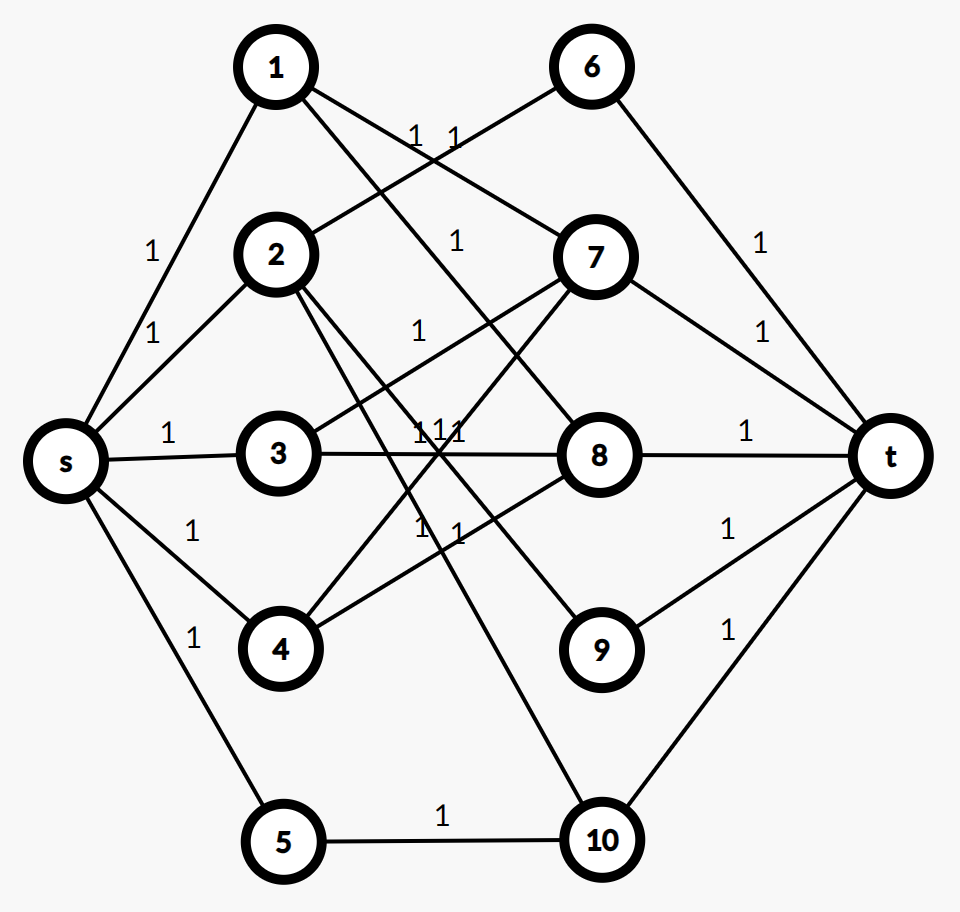
    考虑如何将二分图匹配问题,转化为流网络。设置 1 个汇点和源点,从源点向二分图一侧的每一个点连边,从另一侧向汇点连边,边权均为 1,二分图中的边也全部加入,权值设为 1。这样,二分图的最大匹配等于流网络的最大流。

    P2756 飞行员配对方案问题

    题意:给定 1 个二分图,求最大匹配。

    匈牙利算法是可以求二分图最大匹配的,不过太慢了。不妨,使用上述的方式建立出流网络,并使用 Dinic 求解出该网络的最大流即可。

    举个例子:左图为样例的二分图,而右图为建立的流网络。
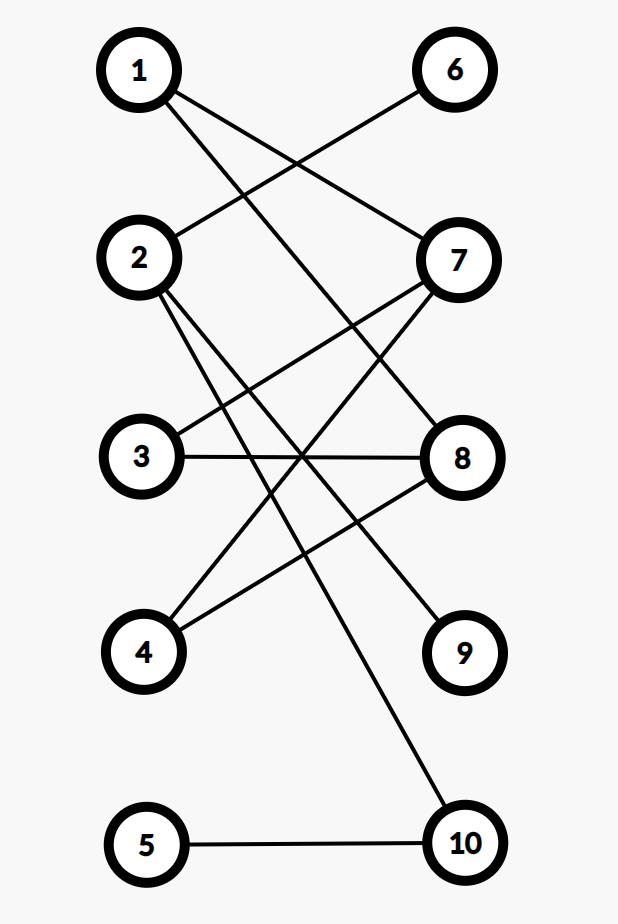
    浅析流网络最大流与二分图最大匹配的相等性:

    对于网络流的题目,只需要考虑对于任意的一个最大匹配,都能对应到一个可行流;而对于任意一个可行流都能对应到一个最大匹配。

    对于任意的一个最大匹配,都能对应到一个可行流:若选择边 E1,E2,,Ek,则可行流中的这些边均为 1,且令这些边左端的顶点分别为 V1,V2,,Vt,右端的为 V1,V2,,Vt,则可行流的 sVi 这些边均为 1Vit 这些边也均为 1。由于匹配不存在 2 条边有公共顶点,所以一定满足容量限制与流量守恒。

    对于任意的一个可行流,都能对应到一个最大匹配:可行流中流量为 1 的没有 st 的边即为最大匹配,由于流量守恒,最多有 1 条边流向一个点,所以满足对于任意 2 条边,都不存在公共点。

    故,只需要用 Dinic 跑一遍最大流即可,输出方案就是找出所有反向边流量为 1(或正向边流量为 0)的边即可。

    注意:二分图下的 Dinic 算法极为特殊,时间复杂度为 O(n2n)

    #include 
    #define fi first
    #define se second
    #define int long long
    
    using namespace std;
    
    typedef pair<int, int> PII;
    typedef long long LL;
    
    const int N = 1e2 + 10, M = 1e5 + 10;
    
    int n, m, s, t;
    int h[N], e[M], ne[M], f[M], idx;
    int d[N], cur[N];
    
    void add(int a, int b, int c) {
    	e[idx] = b, ne[idx] = h[a], f[idx] = c, h[a] = idx ++;
    	e[idx] = a, ne[idx] = h[b], f[idx] = 0, h[b] = idx ++;
    }
    bool bfs() {
    	memset(d, -1, sizeof d);
    	queue<int> q;
    	q.emplace(s), cur[s] = h[s], d[s] = 0;
    	while (q.size()) {
    		auto u = q.front();
    		q.pop();
    
    		for (int i = h[u]; ~i; i = ne[i]) {
    			int j = e[i];
    			if (d[j] == -1 && f[i]) {
    				d[j] = d[u] + 1, cur[j] = h[j];
    				if (j == t) return 1;
    				q.emplace(j);
    			}
    		}
    	}
    	return 0;
    }
    int find(int u, int lim) {
    	if (u == t) return lim;
    
    	int flow = 0;
    	for (int i = cur[u]; ~i && flow < lim; i = ne[i]) {
    		int j = e[i];
    		if (d[j] == d[u] + 1 && f[i]) {
    			int tmp = find(j, min(lim - flow, f[i]));
    			if (!tmp) d[j] = -1;
    			f[i] -= tmp, f[i ^ 1] += tmp, flow += tmp;
    		}
    	}
    	return flow;
    }
    int dinic() {
    	int res = 0, flow;
    	while (bfs()) while (flow = find(s, 1e18)) res += flow;
    	return res;
    }
    
    signed main() {
    	cin.tie(0);
    	cout.tie(0);
    	ios::sync_with_stdio(0);
    
    	memset(h, -1, sizeof h);
    
    	cin >> m >> n;
    
    	s = 0, t = n + 1;
    	int u, v;
    	while (cin >> u >> v && u != -1) {
    		add(u, v, 1);
    	}
    	for (int i = 1; i <= m; i ++)
    		add(s, i, 1);
    	for (int i = m + 1; i <= n; i ++)
    		add(i, t, 1);
    
    	cout << dinic() << endl;
    	for (int i = 0; i < idx; i += 2)
    		if (e[i] != t && e[i ^ 1] != s && !f[i])
    			cout << e[i ^ 1] << " " << e[i] << endl;
    
    	return 0;
    }
    

    习题

    P3254 圆桌问题,与原建图方式有略微差异。

    参考代码
    #include 
    #define fi first
    #define se second
    #define int long long
    
    using namespace std;
    
    typedef pair<int, int> PII;
    typedef long long LL;
    
    const int N = 5e2 + 10, M = 1e5 + 10;
    
    int m, n, s, t;
    int a[N], b[N];
    int h[N], e[M], f[M], ne[M], idx;
    int d[N], cur[N];
    
    void add(int a, int b, int c) {
    	e[idx] = b, ne[idx] = h[a], f[idx] = c, h[a] = idx ++;
    	e[idx] = a, ne[idx] = h[b], f[idx] = 0, h[b] = idx ++;
    }
    bool bfs() {
    	memset(d, -1, sizeof d);
    	queue<int> q;
    	q.emplace(s), d[s] = 0, cur[s] = h[s];
    	while (q.size()) {
    		int u = q.front();
    		q.pop();
    
    		for (int i = h[u]; ~i; i = ne[i]) {
    			int j = e[i];
    			if (d[j] == -1 && f[i]) {
    				d[j] = d[u] + 1;
    				cur[j] = h[j];
    				if (j == t) return 1;
    				q.emplace(j);
    			}
    		}
    	}
    	return 0;
    }
    int find(int u, int lim) {
    	if (u == t) return lim;
    
    	int flow = 0;
    	for (int i = cur[u]; ~i && flow < lim; i = ne[i]) {
    		cur[u] = i;
    		int j = e[i];
    		if (d[j] == d[u] + 1 && f[i]) {
    			int tmp = find(j, min(lim - flow, f[i]));
    			if (!tmp) d[j] = -1;
    			f[i] -= tmp, f[i ^ 1] += tmp, flow += tmp;
    		}
    	}
    
    	return flow;
    }
    int dinic() {
    	int res = 0, flow;
    	while (bfs()) while (flow = find(s, 1e18)) res += flow;
    	return res;
    }
    
    signed main() {
    	cin.tie(0);
    	cout.tie(0);
    	ios::sync_with_stdio(0);
    
    	memset(h, -1, sizeof h);
    	cin >> m >> n;
    
    	s = 0, t = n + m + 1;
    	int tot = 0;
    	for (int i = 1; i <= m; i ++)
    		cin >> a[i], add(s, i, a[i]), tot += a[i];
    	for (int i = 1; i <= n; i ++)
    		cin >> b[i], add(i + m, t, b[i]);
    	for (int i = 1; i <= m; i ++)
    		for (int j = m + 1; j <= n + m; j ++)
    			add(i, j, 1);
    
    	if (dinic() == tot) {
    		cout << 1 << endl;
    		std::vector<vector<int>> way(m + 1);
    		for (int i = 0; i < idx; i += 2)
    			if (e[i] != t && e[i ^ 1] != s && !f[i])
    				way[e[i ^ 1]].emplace_back(e[i] - m);
    		for (int i = 1; i <= m; i ++) {
    			for (auto v : way[i])
    				cout << v << " ";
    			cout << endl;
    		}
    	} else {
    		cout << 0 << endl;
    	}
    
    	return 0;
    }
    

    多源汇最大流

    本质上只不过是源点不是 1 个,汇点也不是 1 个了,那么其实只需要再设一个超级源点连向所有源点,边权为 +,表示向这些源点可以流任意多流量,也就是说从这些源点可以流出任意多流量;同样的,从每一个汇点向超级汇点连一条 + 的边,表示这些汇点可以流向超级汇点任意多流量,也就是说这些汇点都可以接纳任意多的流量。

    这样的新流网络的最大流就是源网络的最大流,所以只需要对于新网络跑一遍 Dinic 即可。

    习题

    AcWing 2234. 多源汇最大流,模版题

    参考代码
    #include 
    #include 
    #include 
    #define int long long
    
    using namespace std;
    
    typedef pair<int, int> PII;
    
    const int SIZE = 5e5 + 10;
    
    int N, M, Sc, Tc, S, T;
    int h[SIZE], e[SIZE], ne[SIZE], f[SIZE], idx;
    int D[SIZE], Current[SIZE];
    
    void add(int a, int b, int c) {
        e[idx] = b, ne[idx] = h[a], f[idx] = c, h[a] = idx ++;
        e[idx] = a, ne[idx] = h[b], f[idx] = 0, h[b] = idx ++;
    }
    
    bool BFS() {
        memset(D, -1, sizeof D);
        queue<int> Q;
    
        Q.push(S), D[S] = 0, Current[S] = h[S];
        while (Q.size()) {
            int u = Q.front();
            Q.pop();
    
            for (int i = h[u]; ~i; i = ne[i]) {
                int j = e[i];
                if (D[j] == -1 && f[i]) {
                    D[j] = D[u] + 1;
                    Current[j] = h[j];
                    if (j == T) return true;
                    Q.push(j);
                }
            }
        }
    
        return false;
    }
    
    int Find(int u, int limit) {
        if (u == T) return limit;
    
        int flow = 0;
        for (int i = Current[u]; ~i && flow < limit; i = ne[i]) {
            Current[u] = i;
            int j = e[i];
            if (D[j] == D[u] + 1 && f[i]) {
                int T = Find(j, min(f[i], limit - flow));
                if (!T) D[j] = -1;
                f[i] -= T, f[i ^ 1] += T, flow += T;
            }
        }
    
        return flow;
    }
    
    int Dinic() {
        int Result = 0, flow;
        while (BFS()) while (flow = Find(S, 1e18)) Result += flow;
        return Result;
    }
    
    signed main() {
        cin.tie(0);
        cout.tie(0);
        ios::sync_with_stdio(0);
    
        memset(h, -1, sizeof h);
    
        cin >> N >> M >> Sc >> Tc;
    
        S = 0, T = N + 1;
        while (Sc --) {
            int u;
            cin >> u;
            add(S, u, 1e18);
        }
    
        while (Tc --) {
            int u;
            cin >> u;
            add(u, T, 1e18);
        }
    
        while (M --) {
            int a, b, c;
    
            cin >> a >> b >> c;
    
            add(a, b, c);
        }
    
        cout << Dinic() << endl;
    
        return 0;
    }
    

    关键边

    POJ3204 Ikki's Story I - Road Reconstruction

    题意:给定 1 个流网络,求有多少条边,满足增加该边边权后能使最大流增加。

    考虑一条边满足什么条件使得增加容量后会使得最大流增加,回顾求最大流的过程:每一次在残留网络中找增广路径,并加到最大流中。

    那么,如果容量增加后,最大流增加,那么必然是增加流量后产生 1 条增广路径。所以,对于每一条边 (u,v),只需要判断是否存在 1 条增广路径 su 以及 1 增广路径 vt。判断的方法就是在最大流的残留网络中 DFS,记录每次走 >0 的边能到达那些点即可。

    #include 
    #define fi first
    #define se second
    #define int long long
    
    using namespace std;
    
    typedef pair<int, int> PII;
    typedef long long LL;
    
    const int N = 5e2 + 10, M = 2e4 + 10;
    
    int n, m, s, t;
    int h[N], e[M], ne[M], f[M], idx;
    int d[N], cur[N], vis[2][N];
    
    void add(int a, int b, int c) {
    	e[idx] = b, ne[idx] = h[a], f[idx] = c, h[a] = idx ++;
    	e[idx] = a, ne[idx] = h[b], f[idx] = 0, h[b] = idx ++;
    }
    bool bfs() {
    	memset(d, -1, sizeof d);
    	queue<int> q;
    	q.emplace(s), d[s] = 0, cur[s] = h[s];
    
    	while (q.size()) {
    		int u = q.front();
    		q.pop();
    
    		for (int i = h[u]; ~i; i = ne[i]) {
    			int j = e[i];
    			if (d[j] == -1 && f[i]) {
    				d[j] = d[u] + 1, cur[j] = h[j];
    				if (j == t) return 1;
    				q.emplace(j);
    			}
    		}
    	}
    	return 0;
    }
    int find(int u, int lim) {
    	if (u == t) return lim;
    
    	int flow = 0;
    	for (int i = cur[u]; ~i && flow < lim; i = ne[i]) {
    		cur[u] = i;
    		int j = e[i];
    		if (d[j] == d[u] + 1 && f[i]) {
    			int tmp = find(j, min(lim - flow, f[i]));
    			if (!tmp) d[j] = -1;
    			f[i] -= tmp, f[i ^ 1] += tmp, flow += tmp;
    		}
    	}
    
    	return flow;
    }
    int dinic() {
    	int res = 0, flow;
    	while (bfs()) while (flow = find(s, 1e18)) res += flow;
    	return res;
    }
    void dfs(int u, int k) {
    	vis[k][u] = 1;
    	for (int i = h[u]; ~i; i = ne[i]) {
    		int j = e[i];
    		if (!vis[k][j] && f[i ^ k])
    			dfs(j, k);
    	}
    }
    
    signed main() {
    	cin.tie(0);
    	cout.tie(0);
    	ios::sync_with_stdio(0);
    
    	memset(h, -1, sizeof h);
    	cin >> n >> m;
    
    	s = 0, t = n - 1;
    	while (m --) {
    		int u, v, w;
    		cin >> u >> v >> w;
    		add(u, v, w);
    	}
    	dinic();
    	dfs(s, 0), dfs(t, 1);
    
    	int res = 0;
    	for (int i = 0; i < idx; i += 2)
    		if (vis[0][e[i ^ 1]] && vis[1][e[i]])
    			res ++;
    
    	cout << res << endl;
    
    	return 0;
    }
    

    拆点

    POJ3281 Dining

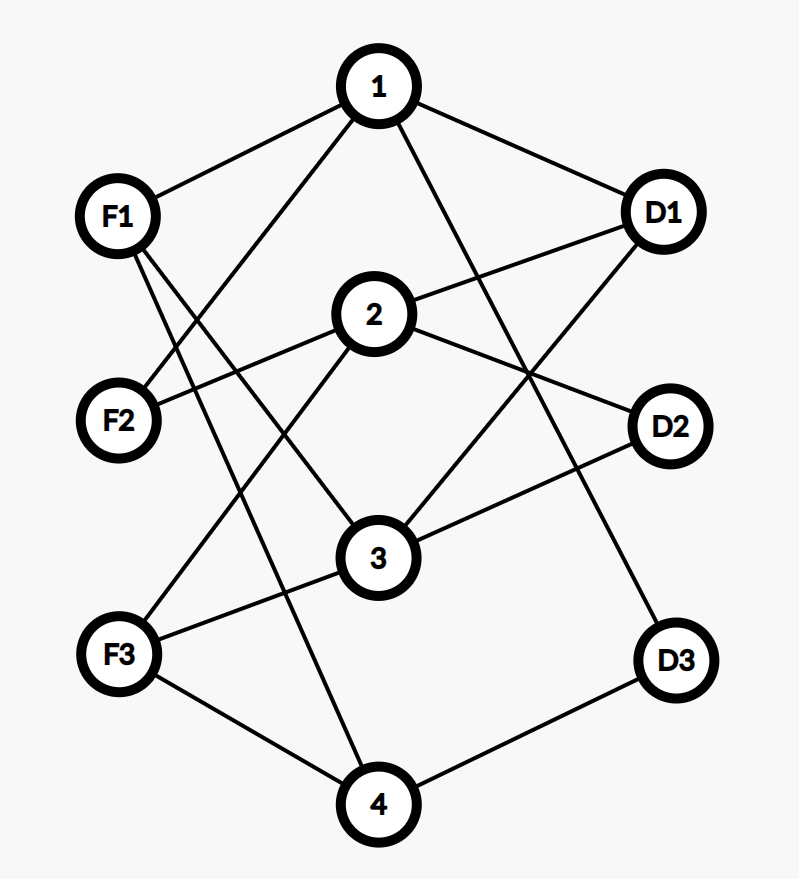
    题意:有 n 头奶牛,F 个食物和 D 个饮料,每头奶牛可以吃某些食物和饮料,但都只能吃食物和饮料各一个。求最多能满足多少头奶牛。(三分图匹配

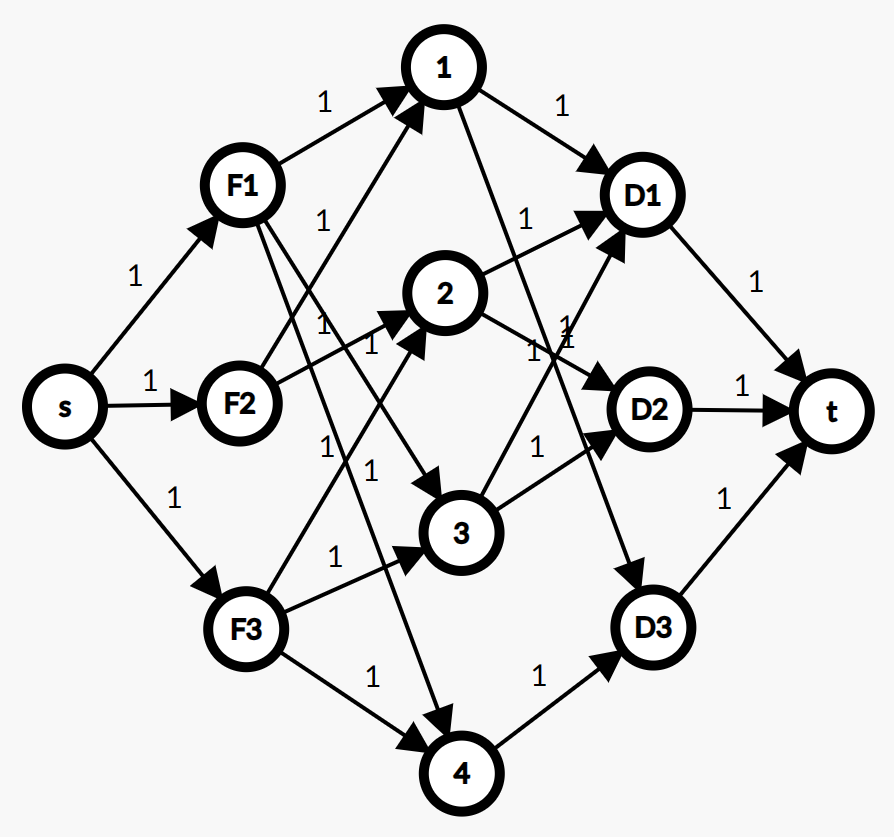
    考虑继续使用类似二分图的建网络流的方式,举个例子:

    不过,这样真的能够求出最终的答案吗?答案是否定的。
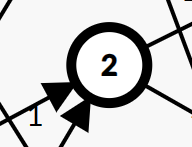
    考虑局部的这样一个位置,最大流得到话会流出 2 的,也就是这个奶牛会贡献 2,而应该是 1

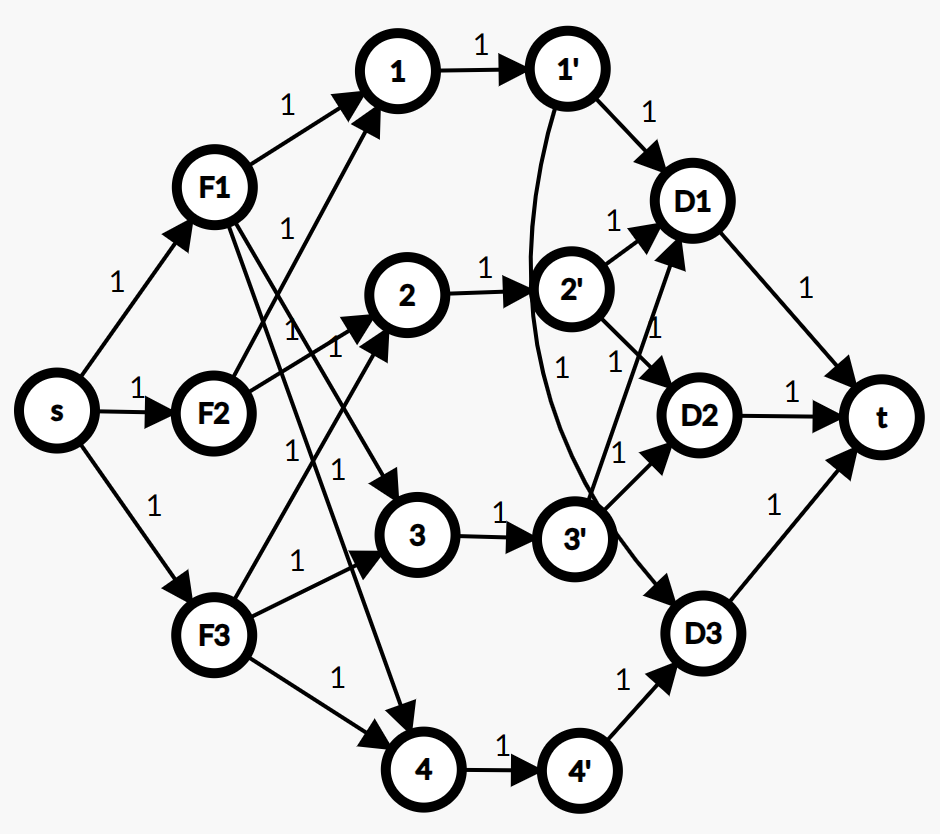
    所以,就要拆点了!

    通过,流量守恒,就可以使得通过每一个点的流量最多为 1,也就满足了题意。

    #include 
    #define fi first
    #define se second
    #define int long long
    
    using namespace std;
    
    typedef pair<int, int> PII;
    typedef long long LL;
    
    const int N = 4e2 + 10, M = 1e5 + 10;
    
    int n, m, k, s, t;
    int h[N], e[M], ne[M], f[M], idx;
    int d[N], cur[N];
    
    void add(int a, int b, int c) {
        e[idx] = b, ne[idx] = h[a], f[idx] = c, h[a] = idx ++;
        e[idx] = a, ne[idx] = h[b], f[idx] = 0, h[b] = idx ++;
    }
    bool bfs() {
        memset(d, -1, sizeof d);
        queue<int> q;
        q.emplace(s), d[s] = 0, cur[s] = h[s];
        while (q.size()) {
            int u = q.front();
            q.pop();
    
            for (int i = h[u]; ~i; i = ne[i]) {
                int j = e[i];
                if (d[j] == -1 && f[i]) {
                    d[j] = d[u] + 1, cur[j] = h[j];
                    if (j == t) return 1;
                    q.emplace(j);
                }
            }
        }
        return 0;
    }
    int find(int u, int lim) {
        if (u == t) return lim;
    
        int flow = 0;
        for (int i = cur[u]; ~i && flow < lim; i = ne[i]) {
            cur[u] = i;
            int j = e[i];
            if (d[j] == d[u] + 1 && f[i]) {
                int tmp = find(j, min(lim - flow, f[i]));
                if (!tmp) d[j] = -1;
                f[i] -= tmp, f[i ^ 1] += tmp, flow += tmp;
            }
        }
        return flow;
    }
    int dinic() {
        int res = 0, flow;
        while (bfs()) while (flow = find(s, 1e18)) res += flow;
        return res;
    }
    
    signed main() {
        cin.tie(0);
        cout.tie(0);
        ios::sync_with_stdio(0);
    
        memset(h, -1, sizeof h);
        cin >> n >> m >> k;
    
        s = 0, t = n * 2 + m + k + 1;
        for (int i = 1; i <= n; i ++) {
            int cf, cd, x;
            cin >> cf >> cd;
            for (int j = 1; j <= cf; j ++)
                cin >> x, add(x, i + m, 1);
            for (int j = 1; j <= cd; j ++)
                cin >> x, add(i + m + n, x + m + n + n, 1);
        }
        for (int i = 1; i <= m; i ++)
            add(s, i, 1);
        for (int i = m + n * 2 + 1; i < t; i ++)
            add(i, t, 1);
        for (int i = m + 1; i <= m + n; i ++)
            add(i, i + n, 1);
    
        cout << dinic() << endl;
    
        return 0;
    }
    

    习题

    P2766 最长不下降子序列问题

    参考代码
    #include 
    #define fi first
    #define se second
    #define int long long
    
    using namespace std;
    
    typedef pair<int, int> PII;
    typedef long long LL;
    
    const int N = 1e3 + 10, M = 4e5 + 10;
    
    int n, s, t;
    int a[N], dp[N];
    int h[N], e[M], ne[M], f[M], idx;
    int d[N], cur[N];
    void add(int a, int b, int c) {
        e[idx] = b, ne[idx] = h[a], f[idx] = c, h[a] = idx ++;
        e[idx] = a, ne[idx] = h[b], f[idx] = 0, h[b] = idx ++;
    }
    bool bfs() {
        memset(d, -1, sizeof d);
        queue<int> q;
        q.emplace(s), d[s] = 0, cur[s] = h[s];
        while (q.size()) {
            int u = q.front();
            q.pop();
    
            for (int i = h[u]; ~i; i = ne[i]) {
                int j = e[i];
                if (d[j] == -1 && f[i]) {
                    d[j] = d[u] + 1, cur[j] = h[j];
                    if (j == t) return 1;
                    q.emplace(j);
                }
            }
        }
        return 0;
    }
    int find(int u, int lim) {
        if (u == t) return lim;
    
        int flow = 0;
        for (int i = cur[u]; ~i && flow < lim; i = ne[i]) {
            cur[u] = i;
            int j = e[i];
            if (d[j] == d[u] + 1 && f[i]) {
                int tmp = find(j, min(lim - flow, f[i]));
                if (!tmp) d[j] = -1;
                f[i] -= tmp, f[i ^ 1] += tmp, flow += tmp;
            }
        }
        return flow;
    }
    int dinic() {
        int res = 0, flow;
        while (bfs()) while (flow = find(s, 1e18)) res += flow;
        return res;
    }
    
    signed main() {
        cin.tie(0);
        cout.tie(0);
        ios::sync_with_stdio(0);
    
        memset(h, -1, sizeof h);
        cin >> n;
        for (int i = 1; i <= n; i ++)
            cin >> a[i];
        s = 0, t = 2 * n + 1;
    
        for (int i = 1; i <= n; i ++) {
            dp[i] = 1, add(i, i + n, 1);
            std::vector<int> opt;
            for (int j = 1; j < i; j ++)
                if (a[j] <= a[i] && dp[j] + 1 > dp[i])
                    opt.clear(), opt.emplace_back(j), dp[i] = dp[j] + 1;
                else if (a[j] <= a[i] && dp[j] + 1 == dp[i])
                    opt.emplace_back(j);
            for (auto v : opt)
                add(n + v, i, 1);
        }
        int res = 0;
        for (int i = 1; i <= n; i ++)
            res = max(res, dp[i]);
        cout << res << endl;
    
        for (int i = 1; i <= n; i ++) {
            if (dp[i] == res)
                add(i + n, t, 1);
            if (dp[i] == 1)
                add(s, i, 1);
        }
        res = dinic();
        cout << res << endl;
    
        for (int i = 0; i < idx; i += 2) {
            if (e[i ^ 1] == 1 && e[i] == 1 + n || e[i ^ 1] == 1 + n && e[i] == t || e[i ^ 1] == s && e[i] == 1)
                f[i] = 1e18;
            else if (e[i ^ 1] == n && e[i] == n + n || e[i ^ 1] == n + n && e[i] == t || e[i ^ 1] == s && e[i] == n)
                f[i] = 1e18;
        }
        res += dinic();
        cout << min(res, n) << endl;
    
        return 0;
    }
    

    POJ3498 March of the Penguins

    参考代码
    #include 
    #define fi first
    #define se second
    #define int long long
    
    using namespace std;
    
    typedef pair<int, int> PII;
    typedef long long LL;
    
    const int N = 2e2 + 10, M = 2e4 + 10;
    
    int n, s, t;
    double ld;
    int h[N], e[M], ne[M], f[M], idx;
    int d[N], cur[N];
    struct Node {
        int x, y;
        int tot, cnt;
        double operator- (const Node &tmp)const {
            int a = x - tmp.x, b = y - tmp.y;
            return sqrt(a * a * 1.0 + b * b * 1.0);
        }
    }pg[N];
    void add(int a, int b, int c) {
        e[idx] = b, ne[idx] = h[a], f[idx] = c, h[a] = idx ++;
        e[idx] = a, ne[idx] = h[b], f[idx] = 0, h[b] = idx ++;
    }
    bool bfs() {
        memset(d, -1, sizeof d);
        queue<int> q;
        q.emplace(s), d[s] = 0, cur[s] = h[s];
        while (q.size()) {
            int u = q.front();
            q.pop();
    
            for (int i = h[u]; ~i; i = ne[i]) {
                int j = e[i];
                if (d[j] == -1 && f[i]) {
                    d[j] = d[u] + 1, cur[j] = h[j];
                    if (j == t) return 1;
                    q.emplace(j);
                }
            }
        }
        return 0;
    }
    int find(int u, int lim) {
        if (u == t) return lim;
    
        int flow = 0;
        for (int i = cur[u]; ~i && flow < lim; i = ne[i]) {
            cur[u] = i;
            int j = e[i];
            if (d[j] == d[u] + 1 && f[i]) {
                int tmp = find(j, min(lim - flow, f[i]));
                if (!tmp) d[j] = -1;
                f[i] -= tmp, f[i ^ 1] += tmp, flow += tmp;
            }
        }
        return flow;
    }
    int dinic() {
        int res = 0, flow;
        while (bfs()) while (flow = find(s, 1e18)) res += flow;
        return res;
    }
    
    void solve() {
        cin >> n >> ld;
    
        int sum = 0;
        for (int i = 1; i <= n; i ++)
            cin >> pg[i].x >> pg[i].y >> pg[i].tot >> pg[i].cnt, sum += pg[i].tot;
    
        s = 0;
        std::vector<int> res;
        for (t = 1; t <= n; t ++) {
            memset(h, -1, sizeof h);
            idx = 0;
            for (int i = 1; i <= n; i ++) {
                add(s, i, pg[i].tot), add(i, i + n, pg[i].cnt);
                for (int j = 1; j <= n; j ++)
                    if (i != j && pg[j] - pg[i] <= ld)
                        add(i + n, j, 1e18);
            }
            if (dinic() == sum)
                res.emplace_back(t);
        }
    
        if (res.empty())
            cout << -1 << endl;
        else {
            for (auto v : res)
                cout << v - 1 << " ";
            cout << endl;
        }
    }
    
    signed main() {
        cin.tie(0);
        cout.tie(0);
        ios::sync_with_stdio(0);
    
        int dt;
    
        cin >> dt;
    
        while (dt --)
            solve();
    
        return 0;
    }
    
  • 相关阅读:
    leetcode:768. 最多能完成排序的块 II【排列 + sortedlist】
    简单聊下STM32F103的时钟
    使用 Android Studio 给 Unity 打包 .SO 文件 (图文详细教程)
    gRPC(五)进阶:通过TLS建立安全连接
    OpenTiny Vue 支持 Vue2.7 啦!
    java考试系统课程设计
    Spring Boot从新秀到超巨,这份实战文档为你指明方向
    Shell脚本学习
    (开源)都进来!简单易懂、功能强大的权限+可视化流程管理系统
    【开发/调试工具】【Linux】嵌入式Linux环境下如何自动化执行操作
  • 原文地址:https://www.cnblogs.com/Tiny-konnyaku/p/18191019