基于ChatGLM-6B第一版,要注意还有ChatGLM2-6B以及ChatGLM3-6B
PrefixEncoder
作用:在微调时(以P-Tuning V2为例),方法训练时冻结模型的全部参数,只激活PrefixEncoder的参数。
其源码如下,整体来看是比较简单的。
class PrefixEncoder(torch.nn.Module):
    def __init__(self, config):
        super().__init__()
        self.prefix_projection = config.prefix_projection
        if self.prefix_projection:
            # 使用一个两层(线性层)的MLP编码prefix
            self.embedding = torch.nn.Embedding(config.pre_seq_len, config.hidden_size)
            self.trans = torch.nn.Sequential(
                torch.nn.Linear(config.hidden_size, config.hidden_size),
                torch.nn.Tanh(),
                torch.nn.Linear(config.hidden_size, config.num_layers * config.hidden_size * 2)
            )
        else:
            self.embedding = torch.nn.Embedding(config.pre_seq_len, config.num_layers * config.hidden_size * 2)

    def forward(self, prefix: torch.Tensor):
        if self.prefix_projection:
            prefix_tokens = self.embedding(prefix)
            past_key_values = self.trans(prefix_tokens)
        else:
            past_key_values = self.embedding(prefix)
        return past_key_values
为什么源码注释中会说到MLP?定位追溯:
self.mlp = GLU(
    hidden_size,
    inner_hidden_size=inner_hidden_size,
    bias=use_bias,
    layer_id=layer_id,
    params_dtype=params_dtype,
    empty_init=empty_init
)

def default_init(cls, *args, **kwargs):
    return cls(*args, **kwargs)

class GLU(torch.nn.Module):
    def __init__(self, hidden_size, inner_hidden_size=None,
                 layer_id=None, bias=True, activation_func=gelu, params_dtype=torch.float, empty_init=True):
        super(GLU, self).__init__()
        if empty_init:
            init_method = skip_init
        else:
            init_method = default_init
        self.layer_id = layer_id
        self.activation_func = activation_func

        # Project to 4h.
        self.hidden_size = hidden_size
        if inner_hidden_size is None:
            inner_hidden_size = 4 * hidden_size
        self.inner_hidden_size = inner_hidden_size
        self.dense_h_to_4h = init_method(
            torch.nn.Linear,
            self.hidden_size,
            self.inner_hidden_size,
            bias=bias,
            dtype=params_dtype,
        )
        # Project back to h.
        self.dense_4h_to_h = init_method(
            torch.nn.Linear,
            self.inner_hidden_size,
            self.hidden_size,
            bias=bias,
            dtype=params_dtype,
        )

    def forward(self, hidden_states):
        """
        hidden_states: [seq_len, batch, hidden_size]
        """

        # [seq_len, batch, inner_hidden_size]
        intermediate_parallel = self.dense_h_to_4h(hidden_states)

        intermediate_parallel = self.activation_func(intermediate_parallel)

        output = self.dense_4h_to_h(intermediate_parallel)

        return output

# 转载请备注出处:https://www.cnblogs.com/zhiyong-ITNote/
init_method对应到default_init,这个函数的作用与直接调用类构造函数相同,但它提供了一种更灵活的方式来创建类的实例,因为它可以接受任意数量的位置参数和关键字参数。在Pytorch中,用于模块化的构造函数。从源码分析来看,GLU/MLP类就是构造了两个线性层与gelu激活函数,其结构可简化如下:
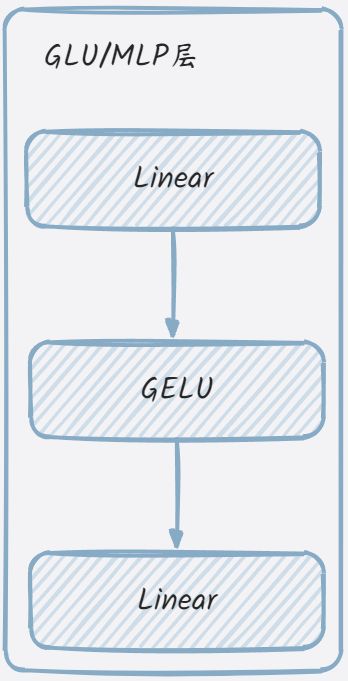
从PrefixEncoder类的初始化方法来看,其就是embedding层与MLP的组合。其结构可简化如下:

详细解读可参考 ChatGLM的模型架构
Q:在这里还有一个问题,从哪里可以定位溯源到微调时禁用了全部的参数,只激活PrefixEncoder的参数并调用了该类?
激活函数与位置编码
代码简单明了,RoPE的理论知识可以多了解。
attention_fn
伪代码表示为:
def attention_fn(
        self,
        query_layer,
        key_layer,
        value_layer,
        attention_mask,
        hidden_size_per_partition,
        layer_id,
        layer_past=None,
        scaling_attention_score=True,
        use_cache=False,
):
    xxxx
标准的注意力机制计算公式如下:


多头注意力就是将多个单头注意力的结果拼接起来,再点乘一个新的权重参数。

attention_fn函数实现了注意力的核心计算过程(即上述数学表达式),包括计算注意力分数、注意力概率和上下文层。这些计算对于实现许多自然语言处理任务,如语言建模、命名实体识别等,都是非常重要的。
SelfAttention
伪代码表示为:
class SelfAttention(torch.nn.Module):
    xxxx
attention_mask_func将注意力掩码应用于Transformer模型中的注意力得分中。
@staticmethod
def attention_mask_func(attention_scores, attention_mask):
    attention_scores.masked_fill_(attention_mask, -10000.0)
    return attention_scores
apply_rotary_pos_emb_index函数为 注入了RoPE位置信息,然后调用
attention_fn计算注意力概率、上下文层表示,并得到返回值。这些都是在forward函数中调用处理的。

最后还调用了dense对上下文表示做线性计算,返回输出。
GLU
GLU也可以理解为是MLP,在后面版本的ChatGLM中,去掉了GLU类的定义声明,直接换成了MLP。在上面已经写过不再赘述。
GLMBlock
一般都会把GLMBlock对应为transformer结构的实现。从其构造函数来看,主要是拼接各个层到一起。

从代码来看,中间有两次的残差连接,如下所示
# Residual connection.
alpha = (2 * self.num_layers) ** 0.5
hidden_states = attention_input * alpha + attention_output

mlp_input = self.post_attention_layernorm(hidden_states)

# MLP.
mlp_output = self.mlp(mlp_input)

# Second residual connection.
output = mlp_input * alpha + mlp_output