-
怒刷LeetCode的第24天(Java版)
目录
第一题
题目来源
题目内容

解决方法
方法一:反向遍历
具体的思路是:
-
先去除字符串两端的空格,确保字符串没有多余的空格。
-
从字符串的最后开始向前遍历,找到第一个非空格字符的位置。
-
继续向前遍历,直到遇到空格字符或者到达字符串的开头,记录下遍历过程中的字符数。
-
返回记录的字符数,即为最后一个单词的长度。
- class Solution {
- public int lengthOfLastWord(String s) {
- // 去除字符串两端的空格
- s = s.trim();
- // 遍历字符串,找到最后一个单词的长度
- int length = 0;
- for (int i = s.length() - 1; i >= 0; i--) {
- if (s.charAt(i) == ' ') {
- break;
- }
- length++;
- }
- return length;
- }
- }
复杂度分析:
时间复杂度分析:
- 字符串去除两端空格的操作的时间复杂度是 O(n),其中 n 是字符串的长度。
- 从字符串的最后开始向前遍历,直到找到最后一个单词的长度,最坏情况下需要遍历整个字符串,时间复杂度也是 O(n)。 因此,总的时间复杂度为 O(n)。
空间复杂度分析:
- 代码中没有使用任何额外的数据结构,只使用了常数级别的额外空间。 因此,空间复杂度为 O(1)。
综上所述,该算法的时间复杂度为 O(n),空间复杂度为 O(1)。
LeetCode运行结果:

方法二:字符串操作函数
除了上述的方法外,还可以使用Java内置的字符串操作函数来解决这个问题。具体的思路是:
-
先去除字符串两端的空格,确保字符串没有多余的空格。
-
使用Java的 split() 函数将字符串按照空格分割成多个单词,并保存在一个字符串数组中。
-
如果字符串数组不为空,则最后一个单词即为数组中的最后一个元素。
-
返回最后一个单词的长度。
- class Solution {
- public int lengthOfLastWord(String s) {
- // 去除字符串两端的空格
- s = s.trim();
- // 分割字符串并获取最后一个单词的长度
- String[] words = s.split(" ");
- if (words.length == 0) {
- return 0;
- }
- return words[words.length - 1].length();
- }
- }
复杂度分析:
时间复杂度分析:
- 字符串去除两端空格的操作的时间复杂度是 O(n),其中 n 是字符串的长度。
- split() 函数的时间复杂度取决于字符串的长度和分隔符的数量。在这里,分隔符是空格,因此最坏情况下需要遍历整个字符串一次,并且需要额外的时间将结果存储到数组中。所以,split() 函数的时间复杂度为 O(n)。
- 获取最后一个单词的长度只需要常数时间。 因此,总的时间复杂度为 O(n)。
空间复杂度分析:
- 代码中使用了一个字符串数组来存储分割后的单词,数组的大小取决于字符串中单词的数量。在最坏情况下,单词的数量与字符串的长度相当,因此空间复杂度为 O(n)。
- 另外,还需要额外的空间存储去除两端空格后的字符串。 综上所述,总的空间复杂度为 O(n)。
综上所述,该算法的时间复杂度为 O(n),空间复杂度为 O(n)。
LeetCode运行结果:

方法三:正则表达式
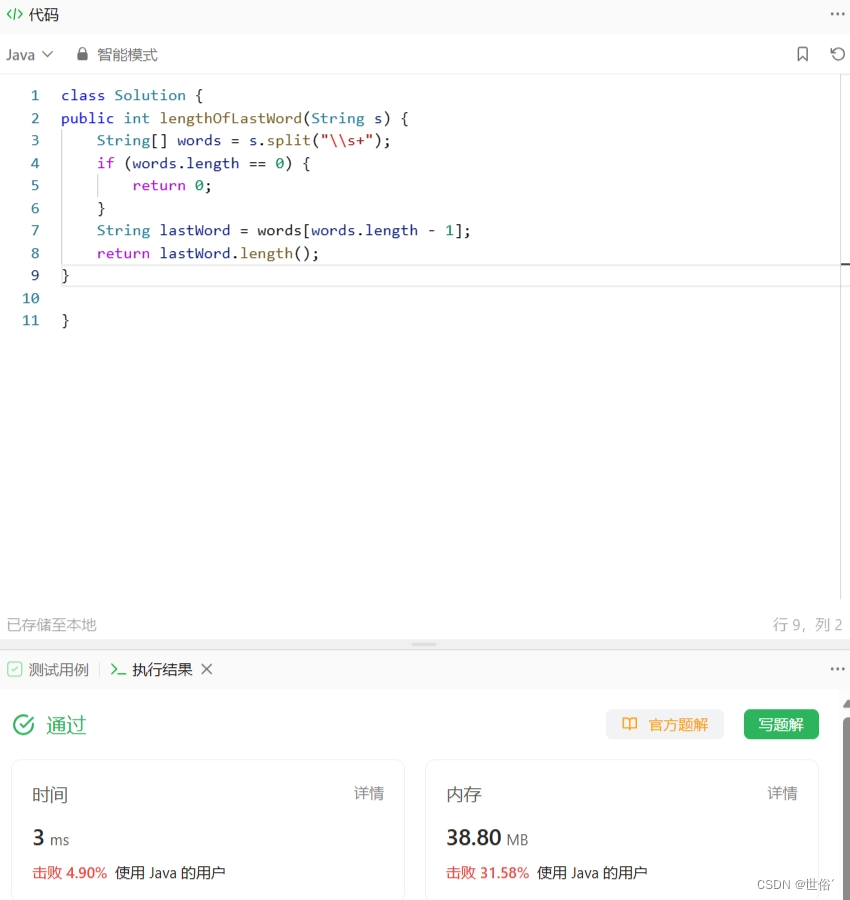
还可以使用正则表达式来解决这个问题。具体的思路是:
- 使用正则表达式 \\s+ 将字符串以空格作为分隔符拆分成多个单词。
- 如果拆分后的单词数组为空,说明字符串中没有单词,直接返回 0。
- 如果不为空,则取最后一个单词并返回其长度。
- class Solution {
- public int lengthOfLastWord(String s) {
- String[] words = s.split("\\s+");
- if (words.length == 0) {
- return 0;
- }
- String lastWord = words[words.length - 1];
- return lastWord.length();
- }
- }
复杂度分析:
- 使用正则表达式的做法,时间复杂度为 O(n),其中 n 是字符串的长度。需要将整个字符串拆分成多个单词,同时只需要遍历一次。
- 空间复杂度为 O(k),其中 k 是字符串中单词的数量。需要用数组存储拆分后的单词,因此空间复杂度取决于单词的数量。
LeetCode运行结果:
第二题
题目来源
题目内容

解决方法
方法一:模拟
这道题可以使用模拟的方法来生成螺旋矩阵。具体的步骤如下:
-
初始化一个空的 n x n 矩阵 matrix。
-
定义四个变量
top、bottom、left、right,分别表示当前螺旋轮廓的上边界、下边界、左边界和右边界。 -
初始化变量
num为 1,表示当前要填入的数字。 -
进行循环,当
num小于等于 n 的平方时,进行以下操作:-
从左到右遍历上边界,将
num填入 matrix[top][i],并将num自增 1。 -
上边界下移一行。
-
若上边界超出下边界,则结束循环。
-
从上到下遍历右边界,将
num填入 matrix[i][right],并将num自增 1。 -
右边界左移一列。
-
若右边界超出左边界,则结束循环。
-
从右到左遍历下边界,将
num填入 matrix[bottom][i],并将num自增 1。 -
下边界上移一行。
-
若下边界超出上边界,则结束循环。
-
从下到上遍历左边界,将
num填入 matrix[i][left],并将num自增 1。 -
左边界右移一列。
-
若左边界超出右边界,则结束循环。
-
-
返回生成的螺旋矩阵 matrix。
- class Solution {
- public int[][] generateMatrix(int n) {
- int[][] matrix = new int[n][n];
- int top = 0, bottom = n - 1, left = 0, right = n - 1;
- int num = 1;
- while (num <= n * n) {
- for (int i = left; i <= right; i++) {
- matrix[top][i] = num++;
- }
- top++;
- if (top > bottom) {
- break;
- }
- for (int i = top; i <= bottom; i++) {
- matrix[i][right] = num++;
- }
- right--;
- if (right < left) {
- break;
- }
- for (int i = right; i >= left; i--) {
- matrix[bottom][i] = num++;
- }
- bottom--;
- if (bottom < top) {
- break;
- }
- for (int i = bottom; i >= top; i--) {
- matrix[i][left] = num++;
- }
- left++;
- if (left > right) {
- break;
- }
- }
- return matrix;
- }
- }
复杂度分析:
- 对于给定的整数 n,我们需要填充 n^2 个元素到螺旋矩阵中。因此,时间复杂度为 O(n^2)。
- 在空间复杂度方面,我们使用了一个 n x n 的矩阵来保存结果。因此,空间复杂度也为 O(n^2)。
综上所述,该算法的时间复杂度和空间复杂度均为 O(n^2)。
LeetCode运行结果:

方法二:递归
除了模拟法之外,还可以使用递归的方法来生成螺旋矩阵。
具体的思路是,每次递归生成最外层的螺旋轮廓,并将其剥离,然后对剩余的内部矩阵进行递归生成。直到矩阵为空或只剩下一个元素时结束递归。
- class Solution {
- public int[][] generateMatrix(int n) {
- int[][] matrix = new int[n][n];
- generateMatrix(matrix, 0, n - 1, 1);
- return matrix;
- }
- private void generateMatrix(int[][] matrix, int start, int end, int num) {
- if (start > end) {
- return;
- }
- // 生成最外层的螺旋轮廓
- for (int i = start; i <= end; i++) {
- matrix[start][i] = num++;
- }
- for (int i = start + 1; i <= end; i++) {
- matrix[i][end] = num++;
- }
- for (int i = end - 1; i >= start; i--) {
- matrix[end][i] = num++;
- }
- for (int i = end - 1; i > start; i--) {
- matrix[i][start] = num++;
- }
- // 递归生成内部矩阵
- generateMatrix(matrix, start + 1, end - 1, num);
- }
- }
复杂度分析:
- 由于递归方法每次递归都会生成最外层的螺旋轮廓,并将其剥离,因此矩阵中的每个元素都会被遍历一次,时间复杂度为 O(n^2)。
- 在空间复杂度方面,由于递归方法并不需要额外的空间来存储状态,因此仅需要使用一个 n x n 的矩阵来保存结果。因此,空间复杂度也为 O(n^2)。
综上所述,该算法的时间复杂度和空间复杂度均为 O(n^2)。
LeetCode运行结果:

方法三:迭代
除了模拟和递归之外,还可以使用迭代的方法来生成螺旋矩阵。该方法使用四个变量表示当前要填入的数字、当前螺旋轮廓的上、下、左、右边界,并按照规律依次填入数字。
- class Solution {
- public int[][] generateMatrix(int n) {
- int[][] matrix = new int[n][n];
- int num = 1;
- int top = 0, bottom = n - 1, left = 0, right = n - 1;
- while (num <= n * n) {
- // 从左到右填入上边界
- for (int i = left; i <= right; i++) {
- matrix[top][i] = num++;
- }
- top++;
- // 从上到下填入右边界
- for (int i = top; i <= bottom; i++) {
- matrix[i][right] = num++;
- }
- right--;
- // 从右到左填入下边界
- for (int i = right; i >= left; i--) {
- matrix[bottom][i] = num++;
- }
- bottom--;
- // 从下到上填入左边界
- for (int i = bottom; i >= top; i--) {
- matrix[i][left] = num++;
- }
- left++;
- }
- return matrix;
- }
- }
复杂度分析:
对于迭代方法来说,时间复杂度和空间复杂度仍然为O(n^2)。
- 由于需要遍历每个元素,并填入正确的数字,时间复杂度为O(n^2)。
- 在空间复杂度方面,仅需要使用一个 n x n 大小的矩阵来保存结果,因此空间复杂度也为O(n^2)。
综上所述,迭代方法的时间复杂度和空间复杂度均为O(n^2)。
LeetCode运行结果:

方法四:数学规律
除了模拟、递归和迭代之外,还可以使用数学规律的方法来生成螺旋矩阵。
在这种方法中,可以将生成螺旋矩阵的过程看作是按层进行填充的过程。首先确定每一层的起始位置和结束位置,并根据数学规律逐步填入数字。
- class Solution {
- public int[][] generateMatrix(int n) {
- int[][] matrix = new int[n][n];
- int num = 1;
- int startRow = 0, endRow = n - 1, startCol = 0, endCol = n - 1;
- while (startRow <= endRow && startCol <= endCol) {
- // 填充当前层的上边界
- for (int i = startCol; i <= endCol; i++) {
- matrix[startRow][i] = num++;
- }
- startRow++;
- // 填充当前层的右边界
- for (int i = startRow; i <= endRow; i++) {
- matrix[i][endCol] = num++;
- }
- endCol--;
- if (startRow <= endRow) {
- // 填充当前层的下边界
- for (int i = endCol; i >= startCol; i--) {
- matrix[endRow][i] = num++;
- }
- endRow--;
- }
- if (startCol <= endCol) {
- // 填充当前层的左边界
- for (int i = endRow; i >= startRow; i--) {
- matrix[i][startCol] = num++;
- }
- startCol++;
- }
- }
- return matrix;
- }
- }
复杂度分析:
对于数学规律方法来说,时间复杂度和空间复杂度仍然为O(n^2)。
- 由于需要遍历每个元素,并填入正确的数字,时间复杂度为O(n^2)。
- 在空间复杂度方面,仅需要使用一个 n x n 大小的矩阵来保存结果,因此空间复杂度也为O(n^2)。
综上所述,数学规律方法的时间复杂度和空间复杂度均为O(n^2)。
LeetCode运行结果:

第三题
题目来源
题目内容

解决方法
方法一:回溯算法
题目要求按照大小顺序列出所有排列情况,并找出第k个排列。
我们可以使用回溯算法来解决这个问题。具体步骤如下:
- 创建一个布尔数组
used,用于标记数字是否已经被使用过。 - 创建一个字符串
permutation,用于保存当前的排列结果。 - 创建一个整数
count,用于计数当前的排列序号。 - 定义递归函数
backtrack,参数为当前处理的数字num和目标排列的长度n。- 如果
num等于n,表示已经生成了一个完整的排列,此时count加一。- 如果
count等于k,说明已经找到了第k个排列,将permutation作为结果返回。
- 如果
- 遍历数字
1到n:- 如果当前数字没有被使用过(即
used[i]为false),则将其加入到permutation中,并将used[i]标记为true,然后递归调用backtrack(num + 1, n)。- 如果得到了结果,直接返回结果。
- 回溯:将当前数字从
permutation中移除,并将used[i]标记为false。
- 如果当前数字没有被使用过(即
- 如果
- 返回空字符串作为结果。
- class Solution {
- public String getPermutation(int n, int k) {
- boolean[] used = new boolean[n + 1];
- StringBuilder permutation = new StringBuilder();
- int[] count = new int[1];
- backtrack(0, n, k, used, permutation, count);
- return permutation.toString();
- }
- private boolean backtrack(int num, int n, int k, boolean[] used, StringBuilder permutation, int[] count) {
- if (num == n) {
- count[0]++;
- if (count[0] == k) {
- return true;
- }
- return false;
- }
- for (int i = 1; i <= n; i++) {
- if (!used[i]) {
- permutation.append(i);
- used[i] = true;
- if (backtrack(num + 1, n, k, used, permutation, count)) {
- return true;
- }
- permutation.deleteCharAt(permutation.length() - 1);
- used[i] = false;
- }
- }
- return false;
- }
- }
复杂度分析:
设n为给定数字的大小。
- 时间复杂度分析:回溯过程中,我们需要找到第k个排列,因此最坏情况下需要生成所有的n!个排列。每个排列的生成需要O(n)的时间,因此总的时间复杂度为O(n * n!)。
- 空间复杂度分析:回溯过程中,我们使用了一个布尔数组used、一个字符串permutation和一个整数count来保存状态和结果。其中,布尔数组used的空间复杂度为O(n),字符串permutation的空间复杂度为O(n),整数count的空间复杂度为O(1)。因此总的空间复杂度为O(n)。
综上所述,该算法的时间复杂度为O(n * n!),空间复杂度为O(n)。由于n的范围限制为1 <= n <= 9,因此算法的运行时间是可以接受的。
LeetCode运行结果:

方法二:迭代
除了回溯算法,我们还可以使用迭代的思路来解决这个问题。
该方法首先通过迭代生成了数字列表和阶乘数组,然后进行迭代过程来计算每一位上的数字,并将其加入到结果中,直到得到第k个排列。
- class Solution {
- public String getPermutation(int n, int k) {
- // 初始化数字列表和阶乘数组
- List
nums = new ArrayList<>(); - int[] factorials = new int[n+1];
- factorials[0] = 1;
- for (int i = 1; i <= n; i++) {
- nums.add(i);
- factorials[i] = factorials[i-1] * i;
- }
- // k需要减一,方便对索引的计算
- k--;
- StringBuilder sb = new StringBuilder();
- for (int i = n; i >= 1; i--) {
- int index = k / factorials[i-1]; // 当前位上的数字在数字列表中的索引
- sb.append(nums.remove(index)); // 将当前位上的数字加入到结果中
- k %= factorials[i-1]; // 更新k
- }
- return sb.toString();
- }
- }
复杂度分析:
时间复杂度分析:
- 计算阶乘数组:需要对数字从 1 到 n 进行遍历,所以时间复杂度为 O(n)。
- 迭代过程:需要进行 n 次迭代,每次迭代的时间复杂度为 O(n),因为要遍历剩余数字列表来确定当前位上的数字。所以总的时间复杂度为 O(n^2)。
空间复杂度分析:
- 存储阶乘数组:阶乘数组长度为 n+1,所以空间复杂度为 O(n)。
综上所述,该算法的时间复杂度为 O(n^2),空间复杂度为 O(n)。
LeetCode运行结果:

-
-
相关阅读:
Java-数组和方法(day6-7)
什么是多维数组?怎样定义多维数组?
全都会!预测蛋白质标注!创建讲义!解释数学公式!最懂科学的智能NLP模型Galactica尝鲜 ⛵
〖全域运营实战白宝书 - 运营角色认知篇③〗- 运营的底层逻辑是什么?
软件Bug和缺陷的区别是什么?
Python-中北大学人工智能OpenCV人脸识别(根据图片训练数据,根据训练好的数据识别人脸)
AWS API gateway api CORS错误处理方法
虚拟化+docker基本概念以及安装部署
xxl-job学习
Flask-REXTx 学习笔记——2.字段掩码(Fields masks)
- 原文地址:https://blog.csdn.net/m0_74293254/article/details/133617450