-
JADE盲分离算法仿真
JADE算法原理
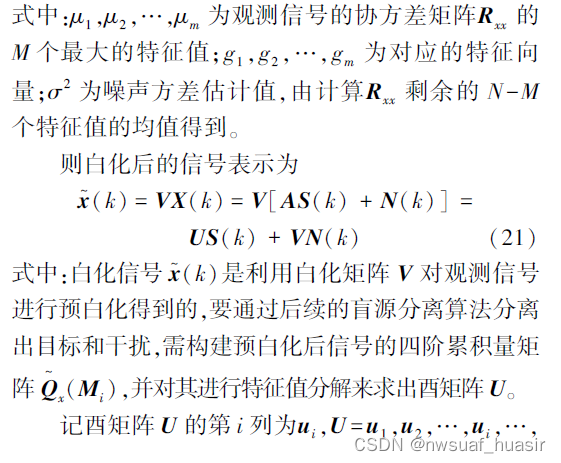
JADE 算法首先通过去均值预白化等预处理过程得到解相关的混合信号,预处理后的信号构建的协方差矩阵变为单位阵,为后续的联合对角化奠定基础;其次,通过建立四阶累积量矩阵,利用高阶累积量的统计独立性等性质从白化后的传感器混合(观测)信号中得到待分解的特征矩阵;最后,通过特征矩阵联合对角化和Givens 旋转得到酉矩阵 U U U,从而获得盲源分离算法中混合矩阵 A A A 的有效估计,进而分离出需要的目标信号。
JADE算法的流程图如下:下面是JADE算法的公式推导,从论文中截的图


JADE仿真程序
JADE算法的函数:
function [A,S]=jade(X,m) % Source separation of complex signals with JADE. % Jade performs `Source Separation' in the following sense: % X is an n x T data matrix assumed modelled as X = A S + N where % % o A is an unknown n x m matrix with full rank. % o S is a m x T data matrix (source signals) with the properties % a) for each t, the components of S(:,t) are statistically % independent % b) for each p, the S(p,:) is the realization of a zero-mean % `source signal'. % c) At most one of these processes has a vanishing 4th-order % cumulant. % o N is a n x T matrix. It is a realization of a spatially white % Gaussian noise, i.e. Cov(X) = sigma*eye(n) with unknown variance % sigma. This is probably better than no modeling at all... % % Jade performs source separation via a % Joint Approximate Diagonalization of Eigen-matrices. % % THIS VERSION ASSUMES ZERO-MEAN SIGNALS % % Input : % * X: Each column of X is a sample from the n sensors % * m: m is an optional argument for the number of sources. % If ommited, JADE assumes as many sources as sensors. % % Output : % * A is an n x m estimate of the mixing matrix % * S is an m x T naive (ie pinv(A)*X) estimate of the source signals [n,T] = size(X); %% source detection not implemented yet ! if nargin==1, m=n ; end; %%%%%%%%%%%%%%%%%%%%%%%%%%%%%%%%%%%%%%%%%%%%%%%%%%%%%%%%%%%%%%%% % A few parameters that could be adjusted nem = m; % number of eigen-matrices to be diagonalized seuil = 1/sqrt(T)/100;% a statistical threshold for stopping joint diag %%%%%%%%%%%%%%%%%%%%%%%%%%%%%%%%%%%%%%%%%%%%%%%%%%%%%%%%%%%%%%%% %%% whitening % if m- 1
- 2
- 3
- 4
- 5
- 6
- 7
- 8
- 9
- 10
- 11
- 12
- 13
- 14
- 15
- 16
- 17
- 18
- 19
- 20
- 21
- 22
- 23
- 24
- 25
- 26
- 27
- 28
- 29
- 30
- 31
- 32
- 33
- 34
- 35
- 36
- 37
- 38
- 39
- 40
- 41
- 42
- 43
- 44
- 45
- 46
- 47
- 48
- 49
- 50
- 51
- 52
- 53
- 54
- 55
- 56
- 57
- 58
- 59
- 60
- 61
- 62
- 63
- 64
- 65
- 66
- 67
- 68
- 69
- 70
- 71
- 72
- 73
- 74
- 75
- 76
- 77
- 78
- 79
- 80
- 81
- 82
- 83
- 84
- 85
- 86
- 87
- 88
- 89
- 90
- 91
- 92
- 93
- 94
- 95
- 96
- 97
- 98
- 99
- 100
- 101
- 102
- 103
- 104
- 105
- 106
- 107
- 108
- 109
- 110
- 111
- 112
- 113
- 114
- 115
- 116
- 117
- 118
- 119
- 120
- 121
- 122
- 123
- 124
- 125
- 126
- 127
- 128
- 129
- 130
- 131
- 132
- 133
- 134
- 135
- 136
- 137
- 138
- 139
- 140
- 141
- 142
- 143
- 144
- 145
- 146
- 147
- 148
- 149
- 150
- 151
- 152
- 153
- 154
- 155
- 156
- 157
- 158
- 159
- 160
- 161
- 162
- 163
- 164
- 165
- 166
- 167
- 168
- 169
- 170
- 171
- 172
主程序:
%% JADE算法仿真 % 输入信号为两段语音,混合矩阵为随机数构成, % 采用基于四阶累计量的特征矩阵联合近似对角化JADE算法对两段语音进行分离,并绘制了源信号、混合信号和分离信号 % Author:huasir 2023.9.19 Beijing close all,clear all;clc; %=========================================================================% % 读取语音文件,输入源信号 % %=========================================================================% [S1,fs1] = audioread('E:\sound1.wav'); % 读取原始语音信号,需要将两个语音文件放置在相应目录下 [S2,fs2] = audioread('E:\ICA\sound2.wav'); figure; subplot(3,2,1),plot(S1),title('输入信号1'); %绘制源信号 subplot(3,2,2),plot(S2),title('输入信号2'); s1 = S1'; %一行代表一个信号 s2 = S2'; S=[s1;s2]; % 将其组成矩阵 %=========================================================================% % 对源信号进行混合,得到观测信号 % %=========================================================================% Sweight = rand(size(S,1)); %由随机数构成混合矩阵 MixedS=Sweight*S; % 将混合矩阵重新排列 subplot(3,2,3),plot(MixedS(1,:)),title('混合信号1'); %绘制混合信号 subplot(3,2,4),plot(MixedS(2,:)),title('混合信号2'); %=========================================================================% % 采用JADE算法进行盲源分离,得到源信号的估计 % %=========================================================================% [Ae,Se]=jade(MixedS,2); %Ae为估计的混合矩阵,Se为估计的源信号 % 将混合矩阵重新排列并输出 subplot(3,2,5),plot(Se(1,:)),title('JADE解混信号1'); subplot(3,2,6),plot(Se(2,:)),title('JADE解混信号2'); %=========================================================================% % 源信号、混合信号以及解混合之后的信号的播放 % %=========================================================================% % sound(S1,8000); %播放输入信号1 % sound(S2,8000); %播放输入信号2 % sound(MixedS(1,:),8000); %播放混合信号1 % sound(MixedS(2,:),8000); %播放混合信号2 % sound(Se(1,:),8000); %播放分离信号1 % sound(Se(2,:),8000); %播放分离信号2 fprintf('混合矩阵为:\n'); % 输出混合矩阵以及估计的混合矩阵 disp(Sweight); fprintf('估计的混合矩阵为:\n'); disp(Ae);- 1
- 2
- 3
- 4
- 5
- 6
- 7
- 8
- 9
- 10
- 11
- 12
- 13
- 14
- 15
- 16
- 17
- 18
- 19
- 20
- 21
- 22
- 23
- 24
- 25
- 26
- 27
- 28
- 29
- 30
- 31
- 32
- 33
- 34
- 35
- 36
- 37
- 38
- 39
- 40
- 41
- 42
- 43
然后对其进行混合,混合后调用JADE函数进行解混合,最后对解混合的信号进行绘制并进行读取。
可以听到两段录音的内容不一样,音调也不用,它们满足不相关性,因此能够很好的分离。由下图可以看出,分离后的信号的幅度和真实信号有所不同,并且排序也不同,这是盲分离算法本身的局限性:即幅度模糊性和排序模糊性。但是一般情况下,信号的信息保存在波形的变化中,人们对于其绝对幅度并不敏感。
结果如下图:
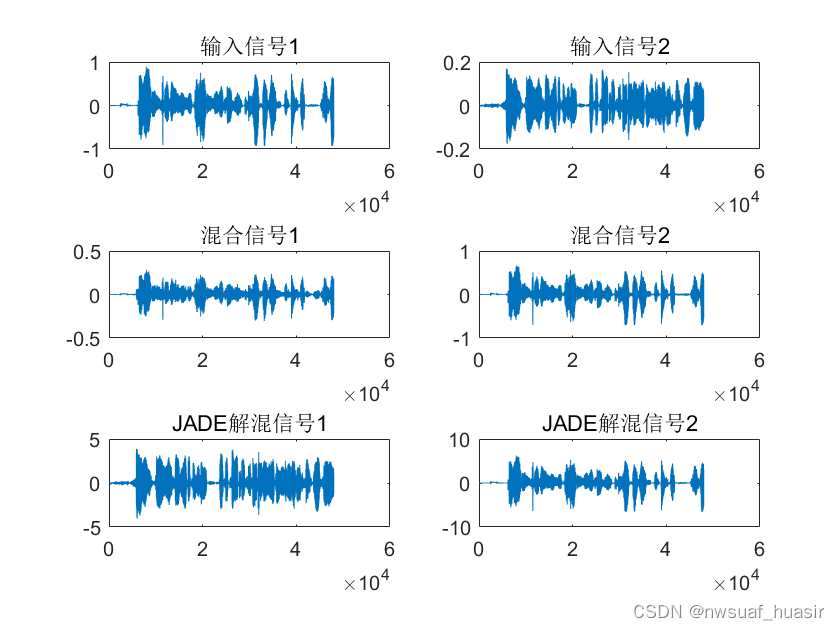
图1. JADE算法分离结果 在主程序中,首先是读取语音文件,语音文件由以下链接给出,当然也可以自己生成源信号。链接:https://pan.baidu.com/s/1DwnZqDBc1sogERcq7RrVqA
提取码:ngk1 -
相关阅读:
HTTP HTTPS 独特的魅力
C++ STL详解
Github: ksrpc原码解读---HTTP异步文件交互
数据中台该如何建设,才能发挥最大价值?
修改设备网络DNS
【精句】k8s资源管理概述
Vue实现打印功能(vue-print-nb)
直方图均衡化
Jmeter生成可视化的HTML测试报告
企业电子招投标采购系统——功能模块&功能描述+数字化采购管理 采购招投标
- 原文地址:https://blog.csdn.net/wzz110011/article/details/133037094