-
LeetCode //C - 102. Binary Tree Level Order Traversal
102. Binary Tree Level Order Traversal
Given the root of a binary tree, return the level order traversal of its nodes’ values. (i.e., from left to right, level by level).
Example 1:
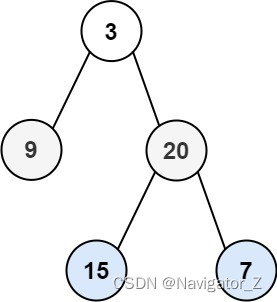
Input: root = [3,9,20,null,null,15,7]
Output: [[3],[9,20],[15,7]]Example 2:
Input: root = [1]
Output: [[1]]Example 3:
Input: root = []
Output: []Constraints:
- The number of nodes in the tree is in the range [0, 2000].
- -1000 <= Node.val <= 1000
From: LeetCode
Link: 102. Binary Tree Level Order Traversal
Solution:
Ideas:
- Create a queue to hold the nodes of the tree.
- Enqueue the root node to the queue.
- While the queue is not empty:
- Calculate the number of nodes at the current level.
- Allocate memory for these nodes.
- For each node at the current level:
- Dequeue the node from the queue.
- Add the node’s value to the result.
- Enqueue the node’s left child (if it exists).
- Enqueue the node’s right child (if it exists).
- Return the result.
Code:
/** * Definition for a binary tree node. * struct TreeNode { * int val; * struct TreeNode *left; * struct TreeNode *right; * }; */ /** * Return an array of arrays of size *returnSize. * The sizes of the arrays are returned as *returnColumnSizes array. * Note: Both returned array and *columnSizes array must be malloced, assume caller calls free(). */ int** levelOrder(struct TreeNode* root, int* returnSize, int** returnColumnSizes) { if (!root) { *returnSize = 0; return NULL; } // Create a queue for BFS struct TreeNode** queue = malloc(2000 * sizeof(struct TreeNode*)); int front = 0, rear = 0; // Enqueue root queue[rear++] = root; int** result = malloc(2000 * sizeof(int*)); *returnColumnSizes = malloc(2000 * sizeof(int)); *returnSize = 0; while (front < rear) { // Number of nodes at current level int levelSize = rear - front; (*returnColumnSizes)[*returnSize] = levelSize; // Allocate memory for nodes of this level result[*returnSize] = malloc(levelSize * sizeof(int)); for (int i = 0; i < levelSize; i++) { // Dequeue node struct TreeNode* current = queue[front++]; // Add node's value to result result[*returnSize][i] = current->val; // Enqueue left child if (current->left) { queue[rear++] = current->left; } // Enqueue right child if (current->right) { queue[rear++] = current->right; } } (*returnSize)++; } free(queue); return result; }- 1
- 2
- 3
- 4
- 5
- 6
- 7
- 8
- 9
- 10
- 11
- 12
- 13
- 14
- 15
- 16
- 17
- 18
- 19
- 20
- 21
- 22
- 23
- 24
- 25
- 26
- 27
- 28
- 29
- 30
- 31
- 32
- 33
- 34
- 35
- 36
- 37
- 38
- 39
- 40
- 41
- 42
- 43
- 44
- 45
- 46
- 47
- 48
- 49
- 50
- 51
- 52
- 53
- 54
- 55
- 56
- 57
- 58
- 59
- 60
-
相关阅读:
windows使用supervisor-win部署flask项目
掌握接口自动化测试,看这篇文章就够了,真滴简单
Linux:磁盘空间占用,查看某个文件或目录占用磁盘空间的大小
【物流推荐】HEGERLS堆垛机—自动化立体仓库中最重要的起重运输设备
【Java】绘图入门和机制,绘图方法演示(绘制坦克)
【刷题记录15】Java工程师丨腾讯面试真题(3)
通过训练NLP制作一个自己的简易输入法
ClickHouse建表优化
Linux入门攻坚——3、基础命令学习-文件管理、别名、glob、重定向、管道、用户及组管理、权限管理
springboot保险公司车辆事故跟踪系统毕业设计源码011444
- 原文地址:https://blog.csdn.net/navicheung/article/details/132925344
