-
Java/ExecutorService中多线程服务ExecuteService的使用
什么是ExecutorService
ExecutorService 是 Java 中的一个接口,它扩展了 Executor 接口,并提供了更多的方法来处理多线程任务。它是 Java 中用于执行多线程任务的框架之一,可以创建一个线程池,将多个任务提交到线程池中执行。ExecutorService 接口提供了许多方法,如 shutdown()、shutdownNow()、submit()、execute()、invokeAll() 等,可以更方便地提交任务、执行任务、关闭线程池等操作。同时,ExecutorService 还提供了线程池的管理和监控功能,可以更好地控制和管理线程池中的线程。在实际应用中,ExecutorService 通常与 Callable 和 Future 接口一起使用,可以实现更加灵活和高效的多线程编程。
by zhengkai.blog.csdn.net
ExecutorService基本原理
ExecutorService 的实现原理主要是基于线程池的概念。当我们创建一个 ExecutorService 对象时,实际上就是创建了一个线程池。线程池中包含了若干个线程,这些线程可以执行我们提交的任务。当线程池中的线程空闲时,它们会等待任务的到来,一旦有任务提交,就会从线程池中选择一个空闲的线程执行该任务。如果线程池中的线程都在执行任务,那么新的任务就会被暂时放在任务队列中,等待线程空闲时再来执行。在 ExecutorService 的实现中,任务的提交和执行是异步的,也就是说,我们提交任务时不会阻塞当前线程,而是将任务交给线程池中的线程去执行。当任务执行完成后,线程会将执行结果返回给我们。同时,我们可以通过调用 ExecutorService 的方法来管理和控制线程池,如增加或减少线程数量、关闭线程池等。总之,ExecutorService 的实现原理是基于线程池的概念,通过管理和调度线程,提高程序的效率和性能,同时避免线程阻塞和死锁等问题,从而更好地管理和调度线程,提高应用程序的并发处理能力。
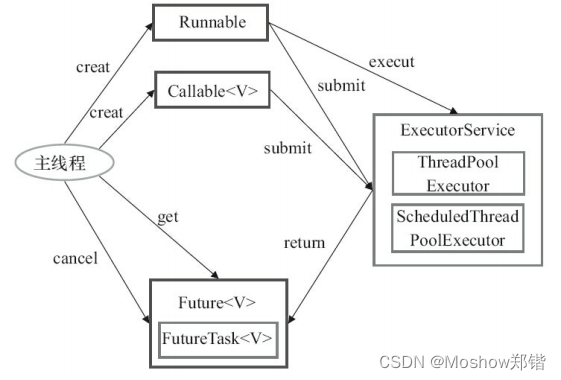
附加:线程池中的五种状态
线程池中有五种状态,分别是 RUNNING、STOP、SHUTDOWN、TIDYING 和 TERMINATED。它们的含义和区别如下:- RUNNING:表示线程池处于运行状态,接受新的任务并且处理任务队列中的任务,直到线程池被显式地关闭。
- SHUTDOWN:表示线程池处于关闭状态,不再接受新的任务,但是会尝试执行任务队列中的任务,直到任务队列为空。在任务队列为空后,线程池会进入 TIDYING 状态。
- STOP:表示线程池处于停止状态,不再接受新的任务,也不会继续执行任务队列中的任务。此时,线程池会尝试中断正在执行的任务,并立即返回任务队列中的所有任务。在任务队列为空后,线程池会进入 TIDYING 状态。
- TIDYING:表示线程池正在进行线程回收的操作,此时线程池中的所有任务都已经执行完成,而线程池中的线程也已经被销毁。在线程回收完成后,线程池会进入 TERMINATED 状态。
- TERMINATED:表示线程池已经完全终止,不再接受任何任务,也不会执行任何任务。此时,线程池中的所有线程都已经被销毁,线程池对象也可以被垃圾回收。
总之,这五种状态代表了 ThreadPoolExecutor 在不同时间点的不同状态,分别表示线程池的运行状态、关闭状态、停止状态、回收状态和终止状态。它们的区别在于线程池在不同状态下的行为和状态转换。
ExecuteService提供了什么方法
使用ExecuteService代表Executors创建线程池
- submit提交的是Callable方法,返回Future,说明submit是有返回值的
- execute执行的是Runnable方法,没有返回值
所以submit和execute的区别是提交的方法和是否有返回值,取决于你的业务需求。

- /*
- * DO NOT ALTER OR REMOVE COPYRIGHT NOTICES OR THIS FILE HEADER.
- *
- * This code is free software; you can redistribute it and/or modify it
- * under the terms of the GNU General Public License version 2 only, as
- * published by the Free Software Foundation. Oracle designates this
- * particular file as subject to the "Classpath" exception as provided
- * by Oracle in the LICENSE file that accompanied this code.
- *
- * This code is distributed in the hope that it will be useful, but WITHOUT
- * ANY WARRANTY; without even the implied warranty of MERCHANTABILITY or
- * FITNESS FOR A PARTICULAR PURPOSE. See the GNU General Public License
- * version 2 for more details (a copy is included in the LICENSE file that
- * accompanied this code).
- *
- * You should have received a copy of the GNU General Public License version
- * 2 along with this work; if not, write to the Free Software Foundation,
- * Inc., 51 Franklin St, Fifth Floor, Boston, MA 02110-1301 USA.
- *
- * Please contact Oracle, 500 Oracle Parkway, Redwood Shores, CA 94065 USA
- * or visit www.oracle.com if you need additional information or have any
- * questions.
- */
- /*
- * This file is available under and governed by the GNU General Public
- * License version 2 only, as published by the Free Software Foundation.
- * However, the following notice accompanied the original version of this
- * file:
- *
- * Written by Doug Lea with assistance from members of JCP JSR-166
- * Expert Group and released to the public domain, as explained at
- * http://creativecommons.org/publicdomain/zero/1.0/
- */
- package java.util.concurrent;
- import java.util.Collection;
- import java.util.List;
- /**
- * An {@link Executor} that provides methods to manage termination and
- * methods that can produce a {@link Future} for tracking progress of
- * one or more asynchronous tasks.
- *
- *
An {@code ExecutorService} can be shut down, which will cause
- * it to reject new tasks. Two different methods are provided for
- * shutting down an {@code ExecutorService}. The {@link #shutdown}
- * method will allow previously submitted tasks to execute before
- * terminating, while the {@link #shutdownNow} method prevents waiting
- * tasks from starting and attempts to stop currently executing tasks.
- * Upon termination, an executor has no tasks actively executing, no
- * tasks awaiting execution, and no new tasks can be submitted. An
- * unused {@code ExecutorService} should be shut down to allow
- * reclamation of its resources.
- *
- *
Method {@code submit} extends base method {@link
- * Executor#execute(Runnable)} by creating and returning a {@link Future}
- * that can be used to cancel execution and/or wait for completion.
- * Methods {@code invokeAny} and {@code invokeAll} perform the most
- * commonly useful forms of bulk execution, executing a collection of
- * tasks and then waiting for at least one, or all, to
- * complete. (Class {@link ExecutorCompletionService} can be used to
- * write customized variants of these methods.)
- *
- *
The {@link Executors} class provides factory methods for the
- * executor services provided in this package.
- *
- *
Usage Examples
- *
- * Here is a sketch of a network service in which threads in a thread
- * pool service incoming requests. It uses the preconfigured {@link
- * Executors#newFixedThreadPool} factory method:
- *
- *
{@code - * class NetworkService implements Runnable {
- * private final ServerSocket serverSocket;
- * private final ExecutorService pool;
- *
- * public NetworkService(int port, int poolSize)
- * throws IOException {
- * serverSocket = new ServerSocket(port);
- * pool = Executors.newFixedThreadPool(poolSize);
- * }
- *
- * public void run() { // run the service
- * try {
- * for (;;) {
- * pool.execute(new Handler(serverSocket.accept()));
- * }
- * } catch (IOException ex) {
- * pool.shutdown();
- * }
- * }
- * }
- *
- * class Handler implements Runnable {
- * private final Socket socket;
- * Handler(Socket socket) { this.socket = socket; }
- * public void run() {
- * // read and service request on socket
- * }
- * }}
- *
- * The following method shuts down an {@code ExecutorService} in two phases,
- * first by calling {@code shutdown} to reject incoming tasks, and then
- * calling {@code shutdownNow}, if necessary, to cancel any lingering tasks:
- *
- *
{@code - * void shutdownAndAwaitTermination(ExecutorService pool) {
- * pool.shutdown(); // Disable new tasks from being submitted
- * try {
- * // Wait a while for existing tasks to terminate
- * if (!pool.awaitTermination(60, TimeUnit.SECONDS)) {
- * pool.shutdownNow(); // Cancel currently executing tasks
- * // Wait a while for tasks to respond to being cancelled
- * if (!pool.awaitTermination(60, TimeUnit.SECONDS))
- * System.err.println("Pool did not terminate");
- * }
- * } catch (InterruptedException ex) {
- * // (Re-)Cancel if current thread also interrupted
- * pool.shutdownNow();
- * // Preserve interrupt status
- * Thread.currentThread().interrupt();
- * }
- * }}
- *
- *
Memory consistency effects: Actions in a thread prior to the
- * submission of a {@code Runnable} or {@code Callable} task to an
- * {@code ExecutorService}
- * any actions taken by that task, which in turn happen-before the
- * result is retrieved via {@code Future.get()}.
- *
- * @since 1.5
- * @author Doug Lea
- */
- public interface ExecutorService extends Executor {
- /**
- * Initiates an orderly shutdown in which previously submitted
- * tasks are executed, but no new tasks will be accepted.
- * Invocation has no additional effect if already shut down.
- *
- *
This method does not wait for previously submitted tasks to
- * complete execution. Use {@link #awaitTermination awaitTermination}
- * to do that.
- *
- * @throws SecurityException if a security manager exists and
- * shutting down this ExecutorService may manipulate
- * threads that the caller is not permitted to modify
- * because it does not hold {@link
- * java.lang.RuntimePermission}{@code ("modifyThread")},
- * or the security manager's {@code checkAccess} method
- * denies access.
- */
- void shutdown();
- /**
- * Attempts to stop all actively executing tasks, halts the
- * processing of waiting tasks, and returns a list of the tasks
- * that were awaiting execution.
- *
- *
This method does not wait for actively executing tasks to
- * terminate. Use {@link #awaitTermination awaitTermination} to
- * do that.
- *
- *
There are no guarantees beyond best-effort attempts to stop
- * processing actively executing tasks. For example, typical
- * implementations will cancel via {@link Thread#interrupt}, so any
- * task that fails to respond to interrupts may never terminate.
- *
- * @return list of tasks that never commenced execution
- * @throws SecurityException if a security manager exists and
- * shutting down this ExecutorService may manipulate
- * threads that the caller is not permitted to modify
- * because it does not hold {@link
- * java.lang.RuntimePermission}{@code ("modifyThread")},
- * or the security manager's {@code checkAccess} method
- * denies access.
- */
- List
shutdownNow(); - /**
- * Returns {@code true} if this executor has been shut down.
- *
- * @return {@code true} if this executor has been shut down
- */
- boolean isShutdown();
- /**
- * Returns {@code true} if all tasks have completed following shut down.
- * Note that {@code isTerminated} is never {@code true} unless
- * either {@code shutdown} or {@code shutdownNow} was called first.
- *
- * @return {@code true} if all tasks have completed following shut down
- */
- boolean isTerminated();
- /**
- * Blocks until all tasks have completed execution after a shutdown
- * request, or the timeout occurs, or the current thread is
- * interrupted, whichever happens first.
- *
- * @param timeout the maximum time to wait
- * @param unit the time unit of the timeout argument
- * @return {@code true} if this executor terminated and
- * {@code false} if the timeout elapsed before termination
- * @throws InterruptedException if interrupted while waiting
- */
- boolean awaitTermination(long timeout, TimeUnit unit)
- throws InterruptedException;
- /**
- * Submits a value-returning task for execution and returns a
- * Future representing the pending results of the task. The
- * Future's {@code get} method will return the task's result upon
- * successful completion.
- *
- *
- * If you would like to immediately block waiting
- * for a task, you can use constructions of the form
- * {@code result = exec.submit(aCallable).get();}
- *
- *
Note: The {@link Executors} class includes a set of methods
- * that can convert some other common closure-like objects,
- * for example, {@link java.security.PrivilegedAction} to
- * {@link Callable} form so they can be submitted.
- *
- * @param task the task to submit
- * @param
the type of the task's result - * @return a Future representing pending completion of the task
- * @throws RejectedExecutionException if the task cannot be
- * scheduled for execution
- * @throws NullPointerException if the task is null
- */
Future submit(Callable task) ;- /**
- * Submits a Runnable task for execution and returns a Future
- * representing that task. The Future's {@code get} method will
- * return the given result upon successful completion.
- *
- * @param task the task to submit
- * @param result the result to return
- * @param
the type of the result - * @return a Future representing pending completion of the task
- * @throws RejectedExecutionException if the task cannot be
- * scheduled for execution
- * @throws NullPointerException if the task is null
- */
Future submit(Runnable task, T result); - /**
- * Submits a Runnable task for execution and returns a Future
- * representing that task. The Future's {@code get} method will
- * return {@code null} upon successful completion.
- *
- * @param task the task to submit
- * @return a Future representing pending completion of the task
- * @throws RejectedExecutionException if the task cannot be
- * scheduled for execution
- * @throws NullPointerException if the task is null
- */
- Future submit(Runnable task);
- /**
- * Executes the given tasks, returning a list of Futures holding
- * their status and results when all complete.
- * {@link Future#isDone} is {@code true} for each
- * element of the returned list.
- * Note that a completed task could have
- * terminated either normally or by throwing an exception.
- * The results of this method are undefined if the given
- * collection is modified while this operation is in progress.
- *
- * @param tasks the collection of tasks
- * @param
the type of the values returned from the tasks - * @return a list of Futures representing the tasks, in the same
- * sequential order as produced by the iterator for the
- * given task list, each of which has completed
- * @throws InterruptedException if interrupted while waiting, in
- * which case unfinished tasks are cancelled
- * @throws NullPointerException if tasks or any of its elements are {@code null}
- * @throws RejectedExecutionException if any task cannot be
- * scheduled for execution
- */
List - throws InterruptedException;
- /**
- * Executes the given tasks, returning a list of Futures holding
- * their status and results
- * when all complete or the timeout expires, whichever happens first.
- * {@link Future#isDone} is {@code true} for each
- * element of the returned list.
- * Upon return, tasks that have not completed are cancelled.
- * Note that a completed task could have
- * terminated either normally or by throwing an exception.
- * The results of this method are undefined if the given
- * collection is modified while this operation is in progress.
- *
- * @param tasks the collection of tasks
- * @param timeout the maximum time to wait
- * @param unit the time unit of the timeout argument
- * @param
the type of the values returned from the tasks - * @return a list of Futures representing the tasks, in the same
- * sequential order as produced by the iterator for the
- * given task list. If the operation did not time out,
- * each task will have completed. If it did time out, some
- * of these tasks will not have completed.
- * @throws InterruptedException if interrupted while waiting, in
- * which case unfinished tasks are cancelled
- * @throws NullPointerException if tasks, any of its elements, or
- * unit are {@code null}
- * @throws RejectedExecutionException if any task cannot be scheduled
- * for execution
- */
List - long timeout, TimeUnit unit)
- throws InterruptedException;
- /**
- * Executes the given tasks, returning the result
- * of one that has completed successfully (i.e., without throwing
- * an exception), if any do. Upon normal or exceptional return,
- * tasks that have not completed are cancelled.
- * The results of this method are undefined if the given
- * collection is modified while this operation is in progress.
- *
- * @param tasks the collection of tasks
- * @param
the type of the values returned from the tasks - * @return the result returned by one of the tasks
- * @throws InterruptedException if interrupted while waiting
- * @throws NullPointerException if tasks or any element task
- * subject to execution is {@code null}
- * @throws IllegalArgumentException if tasks is empty
- * @throws ExecutionException if no task successfully completes
- * @throws RejectedExecutionException if tasks cannot be scheduled
- * for execution
- */
T invokeAny(Collection> tasks) - throws InterruptedException, ExecutionException;
- /**
- * Executes the given tasks, returning the result
- * of one that has completed successfully (i.e., without throwing
- * an exception), if any do before the given timeout elapses.
- * Upon normal or exceptional return, tasks that have not
- * completed are cancelled.
- * The results of this method are undefined if the given
- * collection is modified while this operation is in progress.
- *
- * @param tasks the collection of tasks
- * @param timeout the maximum time to wait
- * @param unit the time unit of the timeout argument
- * @param
the type of the values returned from the tasks - * @return the result returned by one of the tasks
- * @throws InterruptedException if interrupted while waiting
- * @throws NullPointerException if tasks, or unit, or any element
- * task subject to execution is {@code null}
- * @throws TimeoutException if the given timeout elapses before
- * any task successfully completes
- * @throws ExecutionException if no task successfully completes
- * @throws RejectedExecutionException if tasks cannot be scheduled
- * for execution
- */
T invokeAny(Collection> tasks, - long timeout, TimeUnit unit)
- throws InterruptedException, ExecutionException, TimeoutException;
- }
new ExecutorService的创建
创建一个什么样的ExecutorService的实例(即线程池)需要g根据具体应用场景而定,不过Java给我们提供了一个Executors工厂类,它可以帮助我们很方便的创建各种类型ExecutorService线程池,Executors一共可以创建下面这四类线程池:
- newCachedThreadPool 创建一个可缓存线程池,如果线程池长度超过处理需要,可灵活回收空闲线程,若无可回收,则新建线程。
- newFixedThreadPool 创建一个定长线程池,可控制线程最大并发数,超出的线程会在队列中等待。
- newScheduledThreadPool 创建一个定长线程池,支持定时及周期性任务执行。
- newSingleThreadExecutor 创建一个单线程化的线程池,它只会用唯一的工作线程来执行任务,保证所有任务按照指定顺序(FIFO, LIFO, 优先级)执行。
注意:Executors只是一个工厂类,它所有的方法返回的都是ThreadPoolExecutor、ScheduledThreadPoolExecutor这两个类的实例。
execute(Runnable)
这个方法接收一个Runnable实例,并且异步的执行,缺点就是只负责执行不负责返回:
- ExecutorService executorService = Executors.newSingleThreadExecutor();
- executorService.execute(new Runnable() {
- public void run() {
- System.out.println("Asynchronous task");
- }
- });
- executorService.shutdown();
submit(Runnable)
submit(Runnable)和execute(Runnable)区别是前者可以返回一个Future对象,通过返回的Future对象,我们可以检查提交的任务是否执行完毕,请看下面执行的例子:
- Future future = executorService.submit(new Runnable() {
- public void run() {
- System.out.println("Asynchronous task");
- }
- });
- future.get();
- //如果返回了空,则代表没有任务正在执行中,任务已经运行完毕
如果任务执行完成,future.get()方法会返回一个null。注意,future.get()方法会产生阻塞。
submit(Callable)
submit(Callable)和submit(Runnable)类似,也会返回一个Future对象,但是除此之外,submit(Callable)接收的是一个Callable的实现,Callable接口中的call()方法有一个返回值,可以返回任务的执行结果,而Runnable接口中的run()方法是void的,没有返回值。请看下面实例:
- Future future = executorService.submit(new Callable(){
- public Object call() throws Exception {
- System.out.println("Asynchronous Callable");
- return "Callable Result";
- }
- });
- System.out.println("future.get() = " + future.get());
如果任务执行完成,future.get()方法会返回Callable任务的执行结果。注意,future.get()方法会产生阻塞。
invokeAny(Collection> tasks)
invokeAny(Collection> tasks)方法接收的是一个Callable的集合,执行这个方法不会返回Future,但是会返回所有Callable任务中其中一个任务的执行结果。这个方法也无法保证返回的是哪个任务的执行结果,反正是其中的某一个。以下代码每次执行都会返回一个结果,并且返回的结果是变化的,可能会返回“Task2”也可是“Task1”或者“Task3”。
- ExecutorService executorService = Executors.newSingleThreadExecutor();
- Set
- callables.add(new Callable
() { - public String call() throws Exception {
- return "Task 1";
- }
- });
- callables.add(new Callable
() { - public String call() throws Exception {
- return "Task 2";
- }
- });
- callables.add(new Callable
() { - public String call() throws Exception {
- return "Task 3";
- }
- });
- String result = executorService.invokeAny(callables);
- System.out.println("result = " + result);
- executorService.shutdown();
invokeAll(Collection> tasks)
invokeAll(...)与 invokeAny(...)类似也是接收一个Callable集合,但是前者执行之后会返回一个Future的List,其中对应着每个Callable任务执行后的Future对象。r- ExecutorService executorService = Executors.newSingleThreadExecutor();
- Set
- callables.add(new Callable
() { - public String call() throws Exception {
- return "Task 1";
- }
- });
- callables.add(new Callable
() { - public String call() throws Exception {
- return "Task 2";
- }
- });
- callables.add(new Callable
() { - public String call() throws Exception {
- return "Task 3";
- }
- });
- List
- for(Future
future : futures){ - System.out.println("future.get = " + future.get());
- }
- executorService.shutdown();
优雅的关闭ExecutorService
如果的应用程序是通过main()方法启动的,在这个main()退出之后,如果应用程序中的ExecutorService没有关闭,这个应用将一直运行。之所以会出现这种情况,是因为ExecutorService中运行的线程会阻止JVM关闭。
如果要关闭ExecutorService中执行的线程,我们可以调用ExecutorService.shutdown()方法。在调用shutdown()方法之后,ExecutorService不会立即关闭,但是它不再接收新的任务,直到当前所有线程执行完成才会关闭,所有在shutdown()执行之前提交的任务都会被执行。
如果我们想立即关闭ExecutorService,我们可以调用ExecutorService.shutdownNow()方法。这个动作将跳过所有正在执行的任务和被提交还没有执行的任务。但是它并不对正在执行的任务做任何保证,有可能它们都会停止,也有可能执行完成。
优雅一点就是
- //使用这种方式,ExecutorService 首先停止执行新任务,等待指定的时间段完成所有任务。如果该时间到期,则立即停止执行。
- executorService.shutdown();
- try {
- if (!executorService.awaitTermination(800, TimeUnit.MILLISECONDS)) {
- executorService.shutdownNow();
- }
- } catch (InterruptedException e) {
- executorService.shutdownNow();
- }
SpringBoot中注入ExecutorService
- import lombok.extern.slf4j.Slf4j;
- import org.springframework.context.annotation.Bean;
- import org.springframework.context.annotation.Configuration;
- import org.springframework.scheduling.annotation.EnableAsync;
- import org.springframework.scheduling.concurrent.ThreadPoolTaskExecutor;
- import java.util.concurrent.Executor;
- import java.util.concurrent.ExecutorService;
- import java.util.concurrent.Executors;
- import java.util.concurrent.ThreadPoolExecutor;
- /**
- * 多线程池配置
- */
- @Slf4j
- @EnableAsync
- @Configuration
- public class ThreadExecutorConfig {
- /**
- * SpringBoot会优先使用名称为"taskExecutor"的线程池。
- * 如果没有找到,才会使用其他类型为TaskExecutor或其子类的线程池。
- *
- * @return
- */
- @Bean
- public Executor taskExecutor() {
- log.info("start taskExecutor");
- int size = Runtime.getRuntime().availableProcessors();
- //return new ThreadPoolExecutor(size, size, 0L, TimeUnit.MILLISECONDS, new LinkedBlockingQueue<>());
- ThreadPoolTaskExecutor executor = new VisiableThreadPoolTaskExecutor();
- // 配置核心线程数
- executor.setCorePoolSize(2);
- // 设置最大线程数
- executor.setMaxPoolSize(8);
- // 设置队列容量
- executor.setQueueCapacity(20);
- // 设置线程活跃时间(秒)
- executor.setKeepAliveSeconds(0);
- // 配置线程池中的线程的名称前缀
- executor.setThreadNamePrefix("executor-");
- // 设置拒绝策略
- // rejection-policy:当pool已经达到max size的时候,如何处理新任务
- // CALLER_RUNS:不在新线程中执行任务,而是有调用者所在的线程来执行
- executor.setRejectedExecutionHandler(new ThreadPoolExecutor.CallerRunsPolicy());
- // 等待所有任务结束后再关闭线程池
- executor.setWaitForTasksToCompleteOnShutdown(true);
- // 执行初始化
- executor.initialize();
- return executor;
- }
- //Bean销毁时会执行线程池销毁方法
- @Bean(destroyMethod = "shutdown")
- public ExecutorService executorService() {
- return Executors.newScheduledThreadPool(10);
- }
- }
- @AutoWired
- private ExecutorService executorService;
使用Callable+FutureTask
- public class Test {
- public static void main(String[] args) {
- //第一种方式
- ExecutorService executor = Executors.newCachedThreadPool();
- Task task = new Task();
- FutureTask
futureTask = new FutureTask (task); - executor.submit(futureTask);
- executor.shutdown();
- //第二种方式,注意这种方式和第一种方式效果是类似的,只不过一个使用的是ExecutorService,一个使用的是Thread
- /*Task task = new Task();
- FutureTask
futureTask = new FutureTask (task); - Thread thread = new Thread(futureTask);
- thread.start();*/
- try {
- Thread.sleep(1000);
- } catch (InterruptedException e1) {
- e1.printStackTrace();
- }
- System.out.println("主线程在执行任务");
- try {
- System.out.println("task运行结果"+futureTask.get());
- } catch (InterruptedException e) {
- e.printStackTrace();
- } catch (ExecutionException e) {
- e.printStackTrace();
- }
- System.out.println("所有任务执行完毕");
- }
- }
- class Task implements Callable
{ - @Override
- public Integer call() throws Exception {
- System.out.println("子线程在进行计算");
- Thread.sleep(3000);
- int sum = 0;
- for(int i=0;i<100;i++)
- sum += i;
- return sum;
- }
- }
Future 接口
submit()方法和invokeAll()方法返回一个 Future 接口的对象或 Future 类型的对象集合。这些 Future 接口的对象允许我们获取任务执行的结果或检查任务的状态 ( 是正在运行还是执行完毕 )。Future 接口 get() 方法
Future 接口提供了一个特殊的阻塞方法
get(),它返回 Callable 任务执行的实际结果,但如果是 Runnable 任务,则只会返回 null。因为
get()方法是阻塞的。如果调用get()方法时任务仍在运行,那么调用将会一直被执阻塞,直到任务正确执行完毕并且结果可用时才返回。而且更重要的是,正在被执行的任务随时都可能抛出异常或中断执行。因此我们要将
get()调用放在try catch语句块中,并捕捉InterruptedException或ExecutionException异常。- Future
future = executorService.submit(callableTask); - String result = null;
- try {
- result = future.get();
- } catch (InterruptedException | ExecutionException e) {
- e.printStackTrace();
- }
因为
get()方法是阻塞的,而且并不知道要阻塞多长时间。因此可能导致应用程序的性能降低。如果结果数据并不重要,那么我们可以使用超时机制来避免长时间阻塞。String result = future.get(200, TimeUnit.MILLISECONDS);
这个
get()的重载,第一个参数为超时的时间,第二个参数为时间的单位。上面的实例所表示就的就是等待 200 毫秒。注意,这个
get()重载方法,如果在超时时间内正常结束,那么返回的是 Future 类型的结果,如果超时了还没结束,那么将抛出 TimeoutException 异常。除了 get() 方法之外,Future 还提供了其它很多方法,我们将几个重要的方法罗列在此
方法 说明 isDone() 检查已分配的任务是否已处理 cancel() 取消任务执行 isCancelled() 检查任务是否已取消 这些方法的使用方式如下
boolean isDone      = future.isDone();
boolean canceled    = future.cancel(true);
boolean isCancelled = future.isCancelled();
-
相关阅读:
Zookeeper集群 + Kafka集群
一个案例体会Vue的优势
Java笔试题
带你了解基于Ploto构建自动驾驶平台
面试题精讲丨MySQL的隔离级别真的越高越好吗?!
一个月爆肝一个基于SpringBoot的在线教育系统【源码开源】【建议收藏】
Kafka消费异常报Failing OffsetCommit request since the consumer
MySQL | 单行函数 |时间函数 | 系统函数
2023年中国墙体材料发展历程及趋势分析:未来市场规模呈上升态势[图]
备战金九银十,为Java岗准备全套架构视频 +大厂面经+面试专题
- 原文地址:https://blog.csdn.net/moshowgame/article/details/132892625
