-
SpringMVC之定义注解强势来袭!!!
目录
一.原生注解
Java注解是一种元数据,它提供了在Java代码中插入附加信息的方式。注解可以用于类、方法、变量、参数等的声明上,用于描述、标记或配置程序代码,而不改变代码的实际逻辑。
Java注解使用
@符号作为前缀,紧跟着注解名称,并可以包含一系列的参数。注解可以通过编译器处理或在运行时解析。1.1原生注解的分类
1.1 .1JDK基本注解:
@Override:用于标记方法覆盖了父类的方法。@Deprecated:用于标记方法、类或字段已经过时,不推荐使用。@SuppressWarnings:用于抑制编译器警告。⭐⭐ 1.1.2JDK元注解 :
@Retention:定义注解的保留策略
@Retention(RetentionPolicy.SOURCE) 注解仅存在于源码中,在 class字节码文件中不包含
@Retention(RetentionPolicy.CLASS)默认的保留策略,注解会在 class字节码文件中存在,但运行时无法获得,
@Retention(RetentionPolicy.RUNTIME)注解会在class字节码文件 中存在,在运行时可以通过反射获取到
@Target:指定被修饰的Annotation可以放置的位置(被修饰的目标)
@Target(ElementType.TYPE) 接口、类
@Target(ElementType.FIELD) 属性
@Target(ElementType.METHOD) 方法
@Target(ElementType.PARAMETER) 方法参数。。。。。
@Inherited:指定被修饰的Annotation将具有继承性
@Documented:指定被修饰的该Annotation可以被javadoc工具提取成文档.
1.1.3 自定义注解:
- 标记注解:没有成员变量的Annotation; 这种Annotation仅利用自身的存在与否来提供信息
- 元数据注解:包含成员变量的Annotation; 它们可以接受(和提供)更多的元数据;
使用@interface关键字, 其定义过程与定义接口非常类似, 需要注意的是:
Annotation的成员变量在Annotation定义中是以无参的方法形式来声明的, 其方法名和返回值类型定义了该成员变量的名字和类型,而且我们还可以使用default关键字为这个成员变量设定默认值;二.注解的案例
先来导入自定义注解的pom依赖:
- <?xml version="1.0" encoding="UTF-8"?>
- <project xmlns="http://maven.apache.org/POM/4.0.0" xmlns:xsi="http://www.w3.org/2001/XMLSchema-instance"
- xsi:schemaLocation="http://maven.apache.org/POM/4.0.0 https://maven.apache.org/xsd/maven-4.0.0.xsd">
- <modelVersion>4.0.0</modelVersion>
- <parent>
- <groupId>org.springframework.boot</groupId>
- <artifactId>spring-boot-starter-parent</artifactId>
- <version>2.3.7.RELEASE</version>
- <relativePath/> <!-- lookup parent from repository -->
- </parent>
- <groupId>com.yinzi</groupId>
- <artifactId>spboottest01</artifactId>
- <version>0.0.1-SNAPSHOT</version>
- <name>spboottest01</name>
- <description>Demo project for Spring Boot</description>
- <properties>
- <java.version>8</java.version>
- </properties>
- <dependencies>
- <dependency>
- <groupId>org.springframework.boot</groupId>
- <artifactId>spring-boot-starter-web</artifactId>
- </dependency>
- <dependency>
- <groupId>org.springframework.boot</groupId>
- <artifactId>spring-boot-starter-test</artifactId>
- <!-- <scope>test</scope>-->
- </dependency>
- </dependencies>
- <build>
- <plugins>
- <plugin>
- <groupId>org.springframework.boot</groupId>
- <artifactId>spring-boot-maven-plugin</artifactId>
- </plugin>
- </plugins>
- </build>
- </project>
2.1 案例一(获取类与方法上的注解值)
定义一个类:
- package com.yinzi.annotation;
- public enum TranscationModel {
- Read, Write, ReadWrite;//定义三个实例,可以将它看作类
- }
写三个不同的注解:
- /**
- * MyAnnotation1注解可以用在类、接口、属性、方法上
- * 注解运行期也保留
- * 不可继承
- */
- @Target({ElementType.TYPE, ElementType.FIELD,ElementType.METHOD})//用在类、接口、属性、方法上
- @Retention(RetentionPolicy.RUNTIME)
- @Documented
- public @interface MyAnnotation1 {
- String name();
- }
- /**
- * MyAnnotation2注解可以用在方法上
- * 注解运行期也保留
- * 不可继承
- */
- @Target(ElementType.METHOD)
- @Retention(RetentionPolicy.RUNTIME)
- @Documented
- public @interface MyAnnotation2 {
- TranscationModel model() default TranscationModel.ReadWrite;
- }
- /**
- * MyAnnotation3注解可以用在方法上
- * 注解运行期也保留
- * 可继承
- */
- @Target(ElementType.METHOD)
- @Retention(RetentionPolicy.RUNTIME)
- @Inherited
- @Documented
- public @interface MyAnnotation3 {
- TranscationModel[] models() default TranscationModel.ReadWrite;
- }


第三步,创建几个方法使用这些注解
- /**
- *
- * 获取类与方法上的注解值
- */
- @MyAnnotation1(name = "abc")
- public class Demo1 {
- @MyAnnotation1(name = "xyz")//获取这里的值
- private Integer age;
- @MyAnnotation2(model = TranscationModel.Read)
- public void list() {
- System.out.println("list");
- }
- @MyAnnotation3(models = {TranscationModel.Read, TranscationModel.Write})
- public void edit() {
- System.out.println("edit");
- }
- }
最后,进行测试


2.2 案例二(获取类属性上的注解属性值,默认值的赋予)
自定义一个注解,并赋予默认值:
- @Retention(RetentionPolicy.RUNTIME)
- @Target(ElementType.FIELD)
- public @interface TestAnnotation {
- String value() default "默认value值";
- String what() default "这里是默认的what属性对应的值";
- }
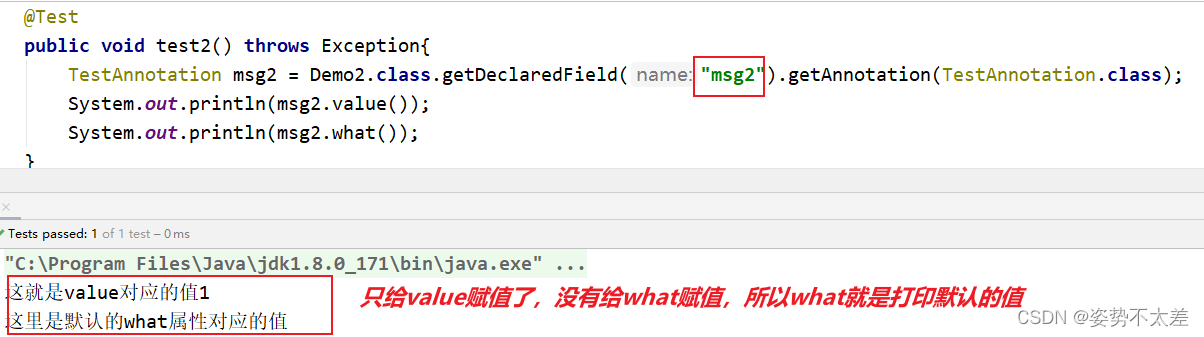
建立类测试:
有些两个值都赋予了,有些只赋予了一个
- /**
- * 获取类属性上的注解属性值
- */
- public class Demo2 {
- @TestAnnotation(value = "这就是value对应的值_msg1", what = "这就是what对应的值_msg1")
- private static String msg1;
- @TestAnnotation("这就是value对应的值1")//没有指定,默认value
- private static String msg2;
- @TestAnnotation(value = "这就是value对应的值2")
- private static String msg3;
- @TestAnnotation(what = "这就是what对应的值")
- private static String msg4;
- }
测试结果:

2.3 案例三(获取参数修饰注解对应的属性值,非空注解)
同样,先建立一个非空注解
- /**
- * 非空注解:使用在方法的参数上,false表示此参数可以为空,true不能为空
- */
- @Documented
- @Target({ElementType.PARAMETER})
- @Retention(RetentionPolicy.RUNTIME)
- public @interface IsNotNull {
- boolean value() default false;//默认为false
- }

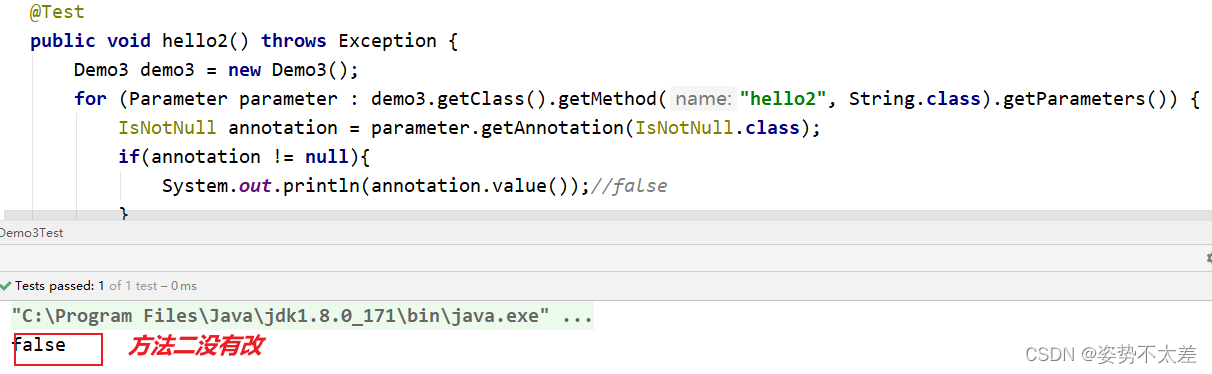
建立方法,进行测试:

测试


三.AOP结合自定义注解案例⭐⭐
配置相关AOP pom文件
- <dependency>
- <groupId>org.springframework.boot</groupId>
- <artifactId>spring-boot-starter-aop</artifactId>
- </dependency>
applicationContext.xml
- "1.0" encoding="UTF-8"?>
- <beans xmlns="http://www.springframework.org/schema/beans"
- xmlns:xsi="http://www.w3.org/2001/XMLSchema-instance"
- xmlns:context="http://www.springframework.org/schema/context" xmlns:tx="http://www.springframework.org/schema/tx"
- xmlns:aop="http://www.springframework.org/schema/aop"
- xsi:schemaLocation="http://www.springframework.org/schema/beans http://www.springframework.org/schema/beans/spring-beans.xsd http://www.springframework.org/schema/context http://www.springframework.org/schema/context/spring-context.xsd http://www.springframework.org/schema/tx http://www.springframework.org/schema/tx/spring-tx.xsd http://www.springframework.org/schema/aop http://www.springframework.org/schema/aop/spring-aop.xsd">
- <context:annotation-config/>
- <context:component-scan base-package="com.yinzi"/>
- <aop:aspectj-autoproxy />
- beans>
定义一个标志日志的注解
- package com.yinzi.annotation;
- import java.lang.annotation.ElementType;
- import java.lang.annotation.Retention;
- import java.lang.annotation.RetentionPolicy;
- import java.lang.annotation.Target;
- /**
- * @author yinzi
- * 日志注解
- */
- @Target(ElementType.METHOD)
- @Retention(RetentionPolicy.RUNTIME)
- public @interface MyLog {
- String desc();
- }
然后,我们创建一个切面类
LogAspect,用于实现日志记录的逻辑。- /**
- * @author yinzi
- */
- @Component
- @Aspect
- public class MyLogAspect {
- private static final Logger logger = LoggerFactory.getLogger(MyLogAspect.class);
- /**
- * 只要用到了com.javaxl.p2.annotation.springAop.MyLog这个注解的,就是目标类
- */
- @Pointcut("@annotation(com.yinzi.annotation.MyLog)")
- private void MyValid() {
- }
- @Before("MyValid()")
- public void before(JoinPoint joinPoint) {
- MethodSignature signature = (MethodSignature) joinPoint.getSignature();
- logger.debug("[" + signature.getName() + " : start.....]");
- System.out.println("[" + signature.getName() + " : start.....]");
- MyLog myLog = signature.getMethod().getAnnotation(MyLog.class);
- logger.debug("【目标对象方法被调用时候产生的日志,记录到日志表中】:"+myLog.desc());
- System.out.println("【目标对象方法被调用时候产生的日志,记录到日志表中】:" + myLog.desc());
- }
- }
在方法上运用日志注解
- /**
- * @author yinzi
- */
- @Controller
- public class LogController {
- @RequestMapping("/mylog")
- @MyLog(desc = "这是结合spring aop知识,讲解自定义注解应用的一个案例")
- public void testLogAspect(){
- System.out.println("这里随便来点啥");
- }
- }
运行结果: 这只是大概的模拟了一下

好啦,今天的分享就到这啦!!

-
相关阅读:
go语言基础之常量与itoa
RNA-seq 详细教程:分析流程介绍(1)
wangeditor5在vue3中的全使用过程(图片上传、附件上传、工具栏配置、编辑器配置)
重磅!flink-table-store 将作为独立数据湖项目重新加入 Apache
用HTML+CSS做一个漂亮简单的轻量级图片相册博客网站(web前端期末大作业)
Linux | 文件描述符理解 | 系统级别的文件操作讲解 | 一切皆文件的由来 | 重定向dup2函数讲解
Navigation 组件(一) Fragment 跳转
scss
多维表格平台盘点 Notion、FlowUs、Airtable、SeaTable、Vika
第二章:ShardingSphere简介
- 原文地址:https://blog.csdn.net/YZZdear/article/details/132887973
