-
Neighbourhood (mathematics)
In topology and related areas of mathematics, a neighbourhood (or neighborhood) is one of the basic concepts in a topological space. It is closely related to the concepts of open set and interior. Intuitively speaking, a neighbourhood of a point is a set of points containing that point where one can move some amount in any direction away from that point without leaving the set.
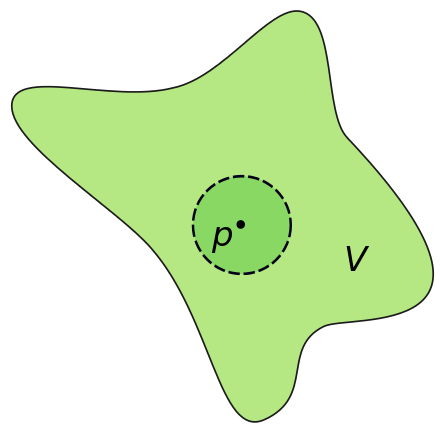
A set {\displaystyle V}V in the plane is a neighbourhood of a point {\displaystyle p}p if a small disc around {\displaystyle p}p is contained in {\displaystyle V.}V.
1 Definitions
1.1 Neighbourhood of a point
If {\displaystyle X}X is a topological space and {\displaystyle p}p is a point in {\displaystyle X,}X, then a neighbourhood of {\displaystyle p}p is a subset {\displaystyle V}V of {\displaystyle X}X that includes an open set {\displaystyle U}U containing {\displaystyle p}p,
{\displaystyle p\in U\subseteq V\subseteq X.}{\displaystyle p\in U\subseteq V\subseteq X.}
This is also equivalent to the point {\displaystyle p\in X}p\in X belonging to the topological interior of {\displaystyle V}V in {\displaystyle X.}X.The neighbourhood {\displaystyle V}V need not be an open subset {\displaystyle X,}X, but when {\displaystyle V}V is open in {\displaystyle X}X then it is called an open neighbourhood.[1] Some authors have been known to require neighbourhoods to be open, so it is important to note conventions.
A set that is a neighbourhood of each of its points is open since it can be expressed as the union of open sets containing each of its points. A rectangle, as illustrated in the figure, is not a neighbourhood of all its points; points on the edges or corners of the rectangle are not contained in any open set that is contained within the rectangle.
The collection of all neighbourhoods of a point is called the neighbourhood system at the point.
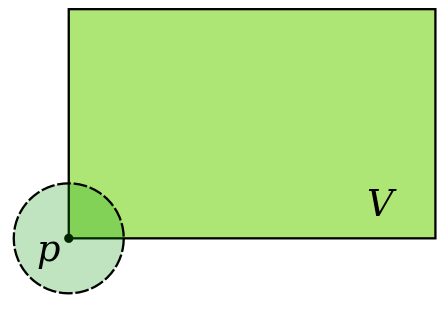
A closed rectangle does not have a neighbourhood on any of its corners or its boundary.
1.2 Neighbourhood of a set
If {\displaystyle S}S is a subset of a topological space {\displaystyle X}X, then a neighbourhood of {\displaystyle S}S is a set {\displaystyle V}V that includes an open set {\displaystyle U}U containing {\displaystyle S}S,
{\displaystyle S\subseteq U\subseteq V\subseteq X.}{\displaystyle S\subseteq U\subseteq V\subseteq X.}
It follows that a set {\displaystyle V}V is a neighbourhood of {\displaystyle S}S if and only if it is a neighbourhood of all the points in {\displaystyle S.}S. Furthermore, {\displaystyle V}V is a neighbourhood of {\displaystyle S}S if and only if {\displaystyle S}S is a subset of the interior of {\displaystyle V.}V. A neighbourhood of {\displaystyle S}S that is also an open subset of {\displaystyle X}X is called an open neighbourhood of {\displaystyle S.}S. The neighbourhood of a point is just a special case of this definition.2 In a metric space
In a metric space {\displaystyle M=(X,d),}{\displaystyle M=(X,d),} a set {\displaystyle V}V is a neighbourhood of a point {\displaystyle p}p if there exists an open ball with center {\displaystyle p}p and radius {\displaystyle r>0,}{\displaystyle r>0,} such that
{\displaystyle B_{r}§=B(p;r)={x\in X:d(x,p)
{\displaystyle V}V is called uniform neighbourhood of a set {\displaystyle S}S if there exists a positive number {\displaystyle r}r such that for all elements {\displaystyle p}p of {\displaystyle S,}S,{\displaystyle B_{r}§={x\in X:d(x,p)
For {\displaystyle r>0,}{\displaystyle r>0,} the {\displaystyle r}r-neighbourhood {\displaystyle S_{r}}S_r of a set {\displaystyle S}S is the set of all points in {\displaystyle X}X that are at distance less than {\displaystyle r}r from {\displaystyle S}S (or equivalently, {\displaystyle S_{r}}S_r is the union of all the open balls of radius {\displaystyle r}r that are centered at a point in {\displaystyle S}S):{\displaystyle S_{r}=\bigcup \limits {p\in {}S}B{r}§.}{\displaystyle S_{r}=\bigcup \limits {p\in {}S}B{r}§.}
It directly follows that an {\displaystyle r}r-neighbourhood is a uniform neighbourhood, and that a set is a uniform neighbourhood if and only if it contains an {\displaystyle r}r-neighbourhood for some value of {\displaystyle r.}r.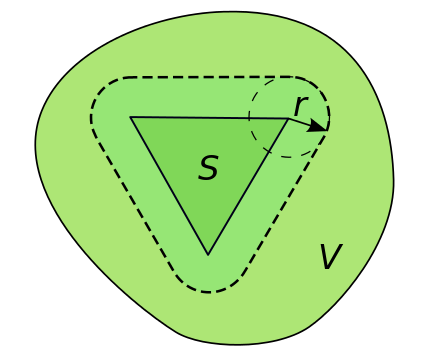
A set {\displaystyle S}S in the plane and a uniform neighbourhood {\displaystyle V}V of {\displaystyle S.}S.

The epsilon neighbourhood of a number {\displaystyle a}a on the real number line.
3 Examples
Given the set of real numbers {\displaystyle \mathbb {R} }\mathbb {R} with the usual Euclidean metric and a subset {\displaystyle V}V defined as
{\displaystyle V:=\bigcup _{n\in \mathbb {N} }B\left(n,;,1/n\right),}{\displaystyle V:=\bigcup _{n\in \mathbb {N} }B\left(n,;,1/n\right),}
then {\displaystyle V}V is a neighbourhood for the set {\displaystyle \mathbb {N} }\mathbb {N} of natural numbers, but is not a uniform neighbourhood of this set.
The set M is a neighbourhood of the number a, because there is an ε-neighbourhood of a which is a subset of M.
4 Topology from neighbourhoods
See also: Filters in topology, Topological space § Neighborhood definition, and Axiomatic foundations of topological spaces § Definition via neighbourhoods
The above definition is useful if the notion of open set is already defined. There is an alternative way to define a topology, by first defining the neighbourhood system, and then open sets as those sets containing a neighbourhood of each of their points.A neighbourhood system on {\displaystyle X}X is the assignment of a filter {\displaystyle N(x)}N(x) of subsets of {\displaystyle X}X to each {\displaystyle x}x in {\displaystyle X,}X, such that
the point {\displaystyle x}x is an element of each {\displaystyle U}U in {\displaystyle N(x)}N(x)
each {\displaystyle U}U in {\displaystyle N(x)}N(x) contains some {\displaystyle V}V in {\displaystyle N(x)}N(x) such that for each {\displaystyle y}y in {\displaystyle V,}V, {\displaystyle U}U is in {\displaystyle N(y).}{\displaystyle N(y).}
One can show that both definitions are compatible, that is, the topology obtained from the neighbourhood system defined using open sets is the original one, and vice versa when starting out from a neighbourhood system.5 Uniform neighbourhoods
In a uniform space {\displaystyle S=(X,\Phi ),}{\displaystyle S=(X,\Phi ),} {\displaystyle V}V is called a uniform neighbourhood of {\displaystyle P}P if there exists an entourage {\displaystyle U\in \Phi }{\displaystyle U\in \Phi } such that {\displaystyle V}V contains all points of {\displaystyle X}X that are {\displaystyle U}U-close to some point of {\displaystyle P;}{\displaystyle P;} that is, {\displaystyle U[x]\subseteq V}{\displaystyle U[x]\subseteq V} for all {\displaystyle x\in P.}{\displaystyle x\in P.}
6 Deleted neighbourhood
A deleted neighbourhood of a point {\displaystyle p}p (sometimes called a punctured neighbourhood) is a neighbourhood of {\displaystyle p,}p, without {\displaystyle {p}.}{\displaystyle {p}.} For instance, the interval {\displaystyle (-1,1)={y:-1
7 See also
Neighbourhood system
Region (mathematics)
Tubular neighbourhood -
相关阅读:
什么是Web组件(Web Components)?它们的主要部分有哪些?
FDTD script command(源/监视器)
Hexo在多台电脑上提交和更新
PHP初中高级1000道面试题大全(持续更新中)
计算机竞赛 题目:基于FP-Growth的新闻挖掘算法系统的设计与实现
关于RXJS,何时需要取消订阅 / 可观测对象的冷热之分
技巧 | Python绘制2022年卡塔尔世界杯决赛圈预测图
【超详细Vue2教程】超详细的Vue2入门教程,让你的开发效率大大提高(自己整理的笔记,超详细!)
LeetCode 1361. 验证二叉树【二叉树,DFS或BFS或并查集】1464
空间复杂度(Space Complexity)
- 原文地址:https://blog.csdn.net/qq_66485519/article/details/128176830