-
TypeScript(四)泛型编程
TypeScript
软件工程的主要目的是构建不仅仅明确和一致的API,还要让你的代码具有很强的可重用性:
比如我们可以通过函数来封装一些API,通过传入不同的函数参数,让函数帮助我们完成不同的操作;
但是对于参数的类型是否也可以参数化呢?什么是类型的参数化?
我们来提一个需求:封装一个函数,传入一个参数,并且返回这个参数;
如果我们是TypeScript的思维方式,要考虑这个参数和返回值的类型需要一致:function foo(arg: number):number { return arg }- 1
- 2
- 3
上面的代码虽然实现了,但是不适用于其他类型,比如string、boolean、Person等类型:
我么可以使用any来解决这个问题function foo(arg: any):any { return arg }- 1
- 2
- 3
虽然any是可以的,但是定义为any的时候,我们其实已经丢失了类型信息:
比如我们传入的是一个number,那么我们希望返回的可不是any类型,而是number类型;
所以,我们需要在函数中可以捕获到参数的类型是number,并且同时使用它来作为返回值的类型;我们需要在这里使用一种特性的变量 - 类型变量(type variable),它作用于类型,而不是值:
function foo<Type>(arg: Type): Type{ return arg }- 1
- 2
- 3
这里我们可以使用两种方式来调用它:
方式一:通过 <类型> 的方式将类型传递给函数;
方式二:通过类型推导(type argument inference),自动推到出我们传入变量的类型:在这里会推导出它们是 字面量类型的,因为字面量类型对于我们的函数也是适用的
foo<string>('abc') foo<number>(123) foo('bcd') foo(234)- 1
- 2
- 3
- 4
- 5
泛型的基本补充
当然我们也可以传入多个类型
function foo<T, E>(al: T, a2: E) { }- 1
- 2
- 3
平时在开发中我们可能会看到一些常用的名称:
T:Type的缩写,类型
K、V:key和value的缩写,键值对
E:Element的缩写,元素
O:Object的缩写,对象泛型接口
在定义接口的时候我们也可以使用泛型
interface IFoo<T> { initialValue: T, valueList: T[], handleValue: (value: T) => void } fonst foo: IFoo<number> = { initialValue: 0, valueList: [0, 2, 3], handleValue: function(value: number) { console.log(value) } }- 1
- 2
- 3
- 4
- 5
- 6
- 7
- 8
- 9
- 10
- 11
- 12
- 13
泛型类
我们也可以编写一个泛型类:
class Point<T, K> { x: T; y: K; constructor(x: T, y: K) { this.x = x; this.y = y; } } const p1 = new Point(10, 20); const p2 = new Point<string, string>('123', '234'); console.log(p1.x); console.log(p2.x);- 1
- 2
- 3
- 4
- 5
- 6
- 7
- 8
- 9
- 10
- 11
- 12
- 13
- 14
- 15
泛型约束(Generic Constraints)
有时候我们希望传入的类型有某些共性,但是这些共性可能不是在同一种类型中:
比如string和array都是有length的,或者某些对象也是会有length属性的;
那么只要是拥有length的属性都可以作为我们的参数类型,那么应该如何操作呢?interface ILength { length: number; } //T相当于是一个变量 用于记录本次调用的类型 所以在整个函数的执行周期中 一直保留着参数类型 function getInfo<T extends ILength>(args: T): T { return args; } const info1 = getInfo('aaaa'); const info2 = getInfo(['aaa', 'bbb', 'ccc']); const info3 = getInfo({ length: 100 });- 1
- 2
- 3
- 4
- 5
- 6
- 7
- 8
- 9
- 10
- 11
这里表示是传入的类型必须有这个属性,也可以有其他属性,但是必须至少有这个成员。
在泛型约束中使用类型参数(Using Type Parameters in Generic Constraints)
你可以声明一个类型参数,这个类型参数被其他类型参数约束;
举个栗子:我们希望获取一个对象给定属性名的值
我们需要确保我们不会获取 obj 上不存在的属性;
所以我们在两个类型之间建立一个约束;//传入的key的类型 obj当中key的其中之一 interface IPerson{ name: string; age: number; } type IPersonKeys = keyof IPerson; //相当于 "name" | "age" key的联合类型 // function getObjectProperty- 1
- 2
- 3
- 4
- 5
- 6
- 7
- 8
- 9
- 10
- 11
- 12
- 13
- 14
- 15
- 16
- 17
- 18
- 19
- 20
- 21
- 22
映射类型(Mapped Types)
有的时候,一个类型需要基于另外一个类型,但是你又不想拷贝一份,这个时候可以考虑使用映射类型。
大部分内置的工具都是通过映射类型来实现的;
大多数类型体操的题目也是通过映射类型完成的;映射类型建立在索引签名的语法上:
映射类型,就是使用了 PropertyKeys 联合类型的泛型;
其中 PropertyKeys 多是通过 keyof 创建,然后循环遍历键名创建一个类型;ts提供了映射类型: 函数
映射类型不能使用interface定义type MapPerson<Type> = { // 索引类型依次进行使用 [Property in keyof Type]: Type[Property]; }; interface IPerson { name: string; age: number; } type NewPerson = MapPerson<IPerson>;- 1
- 2
- 3
- 4
- 5
- 6
- 7
- 8
- 9
- 10
- 11
映射修饰符(Mapping Modifiers)
在使用映射类型时,有两个额外的修饰符可能会用到:
一个是 readonly,用于设置属性只读;
一个是 ? ,用于设置属性可选;你可以通过前缀 - 或者 + 删除或者添加这些修饰符,如果没有写前缀,相当于使用了 + 前缀。
type MapIPerson<Type> = { readonly [Property in keyof Type]?: Type[Property]; }; interface IPerson { name: string; age: number; height: number; address: string; } type IPersonOptional = MapIPerson<IPerson>; const p: IPersonOptional = {};- 1
- 2
- 3
- 4
- 5
- 6
- 7
- 8
- 9
- 10
- 11
- 12
- 13

type MapIPerson<Type> = { -readonly [Property in keyof Type]-?: Type[Property]; }; interface IPerson { name: string; age?: number; readonly height: number; address: string; } type IPersonOptional = MapIPerson<IPerson>;- 1
- 2
- 3
- 4
- 5
- 6
- 7
- 8
- 9
- 10
- 11
- 12
- 13
内置工具与类型体操
类型系统其实在很多语言里面都是有的,比如Java、Swift、C++等等,但是相对来说TypeScript的类型非常灵活:
这是因为TypeScript的目的是为JavaScript添加一套类型校验系统,因为JavaScript本身的灵活性,也让TypeScript类型系统
不得不增加更附加的功能以适配JavaScript的灵活性;
所以TypeScript是一种可以支持类型编程的类型系统;
这种类型编程系统为TypeScript增加了很大的灵活度,同时也增加了它的难度:
如果你不仅仅在开发业务的时候为自己的JavaScript代码增加上类型约束,那么基本不需要太多的类型编程能力;
但是如果你在开发一些框架、库,或者通用性的工具,为了考虑各种适配的情况,就需要使用类型编程;
TypeScript本身为我们提供了类型工具,帮助我们辅助进行类型转换(前面有用过关于this的类型工具)。条件类型(Conditional Types)
很多时候,日常开发中我们需要基于输入的值来决定输出的值,同样我们也需要基于输入的值的类型来决定输出的值的类型。
条件类型(Conditional types)就是用来帮助我们描述输入类型和输出类型之间的关系。
条件类型的写法有点类似于 JavaScript 中的条件表达式(condition ? trueExpression : falseExpression ):
SomeType extends OtherType ? TrueType : FalseType;function sum<T extends number | string>(num1: T, num2: T): T extends number ? number : string; function sum(num1, num2) { return num1 + num2; } const res = sum(20, 30); const res2 = sum('abc', 'cba');- 1
- 2
- 3
- 4
- 5
- 6
在条件类型中推断(inter)
在条件类型中推断(Inferring Within Conditional Types)
条件类型提供了 infer 关键词,可以从正在比较的类型中推断类型,然后在 true 分支里引用该推断结果;
比如我们现在有一个数组类型,想要获取到一个函数的参数类型和返回值类型:type CalcFnType = (num1: number, num2: number) => number; function foo() { return 'abc'; } //同届类型体操的题目: MyReturnType //推断返回值类型 type MyReturnType<T extends (...args: any[]) => any> = T extends (...args: any[]) => infer R ? R : false; //推断参数类型 type MyParameterType<T extends (...args: any[]) => any> = T extends (...args: infer A) => any ? A : never; //获取一个函数的返回值类型 type CalcReturnType = MyReturnType<CalcFnType>; type FooReturnType = MyReturnType<typeof foo>; type FooReturnType1 = ReturnType<CalcFnType>; type CalcParameterType = MyParameterType<CalcFnType>;- 1
- 2
- 3
- 4
- 5
- 6
- 7
- 8
- 9
- 10
- 11
- 12
- 13
- 14
- 15
- 16
- 17
- 18
- 19
- 20
- 21


分发条件类型(Distributive Conditional Types)
在泛型中使用条件类型的时候 如果传入一个联合类型 就会变成分发的
// type toArray= T[]; //(string | number)[] type toArray<T> = T extends any ? T[] : never; //number[] | string[] type NumArray = toArray<number>; //number[] | string[] 而不是(number | string)[] type NumAndStrArray = toArray<number | string>;- 1
- 2
- 3
- 4
- 5
- 6
- 7
如果我们在 ToArray 传入一个联合类型,这个条件类型会被应用到联合类型的每个成员:
当传入string | number时,会遍历联合类型中的每一个成员;
相当于ToArray | ToArray;
所以最后的结果是:string[] | number[];Partial
用于构造一个Type下面的所有属性都设置为可选的类型
interface IPerson { name: string; age: number; slogan?: string; } type IPersonOption2 = Partial<IPerson>;- 1
- 2
- 3
- 4
- 5
- 6

实现myPartialtype MyPartial<T> = { [p in keyof T]?: T[p]; }; //IKun类型都是可选的 type IPersonOption1 = MyPartial<IPerson>;- 1
- 2
- 3
- 4
- 5
- 6
Required
用于构造一个Type下面的所有属性全都设置为必填的类型,这个工具类型跟 Partial 相反。
interface IPerson { name: string; age: number; slogan?: string; } type IKunOption1 = Required<IPerson>;- 1
- 2
- 3
- 4
- 5
- 6
- 7
实现MyRequired
type MyRequired<T> = { [p in keyof T]-?: T[p]; }; type IKunOption2 = MyRequired<IPerson>;- 1
- 2
- 3
- 4
Readonly
用于构造一个Type下面的所有属性全都设置为只读的类型,意味着这个类型的所有的属性全都不可以重新赋值。
interface IPerson { name: string; age: number; slogan?: string; } type MyReadonly<T> = { readonly [p in keyof T]: T[p]; }; type IPersonOption1 = Readonly<IPerson>;;- 1
- 2
- 3
- 4
- 5
- 6
- 7
- 8
- 9
- 10
实现MyReadonly
type MyReadonly<T> = { readonly [p in keyof T]: T[p]; }; type IPersonOption2 = MyReadonly<IPerson>;- 1
- 2
- 3
- 4
Record
用于构造一个对象类型,它所有的key(键)都是Keys类型,它所有的value(值)都是Type类型。
interface IPerson { name: string; age: number; slogan?: string; } type t1 = '上海' | '北京' | '洛杉矶'; type IPersons= Record<t1, IPerson>; const ipersons:IPersons = { 上海: { name: 'xxx', age: 10, }, 北京: { name: 'yyy', age: 5, }, 洛杉矶: { name: 'zzz', age: 3, }, };- 1
- 2
- 3
- 4
- 5
- 6
- 7
- 8
- 9
- 10
- 11
- 12
- 13
- 14
- 15
- 16
- 17
- 18
- 19
- 20
- 21
- 22
- 23
实现MyRecord
//确保keys一定是可以作为key的联合类型 Keys extends keyof any type keys = keyof IPerson; // name | age | slogan type Res = keyof any; // =>number | string | symbol type MyRecord<Keys extends keyof any, T> = { [P in Keys]: T; }; type t1 = '上海' | '北京' | '洛杉矶'; type IPersons = MyRecord<t1, IPerson>;- 1
- 2
- 3
- 4
- 5
- 6
- 7
- 8
- 9
- 10
- 11
Pick
用于构造一个类型,它是从Type类型里面挑了一些属性Keys
interface IPerson { name: string; age: number; slogan?: string; } type IPerson1 = Pick<IPerson, 'name' | 'slogan'>;- 1
- 2
- 3
- 4
- 5
- 6
- 7
- 8
实现MyPick
type MyPick<T, K extends keyof T> = { [P in K]: T[P]; }; type IPerson2 = MyPick<IPerson, 'name' | 'slogan'>;- 1
- 2
- 3
- 4
- 5
- 6
Omit
用于构造一个类型,它是从Type类型里面过滤了一些属性Keys
interface IPerson { name: string; age: number; slogan?: string; } type IPerson1 = Omit<IPerson, 'name' | 'slogan'>;- 1
- 2
- 3
- 4
- 5
- 6
实现MyOmit
//类型体操 type MyOmit<T, K extends keyof T> = { [P in keyof T as P extends K ? never : P]: T[P]; }; type IPerson2 = MyOmit<IPerson, 'name' | 'slogan'>; ``` ## Exclude用于构造一个类型,这个类型从Type中排除了所有的null、undefined的类型。 ```typescript type IPerson = '唱' | '跳' | 'rap' | null | undefined; type IPerson1 = NonNullable<IPerson>; ``` 实现MyNonNullable ```typescript type MyNonNullable<T> = T extends null | undefined ? never : T; type IPerson2 = MyNonNullable<IPerson>; ``` ## InstanceType用于构造一个由所有Type的构造函数的实例类型组成的类型。 ```typescript class Person {} class Dog {} const p1: Person = new Person(); //type Person 构造函数具体的类型 //InstanceType 构造函数创建出来的实例对象的类型 type MyPerson = InstanceType<typeof Person>; const p2: MyPerson = new Person(); ``` 此时p1和p2都是Person类型 可能会觉得instanceType没有用 但是我们可以看下面的情况 ```typescript function factory<T extends new (...args: any[]) => any>(ctor: T): T { return new ctor(); } const p3 = factory(Person); const d = factory(Dog); ``` 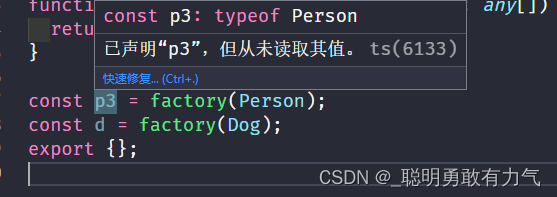 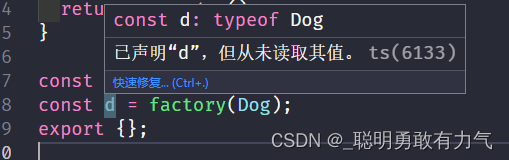 此时返回的类型不是我们期望的 ```typescript function factory<T extends new (...args: any[]) => any>(ctor: T): InstanceType<T> { return new ctor(); } const p3 = factory(Person); const d = factory(Dog); ``` 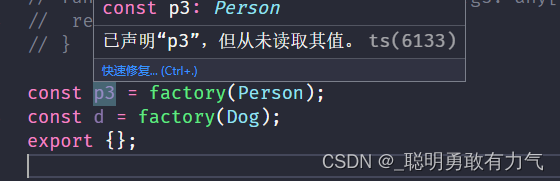 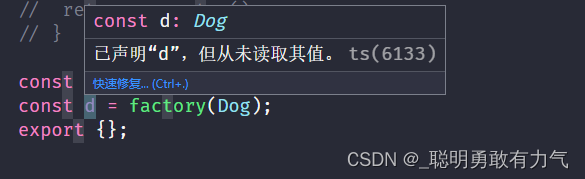 此时就正确了 实现MyInstanceType ```typescript type MyInstanceType<T extends new (...args: any[]) => any> = T extends new ( ...args: any[] ) => infer R ? R : never; ```- 1
- 2
- 3
- 4
- 5
- 6
- 7
- 8
- 9
- 10
- 11
- 12
- 13
- 14
- 15
- 16
- 17
- 18
- 19
- 20
- 21
- 22
- 23
- 24
- 25
- 26
- 27
- 28
- 29
- 30
- 31
- 32
- 33
- 34
- 35
- 36
- 37
- 38
- 39
- 40
- 41
- 42
- 43
- 44
- 45
- 46
- 47
- 48
- 49
- 50
- 51
- 52
- 53
- 54
- 55
- 56
- 57
- 58
- 59
- 60
- 61
- 62
- 63
- 64
- 65
- 66
- 67
- 68
- 69
- 70
- 71
- 72
- 73
- 74
- 75
- 76
- 77
- 78
- 79
- 80
- 81
- 82
- 83
- 84
- 85
- 86
- 87
- 88
- 89
- 90
- 91
- 92
- 93
- 94
- 95
- 96
- 97
- 98
- 99
- 100
-
相关阅读:
SAP S4客户与供应商如何管理 事务代码 BP
2558. 从数量最多的堆取走礼物
基于SpringBoot的校园交友网站
LoRaWan模块应用于智慧城市景观灯
即时通讯技术文集(第7期):长连接网关、P2P等 [共10篇]
芒果叶病害数据集(用于图像分类,每类500张照片)
主流前沿的开源监控和报警系统Prometheus+Grafana入门之旅-中
【uniapp】HBuilderx中uniapp项目运行到微信小程序报错Error: Fail to open IDE
UUCTF(公共赛道)
阿里SQL又爆神作数据生态:MySQL复制技术与生产实践笔记
- 原文地址:https://blog.csdn.net/weixin_65402230/article/details/128007563
