-
C语言学习之路(基础篇)—— 指针(下)
说明:该篇博客是博主一字一码编写的,实属不易,请尊重原创,谢谢大家!
指针和函数
1) 函数形参改变实参的值
示例1:整型变量作为函数的形参,无法改变实参的值
#includevoid swap(int a, int b) { int c; c = a; a = b; b = c; printf("a=%d, b=%d\n", a, b); return; } int main() { int a = 10; int b = 20; swap(a, b); printf("a=%d, b=%d\n", a, b); return 0; } - 1
- 2
- 3
- 4
- 5
- 6
- 7
- 8
- 9
- 10
- 11
- 12
- 13
- 14
- 15
- 16
- 17
- 18
- 19
- 20
- 21
- 22
输出结果 a=20, b=10 a=10, b=20- 1
- 2
- 3
示例2:指针变量作为函数的形参,可以改变实参的值
#includevoid swap(int a, int b) { int c; c = a; a = b; b = c; printf("a=%d, b=%d\n", a, b); return; } void swap2(int *x, int *y) { int c = *x; *x = *y; *y = c; printf("c=%d x=%d, y=%d\n", c, *x, *y); return; } int main() { int a = 10; int b = 20; //swap(a, b); swap2(&a, &b); printf("a=%d, b=%d\n", a, b); return 0; } - 1
- 2
- 3
- 4
- 5
- 6
- 7
- 8
- 9
- 10
- 11
- 12
- 13
- 14
- 15
- 16
- 17
- 18
- 19
- 20
- 21
- 22
- 23
- 24
- 25
- 26
- 27
- 28
- 29

输出结果 c=10 x=20, y=10 a=20, b=10- 1
- 2
- 3
2) 数组名做函数参数
数组名做函数参数,函数的形参会退化为指针。
#include// 数组作为函数的形参会退化为指针 // 形参int b[10]就退化成int *b,哪怕形参是int b[10000],也是int *b void printf_arr(int b[10]) { // 这里sizeof(b)==sizeof(int)==4个字节 // sizeof(b[0])其中b[0] == int *(b+0) == int *b == a == 3,所以sizeof(b[0]) == sizeof(3) == sizeof(int)==4个字节 int len = sizeof(b) / sizeof(b[0]); // 4/4=1 for (int i = 0; i < len; i++) { printf("%d ", b[i]); // 3 } return 0; } int main() { int a[10] = { 3,9,5,1,4,7,6,10,2,8 }; printf_arr(a); // 实参a为数组名,也就是首元素地址 &a[0], 类型为int*类型 return 0; } - 1
- 2
- 3
- 4
- 5
- 6
- 7
- 8
- 9
- 10
- 11
- 12
- 13
- 14
- 15
- 16
- 17
- 18
- 19
- 20
- 21
- 22
- 23
- 24
- 25
那么就需要传递数组元素个数,让printf_arr函数知道,才能打印数组其他元素
#include// 数组作为函数的形参会退化为指针 // 形参int b[10]就退化成int *b,哪怕形参是int b[10000],也是int *b void printf_arr(int b[10], int len) { // 这里sizeof(b)==sizeof(int)==4个字节 // sizeof(b[0])其中b[0] == int *(b+0) == int *b == a == 3,所以sizeof(b[0]) == sizeof(3) == sizeof(int)==4个字节 //int len = sizeof(b) / sizeof(b[0]); // 4/4=1 for (int i = 0; i < len; i++) { printf("%d ", b[i]); // 3 } return 0; } int main() { int a[10] = { 3,9,5,1,4,7,6,10,2,8 }; int len = sizeof(a) / sizeof(a[0]); printf_arr(a, len); // 实参a为数组名,也就是首元素地址 &a[0], 类型为int*类型 return 0; } - 1
- 2
- 3
- 4
- 5
- 6
- 7
- 8
- 9
- 10
- 11
- 12
- 13
- 14
- 15
- 16
- 17
- 18
- 19
- 20
- 21
- 22
- 23
- 24
- 25
- 26

3) 指针做为函数的返回值
#include#include #include int* getNum() { // srand()用来设置rand()产生随机数时的随机种子 srand(time(0)); int num = rand(); return # } int main() { int* p = getNum(); printf("%d\n", *p); return 0; } - 1
- 2
- 3
- 4
- 5
- 6
- 7
- 8
- 9
- 10
- 11
- 12
- 13
- 14
- 15
- 16
- 17
- 18
- 19
- 20
- 21

补充:在函数中定义的变量叫局部变量,局部变量一旦在函数结束之后就会被释放空间,所以在getNum函数return后,再去main函数中操作这块被释放空间是非法的,但是编译器不会告诉我们,这块空间没有被占用,所以不会出问题,但如果被占用,那么就会出错。
在函数外面定义的变量叫全局变量,整个工程都可以使用;整个变量程序启动开辟空间,直到程序结束才会释放空间。
#include#include #include // 在函数外面定义的变量叫全局变量,整个工程都可以使用 // 整个变量程序启动开辟空间,直到程序结束释放空间 int num = 0; int* getNum() { // srand()用来设置rand()产生随机数时的随机种子 srand(time(0)); //{}中定义的变量叫局部变量,局部变量一旦在函数结束之后就会被释放空间 //int num = rand(); num = rand(); return # } int main() { int* p = getNum(); printf("%d\n", *p); return 0; } - 1
- 2
- 3
- 4
- 5
- 6
- 7
- 8
- 9
- 10
- 11
- 12
- 13
- 14
- 15
- 16
- 17
- 18
- 19
- 20
- 21
- 22
- 23
- 24
- 25
- 26

指针和字符串
1) 字符指针
示例1:
#includeint main() { //指针与字符串 char str[] = "cdtaogang"; //定义了一个字符数组,字符数组内容为cdtaogang\0 //定义一个指针用来保存数组首元素的地址 char* p = str; printf("%s\n", p); //%s打印一个字符串,要的是首个字符的地址 printf("%s\n", p+2); printf("%c\n", *(p + 3)); printf("%d\n", sizeof(str)); printf("%d\n", sizeof(p)); return 0; } - 1
- 2
- 3
- 4
- 5
- 6
- 7
- 8
- 9
- 10
- 11
- 12
- 13
- 14
- 15
输出结果 cdtaogang taogang a 10 4- 1
- 2
- 3
- 4
- 5
- 6
示例2:
#includeint main() { //指针与字符串 char str[] = "cdtaogang"; //定义了一个字符数组,字符数组内容为cdtaogang\0 //定义一个指针用来保存数组首元素的地址 char* p = str; *p = 'N'; p++; *p = 'B'; p++; printf("%s\n", p); printf("%s\n", p-2); return 0; } - 1
- 2
- 3
- 4
- 5
- 6
- 7
- 8
- 9
- 10
- 11
- 12
- 13
- 14
- 15
- 16
输出结果 taogang NBtaogang- 1
- 2
- 3
2) 字符串常量
- 字符串常量是不可以改变的,存在文字常量区
- 文字常量区的内容是不可以改变的
char *p = "hello";代表将字符串常量的地址赋值给指针p
示例:
#include#include int main() { char str[] = "helloworld";//定义了一个字符数组,字符数组内容为helloworld //定义一个指针用来保存数组首元素的地址 char* p = str; p = "abcdef";//字符串常量存文字常量区,""在使用时,取的是字符串首元素的地址 printf("%s\n", p); // abcdef printf("%d\n", sizeof(p));//4 printf("%d\n", sizeof("abcdef"));//7 abcdef\0 printf("%d\n", strlen(p));//6 printf("%d\n", strlen("abcdef"));//6 strlen返回字符串长度 //文字常量区的内容是不可以改变的 p = 'm'; printf("%s\n", p); return 0; } - 1
- 2
- 3
- 4
- 5
- 6
- 7
- 8
- 9
- 10
- 11
- 12
- 13
- 14
- 15
- 16
- 17
- 18
- 19
- 20
输出结果 abcdef 4 7 6 6- 1
- 2
- 3
- 4
- 5
- 6
3) 字符指针做函数参数
示例1:
#include#include void mystrcat(char* dst, char* src) { int n = strlen(dst); int i = 0; while (*(src + i)!=0) { *(dst+n) = *(src + i); i++; n++; } *(dst + n) = 0; } int main() { char str1[128] = "hello "; char str2[128] = "cdtaogang"; mystrcat(str1, str2); // 不用传递元素个数,因为字符数组最后一个元素为\0,可以以此作为判断 printf("%d\n", strlen(str1)); printf("%d\n", sizeof(str1)); printf("str1 = %s", str1); return 0; } - 1
- 2
- 3
- 4
- 5
- 6
- 7
- 8
- 9
- 10
- 11
- 12
- 13
- 14
- 15
- 16
- 17
- 18
- 19
- 20
- 21
- 22
- 23
- 24
- 25
- 26
- 27
- 28
输出结果 15 128 str1 = hello cdtaogang- 1
- 2
- 3
- 4
示例2:
#includevoid mystrcat(char* dst, const char* src) { int len1 = 0; int len2 = 0; // 遍历数组计算元素个数 while (dst[len1]) { len1++; } while (src[len2]) { len2++; } int i; for (i = 0; i < len2; i++) { dst[len1 + i] = src[i]; } } int main() { char str1[100] = "hello "; char str2[] = "cdtaogang"; mystrcat(str1, str2); printf("str1 = %s\n", str1); return 0; } - 1
- 2
- 3
- 4
- 5
- 6
- 7
- 8
- 9
- 10
- 11
- 12
- 13
- 14
- 15
- 16
- 17
- 18
- 19
- 20
- 21
- 22
- 23
- 24
- 25
- 26
- 27
- 28
- 29
- 30
- 31
- 32
- 33
输出结果 str1 = hello cdtaogang- 1
- 2
4) const修饰的指针变量
const修饰一个变量为只读const修饰指针,不能通过指针修改指针所指向的空间内容const修饰指针变量,在初始化之后不能改变指针变量本身的指向
#include#include #include int main(void) { //const修饰一个变量为只读 const int a = 10; //a = 100; //err //指针变量, 指针指向的内存, 2个不同概念 char buf[] = "cdtaogang"; //从左往右看,跳过类型,看修饰哪个字符 //如果是*, 说明指针指向的内存不能改变 //如果是指针变量,说明指针的指向不能改变,指针的值不能修改 // const修饰指针,不能通过指针修改指针所指向的空间内容,但p变量本身的值是可以被修改的 const char* p = buf; // 等价于上面 char const *p1 = buf; //p[1] = '2'; //err // 不能通过p指针修改那块空间的内容 p = "agdlsjaglkdsajgl"; //ok // const修饰指针变量p2初始化之后不能改变p2指针变量本身的指向 char* const p2 = buf; p2[1] = '3'; //p2 = "salkjgldsjaglk"; //err // 不能改变p2指针变量本身的指向 // const修饰指针和指针变量,p3为只读,指向不能变,指向的内存也不能变 const char* const p3 = buf; return 0; } - 1
- 2
- 3
- 4
- 5
- 6
- 7
- 8
- 9
- 10
- 11
- 12
- 13
- 14
- 15
- 16
- 17
- 18
- 19
- 20
- 21
- 22
- 23
- 24
- 25
- 26
- 27
- 28
- 29
- 30
- 31
- 32
- 33
5) 字符指针数组 *
字符指针数组:是一个数组,每一个元素都是字符指针。
示例1:
#include//字符指针数组 int main() { char* p1 = "hello"; char* p2 = "hi"; char* p3 = "hey"; //char* str[3] = { p1, p2,p3 }; char* str[3] = { "hello", "hi","hey" }; for (int i = 0; i < 3; i++) { printf("%s ", str[i]); } printf("\n"); // 打印首元素的值 printf("%c\n", *str[0]); // 打印字符串hi中的i printf("%c\n", *(str[1] + 1)); // 打印字符串hey中的y printf("%c\n", *(str[2] + 2)); // 打印字符指针数组所有元素中的e字符 for (int i = 0; i < sizeof(str); i++) { for (int j = 0; j < strlen(str[i]); j++) { if (str[i][j] == 'e') { printf("%c\n", str[i][j]); } } } return 0; } - 1
- 2
- 3
- 4
- 5
- 6
- 7
- 8
- 9
- 10
- 11
- 12
- 13
- 14
- 15
- 16
- 17
- 18
- 19
- 20
- 21
- 22
- 23
- 24
- 25
- 26
- 27
- 28
- 29
- 30
- 31
- 32

输出结果 hello hi hey h i y e e- 1
- 2
- 3
- 4
- 5
- 6
- 7
示例2:
#includeint main() { char* str[3] = { "hello", "hi","hey" }; //定义一个指针保存str数组首元素的地址 char** p = str; // &str[0] == str for (int i = 0; i < 3; i++) { printf("%s", *(p+i)); printf("%s\n", p[i]); } return 0; } - 1
- 2
- 3
- 4
- 5
- 6
- 7
- 8
- 9
- 10
- 11
- 12
- 13
- 14
- 15
- 16

输出结果 hellohello hihi heyhey- 1
- 2
- 3
- 4
示例3:
#includeint main() { char* str[3] = { "hello", "hi","hey" }; //定义一个指针保存str数组首元素的地址 char** p = str; // &str[0] == str // 通过指针p取出首元素的值 printf("%c", *(*(p + 0))); // *(p+0)得到str[0]里面的内容0x1000,而0x1000又代表hello\0首元素地址,所以取首元素的值就是*(*(p+0)) printf("%c", *(p[0]+0)); // 上一步简写 printf("%c", p[0][0]); // 再简写 // 通过指针p取出数组元素hey中的e字符 printf("%c", *(*(p + 2) + 1)); // *(p+2)得到str[2]里面的内容0x3000,而0x3000又代表hey\0首元素地址,在首元素地址上+1即*(p+2)+1就得到e字符的地址,所以取e字符就是*(*(p+2)+1) printf("%c", *(p[2] + 1)); printf("%c", p[2][1]); return 0; } - 1
- 2
- 3
- 4
- 5
- 6
- 7
- 8
- 9
- 10
- 11
- 12
- 13
- 14
- 15
- 16
- 17
- 18

6) 指针数组做为main函数的形参
int main(int argc, char *argv[]);- 1
main函数是操作系统调用的,第一个参数标明argc数组的成员数量,argv数组的每个成员都是char *类型argv是命令行参数的字符指针数组,保存的是参数(字符串)的首元素地址argc代表命令行参数的数量,程序名字本身算一个参数
#include//argc: 传参数的个数(包含可执行程序) //argv:指针数组,指向输入的参数 // .*.exe hello 123456 int main(int argc, char* argv[]) { // 打印运行参数 printf("%d\n", argc); printf("%s\n", argv[0]); printf("%s\n", argv[1]); printf("%s\n", argv[2]); printf("%s\n", argv[3]); return 0; } - 1
- 2
- 3
- 4
- 5
- 6
- 7
- 8
- 9
- 10
- 11
- 12
- 13
- 14
- 15
右击项目>属性,配置调试命令参数
hello 123456

相当于
char* argv[] = {".*.exe", "hello", "123456"},传参不够后,打印取值为null
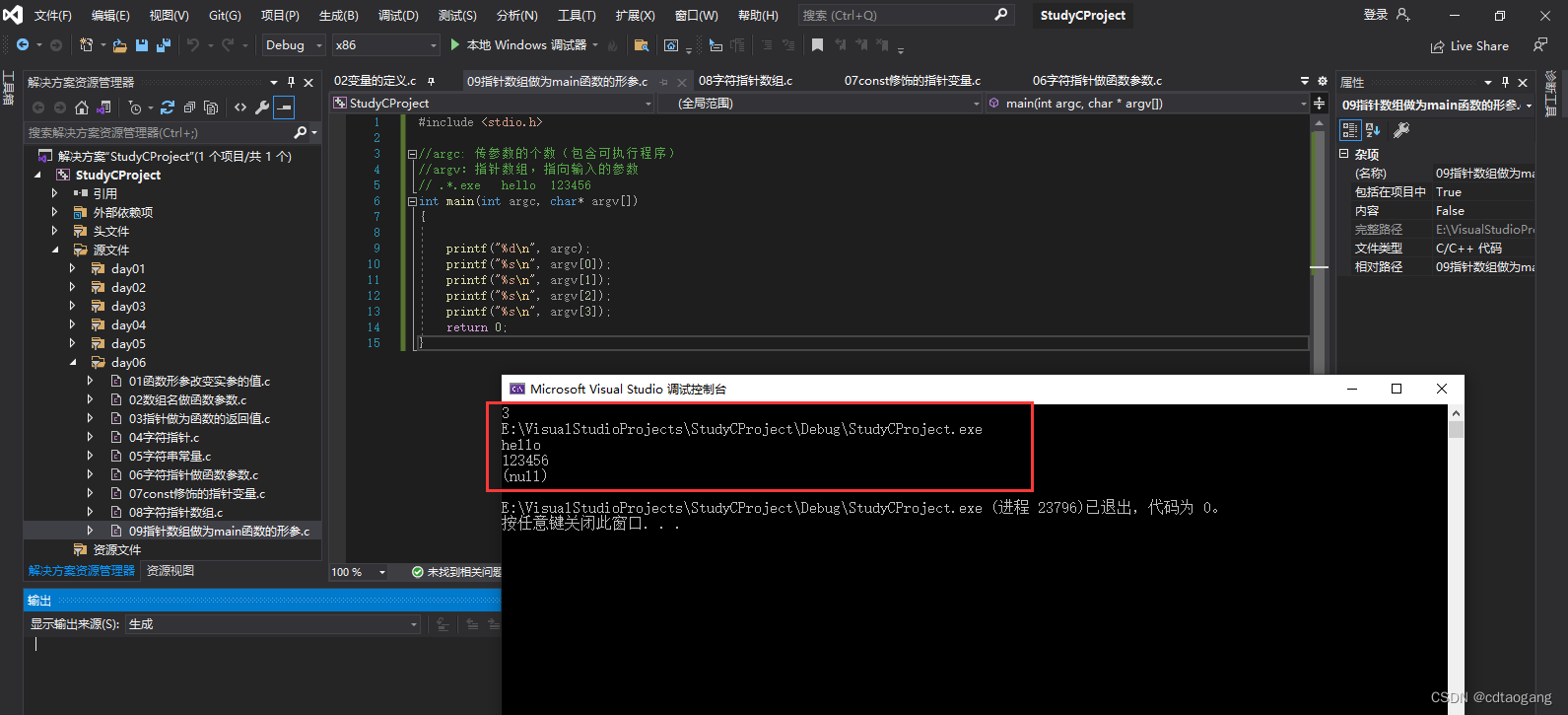
通过
argc的值,就能知道传参个数,所以可以通过for循环来打印输入的参数;需要注意的是在命令行参数之前还有.*.exe程序路径#include//argc: 传参数的个数(包含可执行程序) //argv:指针数组,指向输入的参数 // .*.exe hello 123456 // char* argv[] = {".*.exe", "hello", "123456"} int main(int argc, char* argv[]) { for (int i = 0; i <argc; i++) { printf("%s\n", argv[i]); } return 0; } - 1
- 2
- 3
- 4
- 5
- 6
- 7
- 8
- 9
- 10
- 11
- 12
- 13
- 14
输出结果 E:\VisualStudioProjects\StudyCProject\Debug\StudyCProject.exe hello 123456- 1
- 2
- 3
- 4
我们可以通过
gcc命令编译生成exe可执行程序来执行命令行参数的打印#include// 形参名随便取 int main(int n, char *v[]){ for(int i = 0; i < n; i++) { printf("%s\n", v[i]); } return 0; } - 1
- 2
- 3
- 4
- 5
- 6
- 7
- 8
- 9
- 10
- 11
PS C:\Users\Administrator\Desktop> gcc hello.c -o hello PS C:\Users\Administrator\Desktop> ./hello.exe hello CSDN cdtaogang good good study- 1
- 2

7) 字符串处理函数
7.1 strcpy()
拷贝字符串:
- 表头文件:
#include - 定义函数:
char *strcpy(char *dest, const char *src); - 功能:把
src所指向的字符串复制到dest所指向的空间中,'\0'也会拷贝过去 - 参数:
dest:目的字符串首地址
src:源字符首地址 - 返回值:
成功:返回dest字符串的首地址
失败:NULL
注意:如果参数dest所指的内存空间不够大,可能会造成缓冲溢出的错误情况。
示例1:
#define _CRT_SECURE_NO_WARNINGS #include#include int main() { // strcpy函数 char str1[128] = ""; char str2[128] = "cdtaogang"; char str3[128] = "hello\0cdtaogang"; char str4[128] = "csdn"; strcpy(str1, str2); printf("%s\n", str1); // cdtaogang strcpy(str1, str3); // 遇到 '\0'就结束拷贝 printf("%s\n", str1); // hello strcpy(str2, str4); // csdn后面的'\0'也会拷贝过去,遇到'\0'结束掉相当于替换掉原始数据 printf("%s\n", str2); // csdn return 0; } - 1
- 2
- 3
- 4
- 5
- 6
- 7
- 8
- 9
- 10
- 11
- 12
- 13
- 14
- 15
- 16
- 17
- 18
输出结果 cdtaogang hello csdn- 1
- 2
- 3
- 4
7.2 strncpy()
拷贝字符串:
- 表头文件:
#include - 定义函数:
char *strncpy(char *dest, const char *src, size_t n); - 功能:把
src指向字符串的前n个字符复制到dest所指向的空间中,是否拷贝结束符看指定的长度是否包含'\0'。 - 参数:
dest:目的字符串首地址
src:源字符首地址
n:指定需要拷贝字符串个数 - 返回值:
成功:返回dest字符串的首地址
失败:NULL
示例1:
#define _CRT_SECURE_NO_WARNINGS #include#include int main() { // strncpy函数 char str1[128] = ""; char str2[128] = "hellocdtaogang"; char str3[128] = "he\0llocdtaogang"; strncpy(str1, str2, 2); printf("str1=%s\n", str1); // he strncpy(str1, str2, 5); printf("str1=%s\n", str1); // hello strncpy(str1, str3, 5); printf("str1=%s\n", str1); // he // 验证将将str3字符串前5个字符拷贝至str1中是 he\0\0\0 还是 he\0wl for (int i = 0; i < 5; i++) { printf("%d ", str1[i]); // 104 101 0 0 0 说明拷贝的情况是不足n个字符就遇到了\0那么后面就不拷贝了 } return 0; } - 1
- 2
- 3
- 4
- 5
- 6
- 7
- 8
- 9
- 10
- 11
- 12
- 13
- 14
- 15
- 16
- 17
- 18
- 19
- 20
- 21
- 22
- 23
- 24
- 25
输出结果 str1=he str1=hello str1=he 104 101 0 0 0- 1
- 2
- 3
- 4
- 5
7.3 strcat()
连接两字符串:
- 表头文件:
#include - 定义函数:
char *strcat(char *dest, const char *src); - 功能:将
src字符串连接到dest的尾部,‘\0’也会追加过去 - 参数:
dest:目的字符串首地址
src:源字符首地址 - 返回值:
成功:返回dest字符串的首地址
失败:NULL
示例1:
#define _CRT_SECURE_NO_WARNINGS #include#include int main() { // strcat函数 char str1[128] = "hello"; char str2[128] = "cdtaogang"; char str3[128] = "world\0ocdtaogang"; strcat(str1, str2); printf("str1=%s\n", str1); // hellocdtaogang strcat(str1, str3); printf("str1=%s\n", str1); // hellocdtaogangworld return 0; } - 1
- 2
- 3
- 4
- 5
- 6
- 7
- 8
- 9
- 10
- 11
- 12
- 13
- 14
- 15
- 16
- 17
- 18
输出结果 str1=hellocdtaogang str1=hellocdtaogangworld- 1
- 2
- 3
7.4 strncat()
连接两字符串:
- 表头文件:
#include - 定义函数:
char *strncat(char *dest, const char *src, size_t n); - 功能:将
src字符串前n个字符连接到dest的尾部,‘\0’也会追加过去 - 参数:
dest:目的字符串首地址
src:源字符首地址
n:指定需要追加字符串个数 - 返回值:
成功:返回dest字符串的首地址
失败:NULL
示例1:
#define _CRT_SECURE_NO_WARNINGS #include#include int main() { // strncat函数 char str1[128] = "hello"; char str2[128] = "123456"; char str3[128] = "world\0ocdtaogang"; strncat(str1, str2, 3); printf("str1=%s\n", str1); // hello123 strncat(str1, str3, 10); printf("str1=%s\n", str1); // hello123world return 0; } - 1
- 2
- 3
- 4
- 5
- 6
- 7
- 8
- 9
- 10
- 11
- 12
- 13
- 14
- 15
- 16
- 17
- 18
输出结果 str1=hello123 str1=hello123world- 1
- 2
- 3
7.5 strcmp()
比较字符串:
- 表头文件:
#include - 定义函数:
int strcmp(const char *s1, const char *s2); - 功能:比较
s1和s2的大小,比较的是字符ASCII码大小。 - 参数:
s1:字符串1首地址
s2:字符串2首地址 - 返回值:
相等:0
大于:>0在不同操作系统strcmp结果会不同 返回ASCII差值
小于:<0
示例1:
#define _CRT_SECURE_NO_WARNINGS #include#include int main() { // strcmp函数 char* str1 = "hello world"; char* str2 = "hello cdtaogang"; char* str3 = "hello cdtaogang"; char* str4 = "zzzzzzzzz"; printf("strcmp(str1, str2):%d\n", strcmp(str1, str2)); // 1 printf("strcmp(str2, str3):%d\n", strcmp(str2, str3)); // 0 printf("strcmp(str2, str4):%d\n", strcmp(str2, str4)); // -1 if (strcmp(str1, str2) == 0) { printf("str1==str2\n"); } else if (strcmp(str1, str2) > 0) { printf("str1>str2\n"); } else // < 0 { printf("str1 - 1
- 2
- 3
- 4
- 5
- 6
- 7
- 8
- 9
- 10
- 11
- 12
- 13
- 14
- 15
- 16
- 17
- 18
- 19
- 20
- 21
- 22
- 23
- 24
- 25
- 26
- 27
- 28
- 29
- 30
输出结果 strcmp(str1, str2):1 strcmp(str2, str3):0 strcmp(str2, str4):-1 str1>str2- 1
- 2
- 3
- 4
- 5
7.6 strncmp()
比较字符串:
- 表头文件:
#include - 定义函数:
int strncmp(const char *s1, const char *s2, size_t n); - 功能:比较
s1和s2前n个字符的大小,比较的是字符ASCII码大小。 - 参数:
s1:字符串1首地址
s2:字符串2首地址
n:指定比较字符串的数量 - 返回值:
相等:0
大于:>0
小于:<0
示例1:
#define _CRT_SECURE_NO_WARNINGS #include#include int main() { // strncmp函数 char* str1 = "hello world"; char* str2 = "hello cdtaogang"; char* str3 = "hello cdtaogang"; char* str4 = "zzzzzzzzz"; printf("strncmp(str1, str2, 7):%d\n", strncmp(str1, str2, 7)); // 1 printf("strncmp(str2, str3, 6):%d\n", strncmp(str2, str3, 6)); // 0 printf("strncmp(str2, str4, 1):%d\n", strncmp(str2, str4, 1)); // -1 if (strncmp(str1, str2, 8) == 0) { printf("str1==str2\n"); } else if (strncmp(str1, str2, 8) > 0) { printf("str1>str2\n"); } else // < 0 { printf("str1 - 1
- 2
- 3
- 4
- 5
- 6
- 7
- 8
- 9
- 10
- 11
- 12
- 13
- 14
- 15
- 16
- 17
- 18
- 19
- 20
- 21
- 22
- 23
- 24
- 25
- 26
- 27
- 28
- 29
- 30
输出结果 strncmp(str1, str2, 7):1 strncmp(str2, str3, 6):0 strncmp(str2, str4, 1):-1 str1>str2- 1
- 2
- 3
- 4
- 5
7.7 sprintf()
格式化字符串复制(组包函数)
- 表头文件:
#include - 定义函数:
int sprintf(char *str, const char *format, ...); - 功能:根据参数
format字符串来转换并格式化数据,然后将结果输出到str指定的空间中,直到出现字符串结束符'\0'为止。 - 参数:
str:字符串首地址
format:字符串格式,用法和printf()一样 - 返回值:
成功:实际格式化的字符个数
失败:-1
示例1:
#define _CRT_SECURE_NO_WARNINGS #include#include int main() { // sprintf函数 int year = 2022; int month = 11; int day = 19; //printf("today is %d-%d-%d\n", year, month, day); char buf[1024] = ""; char buf2[1024] = ""; sprintf(buf, "today is %d-%d-%d\n", year, month, day); // 将数据安装格式组包,存放在数组buf中,sprintf函数的返回值是组完包的有效长度 printf("buf=[%s]\n", buf); // buf=[today is 2022-11-19 //] // 打印buf字符个数 int len2 = sprintf(buf2, "to%cday is %d-%d-%d\n", 0, year, month, day); printf("%d\n", strlen(buf2)); // 2 strlen遇到0就结束了,所以字符个数不准确 printf("len=%d\n", len2); // len=21 return 0; } - 1
- 2
- 3
- 4
- 5
- 6
- 7
- 8
- 9
- 10
- 11
- 12
- 13
- 14
- 15
- 16
- 17
- 18
- 19
- 20
- 21
- 22
- 23
输出结果 buf=[today is 2022-11-19 ] 2 len=21- 1
- 2
- 3
- 4
- 5
7.8 sscanf()
格式化字符串输入(拆包函数)
- 表头文件:
#include - 定义函数:
int sscanf(const char *str, const char *format, ...); - 功能:从
str指定的字符串读取数据,并根据参数format字符串来转换并格式化数据。 - 参数:
str:指定的字符串首地址
format:字符串格式,用法和scanf()一样 - 返回值:
成功:参数数目,成功转换的值的个数
失败:-1
示例1:
#define _CRT_SECURE_NO_WARNINGS #include#include int main() { // sscanf函数 int year; int month; int day; //scanf("%d-%d-%d", &year, &month, &day);// 从键盘按照相应的格式获取数据 char buf[1024] = "beijing:2022-11-19"; sscanf(buf, "beijing:%d-%d-%d", &year, &month, &day); // 从buf中按照相应的格式获取数据 printf("today is %d-%d-%d", year, month, day); return 0; } - 1
- 2
- 3
- 4
- 5
- 6
- 7
- 8
- 9
- 10
- 11
- 12
- 13
- 14
- 15
- 16
- 17
输出结果 today is 2022-11-19- 1
- 2
7.9 strchr()
查找字符串中第一个出现的指定字符
- 表头文件:
#include - 定义函数:
char *strchr(const char *s, int c); - 功能:在字符串
s中查找字母c出现的位置 - 参数:
s:字符串首地址
c:匹配字母(字符) - 返回值:
成功:返回第一次出现的c地址
失败:NULL
示例1:
#define _CRT_SECURE_NO_WARNINGS #include#include int main() { // 编写代码实现第一次出现a字符的地址 char src[] = "ddda123abcd"; int i = 0; char* p = src; while (p[i]!=0) { if (p[i] == 'a') { p = &p[i]; break; } i++; } printf("p = %s\n", p); return 0; } - 1
- 2
- 3
- 4
- 5
- 6
- 7
- 8
- 9
- 10
- 11
- 12
- 13
- 14
- 15
- 16
- 17
- 18
- 19
- 20
- 21
- 22
示例2:
char *my_strchr(char* p, char ch) { int i = 0; while (p[i]!=0) { if (p[i]==ch) { return &p[i]; } i++; } return NULL; } int main() { // 定义函数实现 char src[] = "ddda123abcd"; char* p = my_strchr(src, 'a'); printf("p = %s\n", p); return 0; }- 1
- 2
- 3
- 4
- 5
- 6
- 7
- 8
- 9
- 10
- 11
- 12
- 13
- 14
- 15
- 16
- 17
- 18
- 19
- 20
- 21
示例3:
int main() { // strchr函数 char src[] = "ddda123abcd"; char* p = strchr(src, 'a'); printf("p = %s\n", p); return 0; }- 1
- 2
- 3
- 4
- 5
- 6
- 7
- 8

7.10 strstr()
在一字符串中查找指定的字符串
- 表头文件:
#include - 定义函数:
char *strstr(const char *haystack, const char *needle); - 功能:在字符串
haystack中查找字符串needle出现的位置 - 参数:
haystack:源字符串首地址
needle:匹配字符串首地址 - 返回值:
成功:返回第一次出现的needle地址
失败:NULL
示例1:
#define _CRT_SECURE_NO_WARNINGS #include#include char* my_strstr(char* str1, char *str2) { int i = 0; // str[i] == *(str+i) while (str1[i] != 0) { if (str1[i] == str2[0]) { // str1+i就表示str1中'a'的地址 if (0==strncmp(str1+i, str2, strlen(str2))) { return str1+i; } } i++; } return NULL; } int main() { // 定义函数实现 char str1[] = "ddddabcd123abcd333abcd"; char str2[] = "abcd"; char* p = my_strstr(str1, str2); printf("p = %s\n", p); return 0; } - 1
- 2
- 3
- 4
- 5
- 6
- 7
- 8
- 9
- 10
- 11
- 12
- 13
- 14
- 15
- 16
- 17
- 18
- 19
- 20
- 21
- 22
- 23
- 24
- 25
- 26
- 27
- 28
- 29
示例2:
int main() { // strstr函数 char str1[] = "ddddabcd123abcd333abcd"; char str2[] = "abcd"; char* p = strstr(str1, str2); printf("p = %s\n", p); return 0; }- 1
- 2
- 3
- 4
- 5
- 6
- 7
- 8
输出结果 p = abcd123abcd333abcd- 1
- 2
7.11 strtok()
分割字符串
- 表头文件:
#include - 定义函数:
char *strtok(char *str, const char *delim); - 功能:来将字符串分割成一个个片段。当
strtok()在参数s的字符串中发现参数delim中包含的分割字符时, 则会将该字符改为\0字符,当连续出现多个时只替换第一个为\0。 - 参数:
str:指向欲分割的字符串
delim:为分割字符串中包含的所有字符 - 返回值:
成功:分割后字符串首地址
失败:NULL
示例1:
#define _CRT_SECURE_NO_WARNINGS #include#include int main() { // strtok函数 char str[] = "CSDN#1126331350#cdtaogang#9528"; char* p1 = strtok(str, "#"); printf("p1=%s\n", p1); // p1=CSDN // strtok会记录每次切割,并将切割部分内部记录为\0,所以第二次及之后的切割从NULL开始往后找 char* p2 = strtok(NULL, "#"); printf("p2=%s\n", p2); // p2=1126331350 char* p3 = strtok(NULL, "#"); printf("p3=%s\n", p3); // p3=cdtaogang char* p4 = strtok(NULL, "#"); printf("p4=%s\n", p4); // p4=9528 return 0; } - 1
- 2
- 3
- 4
- 5
- 6
- 7
- 8
- 9
- 10
- 11
- 12
- 13
- 14
- 15
- 16
- 17
- 18
- 19
示例2:
int main() { // strtok函数 char str[] = "CSDN#1126331350#cdtaogang#9528"; // 使用while循环将"#"分割的子串全部取出 char* s = strtok(str, "#"); while (s != NULL) { printf("%s\n", s); s = strtok(NULL, "#"); } return 0; }- 1
- 2
- 3
- 4
- 5
- 6
- 7
- 8
- 9
- 10
- 11
- 12
示例3:
int main() { // strtok函数 char str[] = "CSDN#1126331350#cdtaogang#9528"; // 使用do while循环将"#"分割的子串全部取出 char* p[10] = { NULL }; int i = 0; do { if (i == 0) // 表示第一次切割 { p[i] = strtok(str, "#"); } else { p[i] = strtok(NULL, "#"); } } while (p[i++]!=NULL); // i在前先使用再++,即p[0]!=NULL i=i+1 如果strtok的返回值等于NULL,代表切割完毕 // 循环打印 i = 0; while (p[i++]!=NULL) { printf("%s\n", p[i-1]); // 打印时i已经+1了 } return 0; }- 1
- 2
- 3
- 4
- 5
- 6
- 7
- 8
- 9
- 10
- 11
- 12
- 13
- 14
- 15
- 16
- 17
- 18
- 19
- 20
- 21
- 22
- 23
- 24
- 25
- 26
示例4:
int main() { // strtok函数 char str[] = "CSDN#1126&331350#cdtaogang#95&28"; // 使用do while循环将"#&"分割的子串全部取出 char* p[10] = { NULL }; int i = 0; do { if (i == 0) // 表示第一次切割 { p[i] = strtok(str, "#&"); } else { p[i] = strtok(NULL, "#&"); } } while (p[i++]!=NULL); // i在前先使用再++,即p[0]!=NULL i=i+1 如果strtok的返回值等于NULL,代表切割完毕 // 循环打印 i = 0; while (p[i++]!=NULL) { printf("%s\n", p[i-1]); // 打印时i已经+1了 } return 0; }- 1
- 2
- 3
- 4
- 5
- 6
- 7
- 8
- 9
- 10
- 11
- 12
- 13
- 14
- 15
- 16
- 17
- 18
- 19
- 20
- 21
- 22
- 23
- 24
- 25

7.12 atoi()
将字符串转换为整型数
- 表头文件:
#include - 定义函数:
int atoi(const char *nptr); - 功能:
atoi()会扫描nptr字符串,跳过前面的空格字符,直到遇到数字或正负号才开始做转换,而遇到非数字或字符串结束符('\0')才结束转换,并将结果返回返回值。 - 参数:
nptr:待转换的字符串 - 返回值:成功转换后整数
类似的函数有:
atof():把一个小数形式的字符串转化为一个浮点数。atol():将一个字符串转化为long类型
示例1:
#define _CRT_SECURE_NO_WARNINGS #include#include int main() { // atoi函数 // 0-9的字符和-+号就开始转,如果不是+-0-9的字符就结束,如果前面有空格,就跳过 char a[] = "1234"; char b[] = "-1234"; char c[] = "e1234"; char d[] = " 1234"; printf("a=%d\n", atoi(a)); printf("b=%d\n", atoi(b)); printf("c=%d\n", atoi(c)); printf("d=%d\n", atoi(d)); // atof函数 char e[] = "3.14"; printf("e=%f\n", atof(e)); // atol函数 char f[] = "11321321"; printf("f=%ld\n", atol(f)); return 0; } - 1
- 2
- 3
- 4
- 5
- 6
- 7
- 8
- 9
- 10
- 11
- 12
- 13
- 14
- 15
- 16
- 17
- 18
- 19
- 20
- 21
- 22
- 23
输出结果 a=1234 b=-1234 c=0 d=1234 e=3.140000 f=11321321- 1
- 2
- 3
- 4
- 5
- 6
- 7
8) 项目开发常用字符串应用模型
8.1 strstr中的while和do-while模型
利用
strstr标准库函数找出一个字符串中abcd出现的次数。while模型
#include#include int main() { char* p = "32e23abcd11132122abcd333abcd9922abcd333abc32d2qqq"; int n = 0; // 查找匹配到到则进去,循环条件第一次从字符串首元素地址开始查找 while ((p=strstr(p, "abcd"))!=NULL) { // 进入循环后,说明此时已经匹配到一个了,那么就要重新设置查找起点位置 p += strlen("abcd"); n++; } printf("n=%d", n); return 0; } - 1
- 2
- 3
- 4
- 5
- 6
- 7
- 8
- 9
- 10
- 11
- 12
- 13
- 14
- 15
- 16
- 17
- 18
输出结果 n=4- 1
- 2
do-while模型
int main() { char* p = "32e23abcd11132122abcd333abcd9922abcd333abc32d2qqq"; int n = 0; do { p = strstr(p, "abcd"); if (p!=NULL) { p += strlen("abcd"); n++; } } while (p!=NULL); printf("n=%d", n); return 0; }- 1
- 2
- 3
- 4
- 5
- 6
- 7
- 8
- 9
- 10
- 11
- 12
- 13
- 14
- 15
- 16
- 17
输出结果 n=4- 1
- 2
8.2 两头堵模型
求非空字符串元素的个数:
#define _CRT_SECURE_NO_WARNINGS #include#include int main() { char str[] = " hello cdtaogang ";//hello cdtaogang char buf[128] = ""; // 判断空字符 if (str[0] == 0) return; char * begin = str; // 数组首元素地址,也就是起始位置 // str字符串的长度-1就表示最后一个元素的下标,取最后一个字符的地址 char *end = &str[strlen(str) - 1];//end指向最后一个字符 //从起始位置开始找,找到第一个不是空格的位置,并且不能移出数组最后一个位置\0 while (*begin == ' ' && *begin != 0) { begin++; } //从结束位置开始找,找到第一个不是空格的位置,并且不能等于begin字符串的起始位置 while (*end == ' ' && end != begin) { end--; } // 打印数组的长度,字符结束位置-起始位置+1得到字符串的长度 printf("%d\n",end-begin +1); // 将匹配出来的字符串拷贝到buf数组中 strncpy(buf, begin, end-begin +1); printf("buf=%s\n", buf); system("pause"); return 0; } - 1
- 2
- 3
- 4
- 5
- 6
- 7
- 8
- 9
- 10
- 11
- 12
- 13
- 14
- 15
- 16
- 17
- 18
- 19
- 20
- 21
- 22
- 23
- 24
- 25
- 26
- 27
- 28
- 29
- 30
- 31
- 32
- 33
输出结果 15 buf=hello cdtaogang- 1
- 2
- 3
8.3 字符串反转模型(逆置)

#includeint main() { char str[] = "abcdef"; char* begin = str; char* end = &str[strlen(str) - 1]; printf("%c %c\n", *begin, *end); // a f printf("str=%s\n", str); while (end > begin) { //交换元素 char ch = *begin; *begin = *end; *end = ch; begin++; end--; } printf("str=%s\n", str); return 0; } - 1
- 2
- 3
- 4
- 5
- 6
- 7
- 8
- 9
- 10
- 11
- 12
- 13
- 14
- 15
- 16
- 17
- 18
- 19
- 20
- 21
- 22
- 23
- 24

指针小结
定义 说明 int i 定义整形变量 int *p 定义一个指向int的指针变量 int a[10] 定义一个有10个元素的数组,每个元素类型为int int *p[10] 定义一个有10个元素的数组,每个元素类型为int* int func() 定义一个函数,返回值为int型 int *func() 定义一个函数,返回值为int *型 int **p 定义一个指向int的指针的指针,二级指针(即p指向的地址里面存放的是一个指向int的一级指针) -
相关阅读:
WEB前端网页设计 HTML CSS 网页设计参数 - 【浮动与定位】
The Sandbox 与 T&B Media Global 达成合作
springboot+学生信息管理 毕业设计-附源码191219
自动化测试----unittest框架
5.后端·新建子模块与开发(自动模式)
c++常用知识
彻底讲透redo日志磁盘顺序写机制
SpringMvc与SpringBoot有什么不同?
【一】1D测量 Measuring——gen_measure_rectangle2()算子
嵌入式能从事什么职业?
- 原文地址:https://blog.csdn.net/qq_41782425/article/details/127894938