-
Python机器学习16——相关向量机(RVM)
本系列基本不讲数学原理,只从代码角度去让读者们利用最简洁的Python代码实现机器学习方法。
背景介绍
学机器学习的应该都知道支持向量机(SVM),这个方法在深度学习兴起之前算是很热门的分类方法,在机器学习里面,分类算法属SVM效果比较好,回归算法属随机森林(RF)的效果比较好。
虽然目前在深度学习神经网络算法的面前,它们的效果都已经黯然失色。但是学术界还是不少人使用这些传统的算法,因为数学理论强,很受老师们喜欢。
相关向量机(RVM)也是,它是一种基于贝叶斯框架的方法,核心思想是先验后验概率找最大似然,在科研领域中,关于使用RVM的文章不在少数。
但是由于我们最常用的sklearn库没有rvm的接口......所以没办法直接调用,这篇博客就是补充这个空白的。rvm使用Python实现相关向量机,并且做成我们最为熟悉的sklearn库接口,方便使用。
算法原理
我这里就不多介绍原理了,感兴趣同学直接看这个pdf,讲的还是不错的。
https://files-cdn.cnblogs.com/files/axlute/RVMExplained.pdf
代码实现
定义RVM的类,回归和分类都有。
- """Relevance Vector Machine classes for regression and classification."""
- import numpy as np
- from scipy.optimize import minimize
- from scipy.special import expit
- from sklearn.base import BaseEstimator, RegressorMixin, ClassifierMixin
- from sklearn.metrics.pairwise import (
- linear_kernel,
- rbf_kernel,
- polynomial_kernel
- )
- from sklearn.multiclass import OneVsOneClassifier
- from sklearn.utils.validation import check_X_y
- class BaseRVM(BaseEstimator):
- """Base Relevance Vector Machine class.
- Implementation of Mike Tipping's Relevance Vector Machine using the
- scikit-learn API. Add a posterior over weights method and a predict
- in subclass to use for classification or regression.
- """
- def __init__(
- self,
- kernel='rbf',
- degree=3,
- coef1=None,
- coef0=0.0,
- n_iter=3000,
- tol=1e-3,
- alpha=1e-6,
- threshold_alpha=1e9,
- beta=1.e-6,
- beta_fixed=False,
- bias_used=True,
- verbose=False
- ):
- """Copy params to object properties, no validation."""
- self.kernel = kernel
- self.degree = degree
- self.coef1 = coef1
- self.coef0 = coef0
- self.n_iter = n_iter
- self.tol = tol
- self.alpha = alpha
- self.threshold_alpha = threshold_alpha
- self.beta = beta
- self.beta_fixed = beta_fixed
- self.bias_used = bias_used
- self.verbose = verbose
- def get_params(self, deep=True):
- """Return parameters as a dictionary."""
- params = {
- 'kernel': self.kernel,
- 'degree': self.degree,
- 'coef1': self.coef1,
- 'coef0': self.coef0,
- 'n_iter': self.n_iter,
- 'tol': self.tol,
- 'alpha': self.alpha,
- 'threshold_alpha': self.threshold_alpha,
- 'beta': self.beta,
- 'beta_fixed': self.beta_fixed,
- 'bias_used': self.bias_used,
- 'verbose': self.verbose
- }
- return params
- def set_params(self, **parameters):
- """Set parameters using kwargs."""
- for parameter, value in parameters.items():
- setattr(self, parameter, value)
- return self
- def _apply_kernel(self, x, y):
- """Apply the selected kernel function to the data."""
- if self.kernel == 'linear':
- phi = linear_kernel(x, y)
- elif self.kernel == 'rbf':
- phi = rbf_kernel(x, y, self.coef1)
- elif self.kernel == 'poly':
- phi = polynomial_kernel(x, y, self.degree, self.coef1, self.coef0)
- elif callable(self.kernel):
- phi = self.kernel(x, y)
- if len(phi.shape) != 2:
- raise ValueError(
- "Custom kernel function did not return 2D matrix"
- )
- if phi.shape[0] != x.shape[0]:
- raise ValueError(
- "Custom kernel function did not return matrix with rows"
- " equal to number of data points."""
- )
- else:
- raise ValueError("Kernel selection is invalid.")
- if self.bias_used:
- phi = np.append(phi, np.ones((phi.shape[0], 1)), axis=1)
- return phi
- def _prune(self):
- """Remove basis functions based on alpha values."""
- keep_alpha = self.alpha_ < self.threshold_alpha
- if not np.any(keep_alpha):
- keep_alpha[0] = True
- if self.bias_used:
- keep_alpha[-1] = True
- if self.bias_used:
- if not keep_alpha[-1]:
- self.bias_used = False
- self.relevance_ = self.relevance_[keep_alpha[:-1]]
- else:
- self.relevance_ = self.relevance_[keep_alpha]
- self.alpha_ = self.alpha_[keep_alpha]
- self.alpha_old = self.alpha_old[keep_alpha]
- self.gamma = self.gamma[keep_alpha]
- self.phi = self.phi[:, keep_alpha]
- self.sigma_ = self.sigma_[np.ix_(keep_alpha, keep_alpha)]
- self.m_ = self.m_[keep_alpha]
- def fit(self, X, y):
- """Fit the RVR to the training data."""
- X, y = check_X_y(X, y)
- n_samples, n_features = X.shape
- self.phi = self._apply_kernel(X, X)
- n_basis_functions = self.phi.shape[1]
- self.relevance_ = X
- self.y = y
- self.alpha_ = self.alpha * np.ones(n_basis_functions)
- self.beta_ = self.beta
- self.m_ = np.zeros(n_basis_functions)
- self.alpha_old = self.alpha_
- for i in range(self.n_iter):
- self._posterior()
- self.gamma = 1 - self.alpha_*np.diag(self.sigma_)
- self.alpha_ = self.gamma/(self.m_ ** 2)
- if not self.beta_fixed:
- self.beta_ = (n_samples - np.sum(self.gamma))/(
- np.sum((y - np.dot(self.phi, self.m_)) ** 2))
- self._prune()
- if self.verbose:
- print("Iteration: {}".format(i))
- print("Alpha: {}".format(self.alpha_))
- print("Beta: {}".format(self.beta_))
- print("Gamma: {}".format(self.gamma))
- print("m: {}".format(self.m_))
- print("Relevance Vectors: {}".format(self.relevance_.shape[0]))
- print()
- delta = np.amax(np.absolute(self.alpha_ - self.alpha_old))
- if delta < self.tol and i > 1:
- break
- self.alpha_old = self.alpha_
- if self.bias_used:
- self.bias = self.m_[-1]
- else:
- self.bias = None
- return self
- class RVR(BaseRVM, RegressorMixin):
- """Relevance Vector Machine Regression.
- Implementation of Mike Tipping's Relevance Vector Machine for regression
- using the scikit-learn API.
- """
- def _posterior(self):
- """Compute the posterior distriubtion over weights."""
- i_s = np.diag(self.alpha_) + self.beta_ * np.dot(self.phi.T, self.phi)
- self.sigma_ = np.linalg.inv(i_s)
- self.m_ = self.beta_ * np.dot(self.sigma_, np.dot(self.phi.T, self.y))
- def predict(self, X, eval_MSE=False):
- """Evaluate the RVR model at x."""
- phi = self._apply_kernel(X, self.relevance_)
- y = np.dot(phi, self.m_)
- if eval_MSE:
- MSE = (1/self.beta_) + np.dot(phi, np.dot(self.sigma_, phi.T))
- return y, MSE[:, 0]
- else:
- return y
- class RVC(BaseRVM, ClassifierMixin):
- """Relevance Vector Machine Classification.
- Implementation of Mike Tipping's Relevance Vector Machine for
- classification using the scikit-learn API.
- """
- def __init__(self, n_iter_posterior=50, **kwargs):
- """Copy params to object properties, no validation."""
- self.n_iter_posterior = n_iter_posterior
- super(RVC, self).__init__(**kwargs)
- def get_params(self, deep=True):
- """Return parameters as a dictionary."""
- params = super(RVC, self).get_params(deep=deep)
- params['n_iter_posterior'] = self.n_iter_posterior
- return params
- def _classify(self, m, phi):
- return expit(np.dot(phi, m))
- def _log_posterior(self, m, alpha, phi, t):
- y = self._classify(m, phi)
- log_p = -1 * (np.sum(np.log(y[t == 1]), 0) +
- np.sum(np.log(1-y[t == 0]), 0))
- log_p = log_p + 0.5*np.dot(m.T, np.dot(np.diag(alpha), m))
- jacobian = np.dot(np.diag(alpha), m) - np.dot(phi.T, (t-y))
- return log_p, jacobian
- def _hessian(self, m, alpha, phi, t):
- y = self._classify(m, phi)
- B = np.diag(y*(1-y))
- return np.diag(alpha) + np.dot(phi.T, np.dot(B, phi))
- def _posterior(self):
- result = minimize(
- fun=self._log_posterior,
- hess=self._hessian,
- x0=self.m_,
- args=(self.alpha_, self.phi, self.t),
- method='Newton-CG',
- jac=True,
- options={
- 'maxiter': self.n_iter_posterior
- }
- )
- self.m_ = result.x
- self.sigma_ = np.linalg.inv(
- self._hessian(self.m_, self.alpha_, self.phi, self.t)
- )
- def fit(self, X, y):
- """Check target values and fit model."""
- self.classes_ = np.unique(y)
- n_classes = len(self.classes_)
- if n_classes < 2:
- raise ValueError("Need 2 or more classes.")
- elif n_classes == 2:
- self.t = np.zeros(y.shape)
- self.t[y == self.classes_[1]] = 1
- return super(RVC, self).fit(X, self.t)
- else:
- self.multi_ = None
- self.multi_ = OneVsOneClassifier(self)
- self.multi_.fit(X, y)
- return self
- def predict_proba(self, X):
- """Return an array of class probabilities."""
- phi = self._apply_kernel(X, self.relevance_)
- y = self._classify(self.m_, phi)
- return np.column_stack((1-y, y))
- def predict(self, X):
- """Return an array of classes for each input."""
- if len(self.classes_) == 2:
- y = self.predict_proba(X)
- res = np.empty(y.shape[0], dtype=self.classes_.dtype)
- res[y[:, 1] <= 0.5] = self.classes_[0]
- res[y[:, 1] >= 0.5] = self.classes_[1]
- return res
- else:
- return self.multi_.predict(X)
好了,下面就可以像别的sklearn库里面的包一样使用了。
代码测试
我们对分类问题和回归问题都测试一下,并且和支持向量机做对比。
- import numpy as np
- import pandas as pd
- import matplotlib.pyplot as plt
- import seaborn as sns
- from sklearn.preprocessing import StandardScaler
- from sklearn.model_selection import train_test_split
- from sklearn.model_selection import KFold, StratifiedKFold
- from sklearn.model_selection import GridSearchCV
- from sklearn.metrics import plot_confusion_matrix
- from sklearn.svm import SVC
- from sklearn.svm import SVR
- from sklearn.datasets import load_boston
- from sklearn.datasets import load_breast_cancer
分类测试
分类我们使用经典的鸢尾花数据集
- iris = load_breast_cancer() #加载数据
- X = iris.data
- y = iris.target
- X_train, X_test, y_train, y_test = train_test_split(X, y, test_size=0.2, stratify=y, random_state=0)
- scaler = StandardScaler()
- scaler.fit(X_train)
- X_train_s = scaler.transform(X_train)
- X_test_s = scaler.transform(X_test)
支持向量机,不同核函数的效果:
- #线性核函数
- model = SVC(kernel="linear", random_state=123)
- model.fit(X_train_s, y_train)
- print(model.score(X_test_s, y_test))
- #二次多项式核
- model = SVC(kernel="poly", degree=2, random_state=123)
- model.fit(X_train_s, y_train)
- print(model.score(X_test_s, y_test))
- #三次多项式
- model = SVC(kernel="poly", degree=3, random_state=123)
- model.fit(X_train_s, y_train)
- print(model.score(X_test_s, y_test))
- #径向核
- model = SVC(kernel="rbf", random_state=123)
- model.fit(X_train_s, y_train)
- print(model.score(X_test_s, y_test))
- #S核
- model = SVC(kernel="sigmoid",random_state=123)
- model.fit(X_train_s, y_train)
- print(model.score(X_test_s, y_test))

相关向量机(RVM)效果:
- model = RVC(kernel="linear")
- model.fit(X_train_s, y_train)
- print(model.score(X_test_s, y_test))
- model = RVC(kernel="rbf")
- model.fit(X_train_s, y_train)
- print(model.score(X_test_s, y_test))
- model = RVC(kernel="poly")
- model.fit(X_train_s, y_train)
- print(model.score(X_test_s, y_test))
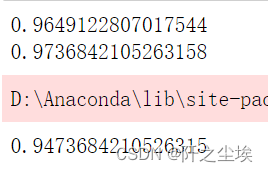
效果差不多。
回归测试
回归使用波士顿数据集
- # Support Vector Regression with Boston Housing Data
- X, y = load_boston(return_X_y=True)
- X_train, X_test, y_train, y_test = train_test_split(X, y, test_size=0.2, random_state=1)
- scaler = StandardScaler()
- scaler.fit(X_train)
- X_train_s = scaler.transform(X_train)
- X_test_s = scaler.transform(X_test)
支持向量机效果:(不同核函数)
- #线性核函数
- model = SVR(kernel="linear")
- model.fit(X_train_s, y_train)
- print(model.score(X_test_s, y_test))
- #二次多项式核
- model = SVR(kernel="poly", degree=2)
- model.fit(X_train_s, y_train)
- print(model.score(X_test_s, y_test))
- #三次多项式
- model = SVR(kernel="poly", degree=3)
- model.fit(X_train_s, y_train)
- print(model.score(X_test_s, y_test))
- #径向核
- model = SVR(kernel="rbf")
- model.fit(X_train_s, y_train)
- print(model.score(X_test_s, y_test))
- #S核
- model = SVR(kernel="sigmoid")
- model.fit(X_train_s, y_train)
- print(model.score(X_test_s, y_test))

相关向量机(RVM)效果:
- model = RVR(kernel="linear")
- model.fit(X_train_s, y_train)
- print(model.score(X_test_s, y_test))
- model = RVR(kernel="rbf")
- model.fit(X_train_s, y_train)
- print(model.score(X_test_s, y_test))
- model = RVR(kernel="poly")
- model.fit(X_train_s, y_train)
- print(model.score(X_test_s, y_test))

可以看到,在回归问题上,相关向量机比支持向量机的效果要好。
结论:
分类用SVM,回归用RVM
当然我这里只用了两个sklearn自带的数据集测试,结论肯定有点武断,有兴趣的同学可以用于别的数据集,然后做多次K折交叉验证,进一步对比他们的效果。
-
相关阅读:
【allegro 17.4软件操作保姆级教程八】布线操作基础之三
【python】爬取杭州市二手房销售数据做数据分析【附源码】
企业知识库有什么价值?
Java 21 新特性:虚拟线程(Virtual Threads)
可观测|时序数据降采样在Prometheus实践复盘
蓝牙信标的优势及应用场景
装机指南1.0
Oracle共享内存不释放
linux常见命令以及jdk,tomcat环境搭建
GDPU 数据结构 天码行空9
- 原文地址:https://blog.csdn.net/weixin_46277779/article/details/127927306
