-
深入浅出带你走进 RocksDB
RocksDB 是基于 Google LevelDB 研发的高性能 Key-Value 持久化存储引擎,以库组件形式嵌入程序中,为大规模分布式应用在 SSD 上运行提供优化。RocksDB 重点是提供工具支持,具体实现将交给上层应用。
正是这种高度可定制化能力,使得 RocksDB 可涵盖包括工作负载等众多场景的应用,今天我们将逐一为大家介绍:
“为什么需要内存管理器?
为什么不使用现有的内存管理器?
RocksDB 究竟是如何实现的?”01 为什么需要内存管理器?
RocksDB 有很多核心场景需要分配内存的,包括但不限于 Memtable、 Cache、Iterator 等,高效优质的内存分配器就显得尤为重要。一个优秀的通用内存分配器需要具备以下特性:
- 尽量避免内存碎片;并发分配性能好;
- 额外的空间损耗尽量少;
- 兼具通用性、兼容性、可移植性且易调试。
内存管理可以分为 3 个层次,自下而上分别是:
- 操作系统内核的内存管理;
- glibc 层使用系统调用维护的内存管理;
- 应用程序从 glibc 层动态分配内存后,根据应用程序本身的程序特性进行优化, 比如使用引用计数、std::shared_ptr、apache 等内存池方式的内存管理。
目前大部分服务端程序使用 glibc 提供的 malloc/free 系列函数,而 glibc 使用的 ptmalloc2 在性能上远远落后于 Google 的 Tcmalloc 和 Facebook 的 Jemalloc 。 后两者只需使用 LD_PRELOAD 环境变量启动程序即可,甚至并不需要重新编译。
02 为什么不使用现有内存管理器?
RocksDB 使用内存的场景集中在 Memtable、Cache、Iterator 等核心链路上,在保证高性能的同时,还需要实现对内存分配器内部控制(包括监控等)。
当前现有的内存分配器不具有主动上报内存监控细节,所以从长远看,依旧需要自己实现 RocksDB 专有的内存管理器。内存管理器设计思路如下:
- 小内存的申请通过 Thread-cache 或者 Per-cpu cache,保证了 CPU 不会频繁的 cache-miss;
- 若支持 MAP_HUGETLB,则会直接 mmap;
- 若大页内存则直接从底层的分配器去申请。
03 RocksDB 是如何实现的?
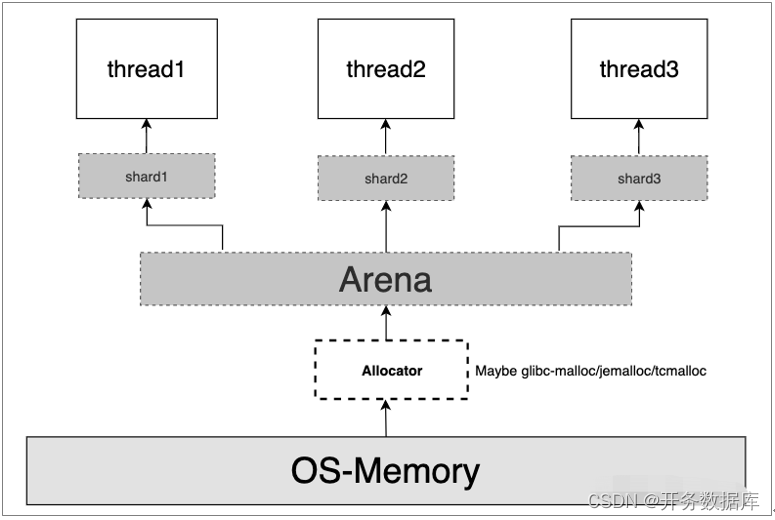
如图所示,RocksDB 的内存管理器是支持并发的,接下来让我们一起从源码入手,看看具体如何实现的。
Allocator
// Abstract interface for allocating memory in blocks. This memory is freed
// When the allocator object is destroyed. See the Arena class for more info.
class Allocator {
 public:
  virtual ~Allocator() {}
  // 分配内存
  virtual char* Allocate(size_t bytes) = 0;
  // 对齐分配内存
  virtual char* AllocateAligned(size_t bytes, size_t huge_page_size = 0,
                                Logger* logger = nullptr) = 0;
  // 块大小
  virtual size_t BlockSize() const = 0;
};
Arena
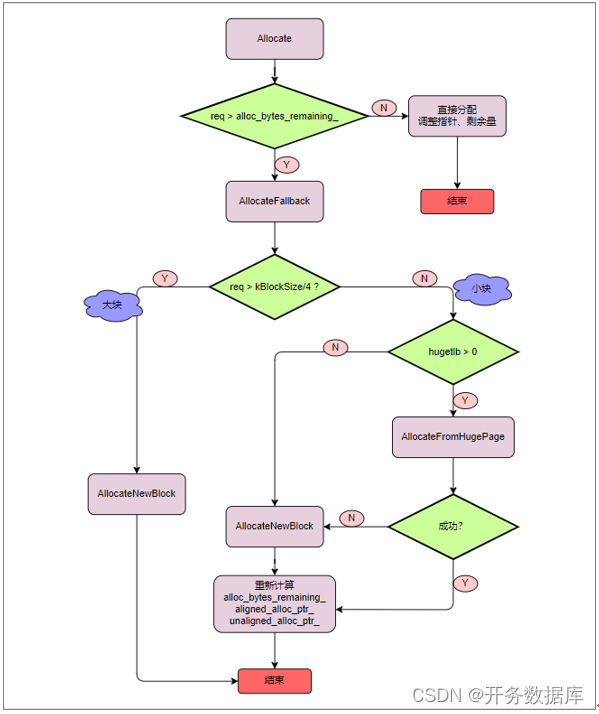
Arena 负责实现 RocksDB 的内存分配,我们从中可以看到其针对不同大小的内存分配请求,采取不同的分配策略,从而减少内存碎片。
class Arena : public Allocator { static const size_t kInlineSize = 2048; static const size_t kMinBlockSize; // 4K static const size_t kMaxBlockSize; // 2G private: char inline_block_[kInlineSize] __attribute__((__aligned__(alignof(max_align_t)))); const size_t kBlockSize; // 每个 Block 的大小 using Blocks = std::vectorhuge_blocks_; // 大块使用 mmap size_t irregular_block_num = 0; // 不整齐的块分配次数(块大于 kBlockSize/4) char* unaligned_alloc_ptr_ = nullptr; // 未对齐的一端指针(高地址开始) char* aligned_alloc_ptr_ = nullptr; // 对齐一端指针(低地址开始) size_t alloc_bytes_remaining_ = 0; // 内存剩余 size_t blocks_memory_ = 0; // 已经分配的内存大小 #ifdef MAP_HUGETLB size_t hugetlb_size_ = 0; #endif // MAP_HUGETLB char* AllocateFromHugePage(size_t bytes); char* AllocateFallback(size_t bytes, bool aligned); char* AllocateNewBlock(size_t block_bytes); AllocTracker* tracker_; } 针对 Allocate 和 AllocateAligned,我们采用对同一块 Block 的两端进行分配。AllocateAligned 从内存块的低地址开始分配,Allocate 从高地址开始分配。分配流程图如下:
ConcurrentArena
内存分配器不仅需要减少内存碎片,同样需要保证并发分配的性能,那么 RocksDB 是如何实现 ConcurrentArena 的呢?
从内存管理架构图可以看出,RocksDB 维护了 CoreLocal 内存数组,每个线程从所在 CPU 对应的本地 Shard 上分配内存,若不足再去主内存 Arena 进行分配。我们从几个核心类开始逐一介绍:
1、ConcurrentArena
class ConcurrentArena : public Allocator { public: // block_size and huge_page_size are the same as for Arena (and are // in fact just passed to the constructor of arena_. The core-local // shards compute their shard_block_size as a fraction of block_size // that varies according to the hardware concurrency level. explicit ConcurrentArena(size_t block_size = Arena::kMinBlockSize, AllocTracker* tracker = nullptr, size_t huge_page_size = 0); char* Allocate(size_t bytes) override { return AllocateImpl(bytes, false /*force_arena*/, [this, bytes]() { return arena_.Allocate(bytes); }); } private: ... CoreLocalArrayshards_; // 维护了一个 CoreLocal 内存数组 Arena arena_; // 主内存 ... }; 2、CoreLocalArray
// An array of core-local values. Ideally the value type, T, is cache aligned to // prevent false sharing. templateclass CoreLocalArray { public: ... // returns pointer to element for the specified core index. This can be used, // e.g., for aggregation, or if the client caches core index. T* AccessAtCore(size_t core_idx) const; private: std::unique_ptr 3、并发分配流程
templatechar* AllocateImpl(size_t bytes, bool force_arena, const Func& func) { size_t cpu; // 1:大块则直接从 Arena 上分配,需要加锁 std::unique_lock arena_lock(arena_mutex_, std::defer_lock); if (bytes > shard_block_size_ / 4 || force_arena || ((cpu = tls_cpuid) == 0 && !shards_.AccessAtCore(0)->allocated_and_unused_.load( std::memory_order_relaxed) && arena_lock.try_lock())) { if (!arena_lock.owns_lock()) { arena_lock.lock(); } auto rv = func(); Fixup(); return rv; } // 2:挑选 CPU 对应的 Shard Shard* s = shards_.AccessAtCore(cpu & (shards_.Size() - 1)); if (!s->mutex.try_lock()) { s = Repick(); s->mutex.lock(); } std::unique_lock lock(s->mutex, std::adopt_lock); size_t avail = s->allocated_and_unused_.load(std::memory_order_relaxed); // 2.1:若当前 Shard 可用内存不够时,去 Arena 分配存入 Shard if (avail < bytes) { // reload std::lock_guard reload_lock(arena_mutex_); // If the arena's current block is within a factor of 2 of the right // size, we adjust our request to avoid arena waste. auto exact = arena_allocated_and_unused_.load(std::memory_order_relaxed); assert(exact == arena_.AllocatedAndUnused()); if (exact >= bytes && arena_.IsInInlineBlock()) { // If we haven't exhausted arena's inline block yet, allocate from arena // directly. This ensures that we'll do the first few small allocations // without allocating any blocks. // In particular this prevents empty memtables from using // disproportionately large amount of memory: a memtable allocates on // the order of 1 KB of memory when created; we wouldn't want to // allocate a full arena block (typically a few megabytes) for that, // especially if there are thousands of empty memtables. auto rv = func(); Fixup(); return rv; } avail = exact >= shard_block_size_ / 2 && exact < shard_block_size_ * 2 ? exact : shard_block_size_; s->free_begin_ = arena_.AllocateAligned(avail); Fixup(); } s->allocated_and_unused_.store(avail - bytes, std::memory_order_relaxed); // 3:根据是否对齐,判断是从高地址/低地址分配 char* rv; if ((bytes % sizeof(void*)) == 0) { // aligned allocation from the beginning rv = s->free_begin_; s->free_begin_ += bytes; } else { // unaligned from the end rv = s->free_begin_ + avail - bytes; } return rv; } 总结
- 入参 Func 就是上面传入的 Lambda 表达式:this, bytes { returnarena_.Allocate(bytes) ;
- 当请求内存块较大时,直接从 Arena 分配且需要加锁;否则直接从当前 CPU 对应的 Shard 分配;
- 若当前 Shard 可用内存不够,需要从 Arena 再次请求;4、根据是否对齐,判断从高/低地址分配。
-
相关阅读:
安装银河麒麟linux系统docker(docker-compose)环境,注意事项(一定能解决,有环境资源)
串口服务器和光纤交换机的区别
Elasticsearch搜索引擎
C#virtual关键
Linux-安装和登陆命令-mount,unmount
Sketch for mac v98.3(ui设计矢量绘图)
3D全景虚拟样板间展销系统扩展用户市场范围
包埋紫杉醇的Pluronic P85/聚乳酸(PLA-P85-PLA)纳米粒子|制备方法
PTR记录-系统架构师(五)
C语言理论--笔试面试基础稳固
- 原文地址:https://blog.csdn.net/ZNBase/article/details/126975482