-
二叉树与递归问题
目录
用递归解决的问题必须注意的:
- 递归的终止条件,也就是递归的出口(否则:栈溢出)
- 递归的过程,也就是最小子结构---逻辑
二叉树是天然的递归结构-----结构就是按照递归定义的
一:求二叉树的深度

- class Solution {
- public:
- int maxDepth(TreeNode* root) {
- int res=0;//定义返回结果
- /*递归终止条件*/
- if(root==NULL) return res;
- /*递归过程--求出左子树高度,求出右子树高度,得出结果*/
- int left=maxDepth(root->left);
- int right=maxDepth(root->right);
- res=max(left,right)+1;//自己占一层
- return res;
- }
- };
可以不申请变量
- int maxDepth(TreeNode* root) {
- int res=0;//定义返回结果
- /*递归终止条件*/
- if(root==NULL) return res;
- /*递归过程--求出左子树高度,求出右子树高度,得出结果*/
- res=max(maxDepth(root->left),maxDepth(root->right))+1;//自己占一层
- return res;
- }
二:二叉树反转
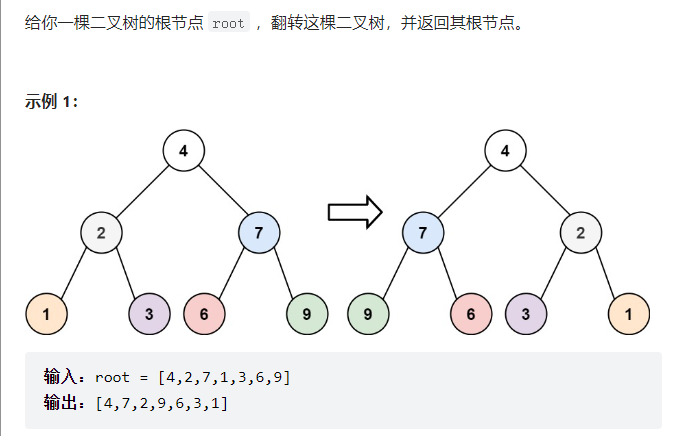
- TreeNode* invertTree(TreeNode* root) {
- //递归结束条件
- if(root==NULL) return root;
- //递归:左子树和右子树互换
- TreeNode* tmp=invertTree(root->right);
- root->right=invertTree(root->left);
- root->left=tmp;
- return root;
- }
这个思路很清晰:
返回值一定是根节点------为NULL返回,不为空执行递归过程。
在写递归逻辑时,一定从最简单入手。
因为左子树和右子树要交换,定义变量tmp接收右子树的结果,然后把右子树直接传入左子树,最后交换即可。
- TreeNode* invertTree(TreeNode* root) {
- //递归结束条件
- if(root==NULL) return root;
- //递归:左子树和右子树互换
- invertTree(root->left);
- invertTree(root->right);
- swap(root->left,root->right);
- return root;
- }
这里不格外定义变量
三:二叉树镜像判断

给出的函数------bool isSymmetric(TreeNode* root)
思路分析:
这里函数只给出一个变量,但是因为轴的存在,肯定的需要两个指针分别指向一左一右来比较数值
bool twoSymNodes(TreeNode* p,TreeNode* q)
然后只要判断,首先一个为空另一个不为空一定不对称
其次:都不为空时,如果数值不同,一定对称。
最后递归:结束递归(两个指针为空),接受
递归:不断传入p左q右和p右q左
- /*
- 说白了就是:比较同层次的两个结点p,q
- 保证:p左=q右;p右=q左
- */
- class Solution {
- public:
- bool twoSymNodes(TreeNode* p,TreeNode* q){
- //只考虑存在
- if(p&&!q) return false;
- else if(!p&&q) return false;
- else if(!p&&!q) return true;
- else{
- if(p->val!=q->val) return false;
- return twoSymNodes(p->left,q->right)&&twoSymNodes(p->right,q->left);
- }
- }
- bool isSymmetric(TreeNode* root) {
- //空树对称
- if(root==NULL) return true;
- //比较---最复杂情况(p左=q右 + p右=q左)
- return twoSymNodes(root,root);
- }
- };
- class Solution {
- public:
- bool twoSymNodes(TreeNode* p,TreeNode* q){
- //递归结束的接受状态
- if(!p&&!q) return true;//p,q均为空
- //不接受状态
- if((p&&!q)||(!p&&q)) return false;
- assert(p&&q);
- if(p->val!=q->val) return false;
- else{
- //递归
- return twoSymNodes(p->left,q->right)&&twoSymNodes(p->right,q->left);
- }
- }
- bool isSymmetric(TreeNode* root) {
- return twoSymNodes(root,root);
- }
- };
当然可以优化一些细节,比如主程序的root==NULL可以不判断。
这里:传参数量不能满足题目要求,要自己设计函数传参 四:递归的终止条件

分析:
算法思想就是:
在左右子树寻找sum-当前结点值,如果相等了只要该结点是叶子结点就满足题意
- bool hasPathSum(TreeNode* root, int targetSum) {
- if(root==NULL) return false;//空树无路径
- if(!root->left&&!root->right&&root->val==targetSum) return true;
- bool a=hasPathSum(root->left,targetSum-(root->val));
- bool b=hasPathSum(root->right,targetSum-(root->val));
- if(a||b) return true;
- else return false;
- }
注意递归终止条件和递归的使用。

- bool hasPathSum(TreeNode* root, int targetSum) {
- if(root==NULL) return false;
- if(!root->left&&!root->right) return root->val==targetSum;
- if(hasPathSum(root->left,targetSum-(root->val))) return true;
- if(hasPathSum(root->right,targetSum-(root->val))) return true;
- return false;
- }
这个写法也满足:叶子结点等于符合条件的值
-
相关阅读:
DDR电源硬件设计要点
第九章 聚类
计算机网络 | 刷题笔记
Idea常用插件及其作用
Java项目硅谷课堂学习笔记-P8点播模块管理-后台-管理员端
tokenizer.tokenize(), tokenizer.encode() , tokenizer.encode_plus() 方法介绍及其区别
MobileNet系列(4):MobileNetv3网络详解
学期伊始,来填两年前的flag,这是我的笔记博客网站!
数据标注典型案例,景联文科技如何助力企业搭建数据方案
如何通过低代码平台来实现移动办公
- 原文地址:https://blog.csdn.net/weixin_47173597/article/details/126920277
