-
systemverilog学习 ---- coverage完结&& 数组操作方法1
cross coverage
交叉覆盖率,指的是覆盖点或者变量的取值。在前面我们只讨论一个变量的所有取值作为覆盖点,但是我们还可以使用两个变量取值的排列组合作为覆盖点。表达式不能再cross中使用,一个覆盖点必须在之前被清晰的定义才行。
bit [3:0] a, b; covergroup cg @(posedge clk); c1:coverpoint a; c2:coverpoint b; c1Xc2: cross c1, c2; endgroup:cg- 1
- 2
- 3
- 4
- 5
- 6
在上面的例子中,定义了两个覆盖点c1和c2,基于c1,c2定义了交叉覆盖c1Xc2。
bit [3:0] a,b; covergroup cov @(posedge clk); aXb: cross a,b; endgroup- 1
- 2
- 3
- 4
在上面的例子中,每个覆盖点都有16个bins,分别是auto[0],auto[1],…,auto[15]。变量a和b的交叉被aXb所标记。交叉起来,则有256种可能的取值。
bit [3:0] a, b, c; covergroup cov @(posedge clk); BC: coverpoint b+c; aXb: cross a, BC; endgroup- 1
- 2
- 3
- 4
- 5
在上面的例子种,这个覆盖组合依然有256种可能的取值组合,更为复杂些,可以同时使用变量和表达式,BC取值覆盖了b+c所有可能的取值组合,aXb则是变量a和覆盖点BC的取值集合。
cover option
我们可以通过一些开关选项option来控制covergroup,coverpoint和cross的行为。
at_least
指定命中bins的次数,前面提到取值落到bins范围,bins会自增,当bins命中的次数小于所指定的值时,则认为此时bins没有覆盖。默认为1.
auto_bin_max
当我们没有显示的创建bins,会自动创建,改选项可以自动指定自动创建的bin的数目,默认值为64.
cross_auto_bin_max
于auto_bin_max较为类似,不过这适用于交叉覆盖。
下面的例子展示了如何使用optioncovergroup cg @(poseedge clk); c1: coverpoint addr {option.auto_bin_max = 128;} c2: coverpoint wr_rd {option.atleast = 2;} c2Xc2: cross c1, c2 {option.cross_auto_bin_max = 128;} endgroup- 1
- 2
- 3
- 4
- 5
数组方法
数组包括数组、动态数组、队列。下面主要讨论操纵数组数据的方法。
参数化定义
有两种方法来定义常数,如下所示:
- parameter
- `define
parameter
参数必须被定义在模块内部,且需使用关键字parameter修饰。一个parameter在模块内部的一个常数,可以有选择性的在模块外部重新定义。一般是用来指定变量的位宽或者时间的延迟。module mem_model #( parameter ADDR_WIDTH=8; parameter DATA_WIDTH=32;) (clk, addr, data); input clk; input [ADDR_WIDTH-1:0] addr; output [DATA_WIDTH-1:0] data; ..... ..... endmodule- 1
- 2
- 3
- 4
- 5
- 6
- 7
- 8
- 9
- 10
- 11
`define
它修饰的是一个全局变量,可以在被所有的文件所访问到。它改变有两种情形,一是另一个宏定义改变了这个值,或者是使用 undef语句。`define WIDTH 8 //to avoid redefincation `ifdef can be used `ifdef WIDTH // do nothing (better to use `ifndef) `else `define WIDTH 8 `ifndef WIDTH `define WIDTH 8 `endif `ifdef can be used as if else `ifdef TYPE_1 `define WIDTH 8 `else `define WIDTH 32 `endif //`ifdef can also be used to avoid redefining/recompiling the module/class //In the below example //definition of MODULE_1 is checked, if it is not defined then MODULE_1 will be //defined and compiles the module/class inside the `ifndef ---- `endif `ifndef MODULE_1 `define MODULE_1 module mem; endmodule `endif- 1
- 2
- 3
- 4
- 5
- 6
- 7
- 8
- 9
- 10
- 11
- 12
- 13
- 14
- 15
- 16
- 17
- 18
- 19
- 20
- 21
- 22
- 23
- 24
- 25
- 26
- 27
- 28
- 29
- 30
- 31
- 32
数组排序方法
这类方法处理一维数组或者队列,可以对数据元素重新排序,有如下构建方法:
方法 描述 reverse() 把数组里面的所有元素都倒转(封装或者是不封装) sort() 升序排序所有数组里面的元素 rsort() 降序排序所有数组里面的元素 shuffle() 随机化数组里面元素的顺序,即打乱 module fixedsize_array; //declaration of array's int array_1[4]; int array_2[4]; int array_3[4]; int array_4[4]; initial begin //array initialization array_1 = '{0,1,2,3}; array_2 = '{2,3,1,0}; array_3 = '{2,3,1,0}; array_4 = '{0,1,2,3}; $display("==============reverse=============="); $display("Before:\t %p", array_1); array_1.reverse(); $display("After :\t %p", array_1); $display("=================================="); $display("==============sort=============="); $display("Before:\t %p", array_2); array_2.sort(); $display("After :\t %p", array_2); $display("=================================="); $display("==============rsort=============="); $display("Before:\t %p", array_3); array_3.rsort(); $display("After :\t %p", array_3); $display("=================================="); $display("==============shuffle=============="); $display("Before:\t %p", array_4); array_4.shuffle(); $display("After :\t %p", array_4); $display("=================================="); end endmodule- 1
- 2
- 3
- 4
- 5
- 6
- 7
- 8
- 9
- 10
- 11
- 12
- 13
- 14
- 15
- 16
- 17
- 18
- 19
- 20
- 21
- 22
- 23
- 24
- 25
- 26
- 27
- 28
- 29
- 30
- 31
- 32
- 33
- 34
- 35
- 36
- 37
- 38
- 39
- 40
- 41
- 42
- 43
- 44
执行结果如下:

class packet; int a; int b; function void display(); $display("\t Value od a = %0d", a); $display("\t Value of b = %0d", b); endfunction endclass module assoc_array; //declaratio of array's packet array_1[*]; packet pkt; initial begin pkt = new(); pkt.a = 8; pkt.b = 3; array_1[3] = pkt; pkt = new(); pkt.a = 0; pkt.b = 6; array_1[7] = pkt; pkt = new(); pkt.a = 2; pkt.b = 1; array_1[9] = pkt; $display("======== sort =========="); $display("Before"); foreach (array_1[i]) begin $display("array_1[%0d]:", i); array_1[i].display(); end array_1.sort with (item.a); $display("\n After"); foreach (array_1[i]) begin $display("array_1[%0d]:", i); array_1[i].display(); end $display("==========================="); end endmodule- 1
- 2
- 3
- 4
- 5
- 6
- 7
- 8
- 9
- 10
- 11
- 12
- 13
- 14
- 15
- 16
- 17
- 18
- 19
- 20
- 21
- 22
- 23
- 24
- 25
- 26
- 27
- 28
- 29
- 30
- 31
- 32
- 33
- 34
- 35
- 36
- 37
- 38
- 39
- 40
- 41
- 42
- 43
- 44
- 45
- 46
- 47
- 48
- 49
- 50
- 51
- 52
对于排序,如果数组元素是类的实例,并且类的变量不止一个时,排序就需要指定哪个值作为怕排序标准,此时可以提供过with指定标准。在qutasim无法执行关联数组,因此下面的实验是跑在vcs上,执行结果如下:
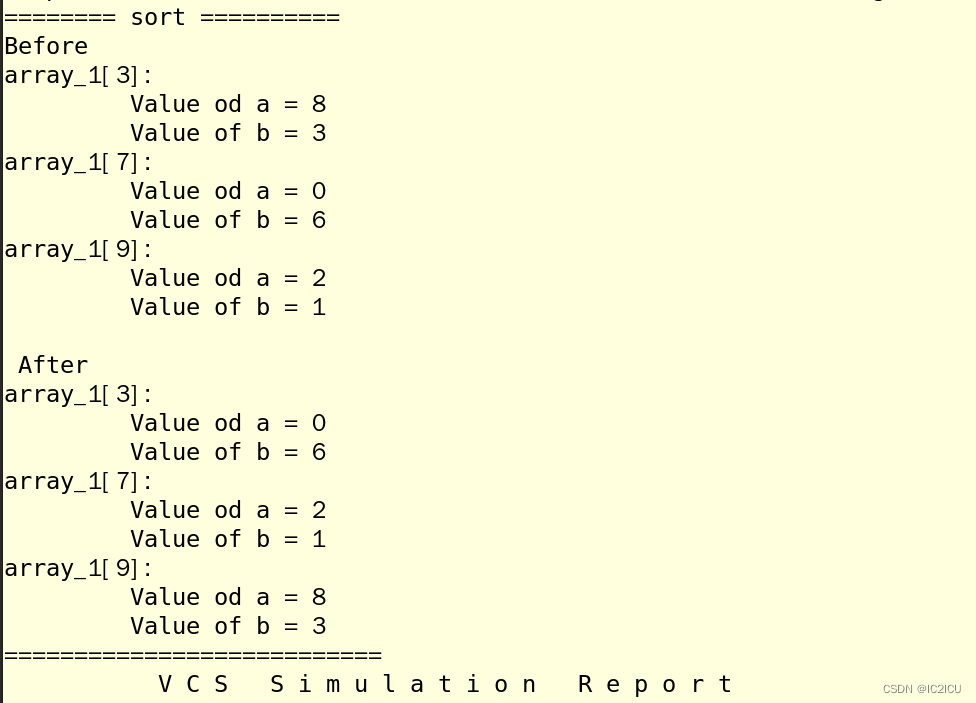
由此可见,我们可以通过with(item.a)让类按照其中的变量a的大小进行排序。 -
相关阅读:
Scala下载和配置
stm32超声波测距不准的解决方法(STM32 delay_us()产生1us)及stm32智能小车超声波测距代码(C语言版本)
聚量推客滴滴学生认证app地推网推拉新升级啦
计网实验软件 Cisco Packet Tracer 8 获取并汉化
JS语言里常见的随机函数示例,实验结果分布规律分析
电力电子转战数字IC20220718-19day51-52——TLM通信
Spring cloud gateway+JWT+服务间鉴权实战
斯凯奇诉爱马仕侵权——品牌发展需警惕知识产权侵权
智慧港口视频智能分析系统解决方案
BBAVectors斜框检测网络更换轻量型主干网络
- 原文地址:https://blog.csdn.net/weixin_45614076/article/details/126478210

- 最新文章
-
沪漂五周年了:我越来越迷茫了
Agentic Skill Routing 实战:别再把所有 Skill 塞进 AI Agent 上下文
MySQL-Seconds_behind_master的精度误差
[MAF预定义ChatClient中间件-03]CachingChatClient——利用缓存省钱省时间
AI的至暗历史:从万众期待到被政府撤资,AI的两次死亡徘徊
Agent OS :五种驯服不确定性的范式
PortSwigger SQL注入LAB11
数据库即时编译JIT
[Begin]AI Learn Data Day 0
深度学习进阶(二十七)现代 LLM 的核心架构设计其二:SwiGLU