-
YOLO V5源码详解
1.数据读取
首先读取图片以及标签路径,并将标签存入缓存,对单标签情况、特定类别、以及是否保持长方形等情况分别进行处理。
如果需要进行mosaic 数据增强,首先找到中心点,将图片分别放置于四个位置,进行裁剪或者拼接以适应,并对labels进行调整。同时,对进行过mosaic数据增强过的图像,再进行copy_paste数据增强和旋转、平移、缩放数据增强。
同时,还可以进行其他数据增强方式,比如mix up,hsv等
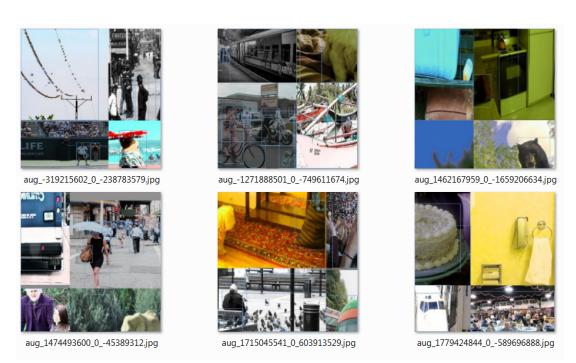
代码如下:
- class LoadImagesAndLabels(Dataset):
- # YOLOv5 train_loader/val_loader, loads images and labels for training and validation
- cache_version = 0.6 # dataset labels *.cache version
- rand_interp_methods = [cv2.INTER_NEAREST, cv2.INTER_LINEAR, cv2.INTER_CUBIC, cv2.INTER_AREA, cv2.INTER_LANCZOS4]
- def __init__(self,
- path,
- img_size=640,
- batch_size=16,
- augment=False,
- hyp=None,
- rect=False,
- image_weights=False,
- cache_images=False, # 缓存图片
- single_cls=False,
- stride=32,
- pad=0.0,
- prefix=''):
- self.img_size = img_size
- self.augment = augment
- self.hyp = hyp
- self.image_weights = image_weights
- self.rect = False if image_weights else rect
- self.mosaic = self.augment and not self.rect # load 4 images at a time into a mosaic (only during training)
- self.mosaic_border = [-img_size // 2, -img_size // 2] # 拼接过程中按照什么中心点进行拼接
- self.stride = stride
- self.path = path
- self.albumentations = Albumentations() if augment else None
- try:
- f = [] # image files
- for p in path if isinstance(path, list) else [path]: # window和linux
- p = Path(p) # os-agnostic
- if p.is_dir(): # dir
- f += glob.glob(str(p / '**' / '*.*'), recursive=True) # 获取指定路径
- # f = list(p.rglob('*.*')) # pathlib
- elif p.is_file(): # file
- with open(p) as t:
- t = t.read().strip().splitlines() # 读取图片路径
- parent = str(p.parent) + os.sep # 指定系统分隔符
- # 相对地址转绝对地址
- f += [x.replace('./', parent) if x.startswith('./') else x for x in t] # local to global path
- # f += [p.parent / x.lstrip(os.sep) for x in t] # local to global path (pathlib)
- else:
- raise FileNotFoundError(f'{prefix}{p} does not exist')
- self.im_files = sorted(x.replace('/', os.sep) for x in f if x.split('.')[-1].lower() in IMG_FORMATS) # 排序
- # self.img_files = sorted([x for x in f if x.suffix[1:].lower() in IMG_FORMATS]) # pathlib
- assert self.im_files, f'{prefix}No images found'
- except Exception as e:
- raise Exception(f'{prefix}Error loading data from {path}: {e}\nSee {HELP_URL}')
- # Check cache
- self.label_files = img2label_paths(self.im_files) # labels
- # 设置缓存
- cache_path = (p if p.is_file() else Path(self.label_files[0]).parent).with_suffix('.cache')
- try:
- cache, exists = np.load(cache_path, allow_pickle=True).item(), True # load dict
- assert cache['version'] == self.cache_version # matches current version
- assert cache['hash'] == get_hash(self.label_files + self.im_files) # identical hash
- except Exception:
- cache, exists = self.cache_labels(cache_path, prefix), False # run cache ops
- # Display cache
- nf, nm, ne, nc, n = cache.pop('results') # found, missing, empty, corrupt, total
- if exists and LOCAL_RANK in {-1, 0}:
- d = f"Scanning '{cache_path}' images and labels... {nf} found, {nm} missing, {ne} empty, {nc} corrupt"
- tqdm(None, desc=prefix + d, total=n, initial=n, bar_format=BAR_FORMAT) # display cache results
- if cache['msgs']:
- LOGGER.info('\n'.join(cache['msgs'])) # display warnings
- assert nf > 0 or not augment, f'{prefix}No labels in {cache_path}. Can not train without labels. See {HELP_URL}'
- # Read cache
- [cache.pop(k) for k in ('hash', 'version', 'msgs')] # remove items 去除不需要的信息
- labels, shapes, self.segments = zip(*cache.values())
- self.labels = list(labels) # 标签信息
- self.shapes = np.array(shapes, dtype=np.float64) # 图片大小
- self.im_files = list(cache.keys()) # update 图片文件名称
- self.label_files = img2label_paths(cache.keys()) # update 标签文件名称
- n = len(shapes) # number of images
- bi = np.floor(np.arange(n) / batch_size).astype(np.int) # batch index
- nb = bi[-1] + 1 # number of batches
- self.batch = bi # batch index of image
- self.n = n
- self.indices = range(n) # 索引
- # Update labels 筛选标签以仅包括这些类(可选)
- include_class = [] # filter labels to include only these classes (optional)
- include_class_array = np.array(include_class).reshape(1, -1)
- for i, (label, segment) in enumerate(zip(self.labels, self.segments)):
- if include_class:
- j = (label[:, 0:1] == include_class_array).any(1)
- self.labels[i] = label[j]
- if segment:
- self.segments[i] = segment[j]
- if single_cls: # single-class training, merge all classes into 0
- self.labels[i][:, 0] = 0
- if segment:
- self.segments[i][:, 0] = 0
- # Rectangular Training
- if self.rect:
- # Sort by aspect ratio
- s = self.shapes # wh
- ar = s[:, 1] / s[:, 0] # aspect ratio
- irect = ar.argsort()
- self.im_files = [self.im_files[i] for i in irect]
- self.label_files = [self.label_files[i] for i in irect]
- self.labels = [self.labels[i] for i in irect]
- self.shapes = s[irect] # wh
- ar = ar[irect]
- # Set training image shapes
- shapes = [[1, 1]] * nb
- for i in range(nb):
- ari = ar[bi == i]
- mini, maxi = ari.min(), ari.max()
- if maxi < 1:
- shapes[i] = [maxi, 1]
- elif mini > 1:
- shapes[i] = [1, 1 / mini]
- self.batch_shapes = np.ceil(np.array(shapes) * img_size / stride + pad).astype(np.int) * stride
- # Cache images into RAM/disk for faster training (WARNING: large datasets may exceed system resources)
- # 将图像缓存到RAM/磁盘中以加快训练(警告:大型数据集可能超过系统资源)
- self.ims = [None] * n
- self.npy_files = [Path(f).with_suffix('.npy') for f in self.im_files]
- if cache_images:
- gb = 0 # Gigabytes of cached images
- self.im_hw0, self.im_hw = [None] * n, [None] * n
- fcn = self.cache_images_to_disk if cache_images == 'disk' else self.load_image
- results = ThreadPool(NUM_THREADS).imap(fcn, range(n))
- pbar = tqdm(enumerate(results), total=n, bar_format=BAR_FORMAT, disable=LOCAL_RANK > 0)
- for i, x in pbar:
- if cache_images == 'disk':
- gb += self.npy_files[i].stat().st_size
- else: # 'ram'
- self.ims[i], self.im_hw0[i], self.im_hw[i] = x # im, hw_orig, hw_resized = load_image(self, i)
- gb += self.ims[i].nbytes
- pbar.desc = f'{prefix}Caching images ({gb / 1E9:.1f}GB {cache_images})'
- pbar.close()
- def cache_labels(self, path=Path('./labels.cache'), prefix=''):
- # Cache dataset labels, check images and read shapes
- x = {} # dict
- nm, nf, ne, nc, msgs = 0, 0, 0, 0, [] # number missing, found, empty, corrupt, messages
- desc = f"{prefix}Scanning '{path.parent / path.stem}' images and labels..."
- with Pool(NUM_THREADS) as pool:
- pbar = tqdm(pool.imap(verify_image_label, zip(self.im_files, self.label_files, repeat(prefix))),
- desc=desc,
- total=len(self.im_files),
- bar_format=BAR_FORMAT)
- for im_file, lb, shape, segments, nm_f, nf_f, ne_f, nc_f, msg in pbar:
- nm += nm_f
- nf += nf_f
- ne += ne_f
- nc += nc_f
- if im_file:
- x[im_file] = [lb, shape, segments]
- if msg:
- msgs.append(msg)
- pbar.desc = f"{desc}{nf} found, {nm} missing, {ne} empty, {nc} corrupt"
- pbar.close()
- if msgs:
- LOGGER.info('\n'.join(msgs))
- if nf == 0:
- LOGGER.warning(f'{prefix}WARNING: No labels found in {path}. See {HELP_URL}')
- x['hash'] = get_hash(self.label_files + self.im_files)
- x['results'] = nf, nm, ne, nc, len(self.im_files)
- x['msgs'] = msgs # warnings
- x['version'] = self.cache_version # cache version
- try:
- np.save(path, x) # save cache for next time
- path.with_suffix('.cache.npy').rename(path) # remove .npy suffix
- LOGGER.info(f'{prefix}New cache created: {path}')
- except Exception as e:
- LOGGER.warning(f'{prefix}WARNING: Cache directory {path.parent} is not writeable: {e}') # not writeable
- return x
- def __len__(self):
- return len(self.im_files)
- # def __iter__(self):
- # self.count = -1
- # print('ran dataset iter')
- # #self.shuffled_vector = np.random.permutation(self.nF) if self.augment else np.arange(self.nF)
- # return self
- def __getitem__(self, index):
- index = self.indices[index] # linear, shuffled, or image_weights
- hyp = self.hyp
- mosaic = self.mosaic and random.random() < hyp['mosaic']
- if mosaic:
- # Load mosaic mosaic数据增强
- img, labels = self.load_mosaic(index)
- shapes = None
- # MixUp augmentation
- if random.random() < hyp['mixup']:
- img, labels = mixup(img, labels, *self.load_mosaic(random.randint(0, self.n - 1)))
- else:
- # 不进行mosaic的操作
- # Load image
- img, (h0, w0), (h, w) = self.load_image(index)
- # Letterbox
- shape = self.batch_shapes[self.batch[index]] if self.rect else self.img_size # final letterboxed shape
- img, ratio, pad = letterbox(img, shape, auto=False, scaleup=self.augment)
- shapes = (h0, w0), ((h / h0, w / w0), pad) # for COCO mAP rescaling
- labels = self.labels[index].copy()
- if labels.size: # normalized xywh to pixel xyxy format
- labels[:, 1:] = xywhn2xyxy(labels[:, 1:], ratio[0] * w, ratio[1] * h, padw=pad[0], padh=pad[1])
- if self.augment:
- img, labels = random_perspective(img,
- labels,
- degrees=hyp['degrees'],
- translate=hyp['translate'],
- scale=hyp['scale'],
- shear=hyp['shear'],
- perspective=hyp['perspective'])
- nl = len(labels) # number of labels
- if nl:
- # x1,y1,x2,y2 转换为x,y,w,h
- labels[:, 1:5] = xyxy2xywhn(labels[:, 1:5], w=img.shape[1], h=img.shape[0], clip=True, eps=1E-3)
- if self.augment:
- # Albumentations 数据增强
- img, labels = self.albumentations(img, labels)
- nl = len(labels) # update after albumentations
- # HSV color-space
- augment_hsv(img, hgain=hyp['hsv_h'], sgain=hyp['hsv_s'], vgain=hyp['hsv_v'])
- # Flip up-down 翻转操作
- if random.random() < hyp['flipud']:
- img = np.flipud(img)
- if nl:
- labels[:, 2] = 1 - labels[:, 2]
- # Flip left-right
- if random.random() < hyp['fliplr']:
- img = np.fliplr(img)
- if nl:
- labels[:, 1] = 1 - labels[:, 1]
- # Cutouts
- # labels = cutout(img, labels, p=0.5)
- # nl = len(labels) # update after cutout
- labels_out = torch.zeros((nl, 6))
- if nl:
- labels_out[:, 1:] = torch.from_numpy(labels)
- # Convert
- img = img.transpose((2, 0, 1))[::-1] # HWC to CHW, BGR to RGB
- # ascontiguousarray函数将一个内存不连续存储的数组转换为内存连续存储的数组,使得运行速度更快
- img = np.ascontiguousarray(img)
- return torch.from_numpy(img), labels_out, self.im_files[index], shapes
- def load_image(self, i):
- # Loads 1 image from dataset index 'i', returns (im, original hw, resized hw)
- im, f, fn = self.ims[i], self.im_files[i], self.npy_files[i],
- if im is None: # not cached in RAM
- if fn.exists(): # load npy
- im = np.load(fn)
- else: # read image
- im = cv2.imread(f) # BGR
- assert im is not None, f'Image Not Found {f}'
- h0, w0 = im.shape[:2] # orig hw
- r = self.img_size / max(h0, w0) # ratio
- if r != 1: # if sizes are not equal
- interp = cv2.INTER_LINEAR if (self.augment or r > 1) else cv2.INTER_AREA # 插值方式
- im = cv2.resize(im, (int(w0 * r), int(h0 * r)), interpolation=interp)
- return im, (h0, w0), im.shape[:2] # im, hw_original, hw_resized
- else:
- return self.ims[i], self.im_hw0[i], self.im_hw[i] # im, hw_original, hw_resized
- def cache_images_to_disk(self, i):
- # Saves an image as an *.npy file for faster loading
- f = self.npy_files[i]
- if not f.exists():
- np.save(f.as_posix(), cv2.imread(self.im_files[i]))
- def load_mosaic(self, index):
- # YOLOv5 4-mosaic loader. Loads 1 image + 3 random images into a 4-image mosaic
- labels4, segments4 = [], []
- s = self.img_size
- yc, xc = (int(random.uniform(-x, 2 * s + x)) for x in self.mosaic_border) # mosaic center x, y
- indices = [index] + random.choices(self.indices, k=3) # 3 additional image indices
- random.shuffle(indices)
- for i, index in enumerate(indices):
- # Load image 加载图片,并将长边resize成(640,640)
- img, _, (h, w) = self.load_image(index)
- # place img in img4
- if i == 0: # top left
- img4 = np.full((s * 2, s * 2, img.shape[2]), 114, dtype=np.uint8) # base image with 4 tiles
- x1a, y1a, x2a, y2a = max(xc - w, 0), max(yc - h, 0), xc, yc # xmin, ymin, xmax, ymax (large image)
- x1b, y1b, x2b, y2b = w - (x2a - x1a), h - (y2a - y1a), w, h # xmin, ymin, xmax, ymax (small image)
- elif i == 1: # top right
- x1a, y1a, x2a, y2a = xc, max(yc - h, 0), min(xc + w, s * 2), yc
- x1b, y1b, x2b, y2b = 0, h - (y2a - y1a), min(w, x2a - x1a), h
- elif i == 2: # bottom left
- x1a, y1a, x2a, y2a = max(xc - w, 0), yc, xc, min(s * 2, yc + h)
- x1b, y1b, x2b, y2b = w - (x2a - x1a), 0, w, min(y2a - y1a, h)
- elif i == 3: # bottom right
- x1a, y1a, x2a, y2a = xc, yc, min(xc + w, s * 2), min(s * 2, yc + h)
- x1b, y1b, x2b, y2b = 0, 0, min(w, x2a - x1a), min(y2a - y1a, h)
- img4[y1a:y2a, x1a:x2a] = img[y1b:y2b, x1b:x2b] # img4[ymin:ymax, xmin:xmax]
- padw = x1a - x1b
- padh = y1a - y1b
- # Labels
- labels, segments = self.labels[index].copy(), self.segments[index].copy()
- if labels.size:
- # 将xywh转换为x1,y1,x2,y2并加上padw,padh
- labels[:, 1:] = xywhn2xyxy(labels[:, 1:], w, h, padw, padh) # normalized xywh to pixel xyxy format
- segments = [xyn2xy(x, w, h, padw, padh) for x in segments]
- labels4.append(labels)
- segments4.extend(segments)
- # Concat/clip labels 将标签限制在0,2s
- labels4 = np.concatenate(labels4, 0)
- for x in (labels4[:, 1:], *segments4):
- np.clip(x, 0, 2 * s, out=x) # clip when using random_perspective()
- # img4, labels4 = replicate(img4, labels4) # replicate
- # Augment
- # copy_pase数据增强
- img4, labels4, segments4 = copy_paste(img4, labels4, segments4, p=self.hyp['copy_paste'])
- # 数据增强,旋转、平移、缩放
- img4, labels4 = random_perspective(img4,
- labels4,
- segments4,
- degrees=self.hyp['degrees'],
- translate=self.hyp['translate'],
- scale=self.hyp['scale'],
- shear=self.hyp['shear'],
- perspective=self.hyp['perspective'],
- border=self.mosaic_border) # border to remove
- return img4, labels4
- def load_mosaic9(self, index):
- # YOLOv5 9-mosaic loader. Loads 1 image + 8 random images into a 9-image mosaic
- labels9, segments9 = [], []
- s = self.img_size
- indices = [index] + random.choices(self.indices, k=8) # 8 additional image indices
- random.shuffle(indices)
- hp, wp = -1, -1 # height, width previous
- for i, index in enumerate(indices):
- # Load image
- img, _, (h, w) = self.load_image(index)
- # place img in img9
- if i == 0: # center
- img9 = np.full((s * 3, s * 3, img.shape[2]), 114, dtype=np.uint8) # base image with 4 tiles
- h0, w0 = h, w
- c = s, s, s + w, s + h # xmin, ymin, xmax, ymax (base) coordinates
- elif i == 1: # top
- c = s, s - h, s + w, s
- elif i == 2: # top right
- c = s + wp, s - h, s + wp + w, s
- elif i == 3: # right
- c = s + w0, s, s + w0 + w, s + h
- elif i == 4: # bottom right
- c = s + w0, s + hp, s + w0 + w, s + hp + h
- elif i == 5: # bottom
- c = s + w0 - w, s + h0, s + w0, s + h0 + h
- elif i == 6: # bottom left
- c = s + w0 - wp - w, s + h0, s + w0 - wp, s + h0 + h
- elif i == 7: # left
- c = s - w, s + h0 - h, s, s + h0
- elif i == 8: # top left
- c = s - w, s + h0 - hp - h, s, s + h0 - hp
- padx, pady = c[:2]
- x1, y1, x2, y2 = (max(x, 0) for x in c) # allocate coords
- # Labels
- labels, segments = self.labels[index].copy(), self.segments[index].copy()
- if labels.size:
- labels[:, 1:] = xywhn2xyxy(labels[:, 1:], w, h, padx, pady) # normalized xywh to pixel xyxy format
- segments = [xyn2xy(x, w, h, padx, pady) for x in segments]
- labels9.append(labels)
- segments9.extend(segments)
- # Image
- img9[y1:y2, x1:x2] = img[y1 - pady:, x1 - padx:] # img9[ymin:ymax, xmin:xmax]
- hp, wp = h, w # height, width previous
- # Offset
- yc, xc = (int(random.uniform(0, s)) for _ in self.mosaic_border) # mosaic center x, y
- img9 = img9[yc:yc + 2 * s, xc:xc + 2 * s]
- # Concat/clip labels
- labels9 = np.concatenate(labels9, 0)
- labels9[:, [1, 3]] -= xc
- labels9[:, [2, 4]] -= yc
- c = np.array([xc, yc]) # centers
- segments9 = [x - c for x in segments9]
- for x in (labels9[:, 1:], *segments9):
- np.clip(x, 0, 2 * s, out=x) # clip when using random_perspective()
- # img9, labels9 = replicate(img9, labels9) # replicate
- # Augment
- img9, labels9 = random_perspective(img9,
- labels9,
- segments9,
- degrees=self.hyp['degrees'],
- translate=self.hyp['translate'],
- scale=self.hyp['scale'],
- shear=self.hyp['shear'],
- perspective=self.hyp['perspective'],
- border=self.mosaic_border) # border to remove
- return img9, labels9
- @staticmethod
- def collate_fn(batch):
- im, label, path, shapes = zip(*batch) # transposed
- for i, lb in enumerate(label):
- lb[:, 0] = i # add target image index for build_targets()
- return torch.stack(im, 0), torch.cat(label, 0), path, shapes
- @staticmethod
- def collate_fn4(batch):
- img, label, path, shapes = zip(*batch) # transposed
- n = len(shapes) // 4
- im4, label4, path4, shapes4 = [], [], path[:n], shapes[:n]
- ho = torch.tensor([[0.0, 0, 0, 1, 0, 0]])
- wo = torch.tensor([[0.0, 0, 1, 0, 0, 0]])
- s = torch.tensor([[1, 1, 0.5, 0.5, 0.5, 0.5]]) # scale
- for i in range(n): # zidane torch.zeros(16,3,720,1280) # BCHW
- i *= 4
- if random.random() < 0.5:
- im = F.interpolate(img[i].unsqueeze(0).float(), scale_factor=2.0, mode='bilinear',
- align_corners=False)[0].type(img[i].type())
- lb = label[i]
- else:
- im = torch.cat((torch.cat((img[i], img[i + 1]), 1), torch.cat((img[i + 2], img[i + 3]), 1)), 2)
- lb = torch.cat((label[i], label[i + 1] + ho, label[i + 2] + wo, label[i + 3] + ho + wo), 0) * s
- im4.append(im)
- label4.append(lb)
- for i, lb in enumerate(label4):
- lb[:, 0] = i # add target image index for build_targets()
- return torch.stack(im4, 0), torch.cat(label4, 0), path4, shapes4
2.模型配置文件读取
depth_multiple表示网络的深度,表示在网络层的数量,非1的层乘以该系数,width_multiple表示网络的深度,网络最终的输出通道数乘以该系数即可得到网络的最终通道数。YOLO提供了不同版本的模型,对于不同版本的模型,最大的不同的在于以上两个系数。
anchor表示网络的先验框
对于网络参数,from表示输入来自于哪一层的输出,number表示网络层的层数,module表示网络层的名称。args表示网络的超参数。
- # YOLOv5 🚀 by Ultralytics, GPL-3.0 license
- # Parameters
- nc: 80 # number of classes
- depth_multiple: 0.33 # model depth multiple
- width_multiple: 0.50 # layer channel multiple
- anchors:
- - [10,13, 16,30, 33,23] # P3/8
- - [30,61, 62,45, 59,119] # P4/16
- - [116,90, 156,198, 373,326] # P5/32
- # YOLOv5 v6.0 backbone
- backbone:
- # [from, number, module, args]
- [[-1, 1, Conv, [64, 6, 2, 2]], # 0-P1/2
- [-1, 1, Conv, [128, 3, 2]], # 1-P2/4
- [-1, 3, C3, [128]],
- [-1, 1, Conv, [256, 3, 2]], # 3-P3/8
- [-1, 6, C3, [256]],
- [-1, 1, Conv, [512, 3, 2]], # 5-P4/16
- [-1, 9, C3, [512]],
- [-1, 1, Conv, [1024, 3, 2]], # 7-P5/32
- [-1, 3, C3, [1024]],
- [-1, 1, SPPF, [1024, 5]], # 9
- ]
- # YOLOv5 v6.0 head
- head:
- [[-1, 1, Conv, [512, 1, 1]],
- [-1, 1, nn.Upsample, [None, 2, 'nearest']],
- [[-1, 6], 1, Concat, [1]], # cat backbone P4
- [-1, 3, C3, [512, False]], # 13
- [-1, 1, Conv, [256, 1, 1]],
- [-1, 1, nn.Upsample, [None, 2, 'nearest']],
- [[-1, 4], 1, Concat, [1]], # cat backbone P3
- [-1, 3, C3, [256, False]], # 17 (P3/8-small)
- [-1, 1, Conv, [256, 3, 2]],
- [[-1, 14], 1, Concat, [1]], # cat head P4
- [-1, 3, C3, [512, False]], # 20 (P4/16-medium)
- [-1, 1, Conv, [512, 3, 2]],
- [[-1, 10], 1, Concat, [1]], # cat head P5
- [-1, 3, C3, [1024, False]], # 23 (P5/32-large)
- [[17, 20, 23], 1, Detect, [nc, anchors]], # Detect(P3, P4, P5)
- ]
读取代码:
- def parse_model(d, ch): # model_dict, input_channels(3)
- # ch (list):表示各层输出通道数
- LOGGER.info(f"\n{'':>3}{'from':>18}{'n':>3}{'params':>10} {'module':<40}{'arguments':<30}") # 打印表头
- # 读取相应数据 anchors:锚框,nc:类别 gd:深度系数 gw 宽度系数
- anchors, nc, gd, gw = d['anchors'], d['nc'], d['depth_multiple'], d['width_multiple']
- na = (len(anchors[0]) // 2) if isinstance(anchors, list) else anchors # number of anchors
- no = na * (nc + 5) # number of outputs = anchors * (classes + 5)
- layers, save, c2 = [], [], ch[-1] # layers, savelist, ch out
- for i, (f, n, m, args) in enumerate(d['backbone'] + d['head']): # from, number, module, args
- m = eval(m) if isinstance(m, str) else m # eval strings
- for j, a in enumerate(args):
- try:
- args[j] = eval(a) if isinstance(a, str) else a # eval strings
- except NameError:
- pass
- n = n_ = max(round(n * gd), 1) if n > 1 else n # depth gain
- if m in (Conv, GhostConv, Bottleneck, GhostBottleneck, SPP, SPPF, DWConv, MixConv2d, Focus, CrossConv,
- BottleneckCSP, C3, C3TR, C3SPP, C3Ghost, nn.ConvTranspose2d, DWConvTranspose2d, C3x):
- c1, c2 = ch[f], args[0]
- if c2 != no: # if not output
- c2 = make_divisible(c2 * gw, 8) # 输出通道
- args = [c1, c2, *args[1:]] # 更新配置参数
- # 对应层需要重复
- if m in [BottleneckCSP, C3, C3TR, C3Ghost, C3x]:
- args.insert(2, n) # number of repeats
- n = 1
- elif m is nn.BatchNorm2d:
- args = [ch[f]] # batch_normal层,上一层的输出维度
- elif m is Concat:
- c2 = sum(ch[x] for x in f) # concat层:通道数之和
- elif m is Detect:
- args.append([ch[x] for x in f]) # detect:通道数之和
- if isinstance(args[1], int): # 整数表示number of anchors
- args[1] = [list(range(args[1] * 2))] * len(f) # 初始化一个anchors矩阵
- elif m is Contract:
- c2 = ch[f] * args[0] ** 2
- elif m is Expand:
- c2 = ch[f] // args[0] ** 2
- else:
- c2 = ch[f]
- # 构建对应层的模型
- m_ = nn.Sequential(*(m(*args) for _ in range(n))) if n > 1 else m(*args) # module
- t = str(m)[8:-2].replace('__main__.', '') # module type
- np = sum(x.numel() for x in m_.parameters()) # number params
- m_.i, m_.f, m_.type, m_.np = i, f, t, np # attach index, 'from' index, type, number params
- LOGGER.info(f'{i:>3}{str(f):>18}{n_:>3}{np:10.0f} {t:<40}{str(args):<30}') # print
- # 保存不等于-1的x的x%i
- save.extend(x % i for x in ([f] if isinstance(f, int) else f) if x != -1) # append to savelist
- layers.append(m_)
- if i == 0:
- ch = []
- ch.append(c2)
- return nn.Sequential(*layers), sorted(save)
3.网络结构(yolox.pt)
(1)前两层
网络前两层一层为6*6的卷积,strides为2,padding为(2,2),第二层为3*3的卷积,strides为2,padding为2,特征维度变换为3*640*640-->80*320*320-->160*160*160
(2) C3模块
C3层有两个路径,第一个短路径, 只有一个1*1的卷积,将特征图从c1降维成c1*e,第二条路径是n个bottleneck模块,每个bottomneck包含两个卷积,第一个卷积为1*1的卷积,将通道数降维成c1-->c1*e,第二层为3*3的卷积,将通道数由c1*e-->c2,最后再做一层3*3的卷积,调整通道数。其中,bottleneck都采用残差连接。经过c3模块,特征图大小不变,通道数由c1变成c2,最后,再经过3*3的卷积,将特征图大小减半。

(3)SPPF模块
SPPF是SPP的快速版本,有四条路径,第一条路径,1*1的卷积,将特征图通道数由c1变成c1//2【1】,第二条路径,对【1】的结果经过5*5的最大池化,pading为2【2】,第三条路径,对【2】的结果,经过5*5的最大池化,pading为2【3】,第四条路径,经过 5*5的最大池化,pad为2【4】。将四条路径的结果融合,再做一层1*1的卷积。

4.PAN流程
PAN实现了双向通信,将高维特征与低维特征进行融合,三个特征图大小分别下采样8倍,16倍和32倍。首先,将高维特征进行上采样,与低维特征融合,然后再通过卷积实现从低维特征到高维特征的融合

假设网络输入为256*256,网络各层输出如下:对于上采样部分,
对于缩小32倍的特征图:将第10层输出进行上采样后,与第6层输出concat,输出大小为1,1280,16,16【1】
对于缩小8倍的特征图,将【1】的结果,经过一层C3层,此时维度变为:将通道数由1280变为640,再经过一层卷积层,将通道数变为320,再经过上采样,与第四层的结果相连接,输出维度为1,640,32,32【2】
下采样部分:
对于【2】,首先,经过一层C3层,将维度变为1,320,32,32,然后经过一层3*3的卷积,与第14层的结果相连,即【1】经过C3和1*1的卷积后的结果相连,维度为1,640,16,16。【3】
对于【3】,经过一层C3层和1*1的卷积,通道数保持不变,与第10层的结果相连,即为32层特征图上采样之前的结果。此时特征图为1,1280,8,8,再经过一层C3模块。【4】
对于【2】【3】【4】层结果,分别做预测
- models.common.Conv 网络层数 0 输出: torch.Size([1, 80, 128, 128])
- models.common.Conv 网络层数 1 输出: torch.Size([1, 160, 64, 64])
- models.common.C3 网络层数 2 输出: torch.Size([1, 160, 64, 64])
- models.common.Conv 网络层数 3 输出: torch.Size([1, 320, 32, 32])
- models.common.C3 网络层数 4 输出: torch.Size([1, 320, 32, 32])
- models.common.Conv 网络层数 5 输出: torch.Size([1, 640, 16, 16])
- models.common.C3 网络层数 6 输出: torch.Size([1, 640, 16, 16])
- models.common.Conv 网络层数 7 输出: torch.Size([1, 1280, 8, 8])
- models.common.C3 网络层数 8 输出: torch.Size([1, 1280, 8, 8])
- models.common.SPPF 网络层数 9 输出: torch.Size([1, 1280, 8, 8])
- models.common.Conv 网络层数 10 输出: torch.Size([1, 640, 8, 8])
- torch.nn.modules.upsampling.Upsample 网络层数 11 输出: torch.Size([1, 640, 16, 16])
- models.common.Concat 网络层数 12 输出: torch.Size([1, 1280, 16, 16])
- models.common.C3 网络层数 13 输出: torch.Size([1, 640, 16, 16])
- models.common.Conv 网络层数 14 输出: torch.Size([1, 320, 16, 16])
- torch.nn.modules.upsampling.Upsample 网络层数 15 输出: torch.Size([1, 320, 32, 32])
- models.common.Concat 网络层数 16 输出: torch.Size([1, 640, 32, 32])
- models.common.C3 网络层数 17 输出: torch.Size([1, 320, 32, 32])
- models.common.Conv 网络层数 18 输出: torch.Size([1, 320, 16, 16])
- models.common.Concat 网络层数 19 输出: torch.Size([1, 640, 16, 16])
- models.common.C3 网络层数 20 输出: torch.Size([1, 640, 16, 16])
- models.common.Conv 网络层数 21 输出: torch.Size([1, 640, 8, 8])
- models.common.Concat 网络层数 22 输出: torch.Size([1, 1280, 8, 8])
- models.common.C3 网络层数 23 输出: torch.Size([1, 1280, 8, 8])
代码如下:
- class Model(nn.Module):
- # YOLOv5 model
- def __init__(self, cfg='yolov5s.yaml', ch=3, nc=None, anchors=None): # model, input channels, number of classes
- super().__init__()
- if isinstance(cfg, dict):
- self.yaml = cfg # model dict
- else: # is *.yaml
- import yaml # for torch hub
- self.yaml_file = Path(cfg).name
- with open(cfg, encoding='ascii', errors='ignore') as f:
- self.yaml = yaml.safe_load(f) # model dict
- # Define model
- ch = self.yaml['ch'] = self.yaml.get('ch', ch) # input channels
- if nc and nc != self.yaml['nc']:
- LOGGER.info(f"Overriding model.yaml nc={self.yaml['nc']} with nc={nc}")
- self.yaml['nc'] = nc # override yaml value
- if anchors:
- LOGGER.info(f'Overriding model.yaml anchors with anchors={anchors}')
- self.yaml['anchors'] = round(anchors) # override yaml value
- # 根据参数、构建模型 self.save:保留需要连接的层
- self.model, self.save = parse_model(deepcopy(self.yaml), ch=[ch]) # model, savelist
- self.names = [str(i) for i in range(self.yaml['nc'])] # default names
- self.inplace = self.yaml.get('inplace', True)
- # Build strides, anchors
- m = self.model[-1] # Detect()
- if isinstance(m, Detect):
- s = 256 # 2x min stride
- m.inplace = self.inplace
- # ch:input channels s:
- m.stride = torch.tensor([s / x.shape[-2] for x in self.forward(torch.zeros(1, ch, s, s))]) # forward
- check_anchor_order(m) # must be in pixel-space (not grid-space) 检查顺序是否正确
- m.anchors /= m.stride.view(-1, 1, 1) # 各特征层的anchors
- self.stride = m.stride # [8,16,32]
- self._initialize_biases() # only run once
- # Init weights, biases
- initialize_weights(self)
- self.info()
- LOGGER.info('')
- def forward(self, x, augment=False, profile=False, visualize=False):
- if augment:
- return self._forward_augment(x) # augmented inference, None
- return self._forward_once(x, profile, visualize) # single-scale inference, train
- def _forward_augment(self, x):
- img_size = x.shape[-2:] # height, width
- s = [1, 0.83, 0.67] # scales
- f = [None, 3, None] # flips (2-ud, 3-lr)
- y = [] # outputs
- for si, fi in zip(s, f):
- xi = scale_img(x.flip(fi) if fi else x, si, gs=int(self.stride.max()))
- yi = self._forward_once(xi)[0] # forward
- # cv2.imwrite(f'img_{si}.jpg', 255 * xi[0].cpu().numpy().transpose((1, 2, 0))[:, :, ::-1]) # save
- yi = self._descale_pred(yi, fi, si, img_size)
- y.append(yi)
- y = self._clip_augmented(y) # clip augmented tails
- return torch.cat(y, 1), None # augmented inference, train
- def _forward_once(self, x, profile=False, visualize=False):
- y, dt = [], [] # outputs
- for m in self.model:
- if m.f != -1: # if not from previous layer
- x = y[m.f] if isinstance(m.f, int) else [x if j == -1 else y[j] for j in m.f] # from earlier layers
- if profile:
- self._profile_one_layer(m, x, dt)
- x = m(x) # run
- print(m.type,"网络层数 ",m.i,"输出:",x.shape)
- y.append(x if m.i in self.save else None) # save output
- if visualize:
- feature_visualization(x, m.type, m.i, save_dir=visualize)
- return x
- def _descale_pred(self, p, flips, scale, img_size):
- # de-scale predictions following augmented inference (inverse operation)
- if self.inplace:
- p[..., :4] /= scale # de-scale
- if flips == 2:
- p[..., 1] = img_size[0] - p[..., 1] # de-flip ud
- elif flips == 3:
- p[..., 0] = img_size[1] - p[..., 0] # de-flip lr
- else:
- x, y, wh = p[..., 0:1] / scale, p[..., 1:2] / scale, p[..., 2:4] / scale # de-scale
- if flips == 2:
- y = img_size[0] - y # de-flip ud
- elif flips == 3:
- x = img_size[1] - x # de-flip lr
- p = torch.cat((x, y, wh, p[..., 4:]), -1)
- return p
- def _clip_augmented(self, y):
- # Clip YOLOv5 augmented inference tails
- nl = self.model[-1].nl # number of detection layers (P3-P5)
- g = sum(4 ** x for x in range(nl)) # grid points
- e = 1 # exclude layer count
- i = (y[0].shape[1] // g) * sum(4 ** x for x in range(e)) # indices
- y[0] = y[0][:, :-i] # large
- i = (y[-1].shape[1] // g) * sum(4 ** (nl - 1 - x) for x in range(e)) # indices
- y[-1] = y[-1][:, i:] # small
- return y
- def _profile_one_layer(self, m, x, dt):
- c = isinstance(m, Detect) # is final layer, copy input as inplace fix
- o = thop.profile(m, inputs=(x.copy() if c else x,), verbose=False)[0] / 1E9 * 2 if thop else 0 # FLOPs
- t = time_sync()
- for _ in range(10):
- m(x.copy() if c else x)
- dt.append((time_sync() - t) * 100)
- if m == self.model[0]:
- LOGGER.info(f"{'time (ms)':>10s} {'GFLOPs':>10s} {'params':>10s} module")
- LOGGER.info(f'{dt[-1]:10.2f} {o:10.2f} {m.np:10.0f} {m.type}')
- if c:
- LOGGER.info(f"{sum(dt):10.2f} {'-':>10s} {'-':>10s} Total")
- def _initialize_biases(self, cf=None): # initialize biases into Detect(), cf is class frequency
- # https://arxiv.org/abs/1708.02002 section 3.3
- # cf = torch.bincount(torch.tensor(np.concatenate(dataset.labels, 0)[:, 0]).long(), minlength=nc) + 1.
- m = self.model[-1] # Detect() module
- for mi, s in zip(m.m, m.stride): # from
- b = mi.bias.view(m.na, -1).detach() # conv.bias(255) to (3,85)
- b[:, 4] += math.log(8 / (640 / s) ** 2) # obj (8 objects per 640 image)
- b[:, 5:] += math.log(0.6 / (m.nc - 0.999999)) if cf is None else torch.log(cf / cf.sum()) # cls
- mi.bias = torch.nn.Parameter(b.view(-1), requires_grad=True)
- def _print_biases(self):
- m = self.model[-1] # Detect() module
- for mi in m.m: # from
- b = mi.bias.detach().view(m.na, -1).T # conv.bias(255) to (3,85)
- LOGGER.info(
- ('%6g Conv2d.bias:' + '%10.3g' * 6) % (mi.weight.shape[1], *b[:5].mean(1).tolist(), b[5:].mean()))
- # def _print_weights(self):
- # for m in self.model.modules():
- # if type(m) is Bottleneck:
- # LOGGER.info('%10.3g' % (m.w.detach().sigmoid() * 2)) # shortcut weights
- def fuse(self): # fuse model Conv2d() + BatchNorm2d() layers
- LOGGER.info('Fusing layers... ')
- for m in self.model.modules():
- if isinstance(m, (Conv, DWConv)) and hasattr(m, 'bn'):
- m.conv = fuse_conv_and_bn(m.conv, m.bn) # update conv
- delattr(m, 'bn') # remove batchnorm
- m.forward = m.forward_fuse # update forward
- self.info()
- return self
- def info(self, verbose=False, img_size=640): # print model information
- model_info(self, verbose, img_size)
- def _apply(self, fn):
- # Apply to(), cpu(), cuda(), half() to model tensors that are not parameters or registered buffers
- self = super()._apply(fn)
- m = self.model[-1] # Detect()
- if isinstance(m, Detect):
- m.stride = fn(m.stride)
- m.grid = list(map(fn, m.grid))
- if isinstance(m.anchor_grid, list):
- m.anchor_grid = list(map(fn, m.anchor_grid))
- return self
4.训练参数解释
--weights:初始权重
--cfg:模型配置文件
--data:数据配置文件
--hyp:学习率等超参数文件
--epochs:迭代次数
-imgsz:图像大小
--rect:长方形训练策略,不resize成正方形
--resume:恢复最近的培训,从last.pt开始
--nosave:只保存最后的检查点
--noval:仅在最后一次epochs进行验证
--noautoanchor:禁用AutoAnchor
--noplots:不保存打印文件
--evolve:为x个epochs进化超参数
--bucket:上传操作
--cache:在ram或硬盘中缓存数据
--image-weights:使用加权图像选择进行训练(类别加权)
--single-cls:单类别标签置0
--device:gpu设置
--multi-scale:改变img大小+/-50%,能够被32整除
--optimizer:学习率优化器
--sync-bn:使用SyncBatchNorm,仅在DDP模式中支持,跨gpu时使用
--workers:最大 dataloader 的线程数 (per RANK in DDP mode)
--project:保存文件的地址
--name:保存日志文件的名称
----exist-ok:现有项目/名称确定,不递增
--quad
--cos-lr:余弦学习率调度
--label-smoothing:
--patience:经过多少个epoch损失不再下降,就停止迭代
--freeze:迁移学习,冻结训练
--save-period:每x个周期保存一个检查点(如果<1,则禁用)
--seed:
--local_rank:gpu编号
-
相关阅读:
关于Hadoop多用户管理支持客户端远程操作的理论总结
《RAPL: A Relation-Aware Prototype Learning Approach for Few-Shot Document-Level Relation Extraction》阅读笔记
25-数据结构-稀疏矩阵-三元组
CANoe-如何基于DoIP协议在诊断控制台诊断通信
word2vec的算法原理(不用开源包,python实现)
PostgreSQL 在WAL文件中查找drop table、update、delete操作
计算机系统(12)----- 处理机调度
作用域和作用域链
【PyTorch深度学习项目实战100例】—— 基于Pytorch的语音情感识别系统 | 第71例
交换排序详讲:冒泡排序+快速排序(多方法+思路+图解+代码)
- 原文地址:https://blog.csdn.net/qq_52053775/article/details/126425760
- 最新文章
-
沪漂五周年了:我越来越迷茫了
Agentic Skill Routing 实战:别再把所有 Skill 塞进 AI Agent 上下文
MySQL-Seconds_behind_master的精度误差
[MAF预定义ChatClient中间件-03]CachingChatClient——利用缓存省钱省时间
AI的至暗历史:从万众期待到被政府撤资,AI的两次死亡徘徊
Agent OS :五种驯服不确定性的范式
PortSwigger SQL注入LAB11
数据库即时编译JIT
[Begin]AI Learn Data Day 0
深度学习进阶(二十七)现代 LLM 的核心架构设计其二:SwiGLU