-
zeek学习(三)——包获取
重要类
- iosource::Manager
- timer_mgr
问题
- 包是从何时开始捕获的?其包的函数流程?
IOSource
class IOSource { // 构造函数, IOSource(bool process_fd = false) // 返回该source是否是打开状态即可读取状态 bool IsOpen() // 如果是packet的Source则返回true virtual bool IsPacketSource() // 对source进行初始化,此函数在派生类中被重写 virtual void InitSource() // 在关闭source时执行,可以在派生类中重写 virtual void Done() // 返回此source的超时值。具有超时类的可以重写此函数 virtual double GetNextTimeout() = 0; // 处理并使用下一个数据项 virtual void Process() = 0; / 可选的处理方法,运行IOSource只处理文件描述符,如果实现此方法则构造时必须传true virtual void ProcessFd(int fd, int flags) { } bool ImplementsProcessFd() const { return implements_process_fd; } // 返回改源的描述信息 virtual const char* Tag() = 0; protected: // 当close时的回调函数 void SetClosed(bool is_closed) { closed = is_closed; } }- 1
- 2
- 3
- 4
- 5
- 6
- 7
- 8
- 9
- 10
- 11
- 12
- 13
- 14
- 15
- 16
- 17
- 18
- 19
- 20
- 21
- 22
- 23
- 24
- 25
- 26
- 27
- 28
- 29
- 30
- 31
- 32
- 33
- 34
- 35
- 36
- 37
timer_mgr

PCAP
void init_run(const std::optional<std::string>& interface, const std::optional<std::string>& pcap_input_file, const std::optional<std::string>& pcap_output_file, bool do_watchdog) { if ( pcap_input_file )// 初始化pcap文件 { reading_live = pseudo_realtime > 0.0; reading_traces = true; iosource::PktSrc* ps = iosource_mgr->OpenPktSrc(*pcap_input_file, false); assert(ps); if ( ! ps->IsOpen() ) reporter->FatalError("problem with trace file %s (%s)", pcap_input_file->c_str(), ps->ErrorMsg()); } else if ( interface ) // 初始化网络接口 { reading_live = true; reading_traces = false; iosource::PktSrc* ps = iosource_mgr->OpenPktSrc(*interface, true); assert(ps); if ( ! ps->IsOpen() ) reporter->FatalError("problem with interface %s (%s)", interface->c_str(), ps->ErrorMsg()); } else // have_pending_timers = true, possibly. We don't set // that here, though, because at this point we don't know // whether the user's zeek_init() event will indeed set // a timer. reading_traces = reading_live = false; if ( pcap_output_file ) //输出 { const char* writefile = pcap_output_file->data(); pkt_dumper = iosource_mgr->OpenPktDumper(writefile, false); assert(pkt_dumper); if ( ! pkt_dumper->IsOpen() ) reporter->FatalError("problem opening dump file %s (%s)", writefile, pkt_dumper->ErrorMsg()); if ( const auto& id = zeek::detail::global_scope()->Find("trace_output_file") ) id->SetVal(make_intrusive<StringVal>(writefile)); else reporter->Error("trace_output_file not defined"); } zeek::detail::init_ip_addr_anonymizers(); session_mgr = new session::Manager(); if ( do_watchdog ) { // Set up the watchdog to make sure we don't wedge. (void)setsignal(SIGALRM, watchdog); (void)alarm(zeek::detail::watchdog_interval); } }- 1
- 2
- 3
- 4
- 5
- 6
- 7
- 8
- 9
- 10
- 11
- 12
- 13
- 14
- 15
- 16
- 17
- 18
- 19
- 20
- 21
- 22
- 23
- 24
- 25
- 26
- 27
- 28
- 29
- 30
- 31
- 32
- 33
- 34
- 35
- 36
- 37
- 38
- 39
- 40
- 41
- 42
- 43
- 44
- 45
- 46
- 47
- 48
- 49
- 50
- 51
- 52
- 53
- 54
- 55
- 56
- 57
- 58
- 59
- 60
- 61
- 62
- 63
PcapSource
类图
[外链图片转存失败,源站可能有防盗链机制,建议将图片保存下来直接上传(img-o1hgnrw8-1660489984249)(https://cdn.nlark.com/yuque/__puml/8d2aa40217f934d218907956836d1c01.svg#lake_card_v2=eyJ0eXBlIjoicHVtbCIsImNvZGUiOiJAc3RhcnR1bWxcbmNsYXNzIElPU291cmNle1xuXHQrIElPU291cmNlKHByb2Nlc3NfZmQpXG5cdCsgfklPU291cmNlKClcblx0KyBib29sIElzT3BlbigpXG5cdCsge2Fic3RyYWN0fSBib29sIElzUGFja2V0U291cmNlKClcblx0KyB7YWJzdHJhY3R9IHZvaWQgSW5pdFNvdXJjZSgpXG5cdCsge2Fic3RyYWN0fSB2b2lkIERvbmUoKVxuXHQrIHthYnN0cmFjdH0gZG91YmxlIEdldE5leHRUaW1lb3V0KClcblx0KyB7YWJzdHJhY3R9IHZvaWQgUHJvY2VzcygpIFxuXHQrIHthYnN0cmFjdH0gdm9pZCBQcm9jZXNzRmQoaW50IGZkLCBpbnQgZmxhZ3MpXG5cdCsgYm9vbCBJbXBsZW1lbnRzUHJvY2Vzc0ZkKCkgXG5cdCsge2Fic3RyYWN0fSBjb25zdCBjaGFyKiBUYWcoKVxuXHQjIHZvaWQgU2V0Q2xvc2VkKGJvb2wgaXNfY2xvc2VkKVxuXHRcblx0LSBjbG9zZWRcblx0LSBpbXBsZW1lbnRzX3Byb2Nlc3NfZmRcbn1cblxuY2xhc3MgUGt0U3JjIHtcblx0KyBQa3RTcmMoKVxuXHQrIH5Qa3RTcmMoKVxuXHQrIGNvbnN0IHN0ZDo6c3RyaW5nJiBQYXRoKClcblx0KyBib29sIElzTGl2ZSgpXG5cdCsgaW50IExpbmtUeXBlKClcblx0KyB1aW50MzJfdCBOZXRtYXNrKClcblx0KyBib29sIElzRXJyb3IoKVxuXHQrIGNvbnN0IGNoYXIqIEVycm9yTXNnKClcblx0KyBib29sIFByZWNvbXBpbGVCUEZGaWx0ZXIoaW50IGluZGV4LCBjb25zdCBzdGQ6OnN0cmluZyYgZmlsdGVyKVxuXHQrIGRldGFpbDo6QlBGX1Byb2dyYW0qIEdldEJQRkZpbHRlcihpbnQgaW5kZXgpXG5cdCsgYm9vbCBBcHBseUJQRkZpbHRlcihpbnQgaW5kZXgsIGNvbnN0IHN0cnVjdCBwY2FwX3BrdGhkciogaGRyLCBjb25zdCB1X2NoYXIqIHBrdClcblx0KyBib29sIEdldEN1cnJlbnRQYWNrZXQoY29uc3QgUGFja2V0KiogaGRyKSBcblx0KyB7YWJzdHJhY3R9IGJvb2wgUHJlY29tcGlsZUZpbHRlcihpbnQgaW5kZXgsIGNvbnN0IHN0ZDo6c3RyaW5nJiBmaWx0ZXIpXG5cdCsge2Fic3RyYWN0fSBib29sIFNldEZpbHRlcihpbnQgaW5kZXgpXG5cdCsge2Fic3RyYWN0fSB2b2lkIFN0YXRpc3RpY3MoU3RhdHMqIHN0YXRzKVxuXHQrIHthYnN0cmFjdH0gZG91YmxlIEdldE5leHRUaW1lb3V0KCkgXG5cdCMgdm9pZCBPcGVuZWQoY29uc3QgUHJvcGVydGllcyYgcHJvcHMpXG5cdCMgdm9pZCBDbG9zZWQoKVxuXHQjIHZvaWQgSW5mbyhjb25zdCBzdGQ6OnN0cmluZyYgbXNnKVxuXHQjIHZvaWQgRXJyb3IoY29uc3Qgc3RkOjpzdHJpbmcmIG1zZylcblx0IyB2b2lkIFdlaXJkKGNvbnN0IHN0ZDo6c3RyaW5nJiBtc2csIGNvbnN0IFBhY2tldCogcGt0KVxuXHQjIHZvaWQgSW50ZXJuYWxFcnJvcihjb25zdCBzdGQ6OnN0cmluZyYgbXNnKVxuXHQjIHZvaWQgT3BlbigpXG5cdCMgdm9pZCBDbG9zZSgpXG5cdCMgYm9vbCBFeHRyYWN0TmV4dFBhY2tldChQYWNrZXQqIHBrdClcblx0IyB2b2lkIERvbmVXaXRoUGFja2V0KClcblx0LVx0Ym9vbCBFeHRyYWN0TmV4dFBhY2tldEludGVybmFsKClcblx0LSB2b2lkIEluaXRTb3VyY2UoKSBvdmVycmlkZVxuXHQtIHZvaWQgRG9uZSgpIG92ZXJyaWRlXG5cdC0gdm9pZCBQcm9jZXNzKCkgb3ZlcnJpZGVcblx0LSBjb25zdCBjaGFyKiBUYWcoKSBvdmVycmlkZVxuXHQtIFByb3BlcnRpZXMgcHJvcHNcbiAgLSBib29sIGhhdmVfcGFja2V0XG5cdC0gUGFja2V0IGN1cnJlbnRfcGFja2V0XG5cdC0gc3RkOjp2ZWN0b3I8ZGV0YWlsOjpCUEZfUHJvZ3JhbSo-IGZpbHRlcnNcblx0LSBzdGQ6OnN0cmluZyBlcnJidWZcblx0fTtcbn1cblxuY2xhc3MgUGNhcFNvdXJjZSB7XG5cdCsgUGNhcFNvdXJjZShjb25zdCBzdGQ6OnN0cmluZyYgcGF0aCwgYm9vbCBpc19saXZlKVxuXHQrIH5QY2FwU291cmNlKCkgb3ZlcnJpZGU7XG5cblx0KyB7c3RhdGljfSBQa3RTcmMqIEluc3RhbnRpYXRlKGNvbnN0IHN0ZDo6c3RyaW5nJiBwYXRoLCBib29sIGlzX2xpdmUpXG5cblx0IyB2b2lkIE9wZW4oKSBvdmVycmlkZVxuXHQjIHZvaWQgQ2xvc2UoKSBvdmVycmlkZVxuXHQjIGJvb2wgRXh0cmFjdE5leHRQYWNrZXQoUGFja2V0KiBwa3QpIG92ZXJyaWRlXG5cdCMgdm9pZCBEb25lV2l0aFBhY2tldCgpIG92ZXJyaWRlXG5cdCMgYm9vbCBQcmVjb21waWxlRmlsdGVyKGludCBpbmRleCwgY29uc3Qgc3RkOjpzdHJpbmcmIGZpbHRlcikgb3ZlcnJpZGVcblx0IyBib29sIFNldEZpbHRlcihpbnQgaW5kZXgpIG92ZXJyaWRlXG5cdCMgdm9pZCBTdGF0aXN0aWNzKFN0YXRzKiBzdGF0cykgb3ZlcnJpZGVcblxuXHQtIHZvaWQgT3BlbkxpdmUoKVxuXHQtIHZvaWQgT3Blbk9mZmxpbmUoKVxuXHQtIHZvaWQgUGNhcEVycm9yKGNvbnN0IGNoYXIqIHdoZXJlID0gbnVsbHB0cilcblxuXHQtIFByb3BlcnRpZXMgcHJvcHM7XG5cdC0gU3RhdHMgc3RhdHM7XG5cdC0gcGNhcF90KiBwZDtcbn1cblxuSU9Tb3VyY2UgLT4gUGt0U3JjXG5Qa3RTcmMgLT4gUGNhcFNvdXJjZVxuXG5cbkBlbmR1bWwiLCJ1cmwiOiJodHRwczovL2Nkbi5ubGFyay5jb20veXVxdWUvX19wdW1sLzhkMmFhNDAyMTdmOTM0ZDIxODkwNzk1NjgzNmQxYzAxLnN2ZyIsImlkIjoienVIbzQiLCJtYXJnaW4iOnsidG9wIjp0cnVlLCJib3R0b20iOnRydWV9LCJjYXJkIjoiZGlhZ3JhbSJ9)]
构造函数
堆栈信息
zeek::iosource::pcap::PcapSource::PcapSource Source.cc:26 zeek::iosource::pcap::PcapSource::Instantiate Source.cc:358 zeek::iosource::Manager::OpenPktSrc Manager.cc:442 zeek::run_state::detail::init_run RunState.cc:165 zeek::detail::setup zeek-setup.cc:853 main main.cc:13 __libc_start_main 0x00007ffff5e62083 _start 0x000055555619e1be- 1
- 2
- 3
- 4
- 5
- 6
- 7
- 8
- 创建
PktSrc* Manager::OpenPktSrc(const std::string& path, bool is_live) { std::pair<std::string, std::string> t = split_prefix(path); const auto& prefix = t.first; const auto& npath = t.second; // Find the component providing packet sources of the requested prefix. PktSrcComponent* component = nullptr; std::list<PktSrcComponent*> all_components = plugin_mgr->Components<PktSrcComponent>(); for ( const auto& c : all_components ) { if ( c->HandlesPrefix(prefix) && ((is_live && c->DoesLive()) || (! is_live && c->DoesTrace())) ) { component = c; break; } } if ( ! component ) reporter->FatalError("type of packet source '%s' not recognized, or mode not supported", prefix.c_str()); // 初始化PktSrc PktSrc* ps = (*component->Factory())(npath, is_live); assert(ps); DBG_LOG(DBG_PKTIO, "Created packet source of type %s for %s", component->Name().c_str(), npath.c_str()); Register(ps); return ps; }- 1
- 2
- 3
- 4
- 5
- 6
- 7
- 8
- 9
- 10
- 11
- 12
- 13
- 14
- 15
- 16
- 17
- 18
- 19
- 20
- 21
- 22
- 23
- 24
- 25
- 26
- 27
- 28
- 29
- 30
- 31
- 32
- 33
- 34
- 35
- 构造PcapSource
iosource::PktSrc* PcapSource::Instantiate(const std::string& path, bool is_live) { return new PcapSource(path, is_live); } PcapSource::PcapSource(const std::string& path, bool is_live) { props.path = path; props.is_live = is_live; pd = nullptr; }- 1
- 2
- 3
- 4
- 5
- 6
- 7
- 8
- 9
- 10
- 11
- 12
open
堆栈信息
zeek::iosource::pcap::PcapSource::Open Source.cc:34 zeek::iosource::PktSrc::InitSource PktSrc.cc:137 zeek::iosource::Manager::Register Manager.cc:369 zeek::iosource::Manager::Register Manager.cc:393 zeek::iosource::Manager::OpenPktSrc Manager.cc:448 zeek::run_state::detail::init_run RunState.cc:165 zeek::detail::setup zeek-setup.cc:853 main main.cc:13 __libc_start_main 0x00007ffff5e62083 _start 0x000055555619e1be- 1
- 2
- 3
- 4
- 5
- 6
- 7
- 8
- 9
- 10
- zeek::iosource::Manager::Register Manager.cc:393
void Manager::Register(PktSrc* src) { pkt_src = src; // The poll interval gets defaulted to 100 which is good for cases like reading // from pcap files and when there isn't a packet source, but is a little too // infrequent for live sources (especially fast live sources). Set it down a // little bit for those sources. if ( src->IsLive() ) poll_interval = 10; else if ( run_state::pseudo_realtime ) poll_interval = 1; Register(src, false); }- 1
- 2
- 3
- 4
- 5
- 6
- 7
- 8
- 9
- 10
- 11
- 12
- 13
- 14
- 15
- zeek::iosource::Manager::Register Manager.cc:369
void Manager::Register_(IOSource* src, bool dont_count, bool manage_lifetime)_
void Manager::Register(IOSource* src, bool dont_count, bool manage_lifetime) { // First see if we already have registered that source. If so, just // adjust dont_count. for ( const auto& iosrc : sources ) { if ( iosrc->src == src ) { if ( iosrc->dont_count != dont_count ) // Adjust the global counter. dont_counts += (dont_count ? 1 : -1); return; } } src->InitSource(); Source* s = new Source; s->src = src; s->dont_count = dont_count; s->manage_lifetime = manage_lifetime; if ( dont_count ) ++dont_counts; sources.push_back(s); }- 1
- 2
- 3
- 4
- 5
- 6
- 7
- 8
- 9
- 10
- 11
- 12
- 13
- 14
- 15
- 16
- 17
- 18
- 19
- 20
- 21
- 22
- 23
- 24
- 25
- 26
- zeek::iosource::PktSrc::InitSource PktSrc.cc:137
void PktSrc::InitSource() { Open(); } void PcapSource::Open() { if ( props.is_live ) OpenLive(); else OpenOffline(); }- 1
- 2
- 3
- 4
- 5
- 6
- 7
- 8
- 9
- 10
- 11
- 打开网络接口
void PcapSource::OpenLive() { char errbuf[PCAP_ERRBUF_SIZE]; // Determine interface if not specified. if ( props.path.empty() ) { pcap_if_t* devs; if ( pcap_findalldevs(&devs, errbuf) < 0 ) { Error(util::fmt("pcap_findalldevs: %s", errbuf)); return; } if ( devs ) { props.path = devs->name; pcap_freealldevs(devs); if ( props.path.empty() ) { Error("pcap_findalldevs: empty device name"); return; } } else { Error("pcap_findalldevs: no devices found"); return; } } // Determine network and netmask. uint32_t net; if ( pcap_lookupnet(props.path.c_str(), &net, &props.netmask, errbuf) < 0 ) { // ### The lookup can fail if no address is assigned to // the interface; and libpcap doesn't have any useful notion // of error codes, just error std::strings - how bogus - so we // just kludge around the error :-(. // sprintf(errbuf, "pcap_lookupnet %s", errbuf); // return; props.netmask = 0xffffff00; } #ifdef PCAP_NETMASK_UNKNOWN // Defined in libpcap >= 1.1.1 if ( props.netmask == PCAP_NETMASK_UNKNOWN ) props.netmask = PktSrc::NETMASK_UNKNOWN; #endif pd = pcap_create(props.path.c_str(), errbuf); if ( ! pd ) { PcapError("pcap_create"); return; } if ( pcap_set_snaplen(pd, BifConst::Pcap::snaplen) ) { PcapError("pcap_set_snaplen"); return; } if ( pcap_set_promisc(pd, 1) ) { PcapError("pcap_set_promisc"); return; } // We use the smallest time-out possible to return almost immediately // if no packets are available. (We can't use set_nonblocking() as // it's broken on FreeBSD: even when select() indicates that we can // read something, we may get nothing if the store buffer hasn't // filled up yet.) // // TODO: The comment about FreeBSD is pretty old and may not apply // anymore these days. if ( pcap_set_timeout(pd, 1) ) { PcapError("pcap_set_timeout"); return; } if ( pcap_set_buffer_size(pd, BifConst::Pcap::bufsize * 1024 * 1024) ) { PcapError("pcap_set_buffer_size"); return; } if ( pcap_activate(pd) ) { PcapError("pcap_activate"); return; } #ifdef HAVE_LINUX if ( pcap_setnonblock(pd, 1, errbuf) < 0 ) { PcapError("pcap_setnonblock"); return; } #endif #ifdef HAVE_PCAP_INT_H Info(util::fmt("pcap bufsize = %d\n", ((struct pcap*)pd)->bufsize)); #endif props.selectable_fd = pcap_get_selectable_fd(pd); props.link_type = pcap_datalink(pd); props.is_live = true; Opened(props); }- 1
- 2
- 3
- 4
- 5
- 6
- 7
- 8
- 9
- 10
- 11
- 12
- 13
- 14
- 15
- 16
- 17
- 18
- 19
- 20
- 21
- 22
- 23
- 24
- 25
- 26
- 27
- 28
- 29
- 30
- 31
- 32
- 33
- 34
- 35
- 36
- 37
- 38
- 39
- 40
- 41
- 42
- 43
- 44
- 45
- 46
- 47
- 48
- 49
- 50
- 51
- 52
- 53
- 54
- 55
- 56
- 57
- 58
- 59
- 60
- 61
- 62
- 63
- 64
- 65
- 66
- 67
- 68
- 69
- 70
- 71
- 72
- 73
- 74
- 75
- 76
- 77
- 78
- 79
- 80
- 81
- 82
- 83
- 84
- 85
- 86
- 87
- 88
- 89
- 90
- 91
- 92
- 93
- 94
- 95
- 96
- 97
- 98
- 99
- 100
- 101
- 102
- 103
- 104
- 105
- 106
- 107
- 108
- 109
- 110
- 111
- 112
- 113
- 114
- 115
- 116
- 117
- 118
- 打开pcap文件
void PcapSource::OpenOffline() { char errbuf[PCAP_ERRBUF_SIZE]; pd = pcap_open_offline(props.path.c_str(), errbuf); if (!pd) { Error(errbuf); return; } props.selectable_fd = fileno(pcap_file(pd)); if (props.selectable_fd < 0) InternalError("OS does not support selectable pcap fd"); props.link_type = pcap_datalink(pd); props.is_live = false; Opened(props); }- 1
- 2
- 3
- 4
- 5
- 6
- 7
- 8
- 9
- 10
- 11
- 12
- 13
- 14
- 15
- 16
- 17
- 18
- 19
- 20
- 21
- 22
PcapDumper
class PcapDumper : public PktDumper { public: PcapDumper(const std::string& path, bool append); ~PcapDumper() override; static PktDumper* Instantiate(const std::string& path, bool appen); protected: // PktDumper interface. void Open() override; void Close() override; bool Dump(const Packet* pkt) override; private: Properties props; bool append; pcap_dumper_t* dumper; pcap_t* pd; };- 1
- 2
- 3
- 4
- 5
- 6
- 7
- 8
- 9
- 10
- 11
- 12
- 13
- 14
- 15
- 16
- 17
- 18
- 19
- 20
- 21
构造
- init_run
if ( pcap_output_file ) //输出 { const char* writefile = pcap_output_file->data(); pkt_dumper = iosource_mgr->OpenPktDumper(writefile, false); assert(pkt_dumper); if ( ! pkt_dumper->IsOpen() ) reporter->FatalError("problem opening dump file %s (%s)", writefile, pkt_dumper->ErrorMsg()); if ( const auto& id = zeek::detail::global_scope()->Find("trace_output_file") ) id->SetVal(make_intrusive<StringVal>(writefile)); else reporter->Error("trace_output_file not defined"); }- 1
- 2
- 3
- 4
- 5
- 6
- 7
- 8
- 9
- 10
- 11
- 12
- 13
- 14
- 15
- OpenPktDumper
PktDumper* Manager::OpenPktDumper(const std::string& path, bool append) { std::pair<std::string, std::string> t = split_prefix(path); std::string prefix = t.first; std::string npath = t.second; // Find the component providing packet dumpers of the requested prefix. PktDumperComponent* component = nullptr; std::list<PktDumperComponent*> all_components = plugin_mgr->Components<PktDumperComponent>(); for (const auto& c : all_components) { if (c->HandlesPrefix(prefix)) { component = c; break; } } if (!component) reporter->FatalError("type of packet dumper '%s' not recognized", prefix.c_str()); // Instantiate packet dumper. //调用构造 PktDumper* pd = (*component->Factory())(npath, append); assert(pd); if (!pd->IsOpen() && pd->IsError()) // Set an error message if it didn't open successfully. pd->Error("could not open"); DBG_LOG(DBG_PKTIO, "Created packer dumper of type %s for %s", component->Name().c_str(), npath.c_str()); pd->Init(); pkt_dumpers.push_back(pd); return pd; }- 1
- 2
- 3
- 4
- 5
- 6
- 7
- 8
- 9
- 10
- 11
- 12
- 13
- 14
- 15
- 16
- 17
- 18
- 19
- 20
- 21
- 22
- 23
- 24
- 25
- 26
- 27
- 28
- 29
- 30
- 31
- 32
- 33
- 34
- 35
- 36
- 37
- 38
- 39
- 构造
iosource::PktDumper* PcapDumper::Instantiate(const std::string& path, bool append) { return new PcapDumper(path, append); }- 1
- 2
- 3
- 4
Init
- Init
void PktDumper::Init() { Open(); }- 1
- 2
- 3
- 4
- Open
void PcapDumper::Open() { int linktype = -1; pd = pcap_open_dead(DLT_EN10MB, BifConst::Pcap::snaplen); if (!pd) { Error("error for pcap_open_dead"); return; } if (props.path.empty()) { Error("no filename given"); return; } struct stat s; int exists = 0; if (append) { // See if output file already exists (and is non-empty). exists = stat(props.path.c_str(), &s); if (exists < 0 && errno != ENOENT) { Error(util::fmt("can't stat file %s: %s", props.path.c_str(), strerror(errno))); return; } } if (!append || exists < 0 || s.st_size == 0) { // Open new file. dumper = pcap_dump_open(pd, props.path.c_str()); if (!dumper) { Error(pcap_geterr(pd)); return; } } else { #ifdef HAVE_PCAP_DUMP_OPEN_APPEND dumper = pcap_dump_open_append(pd, props.path.c_str()); #else // Old file and we need to append, which, unfortunately, // is not supported by libpcap. So, we have to hack a // little bit, knowing that pcap_dumper_t is, in fact, // a FILE ... :-( dumper = (pcap_dumper_t*)fopen(props.path.c_str(), "a"); #endif if (!dumper) { Error(util::fmt("can't open dump %s: %s", props.path.c_str(), strerror(errno))); return; } } props.open_time = run_state::network_time; Opened(props); }- 1
- 2
- 3
- 4
- 5
- 6
- 7
- 8
- 9
- 10
- 11
- 12
- 13
- 14
- 15
- 16
- 17
- 18
- 19
- 20
- 21
- 22
- 23
- 24
- 25
- 26
- 27
- 28
- 29
- 30
- 31
- 32
- 33
- 34
- 35
- 36
- 37
- 38
- 39
- 40
- 41
- 42
- 43
- 44
- 45
- 46
- 47
- 48
- 49
- 50
- 51
- 52
- 53
- 54
- 55
- 56
- 57
- 58
- 59
- 60
- 61
- 62
- 63
- 64
- 65
Analyzer
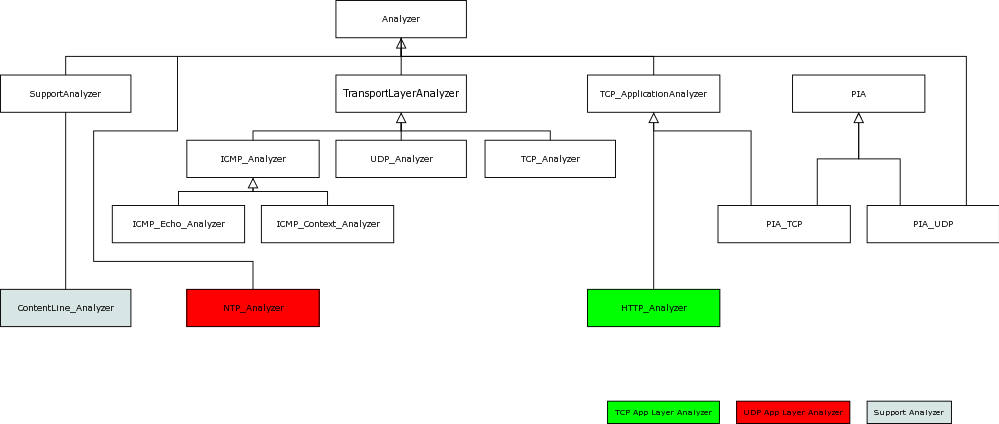
Zeek的动态分析框架是将分析器树与每个连接相关联。这棵树可以包含任意数量的分析器在各种群体,并且在连接的整个生命周期内都可以进行修改。并且zeek提供了两种关键的能力:- 独立于端口进行协议分析。通过一组与协议内容匹配的特征,zeek可以通过器payload找到正确的分析器。当特征匹配时会使用对应的分析器。
- 当分析器解析错误的协议时,可以关闭分析器,并且我们可以使用多个分析器。
所有分析器都派生自类
Analyzer。我们将 分析器树与每个连接相关联,它反映了数据包分析期间的数据流,分析器根据哪些分析器执行其分析。每个数据包首先被传递到树的根节点,该根节点将其(可能转换的)输入传递给它的所有子节点。每个孩子依次将数据传递给其继任者。根节点必须始终是
TransportLayerAnalyzer类型。例如TCP、UDP和ICMP分析器。应用层分析器要么派生自TCP_ApplicationAnalyzer(对于TCP 协议),要么派生自通用Analyzer类(对于所有非TCP 协议)。当连接开始时,初始分析器树由全局
analyzer::Manager实例化。初始树始终包含相应的TransportLayerAnalyzer。对于TCP和UDP,它还分别包含PIA_TCP或PIA_UDP类的实例。PIA 负责在连接进行时检测协议。最重要的是,它们执行签名匹配。根据是否使用任何已知端口,初始树可能立即包含也可能不包含任何应用层分析器。分析器可以支持两种输入方法之一(或两者):分组方式或流方式。分析器可以通过一种方法(例如,分组方式)接受输入,并通过另一种方法(例如,流方式)将其传递给它的孩子。例如TCP_Analyzer将数据包重新组合成字节流,因此所有TCP_ApplicationAnalyzer只能看到流式输入。
Analyzer的接口
// 初始化analyzer void Init() // 清楚analyer void Done() //分组输入接口 // len 数据长度 // data 指向数据的指针 // orig 数据来自连接发起者为true // seq 数据相关的序号,如果没有则为-1 // ip 如果有IP相关的数据包头,如果没有则为空 // caplen ip的长度? void DeliverPacket(int len, const u_char* data, bool orig, uint64 seq, const IP_Hdr* ip, int caplen) // 流式输入的接口 // len 数据长度 // data 指向数据的指针 // orig 数据来自连接发起者为true void DeliverStream(int len, const u_char* data, bool orig) // 取消seq的报文 void Undelivered(uint64 seq, int len, bool orig) // 返回分析器当前使用的内存字节数。 unsigned int MemoryAllocation() const // 返回分析器类的新实例 static Analyzer* InstantiateAnalyzer(Connection* conn) // 如果分析器完全禁用并且不考虑任何连接,则返回 false。(通常情况下,如果没有为分析器定义事件处理程序,就会出现这种情况。) static bool Available() // 给定的端点是否已经传输完成 void EndpointEOF(bool is_orig) // 每当端点进入TCP_CLOSED或TCP_RESET时调用。 void ConnectionFinished(int half_finished) // 连接重置时调用 void ConnectionReset() // 每当看到RST数据包时调用(有时调用 ConnectionReset会延迟) void PacketWithRST()- 1
- 2
- 3
- 4
- 5
- 6
- 7
- 8
- 9
- 10
- 11
- 12
- 13
- 14
- 15
- 16
- 17
- 18
- 19
- 20
- 21
- 22
- 23
- 24
- 25
- 26
- 27
- 28
- 29
- 30
- 31
- 32
- 33
- 34
- 35
- 36
- 37
- 38
- 39
Analyzer如果构建?
Analyzer如何调度,如何形成链式?
Connection
[外链图片转存失败,源站可能有防盗链机制,建议将图片保存下来直接上传(img-pPXGuU0z-1660489984252)(https://cdn.nlark.com/yuque/__puml/544ea3f957a363da4150f42434905c49.svg#lake_card_v2=eyJ0eXBlIjoicHVtbCIsImNvZGUiOiJAc3RhcnR1bWxcblxuY2xhc3MgT2JqIHtcblx0XG59XG5cblxuQGVuZHVtbCIsInVybCI6Imh0dHBzOi8vY2RuLm5sYXJrLmNvbS95dXF1ZS9fX3B1bWwvNTQ0ZWEzZjk1N2EzNjNkYTQxNTBmNDI0MzQ5MDVjNDkuc3ZnIiwiaWQiOiJRTTdFViIsIm1hcmdpbiI6eyJ0b3AiOnRydWUsImJvdHRvbSI6dHJ1ZX0sImNhcmQiOiJkaWFncmFtIn0=)]
启动
run_loop
void run_loop() { util::detail::set_processing_status("RUNNING", "run_loop"); iosource::Manager::ReadySources ready; ready.reserve(iosource_mgr->TotalSize()); while (iosource_mgr->Size() || (BifConst::exit_only_after_terminate && !terminating)) { time_updated = false; iosource_mgr->FindReadySources(&ready); #ifdef DEBUG static int loop_counter = 0; // If no source is ready, we log only every 100th cycle, // starting with the first. if (!ready.empty() || loop_counter++ % 100 == 0) { DBG_LOG(DBG_MAINLOOP, "realtime=%.6f ready_count=%zu", util::current_time(), ready.size()); if (!ready.empty()) loop_counter = 0; } #endif current_iosrc = nullptr; auto communication_enabled = broker_mgr->Active(); if (!ready.empty()) { for (const auto& src : ready) { auto* iosrc = src.src; DBG_LOG(DBG_MAINLOOP, "processing source %s", iosrc->Tag()); current_iosrc = iosrc; if (iosrc->ImplementsProcessFd() && src.fd != -1) iosrc->ProcessFd(src.fd, src.flags); else iosrc->Process(); } } else if ((have_pending_timers || communication_enabled || BifConst::exit_only_after_terminate) && !pseudo_realtime) { // Take advantage of the lull to get up to // date on timers and events. Because we only // have timers as sources, going to sleep here // doesn't risk blocking on other inputs. update_network_time(util::current_time()); expire_timers(); } // Ensure that the time gets updated every pass if we're reading live. // This is necessary for e.g. packet sources that don't have a selectable // file descriptor. They'll always be ready on a very short timeout, but // won't necessarily have a packet to process. In these case, sometimes // the time won't get updated for a long time and timers don't function // correctly. if ((!time_updated && reading_live)) { update_network_time(util::current_time()); expire_timers(); } event_mgr.Drain(); processing_start_time = 0.0; // = "we're not processing now" current_dispatched = 0; current_iosrc = nullptr; if (::signal_val == SIGTERM || ::signal_val == SIGINT) // We received a signal while processing the // current packet and its related events. // Should we put the signal handling into an IOSource? zeek_terminate_loop("received termination signal"); if (!reading_traces) // Check whether we have timers scheduled for // the future on which we need to wait. have_pending_timers = zeek::detail::timer_mgr->Size() > 0; if (pseudo_realtime && communication_enabled) { auto have_active_packet_source = false; iosource::PktSrc* ps = iosource_mgr->GetPktSrc(); if (ps && ps->IsOpen()) have_active_packet_source = true; if (!have_active_packet_source) // Can turn off pseudo realtime now pseudo_realtime = 0.0; } } // Get the final statistics now, and not when finish_run() is // called, since that might happen quite a bit in the future // due to expiring pending timers, and we don't want to ding // for any packets dropped beyond this point. get_final_stats(); }- 1
- 2
- 3
- 4
- 5
- 6
- 7
- 8
- 9
- 10
- 11
- 12
- 13
- 14
- 15
- 16
- 17
- 18
- 19
- 20
- 21
- 22
- 23
- 24
- 25
- 26
- 27
- 28
- 29
- 30
- 31
- 32
- 33
- 34
- 35
- 36
- 37
- 38
- 39
- 40
- 41
- 42
- 43
- 44
- 45
- 46
- 47
- 48
- 49
- 50
- 51
- 52
- 53
- 54
- 55
- 56
- 57
- 58
- 59
- 60
- 61
- 62
- 63
- 64
- 65
- 66
- 67
- 68
- 69
- 70
- 71
- 72
- 73
- 74
- 75
- 76
- 77
- 78
- 79
- 80
- 81
- 82
- 83
- 84
- 85
- 86
- 87
- 88
- 89
- 90
- 91
- 92
- 93
- 94
- 95
- 96
- 97
- 98
- 99
- 100
- 101
Process
void PktSrc::Process() { if (!IsOpen()) return; if (!ExtractNextPacketInternal()) return; run_state::detail::dispatch_packet(¤t_packet, this); have_packet = false; DoneWithPacket(); }- 1
- 2
- 3
- 4
- 5
- 6
- 7
- 8
- 9
- 10
- 11
- 12
- 13
ExtractNextPacketInternal
bool PktSrc::ExtractNextPacketInternal() { if (have_packet) return true; have_packet = false; // Don't return any packets if processing is suspended (except for the // very first packet which we need to set up times). if (run_state::is_processing_suspended() && run_state::detail::first_timestamp) return false; if (run_state::pseudo_realtime) run_state::detail::current_wallclock = util::current_time(true); if (ExtractNextPacket(¤t_packet)) { if (current_packet.time < 0) { Weird("negative_packet_timestamp", ¤t_packet); return false; } if (!run_state::detail::first_timestamp) run_state::detail::first_timestamp = current_packet.time; have_packet = true; return true; } if (run_state::pseudo_realtime && !IsOpen()) { if (broker_mgr->Active()) iosource_mgr->Terminate(); } return false; } bool PcapSource::ExtractNextPacket(Packet* pkt) { if (!pd) return false; const u_char* data; pcap_pkthdr* header; int res = pcap_next_ex(pd, &header, &data); switch (res) { case PCAP_ERROR_BREAK: // -2 // Exhausted pcap file, no more packets to read. assert(!props.is_live); Close(); return false; case PCAP_ERROR: // -1 // Error occurred while reading the packet. if (props.is_live) reporter->Error("failed to read a packet from %s: %s", props.path.data(), pcap_geterr(pd)); else reporter->FatalError("failed to read a packet from %s: %s", props.path.data(), pcap_geterr(pd)); return false; case 0: // Read from live interface timed out (ok). return false; case 1: // Read a packet without problem. // Although, some libpcaps may claim to have read a packet, but either did // not really read a packet or at least provide no way to access its // contents, so the following check for null-data helps handle those cases. if (!data) { reporter->Weird("pcap_null_data_packet"); return false; } break; default: reporter->InternalError("unhandled pcap_next_ex return value: %d", res); return false; } pkt->Init(props.link_type, &header->ts, header->caplen, header->len, data); if (header->len == 0 || header->caplen == 0) { Weird("empty_pcap_header", pkt); return false; } ++stats.received; stats.bytes_received += header->len; // Some versions of libpcap (myricom) are somewhat broken and will return a duplicate // packet if there are no more packets available. Namely, it returns the exact same // packet structure (including the header) out of the library without reinitializing // any of the values. If we set the header lengths to zero here, we can keep from // processing it a second time. header->len = 0; header->caplen = 0; return true; }- 1
- 2
- 3
- 4
- 5
- 6
- 7
- 8
- 9
- 10
- 11
- 12
- 13
- 14
- 15
- 16
- 17
- 18
- 19
- 20
- 21
- 22
- 23
- 24
- 25
- 26
- 27
- 28
- 29
- 30
- 31
- 32
- 33
- 34
- 35
- 36
- 37
- 38
- 39
- 40
- 41
- 42
- 43
- 44
- 45
- 46
- 47
- 48
- 49
- 50
- 51
- 52
- 53
- 54
- 55
- 56
- 57
- 58
- 59
- 60
- 61
- 62
- 63
- 64
- 65
- 66
- 67
- 68
- 69
- 70
- 71
- 72
- 73
- 74
- 75
- 76
- 77
- 78
- 79
- 80
- 81
- 82
- 83
- 84
- 85
- 86
- 87
- 88
- 89
- 90
- 91
- 92
- 93
- 94
- 95
- 96
- 97
- 98
- 99
- 100
- 101
- 102
- 103
dispatch_packet
void dispatch_packet(Packet* pkt, iosource::PktSrc* pkt_src) { double t = run_state::pseudo_realtime ? check_pseudo_time(pkt) : pkt->time; if (!zeek_start_network_time) { zeek_start_network_time = t; if (network_time_init) event_mgr.Enqueue(network_time_init, Args{}); } current_iosrc = pkt_src; #pragma GCC diagnostic push #pragma GCC diagnostic ignored "-Wdeprecated-declarations" current_pktsrc = pkt_src; #pragma GCC diagnostic pop // network_time never goes back. update_network_time(zeek::detail::timer_mgr->Time() < t ? t : zeek::detail::timer_mgr->Time()); processing_start_time = t; expire_timers(); zeek::detail::SegmentProfiler* sp = nullptr; if (load_sample) { static uint32_t load_freq = 0; if (load_freq == 0) load_freq = uint32_t(0xffffffff) / uint32_t(zeek::detail::load_sample_freq); if (uint32_t(util::detail::random_number() & 0xffffffff) < load_freq) { // Drain the queued timer events so they're not // charged against this sample. event_mgr.Drain(); zeek::detail::sample_logger = new zeek::detail::SampleLogger(); sp = new zeek::detail::SegmentProfiler(zeek::detail::sample_logger, "load-samp"); } } //处理包 packet_mgr->ProcessPacket(pkt); event_mgr.Drain(); if (sp) { delete sp; delete zeek::detail::sample_logger; zeek::detail::sample_logger = nullptr; } processing_start_time = 0.0; // = "we're not processing now" current_dispatched = 0; if (pseudo_realtime && !first_wallclock) first_wallclock = util::current_time(true); current_iosrc = nullptr; #pragma GCC diagnostic push #pragma GCC diagnostic ignored "-Wdeprecated-declarations" current_pktsrc = nullptr; #pragma GCC diagnostic pop }- 1
- 2
- 3
- 4
- 5
- 6
- 7
- 8
- 9
- 10
- 11
- 12
- 13
- 14
- 15
- 16
- 17
- 18
- 19
- 20
- 21
- 22
- 23
- 24
- 25
- 26
- 27
- 28
- 29
- 30
- 31
- 32
- 33
- 34
- 35
- 36
- 37
- 38
- 39
- 40
- 41
- 42
- 43
- 44
- 45
- 46
- 47
- 48
- 49
- 50
- 51
- 52
- 53
- 54
- 55
- 56
- 57
- 58
- 59
- 60
- 61
- 62
- 63
- 64
- 65
process_packet
void Manager::ProcessPacket(Packet* packet) { #ifdef DEBUG static size_t counter = 0; DBG_LOG(DBG_PACKET_ANALYSIS, "Analyzing packet %ld, ts=%.3f...", ++counter, packet->time); #endif zeek::detail::SegmentProfiler prof(detail::segment_logger, "dispatching-packet"); if (pkt_profiler) pkt_profiler->ProfilePkt(zeek::run_state::processing_start_time, packet->cap_len); ++num_packets_processed; bool dumped_packet = false; if (packet->dump_packet || zeek::detail::record_all_packets) { DumpPacket(packet, packet->dump_size); dumped_packet = true; } // Start packet analysis root_analyzer->ForwardPacket(packet->cap_len, packet->data, packet, packet->link_type); if (!packet->processed) { if (packet_not_processed) event_mgr.Enqueue(packet_not_processed, Packet::ToVal(packet)); plugin_mgr->HookUnprocessedPacket(packet); if (unprocessed_dumper) unprocessed_dumper->Dump(packet); total_not_processed++; } if (raw_packet) event_mgr.Enqueue(raw_packet, packet->ToRawPktHdrVal()); // Check whether packet should be recorded based on session analysis if (packet->dump_packet && !dumped_packet) DumpPacket(packet, packet->dump_size); }- 1
- 2
- 3
- 4
- 5
- 6
- 7
- 8
- 9
- 10
- 11
- 12
- 13
- 14
- 15
- 16
- 17
- 18
- 19
- 20
- 21
- 22
- 23
- 24
- 25
- 26
- 27
- 28
- 29
- 30
- 31
- 32
- 33
- 34
- 35
- 36
- 37
- 38
- 39
- 40
- 41
- 42
- 43
ForwardPacket
bool Analyzer::ForwardPacket(size_t len, const uint8_t* data, Packet* packet) const { AnalyzerPtr inner_analyzer = nullptr; for (const auto& child : analyzers_to_detect) { if (child->DetectProtocol(len, data, packet)) { DBG_LOG(DBG_PACKET_ANALYSIS, "Protocol detection in %s succeeded, next layer analyzer is %s", GetAnalyzerName(), child->GetAnalyzerName()); inner_analyzer = child; break; } } if (!inner_analyzer) inner_analyzer = default_analyzer; if (!inner_analyzer) { DBG_LOG(DBG_PACKET_ANALYSIS, "Analysis in %s stopped, no default analyzer available.", GetAnalyzerName()); if (report_unknown_protocols) Weird("no_suitable_analyzer_found", packet); return false; } return inner_analyzer->AnalyzePacket(len, data, packet); }- 1
- 2
- 3
- 4
- 5
- 6
- 7
- 8
- 9
- 10
- 11
- 12
- 13
- 14
- 15
- 16
- 17
- 18
- 19
- 20
- 21
- 22
- 23
- 24
- 25
- 26
- 27
- 28
- 29
- 30
- 31
EthernetAnalyzer::AnalyzePacket
bool EthernetAnalyzer::AnalyzePacket(size_t len, const uint8_t* data, Packet* packet) { // Make sure that we actually got an entire ethernet header before trying // to pull bytes out of it. if (16 >= len) { Weird("truncated_ethernet_frame", packet); return false; } // Skip past Cisco FabricPath to encapsulated ethernet frame. if (data[12] == 0x89 && data[13] == 0x03) { auto constexpr cfplen = 16; if (cfplen + 14 >= len) { Weird("truncated_link_header_cfp", packet); return false; } data += cfplen; len -= cfplen; } // Get protocol being carried from the ethernet frame. uint32_t protocol = (data[12] << 8) + data[13]; packet->eth_type = protocol; packet->l2_dst = data; packet->l2_src = data + 6; // Ethernet II frames if (protocol >= 1536) return ForwardPacket(len - 14, data + 14, packet, protocol); // Other ethernet frame types if (protocol <= 1500) { if (16 >= len) { Weird("truncated_ethernet_frame", packet); return false; } // Let specialized analyzers take over for non Ethernet II frames. // Note that pdata remains at the start of the ethernet frame. AnalyzerPtr eth_analyzer = nullptr; if (data[14] == 0xAA && data[15] == 0xAA) // IEEE 802.2 SNAP eth_analyzer = SNAPAnalyzer; else if (data[14] == 0xFF && data[15] == 0xFF) // Novell raw IEEE 802.3 eth_analyzer = NovellRawAnalyzer; else // IEEE 802.2 LLC eth_analyzer = LLCAnalyzer; if (eth_analyzer) return eth_analyzer->AnalyzePacket(len, data, packet); return true; } // Undefined (1500 < EtherType < 1536) Weird("undefined_ether_type", packet); return false; }- 1
- 2
- 3
- 4
- 5
- 6
- 7
- 8
- 9
- 10
- 11
- 12
- 13
- 14
- 15
- 16
- 17
- 18
- 19
- 20
- 21
- 22
- 23
- 24
- 25
- 26
- 27
- 28
- 29
- 30
- 31
- 32
- 33
- 34
- 35
- 36
- 37
- 38
- 39
- 40
- 41
- 42
- 43
- 44
- 45
- 46
- 47
- 48
- 49
- 50
- 51
- 52
- 53
- 54
- 55
- 56
- 57
- 58
- 59
- 60
- 61
- 62
- 63
- 64
- 65
- 66
- 67
- 68
- 69
- 70
- 71
IPAnalyzer::AnalyzePacket
bool IPAnalyzer::AnalyzePacket(size_t len, const uint8_t* data, Packet* packet) { // Check to make sure we have enough data left for an IP header to be here. Note we only // check ipv4 here. We'll check ipv6 later once we determine we have an ipv6 header. if (len < sizeof(struct ip)) { Weird("truncated_IP", packet); return false; } int32_t hdr_size = static_cast<int32_t>(data - packet->data); // Cast the current data pointer to an IP header pointer so we can use it to get some // data about the header. auto ip = (const struct ip*)data; uint32_t protocol = ip->ip_v; // This is a unique pointer because of the mass of early returns from this method. if (protocol == 4) { packet->ip_hdr = std::make_shared<IP_Hdr>(ip, false); packet->l3_proto = L3_IPV4; } else if (protocol == 6) { if (len < sizeof(struct ip6_hdr)) { Weird("truncated_IP", packet); return false; } packet->ip_hdr = std::make_shared<IP_Hdr>((const struct ip6_hdr*)data, false, len); packet->l3_proto = L3_IPV6; } else { Weird("unknown_ip_version", packet); return false; } // If there's an encapsulation stack in this packet, meaning this packet is part of a chain // of tunnels, make sure to store the IP header in the last flow in the stack so it can be // used by previous analyzers as we return up the chain. if (packet->encap) { if (auto* ec = packet->encap->Last()) ec->ip_hdr = packet->ip_hdr; } const struct ip* ip4 = packet->ip_hdr->IP4_Hdr(); // TotalLen() returns the full length of the IP portion of the packet, including // the IP header and payload. uint32_t total_len = packet->ip_hdr->TotalLen(); if (total_len == 0) { // TCP segmentation offloading can zero out the ip_len field. Weird("ip_hdr_len_zero", packet); if (detail::ignore_checksums) // Cope with the zero'd out ip_len field by using the caplen. total_len = packet->cap_len - hdr_size; else // If this is caused by segmentation offloading, the checksum will // also be incorrect. If checksum validation is enabled - jus tbail here. return false; } if (packet->len < total_len + hdr_size) { Weird("truncated_IPv6", packet); return false; } // For both of these it is safe to pass ip_hdr because the presence // is guaranteed for the functions that pass data to us. uint16_t ip_hdr_len = packet->ip_hdr->HdrLen(); if (ip_hdr_len > total_len) { Weird("invalid_IP_header_size", packet); return false; } if (ip_hdr_len > len) { Weird("internally_truncated_header", packet); return false; } if (packet->ip_hdr->IP4_Hdr()) { if (ip_hdr_len < sizeof(struct ip)) { Weird("IPv4_min_header_size", packet); return false; } } else { if (ip_hdr_len < sizeof(struct ip6_hdr)) { Weird("IPv6_min_header_size", packet); return false; } } // Ignore if packet matches packet filter. detail::PacketFilter* packet_filter = packet_mgr->GetPacketFilter(false); if (packet_filter && packet_filter->Match(packet->ip_hdr, total_len, len)) return false; if (!packet->l2_checksummed && !detail::ignore_checksums && ip4 && !IPBasedAnalyzer::GetIgnoreChecksumsNets()->Contains(packet->ip_hdr->IPHeaderSrcAddr()) && detail::in_cksum(reinterpret_cast<const uint8_t*>(ip4), ip_hdr_len) != 0xffff) { Weird("bad_IP_checksum", packet); return false; } if (discarder && discarder->NextPacket(packet->ip_hdr, total_len, len)) return false; detail::FragReassembler* f = nullptr; if (packet->ip_hdr->IsFragment()) { packet->dump_packet = true; // always record fragments if (len < total_len) { Weird("incompletely_captured_fragment", packet); // Don't try to reassemble, that's doomed. // Discard all except the first fragment (which // is useful in analyzing header-only traces) if (packet->ip_hdr->FragOffset() != 0) return false; } else { f = detail::fragment_mgr->NextFragment(run_state::processing_start_time, packet->ip_hdr, packet->data + hdr_size); std::shared_ptr<IP_Hdr> ih = f->ReassembledPkt(); if (!ih) // It didn't reassemble into anything yet. return true; ip4 = ih->IP4_Hdr(); // Switch the stored ip header over to the one from the // fragmented packet. packet->ip_hdr = std::move(ih); len = total_len = packet->ip_hdr->TotalLen(); ip_hdr_len = packet->ip_hdr->HdrLen(); packet->cap_len = total_len + hdr_size; if (ip_hdr_len > total_len) { Weird("invalid_IP_header_size", packet); return false; } } } detail::FragReassemblerTracker frt(f); // We stop building the chain when seeing IPPROTO_ESP so if it's // there, it's always the last. if (packet->ip_hdr->LastHeader() == IPPROTO_ESP) { packet->dump_packet = true; if (esp_packet) event_mgr.Enqueue(esp_packet, packet->ip_hdr->ToPktHdrVal()); // Can't do more since upper-layer payloads are going to be encrypted. return true; } // We stop building the chain when seeing IPPROTO_MOBILITY so it's always // last if present. if (packet->ip_hdr->LastHeader() == IPPROTO_MOBILITY) { packet->dump_packet = true; if (!detail::ignore_checksums && mobility_header_checksum(packet->ip_hdr.get()) != 0xffff) { Weird("bad_MH_checksum", packet); return false; } if (mobile_ipv6_message) event_mgr.Enqueue(mobile_ipv6_message, packet->ip_hdr->ToPktHdrVal()); if (packet->ip_hdr->NextProto() != IPPROTO_NONE) Weird("mobility_piggyback", packet); return true; } // Set the data pointer to match the payload from the IP header. This makes sure that it's also // pointing at the reassembled data for a fragmented packet. data = packet->ip_hdr->Payload(); len -= ip_hdr_len; // Session analysis assumes that the header size stored in the packet does not include the IP // header size. There are two reasons for this: 1) Packet::ToRawPktHdrVal() wants to look at the // IP header for reporting, and 2) The VXLAN analyzer uses the header position to create the // next packet in the tunnel chain. Once the TCP/UDP work is done and the VXLAN analyzer can // move into packet analysis, this can change, but for now we leave it as it is. bool return_val = true; int proto = packet->ip_hdr->NextProto(); packet->proto = proto; // Double check the lengths one more time before forwarding this on. if (total_len < packet->ip_hdr->HdrLen()) { Weird("bogus_IP_header_lengths", packet); return false; } switch (proto) { case IPPROTO_NONE: // If the packet is encapsulated in Teredo, then it was a bubble and // the Teredo analyzer may have raised an event for that, else we're // not sure the reason for the No Next header in the packet. if (!(packet->encap && packet->encap->LastType() == BifEnum::Tunnel::TEREDO)) { Weird("ipv6_no_next", packet); return_val = false; } break; default: packet->proto = proto; // For everything else, pass it on to another analyzer. If there's no one to handle // that, it'll report a Weird. return_val = ForwardPacket(len, data, packet, proto); break; } if (f) f->DeleteTimer(); return return_val; }- 1
- 2
- 3
- 4
- 5
- 6
- 7
- 8
- 9
- 10
- 11
- 12
- 13
- 14
- 15
- 16
- 17
- 18
- 19
- 20
- 21
- 22
- 23
- 24
- 25
- 26
- 27
- 28
- 29
- 30
- 31
- 32
- 33
- 34
- 35
- 36
- 37
- 38
- 39
- 40
- 41
- 42
- 43
- 44
- 45
- 46
- 47
- 48
- 49
- 50
- 51
- 52
- 53
- 54
- 55
- 56
- 57
- 58
- 59
- 60
- 61
- 62
- 63
- 64
- 65
- 66
- 67
- 68
- 69
- 70
- 71
- 72
- 73
- 74
- 75
- 76
- 77
- 78
- 79
- 80
- 81
- 82
- 83
- 84
- 85
- 86
- 87
- 88
- 89
- 90
- 91
- 92
- 93
- 94
- 95
- 96
- 97
- 98
- 99
- 100
- 101
- 102
- 103
- 104
- 105
- 106
- 107
- 108
- 109
- 110
- 111
- 112
- 113
- 114
- 115
- 116
- 117
- 118
- 119
- 120
- 121
- 122
- 123
- 124
- 125
- 126
- 127
- 128
- 129
- 130
- 131
- 132
- 133
- 134
- 135
- 136
- 137
- 138
- 139
- 140
- 141
- 142
- 143
- 144
- 145
- 146
- 147
- 148
- 149
- 150
- 151
- 152
- 153
- 154
- 155
- 156
- 157
- 158
- 159
- 160
- 161
- 162
- 163
- 164
- 165
- 166
- 167
- 168
- 169
- 170
- 171
- 172
- 173
- 174
- 175
- 176
- 177
- 178
- 179
- 180
- 181
- 182
- 183
- 184
- 185
- 186
- 187
- 188
- 189
- 190
- 191
- 192
- 193
- 194
- 195
- 196
- 197
- 198
- 199
- 200
- 201
- 202
- 203
- 204
- 205
- 206
- 207
- 208
- 209
- 210
- 211
- 212
- 213
- 214
- 215
- 216
- 217
- 218
- 219
- 220
- 221
- 222
- 223
- 224
- 225
- 226
- 227
- 228
- 229
- 230
- 231
- 232
- 233
- 234
- 235
- 236
- 237
- 238
- 239
- 240
- 241
- 242
- 243
- 244
- 245
- 246
- 247
- 248
- 249
IPBasedAnalyzer::AnalyzePacket
bool IPBasedAnalyzer::AnalyzePacket(size_t len, const uint8_t* data, Packet* pkt) { ConnTuple tuple; if (!BuildConnTuple(len, data, pkt, tuple)) return false; const std::shared_ptr<IP_Hdr>& ip_hdr = pkt->ip_hdr; detail::ConnKey key(tuple); Connection* conn = session_mgr->FindConnection(key); if (!conn) { conn = NewConn(&tuple, key, pkt); if (conn) session_mgr->Insert(conn, false); } else { if (conn->IsReuse(run_state::processing_start_time, ip_hdr->Payload())) { conn->Event(connection_reused, nullptr); session_mgr->Remove(conn); conn = NewConn(&tuple, key, pkt); if (conn) session_mgr->Insert(conn, false); } else { conn->CheckEncapsulation(pkt->encap); } } if (!conn) return false; // If we successfuly made a connection for this packet that means it'll eventually // get logged, which means we can mark this packet as having been processed. pkt->processed = true; bool is_orig = (tuple.src_addr == conn->OrigAddr()) && (tuple.src_port == conn->OrigPort()); pkt->is_orig = is_orig; conn->CheckFlowLabel(is_orig, ip_hdr->FlowLabel()); zeek::ValPtr pkt_hdr_val; if (ipv6_ext_headers && ip_hdr->NumHeaders() > 1) { pkt_hdr_val = ip_hdr->ToPktHdrVal(); conn->EnqueueEvent(ipv6_ext_headers, nullptr, conn->GetVal(), pkt_hdr_val); } if (new_packet) conn->EnqueueEvent(new_packet, nullptr, conn->GetVal(), pkt_hdr_val ? std::move(pkt_hdr_val) : ip_hdr->ToPktHdrVal()); conn->SetRecordPackets(true); conn->SetRecordContents(true); const u_char* payload = pkt->ip_hdr->Payload(); run_state::current_timestamp = run_state::processing_start_time; run_state::current_pkt = pkt; // TODO: Does this actually mean anything? if (conn->GetSessionAdapter()->Skipping()) return true; DeliverPacket(conn, run_state::processing_start_time, is_orig, len, pkt); run_state::current_timestamp = 0; run_state::current_pkt = nullptr; // If the packet is reassembled, disable packet dumping because the // pointer math to dump the data wouldn't work. if (pkt->ip_hdr->Reassembled()) pkt->dump_packet = false; else if (conn->RecordPackets()) { pkt->dump_packet = true; // If we don't want the content, set the dump size to include just // the header. if (!conn->RecordContents()) pkt->dump_size = payload - pkt->data; } return true; }- 1
- 2
- 3
- 4
- 5
- 6
- 7
- 8
- 9
- 10
- 11
- 12
- 13
- 14
- 15
- 16
- 17
- 18
- 19
- 20
- 21
- 22
- 23
- 24
- 25
- 26
- 27
- 28
- 29
- 30
- 31
- 32
- 33
- 34
- 35
- 36
- 37
- 38
- 39
- 40
- 41
- 42
- 43
- 44
- 45
- 46
- 47
- 48
- 49
- 50
- 51
- 52
- 53
- 54
- 55
- 56
- 57
- 58
- 59
- 60
- 61
- 62
- 63
- 64
- 65
- 66
- 67
- 68
- 69
- 70
- 71
- 72
- 73
- 74
- 75
- 76
- 77
- 78
- 79
- 80
- 81
- 82
- 83
- 84
- 85
- 86
- 87
- 88
- 89
- 90
IPBasedAnalyzer::NewConn
zeek::Connection* IPBasedAnalyzer::NewConn(const ConnTuple* id, const detail::ConnKey& key, const Packet* pkt) { int src_h = ntohs(id->src_port); int dst_h = ntohs(id->dst_port); bool flip = false; if (!WantConnection(src_h, dst_h, pkt->ip_hdr->Payload(), flip)) return nullptr; Connection* conn = new Connection(key, run_state::processing_start_time, id, pkt->ip_hdr->FlowLabel(), pkt); conn->SetTransport(transport); if (flip) conn->FlipRoles(); BuildSessionAnalyzerTree(conn); if (new_connection) conn->Event(new_connection, nullptr); return conn; }- 1
- 2
- 3
- 4
- 5
- 6
- 7
- 8
- 9
- 10
- 11
- 12
- 13
- 14
- 15
- 16
- 17
- 18
- 19
- 20
- 21
- 22
IPBasedAnalyzer::BuildSessionAnalyzerTree
void IPBasedAnalyzer::BuildSessionAnalyzerTree(Connection* conn) { SessionAdapter* root = MakeSessionAdapter(conn); analyzer::pia::PIA* pia = MakePIA(conn); bool scheduled = analyzer_mgr->ApplyScheduledAnalyzers(conn, false, root); // Hmm... Do we want *just* the expected analyzer, or all // other potential analyzers as well? For now we only take // the scheduled ones. if (!scheduled) { // Let's see if it's a port we know. if (!analyzers_by_port.empty() && !zeek::detail::dpd_ignore_ports) { int resp_port = ntohs(conn->RespPort()); std::set<zeek::Tag>* ports = LookupPort(resp_port, false); if (ports) { for (const auto& port : *ports) { analyzer::Analyzer* analyzer = analyzer_mgr->InstantiateAnalyzer(port, conn); if (!analyzer) continue; root->AddChildAnalyzer(analyzer, false); DBG_ANALYZER_ARGS(conn, "activated %s analyzer due to port %d", analyzer_mgr->GetComponentName(port).c_str(), resp_port); } } } } root->AddExtraAnalyzers(conn); if (pia) root->AddChildAnalyzer(pia->AsAnalyzer()); conn->SetSessionAdapter(root, pia); root->Init(); root->InitChildren(); PLUGIN_HOOK_VOID(HOOK_SETUP_ANALYZER_TREE, HookSetupAnalyzerTree(conn)); }- 1
- 2
- 3
- 4
- 5
- 6
- 7
- 8
- 9
- 10
- 11
- 12
- 13
- 14
- 15
- 16
- 17
- 18
- 19
- 20
- 21
- 22
- 23
- 24
- 25
- 26
- 27
- 28
- 29
- 30
- 31
- 32
- 33
- 34
- 35
- 36
- 37
- 38
- 39
- 40
- 41
- 42
- 43
- 44
- 45
Manager::InstantiateAnalyzer
Analyzer* Manager::InstantiateAnalyzer(const char* name, Connection* conn) { zeek::Tag tag = GetComponentTag(name); return tag ? InstantiateAnalyzer(tag, conn) : nullptr; } Analyzer* Manager::InstantiateAnalyzer(const zeek::Tag& tag, Connection* conn) { Component* c = Lookup(tag); if (!c) { reporter->InternalWarning("request to instantiate unknown analyzer"); return nullptr; } if (!c->Enabled()) return nullptr; if (!c->Factory()) { reporter->InternalWarning("analyzer %s cannot be instantiated dynamically", GetComponentName(tag).c_str()); return nullptr; } Analyzer* a = c->Factory()(conn); if (!a) { reporter->InternalWarning("analyzer instantiation failed"); return nullptr; } a->SetAnalyzerTag(tag); return a; }- 1
- 2
- 3
- 4
- 5
- 6
- 7
- 8
- 9
- 10
- 11
- 12
- 13
- 14
- 15
- 16
- 17
- 18
- 19
- 20
- 21
- 22
- 23
- 24
- 25
- 26
- 27
- 28
- 29
- 30
- 31
- 32
- 33
- 34
- 35
- 36
- 37
HTTP
zeek::analyzer::http::HTTP_Analyzer::HTTP_Analyzer HTTP.cc:816 zeek::analyzer::http::HTTP_Analyzer::Instantiate HTTP.h:216 zeek::analyzer::Manager::InstantiateAnalyzer Manager.cc:315 zeek::packet_analysis::IP::IPBasedAnalyzer::BuildSessionAnalyzerTree IPBasedAnalyzer.cc:206 zeek::packet_analysis::IP::IPBasedAnalyzer::NewConn IPBasedAnalyzer.cc:177 zeek::packet_analysis::IP::IPBasedAnalyzer::AnalyzePacket IPBasedAnalyzer.cc:42 zeek::packet_analysis::Analyzer::ForwardPacket Analyzer.cc:113 zeek::packet_analysis::IP::IPAnalyzer::AnalyzePacket IP.cc:276 zeek::packet_analysis::Analyzer::ForwardPacket Analyzer.cc:113 zeek::packet_analysis::Ethernet::EthernetAnalyzer::AnalyzePacket Ethernet.cc:54 zeek::packet_analysis::Analyzer::ForwardPacket Analyzer.cc:113 zeek::packet_analysis::Manager::ProcessPacket Manager.cc:112 zeek::run_state::detail::dispatch_packet RunState.cc:259 zeek::iosource::PktSrc::Process PktSrc.cc:154 zeek::run_state::detail::run_loop RunState.cc:322 main main.cc:59 __libc_start_main 0x00007ffff5e62083 _start 0x000055555619e1be- 1
- 2
- 3
- 4
- 5
- 6
- 7
- 8
- 9
- 10
- 11
- 12
- 13
- 14
- 15
- 16
- 17
- 18
done
zeek::analyzer::http::HTTP_Analyzer::Done HTTP.cc:848 zeek::analyzer::Analyzer::Done Analyzer.cc:198 zeek::packet_analysis::TCP::TCPSessionAdapter::Done TCPSessionAdapter.cc:66 zeek::Connection::Done Conn.cc:143 zeek::session::Manager::Remove Manager.cc:128 zeek::packet_analysis::IP::IPBasedAnalyzer::AnalyzePacket IPBasedAnalyzer.cc:52 zeek::packet_analysis::Analyzer::ForwardPacket Analyzer.cc:113 zeek::packet_analysis::IP::IPAnalyzer::AnalyzePacket IP.cc:276 zeek::packet_analysis::Analyzer::ForwardPacket Analyzer.cc:113 zeek::packet_analysis::Ethernet::EthernetAnalyzer::AnalyzePacket Ethernet.cc:54 zeek::packet_analysis::Analyzer::ForwardPacket Analyzer.cc:113 zeek::packet_analysis::Manager::ProcessPacket Manager.cc:112 zeek::run_state::detail::dispatch_packet RunState.cc:259 zeek::iosource::PktSrc::Process PktSrc.cc:154 zeek::run_state::detail::run_loop RunState.cc:322 main main.cc:59 __libc_start_main 0x00007ffff5e62083 _start 0x000055555619e1be- 1
- 2
- 3
- 4
- 5
- 6
- 7
- 8
- 9
- 10
- 11
- 12
- 13
- 14
- 15
- 16
- 17
- 18
undeliverd
[zeek] zeek::analyzer::http::HTTP_Analyzer::Undelivered HTTP.cc:1059 [zeek] zeek::analyzer::SupportAnalyzer::ForwardUndelivered Analyzer.cc:913 [zeek] zeek::analyzer::tcp::ContentLine_Analyzer::Undelivered ContentLine.cc:117 [zeek] zeek::analyzer::Analyzer::NextUndelivered Analyzer.cc:272 [zeek] zeek::analyzer::Analyzer::NextUndelivered Analyzer.cc:266 [zeek] zeek::analyzer::Analyzer::ForwardUndelivered Analyzer.cc:355 [zeek] zeek::analyzer::tcp::TCP_Reassembler::Gap TCP_Reassembler.cc:153 [zeek] zeek::analyzer::tcp::TCP_Reassembler::Undelivered TCP_Reassembler.cc:250 [zeek] zeek::DataBlockList::Trim Reassem.cc:219 [zeek] zeek::Reassembler::TrimToSeq Reassem.cc:354 [zeek] zeek::analyzer::tcp::TCP_Reassembler::AckReceived TCP_Reassembler.cc:527 [zeek] zeek::analyzer::tcp::TCP_Endpoint::AckReceived TCP_Endpoint.cc:243 [zeek] zeek::packet_analysis::TCP::TCPSessionAdapter::Process TCPSessionAdapter.cc:668 [zeek] zeek::packet_analysis::TCP::TCPAnalyzer::DeliverPacket TCP.cc:121 [zeek] zeek::packet_analysis::IP::IPBasedAnalyzer::AnalyzePacket IPBasedAnalyzer.cc:99 [zeek] zeek::packet_analysis::Analyzer::ForwardPacket Analyzer.cc:113 [zeek] zeek::packet_analysis::IP::IPAnalyzer::AnalyzePacket IP.cc:276 [zeek] zeek::packet_analysis::Analyzer::ForwardPacket Analyzer.cc:113 [zeek] zeek::packet_analysis::Ethernet::EthernetAnalyzer::AnalyzePacket Ethernet.cc:54 [zeek] zeek::packet_analysis::Analyzer::ForwardPacket Analyzer.cc:113 [zeek] zeek::packet_analysis::Manager::ProcessPacket Manager.cc:112 [zeek] zeek::run_state::detail::dispatch_packet RunState.cc:259 [zeek] zeek::iosource::PktSrc::Process PktSrc.cc:154 [zeek] zeek::run_state::detail::run_loop RunState.cc:321 [zeek] main main.cc:59 [libc.so.6] __libc_start_main 0x00007ffff5a1b083 [zeek] _start 0x00005555561bc07e- 1
- 2
- 3
- 4
- 5
- 6
- 7
- 8
- 9
- 10
- 11
- 12
- 13
- 14
- 15
- 16
- 17
- 18
- 19
- 20
- 21
- 22
- 23
- 24
- 25
- 26
- 27
RegisterComponet
[zeek] zeek::plugin::ComponentManager<zeek::packet_analysis::Component>::RegisterComponent ComponentManager.h:244 [zeek] zeek::packet_analysis::Component::Initialize Component.cc:21 [zeek] zeek::plugin::Plugin::InitializeComponents Plugin.cc:450 [zeek] zeek::plugin::Manager::InitPreScript Manager.cc:472 [zeek] zeek::detail::setup zeek-setup.cc:699 [zeek] main main.cc:13 [libc.so.6] __libc_start_main 0x00007ffff5a1c083 [zeek] _start 0x00005555561bc07e- 1
- 2
- 3
- 4
- 5
- 6
- 7
- 8
-
相关阅读:
第 45 届国际大学生程序设计竞赛(ICPC)亚洲区域赛(银川),签到题5题
RPC服务与HTTP服务的区别是什么
第4周学习:MobileNetV1, V2, V3
鸿蒙4.0-DevEco Studio界面工程
Linux离线安装插件
刷爆指针笔试题
重学设计模式之 装饰者模式
彻底理解代理模式
身份识别与鉴权技术调研方案
阿杰的事情
- 原文地址:https://blog.csdn.net/hzb869168467/article/details/126338120
