-
【leetcode】【剑指offer Ⅱ】024. 反转链表
问题描述:
- 给定单链表的头节点
head,反转链表并返回反转后的链表的头节点。
核心思路:
-
该题很有代表性,其可以写出原地反转链表的递归和迭代两个版本的解法。
-
迭代版本的解法相当于是从头到尾遍历链表并模拟断链并反转的过程。
- 迭代版本解法的步骤如下:
- 初始化三个指针
pre、cur和next,其中cur初始化为head,另两个指针初始化为空指针。 - 只要
cur不为空,则一直进行下述操作:- 将
next置为cur的下一个节点,即next = cur->next。【保存下一个节点,因为准备断开cur指向cur->next的链】 - 将
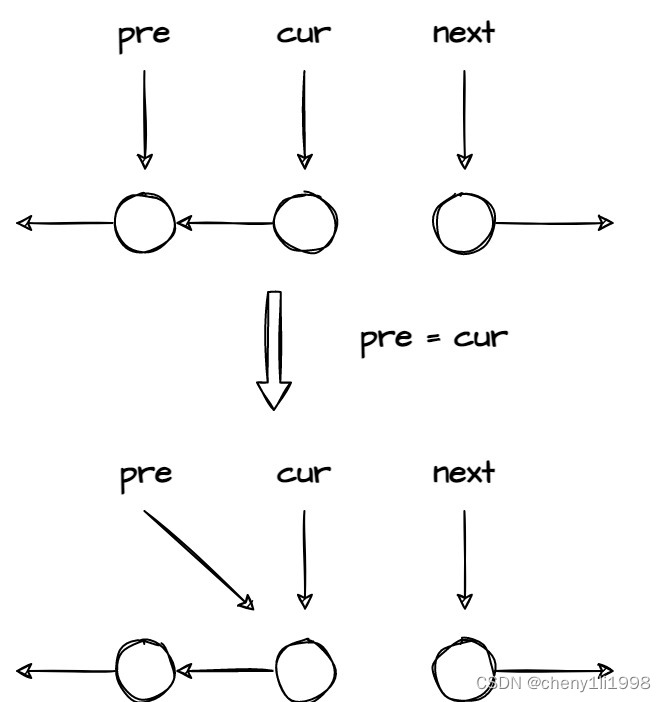
cur的下个节点置为pre,即cur->next = pre。【将cur的方向反转】 pre置为cur,即pre = cur。【pre向后移动】cur置为next,即cur = next。【cur向后移动】
- 将
- 退出循环后,返回
pre指针作为反转后的链表头部。
- 初始化三个指针
- 可以从例子中理解循环中的四个步骤:
-
第一步,保存下一个节点:

-
第二步,将
cur的方向反转:

-
第三步,
pre向后移动:
-
第四步,
cur向后移动:

-
- 迭代版本解法的步骤如下:
-
由前面可以看出,迭代解法相当于从前往后反转链表,而递归解法相反,是从后往前反转链表。
- 普通递归版本解法的步骤如下:
- 判断
head非空且head->next非空,如果其中一个为空则直接返回head。【遇到链表的尾部才会在此处直接返回】 - 递归调用自身,其参数为
head->next,并将返回结果置为newHead。【newHead是本次函数返回的结果,不难想象得出,函数一路递归遍历链表,最后会把链表尾部元素返回作为反转后的链表头部】 - 将
head->next的下一个节点置为head,即head->next->next = head。【将head->next的方向反转】 - 将
head的下一个节点置为空,即head->next = nullptr。【此步较为关键,如果不置空,则会造成cur与cur->next互指的情况】 - 最后返回
newHead指针作为反转后的链表头部。
- 判断
- 普通递归都可以进行尾递归优化。
- 尾递归写法仍然是递归方式的一种,但相比普通递归,其在递归栈的空间上更为节省。
- 简单地说,尾递归的写法就是将普通递归的内部变量转为函数的参数,而尾递归的最后一步为调用自身。【在此不展开讲解尾递归,SICP 书中有详细介绍】
- 神奇的地方在于,尾递归优化的解法与迭代解法是一致的,均是从前往后反转链表。
- 普通递归版本解法的步骤如下:
代码实现:
- 双指针迭代解法的代码实现如下:
class Solution { public: ListNode* reverseList(ListNode* head) { ListNode* pre = nullptr; ListNode* cur = head; ListNode* next; while(cur) { next = cur->next; cur->next = pre; pre = cur; cur = next; } return pre; } };- 1
- 2
- 3
- 4
- 5
- 6
- 7
- 8
- 9
- 10
- 11
- 12
- 13
- 14
- 15
- 16
- 17
- 18
- 单指针迭代解法的代码实现如下:【实质上和前一种解法一致,代码贴自评论区】
class Solution { public: ListNode* reverseList(ListNode* head) { ListNode *p; for(p=NULL; head; swap(head,p)) swap(p,head->next); return p; } };- 1
- 2
- 3
- 4
- 5
- 6
- 7
- 8
- 9
- 普通递归解法的代码实现如下:【贴自官方题解】
class Solution { public: ListNode* reverseList(ListNode* head) { if (!head || !head->next) { return head; } ListNode* newHead = reverseList(head->next); head->next->next = head; head->next = nullptr; return newHead; } };- 1
- 2
- 3
- 4
- 5
- 6
- 7
- 8
- 9
- 10
- 11
- 12
- 尾递归解法的代码实现如下:
class Solution { private: ListNode* reverse(ListNode* pre, ListNode* cur) // 尾递归 { if(!cur) return pre; ListNode* next = cur->next; cur->next = pre; return reverse(cur, next); // 最后一步调用自身 } public: ListNode* reverseList(ListNode* head) { return reverse(nullptr, head); } };- 1
- 2
- 3
- 4
- 5
- 6
- 7
- 8
- 9
- 10
- 11
- 12
- 13
- 14
- 15
- 16
- 给定单链表的头节点
-
相关阅读:
IO流(3)
Golang context 原理分析
esp8266-01固件信息
关于安装PsBody-mesh0.4【MPI-IS/mesh的make all报错】踩坑实录
【计算机网络笔记】什么是网络协议?
刷题笔记之三(统计回文+连续最大和+查找组成一个偶数最接近的两个素数+把字符串转换成整数+不要二)
【JavaScript复习三】循环结构for和while
基于Tensorflow、Keras实现Stable Diffusion
神经系统图 基本结构图,神经系统的组织结构图
Mysql忽略大小写问题
- 原文地址:https://blog.csdn.net/weixin_44705592/article/details/126334039
