-
【深度学习框架】torch.norm函数详解用法
torch.norm参数定义
torch版本1.6
def norm(input, p="fro", dim=None, keepdim=False, out=None, dtype=None)- 1
input
input (Tensor): the input tensor 输入为tensor- 1
p
p (int, float, inf, -inf, 'fro', 'nuc', optional): the order of norm. Default: ``'fro'`` The following norms can be calculated: ===== ============================ ========================== ord matrix norm vector norm ===== ============================ ========================== None Frobenius norm 2-norm 'fro' Frobenius norm -- 'nuc' nuclear norm -- Other as vec norm when dim is None sum(abs(x)**ord)**(1./ord) ===== ============================ ==========================- 1
- 2
- 3
- 4
- 5
- 6
- 7
- 8
- 9
- 10
- 11
dim是matrix norm
如果input是
matrix norm,也就是维度大于等于2维,则
P值默认为fro,Frobenius norm可认为是与计算向量的欧氏距离类似
有时候为了比较真实的矩阵和估计的矩阵值之间的误差
或者说比较真实矩阵和估计矩阵之间的相似性,我们可以采用 Frobenius 范数。
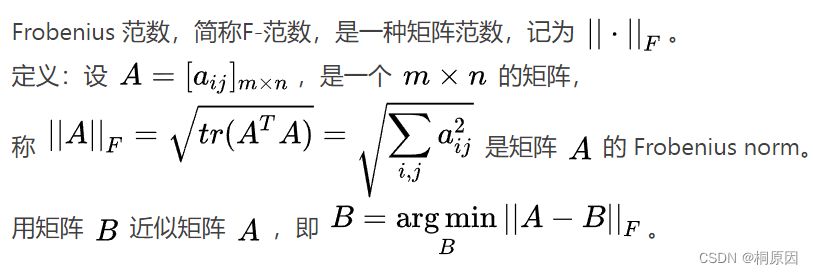 计算矩阵的Frobenius norm (Frobenius 范数),就是矩阵A各项元素的绝对值平方的总和再开根号
p=
'nuc’时,是求核范数,核范数是矩阵奇异值的和。核范数的具体定义为
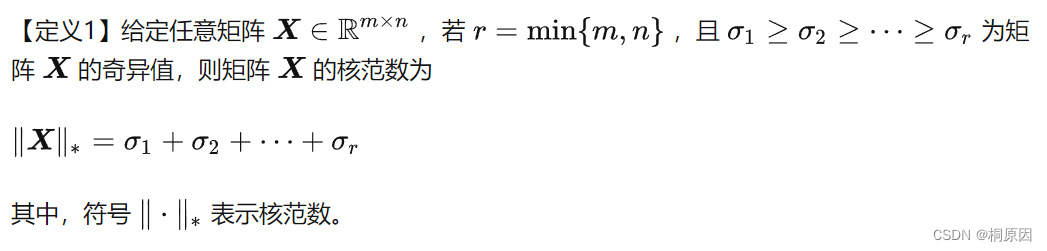
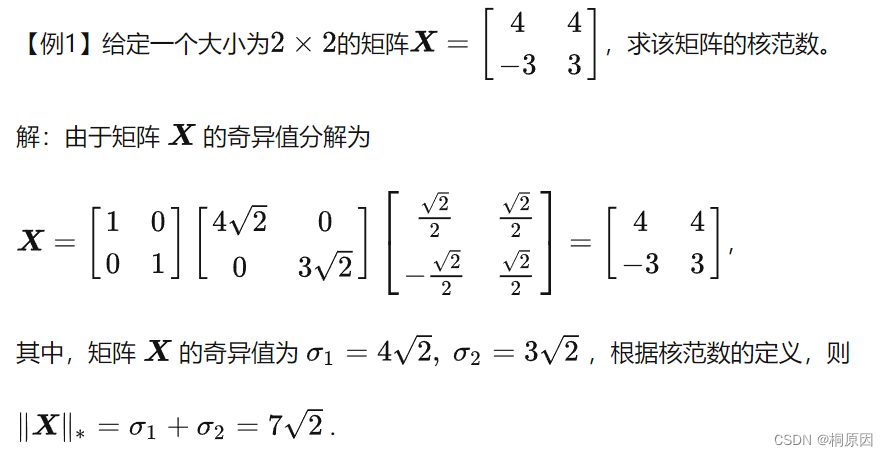
例子来源:https://zhuanlan.zhihu.com/p/104402273p=
other时,当作vec norm计算,p为int的形式,则是如下形式:
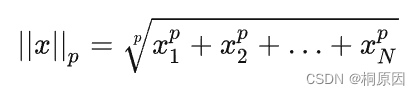
详细解释:https://zhuanlan.zhihu.com/p/260162240dim是vector norm
p=
none时,为L2 Norm,也是属于P范数一种,pytorch调用的函数是F.normalize,pytorch官网定义如下: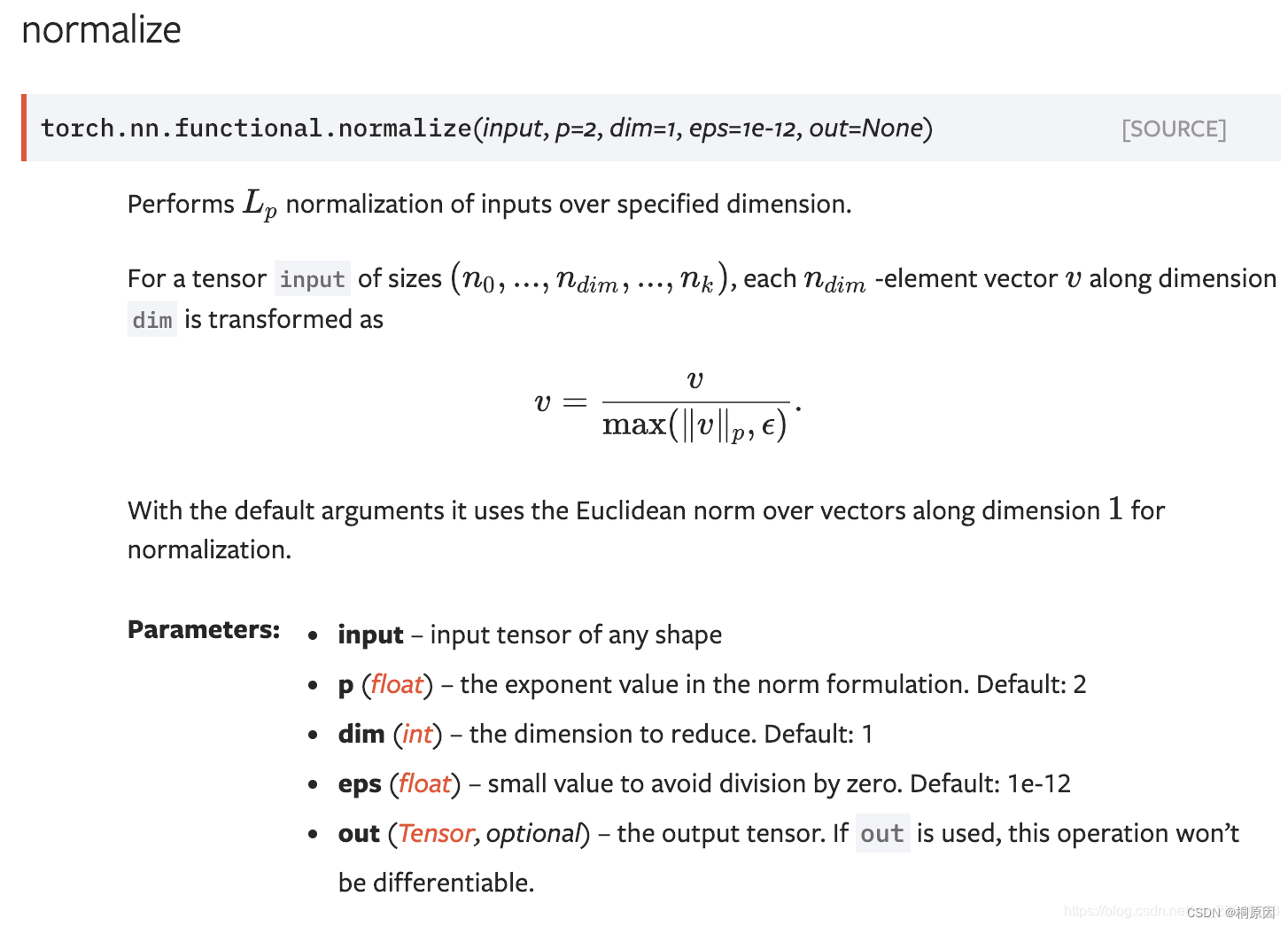
dim
dim (int, 2-tuple of ints, 2-list of ints, optional): If it is an int, vector norm will be calculated, if it is 2-tuple of ints, matrix norm will be calculated. If the value is None, matrix norm will be calculated when the input tensor only has two dimensions, vector norm will be calculated when the input tensor only has one dimension. If the input tensor has more than two dimensions, the vector norm will be applied to last dimension.- 1
- 2
- 3
- 4
- 5
- 6
- 7
如果
dim为None, 当input的维度只有2维时使用matrix norm,当input的维度只有1维时使用vector norm,当input的维度超过2维时,只在最后一维上使用vector norm。
如果dim不为None,1.dim是int类型,则使用vector norm,如果dim是2-tuple int类型,则使用matrix norm.Keepdim
keepdim (bool, optional): whether the output tensors have :attr:`dim` retained or not. Ignored if :attr:`dim` = ``None`` and :attr:`out` = ``None``. Default: ``False``- 1
- 2
- 3
keepdim为True,则保留dim指定的维度,如果为False,则不保留。默认为Falseout
out (Tensor, optional): the output tensor. Ignored if :attr:`dim` = ``None`` and :attr:`out` = ``None``.- 1
- 2
输出为tensor,如果
dim=Noneandout=None.则不输出dtype
dtype (:class:`torch.dtype`, optional): the desired data type of returned tensor. If specified, the input tensor is casted to :attr:'dtype' while performing the operation. Default: None.- 1
- 2
- 3
指定输出的数据类型
示例
>>> import torch >>> a = torch.arange(9, dtype= torch.float) - 4 >>> a tensor([-4., -3., -2., -1., 0., 1., 2., 3., 4.]) >>> b = a.reshape((3, 3)) >>> b tensor([[-4., -3., -2.], [-1., 0., 1.], [ 2., 3., 4.]]) >>> torch.norm(a) >tensor(7.7460) >>>计算流程: math.sqrt((4*4 + 3*3 + 2*2 + 1*1 + -4*-4 + -3*-3 + -2*-2 + -1*-1)) 7.7460 >>> torch.norm(b) # 默认计算F范数 tensor(7.7460)- 1
- 2
- 3
- 4
- 5
- 6
- 7
- 8
- 9
- 10
- 11
- 12
- 13
- 14
- 15
-
相关阅读:
构建数字化SaaS商城运营平台:规划框架探究
element picker 时间控件,指定区间和指定月份置灰
css知识
音频信号分析与实践
JVM原理及优化_调优原则与工具
Geeker-Admin中ProTable表格分页之自定义接口页码、尺寸参数
Qt5 Python-docx库的使用,Qt python混合编程,qt 读写word,不依赖office
用递归函数遍历判断同一层级某个属性值是否相同
如何定时备份使用Docker构建的MySQL容器中的数据库
Vue学习:路由
- 原文地址:https://blog.csdn.net/qq_36287702/article/details/126330404
- 最新文章
-
沪漂五周年了:我越来越迷茫了
Agentic Skill Routing 实战:别再把所有 Skill 塞进 AI Agent 上下文
MySQL-Seconds_behind_master的精度误差
[MAF预定义ChatClient中间件-03]CachingChatClient——利用缓存省钱省时间
AI的至暗历史:从万众期待到被政府撤资,AI的两次死亡徘徊
Agent OS :五种驯服不确定性的范式
PortSwigger SQL注入LAB11
数据库即时编译JIT
[Begin]AI Learn Data Day 0
深度学习进阶(二十七)现代 LLM 的核心架构设计其二:SwiGLU