-
推荐系统之简单线性回归
推荐系统之简单线性回归
1.简单线性回归(最小二乘法)
import numpy as np import matplotlib.pyplot as plt #引入数据 point=np.genfromtxt('data.csv',delimiter=',') #point[0,0] x=point[:,0] y=point[:,1] plt.scatter(x,y) plt.show()- 1
- 2
- 3
- 4
- 5
- 6
- 7
- 8
- 9
- 10
- 11

#定义损失函数 def cost_function(w,b,point): length=len(point) cost_value=0 for i in range(length): zhen=point[i,1] jia=point[i,0]*w+b cost_value+=(zhen-jia)**2 return cost_value/length #求平均值的函数 def average(point): length=len(point) value=0 for i in range(length): value+=point[i] return value/length- 1
- 2
- 3
- 4
- 5
- 6
- 7
- 8
- 9
- 10
- 11
- 12
- 13
- 14
- 15
- 16
- 17
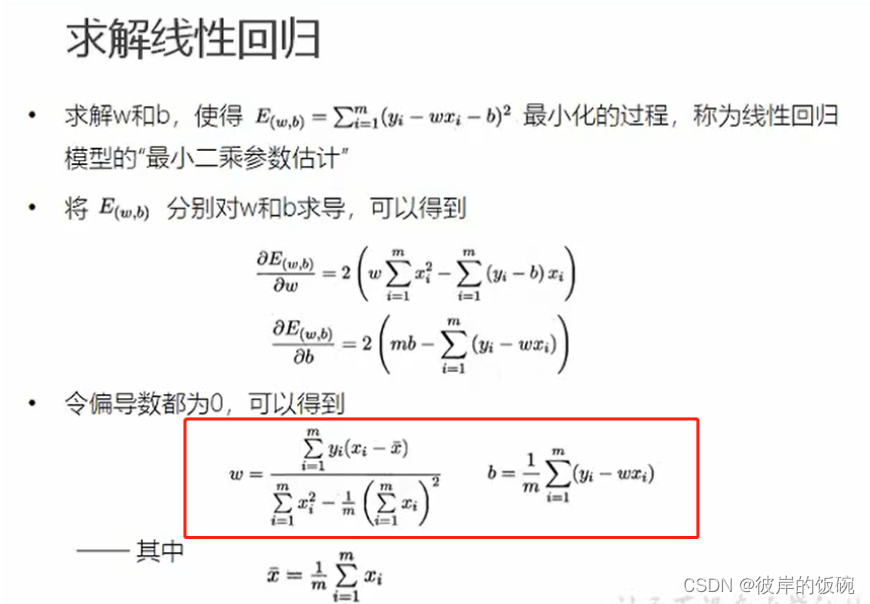
#根据公式求出所谓的w,b 拟合函数 def fit(point): average_x=average(point[:,0]) length=len(point) w=0 b=0 totalx2=0 totalx=0 totalshang=0 totalb=0 for i in range(length): totalx2+=point[i,0]**2 totalx+=point[i,0] totalshang+=point[i,1]*(point[i,0]-average_x) w=totalshang/(totalx2-(totalx**2)/length) for i in range(length): totalb+=point[i,1]-w*point[i,0] b=totalb/length return w,b- 1
- 2
- 3
- 4
- 5
- 6
- 7
- 8
- 9
- 10
- 11
- 12
- 13
- 14
- 15
- 16
- 17
- 18
- 19
#测试 w,b=fit(point) print("w的值是:",w) print("b的值是:",b) cost=cost_function(w,b,point) print("他的损失函数值为:",cost) ''' w的值是: 1.3224310227553846 b的值是: 7.991020982269173 他的损失函数值为: 110.25738346621313 ''' #画出拟合曲线 plt.scatter(x,y) pred_y=w*x+b plt.plot(x,pred_y,c="r") plt.show()- 1
- 2
- 3
- 4
- 5
- 6
- 7
- 8
- 9
- 10
- 11
- 12
- 13
- 14
- 15
- 16
- 17
- 18

2.梯度下降书写
损失函数,与导入数据方式与上面相同
- 定义模型的超参数
#定义模型的超参数 alpha=0.0001 initial_w=0 initial_b=0 num_list=100 #迭代100次- 1
- 2
- 3
- 4
- 5
- 6
- 定义梯度下降算法以及每一步下降的细节
#定义梯度下降算法 def grad_decs(point,initial_b,initial_w,alpha,num_list): w=initial_w b=initial_b cost_list=[] for i in range(num_list): cost_list.append(cost_function(w,b,point)) w,b=step_grad_decs(w,b,alpha,point) return [w,b,cost_list] #定义每一步下降的细节函数 def step_grad_decs(w,b,alpha,point): current_w=w current_b=b M=len(point) total_w=0 total_b=0 for i in range(M): total_w+=(w*point[i,0]+b-point[i,1])*point[i,0] total_b+=w*point[i,0]+b-point[i,1] w=w-alpha*(2/M*total_w) b=b-alpha*(2/M*total_b) return w,b- 1
- 2
- 3
- 4
- 5
- 6
- 7
- 8
- 9
- 10
- 11
- 12
- 13
- 14
- 15
- 16
- 17
- 18
- 19
- 20
- 21
- 22
- 23
- 24
- 测试,运行梯度下降算法计算最优w与b
#测试:运行梯度下降算法计算最优w与b w,b,cost_list=grad_decs( point,initial_b,initial_w,alpha,num_list ) print("w is: ", w) print("b is: ", b) cost = cost_function(w, b, point) print("cost is: ", cost) plt.plot(cost_list) plt.show()- 1
- 2
- 3
- 4
- 5
- 6
- 7
- 8
- 9
- 10
- 11

- 画出拟合曲线
#画出拟合曲线 plt.scatter(x,y) pred_y=w*x+b plt.plot(x,pred_y,c="r") plt.show()- 1
- 2
- 3
- 4
- 5
- 6
- 7

3. 使用sklearn库来实现线性回归
- 调库,创建初始模型
from sklearn.linear_model import LinearRegression lr=LinearRegression() x_new=x.reshape(-1,1) y_new=y.reshape(-1,1) lr.fit(x_new,y_new)- 1
- 2
- 3
- 4
- 5
- 6
- 7
- 从训练好的模型中提取系数与截距
w=lr.coef_ b=lr.intercept_ print("w is: ", w) print("b is: ", b) cost = cost_function(w, b, point) print("cost is: ", cost)- 1
- 2
- 3
- 4
- 5
- 6
- 7
- 8
-
相关阅读:
Lucene和Solr和Elasticsearch区别,全文检索引擎工具包Lucene索引流程和搜索流程实操
hadoop生态现状、介绍、部署
vue-router滚动行为
[论文笔记]BiMPM
用keras框架训练模型,画loss曲线
计算机毕设(附源码)JAVA-SSM基于协同过滤算法的甜品推荐系统
19:A*B问题
Ajax--form表单与模板引擎--通过Ajax提交表单数据及案例 - 评论列表
【软考笔记】(三)知识产权
Linux环境搭建SVN服务器并实现公网访问 - cpolar端口映射
- 原文地址:https://blog.csdn.net/qq_42392049/article/details/126195195


- 最新文章
-
沪漂五周年了:我越来越迷茫了
Agentic Skill Routing 实战:别再把所有 Skill 塞进 AI Agent 上下文
MySQL-Seconds_behind_master的精度误差
[MAF预定义ChatClient中间件-03]CachingChatClient——利用缓存省钱省时间
AI的至暗历史:从万众期待到被政府撤资,AI的两次死亡徘徊
Agent OS :五种驯服不确定性的范式
PortSwigger SQL注入LAB11
数据库即时编译JIT
[Begin]AI Learn Data Day 0
深度学习进阶(二十七)现代 LLM 的核心架构设计其二:SwiGLU