-
Java筑基28-泛型
目录
一、泛型入门

1.使用传统方式
- package com.feiyang.basic14;
- import com.feiyang.static1.main;
- import java.util.ArrayList;
- /**
- * @author:飞扬
- * @公众hao:程序员飞扬
- * @description:泛型
- */
- public class Generic01 {
- public static void main(String[] args) {
- //使用传统方式解决
- ArrayList arrayList = new ArrayList();
- arrayList.add(new Dog("大黄",5));
- arrayList.add(new Dog("黑子",6));
- arrayList.add(new Dog("小花",2));
- //加入不小心添加了只猫
- arrayList.add(new Cat("咪咪",3));
- for (Object o : arrayList) {
- //向下转型(影响效率)
- Dog o1 = (Dog) o;
- System.out.println(o1.getName() + "-" + o1.getAge());
- }
- }
- }
- class Dog{
- private String name;
- private Integer age;
- public Dog(String name, Integer age) {
- this.name = name;
- this.age = age;
- }
- public String getName() {
- return name;
- }
- public void setName(String name) {
- this.name = name;
- }
- public Integer getAge() {
- return age;
- }
- public void setAge(Integer age) {
- this.age = age;
- }
- @Override
- public String toString() {
- return "Dog{" +
- "name='" + name + '\'' +
- ", age='" + age + '\'' +
- '}';
- }
- }
- class Cat{
- private String name;
- private Integer age;
- public Cat(String name, Integer age) {
- this.name = name;
- this.age = age;
- }
- public String getName() {
- return name;
- }
- public void setName(String name) {
- this.name = name;
- }
- public Integer getAge() {
- return age;
- }
- public void setAge(Integer age) {
- this.age = age;
- }
- @Override
- public String toString() {
- return "Dog{" +
- "name='" + name + '\'' +
- ", age='" + age + '\'' +
- '}';
- }
- }
打印输出:
大黄-5
黑子-6
小花-2
Exception in thread "main" java.lang.ClassCastException: com.feiyang.basic14.Cat cannot be cast to com.feiyang.basic14.Dog
at com.feiyang.basic14.Generic01.main(Generic01.java:22)

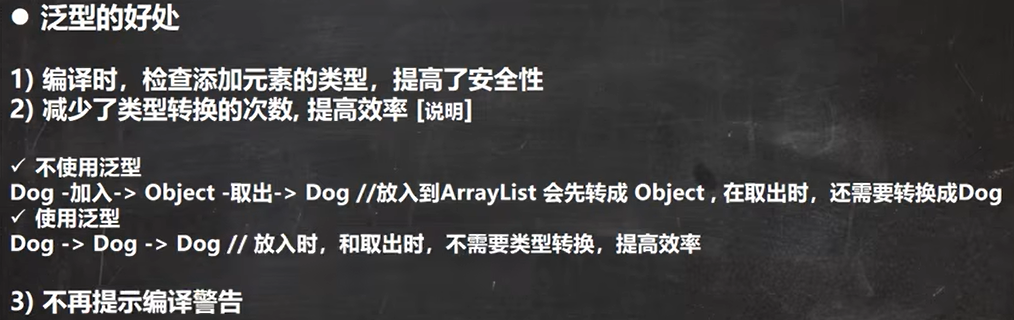
2.用泛型解决上面的问题
- /**
- * @author:飞扬
- * @公众hao:程序员飞扬
- * @description:泛型
- */
- public class Generic02 {
- public static void main(String[] args) {
- //使用传统方式解决
- ArrayList
arrayList = new ArrayList (); - arrayList.add(new Dog("大黄",5));
- arrayList.add(new Dog("黑子",6));
- arrayList.add(new Dog("小花",2));
- //加入不小心添加了只猫
- //arrayList.add(new Cat("咪咪",3));
- // for (Object o : arrayList) {
- // //向下转型(影响效率)
- // Dog o1 = (Dog) o;
- // System.out.println(o1.getName() + "-" + o1.getAge());
- // }
- for (Dog o : arrayList) {
- System.out.println(o.getName() + "-" + o.getAge());
- }
- }
- }
打印输出:
大黄-5
黑子-6
小花-2
二、泛型介绍
- package com.feiyang.basic14;
- /**
- * @author:飞扬
- * @公众hao:程序员飞扬
- * @description:泛型介绍
- */
- public class Generic03 {
- public static void main(String[] args) {
- }
- }
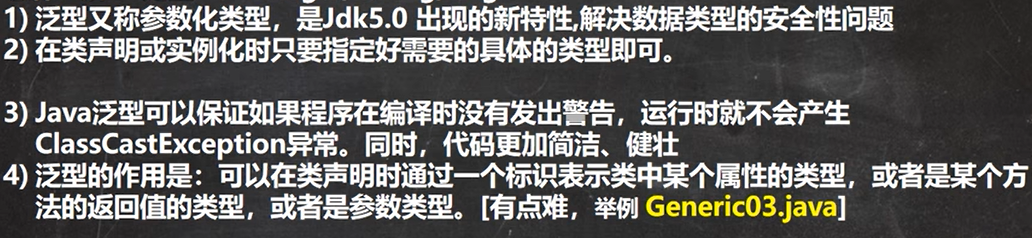
- class Person
{ - //属性类型泛型化
- E s;//E表示s的数据类型,该数据类型在定义Person对象的时候指定,即在编译时就确定E是什么类型。
- //参数类型泛型化
- public Person(E s) {
- this.s = s;
- }
- //返回值类型泛型化
- public E func(){
- return s;
- }
- }
三、泛型语法和应用
1.泛型语法

2.泛型案例
- package com.feiyang.basic14;
- import java.util.HashMap;
- import java.util.HashSet;
- import java.util.Map;
- import java.util.Set;
- /**
- * @author:飞扬
- * @公众hao:程序员飞扬
- * @description:泛型应用案例
- */
- public class GenericExercise {
- public static void main(String[] args) {
- HashSet
hashSet = new HashSet<>(); - hashSet.add(new Student("tom",35));
- hashSet.add(new Student("jack",16));
- hashSet.add(new Student("feiyang",28));
- for (Student student : hashSet) {
- System.out.println(student.getName() + "-" + student.getAge());
- }
- HashMap
- hm.put("tom",new Student("tom",35));
- hm.put("jack",new Student("jack",16));
- hm.put("feiyang",new Student("feiyang",28));
- Set
- for (Map.Entry
- System.out.println(entry.getKey() + "-" + entry.getValue());
- }
- }
- }
- class Student{
- private String name;
- private int age;
- public Student(String name, int age) {
- this.name = name;
- this.age = age;
- }
- public String getName() {
- return name;
- }
- public void setName(String name) {
- this.name = name;
- }
- public int getAge() {
- return age;
- }
- public void setAge(int age) {
- this.age = age;
- }
- @Override
- public String toString() {
- return "Student{" +
- "name='" + name + '\'' +
- ", age=" + age +
- '}';
- }
- }
打印输出:
jack-16
tom-35
feiyang-28
tom-Student{name='tom', age=35}
jack-Student{name='jack', age=16}
feiyang-Student{name='feiyang', age=28}
3.泛型使用细节

- package com.feiyang.basic14;
- import java.util.ArrayList;
- import java.util.List;
- /**
- * @author:飞扬
- * @公众hao:程序员飞扬
- * @description:泛型使用细节
- */
- public class GenericDetail {
- public static void main(String[] args) {
- //1.给泛型指定数据类型,要求是引用数据类型,不能是基本数据类型
- ArrayList
arrayList = new ArrayList ();//OK - //ArrayList
arrayList2 = new ArrayList ();//error - //2.给泛型指定具体类型后,可以传入该类型或其子类型
- aPig.f();
- //Pig bPig = new Pig(new B());//error
- bPig2.f();
- //3.泛型的使用
- ArrayList
list = new ArrayList (); - List
list2 = new ArrayList (); - //也可以简写(推荐),编译器会进行类型推断
- ArrayList
list3 = new ArrayList<>(); - List
list4 = new ArrayList<>(); - List
pig = new ArrayList<>(); - //如果这样写,泛型默认是Object,
- ArrayList list5 = new ArrayList();//等价与=>ArrayList
- }
- }
- class A{}
- //class B{}
- class B extends A{}
- class Pig
{ - E e;
- public Pig(E e) {
- this.e = e;
- }
- public void f(){
- System.out.println(e.getClass());
- }
- }
4.泛型经典练习题

- package com.feiyang.basic14;
- /**
- * @author:飞扬
- * @公众hao:程序员飞扬
- * @description:生日日期类
- */
- public class MyDate implements Comparable
{ - private int year;
- private int month;
- private int day;
- public MyDate(int year, int month, int day) {
- this.year = year;
- this.month = month;
- this.day = day;
- }
- public int getYear() {
- return year;
- }
- public void setYear(int year) {
- this.year = year;
- }
- public int getMonth() {
- return month;
- }
- public void setMonth(int month) {
- this.month = month;
- }
- public int getDay() {
- return day;
- }
- public void setDay(int day) {
- this.day = day;
- }
- @Override
- public String toString() {
- return "MyDate{" +
- "year=" + year +
- ", month=" + month +
- ", day=" + day +
- '}';
- }
- //把对日期的排序抽取出来放到MyDate类
- @Override
- public int compareTo(MyDate o) {
- int yearMinus = this.year - o.getYear();
- if(yearMinus !=0){
- return yearMinus;
- }
- int monthMinus = this.month - o.getMonth();
- if(monthMinus !=0){
- return monthMinus;
- }
- return this.day - o.getDay();
- }
- }
- package com.feiyang.basic14;
- /**
- * @author:程序员飞扬
- * @公众hao:程序员飞扬
- * @description:雇员类
- */
- public class Employee {
- private String name;
- private Double sal;
- private MyDate birthday;
- public Employee(String name, Double sal, MyDate birthday) {
- this.name = name;
- this.sal = sal;
- this.birthday = birthday;
- }
- public String getName() {
- return name;
- }
- public void setName(String name) {
- this.name = name;
- }
- public Double getSal() {
- return sal;
- }
- public void setSal(Double sal) {
- this.sal = sal;
- }
- public MyDate getBirthday() {
- return birthday;
- }
- public void setBirthday(MyDate birthday) {
- this.birthday = birthday;
- }
- @Override
- public String toString() {
- return "Employee{" +
- "name='" + name + '\'' +
- ", sal=" + sal +
- ", birthday=" + birthday +
- '}';
- }
- }
- package com.feiyang.basic14;
- import java.util.ArrayList;
- import java.util.Comparator;
- /**
- * @author:程序员飞扬
- * @公众hao:程序员飞扬
- * @description:泛型案例
- */
- public class GenericExercise02 {
- public static void main(String[] args) {
- ArrayList
employees = new ArrayList (); - employees.add(new Employee("alice",2000.00,new MyDate(1980,10,21)));
- employees.add(new Employee("bob",1800.00,new MyDate(2002,6,18)));
- employees.add(new Employee("alice",3500.00,new MyDate(1980,10,22)));
- employees.sort(new Comparator
() { - @Override
- public int compare(Employee o1, Employee o2) {
- int i = o1.getName().compareTo(o2.getName());
- if(i != 0 ){
- return i;
- }
- int i1 = o1.getBirthday().compareTo(o2.getBirthday());
- return i1;
- }
- });
- //lambda写法
- employees.sort((o1, o2) -> {
- int i = o1.getName().compareTo(o2.getName());
- if(i != 0 ){
- return i;
- }
- int i1 = o1.getBirthday().compareTo(o2.getBirthday());
- return i1;
- });
- employees.forEach(employee -> System.out.println(employee));
- }
- }
打印输出:
Employee{name='alice', sal=2000.0, birthday=MyDate{year=1980, month=10, day=21}}
Employee{name='alice', sal=3500.0, birthday=MyDate{year=1980, month=10, day=22}}
Employee{name='bob', sal=1800.0, birthday=MyDate{year=2002, month=6, day=18}}
四、自定义泛型
1.自定义泛型类

- package com.feiyang.basic14;
- /**
- * @author:飞扬
- * @公众hao:程序员飞扬
- * @description:自定义泛型类
- */
- public class CustomGeneric_ {
- public static void main(String[] args) {
- }
- }
- /**
- * 1.Tiger后面有泛型,所以我们把Tiger成为自定义泛型类
- * 2. T,R,M是泛型的标识类,一般是单个大写字母
- * 3. 泛型标识符可以有多个
- * 4. 普通成员可以使用泛型(属性,方法)
- * 5,使用泛型的数据不能初始化
- * @param
- * @param
- * @param
- */
- class Tiger
- String name;
- T t; //属性使用泛型
- R r;
- M m;
- //T[] tarr = new T[8]; //不可以,因为数组在 new时不能确定T的类型,所有不能开辟内存空间
- //1. 静态和类相关,在类加载时对象还未创建
- //2. 所以静态方法和静态属性使用了泛型,JVM就无法完成初始化
- //static R r2;
- //public static void m1(M m){
- //
- //}
- public Tiger(String name, T t, R r, M m) { //构造器使用泛型
- this.name = name;
- this.t = t;
- this.r = r;
- this.m = m;
- }
- }
案例1

- package com.feiyang.basic14;
- /**
- * @author:飞扬
- * @公众hao:程序员飞扬
- * @description:自定义泛型类
- */
- public class CustomGeneric_ {
- public static void main(String[] args) {
- Tiger
- g.setT(10.9);//OK
- //g.setT("yy");//错误,类型不对
- System.out.println(g);
- Tiger g2 = new Tiger("john~~");//OK,默认T=Object,R=Object,M=Object
- g2.setT("yy");//OK,因为此时T=Object,而"yy"=String,是Object的子类
- System.out.println(g2);
- }
- }
- /**
- * 1.Tiger后面有泛型,所以我们把Tiger成为自定义泛型类
- * 2. T,R,M是泛型的标识类,一般是单个大写字母
- * 3. 泛型标识符可以有多个
- * 4. 普通成员可以使用泛型(属性,方法)
- * 5,使用泛型的数据不能初始化
- * @param
- * @param
- * @param
- */
- class Tiger
- String name;
- T t; //属性使用泛型
- R r;
- M m;
- //T[] tarr = new T[8]; //不可以,因为数组在 new时不能确定T的类型,所有不能开辟内存空间
- //1. 静态和类相关,在类加载时对象还未创建
- //2. 所以静态方法和静态属性使用了泛型,JVM就无法完成初始化
- //static R r2;
- //public static void m1(M m){
- //
- //}
- public Tiger(String name, T t, R r, M m) { //构造器使用泛型
- this.name = name;
- this.t = t;
- this.r = r;
- this.m = m;
- }
- public Tiger(String john) {
- }
- public String getName() {
- return name;
- }
- public void setName(String name) {
- this.name = name;
- }
- public T getT() {
- return t;
- }
- public void setT(T t) {
- this.t = t;
- }
- public R getR() {
- return r;
- }
- public void setR(R r) {
- this.r = r;
- }
- public M getM() {
- return m;
- }
- public void setM(M m) {
- this.m = m;
- }
- @Override
- public String toString() {
- return "Tiger{" +
- "name='" + name + '\'' +
- ", t=" + t +
- ", r=" + r +
- ", m=" + m +
- '}';
- }
- }
输出:
Tiger{name='null', t=10.9, r=null, m=null}
Tiger{name='null', t=yy, r=null, m=null}
2.自定义泛型接口

- package com.feiyang.basic14;
- /**
- * @author:飞扬
- * @公众hao:程序员飞扬
- * @description:
- */
- public class CustomInterfaceGeneric_ {
- }
- interface IUsb
- //普通方法中可以使用接口泛型
- R get(U u);
- void hi(R r);
- void run(R r1,R r2,U u1,U u2);
- //在jdk8中,可以在接口中使用默认方法,也是可以使用泛型
- default R method(U u){
- return null;
- }
- /**
- * 泛型接口使用说明:
- * 1. 接口中,静态成员不能使用泛型
- */
- int n = 10;
- //U name;//静态成员不能使用泛型
- }
- //在继承接口时,指定泛型接口的类型
- interface IA extends IUsb
- }
- //当我们继承IA接口时,因为IA接口继承IUsb接口时指定了U为String,R为Double,
- //所以重写IUsb接口的方法时,用String替换了U,用Double替换了R。
- class AA implements IA{
- @Override
- public Double get(String s) {
- return null;
- }
- @Override
- public void hi(Double aDouble) {
- }
- @Override
- public void run(Double r1, Double r2, String u1, String u2) {
- }
- }
- //在实现接口时直接指定泛型接口的类型
- //给U指定Integer,给R指定Float
- //所以当我们实现IUsb接口时,会用Integer替换U,用Float替换R
- class BB implements IUsb
- @Override
- public Float get(Integer integer) {
- return null;
- }
- @Override
- public void hi(Float aFloat) {
- }
- @Override
- public void run(Float r1, Float r2, Integer u1, Integer u2) {
- }
- }
3.自定义泛型方法

自定义泛型方法练习

- package com.feiyang.basic14;
- /**
- * @author:飞扬
- * @公众hao:程序员飞扬
- * @description:
- */
- public class CustomMethodGenericExercise {
- public static void main(String[] args) {
- Apple
- apple.fly(10);
- apple.fly(new Dog2());
- }
- }
- class Dog2{}
- class Apple
- public
void fly(E e){ - System.out.println(e.getClass().getSimpleName());
- }
- //错误,下面的方法并不是泛型方法,只是想使用类声明的泛型,然而类并没有声明泛型U
- //public void eat(U u){}
- //使用了泛型类声明的泛型M
- public void rnn(M m){}
- }
输出:
Integer
Dog2
五、泛型的继承和通配符

- package com.feiyang.basic14;
- import java.util.ArrayList;
- import java.util.List;
- /**
- * @author:飞扬
- * @公众hao:程序员飞扬
- * @description:
- */
- public class GenericExtends {
- public static void main(String[] args) {
- Object xx = new String("xx");//这样可以
- List list = new ArrayList();//可以,多态的体现
- //List
- //举例说明几个方法的使用
- List
- List
list2 = new ArrayList(); - List
list3 = new ArrayList(); - List
list4 = new ArrayList(); - List
list5 = new ArrayList(); - //List
- printCollection1(list1);
- printCollection1(list2);
- printCollection1(list3);
- printCollection1(list4);
- printCollection1(list5);
- //List
- // printCollection2(list1);//×
- // printCollection2(list2);//×
- // printCollection2(list3);//√
- // printCollection2(list4);//√
- // printCollection2(list5);//√
- //List
- // printCollection3(list1);//√
- // printCollection3(list2);//×
- // printCollection3(list3);//√
- // printCollection3(list4);//×
- // printCollection3(list5);//×
- }
- //几个方法说明:
- //List表示任意的泛型类型都可以接受
- public static void printCollection1(List c){
- for (Object o : c) {
- System.out.println(o);
- }
- }
- //List表示上限,可以接受AAA或AAA的子类
- public static void printCollection2(List c){
- for (Object o : c) {
- System.out.println(o);
- }
- }
- //List表示下限,可以接受AAA类或AAA类的父类
- public static void printCollection3(Listsuper AAA> c){
- for (Object o : c) {
- System.out.println(o);
- }
- }
- }
- class AAA{
- }
- class BBB extends AAA{
- }
- class CCC extends BBB{
- }
六、泛型作业(练习)

- package com.feiyang.basic14;
- /**
- * @author:飞扬
- * @公众hao:程序员飞扬
- * @description:
- */
- public class User {
- private int id;
- private int age;
- private String name;
- public User() {
- }
- public User(int id, int age, String name) {
- this.id = id;
- this.age = age;
- this.name = name;
- }
- public int getId() {
- return id;
- }
- public void setId(int id) {
- this.id = id;
- }
- public int getAge() {
- return age;
- }
- public void setAge(int age) {
- this.age = age;
- }
- public String getName() {
- return name;
- }
- public void setName(String name) {
- this.name = name;
- }
- @Override
- public String toString() {
- return "User{" +
- "id=" + id +
- ", age=" + age +
- ", name='" + name + '\'' +
- '}';
- }
- }
- package com.feiyang.basic14;
- import org.junit.jupiter.api.Test;
- import java.util.*;
- /**
- * @author:飞扬
- * @公众hao:程序员飞扬
- * @description:泛型作业练习
- */
- public class HomeWork01 {
- public static void main(String[] args) {
- }
- @Test
- public void testList(){
- DAO
dao = new DAO<>(); - dao.save("01",new User(1,10,"tom"));
- dao.save("02",new User(2,15,"rose"));
- dao.save("03",new User(3,18,"jack"));
- //返回所有对象
- List
list = dao.list(); - System.out.println(list);
- //更新
- dao.update("03",new User(4,20,"bella"));
- List
list2 = dao.list(); - System.out.println(list2);
- //删除
- dao.delete("01");
- List
list3 = dao.list(); - System.out.println(list3);
- //根据id获得
- System.out.println("02===" + dao.get("02"));
- }
- }
- class DAO
{ - private Map
- public T get(String id){
- return map.get(id);
- }
- public void update(String id,T entity){
- map.put(id,entity);
- }
- //返回map中存放的所有T对象
- public List
list(){ - List
list = new ArrayList(); - Set
keySet = map.keySet(); - for (String key : keySet) {
- list.add(get(key));
- }
- return list;
- }
- public void save(String id,T entity){
- map.put(id,entity);
- }
- public void delete(String id){
- map.remove(id);
- }
- }
-
相关阅读:
肠道菌群代谢组学之粪便微生物移植治疗原发性硬化性胆管炎
Mysql
Java8 新特性之Stream(二)-- Stream的中间操作
Qt开发经验小技巧231-235
NeRF数据集
微信小程序连接云数据库基本使用
golang waitGroup(1)
【手写Mybatis】step04:数据源的解析、事务和sql执行
网络基本概念
Springboot——拦截器
- 原文地址:https://blog.csdn.net/lu_xin5056/article/details/126193147
