-
王道链表综合题(下)
提示:心中有丘壑 眉目作山河
第十七题

先谈
先建立双向循环链表 然后使用两个指针,一个从前向后 一个从后向前 比较是否相等便可,注意本题使用栈消栈顶则较麻烦 因为总的个数可能是奇数个
双链表头插法建立
BiLNode* InitHeadBiList(){ BiLNode* L=(BiLNode*)malloc(sizeof(BiLNode)); L->next=L; L->pre=L; cout<<"请输入双向循环链表的值"<<endl; int input; while(scanf("%d",&input)!=EOF){ BiLNode* cur=(BiLNode*)malloc(sizeof(BiLNode)); cur->data=input; //下面来建立四条链 cur->pre=L->pre; cur->next=L; L->pre->next=cur; L->pre=cur; } BiLNode* p=L->next; cout<<"此时双向循环链表是"; while(p!=L){ cout<<p->data<<" "; p=p->next; } cout<<endl; //前面单链表中使用的都是头插法 这里使用尾插法, return L; }- 1
- 2
- 3
- 4
- 5
- 6
- 7
- 8
- 9
- 10
- 11
- 12
- 13
- 14
- 15
- 16
- 17
- 18
- 19
- 20
- 21
- 22
- 23
- 24
- 25
解决17题代码
void Solution17(BiLNode* L){ BiLNode* p=L->next; BiLNode* q=L->pre; while(p->data==q->data&&p!=q&&p->next!=q){ p=p->next; q=q->pre; } if(p==q){ cout<<"此时链表对称"; } else if(p->next==q){ if(p->data==q->data){ cout<<"此时链表对称"; } else{ cout<<"此时链表不对称" ; } } else { cout<<"此时链表并不对称"; } }- 1
- 2
- 3
- 4
- 5
- 6
- 7
- 8
- 9
- 10
- 11
- 12
- 13
- 14
- 15
- 16
- 17
- 18
- 19
- 20
- 21
- 22
第十八题

先谈
找到h1的yi巴 然后将h2 接入即可
代码
void Solution18(LNode* &L1,LNode* &L2){ //因为我这里不是两个循环链表 所以先造两个循环链表 LNode* tail1=L1; while(tail1->next){ tail1=tail1->next; } tail1->next=L1; LNode* tail2=L2; while(tail2->next){ tail2=tail2->next; } tail2->next=L2; //以上完成两个循环链表的构建 tail1=L1; while(tail1->next!=L1){ tail1=tail1->next; } tail2=L2; while(tail2->next!=L2){ tail2=tail2->next; } tail1->next=L2->next; tail2->next=L1; //输出打印验证 tail1=L1->next; while(tail1){ cout<<tail1->data; tail1=tail1->next; } }- 1
- 2
- 3
- 4
- 5
- 6
- 7
- 8
- 9
- 10
- 11
- 12
- 13
- 14
- 15
- 16
- 17
- 18
- 19
- 20
- 21
- 22
- 23
- 24
- 25
- 26
- 27
- 28
- 29
- 30
运行截图
至于为什么有零,是因为这里我使用的带头结点的循环链表

第十九题

先谈
本题无非定义两个指针,一个用于保存最小值,一个用于遍历,然后在删除就可以了
代码
void Solution19(LNode* &L){ LNode* tail=L->next; while(tail->next){ tail=tail->next; } tail->next=L; cout<<tail->data; LNode* p=L->next; LNode* q=L; LNode* Min=L; while(L->next!=L){ p=L->next; Min=L;//定位到最小值的前一个结点 while(p->next!=L){//从头往后找一个最小值 if(p->next->data<Min->next->data){ Min=p; } p=p->next; } LNode* Del=Min->next;cout<<"此时删除的节点是"<<Min->next->data<<" "<<endl; Min->next=Min->next->next; free(Del);Del=NULL; } free(L); L=NULL; }- 1
- 2
- 3
- 4
- 5
- 6
- 7
- 8
- 9
- 10
- 11
- 12
- 13
- 14
- 15
- 16
- 17
- 18
- 19
- 20
- 21
- 22
- 23
- 24
- 25
- 26
运行截图

第二十题

先谈
首先我们需要通过一个指针先找到这个x 然后给他的freq域加一 然后判断此时这个x 应处的位置,判断与当前位置是否一致 若是不一致则进行删除插入
头插法建立双向链表
Freq* InitFreqBiList(){ Freq* L=(Freq*)malloc(sizeof(Freq)); L->next=NULL; L->pre=NULL; cout<<"请输入双向链表的值"<<endl; int input; while(scanf("%d",&input)!=EOF){ Freq* cur=(Freq*)malloc(sizeof(Freq)); cur->data=input; //下面来建立四条链 cur->pre=L; cur->next=L->next; if(L->next==NULL){ } else{ L->next->pre=cur; } L->next=cur; } Freq* p=L->next; cout<<"此时双向链表是"; while(p!=NULL){ cout<<p->data<<" "; p=p->next; } cout<<endl; return L; }- 1
- 2
- 3
- 4
- 5
- 6
- 7
- 8
- 9
- 10
- 11
- 12
- 13
- 14
- 15
- 16
- 17
- 18
- 19
- 20
- 21
- 22
- 23
- 24
- 25
- 26
- 27
- 28
- 29
20题代码
Freq* Solution20(Freq* &L,int x){ Freq* p=L->next; Freq* flag=L; while(p!=NULL){ if(p->data==x){ p->freq+=1; flag=p; break; } p=p->next; } //然后按照freq的值进行插入 从p的位置开始向前找 while(p!=NULL){ if(p->freq>flag->freq||p->pre==NULL){//插入p的后面位置 cout<<p->freq<<" "<<flag->freq<<" "<<endl; Freq* OldFreq=flag; //删除 flag->pre->next=flag->next; flag->next->pre=flag->pre; //插入 OldFreq->next=p->next; OldFreq->pre=p; p->next->pre=OldFreq; p->next=OldFreq; break; } p=p->pre; } p=L->next; while(p){ cout<<p->data<<" "; p=p->next; } cout<<endl; cout<<"此时数组中的频率是"; p=L->next; while(p){ cout<<p->freq<<" "; p=p->next; } cout<<endl; }- 1
- 2
- 3
- 4
- 5
- 6
- 7
- 8
- 9
- 10
- 11
- 12
- 13
- 14
- 15
- 16
- 17
- 18
- 19
- 20
- 21
- 22
- 23
- 24
- 25
- 26
- 27
- 28
- 29
- 30
- 31
- 32
- 33
- 34
- 35
- 36
- 37
- 38
- 39
- 40
- 41
- 42
运行截图

第二十一题

先谈
首先自然是暴力算法,使用两个指针,一个固定,一个用于遍历,判断两个是否会相等
第二种就是使用快慢指针的方式,一个每一次移动两个位置,一个每一次移动一个位置,当他们进入环中的时候,因为步子不一样,导致最后一定会相遇,并且相遇的时候,solw 指针移动的不足一圈,有人可能会想为什么不足一圈,因为若是slow与quick 同样起点一起移动 等slow移动到终点的时候,qucik 一定移动了两圈, 这两圈也就导致无论圈中结点是奇数或者是偶数都一定会相遇,并且quick 本来就比slow先进入 环中

代码
注意设置快慢指针的时候,要注意都是指向表头的,但是若是开始的指向不一样 得到的关系也就不一样
LNode* Solution21(LNode* &L){ if(L->next==NULL){ cout<<"此时链表为空"<<endl; } //首先构造一个带环的L cout<<"你想将第几个结点设置为环的入口"<<endl; int input;cin>>input; LNode* tail=L->next; LNode* enter; while(tail->next){ if(!(--input)){ enter=tail; } tail=tail->next; } tail->next=enter; //完成带环链表的构建 LNode* solw=L; LNode* quick=L; do{ solw=solw->next; quick=quick->next->next; }while(solw!=quick); return solw; }- 1
- 2
- 3
- 4
- 5
- 6
- 7
- 8
- 9
- 10
- 11
- 12
- 13
- 14
- 15
- 16
- 17
- 18
- 19
- 20
- 21
- 22
- 23
- 24
- 25
运行截图

第二十二题

先谈
第一想法将链表反转,找到之后再反转,
第二想法就是将链表中的数据存放在容器中,然后直接查找就可
第三个方法是先使用一个指针探路,然后知道链表的长度 然后再重现移动n-r个结点即可
王道上的方法:先使用一个指针移动k个单位 再使用一个指针从头开始移动 当第一个指针移动到最后一个位置的时候,刚才那个从头移动的指针 此时的位置正好是倒数第K个位置,代码
void Solution22(LNode* &L){ cout<<"请输入你要查找倒数第几个上的元素"<<endl; int input;cin>>input; int x=input; LNode* quick=L->next; LNode* slow=L->next; while(--input){ quick=quick->next; } while(quick->next){ quick=quick->next; slow=slow->next; } cout<<"倒数第"<<x<<"上的元素是"<<slow->data<<endl; }- 1
- 2
- 3
- 4
- 5
- 6
- 7
- 8
- 9
- 10
- 11
- 12
- 13
- 14
运行截图

第二十三题

先谈
这个不就是寻找两个链表的公共结点?
有兴趣的可以看这一篇中的第八题使用栈结构,这里我们使用一个新的方法快慢指针的方式 首先使得一个指针先移动Len1-Len2个长度 然后两个再一起移动 然后比较两个指针指向是否相等来判断什么位置是公共结点代码
LNode* Solution23(LNode* &L1,LNode* &L2){ int input;LNode* p=L2;LNode* q=L1; LNode* L3=NULL; cout<<"请问你要将L1接到L2的第几个位置之前(位置从1开始)"<<endl; cin>>input; while(input--){ p=p->next; } while(q->next){ q=q->next; } q->next=p; cout<<"此时拼接之后的链表L1是"; q=L1; while(q->next){ cout<<q->next->data<<" "; q=q->next; } cout<<endl; //此上已经构造两个链表具有公共节点 //首先需要知道L1的长度 然后需要知道L2的长度 p=L1->next;int len1=1; q=L2->next;int len2=1; while(p->next){ p=p->next; len1+=1; } while(q->next){ q=q->next; len2+=1; } //先让长的移|len1-len2|; p=L1->next;q=L2->next; if(len1>len2){ int margin=len1-len2; while(margin--){ p=p->next; } while(p!=q){ p=p->next; q=q->next; } } else{ int margin=len2-len1; while(margin--){ q=q->next; } while(p!=q){ p=p->next; q=q->next; } } L3=p; return L3; }- 1
- 2
- 3
- 4
- 5
- 6
- 7
- 8
- 9
- 10
- 11
- 12
- 13
- 14
- 15
- 16
- 17
- 18
- 19
- 20
- 21
- 22
- 23
- 24
- 25
- 26
- 27
- 28
- 29
- 30
- 31
- 32
- 33
- 34
- 35
- 36
- 37
- 38
- 39
- 40
- 41
- 42
- 43
- 44
- 45
- 46
- 47
- 48
- 49
- 50
- 51
- 52
- 53
- 54
- 55
运行效果

第二十四题

先谈
第一想法是使用一个数组,若是其中已经有元素则不删除 若是其中已经有元素则删除
代码
void Solution24(LNode* &L){ int a[100]={0}; LNode* p=L; while(p->next){ if(a[abs(p->next->data)]!=0){ LNode* Oldp=p->next; p->next=p->next->next; free(Oldp); } else{ a[p->next->data]=1; p=p->next; } } PrintHead(L); }- 1
- 2
- 3
- 4
- 5
- 6
- 7
- 8
- 9
- 10
- 11
- 12
- 13
- 14
- 15
- 16
运行截图

第二十五题

先谈
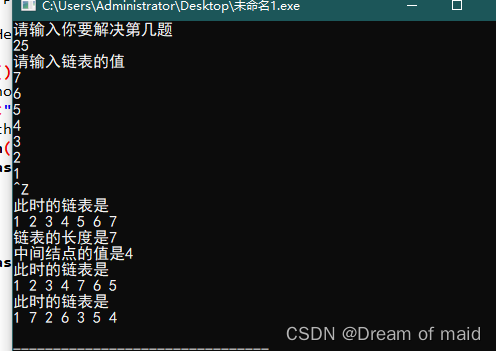
首先看到奇数项是递增的 而偶数项是递减的 所以我想可能需要反转数组,这里反转后一部分的链表 然后将An插入A1 的后面,将An-1插入到A2 后面 直到后一部分遍历结束
代码
void Solution25(LNode* &L){ LNode* p=L->next; LNode* q=L->next; //首先需要知道链表的长度 int len=1; while(p->next){ len+=1; p=p->next; } int mid=len-len/2; LNode* MidNode=L->next; cout<<"链表的长度是"<<len<<endl; //找到中间结点的位置 while(--mid){ q=q->next; } MidNode=q; cout<<"中间结点的值是"<<MidNode->data<<endl; //将中间结点之后的结点反转 LNode* r=MidNode->next->next; p=MidNode->next; q=MidNode->next; while(r){ q=r; r=q->next; q->next=p; p=q; }; MidNode->next->next=NULL; MidNode->next=p; PrintHead(L); //将后半部分的插入到前半部分中 p=L->next; while(MidNode->next){ //删除后半部分的第一个结点 LNode* cur=MidNode->next; MidNode->next=MidNode->next->next; //将结点插入前半部分p的后面; cur->next=p->next; p->next=cur; //将p向后移动两个单位 p=p->next->next; } PrintHead(L); }- 1
- 2
- 3
- 4
- 5
- 6
- 7
- 8
- 9
- 10
- 11
- 12
- 13
- 14
- 15
- 16
- 17
- 18
- 19
- 20
- 21
- 22
- 23
- 24
- 25
- 26
- 27
- 28
- 29
- 30
- 31
- 32
- 33
- 34
- 35
- 36
- 37
- 38
- 39
- 40
- 41
- 42
- 43
- 44
- 45
运行截图
可执行代码汇总
#includeusing namespace std; #define F(i,m,n) for(int i=m;i<n;i++) #define ElemType int typedef struct LNode{ ElemType data; struct LNode* next; }LNode; typedef struct BiLNode{ ElemType data; struct BiLNode* pre; struct BiLNode* next; }BiLNode; typedef struct Freq{ ElemType data; struct Freq* pre; struct Freq* next; int freq=0; }Freq; void Print(LNode* L){ cout<<"此时的链表是"<<endl; if(L==NULL){ cout<<"此时是空表"<<endl; return; } for(LNode* i=L;i!=NULL;i=i->next){ cout<<i->data<<" "; } cout<<endl; } void PrintHead(LNode* L){ cout<<"此时的链表是"<<endl; if(L->next==NULL){ cout<<"此时是空表"<<endl; return; } for(LNode* i=L->next;i!=NULL;i=i->next){ cout<<i->data<<" "; } cout<<endl; } LNode* InitHeadList(){ cout<<"请输入链表的值"<<endl; LNode* L=(LNode*)malloc(sizeof(LNode)); L->data=0;//头结点这里可以存放链表的长度 L->next=NULL; int input; while(scanf("%d",&input)!=EOF){ LNode* cur=(LNode*)malloc(sizeof(LNode)); cur->data=input; cur->next=L->next; L->next=cur; } PrintHead(L); return L; } Freq* InitFreqBiList(){ Freq* L=(Freq*)malloc(sizeof(Freq)); L->next=NULL; L->pre=NULL; cout<<"请输入双向链表的值"<<endl; int input; while(scanf("%d",&input)!=EOF){ Freq* cur=(Freq*)malloc(sizeof(Freq)); cur->data=input; //下面来建立四条链 cur->pre=L; cur->freq=0; cur->next=L->next; if(L->next==NULL){ } else{ L->next->pre=cur; } L->next=cur; } Freq* p=L->next; cout<<"此时双向链表是"; while(p!=NULL){ cout<<p->data<<" "; p=p->next; } cout<<endl; return L; } BiLNode* InitHeadBiList(){ BiLNode* L=(BiLNode*)malloc(sizeof(BiLNode)); L->next=L; L->pre=L; cout<<"请输入双向循环链表的值"<<endl; int input; while(scanf("%d",&input)!=EOF){ BiLNode* cur=(BiLNode*)malloc(sizeof(BiLNode)); cur->data=input; //下面来建立四条链 cur->pre=L->pre; cur->next=L; L->pre->next=cur; L->pre=cur; } BiLNode* p=L->next; cout<<"此时双向循环链表是"; while(p!=L){ cout<<p->data<<" "; p=p->next; } cout<<endl; //前面单链表中使用的都是头插法 这里使用尾插法, return L; } LNode* InitList(){ cout<<"请输入链表的值"<<endl; int input; LNode* L=NULL; while(scanf("%d",&input)!=EOF){ LNode* cur=(LNode*)malloc(sizeof(LNode)); cur->next=L; cur->data=input; L=cur; } Print(L); return L; } void Solution17(BiLNode* L){ BiLNode* p=L->next; BiLNode* q=L->pre; while(p->data==q->data&&p!=q&&p->next!=q){ p=p->next; q=q->pre; } if(p==q){ cout<<"此时链表对称"; } else if(p->next==q){ if(p->data==q->data){ cout<<"此时链表对称"; } else{ cout<<"此时链表不对称" ; } } else { cout<<"此时链表并不对称"; } } void Solution18(LNode* &L1,LNode* &L2){ //因为我这里不是两个循环链表 所以先造两个循环链表 LNode* tail1=L1; while(tail1->next){ tail1=tail1->next; } tail1->next=L1; LNode* tail2=L2; while(tail2->next){ tail2=tail2->next; } tail2->next=L2; //以上完成两个循环链表的构建 tail1=L1; while(tail1->next!=L1){ tail1=tail1->next; } tail2=L2; while(tail2->next!=L2){ tail2=tail2->next; } tail1->next=L2->next; tail2->next=L1; //输出打印验证 tail1=L1->next; while(tail1){ cout<<tail1->data; tail1=tail1->next; } } void Solution19(LNode* &L){ LNode* tail=L->next; while(tail->next){ tail=tail->next; } tail->next=L; cout<<tail->data; LNode* p=L->next; LNode* q=L; LNode* Min=L; while(L->next!=L){ p=L->next; Min=L;//定位到最小值的前一个结点 while(p->next!=L){//从头往后找一个最小值 if(p->next->data<Min->next->data){ Min=p; } p=p->next; } LNode* Del=Min->next;cout<<"此时删除的节点是"<<Min->next->data<<" "<<endl; Min->next=Min->next->next; free(Del);Del=NULL; } free(L); L=NULL; } Freq* Solution20(Freq* &L,int x){ Freq* p=L->next; Freq* flag=L; while(p!=NULL){ if(p->data==x){ p->freq+=1; flag=p; break; } p=p->next; } //然后按照freq的值进行插入 从p的位置开始向前找 while(p!=NULL){ if(p->freq>flag->freq||p->pre==NULL){//插入p的后面位置 cout<<p->freq<<" "<<flag->freq<<" "<<endl; Freq* OldFreq=flag; //删除 flag->pre->next=flag->next; flag->next->pre=flag->pre; //插入 OldFreq->next=p->next; OldFreq->pre=p; p->next->pre=OldFreq; p->next=OldFreq; break; } p=p->pre; } p=L->next; while(p){ cout<<p->data<<" "; p=p->next; } cout<<endl; cout<<"此时数组中的频率是"; p=L->next; while(p){ cout<<p->freq<<" "; p=p->next; } cout<<endl; } LNode* Solution21(LNode* &L){ if(L->next==NULL){ cout<<"此时链表为空"<<endl; } //首先构造一个带环的L cout<<"你想将第几个结点设置为环的入口"<<endl; int input;cin>>input; LNode* tail=L->next; LNode* enter; while(tail->next){ if(!(--input)){ enter=tail; } tail=tail->next; } tail->next=enter; //完成带环链表的构建 LNode* solw=L; LNode* quick=L; do{ solw=solw->next; quick=quick->next->next; }while(solw!=quick); return solw; } void Solution22(LNode* &L){ cout<<"请输入你要查找倒数第几个上的元素"<<endl; int input;cin>>input; int x=input; LNode* quick=L->next; LNode* slow=L->next; while(--input){ quick=quick->next; } while(quick->next){ quick=quick->next; slow=slow->next; } cout<<"倒数第"<<x<<"上的元素是"<<slow->data<<endl; } LNode* Solution23(LNode* &L1,LNode* &L2){ int input;LNode* p=L2;LNode* q=L1; LNode* L3=NULL; cout<<"请问你要将L1接到L2的第几个位置之前(位置从1开始)"<<endl; cin>>input; while(input--){ p=p->next; } while(q->next){ q=q->next; } q->next=p; cout<<"此时拼接之后的链表L1是"; q=L1; while(q->next){ cout<<q->next->data<<" "; q=q->next; } cout<<endl; //此上已经构造两个链表具有公共节点 //首先需要知道L1的长度 然后需要知道L2的长度 p=L1->next;int len1=1; q=L2->next;int len2=1; while(p->next){ p=p->next; len1+=1; } while(q->next){ q=q->next; len2+=1; } //先让长的移|len1-len2|; p=L1->next;q=L2->next; if(len1>len2){ int margin=len1-len2; while(margin--){ p=p->next; } while(p!=q){ p=p->next; q=q->next; } } else{ int margin=len2-len1; while(margin--){ q=q->next; } while(p!=q){ p=p->next; q=q->next; } } L3=p; return L3; } void Solution24(LNode* &L){ int a[100]={0}; LNode* p=L; while(p->next){ if(a[abs(p->next->data)]!=0){ LNode* Oldp=p->next; p->next=p->next->next; free(Oldp); } else{ a[p->next->data]=1; p=p->next; } } PrintHead(L); } void Solution25(LNode* &L){ LNode* p=L->next; LNode* q=L->next; //首先需要知道链表的长度 int len=1; while(p->next){ len+=1; p=p->next; } int mid=len-len/2; LNode* MidNode=L->next; cout<<"链表的长度是"<<len<<endl; //找到中间结点的位置 while(--mid){ q=q->next; } MidNode=q; cout<<"中间结点的值是"<<MidNode->data<<endl; //将中间结点之后的结点反转 LNode* r=MidNode->next->next; p=MidNode->next; q=MidNode->next; while(r){ q=r; r=q->next; q->next=p; p=q; }; MidNode->next->next=NULL; MidNode->next=p; PrintHead(L); //将后半部分的插入到前半部分中 p=L->next; while(MidNode->next){ //删除后半部分的第一个结点 LNode* cur=MidNode->next; MidNode->next=MidNode->next->next; //将结点插入前半部分p的后面; cur->next=p->next; p->next=cur; //将p向后移动两个单位 p=p->next->next; } PrintHead(L); } void Menu(){ int choice; cout<<"请输入你要解决第几题"<<endl; cin>>choice; switch(choice){ case 17:{ BiLNode* L=InitHeadBiList(); Solution17(L); break; } case 18:{ LNode* L1=InitHeadList(); LNode* L2=InitHeadList(); Solution18(L1,L2); break; } case 19:{ LNode* L=InitHeadList(); Solution19(L); break; } case 20:{ int input; Freq* L=InitFreqBiList(); while(1){ int choice; cout<<"若是输入请输入1"<<endl; cin>>choice; switch(choice){ case 1:{ cout<<"请输入你要查找的值"<<endl; cin>>input; Solution20(L,input); break; } default:{ exit(0); break; } } } } case 21:{ LNode* L=InitHeadList(); LNode* cur=Solution21(L); cout<<"此时环的入口是"<<cur->data; break; } case 22:{ LNode* L=InitHeadList(); Solution22(L); break; } case 23:{ LNode* L1;LNode* L2;LNode* L3; L1=InitHeadList(); L2=InitHeadList(); L3=Solution23(L1,L2); Print(L3); break; } case 24:{ LNode* L=InitHeadList(); Solution24(L); break; } case 25:{ LNode* L=InitHeadList(); Solution25(L); break; } } } int main(){ Menu(); } - 1
- 2
- 3
- 4
- 5
- 6
- 7
- 8
- 9
- 10
- 11
- 12
- 13
- 14
- 15
- 16
- 17
- 18
- 19
- 20
- 21
- 22
- 23
- 24
- 25
- 26
- 27
- 28
- 29
- 30
- 31
- 32
- 33
- 34
- 35
- 36
- 37
- 38
- 39
- 40
- 41
- 42
- 43
- 44
- 45
- 46
- 47
- 48
- 49
- 50
- 51
- 52
- 53
- 54
- 55
- 56
- 57
- 58
- 59
- 60
- 61
- 62
- 63
- 64
- 65
- 66
- 67
- 68
- 69
- 70
- 71
- 72
- 73
- 74
- 75
- 76
- 77
- 78
- 79
- 80
- 81
- 82
- 83
- 84
- 85
- 86
- 87
- 88
- 89
- 90
- 91
- 92
- 93
- 94
- 95
- 96
- 97
- 98
- 99
- 100
- 101
- 102
- 103
- 104
- 105
- 106
- 107
- 108
- 109
- 110
- 111
- 112
- 113
- 114
- 115
- 116
- 117
- 118
- 119
- 120
- 121
- 122
- 123
- 124
- 125
- 126
- 127
- 128
- 129
- 130
- 131
- 132
- 133
- 134
- 135
- 136
- 137
- 138
- 139
- 140
- 141
- 142
- 143
- 144
- 145
- 146
- 147
- 148
- 149
- 150
- 151
- 152
- 153
- 154
- 155
- 156
- 157
- 158
- 159
- 160
- 161
- 162
- 163
- 164
- 165
- 166
- 167
- 168
- 169
- 170
- 171
- 172
- 173
- 174
- 175
- 176
- 177
- 178
- 179
- 180
- 181
- 182
- 183
- 184
- 185
- 186
- 187
- 188
- 189
- 190
- 191
- 192
- 193
- 194
- 195
- 196
- 197
- 198
- 199
- 200
- 201
- 202
- 203
- 204
- 205
- 206
- 207
- 208
- 209
- 210
- 211
- 212
- 213
- 214
- 215
- 216
- 217
- 218
- 219
- 220
- 221
- 222
- 223
- 224
- 225
- 226
- 227
- 228
- 229
- 230
- 231
- 232
- 233
- 234
- 235
- 236
- 237
- 238
- 239
- 240
- 241
- 242
- 243
- 244
- 245
- 246
- 247
- 248
- 249
- 250
- 251
- 252
- 253
- 254
- 255
- 256
- 257
- 258
- 259
- 260
- 261
- 262
- 263
- 264
- 265
- 266
- 267
- 268
- 269
- 270
- 271
- 272
- 273
- 274
- 275
- 276
- 277
- 278
- 279
- 280
- 281
- 282
- 283
- 284
- 285
- 286
- 287
- 288
- 289
- 290
- 291
- 292
- 293
- 294
- 295
- 296
- 297
- 298
- 299
- 300
- 301
- 302
- 303
- 304
- 305
- 306
- 307
- 308
- 309
- 310
- 311
- 312
- 313
- 314
- 315
- 316
- 317
- 318
- 319
- 320
- 321
- 322
- 323
- 324
- 325
- 326
- 327
- 328
- 329
- 330
- 331
- 332
- 333
- 334
- 335
- 336
- 337
- 338
- 339
- 340
- 341
- 342
- 343
- 344
- 345
- 346
- 347
- 348
- 349
- 350
- 351
- 352
- 353
- 354
- 355
- 356
- 357
- 358
- 359
- 360
- 361
- 362
- 363
- 364
- 365
- 366
- 367
- 368
- 369
- 370
- 371
- 372
- 373
- 374
- 375
- 376
- 377
- 378
- 379
- 380
- 381
- 382
- 383
- 384
- 385
- 386
- 387
- 388
- 389
- 390
- 391
- 392
- 393
- 394
- 395
- 396
- 397
- 398
- 399
- 400
- 401
- 402
- 403
- 404
- 405
- 406
- 407
- 408
- 409
- 410
- 411
- 412
- 413
- 414
- 415
- 416
- 417
- 418
- 419
- 420
- 421
- 422
- 423
- 424
- 425
- 426
- 427
- 428
- 429
- 430
- 431
- 432
- 433
- 434
- 435
- 436
- 437
- 438
- 439
- 440
- 441
- 442
- 443
- 444
- 445
- 446
- 447
- 448
- 449
- 450
- 451
- 452
- 453
- 454
- 455
- 456
- 457
- 458
- 459
- 460
- 461
- 462
- 463
- 464
- 465
- 466
- 467
- 468
- 469
- 470
- 471
- 472
- 473
- 474
-
相关阅读:
Java项目:JSP在线租车服务系统
TPU-MLIR——实现Chatglm2-6B大模型移植部署
S7-1200/1500程序设计规范指南之二:定义
令人头秃,Java到底该怎么学啊?!零基础的可以自学吗?这份“限量版”Java零基础宝典让你不再烦恼,学习也能如此轻松!
NSSCTF CRYPTO 题解(四)
java后端调用接口Basic auth认证
光猫桥接与直接拨号的对比
【2023云栖】大模型驱动DataWorks数据开发治理平台智能化升级
JavaSE——方法、递归
[附源码]Python计算机毕业设计成绩管理与学情分析系统
- 原文地址:https://blog.csdn.net/qq_56012214/article/details/126028179
- 最新文章
-
沪漂五周年了:我越来越迷茫了
Agentic Skill Routing 实战:别再把所有 Skill 塞进 AI Agent 上下文
MySQL-Seconds_behind_master的精度误差
[MAF预定义ChatClient中间件-03]CachingChatClient——利用缓存省钱省时间
AI的至暗历史:从万众期待到被政府撤资,AI的两次死亡徘徊
Agent OS :五种驯服不确定性的范式
PortSwigger SQL注入LAB11
数据库即时编译JIT
[Begin]AI Learn Data Day 0
深度学习进阶(二十七)现代 LLM 的核心架构设计其二:SwiGLU