前言:最近项目中需要用到字符串加解密,遂研究了一波,发现密码学真的是博大精深,好多算法的设计都相当巧妙,学到了不少东西,在这里做个小小的总结,方便后续查阅。
文中关键词:
- 明文(P,Plaintext)
- 密文(C,Ciphertext)
- 密钥(K,Key)
- 加密算法(E,Encypted Algorithm)
- 解密算法(D,Decrypted Algorithm)
- 公钥(Public Key)
- 私钥(Private Key)
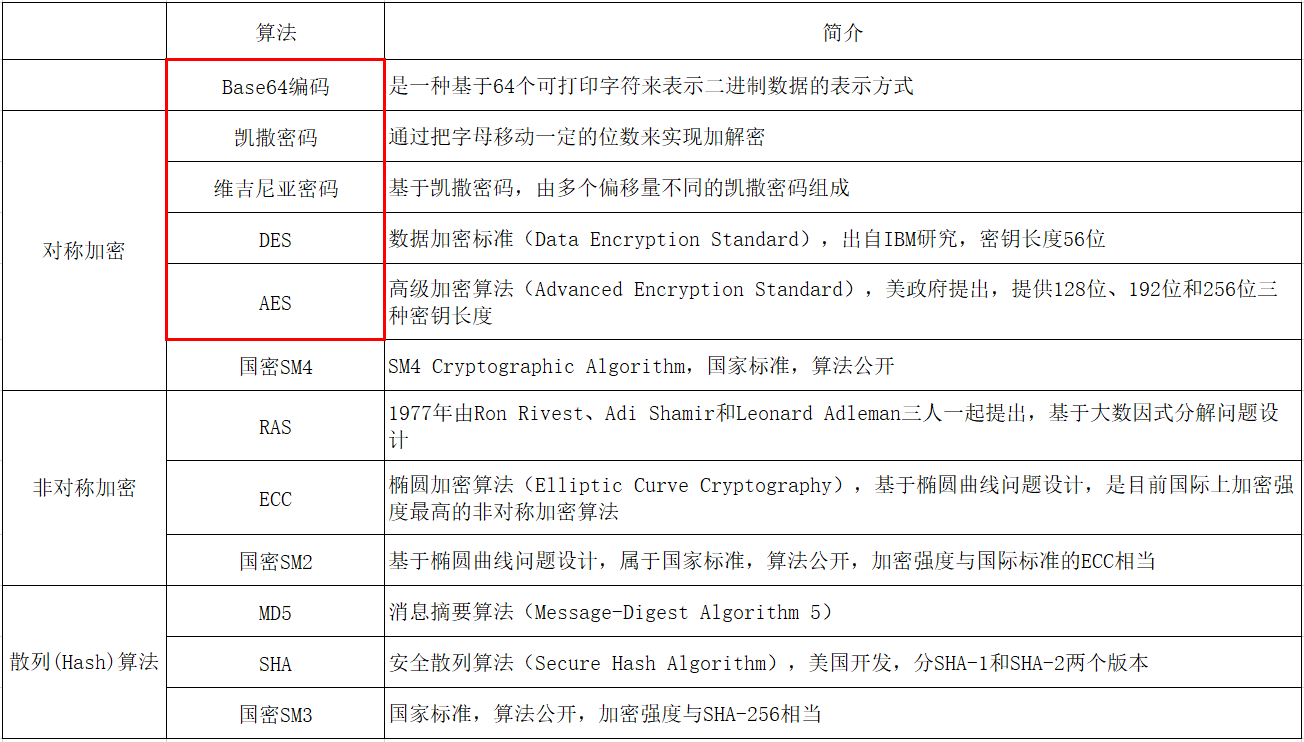
常见加密算法如下,本文主要介绍红框里边的5种算法以及C#代码实现
1. Base64编码
1.1 原理介绍
(1)Base64是一种基于64个可打印字符来表示二进制数据的表示方法。其索引表如下:

共包含64个可打印字符为:A-Z、a-z、0-9、+、/,另外还会有“=”或者“==”作为填充字符出现在编码中。
(2)编码规则
- 将待编码字符串每三个字节分为一组,每组24bit
- 将上边的24bit分为4组,每组6bit
- 在每组前添加两个0,每组由6bit变为8bit,总共32bit,即4byte
- 根据Base64编码对照表获取对应的编码值

上述图例中:“Man”经过Base64编码之后变为“TWFu”。
(3)字节数不足3个时

- 两个字节:2byte共16bit,按照编码规则,每6bit分为一组,则第三组缺少2bit,用0补齐,得到3个Based64编码,第四组完全没有数据则用“=”补上。因此上图“BC”经过Base64编码之后变为“QkM=”;
- 一个字节:1byte共8bit,按照编码规则,每6bit分为一组,则第二组缺少4bit,用0补齐,得到2个Based64编码,后两组完全没有数据都用“=”补上。因此上图“A”经过Base64编码之后变为“QQ==”。
1.2 C#代码
1 2 3 4 5 6 7 8 9 10 11 12 13 14 15 16 17 18 19 20 21 22 23 24 25 | // Base64编码public sealed class Base64{ // Base64加密 public static string Base64Encrypt(string plaintext) { string ciphertext = ""; byte[] buffer = Encoding.ASCII.GetBytes(plaintext); ciphertext = Convert.ToBase64String(buffer); return ciphertext; } // Base64解密 public static string Base64Decrypt(string ciphertext) { string plaintext = ""; byte[] buffer = Convert.FromBase64String(ciphertext); plaintext = Encoding.ASCII.GetString(buffer); return plaintext; }} |
2. 凯撒密码
2.1 原理介绍
凯撒密码是一种很古老的加密体制,主要是通过代换来达到加密的目的。其基本思想是:通过把字母移动一定的位数来实现加密和解密。移动位数就是加密和解密的密钥。
举例说明,假设明文为“ABCD”,密钥设置为7,那么对应的密文就是“HIJK”。具体流程如下表所示:

2.2 C#代码
1 2 3 4 5 6 7 8 9 10 11 12 13 14 15 16 17 18 19 20 21 22 23 24 25 26 27 28 29 30 31 32 33 34 35 36 37 38 39 40 41 42 43 44 45 46 47 48 49 50 51 52 53 54 55 | // Caesar Cipher(凯撒密码)public sealed class Caesar{ // 加密 public static string CaesarEncrypt(string plaintext, int key) { // 字符串转换为字节数组 byte[] origin = Encoding.ASCII.GetBytes(plaintext); string rst = null; for (int i = 0; i < origin.Length; i++) { // 获取字符ASCII码 int asciiCode = (int)origin[i]; // 偏移 asciiCode += key; byte[] byteArray = new byte[] { (byte)asciiCode }; // 将偏移后的数据转为字符 ASCIIEncoding asciiEncoding = new ASCIIEncoding(); string strCharacter = asciiEncoding.GetString(byteArray); // 拼接数据 rst += strCharacter; } return rst; } // 解密 public static string CaesarDecrypt(string ciphertext, int key) { // 字符串转换为字节数组 byte[] origin = Encoding.ASCII.GetBytes(ciphertext); string rst = null; for (int i = 0; i < origin.Length; i++) { // 获取字符ASCII码 int asciiCode = (int)origin[i]; // 偏移 asciiCode -= key; byte[] byteArray = new byte[] { (byte)asciiCode }; // 将偏移后的数据转为字符 ASCIIEncoding asciiEncoding = new ASCIIEncoding(); string strCharacter = asciiEncoding.GetString(byteArray); // 拼接数据 rst += strCharacter; } return rst; }} |
3. Vigenere密码
3.1 原理介绍
在凯撒密码中,每一个字母通过一定的偏移量(即密钥K)变成另外一个字母,而维吉尼亚密码就是由多个偏移量不同的凯撒密码组成,属于多表密码的一种。在一段时间里它曾被称为“不可破译的密码”。
维吉尼亚密码在加密和解密时,需要一个表格进行对照。表格一般为26*26的矩阵,行和列都是由26个英文字母组成。加密时,明文字母作为列,密钥字母作为行,所对应坐标上的字母即为对应的密文字母。

可以用上述表格直接查找对应的密文,也可通过取模计算的方式。用0-25代替字母A-Z,C表示密文,P表示明文,K表示密钥,维吉尼亚加密算法可表示为:

密文可表示为:

举例说明,假设明文为“I AM A CHINESE”,密钥为“CHINA”,那么密文就是“L HU N CJPVRSG”。具体过程如下表:

3.2 C#代码
1 2 3 4 5 6 7 8 9 10 11 12 13 14 15 16 17 18 19 20 21 22 23 24 25 26 27 28 29 30 31 32 33 34 35 36 37 38 39 40 41 42 43 44 45 46 47 48 49 50 51 52 53 54 55 56 57 58 59 60 61 62 63 64 65 | // Vigenere Cipher(维吉尼亚密码)public sealed class Vigenere{ // 加密 public static string VigenereEncrypt(string plaintext, string key) { string ciphertext = ""; byte[] origin = Encoding.ASCII.GetBytes(plaintext.ToUpper()); byte[] keys = Encoding.ASCII.GetBytes(key.ToUpper()); int length = origin.Length; int d = keys.Length; for (int i = 0; i < length; i++) { int asciiCode = (int)origin[i]; // 加密(移位) asciiCode = asciiCode + (int)keys[i % d] - (int)'A'; if (asciiCode > (int)'Z') { asciiCode -= 26; } byte[] byteArray = new byte[] { (byte)asciiCode }; // 将偏移后的数据转为字符 ASCIIEncoding asciiEncoding = new ASCIIEncoding(); string strCharacter = asciiEncoding.GetString(byteArray); ciphertext += strCharacter; } return ciphertext; } // 解密 public static string VigenereDecrypt(string ciphertext, string key) { string plaintext = ""; byte[] origin = Encoding.ASCII.GetBytes(ciphertext.ToUpper()); byte[] keys = Encoding.ASCII.GetBytes(key.ToUpper()); int length = origin.Length; int d = keys.Length; for (int i = 0; i < length; i++) { int asciiCode = (int)origin[i]; // 解密(移位) asciiCode = asciiCode - (int)keys[i % d] + (int)'A'; if (asciiCode < (int)'A') { asciiCode += 26; } byte[] byteArray = new byte[] { (byte)asciiCode }; // 将偏移后的数据转为字符 ASCIIEncoding asciiEncoding = new ASCIIEncoding(); string strCharacter = asciiEncoding.GetString(byteArray); plaintext += strCharacter; } return plaintext; }} |
4. DES
4.1 原理介绍
DES(数据加密标准,Data Encryption Standard),出自IBM的研究,后被美国政府正式采用,密钥长度56位,以现代的计算能力可在24h以内被暴力破解。算法设计原理参考这篇博客。
顺便说一下3DES(Triple DES),它是DES向AES过渡的加密算法,使用3条56位的密钥对数据进行三次加密。是DES的一个更安全的变形。它以DES为基本模块,通过组合分组方法设计出分组加密算法。比起最初的DES,3DES更为安全。
4.2 C#代码
C#中提供封装好的DES加解密方法,直接调用即可。
1 2 3 4 5 6 7 8 9 10 11 12 13 14 15 16 17 18 19 20 21 22 23 24 25 26 27 28 29 30 31 32 33 34 35 36 37 38 39 40 41 42 43 44 45 46 47 48 49 50 51 52 53 54 55 56 57 58 59 60 61 62 63 64 65 66 67 68 69 70 71 72 73 74 75 76 77 78 79 80 81 82 | // DES(数据加密标准,Data Encryption Standard)public sealed class DES{ /* DES相关 ecb、ctr模式不需要初始化向量 cbc、ofc、cfb需要初始化向量 初始化向量的长度:DES/3DES为8byte;AES为16byte。加解密使用的IV相同。 */ /// /// DES加密 /// /// 明文 /// 密钥,长度8byte /// 初始化向量,长度8byte /// public static string DESEncrypt(string plaintext, string key, string iv) { try { byte[] btKey = Encoding.UTF8.GetBytes(key); byte[] btIV = Encoding.UTF8.GetBytes(iv); DESCryptoServiceProvider des = new DESCryptoServiceProvider(); using (MemoryStream ms = new MemoryStream()) { byte[] inData = Encoding.UTF8.GetBytes(plaintext); try { using (CryptoStream cs = new CryptoStream(ms, des.CreateEncryptor(btKey, btIV), CryptoStreamMode.Write)) { cs.Write(inData, 0, inData.Length); cs.FlushFinalBlock(); } return Convert.ToBase64String(ms.ToArray()); } catch { return plaintext; } } } catch { } return "DES加密出错"; } /// /// DES解密 /// /// 密文 /// 密钥,长度8byte /// 初始化向量,长度8byte /// public static string DESDecrypt(string ciphertext, string key, string iv) { if (ciphertext == "") return ""; try { byte[] btKey = Encoding.UTF8.GetBytes(key); byte[] btIV = Encoding.UTF8.GetBytes(iv); DESCryptoServiceProvider des = new DESCryptoServiceProvider(); using (MemoryStream ms = new MemoryStream()) { byte[] inData = Convert.FromBase64String(ciphertext); try { using (CryptoStream cs = new CryptoStream(ms, des.CreateDecryptor(btKey, btIV), CryptoStreamMode.Write)) { cs.Write(inData, 0, inData.Length); cs.FlushFinalBlock(); } return Encoding.UTF8.GetString(ms.ToArray()); } catch { return ciphertext; } } } catch { } return "DES解密出错"; }} |
5. AES
5.1 原理简述
AES(高级加密算法,Advanced Encryption Standard),美国政府提出,该加密算法采用对称分组密码体制,提供128位、192位和256位三种密钥长度,算法应易于各种硬件和软件实现。这种加密算法是美国联邦政府采用的区块加密标准。AES本身就是为了取代DES的,AES具有更好的安全性、效率和灵活性。
5.2 C#代码
1 2 3 4 5 6 7 8 9 10 11 12 13 14 15 16 17 18 19 20 21 22 23 24 25 26 27 28 29 30 31 32 33 34 35 36 37 38 39 40 41 42 43 44 45 46 47 48 49 50 51 52 53 54 55 56 57 58 59 60 61 62 63 64 65 66 67 | // AES(高级加密算法,Advanced Encryption Standard),美政府提出public sealed class AES{ /// /// AES加密 /// /// 明文 /// 密钥,长度16byte /// 初始化向量,长度16byte /// public static string AESEncrypt(string plaintext, string key, string iv) { if (plaintext == "") return ""; try { byte[] btKey = Encoding.UTF8.GetBytes(key); byte[] btIV = Encoding.UTF8.GetBytes(iv); byte[] inputByteArray = Encoding.UTF8.GetBytes(plaintext); using (AesCryptoServiceProvider provider = new AesCryptoServiceProvider()) { using (MemoryStream mStream = new MemoryStream()) { CryptoStream cStream = new CryptoStream(mStream, provider.CreateEncryptor(btKey, btIV), CryptoStreamMode.Write); cStream.Write(inputByteArray, 0, inputByteArray.Length); cStream.FlushFinalBlock(); cStream.Close(); return Convert.ToBase64String(mStream.ToArray()); } } } catch { } return "AES加密出错"; } /// /// AES解密 /// /// 密文 /// 密钥,长度16byte /// 初始化向量,长度16byte /// public static string AESDecrypt(string ciphertext, string key, string iv) { if (ciphertext == "") return ""; try { byte[] btKey = Encoding.UTF8.GetBytes(key); byte[] btIV = Encoding.UTF8.GetBytes(iv); byte[] inputByteArray = Convert.FromBase64String(ciphertext); using (AesCryptoServiceProvider provider = new AesCryptoServiceProvider()) { using (MemoryStream mStream = new MemoryStream()) { CryptoStream cStream = new CryptoStream(mStream, provider.CreateDecryptor(btKey, btIV), CryptoStreamMode.Write); cStream.Write(inputByteArray, 0, inputByteArray.Length); cStream.FlushFinalBlock(); cStream.Close(); return Encoding.UTF8.GetString(mStream.ToArray()); } } } catch { } return "AES解密出错"; }} |
参考资料
3. 加密算法汇总
4. DES算法加密原理